
The Complete Python Robotics Simulation Bundle+
A real robotics lab costs tens of thousands of dollars. A simulation environment costs nothing. Learn here how to use them.

This course includes.
Curriculum & lectures.
+ Access Your Courses 1 lecture
About this course.

Robotics used to have a gatekeeping problem.
To learn it properly, you needed access to a lab. You needed expensive hardware. You needed a university programme that taught the right frameworks. You needed equipment that broke, cost thousands to replace, and took weeks to arrive.
Most people who wanted to learn robotics looked at that list and quietly moved on to something else.
That barrier is gone.
Simulation changed everything. Today, the most powerful robotics environments in the world run on a laptop. The same tools used by autonomous vehicle teams, surgical robotics researchers, and AI labs at the frontier of machine intelligence are free, open-source, and available to anyone who knows how to use them.
The problem now is not access. The problem is knowing which frameworks matter, how they connect, and how to build real skills across all of them without spending years piecing it together from scattered tutorials and outdated documentation.
That is exactly what this bundle solves.
Welcome to the most complete Python robotics simulation curriculum available outside of a university programme.
Why Simulation is the Smartest Way to Learn Robotics
Before a single physical robot is built, it is simulated. Every autonomous vehicle on the road today was tested millions of times in simulation before it touched asphalt. Every surgical robot was validated in a virtual environment before it entered an operating room. Every warehouse automation system was stress-tested in simulation before a single motor turned.
Simulation is not a shortcut. It is the professional standard.
This bundle teaches you the three frameworks that define that standard: ROS 2, the industry operating system for real-world robotics. Webots, the open-source simulator trusted in research labs worldwide. And MuJoCo, the physics engine used by DeepMind and OpenAI for reinforcement learning at the frontier of AI research.
A complete path from your first simulation to physics-accurate AI-powered robotics.

🛠️ What You Will Build
This is not a theory course. Every framework you learn, you apply to a real project before moving on.
By the time you complete this bundle you will have:
Built your first complete Python robotics application from the ground up, understanding how robots model the world and move through it
Simulated a fully operational robot in ROS 2 and Gazebo, integrated real sensor data, processed live camera vision feeds, and understood how autonomous systems perceive their environment
Programmed a robot to detect and avoid obstacles in real time using Webots, applying dynamics and control theory to physical movement simulation
Modelled robot kinematics in Python, understanding the mathematics that turn motor commands into precise physical motion
Built and run a simulation in MuJoCo, the physics-accurate environment used by the world's leading AI research teams for reinforcement learning
Each project is portfolio-ready. Each framework is industry-relevant. Each course ends with something you built, not just something you watched.
📚 The Blueprint

Act 1: Python Foundations. The Language Every Robot Speaks.
Before you touch a simulator, you need to think like a robotics developer. This track builds the Python foundation that makes every framework in this bundle accessible. Skip it if you are already fluent. Start here if you want to build the right mental model from the ground up.
🔵 Foundations of Robotics Simulation in Python What simulation actually is, why it matters, and how Python sits at the centre of the modern robotics stack. You will write your first simulation code, understand the core abstractions every framework builds on, and leave this course with a clear picture of where the entire bundle is heading.
🔵 Hello Robot: Build Python Applications and Projects Theory becomes practice. You will build real Python robotics applications from scratch, working through projects that teach you how robots receive instructions, process information, and execute behaviour. The course that bridges programming knowledge and robotics thinking.
🔵 Python Robot Modeling and Kinematics How does a robot know where its arm is? How does it calculate the path between two positions? This course covers the mathematics of robot movement: forward kinematics, inverse kinematics, joint modelling, and the transformation matrices that sit beneath every robotics framework you will ever use. Built in Python, from first principles.
Act 2: ROS 2 and Webots. The Industry Standard and the Research Workhorse.

ROS 2 is on more robotics job descriptions than any other framework. Webots is the open-source simulator trusted by research institutions worldwide. Together they cover the full spectrum of professional robotics development, from industry applications to academic research. This track teaches both.
🟢 ROS 2 Foundations: Robotics and Gazebo Simulation Your entry point into the Robot Operating System. ROS 2 is the communication backbone of modern robotics, used in autonomous vehicles, surgical systems, industrial automation, and research platforms across every sector. This course covers the core architecture, the Gazebo simulation environment, and how to build and run your first ROS 2-powered robot.
🟢 Python Robotics: Sensors and Simulation with ROS 2 A robot without sensors is blind. This course teaches you how to integrate sensor data into ROS 2 systems, how robots perceive distance, pressure, orientation, and environment, and how to build simulation environments that accurately model real-world sensor behaviour. The course that turns a moving robot into an aware one.
🟢 ROS 2 Camera Sensors and Vision Processing with Python Computer vision is one of the most in-demand skills in the entire robotics field. This course covers camera sensor integration in ROS 2, image processing pipelines, and real-time visual data analysis. By the end you will have built a robot that sees, processes what it sees, and responds to its visual environment.
🟢 Introduction to Webots Robotic Simulator Webots is free, open-source, and used in robotics research programmes worldwide. This course is your complete introduction: the environment, the interface, the core simulation concepts, and how to build and run your first Webots robot. The starting point for the two courses that follow.
🟢 Dynamics and Control Systems in Webots Robotic Simulator How do you make a robot move the way you intend? This course covers the physics of robotic movement, control system design, and how to apply dynamics theory inside Webots to build robots that behave predictably in simulated environments. The course that takes your robots from moving to controlled.
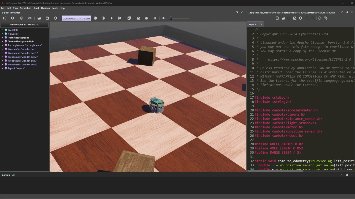
🟢 Program Your First Obstacle-Avoiding Robot in Webots The capstone of the Webots track. You will build a complete, functional robot that detects obstacles in real time and navigates around them autonomously. A project that brings together everything from the previous two courses and produces a result you can demonstrate, share, and build on.
Act 3: MuJoCo. Where Robotics Meets AI Research.

MuJoCo is not a beginner tool. It is the physics simulation engine used by DeepMind, OpenAI, and research teams at the frontier of artificial intelligence. It is where reinforcement learning meets physical simulation. And it is the capstone of this bundle for a reason: by the time you reach it, you will be ready for it.
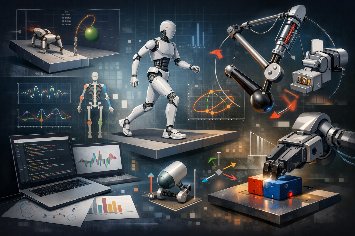
🔴 MuJoCo Foundations for Robotics Simulation in Python A complete introduction to MuJoCo from the ground up. You will understand the physics model that makes MuJoCo the standard for AI research, build and run simulations in Python, and develop the fluency with the framework that opens the door to reinforcement learning, AI-powered robotics, and research-level simulation work. The course that signals to every serious robotics employer that you have gone further than the standard curriculum.
Taught by people who ship.
James Dabalus
James is a versatile IT Technician specializing in Prompt Engineering, Generative AI, Graphic Design, Web Development, Video Editing, and E-learning. With a passion for automation, he continually seeks innovative ways to streamline digital workflows.
Bundled items.
10 courses
Dynamics & Control Systems in Webots Robotic Simulator
Foundations of Robotics Simulation in Python
Hello Robot - Build Python Applications & Projects
Introduction to Webots Robotic Simulator
MuJuCo Foundations for Robotics Simulation in Python
Program Your First Obstacle-Avoiding Robot in Webots
Ready to start building?
A real robotics lab costs tens of thousands of dollars. A simulation environment costs nothing. Learn here how to use them.