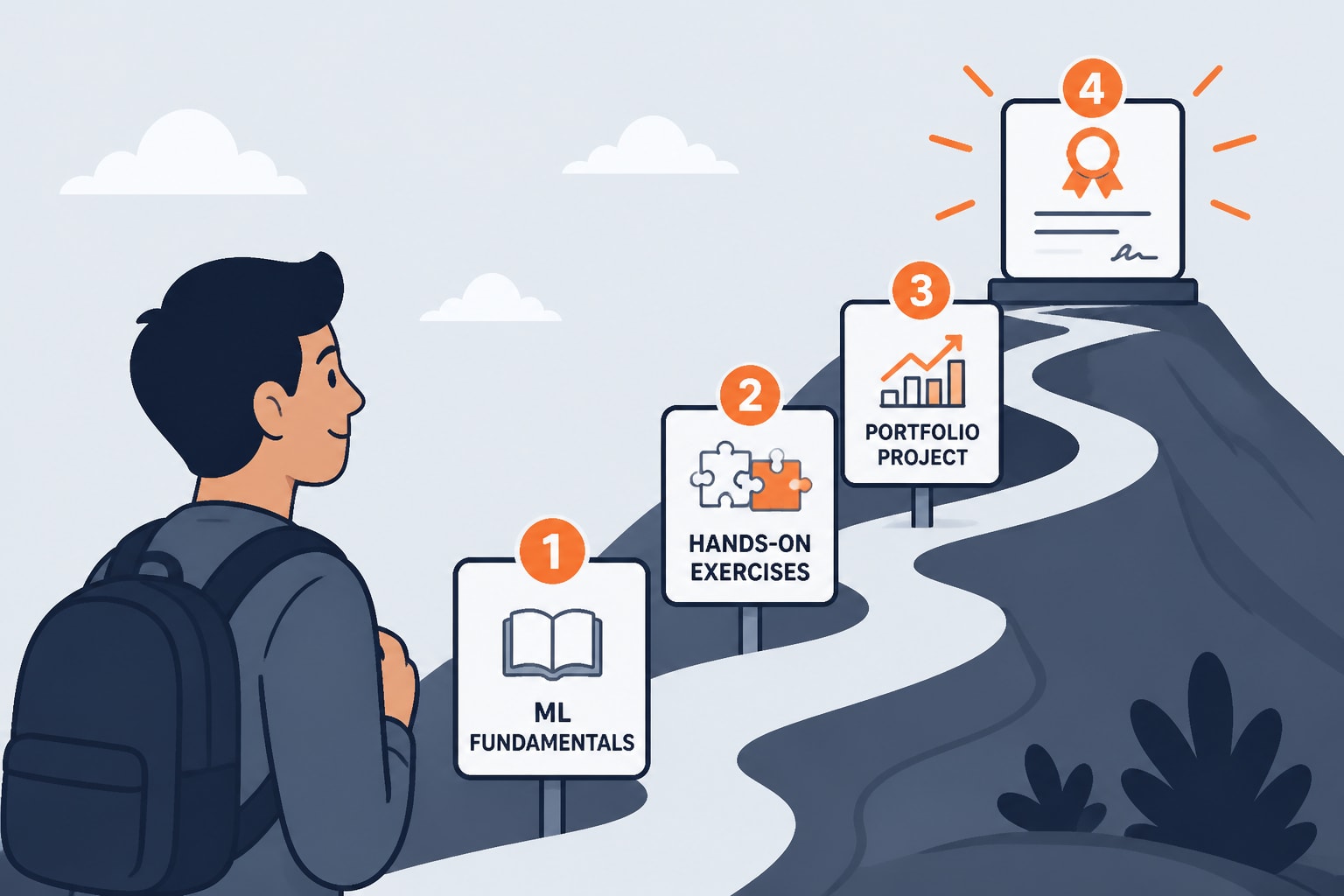
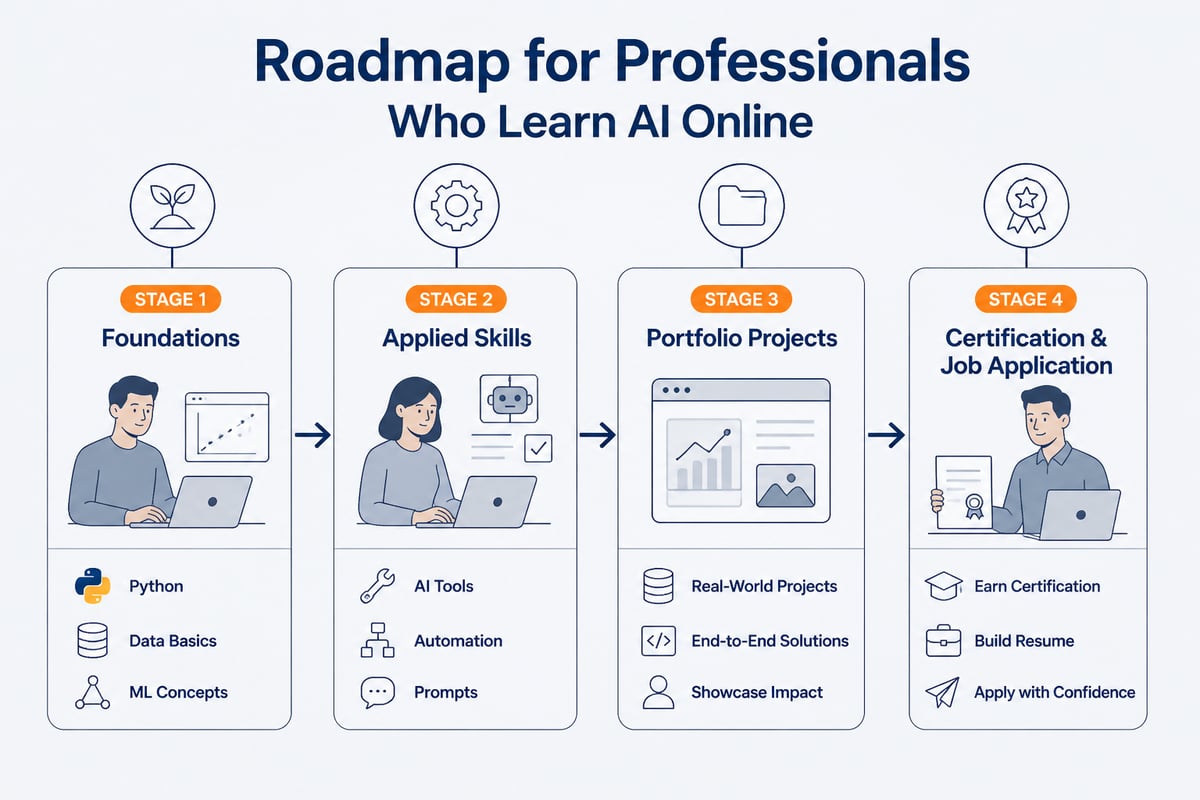
The most reliable way to learn AI online is to follow a structured sequence: build foundations in Python and core machine learning concepts, apply them in hands-on projects, then validate your skills with a recognized certification. Many professionals can reach job-relevant competence within several months, depending on the role they are targeting and the hours they commit each week. This roadmap explains what to study, in what order, how long each stage takes, and how to turn the result into a promotion or a career change.
What does it mean to learn AI as a working professional?
Learning AI as a professional means building the ability to use, evaluate, and apply AI systems in your field, not necessarily to build new models from scratch. The distinction matters because it shapes everything that follows, from course selection to timeline.
The OECD reports that only a very small share of workers will need advanced AI-specific skills such as programming or model development. Broader digital and data skills are far more widely relevant. For most professionals, this points toward applied AI literacy: understanding what AI can and cannot do, working with data, and using AI tools responsibly inside existing workflows.
Three common destinations exist, and each one changes your study plan:
- AI-literate professional: a manager, analyst, or marketer who uses AI tools and makes informed decisions about them.
- AI practitioner: someone who builds automations, prompts, pipelines, or lightweight applications.
- AI engineer or specialist: someone who trains, fine-tunes, and deploys models, which requires deeper mathematics and programming.
Decide which of these you are aiming for before you enroll in anything. A career switcher targeting an engineering role needs a different path than a finance manager who wants to supervise AI-driven reporting.
Why is the skills gap an opportunity for career changers?
The skills gap is an opportunity because employers are adopting AI faster than they can staff it. The OECD finds that many employers in manufacturing and finance that have not adopted AI cite skills as the main barrier. It also reports that a majority of employers in those sectors that have adopted AI report an increased need for highly educated workers.
Two practical conclusions follow. First, demonstrable skills carry weight with hiring managers who are actively looking for them. Second, credentials and project evidence together signal readiness more convincingly than either one alone, which is why the later sections of this roadmap pair certification with a portfolio.
How do you choose the right learning path for your goal?
Choose your path by working backward from the role you want, then matching the depth of study to that role. A clear target prevents the most common waste of time: finishing advanced material you will never use while skipping basics you need daily.
| Goal | Core skills | Typical depth | Estimated timeline |
|---|---|---|---|
| AI-literate manager or analyst | AI concepts, data literacy, responsible use, prompt practice | Conceptual plus tool use | A few months |
| Automation or applied AI practitioner | Python, APIs, workflow automation, prompt design | Hands-on building | Several months |
| Machine learning or AI engineer | Python, statistics, ML algorithms, model deployment | Technical and mathematical | Many months to a year or more |
These timelines are general planning estimates for steady part-time study. They are not guarantees. Prior programming or statistics experience can shorten them, and an irregular schedule will lengthen them.
If you are a career switcher without a technical background, start at the first row even if your end goal sits in the third. Concept fluency makes every later technical lesson easier to absorb.
What foundations should you build first?
Start with four foundations: AI and machine learning concepts, Python programming, basic data handling, and an introduction to statistics. These four support nearly every AI role, and skipping them is the main reason learners stall at the intermediate stage.
Core AI and machine learning concepts
Learn the vocabulary and the logic before the tools. You should be able to explain the difference between artificial intelligence, machine learning, and deep learning, describe supervised and unsupervised learning, and recognize what a model, a training set, and a neural network are. An introductory course such as Intro to AI: AI Foundation Specialist 101 covers this ground and starts from the question of what machine learning actually is.
Python programming
Python remains the working language of applied AI. You do not need advanced software engineering, but you do need to read and write functions, work with lists and dictionaries, and use libraries. A structured option is the Python Programming Fundamentals learning path, which suits learners who want a sequence rather than scattered tutorials.
Data and statistics
Models are only as good as the data behind them. Practice cleaning a dataset, spotting missing values, and calculating averages, distributions, and correlations. Spreadsheet fluency helps here, and finance professionals often find that analytical habits from Excel transfer directly.
Responsible AI basics
Employers increasingly expect candidates to understand risk. The NIST AI Risk Management Framework has a Generative AI Profile that gives organizations guidance on identifying and managing generative AI risks. Reading its structure early gives you language that compliance, legal, and leadership teams already use.
Which applied skills turn knowledge into hireable ability?
Applied skills are the tool-level abilities that let you produce working results, and they are what separate a certificate holder from a candidate who can contribute in week one. Once the foundations are in place, shift your weekly time toward building.
Prioritize these in roughly this order:
- Prompt design and evaluation. Writing clear instructions for language models, then checking outputs for accuracy and bias.
- Workflow automation. Connecting data sources, models, and business systems so tasks run without manual steps. The course on AI automation with n8n, Python, and modern workflows is a direct example of this skill set.
- Working with APIs. Calling AI services from code and handling the responses.
- Building small AI-powered applications. A project like an AI-powered resume builder using Google Gemini and Python shows how a model, a template, and a user interface fit together.
- Database and data workflows. Moving and transforming data reliably, as covered in automating database workflows with n8n and SQL.
Tools change quickly, so favor learning resources that are updated regularly. MammothClub states that its courses, labs, and assessments are updated every month as tools change, which is the kind of maintenance cadence worth looking for on any platform.
How should you structure your weekly study routine?
A workable routine blocks fixed study sessions, alternates learning with building, and ends each week with a small deliverable. Consistency matters more than intensity, and a schedule you can sustain for months beats a burst of enthusiasm that fades by week three.
A sample week for a professional with a full-time job might look like this:
- Two weekday evenings (60 to 90 minutes each): lessons and reading.
- One weekday evening (60 minutes): guided lab or practice questions.
- One weekend block (2 to 3 hours): a project task that applies the week's concepts.
- Ten minutes on Sunday: write a short note on what you built and what confused you.
That last habit is underrated. A running log becomes raw material for your portfolio write-ups and your interview answers. It also exposes weak spots early, while they are still cheap to fix.
Text-first, searchable lessons suit this routine well, because you can look up a specific concept in seconds rather than scrubbing through video. MammothClub describes its lessons as text-first and AI-searchable, designed to be applied the same day, which fits short evening sessions.

What should your AI portfolio include?
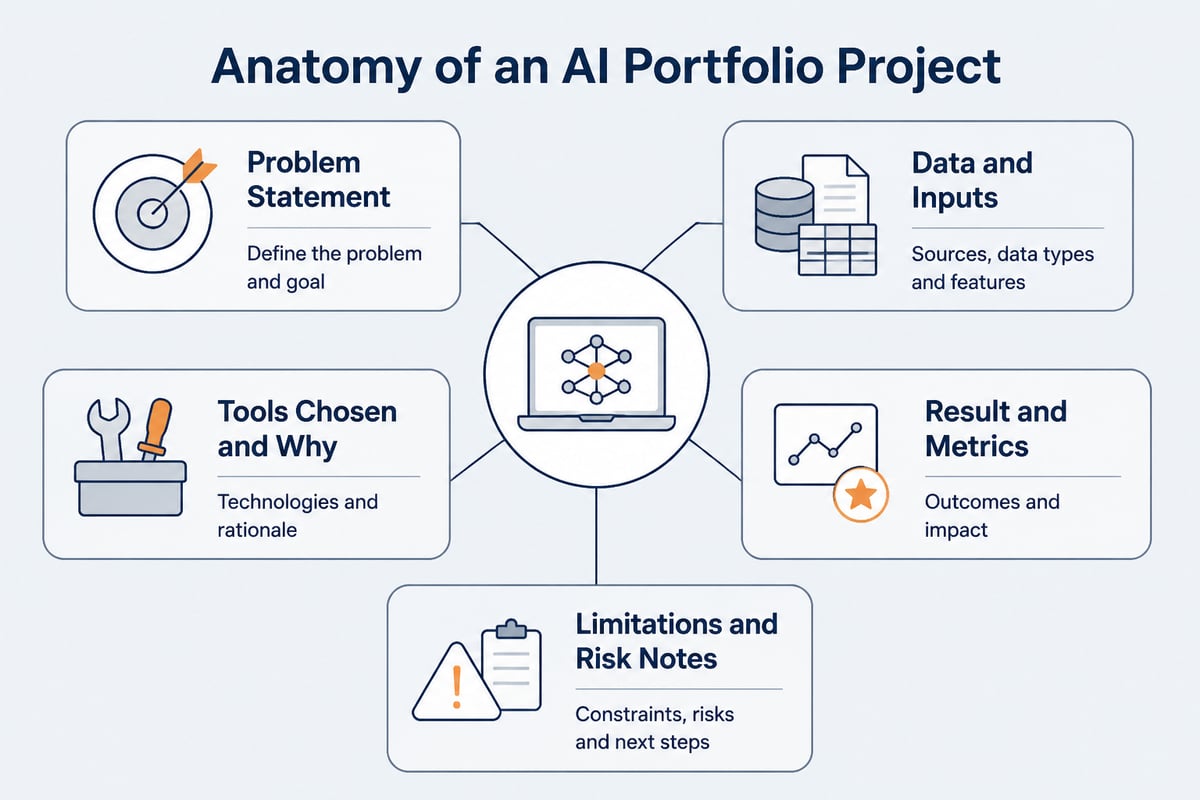
Your portfolio should contain three to five small, finished projects that each solve a recognizable business problem and explain your decisions. Hiring managers rarely open a long repository. They look for evidence that you can frame a problem, build a solution, and describe its limits honestly.
Strong portfolio entries share a few traits:
- A clear problem statement in one or two sentences.
- A short description of the data or inputs used.
- The tools and methods chosen, with a reason for each.
- A result, even a modest one, and what you would improve.
- A note on risks such as bias, privacy, or error rates.
Hypothetical example: a marketing analyst could build an automated pipeline that collects campaign data, summarizes performance with a language model, and flags anomalies for human review. A write-up explaining why a human check stays in the loop would demonstrate automation, prompt design, and responsible use together.
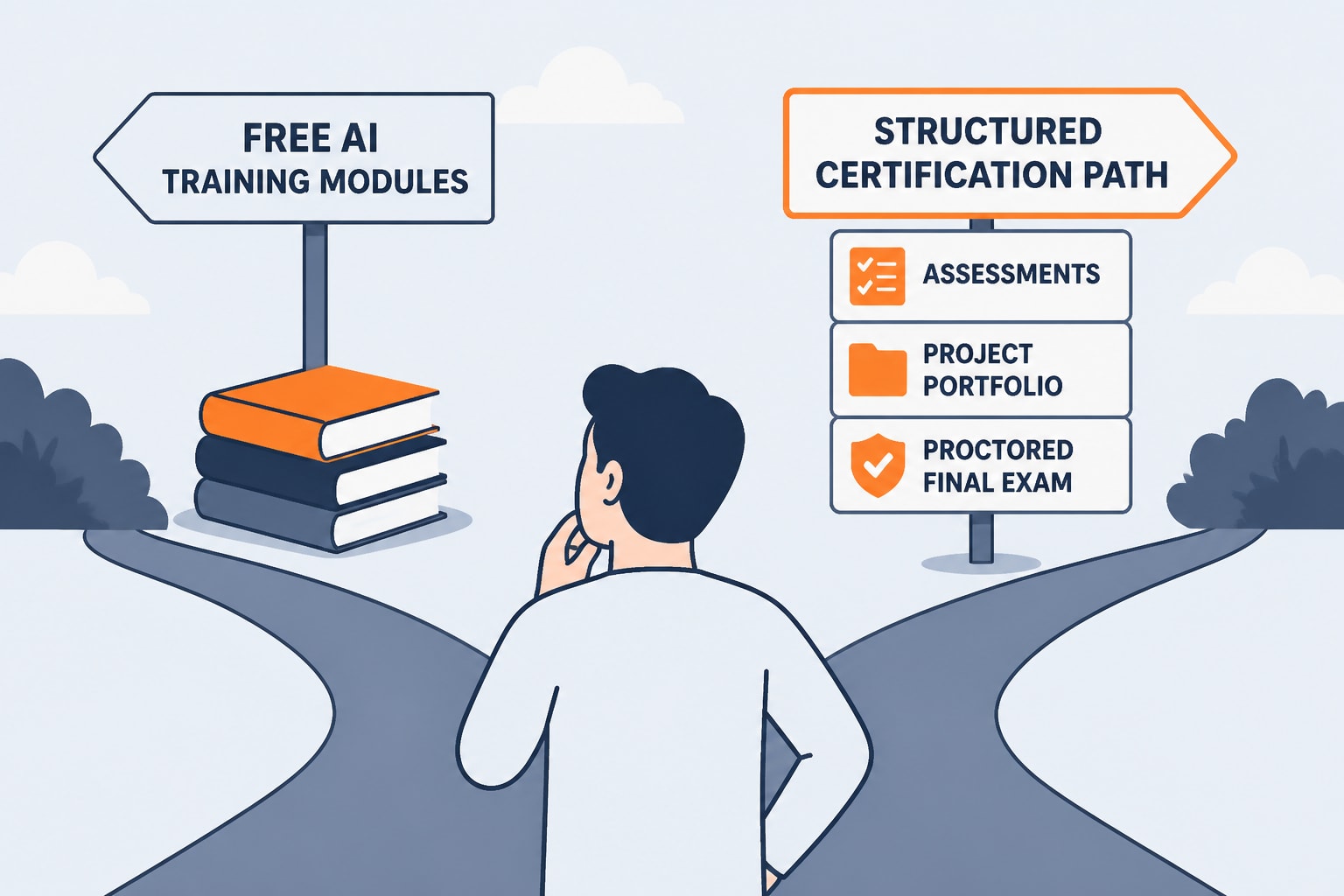
Projects built inside a certification path have an advantage, since they are scoped and assessed. MammothClub's certification paths include built-in assessments and project portfolios, which gives learners finished work to show rather than a list of completed videos.
Which certifications carry weight with employers?
Certifications carry the most weight when they involve proctored or assessed validation, align to a recognized role, and are paired with project evidence. A certificate of attendance proves exposure. A certification earned through a structured assessment proves a measured level of skill.
When comparing options, check these points:
- Assessment rigor. Does the program include a final exam, and is it proctored?
- Role alignment. Does the credential map to a job title you are targeting?
- Currency. Is the content refreshed as tools and platforms change?
- Practice resources. Are there labs and practice questions to prepare you?
- Portfolio output. Do you finish with something you can show?
Vendor-aligned fundamentals credentials are a common first step. If you are weighing the Microsoft route, the guides on the AI-900 learning path and Microsoft Learn AI fundamentals explain what to study.
MammothClub's certification paths combine built-in assessments, project portfolios, and proctored final exams, and the platform offers a large bank of practice exam questions for exam preparation.
How do you evaluate an online platform before committing?
Evaluate a platform on the quality of its instructors, the freshness of its content, the depth of its practice tools, and the evidence of outcomes. Price matters, but a cheap course that is outdated or unstructured costs more in lost time.
Use this checklist:
- Instructor credibility. Are courses taught by working practitioners? MammothClub says every course starts with a working practitioner and then goes through editorial and technical review.
- Update frequency. AI tooling changes monthly. Stale content teaches obsolete interfaces.
- Hands-on practice. Labs, templates, and assessments matter more than lecture hours.
- Structure. Look for defined paths with a start, a middle, and a verified end.
- Social proof. Review volume and organizational adoption are useful signals. MammothClub reports over 40,000 positive reviews, over 9 million courses sold, and more than 1,400 organizations and libraries on the platform.
- Total cost of access. One membership covering courses, labs, templates, and digital assets is simpler than buying each item separately.
For learners who want a single structured environment, the Mammoth Club Unlimited Membership provides annual all-access to 3,000+ courses, certification paths, practice exams, tools, and digital assets, so you can move from foundations to certification without switching providers.
This approach does not suit everyone. If you only want a single short video or free content, a structured program is more than you need.
What mistakes slow learners down?
The most common mistakes are studying without a target role, collecting certificates without building anything, and jumping to advanced topics before foundations are solid. Each one is avoidable with a little planning.
- Tutorial hopping. Starting a new course every week produces familiarity without skill. Finish one path before beginning another.
- Ignoring data work. Many learners want to build models but avoid cleaning data, which is where most real effort goes.
- Neglecting communication. AI work is judged by whether stakeholders understand and trust it. Practice explaining results in plain language.
- Skipping the risk conversation. Candidates who can discuss privacy, bias, and oversight stand out.
- Over-investing in math too early. Unless you are targeting engineering roles, learn the math as you need it.
How can you apply AI skills at your current job first?
You can apply new AI skills at your current job by choosing one repetitive, low-risk task and automating or accelerating it with a measured before-and-after comparison. Internal wins build credibility, and they give you concrete results for a promotion case or an interview.
Good starting candidates include summarizing recurring reports, drafting first-pass customer responses for human review, classifying incoming requests, and extracting fields from documents. Track time saved and error rates, and record any limits you discover. Share the method with your manager before deploying anything that touches sensitive data, and follow your organization's data policies.
Managers building team capability can look at the guidance on AI courses for managers, which addresses oversight and adoption rather than coding.
Frequently asked questions
How long does it take to learn AI online?
Plan on one to three months for working literacy, three to six months for applied practitioner skills, and nine to eighteen months for engineering-level competence. These are estimates based on five to eight study hours per week and vary with prior experience.
Do I need to know how to code to start?
No, not for AI-literate roles. For practitioner and engineering paths, Python is the practical starting point, and a structured fundamentals course gets most beginners productive within weeks.
Is a certification necessary to get hired?
It is not strictly required, but a proctored or assessed certification combined with portfolio projects strengthens an application, especially for career switchers without a technical degree.
Can I learn AI while working full time?
Yes. A sustained routine of roughly five to eight hours per week, split across short sessions and one project block, is realistic for most working professionals.
Which should I learn first, Python or AI concepts?
Learn core concepts first for a few weeks, then begin Python. Understanding what a model does makes the code far less abstract.
How do I know which AI courses are current?
Check whether the provider states its update cadence, whether lessons reference current tool versions, and whether assessments reflect today's platforms. Monthly updates are a reasonable benchmark.
What is the best way to prove my skills to employers?
Combine a recognized certification with three to five documented projects, each with a problem statement, method, result, and risk note.
Your next step is to write down the one role you want in the next twelve months and pick the matching row from the learning-path table, so your first course choice is deliberate. From there, MammothClub can supply the structure through its text-first courses, practice labs, and proctored certification paths, and the Mammoth Club Unlimited Membership keeps all of it under one annual plan. Start unlimited by joining today and moving from foundations to a certification you can show employers.