The best AI developer course is the one that matches your current Python level and ends in something you can show an employer: a working application, a portfolio project or a recognized certificate. For most professionals, that means pairing a hands-on technical path with a credential, rather than collecting short introductions that never lead to a deliverable.
The case for investing the time is measurable. The World Economic Forum estimates that a large share of workers' key skills will change by 2030, with AI and big data among the fastest-growing skills. The 2025 PwC AI Jobs Barometer, as cited by the same source, found a substantial average wage premium for jobs requiring AI skills worldwide. This guide covers eight options with their hours, prices and ideal use, then explains how to choose between them.
How to choose an AI developer course
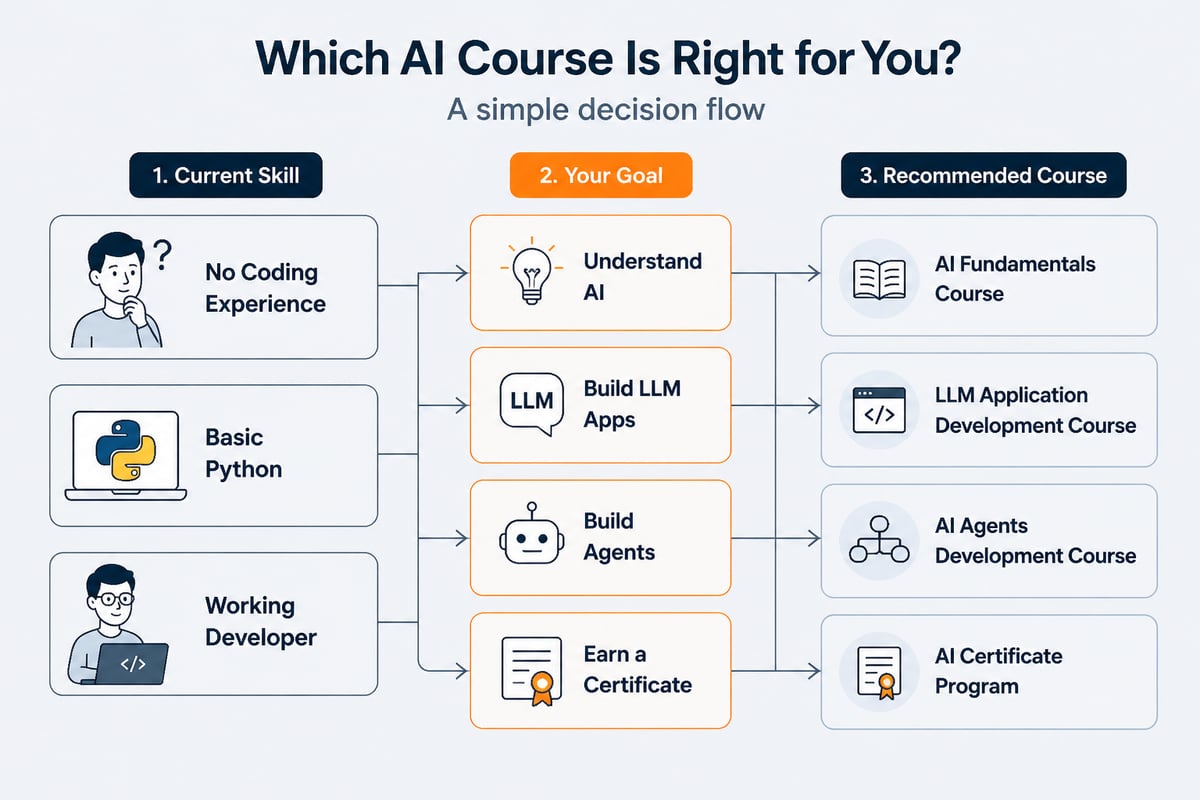
Choose by three criteria: your coding baseline, the output you need at the end, and whether an employer will recognize the credential.
- Coding baseline. Courses labeled "no coding required" teach concepts. Courses built around Python, APIs and open-source libraries teach implementation. Mixing the two up is the most common reason learners stall in week two.
- Output. A hiring manager responds to a deployed project, a portfolio or an exam result far more than to a list of watched videos.
- Time budget. Listed durations range from roughly 10 hours to 10 months. Match the format to the hours you can commit each week.
- Currency. AI tooling changes monthly. Check how recently a course's labs and examples were updated.
The eight options below are ordered from developer-focused practice to broader conceptual training, with MammothClub's two membership options placed where they fit by merit.
1. Associate AI Engineer for Developers (DataCamp)
Associate AI Engineer for Developers is a structured DataCamp track that teaches developers to build generative AI applications through hands-on exercises.
- Format: 10 courses, about 29 hours
- Price: from about $14 per month billed annually, subscription required
- Key specs: hands-on work with APIs and open-source libraries; 51,432 learners listed
- Best use: developers who want guided, in-browser practice building generative AI applications with a defined curriculum
Verdict: A compact, practical track that suits a developer with some programming background who wants structure over self-direction.
2. AI Engineer in Python (Dataquest)
AI Engineer in Python is a long-form Dataquest career path for learners who want to move from Python fundamentals to AI engineering in a single sequence.
- Format: 10-month path at five hours per week, with free introductory content
- Price: about $49 per month
- Best use: Python learners committing to a structured, months-long path rather than a short course
Verdict: The most extended commitment on this list, and the right pick if you are switching careers and need a full progression rather than a single skill.
3. Mammoth Club Unlimited Membership
The Mammoth Club Unlimited Membership is an annual all-access plan covering 3,000+ courses, certification paths, practice exams, tools and digital assets.
- Price: from $199 per year
- Key specs: text-first, AI-searchable lessons built to be applied the same day; structured certification paths with built-in assessments, project portfolios and proctored final exams; courses, labs and assessments updated monthly; over 500,000 practice exam questions and over 5,000 hours of content
- Best use: professionals who want a recognized credential and a portfolio, and who plan to take several courses across AI, Python and cloud rather than one
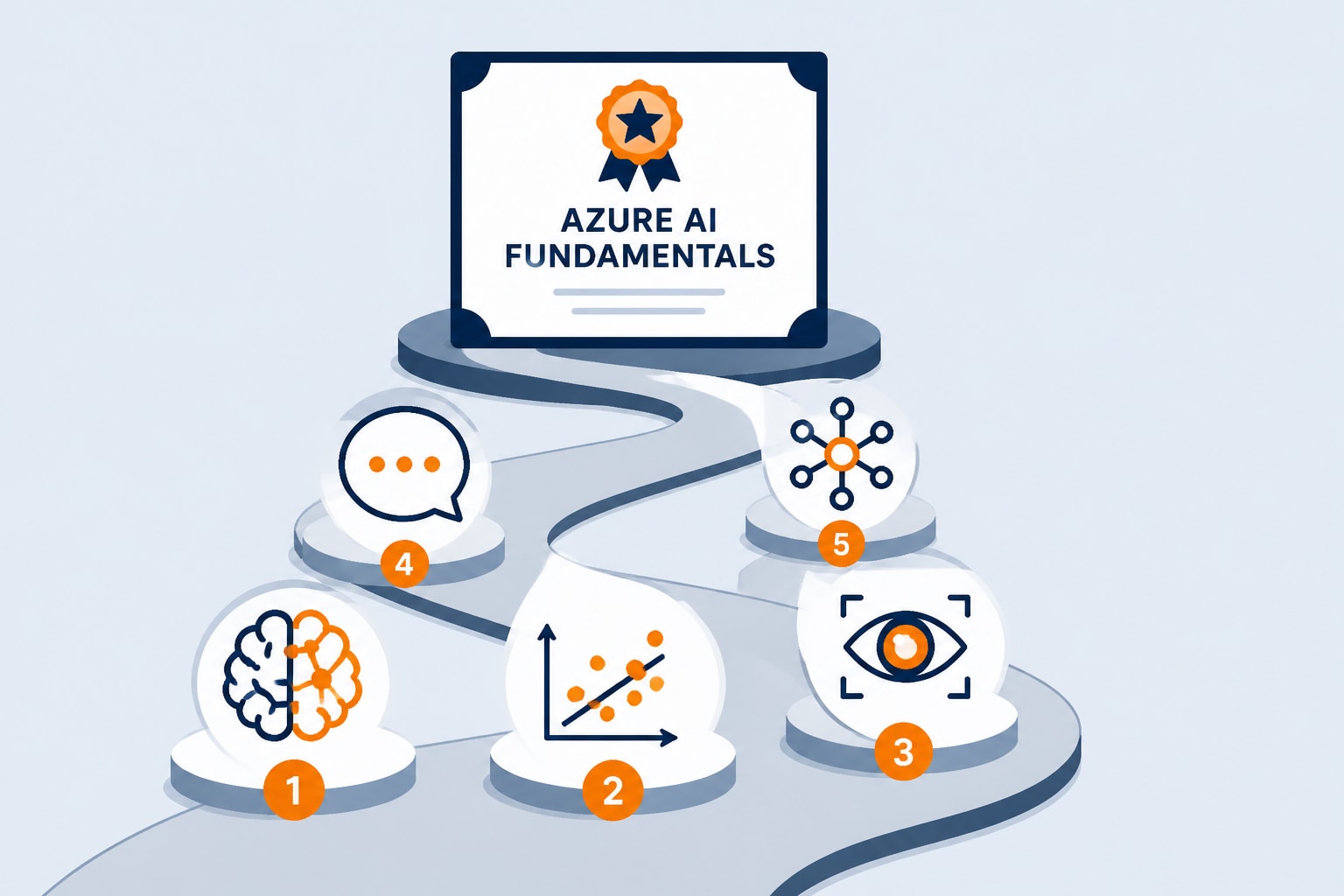
- Relevant courses: a 4-hour AI agent development course with Python and Claude, a Microsoft Azure AI certification course with 10 practice exams, and an AWS Certified Machine Learning Specialty prep course
Verdict: Strongest where the goal is a verifiable credential; a poor fit if you only want free material or a single short video.
4. Hugging Face LLM Course
The Hugging Face LLM Course is a free, text-and-code course that teaches large language models using open-source tools.
- Price: free
- Format: estimated 30 to 50 hours to complete
- Best use: self-directed Python developers who want to work with open-source LLM libraries and can supply their own discipline
Verdict: Excellent depth at no cost, but it offers no formal credential, so pair it with a project you can publish.
5. Generative AI with Large Language Models (DeepLearning.AI and AWS)
Generative AI with Large Language Models is a course from DeepLearning.AI and AWS that combines LLM concepts with practical labs.
- Format: about 16 hours, with free auditing and a certificate option listed at $49 per month
- Best use: developers who want a structured introduction to how LLMs work and how they are applied in practice
Verdict: A balanced middle option: shorter than a full path, more rigorous than an overview.
6. AI Agents Course (Hugging Face)
The AI Agents Course is a free, self-paced Hugging Face course on building agents with current frameworks.
- Price: free
- Key specs: covers smolagents, LlamaIndex and LangGraph; completion certificate described in its listing
- Best use: developers who already write Python and want to learn agent-building frameworks
Verdict: The most current topic on the list and a sensible second course after an LLM fundamentals course.
7. Team Plan (MammothClub)
The Team Plan is MammothClub's membership for teams, adding shared access, progress tracking and certification management to the same course library.
- Price: $159 per user per year
- Best use: organizations upskilling several developers at once that need to track who has completed which certification path
- Related options: browse certification courses to see which paths a team could assign
Verdict: The right choice when training is a team goal with reporting needs; individuals should consider the Unlimited Membership instead.
8. AI for Everyone (DeepLearning.AI)
AI for Everyone is a beginner-friendly DeepLearning.AI course that explains AI without requiring any coding.
- Format: about 10 hours, as listed by Dataquest; free to audit
- Best use: professionals who need a nontechnical overview before moving into a technical path, such as managers briefing engineering teams
Verdict: Useful for vocabulary and context, but it will not make you job-ready as a developer.
Two more free introductions worth knowing
Two free options suit concept-level learning rather than developer training. Elements of AI from the University of Helsinki and MinnaLearn is self-paced and needs no coding. AI Capabilities and Limitations from Anthropic has 13 lessons, requires no technical background and explains what AI systems can and cannot do. Both help with fundamentals, but neither replaces a hands-on course. Readers who want to compare corporate-backed learning programs can review this overview of official AI courses by company.
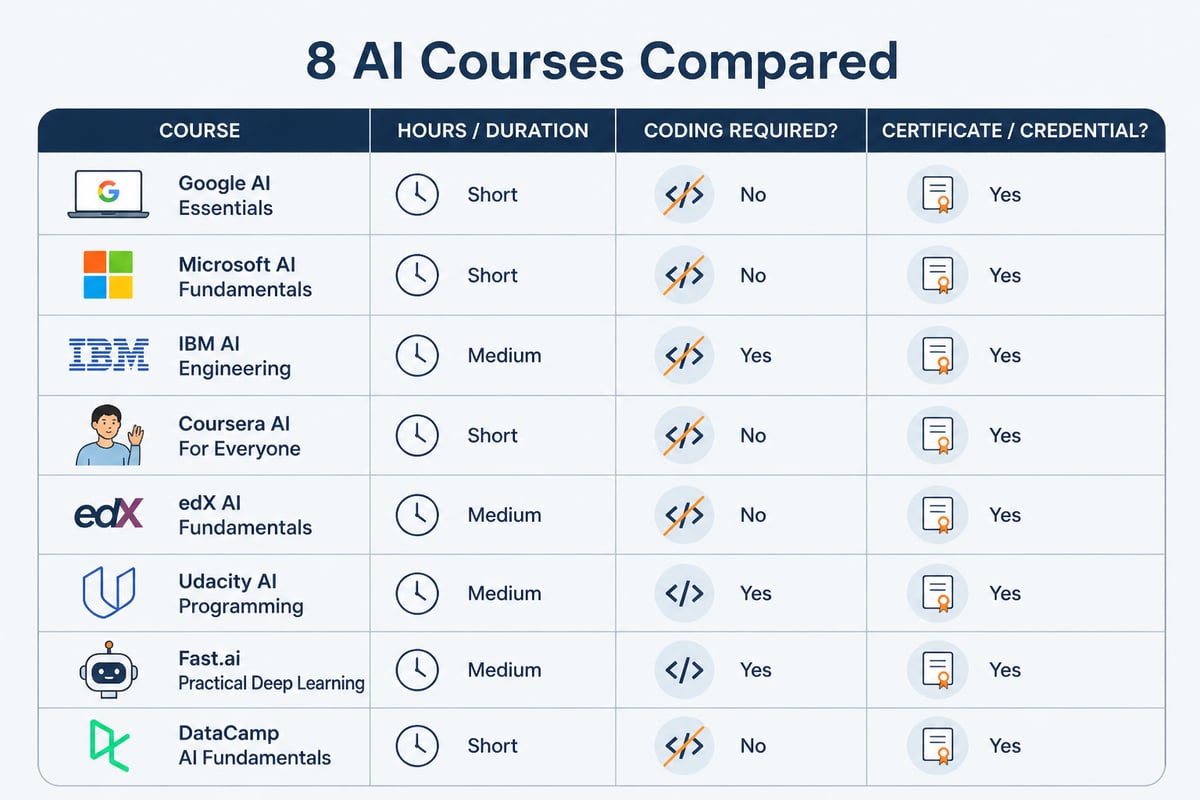
Comparison of the eight options
| Course | Provider | Time | Cost | Coding needed | Best for |
|---|---|---|---|---|---|
| Associate AI Engineer for Developers | DataCamp | ~29 hours | From ~$14/month (annual) | Yes | Hands-on generative AI practice |
| AI Engineer in Python | Dataquest | 10 months at 5 hrs/week | ~$49/month | Yes | Structured career path |
| Mammoth Club Unlimited Membership | MammothClub | Self-paced | From $199/year | Varies by course | Certification and portfolio |
| Hugging Face LLM Course | Hugging Face | ~30-50 hours | Free | Yes | Open-source LLM tools |
| Generative AI with LLMs | DeepLearning.AI and AWS | ~16 hours | Free to audit; certificate ~$49/month | Yes | LLM fundamentals with labs |
| AI Agents Course | Hugging Face | Self-paced | Free | Yes | Agent frameworks |
| Team Plan | MammothClub | Self-paced | $159/user/year | Varies by course | Team upskilling |
| AI for Everyone | DeepLearning.AI | ~10 hours | Free to audit | No | Nontechnical overview |
Which AI developer course is best for a career switcher?
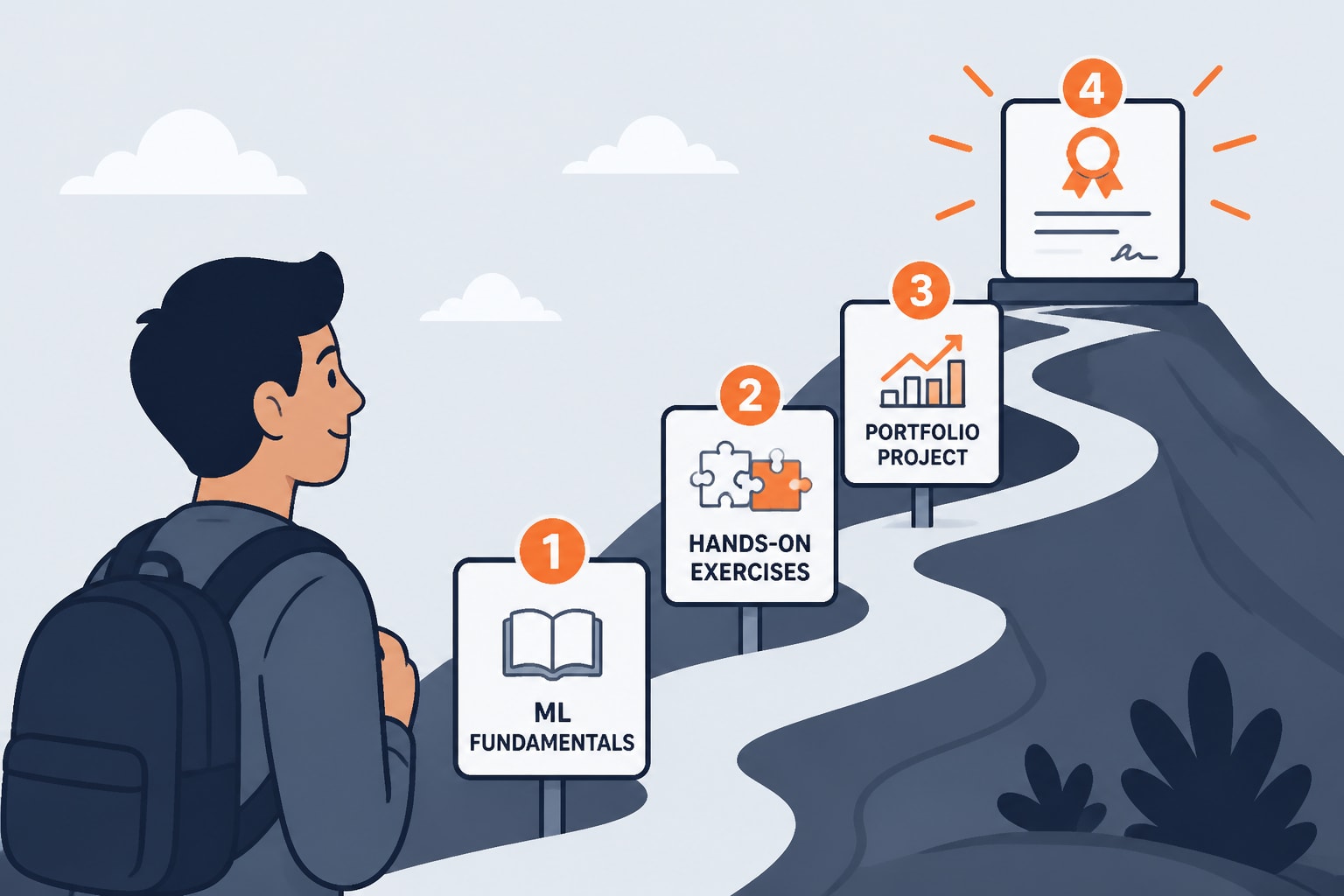
For a career switcher, the best AI developer course combines a structured Python-to-AI progression with a credential an employer can verify. A practical sequence looks like this:
- Build Python fluency. A structured option such as MammothClub's Python programming learning path or the Dataquest path covers the baseline.
- Learn LLM fundamentals. Take Generative AI with LLMs or the Hugging Face LLM Course.
- Build one agent or application. Use the AI Agents Course or a project-based course, and publish the result.
- Earn a credential. Pursue a proctored certification so your resume carries a recognized result.
Hypothetical example: a learner with basic spreadsheet skills could spend the first months on Python, then move to an LLM course, and finish with a cloud AI certification plus one portfolio project. The sequence matters more than the specific brands.
What jobs can you get with AI skills?
AI skills open roles in software development, data analysis, machine learning engineering and AI-assisted automation, and they also add value to existing roles in product, operations and consulting. The PwC figure cited earlier, a substantial average wage premium for jobs requiring AI skills, suggests the credential and the skills are both rewarded when applied in the role. Employers hiring for these roles tend to look for demonstrated implementation: a deployed project, a certification or a documented portfolio.
Are there free AI courses for developers?
Yes, several credible options are free. The Hugging Face LLM Course and AI Agents Course are free, Generative AI with LLMs can be audited at no cost, and Elements of AI is free. The trade-off is that free routes rarely include proctored assessments or a recognized credential. If a certificate is your goal, budget for a paid path. For a broader comparison of engineering-focused options, this Dataquest roundup of AI engineering courses recommends courses by learner profile.
Build proof of skill, not just a course history
A course history proves attendance. A project proves ability. Whatever you choose, plan to produce at least one artifact: a small agent, a retrieval-based chatbot or an automation workflow. For a hands-on starting point, MammothClub's Python chatbot bootcamp and AI automation course for n8n and Python are project-oriented options. Document the result with a short write-up covering the problem, the tools and the outcome, since that gives an interviewer something concrete to discuss.
Frequently asked questions
Which AI course is best for developers?
For developers, the strongest picks are hands-on: Associate AI Engineer for Developers for guided practice, the Hugging Face LLM Course for open-source depth, and Generative AI with LLMs for a structured grounding. Choose based on whether you want a curriculum, free self-study or a credential.
How long does an AI developer course take?
Listed durations range from about 10 hours for an overview to about 29 hours for a developer track, 30 to 50 hours for the Hugging Face LLM Course and 10 months at five hours per week for the Dataquest career path.
Do I need to know Python first?
For the developer-focused options, yes. Basic Python, functions and working with APIs make the technical courses far easier. Learners without that baseline should start with a Python path or a no-coding overview first.
Is a certificate necessary to get hired?
Not always, but a verifiable credential combined with a portfolio project strengthens an application, especially for career switchers without a technical title. Proctored exams carry more weight than completion badges.
Should a team buy individual courses or a plan?
If several people need training and a manager needs visibility into progress, a team plan with progress tracking and certification management is simpler to administer than separate purchases. For current terms, check the product pages on MammothClub.
Take one concrete step today: pick a single project you want to ship, such as an agent or a chatbot, and choose the one course from this list that teaches the tools it needs. If you also want a recognized credential, the Mammoth Club Unlimited Membership covers certification paths, practice exams and labs in one plan, and MammothClub lets you start unlimited with 3,000+ courses behind a single membership.