.png)
In 2025, the demand for professionals skilled in artificial intelligence nanodegree programs is reaching new heights. With the US Bureau of Labor Statistics projecting a 21% surge in AI-related jobs, this is a pivotal moment to future-proof your career.
This comprehensive guide will demystify the artificial intelligence nanodegree, explaining its structure, why it matters, and how you can use it to advance in the fast-evolving tech world. You will discover what the program covers, the admission requirements, curriculum highlights, career opportunities, top learning platforms, and proven strategies for success.
Whether you are looking to switch careers, upskill, or lead innovation in your field, this is your roadmap to mastering AI. Are you ready to take charge of your learning journey and unlock new opportunities?
What Is an Artificial Intelligence Nanodegree?
Understanding the artificial intelligence nanodegree is crucial for anyone considering a tech career in 2025. This specialized program has become a popular path for acquiring in-demand AI skills, thanks to its unique approach and industry relevance.

Defining the AI Nanodegree
An artificial intelligence nanodegree is a micro-credential focused on building practical, job-ready AI skills. Unlike traditional university degrees, which often prioritize broad theoretical knowledge, a nanodegree offers a targeted, project-based learning experience.
These programs emerged from the rise of online tech education, with platforms like Udacity pioneering the format. The artificial intelligence nanodegree emphasizes real-world applications, allowing learners to solve industry problems from the start.
For example, Udacity’s AI Nanodegree has become a market leader by blending interactive lessons, coding exercises, and mentor feedback. The structure is designed for those who want to demonstrate capability through hands-on projects, rather than just passing exams.
This approach not only accelerates learning but also ensures that graduates are prepared for immediate workforce demands. As the tech landscape evolves, the artificial intelligence nanodegree stands out as a modern alternative to conventional credentials.
Key Features and Benefits
The artificial intelligence nanodegree stands apart for its combination of flexibility, mentorship, and real-world relevance. The curriculum is project-based, meaning students build practical solutions like Sudoku solvers or intelligent game agents, mirroring actual industry challenges.
Learners can progress at their own pace, making it accessible for working professionals and students alike. Access to expert mentors and a vibrant learner community helps troubleshoot problems and foster collaboration.
Upon completion, participants earn an industry-recognized certification and often receive career services such as resume reviews and interview prep. These features directly support job readiness and career advancement.
Consider this comparison:
Feature | AI Nanodegree | MOOC | University Degree |
|---|---|---|---|
Format | Project-based | Lecture-based | Theory-heavy |
Flexibility | High | High | Low |
Mentor Support | Yes | Limited/None | Yes |
Industry Recognition | High | Moderate | High |
Time to Complete | 3-6 months | Varies | 2-4 years |
With over 9 million courses sold and 40,000+ positive reviews across leading providers, the artificial intelligence nanodegree is trusted by learners worldwide. The focus on skills over theory means graduates are equipped to contribute from day one, a key advantage in the fast-moving AI sector.
Who Should Consider an AI Nanodegree?
The artificial intelligence nanodegree is ideal for a range of learners. Aspiring AI engineers, data scientists, and software developers find it a direct route to building expertise. Professionals seeking to upskill or transition into AI roles benefit from the practical, workforce-oriented curriculum.
Students preparing for tech careers or industry certifications gain a competitive edge with hands-on experience. Organizations also use these programs to deliver scalable, up-to-date AI training to teams.
Alumni of artificial intelligence nanodegree programs are now working at Fortune 500 companies, reflecting the program’s value in the job market. Applicants typically need English proficiency and a basic foundation in programming, especially Python.
The job outlook is exceptionally strong. According to AI job market statistics 2025, AI engineer salaries range from $134,180 to $208,800, and demand for AI talent continues to grow across all industries. This surge in opportunity makes the artificial intelligence nanodegree a smart investment for a future-proof career.
Admission Requirements and Prerequisites in 2025
Understanding the admission requirements for an artificial intelligence nanodegree is crucial to set yourself up for success. As AI roles become more competitive, meeting these prerequisites ensures you are prepared to tackle advanced coursework and thrive in a rapidly evolving job market.
Core Prerequisites for Enrollment
Before starting your artificial intelligence nanodegree, certain foundational skills are expected. You should have proficiency in Python, especially with object-oriented and intermediate programming concepts. Understanding data structures and algorithms is essential, as is a solid grasp of basic statistics and probability.
English language proficiency, both written and spoken, is another requirement since most course content and peer interactions are in English. Leading platforms, such as Udacity, clearly outline these prerequisites to ensure students are ready for the technical demands.
These requirements are not just formalities. They are designed to help you maximize learning and keep pace with the curriculum. As the AI job market continues to evolve, aligning your skills with industry expectations is vital. For a closer look at how these prerequisites match current hiring trends, see the latest AI job market trends in 2025.
How to Prepare for an AI Nanodegree
Preparation is key to making the most of your artificial intelligence nanodegree. Start by completing recommended courses such as Introduction to Python or Data Structures. Many platforms offer self-assessment quizzes and skill evaluations to help you identify and address knowledge gaps.
Free resources, including MOOCs and online tutorials, can bridge foundational gaps at your own pace. If you need a more structured path, consider stepping stone programs like the Programming for Data Science Nanodegree. Engaging in hands-on practice before enrolling will help you build confidence and familiarity with core concepts.
Effective study planning is equally important. Allocate regular time each week, set clear goals, and use project-based learning to reinforce new skills. This proactive approach will help you transition smoothly into the artificial intelligence nanodegree curriculum.
MammothClub: AI Learning Platform for Prerequisite Mastery
MammothClub offers a robust platform for mastering prerequisites before diving into an artificial intelligence nanodegree. With over 3,000 tech and AI courses, interactive bootcamps, and personalized learning tools, learners can quickly close skill gaps.
The platform’s adaptive courses and targeted skill assessments are designed for both individuals and organizations, making scalable, results-driven AI training accessible to all. Structured career paths and certification programs enable fast, focused upskilling, ensuring you are well-prepared for advanced study.
Whether you are an aspiring AI engineer or a team leader seeking up-to-date training, MammothClub provides a comprehensive solution to help you succeed in your artificial intelligence nanodegree journey.
Inside the AI Nanodegree Curriculum: Courses, Projects, and Skills
Embarking on an artificial intelligence nanodegree means diving into a curriculum designed to equip you with both foundational theory and hands-on skills. The structure, projects, and support systems are tailored to prepare you for the dynamic demands of AI roles in 2025.

Core Curriculum Breakdown
The artificial intelligence nanodegree curriculum typically features a sequence of eight or more courses, broken into 39 lessons and multiple capstone projects. You start with foundational modules like Introduction to AI, search algorithms, optimization, and planning.
As you progress, advanced topics such as Bayesian networks, probabilistic models, and adversarial search are introduced. This layered approach ensures that each core concept builds on the previous one, reinforcing both theoretical understanding and practical application.
For example, Udacity’s artificial intelligence nanodegree guides learners through a course progression that starts with basic search and constraint satisfaction, then moves into optimization and planning, before culminating in advanced probabilistic reasoning. The blend of theory and hands-on practice is essential for mastering AI concepts.
Here’s a typical course structure:
Module | Key Topics | Project Example |
|---|---|---|
Introduction to AI | Search, Constraint Satisfaction | Sudoku Solver |
Optimization | Local Search, Genetic Algorithms | Traveling Salesman Problem |
Planning | Automated Planning, Robotics | Logistics Planner |
Probabilistic Models | Bayesian Networks, HMMs | Spam Detection, Part-of-Speech Tagging |
This curriculum format ensures that artificial intelligence nanodegree graduates are equipped with both depth and breadth of knowledge, ready for real-world AI challenges.
Key Projects and Real-World Applications
Project-based learning is at the heart of every artificial intelligence nanodegree. You won’t just study algorithms, you’ll apply them to build intelligent agents for games like PacMan, develop automated planning systems for logistics, and solve optimization puzzles such as the traveling salesman problem.
Real-world simulations are integral. For instance, a capstone project might involve part-of-speech tagging using Hidden Markov Models, reflecting tasks you’d encounter in natural language processing roles. Another project could have you design a Sudoku solver, sharpening your logic and constraint satisfaction abilities.
These projects do more than test your knowledge, they mirror the kinds of challenges faced by AI professionals in the workplace. According to the AI's impact on employment projections, hands-on AI skills are increasingly vital as industries evolve. By working on these practical assignments, you develop the confidence and competence needed to tackle emerging AI-driven roles.
Every artificial intelligence nanodegree emphasizes iterative improvement and critical thinking, ensuring you are industry-ready and can showcase a robust portfolio upon graduation.
Skills You’ll Develop
An artificial intelligence nanodegree is designed to cultivate a comprehensive skill set. On the technical side, you’ll master search algorithms, symbolic logic, constraint satisfaction, optimization methods, Bayesian inference, and genetic algorithms. You’ll also gain experience with Python, Anaconda, and essential AI libraries.
Soft skills are equally important. Problem-solving, critical thinking, and project management are woven throughout each module. You’ll learn how to break down complex challenges, manage your time, and collaborate effectively with peers.
Here are some of the 36+ in-demand AI skills you’ll develop:
Implementing search and optimization algorithms
Applying probabilistic reasoning and Bayesian networks
Designing and evaluating intelligent agents
Managing real-world AI projects from start to finish
For example, you might build a forward-planning agent for automation or create a robust NLP classifier. These experiences ensure that artificial intelligence nanodegree graduates stand out in interviews and on the job.
Instructor Expertise and Learning Support
The quality of instruction is a hallmark of any top artificial intelligence nanodegree. Courses are often led by industry pioneers like Sebastian Thrun, Peter Norvig, and Thad Starner, who bring real-world expertise and insights to the curriculum.
Learning support extends beyond lectures. You’ll have access to expert mentors, detailed project reviews, and a vibrant peer community. Career coaching and interview preparation services are also available, helping you translate your new skills into career advancement.
Many students credit their artificial intelligence nanodegree experience for landing roles at leading tech firms. Success stories highlight how expert feedback and mentorship accelerate mastery, turning theoretical knowledge into practical expertise.
By leveraging these resources, you maximize every aspect of your artificial intelligence nanodegree journey, positioning yourself for lasting success in the AI field.
Top Platforms Offering AI Nanodegrees in 2025
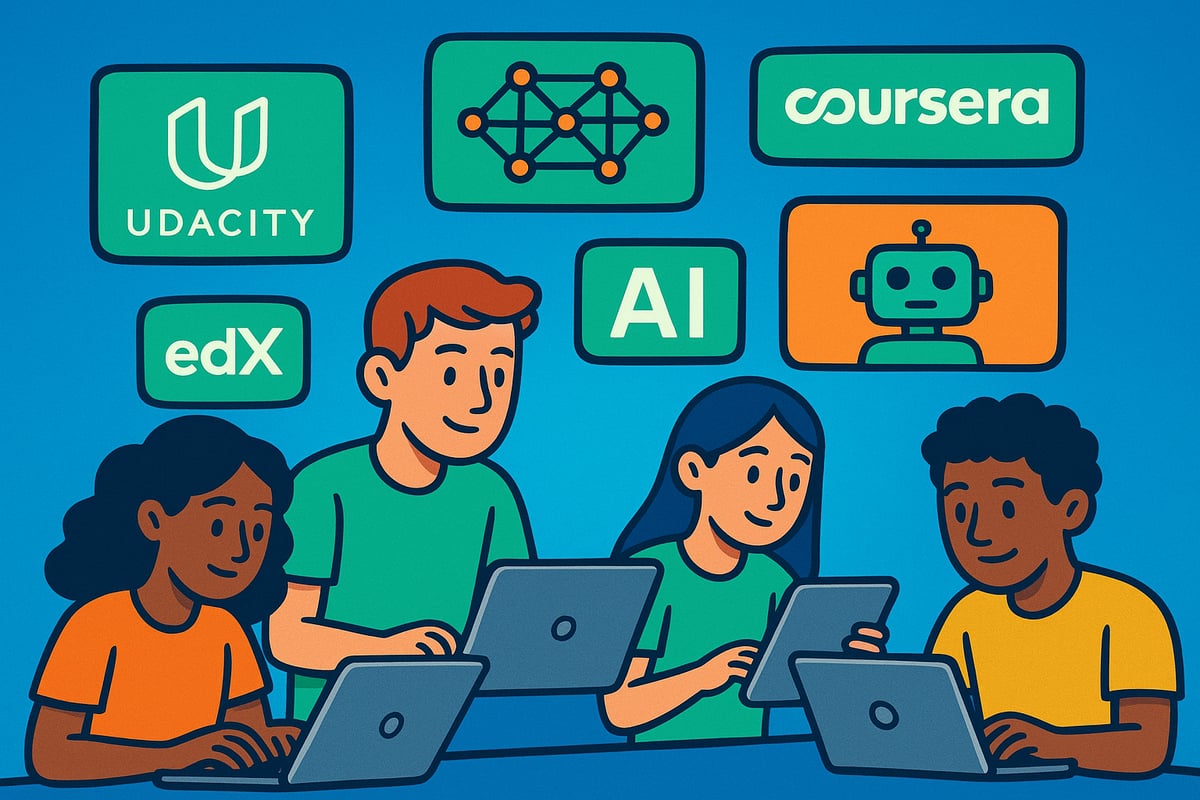
Choosing the right platform for your artificial intelligence nanodegree is a critical step in your AI career journey. In 2025, several leading platforms stand out by offering specialized content, industry partnerships, and flexible learning paths.
Leading Providers and Their Unique Offerings
Several platforms are redefining the artificial intelligence nanodegree landscape by combining comprehensive content, real-world projects, and career support.
Udacity continues as a flagship provider, offering a robust artificial intelligence nanodegree with hands-on projects, industry mentorship, and a flexible, self-paced format. Their curriculum is designed in collaboration with leading tech companies, ensuring direct workforce relevance. Udacity’s monthly subscription model ($249/month) gives learners unlimited access to content and the freedom to cancel anytime, which is ideal for professionals aiming to upskill quickly.
Coursera partners with top universities and companies to deliver micro-credentials and professional certificates. Their artificial intelligence nanodegree alternatives often include university-branded specializations with flexible scheduling. Learners can access graded assignments, peer interaction, and, in some cases, university credits.
edX offers university-backed micro-credentials and professional certificates, including AI-focused programs from institutions like MIT and Harvard. Their artificial intelligence nanodegree options emphasize academic rigor and often provide a pathway to stackable credits toward a master’s degree.
FutureLearn and similar platforms feature global access and niche AI specializations. Their artificial intelligence nanodegree-style programs cater to learners seeking targeted skills, shorter time commitments, and interactive learning communities.
Here is a quick comparison:
Platform | Key Features | Pricing | Flexibility | Industry Partners |
|---|---|---|---|---|
Udacity | Project-based, mentor support | $249/month | Self-paced | Yes |
Coursera | University partnerships, certificates | Varies/course | Flexible | Yes |
edX | Academic rigor, stackable credits | Varies/course | Flexible | Yes |
FutureLearn | Niche specializations, global reach | Varies/course | Flexible | Some |
These platforms are continually updating their artificial intelligence nanodegree offerings to keep pace with evolving industry needs and technological advancements.
How to Choose the Right Platform
Selecting the best artificial intelligence nanodegree platform requires careful consideration of several factors:
Curriculum Depth: Review course syllabi to ensure the program covers foundational and advanced AI topics aligned with your goals.
Instructor Quality: Look for platforms featuring experienced instructors from academia and industry.
Support Services: Evaluate the availability of mentorship, project reviews, and career coaching.
Accreditation: Some artificial intelligence nanodegree programs, like Udacity’s, are eligible for credit toward a master’s degree in AI.
Community and Networking: Platforms with active learner communities foster collaboration, networking, and peer support.
Project Feedback: Immediate, detailed project feedback is essential for mastering real-world AI skills.
User reviews and ratings also provide valuable insights. For example, Udacity’s artificial intelligence nanodegree averages 4.5 out of 5 from over 190 reviewers, reflecting high learner satisfaction.
Financial aid, discounts, and trial options are available on most platforms, making advanced AI education accessible to a wider audience. By weighing these factors, you can select the artificial intelligence nanodegree that best matches your learning style, career objectives, and budget.
Career Outcomes and Opportunities After an AI Nanodegree
In 2025, earning an artificial intelligence nanodegree opens the door to a thriving job market. The field is expanding rapidly, with the US Bureau of Labor Statistics projecting a 21% growth in AI-related roles. This surge is driven by AI’s influence across sectors from healthcare to entertainment. Notably, AI powers automation for NASA Mars rovers and the Hubble telescope, reflecting its real-world impact.
The demand for AI talent is outpacing supply, and salaries reflect this competitive landscape. According to Talent.com, the average salary for an AI engineer is $163,152. As organizations adopt AI-driven solutions, skilled professionals are needed for development, deployment, and management. For a deeper look at how AI is shaping the workforce, including both new opportunities and displacement, see AI job creation and displacement trends.
AI Job Market Trends for 2025
The artificial intelligence nanodegree positions graduates for success as the AI job market accelerates. From 2022 to 2032, AI-related roles are forecasted to grow much faster than average. This reflects the broad integration of AI across industries like logistics, finance, and medicine.
Salaries are rising, with experienced AI engineers earning between $134,180 and $208,800. The global talent gap means employers are eager to recruit candidates with practical skills gained through an artificial intelligence nanodegree. AI is not only creating new jobs but transforming existing ones, leading to dynamic career paths.
Employers value hands-on experience, which is central to the artificial intelligence nanodegree. Project-based learning prepares graduates to tackle real-world challenges, making them highly competitive in the job market.
Roles and Industries for AI Nanodegree Graduates
Graduates of an artificial intelligence nanodegree are equipped for a variety of roles. Common positions include AI engineer, machine learning engineer, data scientist, AI product manager, and research scientist. Emerging titles, such as AI ethics specialist and AI solutions architect, are gaining traction as organizations prioritize responsible AI development.
Industries benefiting from AI skills span tech, automotive, healthcare, retail, and business analytics. For example, AI is revolutionizing logistics through smart routing and robotic process automation. In healthcare, AI enables predictive diagnostics and personalized medicine.
Below is a summary of typical roles and industries for artificial intelligence nanodegree graduates:
Role | Industry | Example Impact |
|---|---|---|
AI Engineer | Tech, Automotive | Autonomous vehicles |
Data Scientist | Healthcare, Retail | Predictive analytics |
AI Product Manager | Finance, E-commerce | AI-powered recommendation |
AI Ethics Specialist | All Sectors | Fairness, transparency |
Success stories include alumni joining Fortune 500 and Global 2000 companies, where they drive innovation in natural language processing, robotics, and optimization.
Maximizing Career Value from Your Nanodegree
To get the most from your artificial intelligence nanodegree, focus on building a strong project portfolio. Showcase capstone projects on platforms like GitHub or a personal website, demonstrating your skills to potential employers.
Leverage career coaching and interview preparation services provided by top nanodegree platforms. Networking with fellow alumni and joining AI professional groups can open doors to new opportunities.
Continue learning by stacking credentials or pursuing a master’s degree pathway. Track your progress by setting milestones, such as salary increases, promotions, or landing a new role after completing your artificial intelligence nanodegree. Use feedback from mentors and employers to guide your next steps and ensure ongoing career growth.
How to Succeed in Your Artificial Intelligence Nanodegree Journey
Embarking on your artificial intelligence nanodegree journey is an exciting step toward a thriving future in tech. Success requires a strategic approach, dedication, and the ability to adapt as you learn. By focusing on practical techniques and leveraging available resources, you can maximize your learning and career outcomes.
Effective Learning Strategies
To excel in your artificial intelligence nanodegree, start by setting clear, achievable goals. Break down the curriculum into weekly milestones, and track your progress regularly. Use a digital calendar or project management app to schedule study sessions and deadlines.
Active learning is crucial. Instead of passively watching lessons, code along with instructors. Experiment with different algorithms and tweak project parameters to see real-world effects. This hands-on approach helps solidify complex concepts.
Form or join study groups with peers enrolled in the artificial intelligence nanodegree. Discussing topics, sharing resources, and collaborating on challenges accelerates understanding. Utilize community forums for quick problem-solving and support from mentors.
Regularly review feedback on projects. Revise your work based on suggestions, and do not hesitate to seek clarification. Weekly study plans and milestone tracking keep you accountable and motivated.
Overcoming Common Challenges
Balancing the artificial intelligence nanodegree with other commitments can be demanding. Create a realistic study schedule that fits your lifestyle, and communicate your goals to family or colleagues for support.
Difficult concepts like probabilistic models or optimization may seem overwhelming. When stuck, reach out to mentors or peers early. Adaptive learning tools can personalize study paths and target your weak areas.
Stay motivated by celebrating small wins, such as completing a lesson or solving a challenging project. If you encounter setbacks, remember that persistence is key. Use online tutorials or supplementary resources to reinforce tricky topics.
Time management is essential. Break tasks into manageable segments, and prioritize high-impact activities. Maintaining momentum throughout your artificial intelligence nanodegree journey ensures consistent progress.
Building a Standout Portfolio
A strong portfolio is vital to showcase your skills from the artificial intelligence nanodegree. Document each project clearly, highlighting your problem-solving approach and the impact of your solutions.
Use platforms like GitHub or a personal website to display your work. Include case studies, project summaries, and code repositories. Recruiters value clear explanations of your AI methodologies and decision-making processes.
Participate in AI competitions or hackathons to further strengthen your portfolio. Demonstrate innovation by sharing unique applications, such as a PacMan search agent or an NLP classifier. These examples illustrate your technical depth and creativity.
Networking with alumni and professionals through your artificial intelligence nanodegree community can open doors to collaborations and job opportunities. Keep your portfolio updated and ready to share with potential employers.
Continuing Your AI Learning After Graduation
Graduating from an artificial intelligence nanodegree is just the beginning. Stay current by exploring advanced AI topics like deep learning, reinforcement learning, or AI ethics. Many platforms offer specialized nanodegrees and micro-masters for further growth.
Join professional AI networks, attend conferences, and participate in webinars to expand your knowledge and connections. Engage with the latest AI research, industry news, and open-source projects to remain competitive.
Leverage alumni communities for mentorship and career advice. Share your experiences and learn from others who have advanced in the field. Continuing education strengthens your expertise and demonstrates commitment to lifelong learning in artificial intelligence nanodegree programs.
Suggested resources often include curated lists of books, research papers, and online courses. Make ongoing learning a habit to ensure your skills remain relevant and marketable.
Measuring Your Progress and ROI
Tracking your progress throughout the artificial intelligence nanodegree helps you stay focused and motivated. Set measurable learning objectives, such as mastering a specific algorithm or completing a capstone project.
Use a simple table or checklist to monitor skill acquisition and project completion:
Goal | Target Date | Status |
|---|---|---|
Complete Module 1 | 02/10/2025 | In Progress |
Build NLP Classifier | 02/20/2025 | Pending |
Capstone Project | 03/05/2025 | Not Started |
Evaluate your career outcomes post-nanodegree. Compare job titles, salary increases, or new opportunities before and after completing the program. Seek feedback from mentors and employers to identify strengths and areas for further improvement.
Regular reflection ensures you maximize the value of your artificial intelligence nanodegree and make informed decisions about future learning paths.
As you look ahead to 2025 and consider taking your first steps into the world of artificial intelligence, remember that building a strong foundation is essential for long-term success. Whether you’re aiming to future-proof your career or unlock new opportunities, mastering the basics gives you the confidence to tackle advanced projects and real-world challenges. If you’re ready to start your AI journey and want a guided, hands-on introduction, you can Become a certified AI Foundation Specilaist. Start for free and begin building the skills that will shape your future.