A machine intelligence course teaches you how computers learn from data to make predictions and decisions, and the best ones for working professionals end in a recognized certification backed by a project portfolio. If you are aiming for a promotion or a career switch, the right choice depends on three things: your current background, the credential you need, and whether the program makes you build and defend real work.
This guide moves from the basics to confident selection. It covers what the field includes, what a solid curriculum contains, how to compare formats, and how to turn a completed program into a hiring advantage.
What does a machine intelligence course actually cover?
A machine intelligence course covers the methods that let software improve from data, including machine learning, deep learning, and increasingly, generative AI. The label varies by provider, so the same material may appear under "machine learning," "applied AI," or "artificial intelligence" in a catalog.
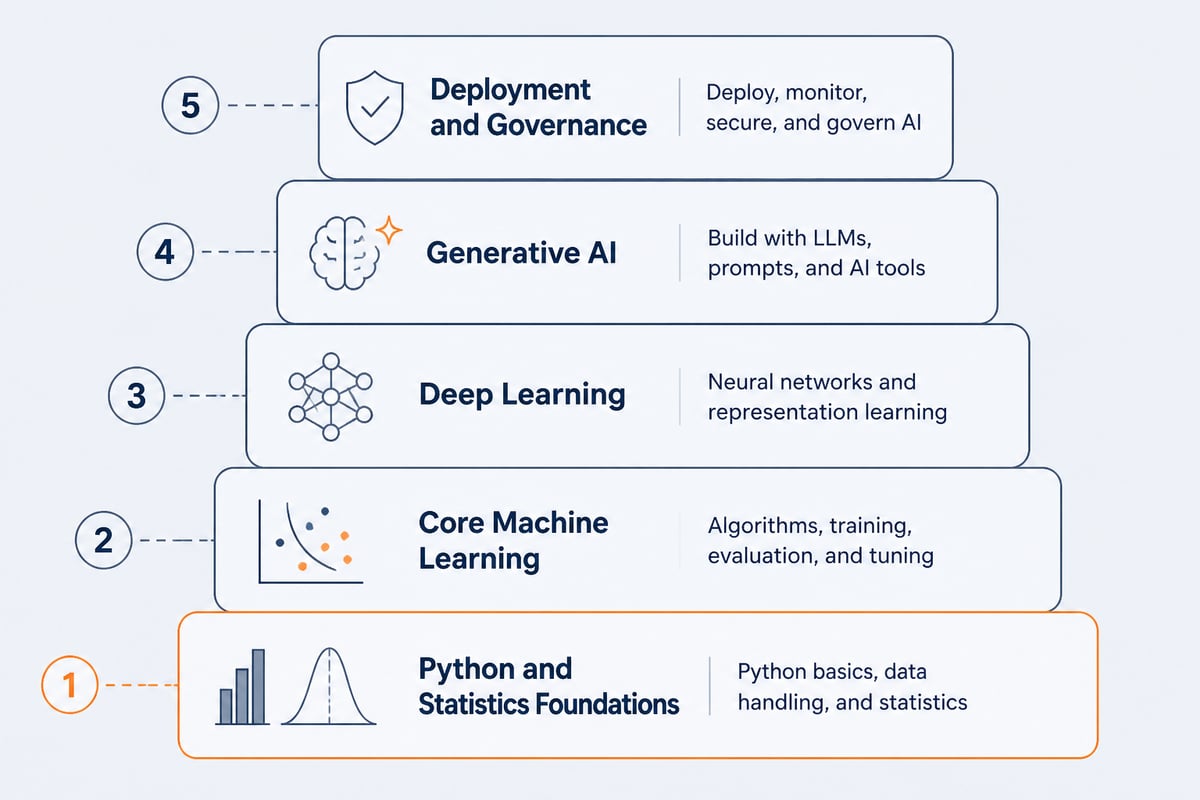
Most programs organize content into a few layers:
- Foundations: Python programming, statistics, probability, and basic linear algebra.
- Core machine learning: supervised learning (regression, classification), unsupervised learning (clustering, dimensionality reduction), and model evaluation.
- Deep learning: neural networks, computer vision, and natural language processing.
- Generative AI: large language models, prompt design, and retrieval-based applications.
- Deployment and governance: putting models into production and managing their risks.
Machine intelligence is the broader umbrella. Machine learning is the part most professionals study first, because it produces the skills employers screen for: building, evaluating, and explaining predictive models.
Which skills should you have before enrolling?
You need working comfort with spreadsheets or basic programming and a refresher-level grasp of statistics, but you do not need a computer science degree. Most structured programs assume you can read simple code and interpret averages, distributions, and percentages.
A realistic readiness check looks like this:
- Programming: Can you write a short Python script with loops and functions? If not, begin with a Python fundamentals course first.
- Math: Do you understand mean, variance, and correlation? Calculus and matrix math are introduced gradually in good programs.
- Data handling: Have you cleaned or summarized a dataset in Excel, SQL, or similar tools?
- Time: Can you commit a consistent weekly block? Steady progress beats occasional marathons.
Career switchers often worry about the math. In practice, applied roles lean far more on judgment, such as choosing the right metric or spotting leaked data, than on deriving equations by hand.
What should a strong curriculum include?
A strong curriculum pairs concept lessons with hands-on labs, graded assessments, and a final project you can show an employer. Reading about gradient descent is not the same as debugging a model that refuses to converge, and hiring managers know the difference.
Look for these markers of quality:
- Practitioner-led content. Material written by people who ship models for a living reflects current tools and real constraints.
- Hands-on labs. You should train, tune, and evaluate models yourself, not watch someone else do it.
- Business framing. Lessons on real-world business applications of ML help you connect a model to a revenue, cost, or risk outcome.
- Regular updates. Tooling changes quickly, so a course last revised years ago will teach outdated libraries.
- Assessment depth. Quizzes, practice exams, and a proctored final carry more weight than a completion badge.
How do the main course formats compare?
The main formats differ in structure, cost, credential strength, and accountability, and the best fit depends on whether you need a verifiable credential or only exposure to the topic. The table below compares them on the attributes that matter to a professional.
| Format | Typical structure | Credential value | Accountability | Best use |
|---|---|---|---|---|
| University program | Semester-based, instructor-led | High, formal | Deadlines, grades | Deep academic grounding |
| Single video tutorial | One short lecture | None | None | Quick concept refresh |
| Self-paced marketplace course | Recorded lessons | Low to moderate | Self-driven | Targeted skill gaps |
| Structured certification path | Courses, labs, assessments, proctored exam | Moderate to high | Built-in testing | Hiring and promotion goals |
| Corporate training program | Cohort-based, employer-sponsored | Varies | Manager and team | Team-wide upskilling |
If your goal is to be recognized by an employer, the structured certification path usually offers the best balance of time and signal. For a comparison of provider styles, see this overview of the best AI and ML courses online.
How do you choose a machine intelligence course for your goal?
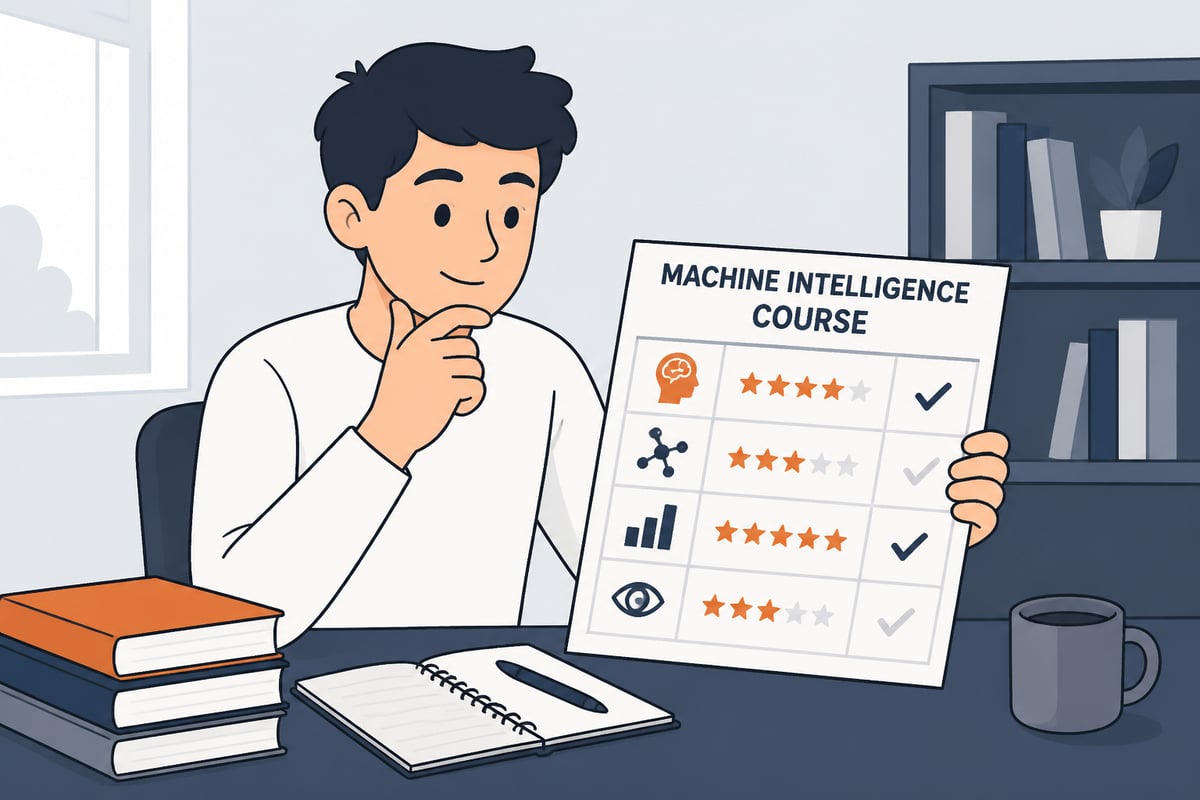
Match the course to the specific outcome you want, then verify that its assessments prove that skill. A hiring goal, a promotion goal, and a leadership goal call for different programs.
If you want to be hired as a practitioner
Choose a path that ends in a portfolio and an exam. Employers screening junior and mid-level candidates look for evidence: a deployed project, a documented notebook, and a credential from an assessment you could not simply click through. Cloud-vendor tracks, such as the AWS Certified Machine Learning Specialty prep course, are recognized because they test applied judgment on a specific platform.
If you want a promotion in a non-technical role
You need fluency, not model-building depth. A foundations program such as Intro to AI: AI Foundation Specialist gives you the vocabulary to evaluate vendors, scope projects, and challenge assumptions in meetings. Pair it with a business-oriented option from the guide to an AI in business course.
If you plan to move into engineering
Plan for a longer sequence: Python, core machine learning, deep learning, then deployment. The roadmap for an AI engineer course outlines how those stages connect, and the advanced track in this advanced AI course guide shows where to go after the basics.
Why do governance and risk belong in your course?
Governance belongs in your course because employers now expect practitioners to understand how AI systems fail and how to manage that risk. A model that performs well in a notebook can still produce biased, insecure, or unreliable results in production.
The U.S. National Institute of Standards and Technology has formalized this thinking. NIST's AI Risk Management Framework is intended for voluntary use to help organizations incorporate trustworthiness considerations into the design, development, use, and evaluation of AI systems. NIST also published its Generative Artificial Intelligence Profile on July 26, 2024, as a companion resource, which you can find alongside related materials in the NIST framework resource hub.
For a professional, this means a course that covers evaluation, documentation, and risk is preparing you for how teams actually work. If you operate in Europe, regulatory literacy matters as well. Providers such as GURO myaitraining.eu offer short AI literacy courses aligned with Article 4 of the EU AI Act, which can complement a technical program for teams that must demonstrate baseline AI understanding.
How should you study to finish and retain the material?
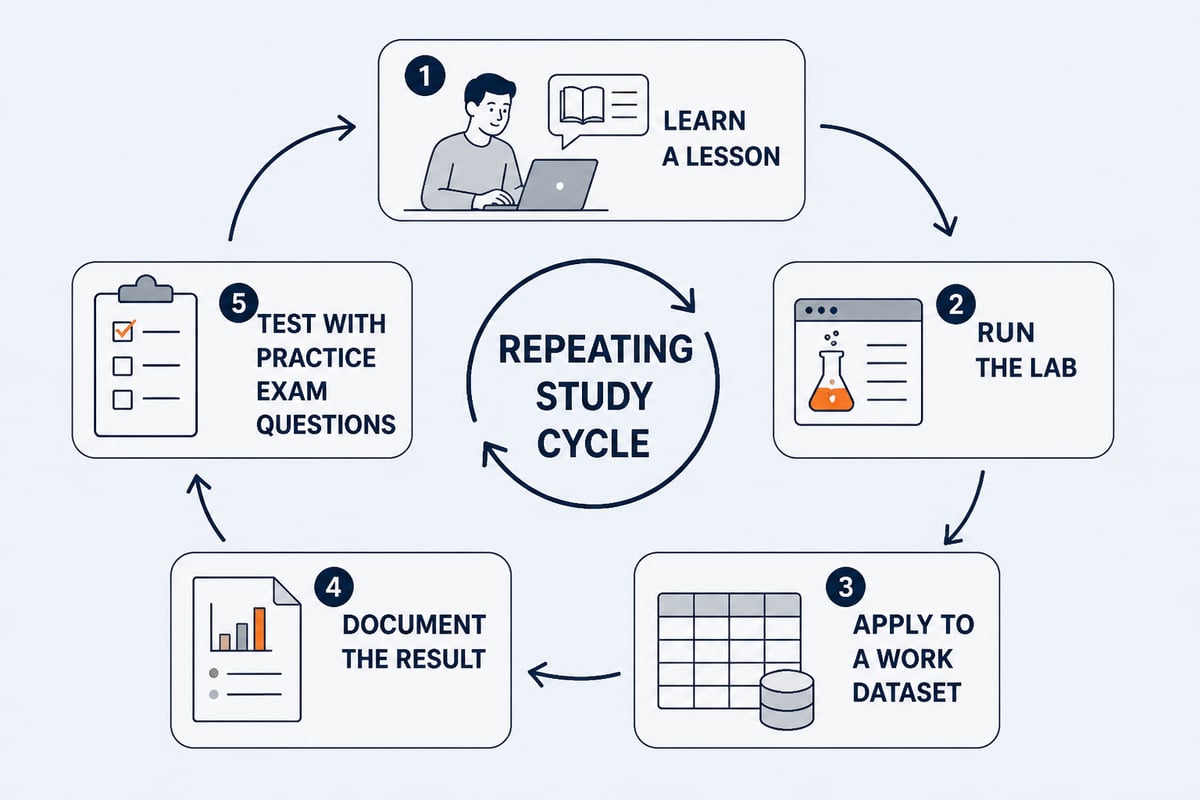
Finish by working in short, applied cycles: read a lesson, run the lab, then apply the concept to a dataset from your own job the same day. Retention comes from use, not from passive viewing.
A workable routine:
- Set a weekly target measured in lessons or labs, not hours alone.
- Apply immediately. After a lesson on regression, predict something you already track, such as churn, demand, or ticket volume.
- Document as you go. Keep a short write-up for each project: the problem, the data, the method, the result, and the limits.
- Test yourself early. Use practice exam questions weeks before the final exam, not the night before.
- Ask for support. Tell your manager what you are studying and why.
That last step matters more than it seems. In its Global Workforce Hopes and Fears Survey 2025, which surveyed workers across dozens of countries and sectors, PwC found that workers who felt supported to upskill were considerably more motivated than those reporting the least support. Employer backing, even informal, measurably improves follow-through.
How do you turn a completed course into career results?
Turn a completed course into results by packaging three things: the credential, a portfolio of two or three projects, and a clear statement of the business problem each one solved. Employers rarely care that you finished; they care what you can now do for them.
- Lead with outcomes. Write "built a classification model that flagged high-risk invoices with documented precision and recall," not "completed a machine learning course."
- Show the process. Include data cleaning, metric selection, and an honest note on limitations.
- Add the credential to your profile only after you pass the proctored assessment, since that is the part a recruiter can trust.
- Connect it to a role. Tie your work to the function you want: operations forecasting, customer analytics, or product automation.
Applied skills also travel beyond engineering teams. Consultancies such as Stellium Consulting, a Microsoft Solutions Partner, build AI-powered solutions for enterprises, which illustrates the kind of employer demand that rewards professionals who can bridge business needs and technical delivery.
What does MammothClub offer for a machine intelligence course?
MammothClub offers structured certification paths with built-in assessments, project portfolios, and proctored final exams, delivered through text-first, AI-searchable lessons built to be applied the same day. Courses are built with practitioner input and go through review, and they are revised regularly as tools change.
The platform's scale gives context for how others use it: over 9 million courses sold, more than 1,400 organizations and libraries on the platform, and over 40,000 positive reviews. For exam preparation, it includes over 500,000 practice exam questions across over 5,000 hours of content, and one membership covers courses, practice labs, templates, and digital assets.
This format suits professionals who want a credential and demonstrable work. It is not designed for readers who want only free material or a single short video, and those learners will find better matches elsewhere. To compare credential options before you commit, review the guides to machine learning and AI certification and top artificial intelligence certifications.
Frequently asked questions
How long does a machine intelligence course take?
Foundations programs typically take a few weeks of part-time study, while a full certification path that includes deep learning, projects, and an exam usually spans several months. Your pace depends on prior Python and statistics experience.
Do I need to know how to code first?
Basic Python helps a great deal. If you have no programming background, complete a Python fundamentals course before starting machine learning content so the labs do not stall your progress.
Is a certification enough to get hired?
A certification opens doors, but a portfolio closes them. Pair the credential with projects that show you can frame a problem, build a model, and explain the result in plain language.
What is the difference between machine learning and machine intelligence?
Machine learning is a method within the broader field. Machine intelligence is the wider term for systems that perform tasks associated with human intelligence, including learning, reasoning, and language understanding.
Can a course help my team, not just me?
Yes. Organizations commonly train groups together so they share vocabulary and standards. Sales and revenue teams, for example, can pair AI skills with tools from firms like Aletto, which automates AI follow-up and booking for B2B pipelines, and CRM-heavy teams can look to capeMBX Consulting for Salesforce implementations built to be AI-ready.
Your next step is to write down the single role or promotion you want, then shortlist two programs that end in a proctored exam and a project portfolio. When you are ready to start, Start unlimited with a MammothClub membership and work through courses, practice labs, and assessments toward a certification employers can verify.