AI is transforming the workplace at an unprecedented pace, with experts predicting that millions of new roles will emerge by 2026. As companies race to integrate advanced technologies, the need for professionals with targeted expertise has never been greater.
To stay ahead, mastering the right ai specialization courses is crucial for anyone aiming to advance their career in this evolving tech landscape. Whether you are a developer, manager, or industry newcomer, strategic upskilling will set you apart and open doors to exciting opportunities.
In this guide, discover the 9 essential ai specialization courses designed to boost your skills, keep you relevant, and help you thrive in the future job market.
Why AI Specialization Matters for Your Career in 2026
In 2026, the rapid evolution of artificial intelligence is reshaping the professional landscape. AI specialization courses are now a critical driver for those seeking to secure high-impact roles and stay ahead of industry trends. Understanding why these courses matter can help you make informed choices about your career path.
The AI Job Market Outlook
AI specialization courses are becoming essential as the job market undergoes dramatic change. According to the AI roles projected to grow by 35% by 2026, demand for AI professionals is surging.
LinkedIn and Gartner highlight specializations like machine learning engineering, AI product management, and AI ethics as top priorities for employers. Emerging roles include AI Product Manager, AI Ethics Officer, and ML Engineer.
As companies accelerate digital transformation, those with focused expertise gain a decisive advantage. The growth in AI roles signals an urgent need for targeted upskilling through ai specialization courses.
Evolving Skill Requirements
The shift from generalist to specialist roles is transforming hiring criteria. Employers are now seeking candidates with deep skills in areas such as deep learning, natural language processing, computer vision, and AI ethics.
For example, tech giants and startups alike seek professionals who can build advanced neural networks or ensure responsible AI deployment. Companies value hands-on experience with real-world data and the ability to navigate complex ethical considerations.
AI specialization courses empower learners to develop niche expertise, making them more attractive to organizations that require specialized knowledge for innovative projects.
Salary and Advancement Opportunities
Pursuing ai specialization courses can deliver significant financial and professional rewards. Specialists often command higher salaries than generalists, reflecting the premium placed on advanced skills.
| Role | Average Salary (USD) |
|---|---|
| AI Generalist | $110,000 |
| ML Engineer | $140,000 |
| AI Product Manager | $150,000 |
| NLP Specialist | $145,000 |
Case studies show that professionals who complete recognized specialization courses often move into leadership roles or gain promotions. Investing in targeted education opens doors to new career heights and greater earning potential.
The Competitive Edge of Certification
Earning respected credentials from ai specialization courses gives you a distinct edge in a crowded marketplace. Certifications are valued by recruiters, who often prioritize candidates with documented expertise.
Industry leaders note that certified professionals demonstrate both commitment and up-to-date knowledge. Continuous learning is vital, as AI technologies evolve quickly and new standards emerge.
By pursuing ongoing certification, you position yourself as a forward-thinking expert ready to tackle the most demanding challenges in AI.
9 Essential AI Specialization Courses to Boost Your Career
The demand for ai specialization courses is soaring as professionals seek to future-proof their careers. Selecting the right course can unlock new roles, higher salaries, and deeper expertise. Below are nine standout programs, each tailored to a unique career path in artificial intelligence. Whether you’re a developer, manager, or healthcare professional, these ai specialization courses offer pathways to mastery and advancement.
1. [Deep Learning Specialization by Andrew Ng (Coursera)]
The Deep Learning Specialization by Andrew Ng is one of the most recognized ai specialization courses globally. Priced at $49 per month, it covers neural networks, convolutional networks (CNNs), recurrent neural networks (RNNs), and hands-on projects.
This program stands out for its practical assignments and the expertise of Andrew Ng, a leader in the AI field. Learners gain real-world experience through peer-reviewed projects, making it ideal for aspiring machine learning engineers and data scientists.
Pros:
- Industry-recognized credential
- Flexible pacing
- Beginner-friendly approach
Cons:
- Requires foundational Python and math skills
A unique aspect is the supportive learning community, ensuring students are never alone on their journey. For those seeking ai specialization courses that blend theory with application, this program is a top contender.
2. [AI For Everyone by Andrew Ng (Coursera)]
AI For Everyone is a foundational ai specialization course tailored for non-technical professionals. It’s free to audit or $49 for a certificate, making it accessible for managers, business leaders, and those new to AI.
The curriculum demystifies AI concepts, explores business applications, and addresses ethical considerations. No coding is required, so anyone can participate and benefit.
Pros:
- Concise, well-structured modules
- No technical prerequisites
Cons:
- Less technical depth
- Limited hands-on experience
This course’s unique value lies in its focus on AI strategy and adoption within organizations. It’s one of the most approachable ai specialization courses for those seeking to lead or support AI-driven projects without a technical background.
3. [Professional Certificate in Machine Learning and Artificial Intelligence (edX/MIT)]
For experienced professionals, the MIT Professional Certificate in Machine Learning and Artificial Intelligence is among the most advanced ai specialization courses available. Each course costs $2,800 and covers advanced machine learning, deep learning, AI ethics, and real-world applications.
Taught by renowned MIT faculty, the curriculum is rigorous and research-driven. It’s tailored for technical leads and seasoned practitioners aiming for top-tier roles.
Pros:
- Prestigious MIT credential
- Access to a powerful alumni network
Cons:
- High cost
- Demanding prerequisites
The prestige of the MIT brand and the depth of content set this apart from other ai specialization courses. Networking opportunities and exposure to cutting-edge research make it a career-defining investment.
4. [AI Product Manager Nanodegree (Udacity)]
The AI Product Manager Nanodegree is designed to bridge the gap between AI technology and product management. Priced at $399 per month, it covers AI strategy, product lifecycle, data pipelines, and user experience.
Learners tackle real industry projects and receive mentorship, preparing them for roles where business acumen meets technical innovation.
Pros:
- Practical, job-ready focus
- Portfolio-building opportunities
Cons:
- Time-intensive
- Not suitable for complete beginners
This nanodegree stands out among ai specialization courses for its business-centric approach. It’s ideal for product managers, tech leads, and entrepreneurs aiming to launch AI-powered products.
5. [Natural Language Processing Specialization (Coursera)]
The Natural Language Processing Specialization is essential for those interested in text analysis, sentiment detection, and machine translation. At $49 per month, it delves into advanced NLP techniques, including transformer models.
Taught by top NLP researchers, this is one of the most in-depth ai specialization courses for data scientists and NLP engineers. It offers hands-on coding assignments and real-world case studies.
Pros:
- Project-based, practical curriculum
- Covers state-of-the-art NLP methods
Cons:
- Requires Python and machine learning basics
Learners gain a competitive edge in the rapidly evolving field of NLP, making this course a popular choice among ai specialization courses.
6. [Computer Vision Nanodegree (Udacity)]
The Computer Vision Nanodegree focuses on image processing, object detection, and neural networks for visual data. Priced at $399 per month, it equips learners with skills for autonomous vehicles, robotics, and real-time vision systems.
Industry mentors and real-world projects help students build a portfolio that stands out to employers.
Pros:
- Up-to-date curriculum
- Portfolio-ready projects
Cons:
- Requires prior programming experience
A key advantage over other ai specialization courses is its emphasis on hands-on, industry-relevant applications in computer vision, a field in high demand.
7. [AI Ethics and Responsible AI (edX/Microsoft)]
AI Ethics and Responsible AI by Microsoft on edX is a timely addition to the landscape of ai specialization courses. Free to audit or $99 for a verified certificate, it explores AI ethics, fairness, transparency, and regulatory compliance.
The course features real-world case studies and practical frameworks for responsible AI deployment.
Pros:
- Focus on ethical and societal impacts
- Developed by a tech industry leader
Cons:
- Less technical, more conceptual
This program is crucial for policymakers, compliance officers, and developers who must navigate the complex ethical dimensions of AI. Among ai specialization courses, its focus on governance and responsible use is unique.
8. [TensorFlow Developer Certificate Program (TensorFlow)]
The TensorFlow Developer Certificate Program is a practical, skills-based credential for those seeking to master one of the industry’s leading AI tools. The exam fee is $100, with free study resources available.
The curriculum covers TensorFlow fundamentals, model building, and deployment, preparing learners for real-world development.
Pros:
- Official Google recognition
- Globally respected certification
Cons:
- Self-paced, challenging exam
This certification is a strong differentiator in the job market. For those evaluating ai specialization courses with a focus on technical credibility, it is a top pick. For a broader view on certification options, see the Best AI certification options.
9. [AI for Healthcare Specialization (Coursera/Stanford)]
The AI for Healthcare Specialization, led by Stanford faculty, targets the intersection of AI and medicine. At $49 per month, it covers medical imaging, predictive analytics, and clinical applications.
Learners work on healthcare-focused projects using real datasets, gaining niche expertise that is increasingly sought after.
Pros:
- Healthcare-specific focus
- Real-world case studies
Cons:
- Requires ML or healthcare background
This course stands out among ai specialization courses for its targeted approach to a rapidly growing sector, making it ideal for medical professionals and data scientists alike.
How to Choose the Right AI Specialization Course for Your Goals
Selecting from the vast landscape of ai specialization courses requires a strategic approach. The right decision can elevate your expertise, open new career pathways, and maximize your return on investment. Let’s break down how to make the smartest choice for your unique goals.
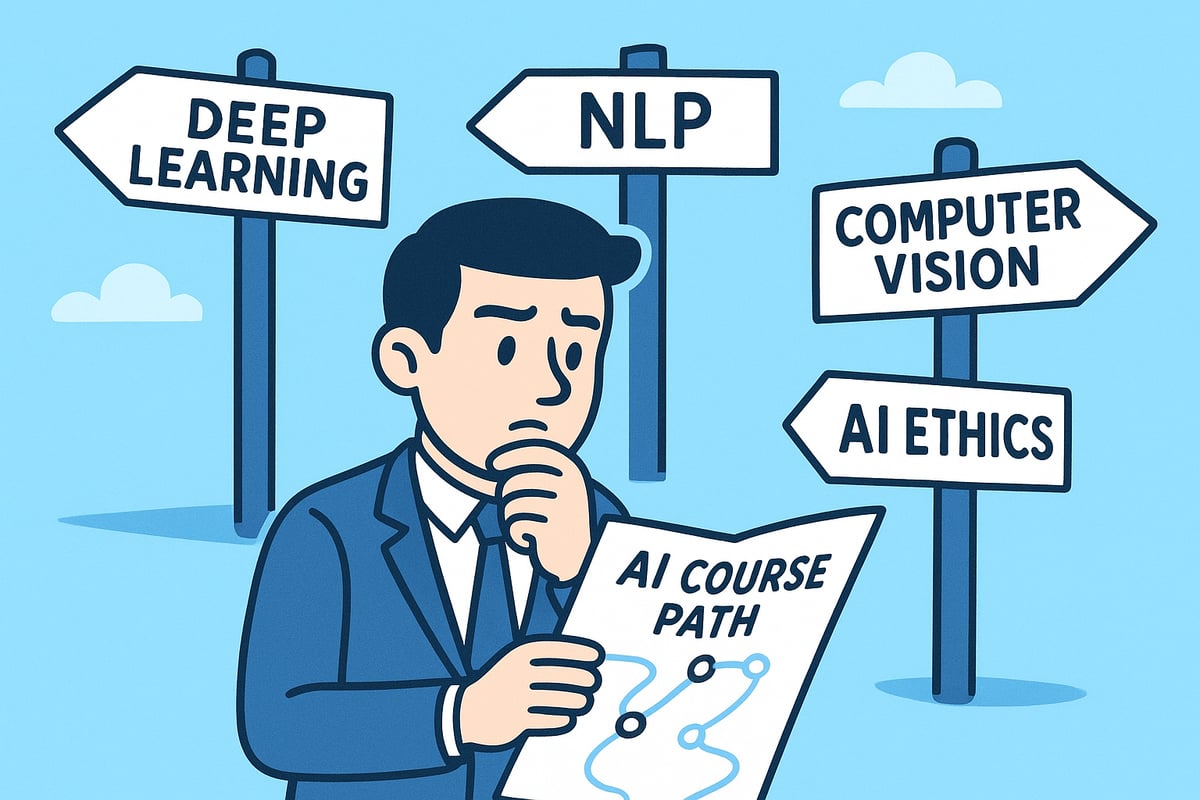
Assessing Your Background and Career Stage
Begin by evaluating your current skills and professional experience. Are you a recent graduate, a mid-career professional, or transitioning from a non-technical field? Matching the level of ai specialization courses to your background is essential. For example, beginners may benefit from foundational programs, while experienced tech professionals could target advanced certifications.
Consider your career objectives. If you’re switching industries, focus on courses with broad applicability and hands-on projects. Upskilling professionals might look for advanced topics or niche domains. For a structured approach to mapping your learning journey, refer to this AI and machine learning learning path for clear guidance on aligning your education with your goals.
Aligning with Industry Demand and Trends
To maximize your investment in ai specialization courses, research current and projected job market trends. Employers increasingly seek specialists in deep learning, NLP, computer vision, and AI ethics. Analyze which skills are most in demand in your target industry or role.
Reviewing up-to-date labor data and expert analyses, such as the insights in AI skills in demand and salary trends 2026, can help you prioritize the most valuable areas of specialization. Staying informed ensures your chosen course aligns with future opportunities and positions you for long-term growth.
Evaluating Course Content and Credentials
Not all ai specialization courses are created equal. Scrutinize the curriculum, instructor expertise, and learning format. Prioritize programs with hands-on projects, peer-reviewed assignments, and real-world case studies. These elements build practical skills and a robust portfolio.
Assess the credibility of the institution or platform offering the course. Well-known universities and industry leaders often provide certifications that carry significant weight with employers. Look for accreditations or endorsements that validate your skills and set you apart in the hiring process.
| Criteria | Why It Matters | What to Look For |
|---|---|---|
| Curriculum Depth | Ensures comprehensive learning | Projects, case studies |
| Instructor Quality | Impacts skill transfer and mentorship | Industry/research leaders |
| Recognition | Boosts resume and credibility | Accredited institutions |
Balancing Cost, Flexibility, and ROI
Finally, weigh the financial and logistical aspects of ai specialization courses. Compare tuition, certification fees, and time commitments against your budget and schedule. Consider whether the course offers self-paced modules, live sessions, or flexible deadlines.
Estimate the potential salary uplift or career advancement opportunities upon completion. Investing in a reputable certification can yield substantial returns, but it’s crucial to balance costs with expected outcomes. Realistic planning ensures your upskilling journey is sustainable and rewarding.
Maximizing Career Impact from AI Specialization Courses
Achieving real results from ai specialization courses requires more than just earning a certificate. To truly stand out, you must strategically apply your new skills, build a compelling portfolio, and stay engaged in the ever-changing AI ecosystem. Let us explore how you can transform coursework into lasting career growth.

Building a Standout AI Portfolio
A well-crafted portfolio is your gateway to top AI roles. Employers increasingly look for hands-on project experience, not just theory. Use ai specialization courses to complete real-world projects, then showcase them on GitHub or a personal website.
- Include code samples from deep learning, NLP, or computer vision tasks.
- Document each project with clear explanations and outcomes.
- Highlight challenges solved using AI and the impact of your solution.
For more inspiration on what to include, see this list of essential AI courses for professionals, which highlights project-rich specializations. The right portfolio, built with projects from ai specialization courses, can instantly capture an employer’s attention.
Networking and Community Engagement
Career success in AI is often about who you know as much as what you know. Engaging with peers and experts through ai specialization courses opens doors to invaluable networks. Join course-specific forums, alumni groups, and professional AI communities.
- Participate in online discussions and share your project experiences.
- Attend virtual meetups or webinars linked to your courses.
- Connect with mentors and recruiters who frequent these communities.
According to LinkedIn, 70 percent of tech jobs are filled through networking. By leveraging the connections made during ai specialization courses, you can uncover hidden opportunities and stay ahead in your career.
Applying Skills in Real-World Projects
Translating knowledge from ai specialization courses into practical experience is key. Seek internships, freelance gigs, or contribute to open-source AI initiatives. Many professionals land their first AI roles by showcasing results from these projects.
- Volunteer for AI tasks at your current workplace or in nonprofit settings.
- Apply for internships that align with your specialization, such as NLP or computer vision.
- Build a track record by contributing to open-source AI repositories.
A compelling example is a data scientist who, after completing ai specialization courses, contributed to an open-source medical imaging project and secured a full-time AI healthcare role as a result.
Continuous Learning and Staying Updated
The AI field evolves rapidly, so ongoing education is a must. Use ai specialization courses as a foundation, then stay updated through industry journals, webinars, and conferences.
- Subscribe to AI research newsletters and leading journals.
- Attend online or in-person AI events to learn about new trends.
- Regularly update your skills with micro-courses or advanced specializations.
Continuous improvement signals to employers that you are committed to staying relevant. In a dynamic industry, those who keep learning after their initial ai specialization courses are best positioned for long-term success.
As you consider which AI specialization course aligns with your goals and the future demands of the tech workforce, remember that building a strong foundation is the key to long-term career growth. The right starting point not only opens doors to advanced opportunities but also makes navigating complex AI topics much smoother. If you are ready to take the next step and want to gain a recognized credential as you begin your journey, you can Become a certified AI Foundation Specilaist. Start for free
This is your chance to upskill with confidence and set yourself apart in an ever-evolving field.