The artificial intelligence landscape has evolved dramatically since 2020, transforming from a specialized field into an essential competency across industries. While introductory courses serve those starting their journey, professionals seeking to architect large language models, implement production-grade AI systems, or lead enterprise AI initiatives require far more depth. An advanced AI course bridges the gap between basic understanding and expert-level implementation, equipping learners with the technical sophistication demanded by today's competitive market. This guide explores what separates advanced AI education from introductory material, the essential components of rigorous training programs, and how professionals can leverage these skills to drive organizational transformation.
What Defines an Advanced AI Course in 2026
The distinction between introductory and advanced AI training extends beyond simply covering "harder" material. An advanced AI course assumes foundational knowledge in machine learning fundamentals, linear algebra, calculus, and programming proficiency in Python or similar languages. Rather than explaining what neural networks are, these programs dive into architectural innovations, optimization strategies, and production deployment challenges.
Technical Prerequisites and Depth
Learners entering an advanced AI course typically possess 12-24 months of practical machine learning experience and understand concepts like gradient descent, backpropagation, regularization techniques, and evaluation metrics. The curriculum builds on this foundation by exploring:
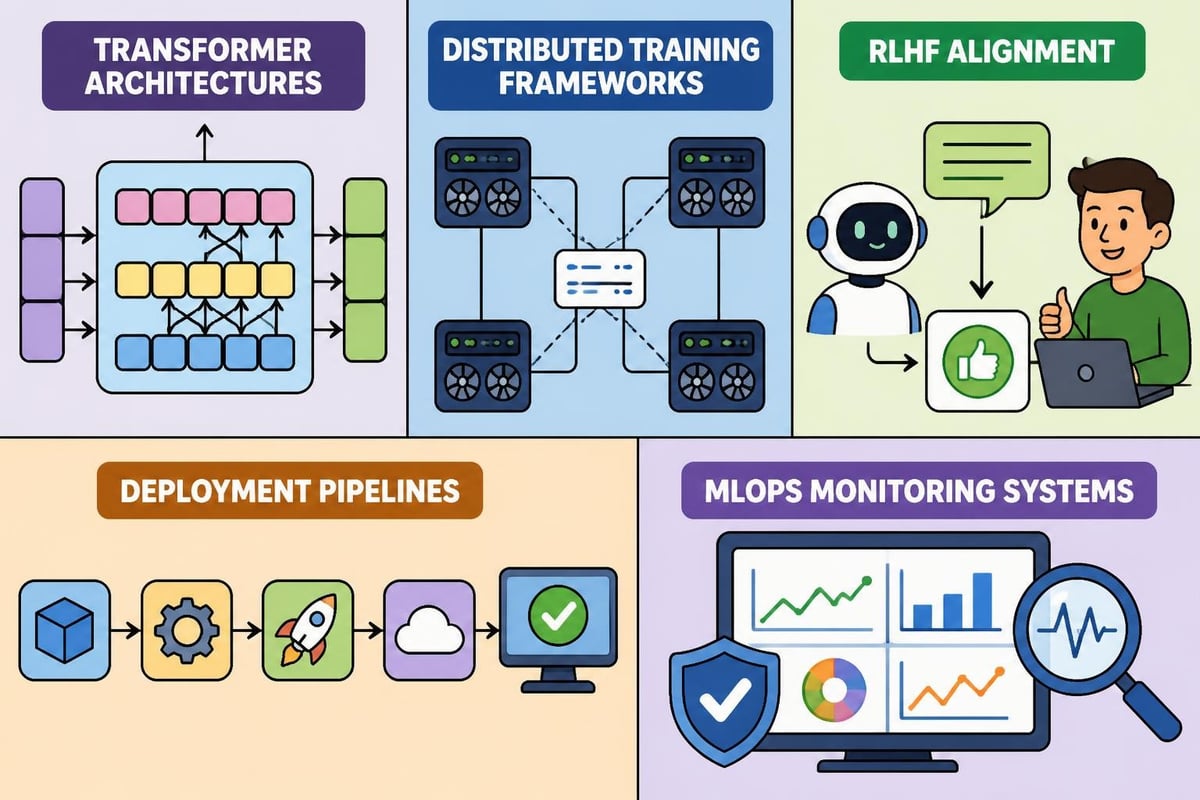
- Transformer architectures and attention mechanisms at the implementation level
- Fine-tuning strategies for large language models including LoRA, QLoRA, and full parameter updates
- Reinforcement learning from human feedback (RLHF) for model alignment
- Distributed training across multiple GPUs using frameworks like DeepSpeed and FSDP
- Model compression techniques including quantization, pruning, and knowledge distillation
The OpenAI developer guide on fine-tuning and best practices exemplifies the type of technical detail advanced courses incorporate, moving beyond theory into production-oriented implementation.
Research-Backed Curriculum Design
Distinguished advanced programs incorporate cutting-edge research that hasn't yet permeated mainstream practice. Stanford's advanced NLP course (CS224N) demonstrates this approach through its syllabus structure, integrating recent papers on attention mechanisms, retrieval-augmented generation, and chain-of-thought prompting within weeks of publication.
An effective advanced AI course maintains this research connection while grounding concepts in practical application. The balance ensures learners understand both the theoretical underpinnings that drive innovation and the engineering compromises required for production deployment.
| Introductory Course Focus | Advanced Course Focus |
|---|---|
| What is a neural network? | Optimizing transformer memory efficiency |
| Training a simple classifier | Implementing custom attention patterns |
| Using pre-trained models | Fine-tuning with custom objectives |
| Basic model evaluation | Production monitoring and A/B testing |
| Single-machine training | Multi-GPU distributed strategies |
Core Technical Modules in Professional AI Training
The architecture of an advanced AI course typically spans 80-200 hours of instruction, depending on specialization depth. MammothClub's AI and machine learning courses illustrate how comprehensive programs structure learning paths to build expertise progressively.
Natural Language Processing and Large Language Models
Modern NLP dominates the advanced AI course landscape given the transformative impact of models like GPT-4, Claude, and Gemini. Professional-level training covers:
Transformer Deep Dive: Implementation details of self-attention, multi-head attention, positional encodings, and layer normalization. Learners build transformers from scratch to understand computational complexity and memory requirements.
Fine-Tuning Methodologies: Parameter-efficient approaches that adapt foundation models to specific domains. This includes instruction tuning, few-shot learning optimization, and domain adaptation strategies that minimize computational costs while maximizing performance.
Retrieval-Augmented Generation: Integration patterns that combine large language models with external knowledge bases, vector databases, and real-time data sources to reduce hallucination and improve factual accuracy.
Recent research like the 2024 ArXiv paper on using reinforcement learning to teach LLMs to reason informs advanced modules on alignment and reasoning enhancement, showing how cutting-edge techniques translate into practice.
Computer Vision and Multimodal Systems
Vision transformers (ViTs) and diffusion models have revolutionized image processing, creating new opportunities and challenges for practitioners. An advanced AI course addressing computer vision explores:
- Architecture evolution from CNNs through vision transformers to modern hybrid approaches
- Diffusion model mathematics and stable training procedures
- Zero-shot and few-shot visual classification techniques
- Video understanding and temporal modeling at scale
- Cross-modal learning between text, images, and other modalities
Hands-on projects typically involve fine-tuning CLIP-style models, implementing custom diffusion schedulers, or building retrieval systems that span multiple data types.
Reinforcement Learning and Decision Systems
While supervised learning dominates many applications, reinforcement learning enables autonomous decision-making in robotics, game AI, recommendation systems, and resource optimization. Advanced training covers:
- Policy gradient methods including PPO, TRPO, and A3C variants
- Q-learning at scale with experience replay and target networks
- Model-based RL that learns environment dynamics for planning
- Multi-agent reinforcement learning for competitive and cooperative scenarios
- Offline RL techniques that learn from logged data without environment interaction
The connection between RL and large language model alignment (RLHF) has made this topic essential for anyone working with generative AI at production scale.
Production Deployment and MLOps Fundamentals
Theory without implementation creates limited value. An effective advanced AI course dedicates substantial time to production engineering, infrastructure, and operational concerns that determine project success.
Model Serving Architecture
Moving from notebook experiments to production services requires understanding latency-throughput tradeoffs, autoscaling patterns, and cost optimization. The Hugging Face documentation on Inference Endpoints provides practical patterns that advanced courses incorporate:
- Batch vs. real-time inference decision frameworks
- GPU memory optimization through quantization and dynamic batching
- Model parallelism for serving large models that exceed single-GPU capacity
- Caching strategies to reduce redundant computation
- Load balancing across heterogeneous hardware
The Hugging Face Transformers serving and deployment guide adds technical depth on optimized runtimes like TGI and vLLM that can reduce inference costs by 3-10x compared to naive implementations.
Enterprise MLOps Practices
Organizational AI success depends on repeatable processes, version control, monitoring, and governance. Advanced training addresses these through:
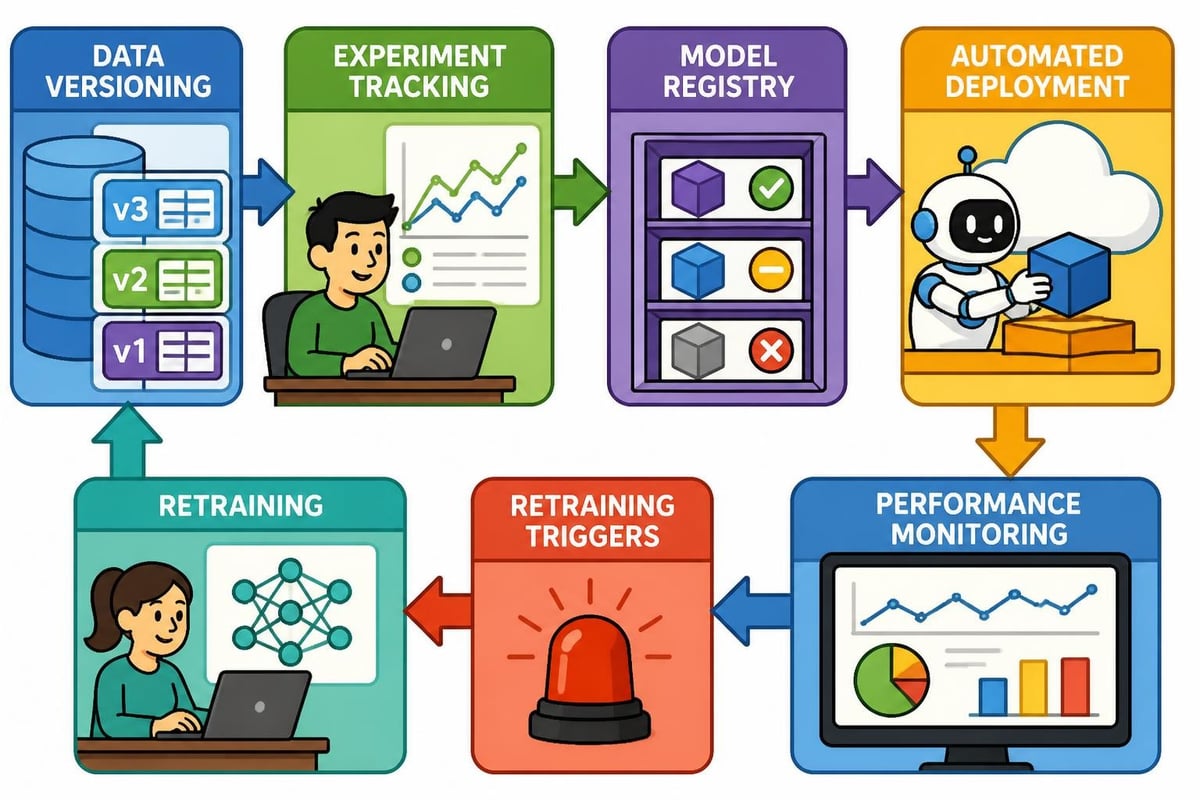
Pipeline Orchestration: Tools like Kubeflow, MLflow, and Vertex AI for managing complex workflows with data preprocessing, training, validation, and deployment stages. The Google Cloud Vertex AI documentation serves as authoritative reference material for enterprise-grade practices.
Experiment Tracking: Systematic approaches to hyperparameter tuning, model versioning, and reproducibility that enable teams to iterate efficiently and maintain audit trails.
Performance Monitoring: Implementing dashboards that track accuracy drift, latency percentiles, throughput metrics, and business KPIs to detect degradation before it impacts users.
Model Governance: Compliance frameworks, bias detection, interpretability requirements, and documentation standards that align with regulatory expectations.
The Machine Learning Systems textbook offers comprehensive coverage of these topics, making it valuable supplementary material for advanced learners focused on production systems.
Specialized Tracks and Industry Applications
Generic AI training provides breadth, but professionals often need domain-specific expertise. Advanced courses increasingly offer specialization paths tailored to industry verticals.
Healthcare and Life Sciences
Medical AI applications face unique challenges around data privacy (HIPAA), regulatory approval (FDA), and safety-critical performance. Specialized modules cover:
- Federated learning for training on distributed patient data without centralization
- Medical imaging architectures optimized for CT, MRI, and pathology slide analysis
- Clinical NLP for extracting structured information from unstructured medical records
- Drug discovery applications using molecular property prediction and generative chemistry
Financial Services and Risk Management
Banks, insurance companies, and investment firms deploy AI for fraud detection, credit scoring, algorithmic trading, and regulatory compliance. Advanced training addresses:
- Time series forecasting with transformers and temporal convolutional networks
- Anomaly detection in high-dimensional transaction data
- Explainability requirements for credit decisions and regulatory reporting
- Adversarial robustness against financially-motivated attacks
Autonomous Systems and Robotics
Self-driving vehicles, warehouse automation, and drone systems require real-time decision-making under uncertainty. Specialized content includes:
- Sensor fusion combining camera, lidar, and radar data
- Path planning and motion control using learned policies
- Sim-to-real transfer techniques that bridge simulation and physical deployment
- Safety verification methods for AI-controlled systems
Research Integration and Continuous Learning
The rapid pace of AI innovation means that any curriculum risks obsolescence within months. An exceptional advanced AI course incorporates mechanisms for continuous learning and research engagement.
Academic Research Literacy
Professional AI practitioners need to read, evaluate, and implement findings from recent papers. Training develops this skill through:
- Paper reading seminars that dissect methodology, results, and limitations
- Reproduction projects where learners implement techniques from papers
- Benchmark participation using resources like Papers with Code to compare implementations against published results
- Critical analysis skills to identify overfitting to benchmarks, statistical issues, or limited generalization
This research grounding enables professionals to adopt innovations months or years before they reach mainstream tooling.
Open Source Contribution Pathways
Contributing to major AI frameworks like PyTorch, TensorFlow, or Hugging Face Transformers provides deep technical insight while building professional networks. Advanced programs guide learners through:
- Identifying suitable first contributions based on skill level
- Understanding project governance and code review processes
- Implementing features or bug fixes that require architecture knowledge
- Documenting changes and engaging with maintainer feedback
These contributions serve as portfolio pieces that demonstrate expertise to employers while strengthening the broader ecosystem.
Ethics, Safety, and Responsible AI Development
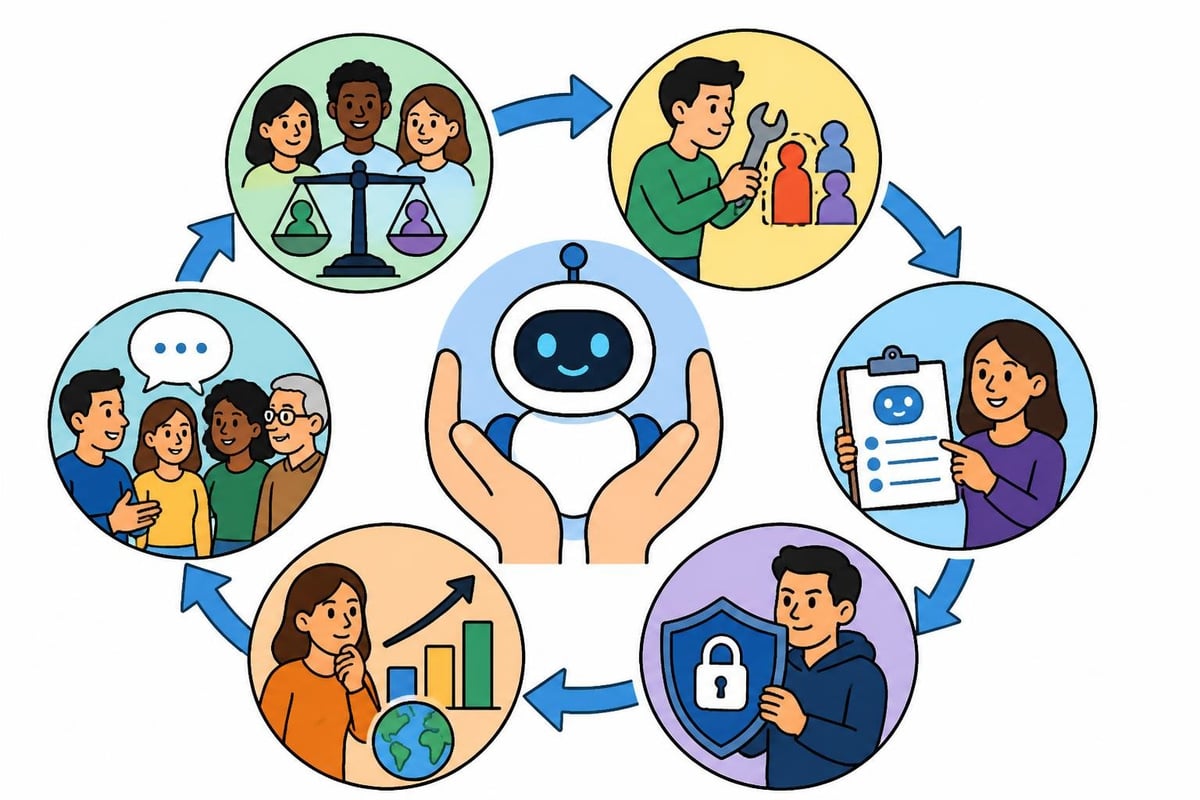
Technical capability without ethical grounding creates significant risks. Modern advanced AI courses integrate responsible development practices throughout the curriculum rather than treating ethics as an afterthought.
Alignment and Safety Engineering
The DeepMind post on securing the future of AI agents highlights industry perspectives on system-level safety, red-teaming exercises, and defense-in-depth approaches. Advanced training translates these concepts into practice through:
- Adversarial testing methodologies to identify model vulnerabilities
- Alignment techniques including constitutional AI and debate-based approaches
- Monitoring systems that detect distributional shift or unsafe outputs
- Human-in-the-loop architectures for high-stakes decisions
Governance and Policy Frameworks
AI regulation is evolving globally, with frameworks like the EU AI Act, the UNESCO Recommendation on the Ethics of Artificial Intelligence, and sector-specific guidelines creating compliance obligations. Professional-level education addresses:
- Regulatory landscape across major jurisdictions
- Documentation requirements for high-risk AI systems
- Bias auditing and fairness metrics appropriate to application domains
- Privacy-preserving techniques including differential privacy and secure computation
These competencies enable practitioners to navigate complex legal and ethical terrain while delivering business value.
Certification and Professional Recognition
Credentials signal expertise to employers and clients, but quality varies dramatically across providers. An advanced AI course that offers meaningful certification typically requires:
Hands-On Assessments: Portfolio projects, kaggle-style competitions, or capstone implementations that demonstrate applied skill rather than multiple-choice knowledge.
Industry Recognition: Partnerships with technology companies, professional associations, or academic institutions that validate curriculum rigor and relevance.
Continuous Updating: Regular content refresh cycles that keep pace with field evolution, ensuring certificates remain valuable over time.
MammothClub's approach through corporate certification programs emphasizes measurable skill development and portfolio building alongside formal credentials.
Practical Project Design and Portfolio Development
The transition from student to practitioner hinges on demonstrated ability to solve real problems. Superior advanced training incorporates substantial project work that mirrors professional challenges.
End-to-End System Implementation
Rather than isolated exercises, comprehensive projects require learners to:
- Formulate business problems as machine learning tasks
- Gather and preprocess realistic (often messy) datasets
- Select appropriate model architectures and training strategies
- Deploy systems with monitoring and maintenance plans
- Present results to non-technical stakeholders
Example projects might include building a retrieval-augmented QA system for enterprise documentation, fine-tuning a code generation model for a specific framework, or implementing a recommendation engine with A/B testing infrastructure.
Open Source Portfolio Building
GitHub repositories showcasing clean code, thorough documentation, and reproducible results serve as powerful career accelerators. Advanced courses guide learners in creating portfolio pieces that demonstrate:
- Software engineering discipline including testing, logging, and dependency management
- Communication skills through READMEs, tutorials, and blog posts explaining design decisions
- Domain expertise by tackling problems relevant to target industries or roles
These artifacts provide concrete evidence of capability that complements formal credentials.
Learning Format and Time Investment Considerations
The intensity and structure of an advanced AI course significantly impacts outcomes. Professionals must balance learning with existing responsibilities while maintaining the focus required for complex material.
Synchronous vs. Asynchronous Options
Live cohort-based programs offer real-time interaction with instructors and peers, creating accountability and enabling immediate clarification of difficult concepts. They typically require 10-20 hours per week over 12-16 weeks.
Self-paced courses provide flexibility for busy professionals but demand strong self-discipline. Interactive elements like auto-graded assignments, peer code review, and office hours help maintain engagement.
Hybrid models combine pre-recorded content with scheduled live sessions, offering flexibility while preserving community and expert access.
The optimal format depends on learning style, schedule constraints, and prior self-directed learning success.
Cost-Benefit Analysis
Advanced AI training represents a significant investment, with programs ranging from $500 for self-paced certificates to $15,000+ for university-affiliated bootcamps. Consider:
| Investment Factor | Evaluation Questions |
|---|---|
| Direct Cost | Does pricing include updates? Are payment plans available? |
| Time Commitment | Can I maintain the required pace given other obligations? |
| Opportunity Cost | What am I forgoing during the learning period? |
| Career Impact | How quickly will new skills translate to income growth? |
| Employer Support | Will my organization sponsor training or provide study time? |
Many professionals find that specialized AI skills generate 20-40% salary increases within 12-18 months, making rigorous training highly ROI-positive despite upfront costs.
Team Training and Enterprise Implementation
Individual upskilling differs fundamentally from organizational capability building. Enterprise adoption of advanced AI requires coordinated team development, shared infrastructure, and change management.
Corporate Training Programs
Organizations deploying AI at scale benefit from customized training that addresses their specific tech stack, data environments, and business priorities. Effective corporate programs include:
- Pre-assessment to identify skill gaps and group learners by proficiency
- Custom content incorporating company data sources, domain vocabulary, and existing tooling
- Team projects that solve actual business problems while building skills
- Executive briefings that help leadership understand capabilities and limitations
- Post-training support including office hours and implementation consulting
MammothClub's corporate certification programs demonstrate how platforms tailor advanced training to organizational needs while maintaining technical rigor.
Building Internal AI Communities
Sustainable organizational AI capability requires more than one-time training. Leading companies establish:
- Internal knowledge-sharing forums where practitioners discuss challenges and solutions
- Research paper reading groups that keep teams current with innovations
- Hackathons and innovation competitions that encourage experimentation
- Mentorship pairings between advanced practitioners and those earlier in their journey
These initiatives transform individual knowledge into organizational capability that persists beyond employee turnover.
Mastering advanced AI requires far more than consuming lectures. It demands hands-on implementation, research engagement, production deployment experience, and continuous learning as the field evolves. Whether you're an individual professional seeking to lead AI initiatives or an organization building competitive advantage through AI adoption, the right training program accelerates your journey from understanding concepts to delivering measurable business impact. MammothClub provides the comprehensive curriculum, hands-on labs, and certification pathways that transform AI knowledge into career-defining expertise, with interactive bootcamps and corporate programs designed to keep your skills sharp in this rapidly advancing field.