Artificial intelligence is rapidly reshaping the pharmaceutical landscape, driving a surge in demand for experts with specialized skills. If you are searching for the ultimate ai in drug discovery course, this guide is designed for you. Here, you will discover how AI accelerates drug development, the essential skills you need, what top courses offer, and which certifications matter most. Learn how to position yourself at the forefront of innovation, gain practical know-how, and unlock new career opportunities in 2026 and beyond.
The Rise of AI in Drug Discovery: Why Now?
For decades, the pharmaceutical industry grappled with a daunting innovation crisis. Developing a single new drug often required 10–15 years and an investment of more than $2.6 billion per compound, according to the Tufts Center for the Study of Drug Development. Despite these massive efforts, success rates remained low, with many candidates failing in late-stage trials. Anyone interested in an ai in drug discovery course must first understand these historic hurdles that have shaped the industry’s current transformation.
Traditional drug discovery faced several persistent bottlenecks. Identifying viable biological targets was slow and labor-intensive. Screening vast chemical libraries for promising compounds required enormous resources. Predicting how a drug would interact with the human body, or whether it might cause harmful side effects, often relied on time-consuming experiments. These inefficiencies made pharmaceutical innovation increasingly unsustainable, driving the urgent need for new approaches like those taught in an ai in drug discovery course.
Artificial intelligence has emerged as a powerful catalyst, addressing each of these challenges. AI models now accelerate target identification, automate compound screening, and employ predictive analytics for toxicity and efficacy. A landmark example is Exscientia’s DSP-1181, the first AI-designed molecule to reach human clinical trials in record time. The surge in AI adoption is reflected in the market’s rapid growth, with funding for AI-driven drug discovery exceeding $2 billion in 2023. In fact, AI in Drug Discovery Market Growth Statistics project the sector to reach over $35 billion by 2034. Regulatory bodies like the FDA are also embracing these innovations, releasing AI/ML Action Plans to guide safe and effective integration into drug development pipelines.
This unprecedented momentum highlights a critical need for professionals who can bridge AI technology and life sciences. As the demand for experts continues to soar, enrolling in an ai in drug discovery course offers a direct pathway to mastering the skills required for this evolving landscape. Those who step up to learn and lead will shape the medicines and therapies of tomorrow.
Key Data at a Glance
| Challenge | Traditional Approach | AI-Driven Solution |
|---|---|---|
| Timeline | 10–15 years | As little as 2–5 years |
| Cost per Drug | $2.6 billion | Projected 30–50% reduction |
| Success Rate | Low | Improving with AI models |
| Regulatory Support | Emerging | FDA/EMA AI guidelines |
Core Competencies for AI in Drug Discovery Courses
Mastering the ai in drug discovery course landscape requires a blend of scientific expertise, data fluency, and ethical awareness. As AI reshapes pharmaceutical research, these core competencies form the backbone of every leading curriculum. Whether you are a scientist, engineer, or data analyst, developing these skills will empower you to drive innovation in this fast-evolving domain.
Foundational Knowledge: Biology, Chemistry, and Data Science
A robust ai in drug discovery course begins with scientific fundamentals. Understanding molecular biology, genomics, and cheminformatics is essential, as these disciplines reveal how drugs interact with biological systems.
Key chemistry concepts, such as molecular structures, pharmacodynamics, and pharmacokinetics, are also critical. They help students predict how compounds behave in the body.
Data science underpins modern drug discovery. Skills in statistics, data wrangling, and visualization are vital for analyzing complex biomedical datasets. For instance, using genomic data to pinpoint druggable targets is a common real-world application.
| Knowledge Area | Key Topics | Application Example |
|---|---|---|
| Biology | Genomics, molecular pathways | Target identification |
| Chemistry | Molecular structures, ADMET | Compound screening |
| Data Science | Statistics, visualization, data mining | Predictive analytics in drug research |
For those seeking to build a strong foundation, exploring AI and Machine Learning Courses can provide a structured starting point and practical tools for this field.
AI & Machine Learning Fundamentals
The heart of any ai in drug discovery course is proficiency in AI, machine learning, and deep learning. Students must grasp core algorithms, including supervised and unsupervised learning, as well as reinforcement learning, all of which are commonly used for drug discovery challenges.
Understanding model evaluation is equally important. Techniques like cross-validation and ROC-AUC help ensure that predictive models for adverse drug reactions or efficacy are reliable and unbiased. For example, building a classifier to predict off-target effects can save time and resources in preclinical studies.
Familiarity with tools such as Python, TensorFlow, and Scikit-learn is expected. These platforms enable rapid prototyping and deployment of machine learning solutions within pharmaceutical pipelines.
Data Sources, Integration, and Preprocessing
A successful ai in drug discovery course emphasizes practical skills in managing diverse datasets. Students encounter genomic, chemical, clinical trial, and real-world evidence data, each with unique challenges.
Integrating heterogeneous data often involves addressing missing values and normalization issues. Preprocessing steps like feature selection and dimensionality reduction are critical for building robust models. For instance, integrating public resources such as ChEMBL and PubChem can enhance compound screening workflows.
Hands-on exercises may include preprocessing a real-world dataset, highlighting the importance of data quality and reproducibility in AI-driven research.
Ethical, Regulatory, and Security Considerations
Any ai in drug discovery course must address the ethical and regulatory landscape. Students need to understand data privacy requirements, such as HIPAA and GDPR, to ensure responsible handling of sensitive health data.
Familiarity with regulatory guidelines from agencies like the FDA and EMA is vital, as these bodies increasingly support AI-driven approaches. Security best practices are also emphasized, safeguarding patient and proprietary data throughout the drug development process.
Courses often include modules on ethical AI use, ensuring that future professionals can navigate both innovation and compliance with confidence.
Key Modules and Curriculum Structure of Leading Courses
The ai in drug discovery course curriculum is designed to equip learners with both foundational theory and hands-on experience. Courses are structured into core modules, each focusing on a specific aspect of the drug discovery pipeline. This modular approach allows learners to build expertise step by step, ensuring comprehensive coverage of both science and technology.
Module 1: Introduction to Drug Discovery and AI
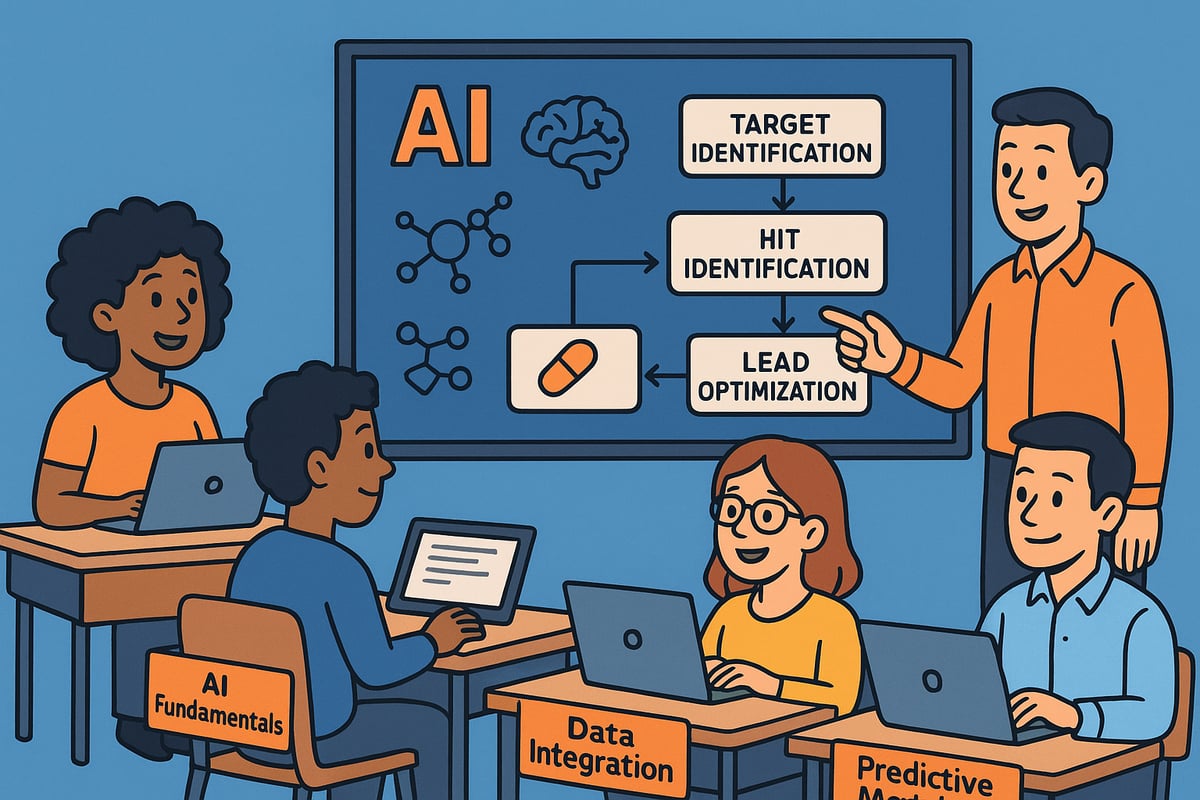
This module of any ai in drug discovery course sets the stage with a deep dive into the drug discovery pipeline. Learners explore the journey from target identification to clinical trials, understanding where AI can make the biggest impact. For example, AI accelerates hit discovery by analyzing massive datasets rapidly.
A typical lesson contrasts traditional vs AI-driven approaches, highlighting efficiency gains. Assignments might include mapping the pipeline and identifying points for AI intervention. This foundation ensures students appreciate the context before advancing to technical skills.
Module 2: Data Acquisition, Integration, and Preprocessing
In the ai in drug discovery course, this module focuses on sourcing and preparing data for analysis. Students learn to handle omics data, chemical libraries, and clinical datasets. Data cleaning and harmonization are tackled through hands-on exercises.
Challenges such as missing values, heterogeneity, and ethical considerations are addressed. For instance, a project may require preprocessing a real-world dataset, teaching normalization and bias mitigation. Mastering these skills is critical for reliable AI modeling.
Module 3: Machine Learning and Deep Learning Techniques
A strong ai in drug discovery course emphasizes machine learning and deep learning fundamentals. This module introduces supervised and unsupervised learning, along with neural networks tailored to biomedical data.
Practical exercises use libraries like TensorFlow, PyTorch, and Scikit-learn to build classification and clustering models. Students may analyze molecular graphs or predict compound activity. Emphasis is placed on model evaluation, ensuring robust and generalizable results.
Module 4: Predictive Modeling and Simulation in Drug Discovery
Predictive modeling is at the heart of the ai in drug discovery course. This module covers building models for drug-target interactions, toxicity, and pharmacokinetics. Learners apply cross-validation and external validation to assess performance.
Assignments might include developing a predictive model in a Jupyter Notebook or simulating compound behavior. Real-world case studies, such as pharmacokinetics prediction, illustrate the practical utility of these techniques in modern pharmaceutical research.
Module 5: AI-Driven Drug Design and Optimization
This module teaches how an ai in drug discovery course leverages computational chemistry and virtual screening. Students explore both structure-based and ligand-based design, using tools like RDKit and Open Babel.
Hands-on exercises include molecular docking simulations and AI-driven molecule optimization. For example, learners may design candidate molecules for emerging diseases, applying the latest AI techniques for rapid iteration and improved efficacy.
Module 6: High-Throughput Screening and Automation
The ai in drug discovery course also delves into high-throughput screening (HTS) and laboratory automation. Here, AI models streamline compound screening, integrating with robotics and laboratory information management systems.
Projects may demonstrate how AI reduces screening times and improves hit identification. Students gain experience with real-world automation workflows, preparing them for roles in both research and industry settings.
Module 7: Drug Repurposing and Innovation
Innovation is a hallmark of every ai in drug discovery course. This final module explores how AI identifies new uses for existing drugs, a strategy that saves time and resources. Learners review case studies, such as drug repurposing successes during the COVID-19 pandemic.
Assignments challenge students to apply AI models to repurposing scenarios, reinforcing skills in hypothesis generation and data integration. For those seeking a structured path to mastering these modules, the Artificial Intelligence Course Guide offers further insights into curriculum design and course selection.
Top Platforms, Certifications, and Learning Formats for 2026
Advancing your expertise through an ai in drug discovery course is more accessible than ever, thanks to a wide range of platforms and flexible learning formats. In 2026, professionals and students can select from MOOCs, specialized academies, and adaptive platforms designed to meet evolving industry needs.
Leading Online Learning Platforms for AI in Drug Discovery
Choosing the right ai in drug discovery course means evaluating platforms that deliver both foundational knowledge and hands-on experience. Major MOOC providers like Coursera, Udemy, edX, and FutureLearn offer courses featuring on-demand video, interactive assignments, and peer forums.
Specialized platforms such as Bioinformatics.org and AI for Healthcare Academy focus on bioinformatics, data science, and AI applications in pharma. For example, Udemy’s “Accelerated Drug Discovery Using AI” provides concise video content, articles, and assignments tailored to real-world drug discovery challenges.
| Platform | Key Features | Focus Area |
|---|---|---|
| Coursera | University partners, peer review, certificates | General, advanced |
| Udemy | Short courses, practical projects | Applied skills |
| edX | University-level, self-paced | Academic depth |
| Bioinformatics.org | Community-driven, niche topics | Life sciences, AI |
Certification Pathways and Industry Recognition
Earning a recognized certification through an ai in drug discovery course can significantly boost your career prospects in pharma and biotech. Certifications validate your skills and demonstrate commitment to employers seeking advanced talent.
Options include platform certificates, university-issued credentials, and industry-recognized badges. Notably, the Certified AI in Drug Discovery Professional (CAIDDP) program equips learners to design and manage AI tools for candidate identification, screening, and optimization.
Employers increasingly value credentials that align with real-world job requirements. Choosing a course with a respected certification can be a decisive factor for advancement.
Learning Formats: Self-Paced, Bootcamps, and Corporate Training
Selecting the optimal learning format for your ai in drug discovery course depends on your schedule, goals, and preferred learning style. Self-paced courses allow flexibility and can be ideal for working professionals, while instructor-led bootcamps offer structure and live interaction.
Interactive formats often feature live projects, code reviews, and vibrant community support. Corporate training solutions enable entire pharma teams to upskill efficiently, with companies frequently offering group licenses for organizational learning.
Key comparisons:
- Self-paced: Flexible, affordable, fits any schedule
- Bootcamps: Intense, live feedback, deadlines for accountability
- Corporate training: Scalable, team-focused, measurable outcomes
Mammoth Club: AI Learning for Drug Discovery Professionals
For those seeking a comprehensive ai in drug discovery course experience, Mammoth Club stands out. This global platform offers over 3,000 courses spanning AI, data science, and bioinformatics, tailored to the needs of drug discovery professionals.
Mammoth Club features adaptive AI-powered lessons, certification prep, and premium resources. Individuals benefit from career advancement tools, while pharma organizations can scale training across teams with measurable results. Whether you are advancing your own career or upskilling your workforce, Mammoth Club delivers a future-proof solution.
Hands-On Skills, Tools, and Real-World Projects
Mastering hands-on skills is the cornerstone of any successful ai in drug discovery course. While theory provides foundational knowledge, practical experience with industry-standard tools and real-world datasets is what distinguishes top professionals in this field. A well-designed curriculum integrates technical proficiency, teamwork, and exposure to authentic biomedical challenges.
Essential Software and Programming Languages
Every ai in drug discovery course emphasizes proficiency in Python and R, as these languages are central to data analysis, machine learning, and cheminformatics. Python, with libraries like Scikit-learn, TensorFlow, and PyTorch, enables rapid prototyping of predictive models. RDKit and Open Babel are indispensable for molecular manipulation and chemical informatics.
Jupyter Notebooks facilitate reproducible research and clear documentation, making it easier to share insights with peers. Students also learn to integrate public databases and use command-line tools for large-scale data processing. For those seeking to expand their toolkit, exploring Best Courses in AI can help identify additional technical skills aligned with pharmaceutical innovation.
Practical Assignments and Capstone Projects
An ai in drug discovery course stands out when it offers real-world, project-based learning. Assignments typically include data preprocessing, feature engineering, and building machine learning models for tasks like toxicity prediction or compound screening. Students may participate in molecular docking simulations, virtual screening exercises, or even design end-to-end workflows from raw data to candidate drug identification.
Capstone projects often require integrating multiple concepts, such as combining genomic and chemical data to identify novel drug targets. These hands-on experiences mirror the challenges faced by professionals, ensuring graduates are job-ready. For those looking to map their learning journey, the AI/ML Learning Path provides guidance on structuring practical milestones effectively.
Collaboration and Peer Learning
Collaboration is a vital element of every ai in drug discovery course. Students are encouraged to work together on group projects, participate in code reviews, and engage in discussion forums. These activities foster problem-solving, critical thinking, and the ability to communicate complex findings clearly.
Building a network with peers and instructors opens doors to future collaborations and career opportunities. Capstone presentations and peer feedback sessions simulate real-world scientific communication, helping learners refine both technical and soft skills. Regular interaction ensures continuous improvement and a supportive learning environment.
Access to Real-World Datasets and Case Studies
Authentic data is at the heart of any effective ai in drug discovery course. Students routinely access public resources such as ChEMBL, PubChem, and DrugBank, working with genomic, chemical, and clinical datasets. By analyzing published case studies—like AI applications in rare disease drug discovery—they gain perspective on translating algorithms into impactful solutions.
Integration of academic and industry datasets teaches students to navigate data heterogeneity, address missing values, and apply normalization techniques. Exposure to real-world scenarios prepares learners to handle the complexity and variability inherent in pharmaceutical research.
Assessment, Feedback, and Certification
Comprehensive assessment is integral to a high-quality ai in drug discovery course. Learners are evaluated through quizzes, coding assignments, and project submissions. Both automated and instructor-led feedback help clarify concepts and correct misconceptions promptly.
Certification, often in the form of digital badges, allows graduates to showcase their achievements on professional platforms like LinkedIn. Rigorous assessment standards ensure that credentials reflect genuine expertise, supporting career advancement and recognition within the field.
Career Pathways and Future Trends in AI-Driven Drug Discovery
The landscape for professionals with expertise from an ai in drug discovery course is rapidly evolving. As AI transforms pharmaceutical R&D, new roles are emerging, requiring a blend of scientific, computational, and regulatory skills. Staying informed about future trends is essential for anyone planning a long-term career in this field.
In-Demand Roles and Career Trajectories
Graduates of an ai in drug discovery course are entering a job market filled with opportunity. Top roles include AI drug discovery scientist, computational chemist, bioinformatics analyst, and machine learning engineer in pharma.
Employers seek candidates with advanced degrees in life sciences, computer science, or engineering, combined with practical AI skills. According to AI in Drug Development Statistics 2026, demand for these roles is rising, with average salaries reflecting strong market value.
- AI drug discovery scientist
- Computational chemist
- Bioinformatics analyst
- Machine learning engineer
Job growth is projected to accelerate as more organizations adopt AI-driven strategies in drug development.
Emerging Technologies and Innovations
An ai in drug discovery course prepares professionals to work with cutting-edge technologies. Multi-modal AI, which integrates genomics, medical imaging, and electronic health records, is revolutionizing data analysis. Generative AI models now design novel molecules with optimized properties, speeding up lead optimization.
Cloud-based AI platforms enable global collaboration, allowing teams to share data and models securely. AI agents are being used to automate hypothesis generation, further accelerating the discovery process. For a broader perspective on technology adoption, the AI in Drug Discovery Market Report 2025-2034 provides detailed market trends and forecasts.
Challenges and Opportunities
While an ai in drug discovery course equips learners with valuable skills, challenges remain. Data bias and model interpretability can impact reliability and acceptance. Ensuring reproducibility is crucial, especially when regulatory agencies scrutinize AI-driven results.
Regulatory approval for AI-generated drug candidates requires robust validation and clear documentation. However, these challenges open doors for innovation, entrepreneurship, and the development of new standards in the industry.
- Addressing data bias and fairness
- Improving model transparency
- Navigating regulatory requirements
- Opportunities for startups in AI pharma
Building a Future-Proof Skillset
Continuous learning is at the heart of any ai in drug discovery course. Professionals must stay current with evolving AI tools, programming languages, and scientific breakthroughs. Engaging with professional communities, attending conferences, and reading journals are vital steps for career growth.
Building a strong network accelerates learning and exposes you to new ideas. Many top courses offer community forums, peer feedback, and project-based learning, ensuring that skills remain relevant and adaptable.
Predictions for 2026 and Beyond
By 2026, AI is expected to halve the costs and timelines of traditional drug discovery. Personalized medicine, powered by AI-driven insights, will become increasingly common. The ai in drug discovery course will play a pivotal role in preparing professionals to lead these advancements.
The roles of AI specialists will continue to evolve, with a growing emphasis on interdisciplinary collaboration and ethical AI practices. As the field advances, those who prioritize lifelong learning will shape the future of healthcare and pharmaceuticals.
As you’ve seen, mastering AI in drug discovery requires the right blend of technical knowledge, hands-on practice, and access to up-to-date resources. Whether you’re aiming to innovate in pharma or accelerate your own career, ongoing learning is key. Imagine having access to thousands of AI courses, interactive projects, and industry-recognized certifications—all designed to help you stay ahead in this rapidly evolving field. If you’re ready to take the next step and build a future-proof skillset, you can get 3000 AI coures for just 50 cents a day!