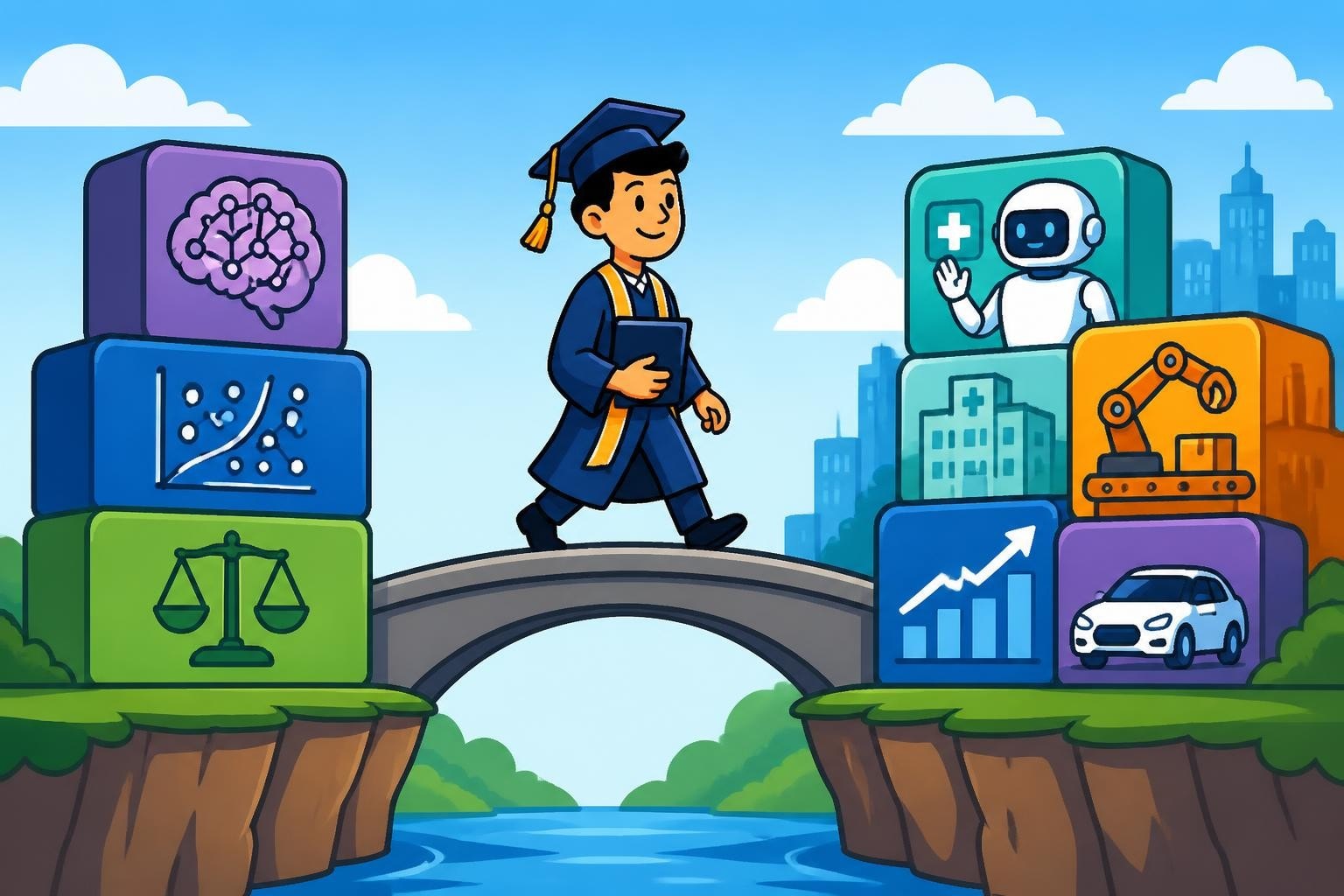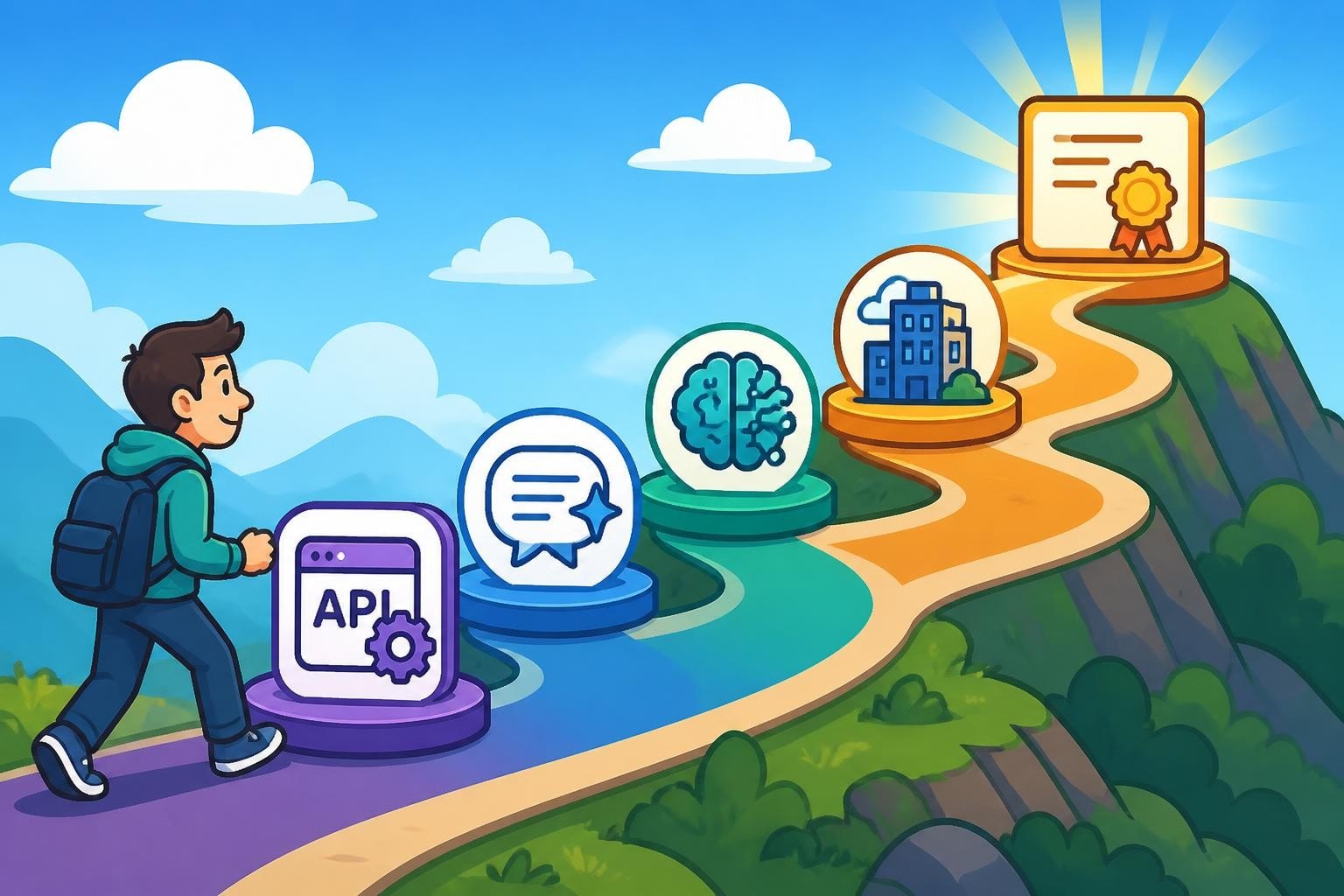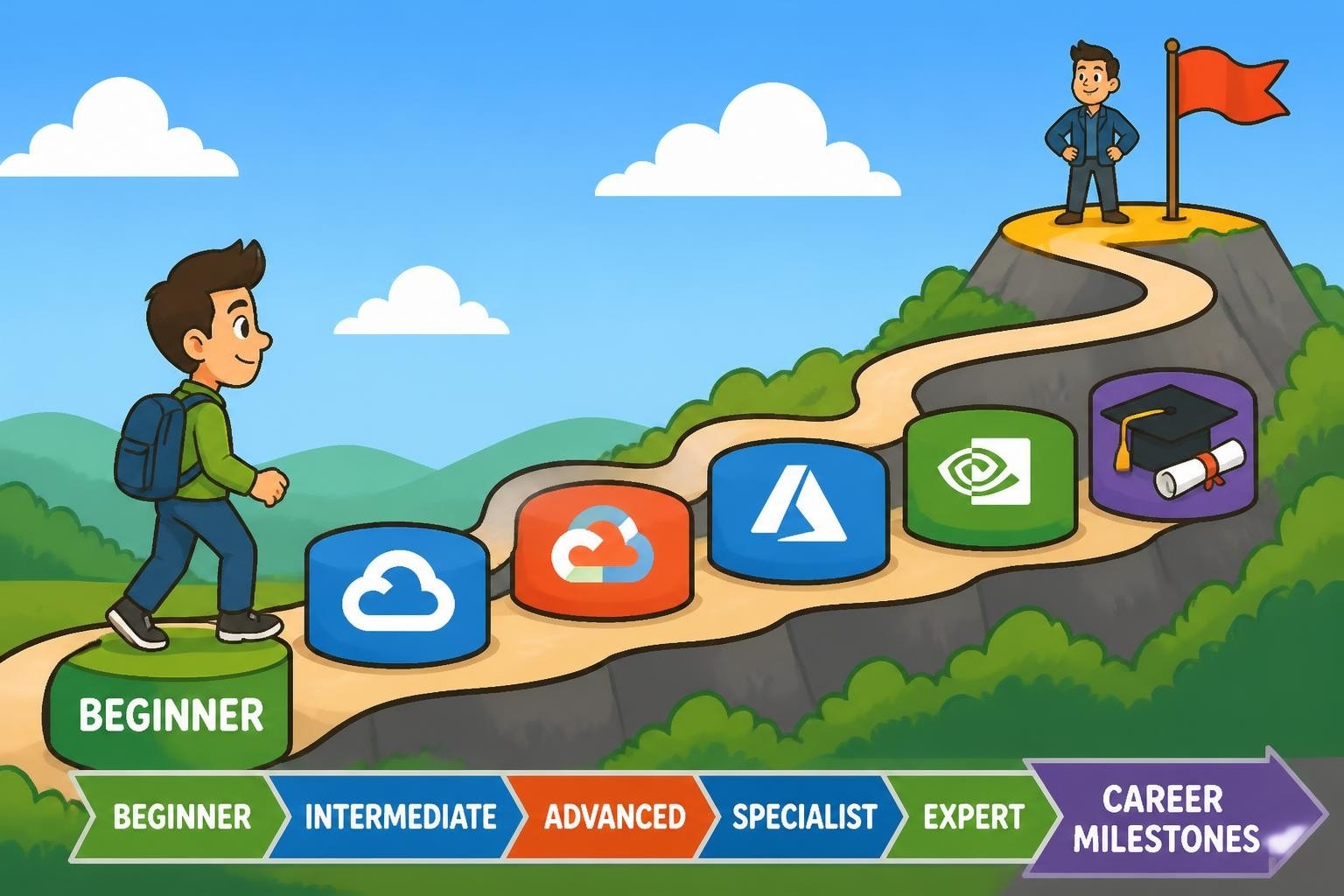
India's top engineering institutes have revolutionized access to world-class artificial intelligence education through comprehensive online programs. IIT artificial intelligence course online offerings now span from short certifications to full postgraduate programs, making elite AI training accessible to working professionals worldwide. These programs combine rigorous academic frameworks with practical, industry-relevant applications-bridging the gap between theoretical foundations and real-world implementation. For professionals seeking to build competitive AI skills without leaving their careers, understanding which IIT programs deliver the strongest return on investment is essential.
Understanding IIT Online AI Course Landscape
The Indian Institutes of Technology have deployed multiple pathways for online AI learning, each designed for different career stages and learning objectives. Unlike commercial training platforms, IIT programs maintain the same faculty expertise and curriculum rigor as their on-campus counterparts while adapting delivery for remote learners.
Program Types and Delivery Models
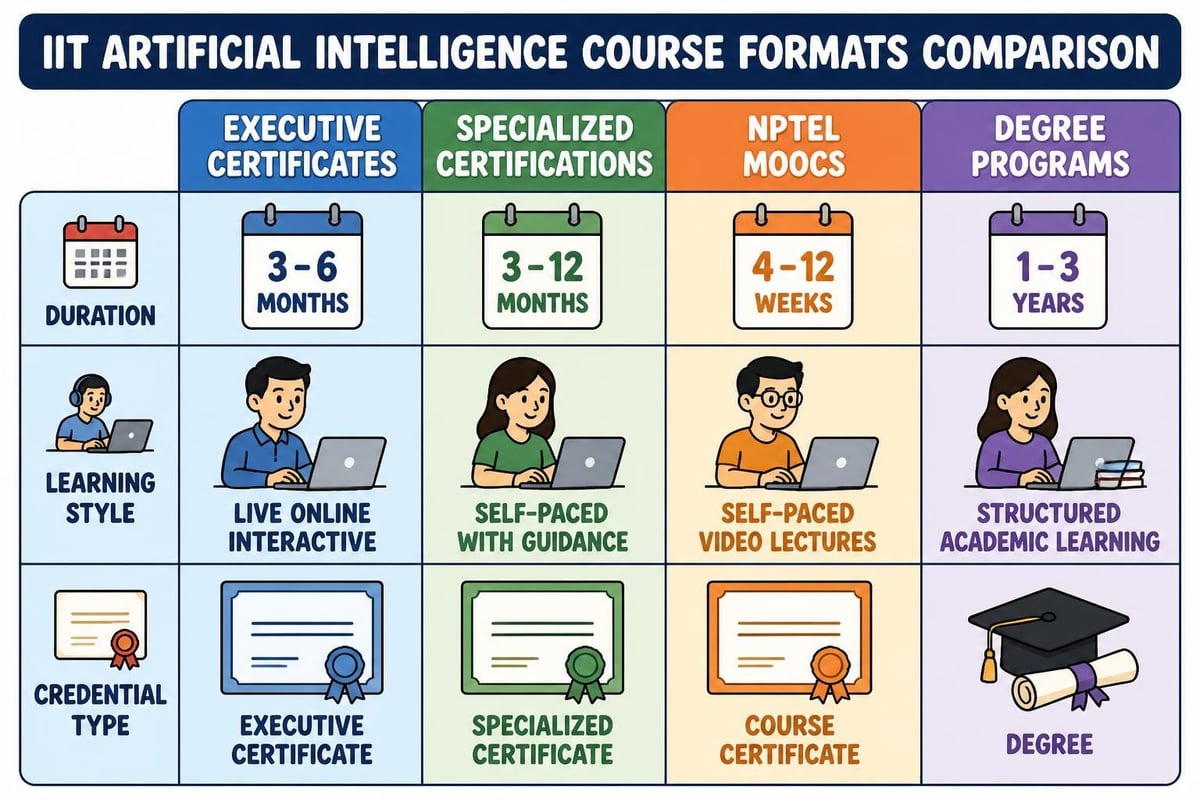
IIT online AI courses fall into four primary categories:
- Executive postgraduate certificates targeting mid-career professionals (6-12 months)
- Specialized certifications focusing on specific AI tools and frameworks (3-6 months)
- NPTEL MOOCs offering free, self-paced foundational courses (12 weeks)
- Degree-equivalent programs providing comprehensive graduate-level training (12-24 months)
The Executive Postgraduate Certificate (EPGC) in Applied AI & Machine Learning from IIT Kharagpur exemplifies the executive certificate model, combining live online sessions with asynchronous learning modules and hands-on projects.
What Distinguishes IIT AI Programs
IIT artificial intelligence course online programs deliver three distinct advantages over commercial alternatives:
Academic Rigor: Faculty from IIT's dedicated AI departments design curricula grounded in fundamental computer science and mathematics. The Department of Artificial Intelligence at IIT Kharagpur demonstrates the research depth behind these programs, with faculty actively publishing in top-tier AI conferences.
Credential Recognition: IIT certifications carry significant weight with Indian employers and increasingly with international organizations seeking proof of rigorous technical training. This recognition stems from decades of IIT graduates demonstrating exceptional technical capabilities.
Industry Collaboration: Programs incorporate case studies and projects from partner organizations, ensuring curriculum remains current with industry practices rather than lagging behind technological change.
Core Curriculum Components Across IIT AI Programs
Regardless of program length or specialization, IIT artificial intelligence course online offerings share foundational curriculum elements that distinguish them from bootcamp-style training.
Mathematical and Statistical Foundations
Strong IIT programs dedicate 25-30% of coursework to mathematical prerequisites:
| Topic Area | Key Concepts | Application in AI |
|---|---|---|
| Linear Algebra | Matrix operations, eigenvalues, vector spaces | Neural network computations, dimensionality reduction |
| Probability & Statistics | Distributions, hypothesis testing, Bayesian inference | Uncertainty modeling, probabilistic reasoning |
| Calculus & Optimization | Gradient descent, convex optimization | Model training, hyperparameter tuning |
| Information Theory | Entropy, cross-entropy, KL divergence | Loss functions, model evaluation |
This mathematical grounding enables professionals to understand why certain algorithms perform better in specific contexts-knowledge that separates practitioners who can optimize models from those who simply run pre-built scripts.
Machine Learning Fundamentals
The machine learning core typically spans supervised, unsupervised, and reinforcement learning paradigms. Programs emphasize algorithm selection based on problem characteristics rather than treating ML as a black box.
- Supervised Learning: Regression, classification, ensemble methods, regularization techniques
- Unsupervised Learning: Clustering, dimensionality reduction, anomaly detection
- Deep Learning: Neural architectures, CNNs, RNNs, transformers, attention mechanisms
- Reinforcement Learning: Markov decision processes, Q-learning, policy gradients
Practical Implementation Skills
IIT courses balance theory with hands-on programming, typically using Python ecosystems. The IIT Kanpur certification program on Python for AI/ML/DL showcases this approach, dedicating significant lab time to frameworks like TensorFlow, PyTorch, and scikit-learn.
For professionals expanding their AI expertise, exploring comprehensive AI and ML courses beyond single institutions provides broader perspective on different teaching methodologies and specialization areas.
NPTEL and National Platform Integration
The National Programme on Technology Enhanced Learning represents India's largest initiative for democratizing IIT-quality education. Understanding NPTEL's role within the IIT artificial intelligence course online ecosystem reveals how professionals can access foundational training at no cost.
NPTEL Course Structure and Recognition
NPTEL courses feature IIT faculty delivering 12-week programs with weekly video lectures, assignments, and proctored exams. An Introduction to Artificial Intelligence from IIT Madras demonstrates the standard NPTEL format: structured curriculum, regular assessments, and optional paid certification.
Key characteristics include:
- Free access to all video content and reading materials
- Weekly assignments with automated grading
- Optional proctored exam for paid certification (₹1,000-1,500)
- Certificates co-branded with the teaching IIT
- Credit recognition by many universities and employers
The NPTEL+ self-paced offering expands this model by removing fixed schedules, allowing professionals to complete courses at their own pace while maintaining the same content quality.
SWAYAM Plus and Government AI Initiatives
IIT Madras leads the SWAYAM Plus platform, which recently launched "AI for All" courses targeting one million learners. This national initiative aims to build baseline AI literacy across India's workforce, complementing advanced IIT artificial intelligence course online programs.
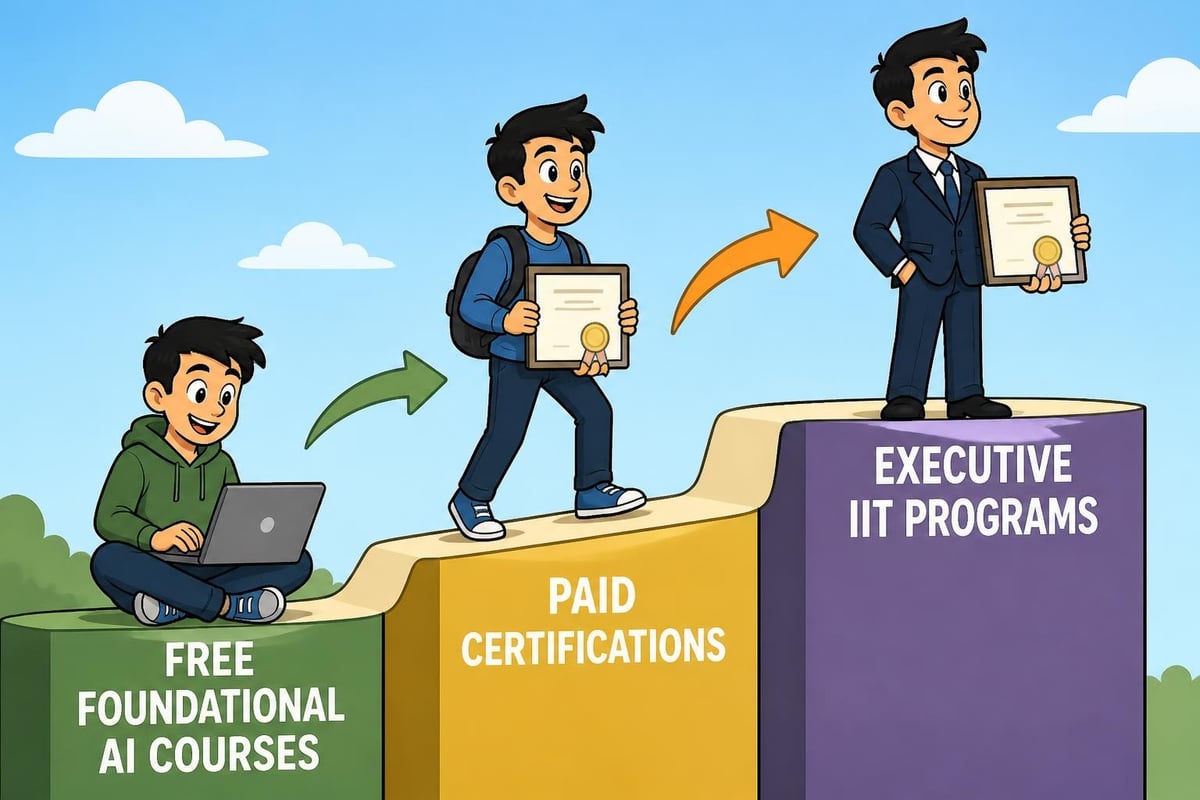
SWAYAM Plus courses serve as effective prerequisites for professionals considering advanced certifications, providing foundational knowledge before committing to intensive paid programs.
Comparing IIT Programs to Global Platforms
While IIT artificial intelligence course online programs offer unique value, understanding how they compare to international offerings helps professionals make informed decisions.
IIT vs. International University MOOCs
IITs increasingly collaborate with global platforms, as demonstrated in this edX case study featuring IIT Bombay. However, their independently-hosted programs maintain distinct characteristics:
| Dimension | IIT Programs | Global MOOCs (Coursera, edX) | Commercial Platforms |
|---|---|---|---|
| Curriculum Depth | Strong theoretical foundations | Variable; often survey-level | Practice-focused, less theory |
| Industry Recognition (India) | Very high | Moderate to high | Moderate |
| Cost | ₹50,000-250,000 | $50-500 per course | $200-3,000 |
| Faculty Interaction | Moderate (TA support) | Low (peer-graded) | Variable |
| Job Placement Support | Limited | None | Often included |
When IIT Programs Make Sense
IIT artificial intelligence course online programs deliver strongest value for:
Indian professionals seeking credentials recognized by local employers and government organizations. The IIT brand carries exceptional weight in the Indian tech ecosystem, often opening doors that international certifications cannot.
Early-to-mid career engineers with strong quantitative backgrounds who want rigorous technical depth rather than surface-level tool training. IIT programs assume mathematical comfort and reward those willing to engage with complex theoretical concepts.
Organizations building in-house AI capabilities who need employees with standardized, verified knowledge. Corporate training programs increasingly partner with IITs for cohort-based learning that ensures consistent skill development across teams.
For professionals seeking broader catalogs or different pedagogical approaches, platforms like MammothClub's corporate certification programs offer complementary pathways with more diverse instructor perspectives and specialized applications.
Career Outcomes and Skill Applications
Understanding how IIT artificial intelligence course online credentials translate to career advancement helps professionals evaluate return on investment.
Job Roles and Salary Impact
Graduates from IIT AI programs typically pursue these career paths:
- Machine Learning Engineer: Building and deploying production ML systems (₹8-20L for 0-3 years experience)
- Data Scientist: Statistical modeling and business analytics (₹7-18L for 0-3 years)
- AI Research Engineer: Developing novel algorithms and architectures (₹10-25L for 0-3 years)
- Computer Vision Engineer: Image and video analysis applications (₹9-22L for 0-3 years)
- NLP Specialist: Language understanding and generation systems (₹8-20L for 0-3 years)
Salary premiums for IIT credentials vary by company type. Service companies (TCS, Infosys, Wipro) typically offer 15-25% premiums for IIT certifications, while startups weight practical portfolio projects more heavily than institutional credentials.
Building Complementary Skills
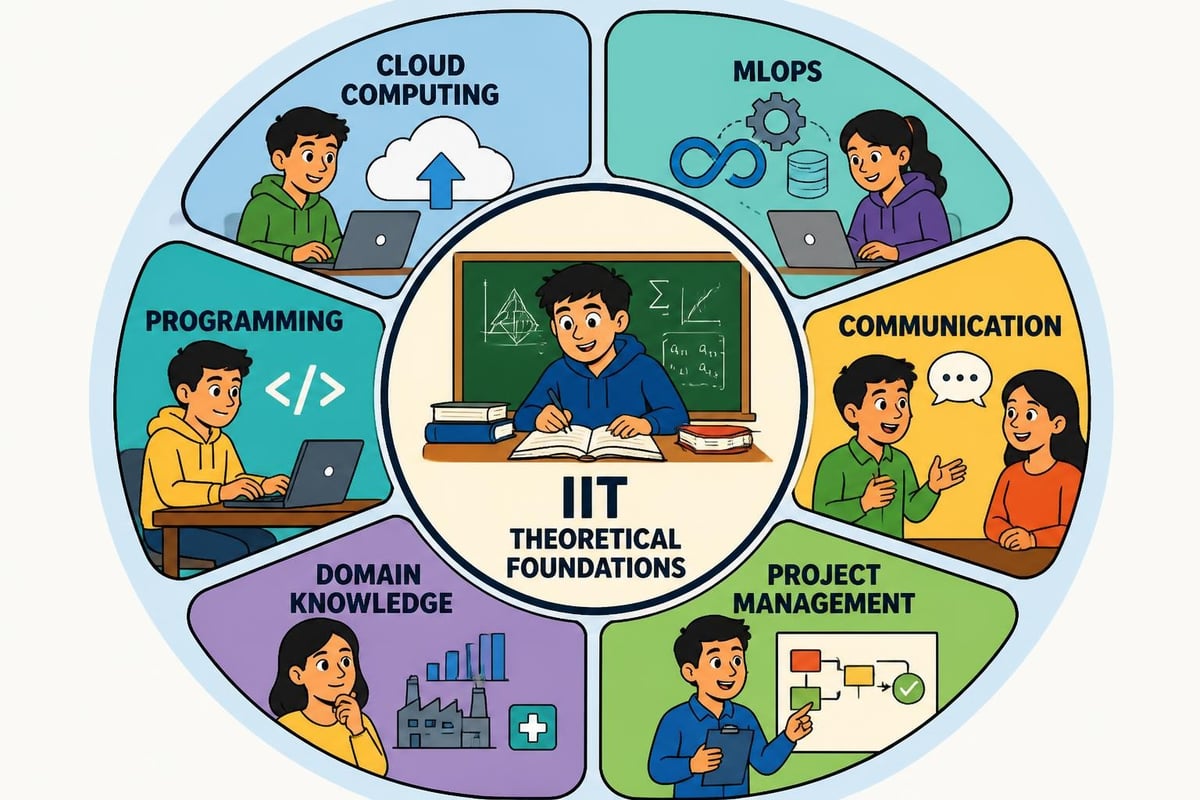
IIT programs provide strong technical foundations but require supplementation for comprehensive career readiness:
- Cloud platforms: AWS, Azure, or GCP certification for deployment skills
- MLOps: Model versioning, monitoring, and production pipelines
- Domain expertise: Healthcare, finance, or retail-specific AI applications
- Communication: Translating technical concepts for non-technical stakeholders
Professionals can enhance their IIT foundations through applied AI course work that emphasizes real-world implementation challenges and business context.
Program Selection Framework
Choosing the right IIT artificial intelligence course online program requires matching program characteristics to individual circumstances and goals.
Assessing Your Prerequisites
Mathematical readiness determines program fit more than programming experience. Ask yourself:
- Can I comfortably work with matrices and derivatives?
- Do I understand probability distributions and statistical inference?
- Have I completed calculus through multivariable integration?
If these areas feel unfamiliar, starting with NPTEL foundational courses or mathematics refreshers prevents frustration in advanced programs.
Time availability significantly impacts completion rates. Executive programs expect 10-15 hours weekly, while self-paced courses allow flexibility at the cost of reduced structure and peer interaction.
Evaluating Program Quality Indicators
Not all IIT artificial intelligence course online programs maintain equal rigor or outcomes. Evaluate:
| Quality Factor | What to Look For | Red Flags |
|---|---|---|
| Faculty Credentials | Active researchers with recent publications | Industry practitioners without academic background |
| Curriculum Updates | References to 2024-2026 research and tools | Content unchanged for 3+ years |
| Assessment Rigor | Proctored exams, project defenses | Only multiple-choice quizzes |
| Capstone Projects | Real datasets, open-ended problems | Pre-packaged toy datasets |
| Alumni Network | Active LinkedIn groups, placement stats | No verifiable graduate outcomes |
Cost transparency matters. Legitimate programs clearly state total fees upfront. Be wary of programs with hidden costs for exams, certificates, or "optional" resources that prove essential.
Balancing Theory and Practice
The optimal IIT program depends on your current skill level and career stage:
- For beginners: Start with NPTEL fundamentals, then progress to specialized certifications
- For experienced developers: Executive certificates with capstone projects matching your domain
- For researchers: Programs emphasizing recent papers and novel architectures
- For managers: High-level overviews focusing on strategy and team leadership
Implementation Strategies for Working Professionals
Successfully completing an IIT artificial intelligence course online while maintaining full-time employment requires deliberate planning and habit formation.
Time Management Approaches
Block scheduling works better than daily study sessions for technical material. Reserve 3-4 hour blocks on weekends for deep focus on complex topics like backpropagation mathematics or reinforcement learning algorithms.
Create progressive deadlines that fall before official due dates:
- Personal deadline: 3 days before assignment due
- Buffer deadline: 1 day before assignment due
- Official deadline: Actual submission date
This approach accommodates unexpected work demands without derailing your progress.
Maximizing Learning Retention
Active recall dramatically improves retention over passive video watching. After each lecture:
- Close your notes and write down everything you remember
- Identify gaps and review those specific sections
- Implement concepts in code without referring to examples
- Explain the concept to someone unfamiliar with AI
Spaced repetition for mathematical concepts prevents the common experience of understanding during lectures but forgetting during exams. Review key formulas and derivations at 1 day, 3 days, 1 week, and 1 month intervals.
Building a Portfolio Alongside Coursework
Transform course assignments into portfolio pieces:
- Document your process: Write blog posts explaining your approach to course projects
- Extend requirements: Add features or analyses beyond minimum specifications
- Deploy publicly: Host projects on GitHub with clear READMEs and documentation
- Create visualizations: Make your results accessible to non-technical audiences
This portfolio becomes more valuable than the certificate itself for many employers, demonstrating applied capability rather than just completion.
Future Trends in IIT Online AI Education
The landscape of IIT artificial intelligence course online offerings continues evolving rapidly in response to technological advances and market demands.
Emerging Specializations
IIT programs increasingly offer focused tracks beyond general AI:
- Generative AI and LLMs: Fine-tuning, prompt engineering, retrieval-augmented generation
- Edge AI: Model compression, quantization, on-device deployment
- Explainable AI: Interpretability methods, regulatory compliance, fairness
- Multi-modal Learning: Vision-language models, cross-modal reasoning
These specializations reflect industry demand for practitioners who understand not just foundational concepts but also cutting-edge applications.
Integration with Industry Certifications
Forward-thinking IIT programs now map curriculum to industry certifications, allowing graduates to pursue complementary credentials like:
- Cloud provider AI certifications: AWS Machine Learning Specialty, Google Professional ML Engineer
- Framework-specific credentials: TensorFlow Developer Certificate, PyTorch certification
- Specialized tools: MLflow, Kubeflow, Ray for production ML systems
This integration acknowledges that professionals need both academic rigor and vendor-recognized skills for maximum career mobility.
Adaptive Learning Technologies
Newer IIT artificial intelligence course online programs incorporate AI-driven personalization:
- Adaptive assessments that adjust difficulty based on performance
- Automated code review with detailed feedback on programming assignments
- Personalized content recommendations based on learning patterns
- Intelligent tutoring systems for mathematics and programming support
These technologies reduce dropout rates by providing support tailored to individual learning needs.
Cost-Benefit Analysis for Corporate Training
Organizations increasingly invest in IIT AI programs for employee upskilling, but ROI requires careful evaluation.
Direct and Indirect Costs
Program fees range from ₹50,000 for short certifications to ₹2.5 lakhs for comprehensive executive programs. However, total cost of ownership includes:
- Employee time (10-15 hours weekly × program duration)
- Reduced productivity during intensive study periods
- Infrastructure costs (computing resources for practice)
- Management overhead for cohort coordination
Measurable Returns
Organizations typically see returns through:
| Metric | Typical Impact | Measurement Method |
|---|---|---|
| Reduced consulting spend | 20-40% decrease | Compare pre/post training external costs |
| Faster project completion | 15-30% improvement | Track project velocity metrics |
| Innovation pipeline | 2-3× increase in AI proposals | Count submitted innovation ideas |
| Retention improvement | 10-20% higher retention | Survey training participants |
Skills gap closure represents the most significant but hardest-to-quantify benefit. Teams with IIT-trained members can tackle more sophisticated projects internally rather than outsourcing.
Optimal Cohort Strategies
Sending individual employees yields lower ROI than cohort-based approaches:
- Create internal study groups (4-6 employees) for peer support
- Stagger enrollments so teams always have recent graduates
- Assign capstone projects aligned with business problems
- Establish knowledge sharing through brown bags and internal wiki
IIT artificial intelligence course online programs provide rigorous, academically-grounded pathways for professionals seeking to build competitive AI capabilities. Whether you choose NPTEL fundamentals, specialized certifications, or comprehensive executive programs, success requires matching program depth to your mathematical background, career goals, and time availability. If you're looking for a broader catalog with 3,000+ AI and tech courses, interactive bootcamps, and AI-powered learning dashboards that complement IIT's academic rigor with diverse practical applications, explore how MammothClub helps professionals and organizations upskill fast with measurable, results-driven training.