Artificial intelligence and machine learning are reshaping the world, driving innovation across every industry. The need for skilled professionals is rapidly increasing as companies compete to leverage these technologies.
This ai ml full course guide is your step-by-step roadmap to mastering AI and ML by 2026, regardless of your current skill level. Whether you are a beginner or looking to advance your expertise, this resource will help you acquire the right skills and certifications.
Explore essential concepts, leading learning paths, hands-on projects, and strategies to future-proof your tech career. Get ready to unlock new opportunities and stay ahead in the digital age.
Why AI & ML Skills Matter in 2026
Artificial intelligence and machine learning are not just buzzwords—they are the engines powering modern innovation. The global AI/ML market is projected to surpass $500 billion by 2026, reflecting explosive growth across every industry. According to AI job market statistics 2025, nearly 40 percent of businesses are on track to adopt AI-driven solutions, creating vast opportunities for those who pursue an ai ml full course.
This surge in adoption is fueling a dramatic rise in demand for skilled professionals. Roles like Machine Learning Engineer, Data Scientist, AI Product Manager, and Research Scientist are now among the most sought-after positions. The median salary for AI/ML roles has reached $135,000 and continues to climb. Companies face stiff competition to secure top talent, making the ai ml full course a strategic choice for career advancement.
AI is transforming how organizations operate. In healthcare, AI supports diagnostics and personalized treatment plans. Finance firms use AI for fraud detection and algorithmic trading. Retailers leverage machine learning for recommendation engines and inventory management. For example, logistics companies optimize supply chains with AI-driven analytics, demonstrating how the concepts taught in an ai ml full course have a tangible, real-world impact.
The value of upskilling cannot be overstated. Seventy percent of technology professionals believe AI/ML skills are essential for career resilience. Completing an ai ml full course leads to faster promotions, greater job mobility, and the ability to adapt to new roles. Upskilling secures your place in a rapidly evolving workforce.
Despite this demand, there is a persistent AI skills gap. Only 26 percent of organizations feel confident in their AI talent pool. The pace of innovation outstrips what traditional education can supply. This gap highlights the necessity of focused, flexible learning—attributes that define a quality ai ml full course.
Access to high-quality AI/ML education is now truly global. Online platforms democratize learning, allowing professionals from India, the USA, and Europe to enroll in the same advanced courses. This worldwide accessibility means anyone, anywhere, can start or advance their AI career with the right ai ml full course.
Looking ahead, AI/ML skills are set to become core competencies for the digital future. Adaptability and continuous learning are the keys to long-term success. By committing to an ai ml full course, you position yourself at the forefront of technological change, ready to seize emerging opportunities and navigate new challenges.
Building Your AI ML Learning Foundation
Starting your ai ml full course journey means mastering a few core prerequisites. These foundational skills make advanced topics easier to grasp and set you up for real-world success.
Below is a quick comparison of must-have skills:
| Area | Key Topics |
|---|---|
| Math | Linear algebra, calculus, probability, statistics |
| Programming | Python, R, Java, C++ |
| Data Skills | NumPy, pandas, SQL |
Solid math skills help you understand algorithms. Programming, especially Python, is essential for building and testing models. Data handling lets you manipulate datasets effectively, a daily task in AI and ML.
Step 1: Assess Your Starting Point
Before diving into your ai ml full course, pause to evaluate your current abilities. This step saves time and frustration by showing you where to focus first.
Try using free online assessments and quizzes to gauge your strengths and weaknesses. Platforms like Kaggle, Coursera, and edX offer diagnostic tools.
Ask yourself: Are you comfortable with Python basics? Can you interpret data using pandas or NumPy? Honest answers help you map out a personalized learning route and avoid unnecessary repetition.
Step 2: Structured Learning Paths
A successful ai ml full course is built on a structured learning path that matches your level. Beginners should start with Python fundamentals, simple data structures, and algorithm basics.
Intermediate learners move on to data analysis, supervised and unsupervised learning, and model evaluation. Advanced learners tackle deep learning, reinforcement learning, and AI ethics.
Following a clear path ensures steady progress and prevents overwhelm. Adjust your plan as your confidence grows and your goals evolve.
Step 3: Choosing the Right Resources
Selecting reliable resources is vital for your ai ml full course success. Top-rated MOOCs like Coursera, edX, and Udacity offer comprehensive curriculums.
For focused foundations, the Essential Machine Learning Foundations bundle covers everything from basic concepts to practical exercises.
Books such as “Hands-On Machine Learning with Scikit-Learn, Keras, and TensorFlow” and YouTube channels like 3Blue1Brown or StatQuest provide additional clarity. Choose formats that suit your learning style for best results.
Step 4: Setting SMART Goals
Setting SMART goals gives your ai ml full course structure and motivation. Each goal should be Specific, Measurable, Achievable, Relevant, and Time-bound.
For example:
# SMART Goal Example
goal = "Complete an online ML course and build a classification project within 3 months"
Break big objectives into smaller milestones. Track your progress weekly. Celebrate small wins to stay motivated and keep your learning journey on track. SMART goals make ambitious targets feel manageable.
Step 5: Creating a Consistent Study Routine
Consistency is key in any ai ml full course. Establish a weekly schedule that balances theory and hands-on practice.
Join study groups or online forums for accountability. Engage with mentors or peers for support and troubleshooting.
Regular, focused study sessions lead to better retention and skill development. Adapt your routine as your workload or interests change, but keep learning a priority.
Step 6: Tracking Progress and Adjusting
Monitor your learning with dashboards or progress trackers. Many platforms offer visual charts to help you see growth areas and topics needing review.
Reflect on your achievements and adjust your ai ml full course plan as needed. If you find a concept challenging, revisit resources or seek help from communities.
Continuous self-assessment ensures you build a strong, adaptable foundation, ready for advanced AI and ML challenges.
Mastering Core AI and ML Concepts
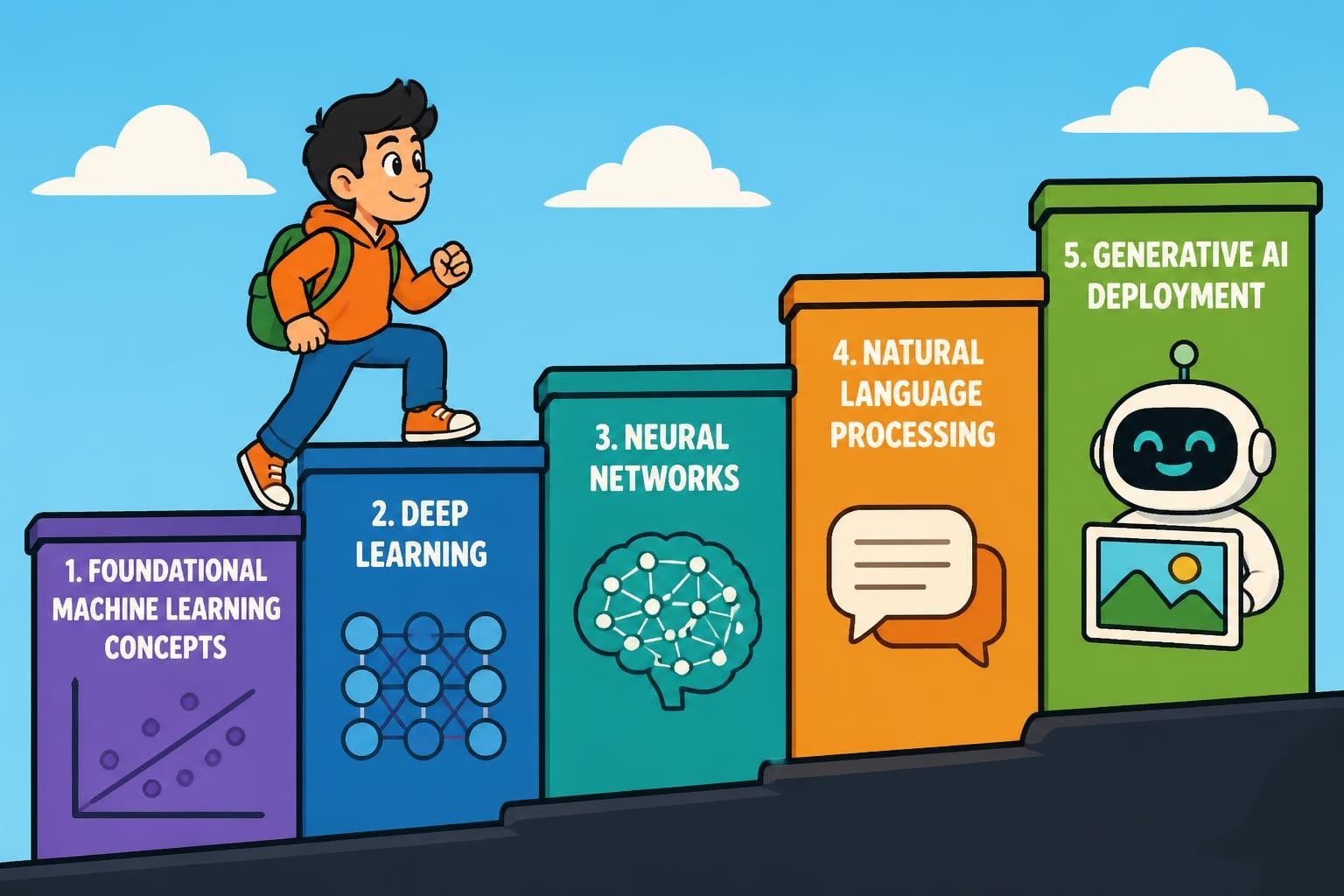
Mastering the core concepts in artificial intelligence and machine learning is the heart of every ai ml full course. Whether you are a beginner or aiming to refine your expertise, understanding these pillars will empower you to tackle real-world challenges and build robust solutions. Let’s break down the essentials step by step.
Step 1: Machine Learning Fundamentals
At the foundation of every ai ml full course are core machine learning principles. You will encounter supervised and unsupervised learning, which are the main categories for algorithms. In supervised learning, models are trained on labeled data for tasks like classification and regression. Unsupervised learning finds patterns or clusters in data without labels.
Key algorithms include linear regression, decision trees, k-means clustering, support vector machines, and Naive Bayes. For example, you might build a spam email classifier using supervised learning and decision trees. Mastering these basics is crucial, as they form the backbone of more advanced topics in the ai ml full course.
Step 2: Deep Learning and Neural Networks
Deep learning takes machine learning further by using neural networks with multiple layers. In any ai ml full course, you will explore concepts like activation functions, backpropagation, and architectures such as convolutional neural networks (CNNs) and recurrent neural networks (RNNs).
Popular frameworks include TensorFlow, PyTorch, and Keras, which simplify building and training models. For instance, you could develop an image recognition system using CNNs to classify objects within photographs. Understanding these frameworks and their applications is vital for anyone pursuing an ai ml full course.
Step 3: Natural Language Processing (NLP)
Natural language processing is a key component of the ai ml full course. NLP techniques allow computers to interpret, analyze, and generate human language. You will learn about text preprocessing, sentiment analysis, and advanced language models such as BERT and GPT.
Common use cases include chatbots, document summarization, and real-time translation. A practical project might involve building a sentiment analyzer for movie reviews, which helps you apply NLP methods learned in your ai ml full course.
Step 4: Computer Vision
Computer vision is the field where machines interpret images and video, making it a central topic in any ai ml full course. You will study image classification, object detection, and facial recognition. Key datasets like MNIST, CIFAR-10, and ImageNet are used for practice and benchmarking.
For example, you might build a real-time object detector using the YOLO algorithm. This hands-on approach not only solidifies your understanding but also helps you see the practical impact of computer vision learned through your ai ml full course.
Step 5: Reinforcement Learning
Reinforcement learning introduces agents that learn to make decisions by interacting with environments. This topic is a highlight of the ai ml full course, focusing on concepts like rewards, policies, and exploration strategies.
Applications range from robotics and game AI to recommendation systems. As a hands-on example, you could train an AI to play Atari games, observing how it improves through trial and error. Mastery of reinforcement learning opens doors to cutting-edge projects within the ai ml full course.
Step 6: AI Ethics and Responsible AI
Understanding ethics is critical in any ai ml full course. AI systems must be designed with fairness, transparency, and explainability in mind. You will explore regulatory frameworks such as GDPR, the EU AI Act, and the US AI Bill of Rights.
A practical scenario could involve mitigating bias in algorithms used for loan approvals. Addressing these challenges ensures that your ai ml full course knowledge is applied responsibly and aligns with global best practices.
Step 7: Hands-On Practice
The best way to cement your ai ml full course knowledge is through hands-on experience. Engage in Kaggle competitions, contribute to open-source projects, and build a diverse project portfolio. Peer code reviews and collaboration with others enhance your learning and expose you to new perspectives.
For a comprehensive, structured approach, you might consider the AI and Machine Learning Bundle, which provides guided practice and real-world projects. This helps you translate theory into practical skills, ensuring your ai ml full course journey leads to mastery.
The Ultimate AI ML Course Roadmap: Step-by-Step Learning Journey
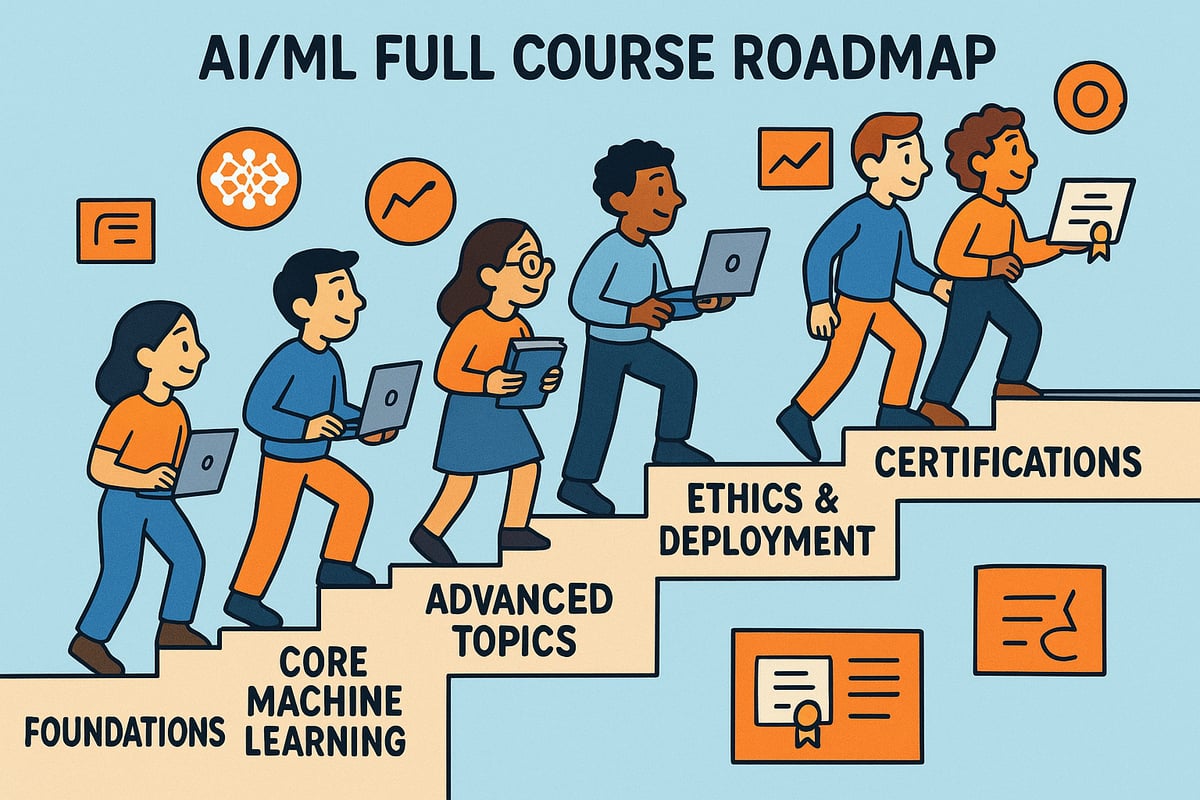
Embarking on your ai ml full course journey requires a clear, structured plan. This step-by-step roadmap ensures you build strong foundations, gain practical experience, and stay ahead in the ever-evolving field of artificial intelligence and machine learning. Let us break down the path into actionable stages, each focused on essential skills and milestones.
Stage 1: Foundations (Weeks 1-4)
Start your ai ml full course by mastering the basics. Focus on Python programming, core mathematics, and data visualization. Python is the primary language for most AI ML applications, while linear algebra and statistics provide the theoretical backbone.
- Python: Variables, loops, functions, basic libraries (NumPy, pandas)
- Math: Linear algebra, calculus, probability
- Visualization: Matplotlib, Seaborn
Set aside regular study periods and complete introductory projects, such as analyzing simple datasets. Consistency at this stage will make advanced topics much easier to grasp.
Stage 2: Core Machine Learning (Weeks 5-12)
The next phase of your ai ml full course involves diving into supervised and unsupervised learning. Learn about model selection, evaluation, and feature engineering. Try mini-projects like predicting house prices or segmenting customers.
- Algorithms: Regression, classification, clustering
- Practice: Scikit-learn, data preprocessing, cross-validation
Explore top-rated courses to deepen your understanding. If you are comparing learning options, consult this Best Course in Machine Learning guide to find programs that match your goals and schedule.
Stage 3: Deep Learning & Specializations (Weeks 13-24)
Now, your ai ml full course journey advances to neural networks and deep learning. Study the architecture and training of CNNs, RNNs, and GANs. Tackle capstone projects such as building an image classifier or a text generator.
- Tools: TensorFlow, Keras, PyTorch
- Topics: Convolutional networks, sequence modeling, transfer learning
Follow hands-on tutorials and experiment with open datasets. This stage is where your skills begin to stand out.
Stage 4: Advanced Topics & Real-World Applications (Weeks 25-36)
At this point, the ai ml full course roadmap expands into specialized domains like NLP, computer vision, and reinforcement learning. Apply your skills to industry-relevant problems.
- Projects: Healthcare diagnostics, fraud detection, autonomous vehicles
- Competitions: Kaggle, DrivenData
Participate in open-source projects and competitions to gain practical exposure. Real-world applications will boost your confidence and portfolio.
Stage 5: Ethics, Deployment, and Scaling (Weeks 37-40)
No ai ml full course is complete without addressing deployment and ethics. Learn to deploy models using Flask, Docker, or cloud platforms such as AWS and Azure. Understand the importance of fairness, transparency, and responsible AI.
- Deployment: APIs, cloud integration, monitoring
- Ethics: Bias mitigation, compliance, explainability
Practice deploying a model end-to-end and document ethical considerations to prepare for production environments.
Stage 6: Certification and Portfolio Building (Weeks 41-52)
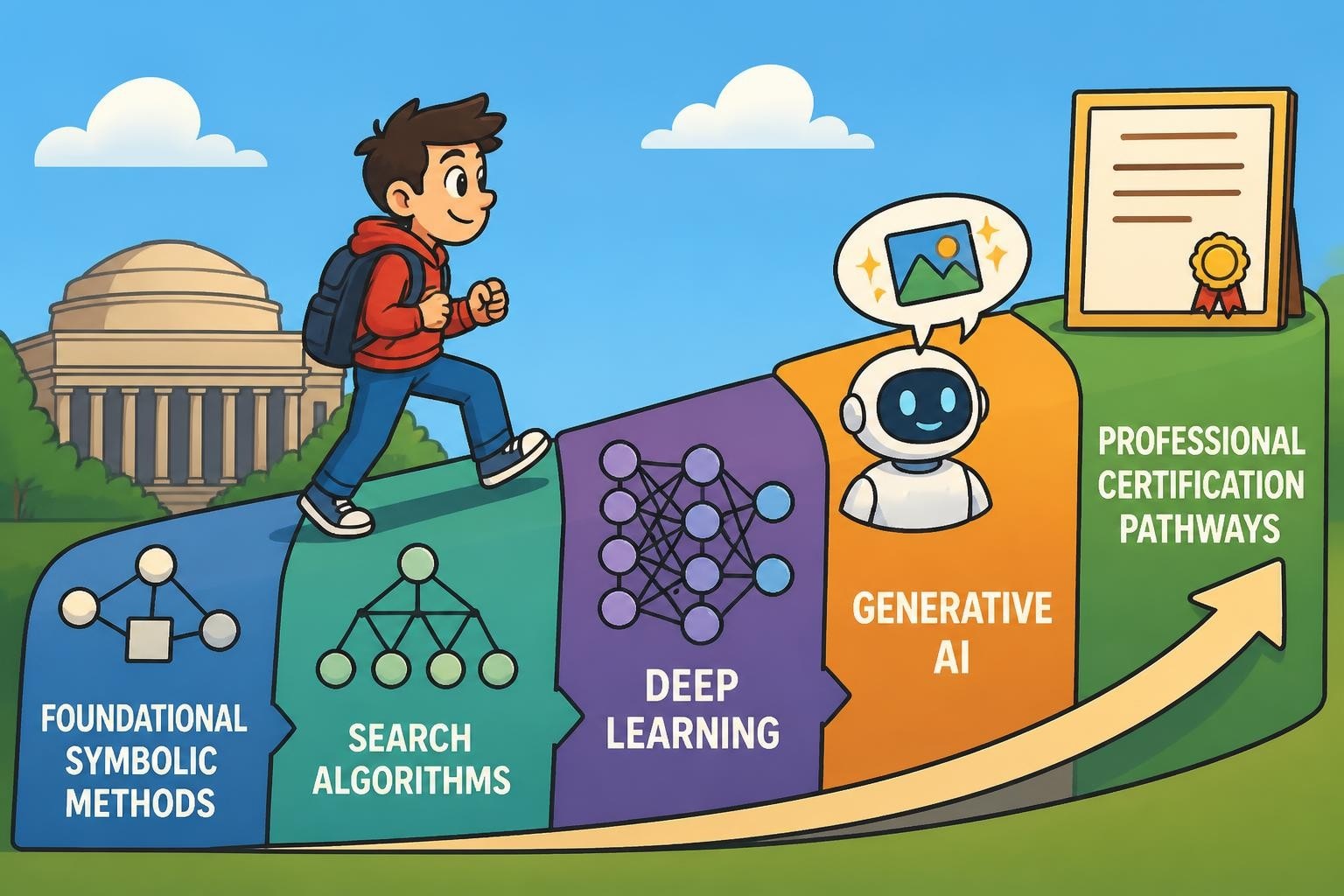
Dedicate this phase of your ai ml full course to earning certifications and showcasing your skills. Prepare for exams like TensorFlow Developer or AWS ML Specialty. Build a GitHub portfolio and a personal website to highlight your projects.
- Certifications: Exam prep, mock tests
- Portfolio: Clean code, detailed READMEs, project demos
A strong portfolio and recognized certifications are vital for standing out in the AI/ML job market.
Stage 7: Continuous Learning and Staying Updated
The ai ml full course journey does not end with certificates. Stay current by following the latest AI research, attending webinars, and joining professional communities.
- Research: arXiv, Google Scholar
- Communities: AI forums, newsletters, hackathons
Ongoing learning ensures your skills remain relevant and you are prepared for new advancements in the field.
By following this structured ai ml full course roadmap, you will gain the expertise, confidence, and credentials necessary to thrive as an AI/ML professional in 2026 and beyond.
Gaining Real-World Experience & Building Your AI Portfolio
Gaining real-world experience is a cornerstone for anyone pursuing an ai ml full course. Employers and recruiters consistently look beyond certificates, seeking candidates who can demonstrate applied skills and initiative through tangible projects and portfolios.
Importance of Hands-On Projects
Practical experience is the true differentiator for ai ml full course graduates. While theoretical knowledge gives you the foundation, hands-on projects prove you can solve real problems.
Employers value candidates who can showcase how they tackled challenges, selected algorithms, and interpreted results. According to recent AI skills demand by education level research, organizations increasingly prioritize job seekers who can demonstrate these competencies with real datasets.
For example, building a predictive maintenance system for factory equipment, or developing a fraud detection tool for banking, shows initiative and readiness for production environments.
Types of Portfolio Projects
A robust ai ml full course portfolio should reflect a range of project types. This diversity highlights your flexibility and depth.
| Project Type | Example | Skills Demonstrated |
|---|---|---|
| Classification | Spam email detector | Data preprocessing, ML |
| Regression | House price prediction | Feature engineering |
| NLP | Sentiment analysis for reviews | Text processing |
| Image Analysis | Object detection with YOLO | Computer vision, CNNs |
| Recommendation | Movie recommender system | Collaborative filtering |
| Open-Source | Contributing to scikit-learn | Collaboration, code review |
Open-source contributions and collaborative projects further strengthen your profile. Employers notice when you engage with the wider AI community.
Showcasing Your Work
How you present your ai ml full course projects can be as important as the projects themselves. Start with a well-organized GitHub repository. Include clean, documented code, clear project READMEs, and visualizations of results.
Next, build a personal website or portfolio to detail project goals, methodologies, and outcomes. Use screenshots, charts, or interactive dashboards to make your work stand out.
Finally, leverage LinkedIn by sharing project highlights, technical blogs, or even short video explainers. Regular updates signal your active engagement and growing expertise.
Participating in Competitions and Hackathons
Competitions and hackathons are a practical extension of any ai ml full course. Platforms like Kaggle, DrivenData, and Zindi offer real-world datasets and exposure to industry challenges.
Participating in these events builds your skills, provides networking opportunities, and helps you receive feedback from experienced practitioners. For instance, placing in the top 10 percent of a Kaggle competition can set your resume apart.
Hackathons also foster teamwork and creative thinking as you collaborate to solve problems under tight deadlines. Each competition is a chance to add a new achievement to your portfolio.
Internships and Freelance Opportunities
Internships and freelance roles are direct pathways to professional experience after completing an ai ml full course. They allow you to apply skills in a business context, often working on live projects with real impact.
Platforms such as Upwork, Toptal, and AngelList frequently list AI and ML gigs. You might assist a startup with data analysis, optimize an existing model, or help automate a workflow.
These roles not only build technical skills but also teach communication, project management, and client interaction. Securing an internship or freelance project can be a turning point in your AI journey.
Networking and Mentorship
Building a strong network accelerates your ai ml full course progress. Join AI communities like Reddit r/MachineLearning or active Discord servers to connect with peers and experts.
Seek out mentors through LinkedIn or professional groups. A mentor can provide guidance, review your portfolio, and share insights on career advancement.
Attend industry meetups, conferences, and workshops to stay updated on trends and make valuable connections. Networking often leads to collaborations, job referrals, and new learning opportunities.
Tracking Progress and Iterating
Continual improvement is vital for ai ml full course success. Regularly update your portfolio with new projects and skills. Use learning dashboards or progress trackers to monitor achievements and identify areas for growth.
Solicit feedback from peers or industry professionals. Iterate on your projects, refining your code, models, and presentation over time.
As you advance, consider exploring advanced learning paths such as those outlined in the AI PG Courses Guide, which can position you for specialized roles and higher certifications. Adapt your project complexity to match your evolving skillset, and never stop learning.
Certifications, Career Paths, and Future Trends in AI/ML
The ai ml full course journey does not end with technical mastery, but extends into strategic career moves and staying ahead of future trends. As AI and ML reshape industries, the right certifications, career choices, and proactive learning will define your long-term success. Let us break down the top certifications, career options, and the trends you need to watch as you build your expertise.
Top AI/ML Certifications in 2026
Certifications are a critical part of any ai ml full course, validating your skills and boosting your profile. The most recognized in 2026 include Google’s Professional ML Engineer, AWS Certified ML Specialty, Microsoft Certified AI Engineer, and TensorFlow Developer. Each has unique prerequisites, from coding skills to hands-on project experience.
| Certification | Prerequisite | Focus Area | Recognition |
|---|---|---|---|
| Google ML Engineer | Coding, ML experience | Cloud, ML pipelines | High |
| AWS ML Specialty | AWS, ML fundamentals | Cloud ML, deployment | High |
| Microsoft AI Engineer | Python, AI concepts | Azure AI, NLP, CV | Growing |
| TensorFlow Developer | Python, TF experience | Deep Learning | High |
When planning your ai ml full course, consider not just content, but the industry value of each credential. For a detailed breakdown of salary potential and certification impact, see the AI certifications salary guide 2025.
Choosing the Right Career Path
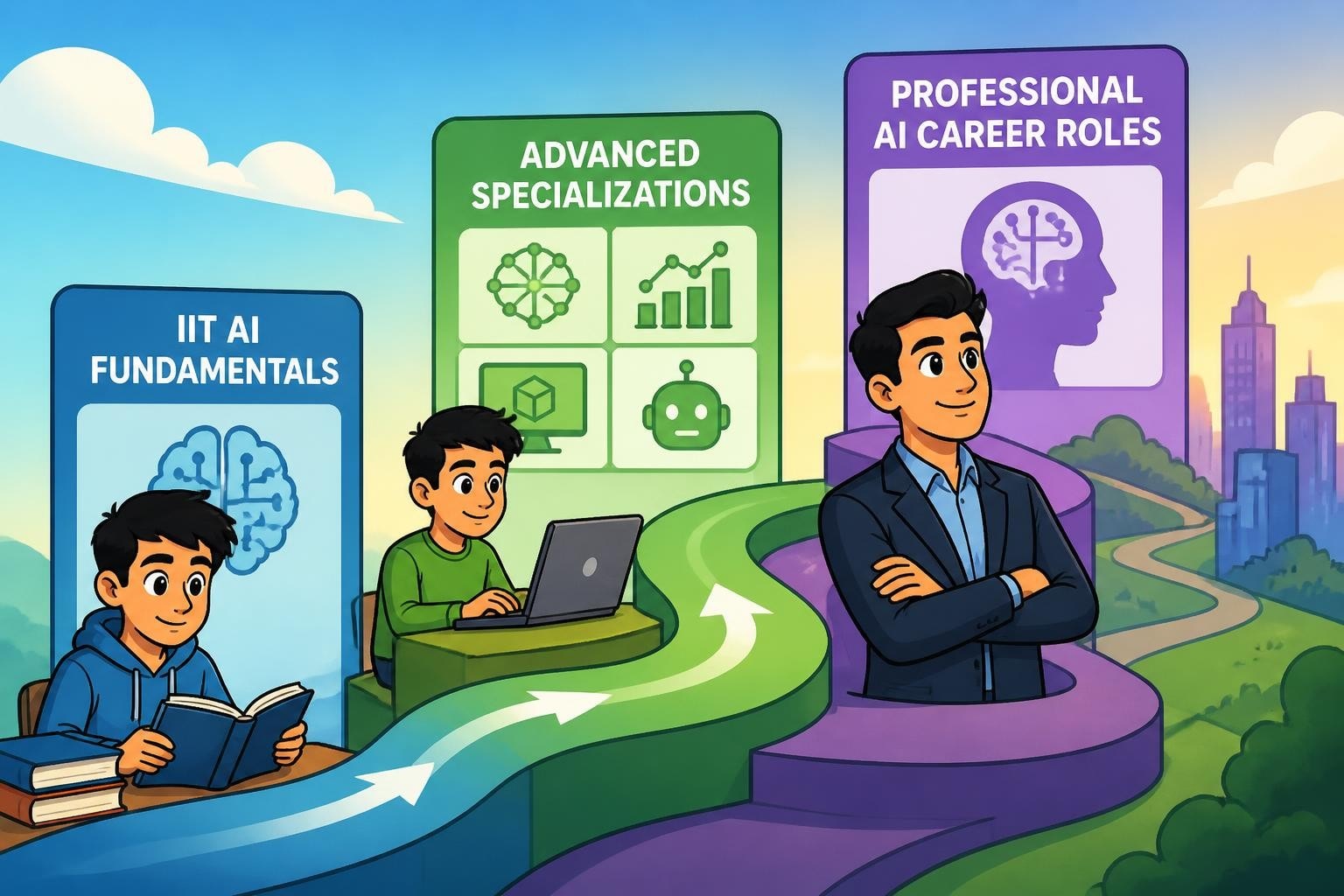
Selecting a career path is a pivotal step in any ai ml full course. Common roles include Data Scientist, ML Engineer, AI Researcher, AI Product Manager, and AI Consultant. Each role demands a mix of technical, analytical, and communication skills.
Career progression often starts with junior data roles, then advances to senior engineering or product leadership. For example, a typical path may begin as a Data Analyst, moving to ML Engineer, and eventually to AI Product Manager. Growth potential is immense, especially for those who combine domain expertise with technical mastery.
Industry-Specific AI/ML Applications
An effective ai ml full course prepares you for real-world impact. AI and ML are transforming healthcare through diagnostics and personalized medicine, revolutionizing finance with fraud detection and algorithmic trading, and reshaping retail via recommendation engines and inventory optimization.
For instance, e-commerce companies leverage AI-driven sales forecasting to predict demand and optimize stock. In healthcare, AI models interpret medical images for faster diagnostics. The diversity of applications means AI/ML skills are adaptable across sectors, ensuring long-term relevance.
Remote and Global AI Opportunities
The global demand for AI talent is fueling remote jobs and distributed teams, making an ai ml full course valuable worldwide. The US, India, and Europe lead hiring, but opportunities are rising everywhere. Salaries are competitive, with many roles offering six-figure packages for experienced professionals.
For a closer look at hiring hotspots and salary shifts, check the AI hiring trends 2025. With remote work, your ai ml full course can open doors to international careers, regardless of your location.
Staying Ahead: Emerging Trends for 2026
A future-proof ai ml full course must tackle emerging trends. Generative AI, explainable AI (XAI), edge AI, and AI safety are shaping the landscape. Regulation is tightening, with new frameworks like the EU’s AI Act and US guidelines.
Large Language Models (LLMs) are powering advances in automation and human-AI collaboration. Continuous learning and adaptability are crucial, as AI evolves rapidly. Staying current with these trends ensures your skills remain sought-after.
Building Your Personal Brand in AI/ML
Your ai ml full course should include strategies for personal branding. Publishing research, blogging on platforms like Medium, and speaking at conferences boost visibility. Share insights and projects on LinkedIn and Twitter to reach a wider audience.
Networking with peers and joining professional communities can lead to mentorship and collaboration. Establishing an online presence differentiates you from other candidates and attracts recruiters looking for thought leaders in AI/ML.
Long-Term Career Growth Strategies
Sustaining your ai ml full course momentum requires a commitment to lifelong learning. Cross-disciplinary skills such as business, design, and leadership amplify your impact. Explore career pivots, from technical roles to AI product leadership or entrepreneurship.
Regularly update your portfolio, pursue new certifications, and seek feedback from industry professionals. The most successful AI/ML professionals combine technical depth with strategic vision, ensuring resilience as the field evolves.
You’ve seen how mastering AI and machine learning can open doors to future-proof careers, higher salaries, and exciting innovations across every industry. Whether you’re just starting out or looking to deepen your expertise, having a clear learning path and access to practical, up-to-date resources makes all the difference. I know how important it is to feel confident and certified as you make progress—so why not take your first step today? You can build a solid foundation and start your journey with confidence. Become a certified AI Foundation Specilaist. Start for free