
The rapid integration of artificial intelligence into consumer and enterprise products has fundamentally transformed the product manager role. While traditional PM skills remain foundational, managing AI-powered features demands new competencies: understanding model behavior, designing evaluation frameworks, collaborating with data scientists, and navigating responsible AI considerations. An ai product manager course provides the specialized training professionals need to lead AI initiatives confidently and ship products that deliver measurable business value while maintaining user trust.
Why AI Product Management Requires Specialized Training
Product managers entering the AI space quickly discover that their existing toolkit falls short. Unlike deterministic software, machine learning models exhibit probabilistic behavior, require continuous evaluation, and demand different development workflows.
The Skills Gap Between Traditional and AI Product Management
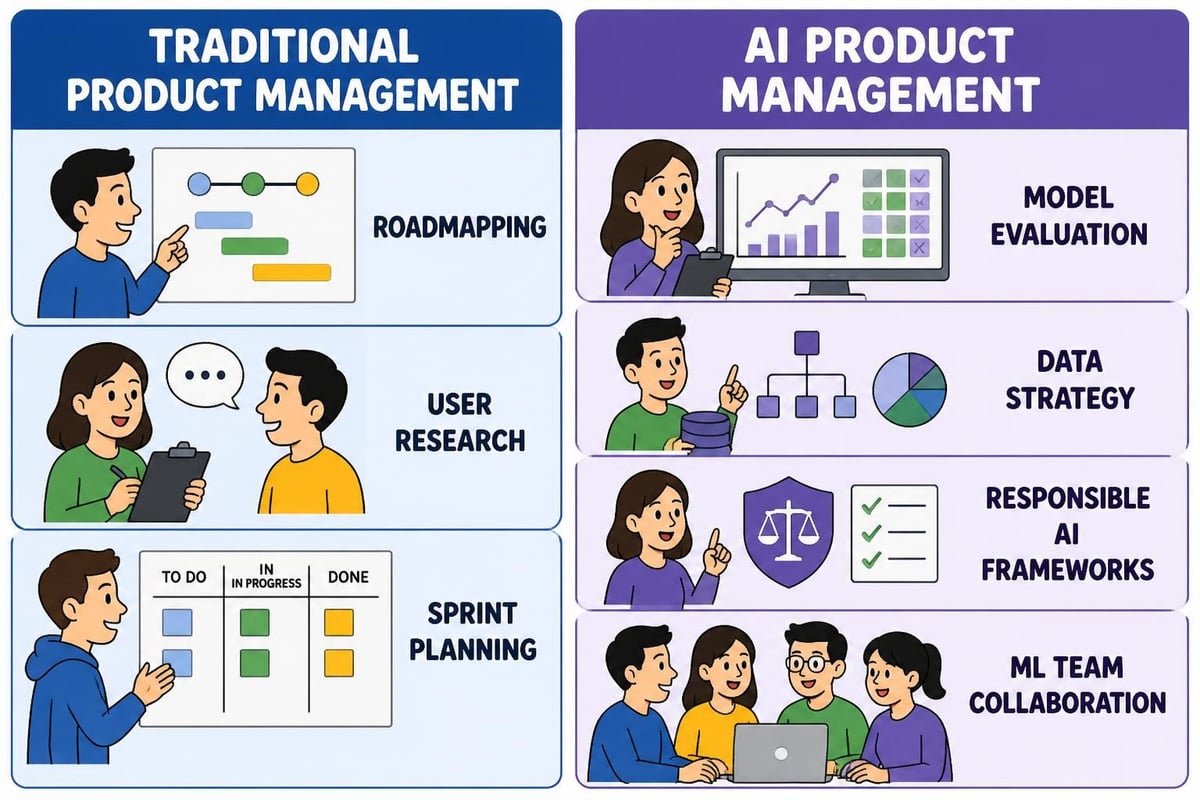
Traditional product management focuses on user stories, roadmaps, and feature prioritization. AI product management adds layers of complexity:
- Model performance evaluation beyond standard feature acceptance criteria
- Data quality assessment and understanding training data limitations
- Cross-functional coordination with ML engineers and data scientists
- Responsible AI governance including fairness, transparency, and safety considerations
- Managing uncertainty when model outputs are probabilistic rather than deterministic
According to Harvard Business Review's research on AI adoption, organizations that invest in product management skills specifically tailored to AI see significantly faster deployment cycles and higher success rates with AI initiatives.
Understanding the AI Product Development Lifecycle
An effective ai product manager course teaches the complete lifecycle from problem identification through deployment and monitoring. This differs substantially from traditional software development:
| Traditional Software PDLC | AI Product PDLC | PM Responsibility |
|---|---|---|
| Define requirements | Define success metrics + data requirements | Translate business goals into measurable ML outcomes |
| Design & prototype | Data collection + model experimentation | Collaborate with data scientists on feasibility |
| Development | Model training + evaluation | Define acceptable performance thresholds |
| QA & testing | Offline evaluation + A/B testing | Design multi-stage validation approach |
| Deployment | Gradual rollout + monitoring | Monitor model drift and user impact |
The Google Developers guide on assembling ML teams emphasizes that product managers must orchestrate collaboration between engineers, data scientists, and designers-each with different workflows and success criteria.
Core Curriculum Components of Leading AI Product Manager Courses
The most comprehensive ai product manager course offerings cover technical fundamentals, product strategy, and organizational leadership. Understanding what to look for helps professionals select training that matches their career goals.
Technical Foundations Without Requiring Engineering Expertise
You don't need to code neural networks, but you must understand how ML systems work. Quality courses cover:
- ML model types (supervised, unsupervised, reinforcement learning) and their appropriate use cases
- Training data requirements including volume, quality, and bias considerations
- Model evaluation metrics like precision, recall, F1 score, and when to prioritize each
- Deployment architectures including batch inference, real-time prediction, and edge deployment
Platforms like MammothClub offer structured pathways from foundational AI concepts through advanced product strategy, allowing PMs to build technical literacy at their own pace.
Product Strategy and Use Case Identification
The best product managers know which problems benefit from AI and which don't. An ai product manager course should teach:
- Opportunity assessment frameworks for evaluating AI feasibility
- ROI calculation methods specific to ML initiatives
- Build vs. buy decision frameworks for AI capabilities
- Scoping strategies to start with narrow, high-value use cases
Microsoft's Azure AI strategy guidance provides practical frameworks for SaaS product owners to evaluate use-case selection and governance-concepts that should be central to any comprehensive course.
Responsible AI and Ethical Product Design
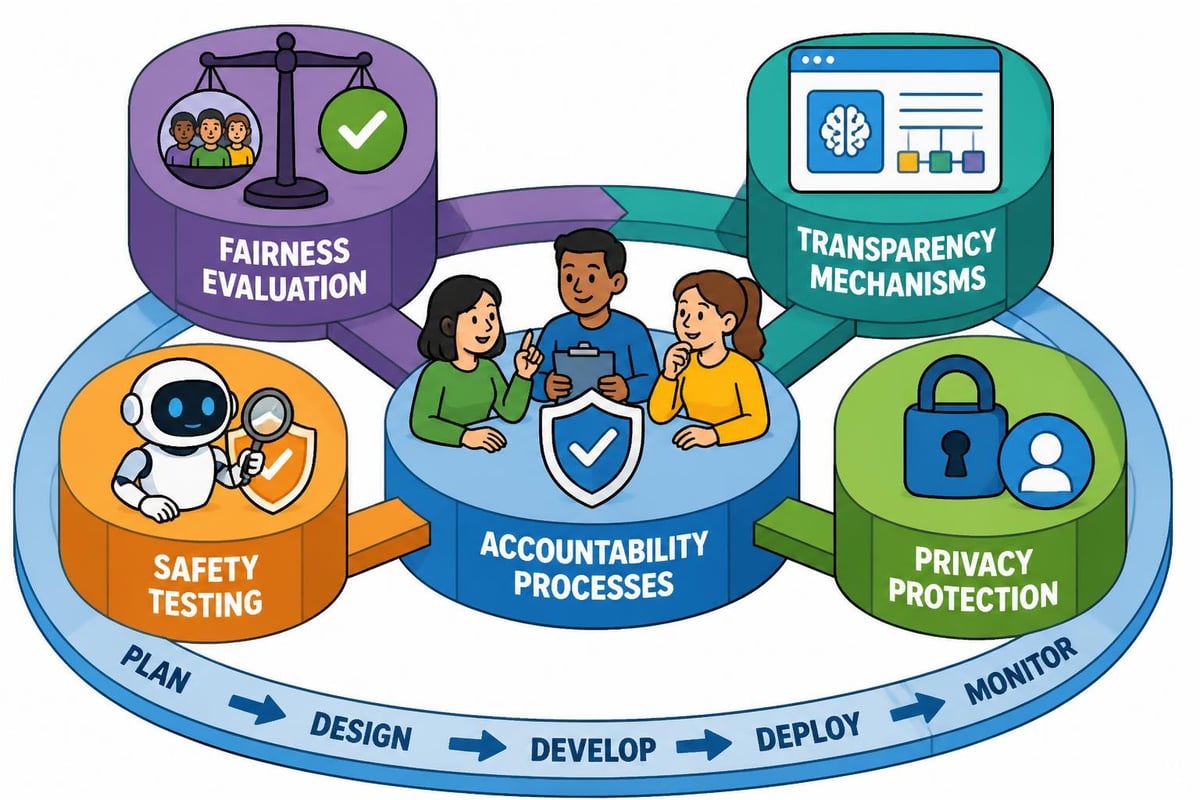
Shipping AI products without considering fairness, transparency, and safety creates significant business and reputational risks. Curriculum should include:
- Bias detection and mitigation strategies throughout the product lifecycle
- Explainability requirements and when users need to understand model decisions
- Safety evaluation frameworks particularly for generative AI applications
- Privacy-preserving techniques like differential privacy and federated learning
The People + AI Guidebook from Google offers research-backed design patterns for building human-centered AI products, covering everything from onboarding users to AI features through ongoing evaluation.
Practical Skills and Real-World Application
Theory matters, but the ability to apply concepts in production environments separates effective AI product managers from those who struggle. An ai product manager course must bridge the gap between concepts and implementation.
Cross-Functional Collaboration and Team Dynamics
Product managers serve as translators between business stakeholders and technical teams. For AI products, this requires understanding:
- How data scientists approach problems (experimentation, iteration, statistical thinking)
- ML engineer priorities (model performance, latency, infrastructure costs)
- Designer considerations for AI-powered experiences (managing expectations, handling errors gracefully)
- Executive communication (framing AI investments, explaining probabilistic outcomes)
The Berkeley Responsible AI Initiative's playbook provides actionable guidance specifically for product managers navigating cross-functional coordination on generative AI projects.
Building Effective Evaluation and Experimentation Programs
Unlike traditional A/B tests, AI feature evaluation requires multilayered approaches:
Offline evaluation metrics:
- Model accuracy, precision, recall on held-out test sets
- Fairness metrics across demographic groups
- Latency and computational cost
Online evaluation strategies:
- Staged rollouts with monitoring dashboards
- Counter-metric tracking (unintended negative impacts)
- Long-term outcome measurement beyond immediate engagement
OpenAI's safety and production best practices offer practical checklists for eval-driven design that product teams should follow when shipping AI features.
Documentation and Stakeholder Communication
AI product managers must communicate complexity clearly to diverse audiences. This includes:
- Product requirement documents that specify model behavior expectations
- Risk assessments documenting potential failure modes
- User-facing explanations of how AI features work
- Executive summaries translating technical performance into business impact
Effective communication prevents misaligned expectations and ensures teams build the right solutions.
Advanced Topics for Experienced Product Managers
As AI product managers gain experience, advanced topics become critical for leading complex initiatives and shaping organizational AI strategy.
Generative AI Product Strategy
The rise of large language models and generative AI introduces new product paradigms. Advanced courses cover:
- Prompt engineering as a product design tool
- Fine-tuning vs. RAG vs. prompt optimization trade-offs
- Hallucination management and reliability strategies
- Cost optimization for token-intensive applications
For professionals looking to deepen their generative AI expertise, courses like prompt engineering with Claude offer hands-on practice with state-of-the-art models.
Security, Privacy, and Compliance
AI products introduce unique security considerations. An advanced ai product manager course addresses:
| Security Concern | Product Implication | PM Responsibility |
|---|---|---|
| Data poisoning attacks | Compromised model behavior | Define data validation requirements |
| Model inversion | Privacy leakage from training data | Implement privacy-preserving techniques |
| Adversarial inputs | Unexpected model outputs | Design input validation and monitoring |
| Third-party model dependencies | Supply chain vulnerabilities | Evaluate vendor security practices |
The Microsoft Security and Responsible AI Guide provides consolidated, practical guidance that product teams should integrate into AI product development lifecycles.
Organizational Change and AI Transformation
Senior product managers often lead AI adoption across organizations. This requires:
- Change management frameworks for AI-first transformation
- Training programs for cross-functional teams
- Governance structures balancing innovation with risk management
- Metrics and KPIs for measuring AI maturity
Choosing the Right AI Product Manager Course
With growing demand, numerous training options have emerged. Evaluating courses requires understanding your current skill level, career goals, and learning preferences.
Key Selection Criteria
Content depth and breadth:
- Does it cover both technical fundamentals and strategic leadership?
- Are responsible AI and ethics integrated throughout, not just an add-on module?
- Does it include hands-on exercises, case studies, and real-world examples?
Instructor expertise:
- Have instructors shipped AI products in production environments?
- Do they bring cross-functional experience (technical and business)?
- Are they current with 2026 best practices and emerging patterns?
Learning format:
- Self-paced video courses for flexibility
- Live cohort programs for networking and peer learning
- Interactive bootcamps for intensive skill-building
Certification and recognition:
- Does completion provide verifiable credentials?
- Is the certification recognized by employers in your target industry?
- Does it align with established frameworks (like IEEE standards)?
Platforms specializing in AI education, such as those offering AI management courses, provide structured pathways designed specifically for product managers at different career stages.
Self-Study vs. Structured Programs
Self-directed learning works well for experienced PMs adding AI skills:
- Access to comprehensive course libraries
- Ability to focus on specific gaps (e.g., evaluation frameworks, responsible AI)
- Lower cost and maximum flexibility
Structured programs benefit those new to product management or AI:
- Guided curriculum ensuring no critical gaps
- Cohort learning with peer collaboration
- Mentorship and feedback on practical projects
- Networking with other AI product professionals
Many professionals combine approaches, using structured programs for foundational skills and self-study for specialized topics like specific frameworks or tools.
Building Career Momentum After Course Completion
Completing an ai product manager course is the beginning, not the end. Converting knowledge into career advancement requires strategic application.
Immediate Application Strategies
Within your current role:
- Identify one AI opportunity within existing products
- Propose a small-scale pilot using frameworks from your training
- Share learnings with your team to build organizational AI literacy
- Document your process to build a portfolio of AI product work
Building credibility:
- Write case studies about AI product challenges you've solved
- Contribute to AI product management communities
- Present at internal company meetings or external meetups
- Pursue additional specialized certifications in areas like Azure AI
Continuous Learning in a Rapidly Evolving Field
AI capabilities evolve rapidly. Product managers must commit to ongoing education:
- Follow research developments in ML and generative AI
- Track regulatory changes affecting AI products in your industry
- Experiment with new tools as they emerge (new model architectures, evaluation frameworks)
- Engage with communities like IEEE's Autonomous Intelligence Systems initiative
Platforms offering extensive course libraries enable continuous upskilling as new techniques and tools emerge. Access to thousands of updated courses ensures your knowledge remains current.
Industry-Specific Considerations
Different industries face unique AI product challenges. The most valuable ai product manager course either specializes in your domain or provides frameworks adaptable across contexts.
Healthcare and Life Sciences
Unique considerations:
- Regulatory compliance (FDA, HIPAA, clinical validation)
- Explainability requirements for clinical decision support
- Patient safety and liability considerations
- Integration with electronic health records
Key skills:
- Understanding clinical workflows and medical terminology
- Navigating regulatory approval processes
- Designing for clinical validation studies
- Managing patient privacy beyond general data protection
Financial Services
Unique considerations:
- Model transparency for regulatory compliance
- Fraud detection and anti-money laundering use cases
- Credit decisioning fairness requirements
- Real-time processing demands
Key skills:
- Understanding financial regulations affecting AI
- Building audit trails for model decisions
- Managing risk in high-stakes environments
- Demonstrating fairness across protected classes
E-commerce and Consumer Technology
Unique considerations:
- Personalization at scale
- Recommendation system design
- Search relevance optimization
- User privacy and data collection balance
Key skills:
- Designing cold-start solutions for new users
- A/B testing complex ranking algorithms
- Optimizing for engagement without manipulation
- Building transparent preference controls
Regardless of industry, principles from resources like Google's People-centered AI guidance provide foundational best practices for responsible generative AI product development.
Measuring Success and ROI
Organizations investing in AI product manager training need clear metrics demonstrating value. Individual learners should track skill development and career progression.
Organizational Metrics
Product velocity:
- Time from AI concept to production deployment
- Number of successful AI features shipped per quarter
- Percentage of AI projects meeting success criteria
Team effectiveness:
- Cross-functional collaboration quality scores
- Reduction in misaligned expectations between teams
- Improved data scientist and PM partnership ratings
Business impact:
- Revenue attribution to AI-powered features
- Cost savings from AI automation
- User satisfaction with AI experiences
Individual Career Metrics
Skill development:
- Completion of technical and strategic modules
- Practical projects demonstrating applied knowledge
- Certifications earned and maintained
Career advancement:
- Promotions to senior or lead PM roles
- Expansion into AI product strategy positions
- Compensation increases reflecting specialized expertise
- Leadership of cross-functional AI initiatives
Professionals who complete comprehensive training and apply it consistently typically see measurable career progression within 6-12 months.
Common Challenges and How to Overcome Them
Even with excellent training, AI product managers face predictable obstacles. Anticipating these challenges enables proactive solutions.
Managing Uncertainty and Probabilistic Outcomes
Challenge: Stakeholders expect deterministic guarantees; ML models provide probabilistic predictions.
Solutions:
- Frame features in terms of confidence intervals and expected accuracy
- Set realistic performance expectations before development begins
- Design user experiences that handle errors gracefully
- Implement monitoring dashboards showing real-world performance
Balancing Innovation and Responsible AI
Challenge: Pressure to ship quickly conflicts with thorough safety and fairness evaluation.
Solutions:
- Integrate evaluation into development sprints, not as a final gate
- Use staged rollouts to identify issues before full deployment
- Build reusable evaluation frameworks that accelerate future projects
- Demonstrate how responsible AI reduces long-term risk and cost
Bridging Communication Gaps
Challenge: Data scientists, engineers, designers, and executives speak different languages.
Solutions:
- Develop visual communication tools (diagrams, dashboards, prototypes)
- Learn enough technical detail to ask informed questions
- Translate between business metrics and model performance measures
- Create shared documentation accessible to all stakeholders
Training programs that include cross-functional simulation exercises prepare PMs for these real-world scenarios better than purely theoretical content.
Mastering AI product management requires more than traditional PM skills-it demands specialized knowledge of model behavior, evaluation frameworks, responsible AI practices, and cross-functional collaboration tailored to ML teams. As AI continues transforming products across industries, professionals with these capabilities will drive innovation while maintaining user trust and delivering measurable business value. Whether you're transitioning into AI product management or expanding your expertise, MammothClub provides the comprehensive training, hands-on practice, and ongoing learning resources to accelerate your journey from foundational concepts through advanced strategic leadership.