
The rapid evolution of artificial intelligence has created an urgent skills gap across industries. Professionals who once excelled in traditional roles now find themselves needing to understand machine learning algorithms, neural networks, and AI ethics to remain competitive. An ai intelligence course provides structured learning that transforms theoretical knowledge into practical capability, but choosing the right program requires understanding what separates comprehensive training from superficial overviews. This guide examines the essential components of effective AI education, helping you identify programs that deliver measurable career outcomes and organizational value.
Core Components of Effective AI Intelligence Training
A rigorous ai intelligence course should cover five foundational pillars that build progressively from mathematical fundamentals to real-world implementation. These components create a comprehensive learning experience that prepares professionals for practical challenges.
Mathematical Foundations and Prerequisites
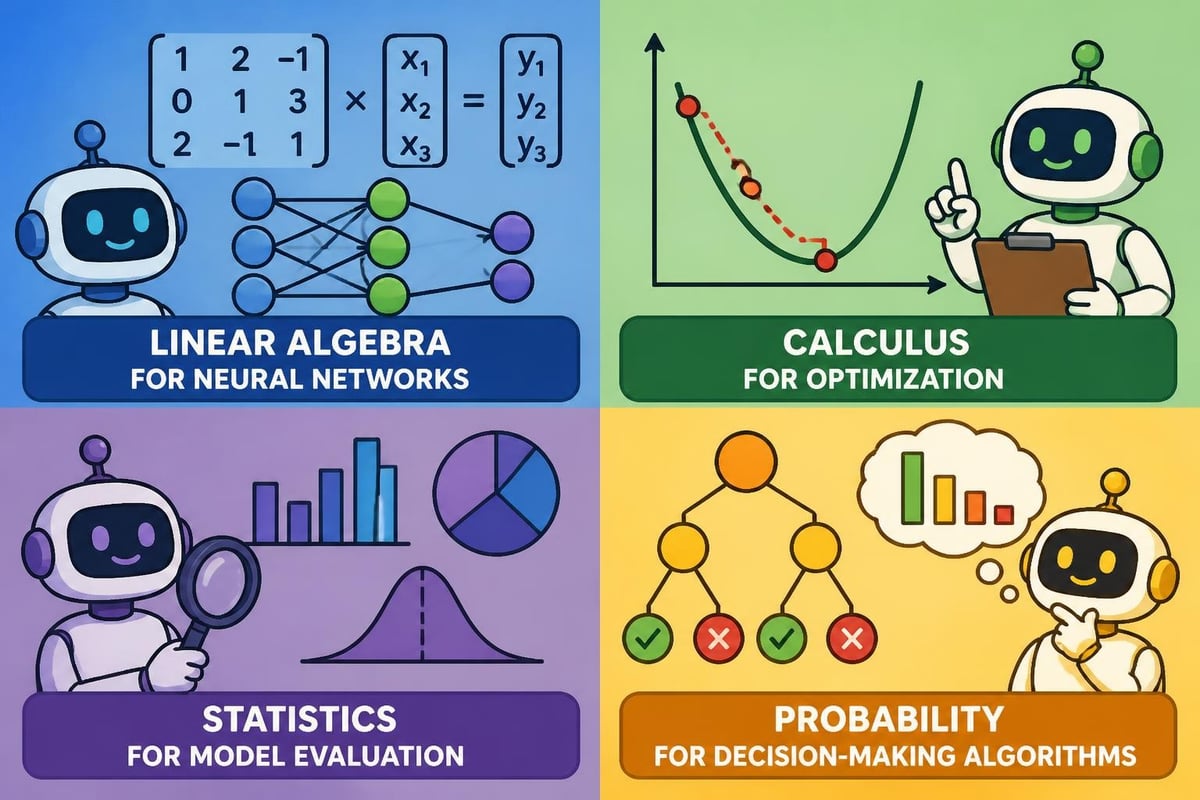
Every quality program begins with the mathematical toolkit required for AI work. Linear algebra forms the backbone of neural network operations, while calculus enables optimization of machine learning models. Statistics provides the framework for understanding probability distributions, hypothesis testing, and model evaluation.
- Linear algebra: matrix operations, eigenvalues, vector spaces
- Calculus: derivatives, gradients, backpropagation mathematics
- Probability theory: Bayes' theorem, distributions, expectation
- Optimization: gradient descent, stochastic methods, convergence
Programs like Google's Machine Learning Crash Course demonstrate how these foundations integrate with practical exercises. The most effective courses present these concepts alongside immediate applications rather than abstract theory alone.
Machine Learning Algorithms and Paradigms
Understanding the spectrum of machine learning approaches enables practitioners to select appropriate techniques for specific problems. An ai intelligence course must cover supervised, unsupervised, and reinforcement learning paradigms with hands-on implementation.
| Learning Paradigm | Primary Use Cases | Key Algorithms | Business Applications |
|---|---|---|---|
| Supervised | Classification, regression | Linear regression, SVM, random forests | Customer churn prediction, price forecasting |
| Unsupervised | Pattern discovery, clustering | K-means, PCA, autoencoders | Market segmentation, anomaly detection |
| Reinforcement | Sequential decision-making | Q-learning, policy gradients | Robotics, game AI, resource optimization |
The curriculum should include practical experience with scikit-learn, TensorFlow, or PyTorch. Implementation exercises transform conceptual understanding into coding proficiency, which employers consistently rank as critical for AI roles.
Deep Learning Architectures and Applications
Neural networks represent the cutting edge of AI capability, powering everything from computer vision to natural language processing. Course content should explore convolutional neural networks (CNNs) for image recognition, recurrent neural networks (RNNs) for sequence data, and transformer architectures that revolutionized language models.
Stanford's CS230 Deep Learning course provides an excellent model for structuring this material. Students benefit from understanding not just how to use pre-trained models, but how to architect, train, and debug their own networks for custom applications.
Modern training should address transfer learning and fine-tuning techniques that allow organizations to adapt large language models to specific domains without massive computational resources. This practical approach accelerates real-world deployment.
Curriculum Design Best Practices for Corporate Training
Organizations investing in AI upskilling need programs that align with business objectives while accommodating diverse learning backgrounds. The ACM/IEEE-CS Computer Science Curricula guidelines provide authoritative frameworks that balance theoretical rigor with practical application.
Interdisciplinary Integration Strategies
Recent research on curriculum design for engineering students highlights the importance of cross-functional perspectives. An effective ai intelligence course integrates:
- Domain expertise: applying AI to industry-specific challenges
- Software engineering: production-ready code, version control, testing
- Data engineering: pipeline construction, ETL processes, data quality
- Project management: Agile methodologies for AI development cycles
This interdisciplinary approach prevents the common pitfall of creating technically proficient graduates who struggle to translate algorithms into business value. Case studies should reflect challenges from finance, healthcare, manufacturing, and other sectors where participants work.
Assessment and Certification Frameworks
Measuring learning outcomes requires more than multiple-choice exams. Comprehensive assessment includes:
- Project-based evaluations: end-to-end ML pipeline implementation
- Peer code reviews: collaborative learning and best practice sharing
- Capstone presentations: communicating technical work to non-technical stakeholders
- Industry certifications: AWS Machine Learning Specialty, Azure AI certifications
Corporate programs should tie certification to internal advancement paths, creating clear career incentives for completion. AI management courses often complement technical training by preparing leaders to oversee AI initiatives.
Ethical and Governance Considerations in AI Education
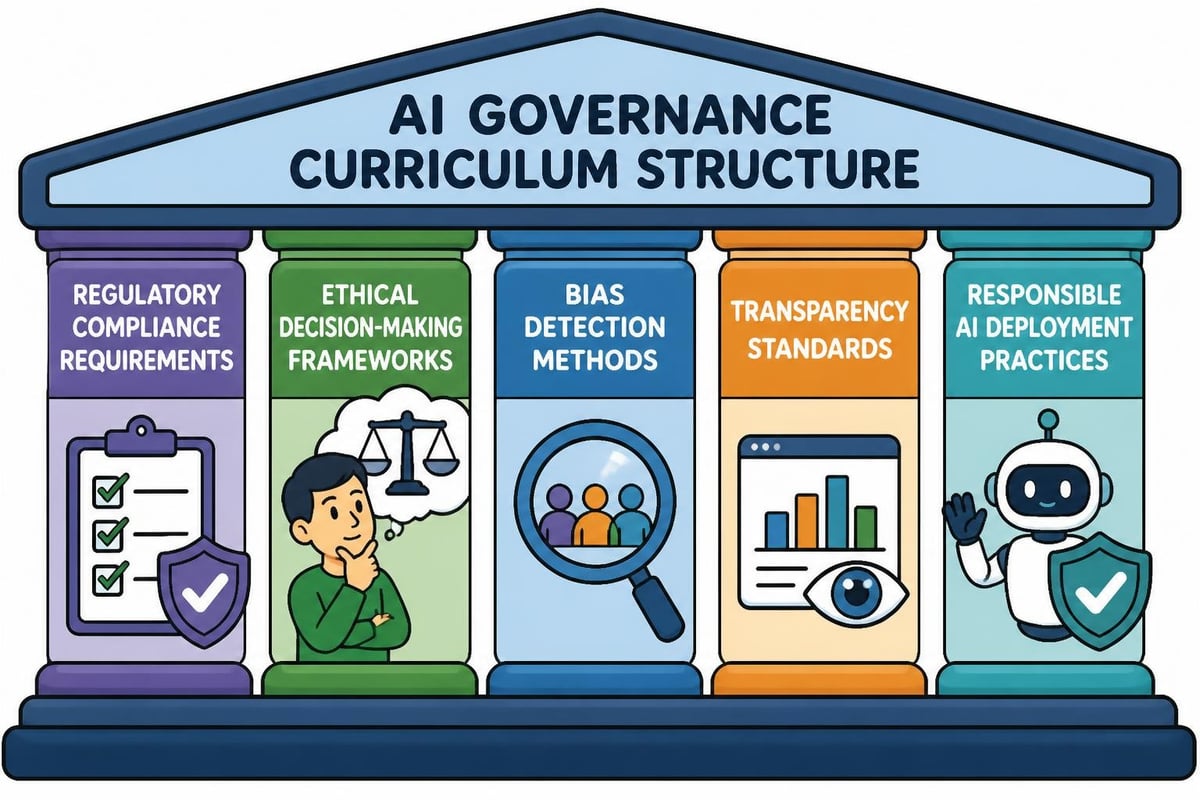
The rapid deployment of AI systems has created urgent questions about fairness, accountability, transparency, and privacy. A comprehensive ai intelligence course must address these concerns as core curriculum rather than optional appendices.
Regulatory and Compliance Requirements
Recent course designs focus on AI governance in higher education, providing blueprints for integrating regulatory considerations throughout the curriculum. Key topics include:
- GDPR and data privacy: handling personal information in training datasets
- Model explainability: LIME, SHAP values, attention visualization
- Algorithmic bias: detection, measurement, and mitigation strategies
- Risk management: documentation, monitoring, incident response
Organizations deploying AI systems face increasing scrutiny from regulators and customers alike. Training that incorporates compliance from the beginning prevents costly retrofitting and reputational damage.
Responsible AI Development Practices
Beyond legal requirements, ethical AI development requires cultural commitment to fairness and transparency. Course materials should include:
- Bias auditing techniques for training data and model outputs
- Fairness metrics (demographic parity, equalized odds, calibration)
- Human-in-the-loop design patterns for high-stakes decisions
- Stakeholder analysis and impact assessment methodologies
Real-world case studies of AI failures-from biased hiring algorithms to discriminatory lending models-provide powerful learning moments. Understanding what went wrong builds intuition for preventing similar issues in future projects.
Evidence-Based Learning Technologies and Tools
Modern AI education benefits from the same technologies it teaches. A scoping review of AI use in educational contexts maps emerging frontiers in AI-enhanced learning that improve engagement and outcomes.
Adaptive Learning Platforms and Personalization
AI-powered platforms analyze individual progress, identifying knowledge gaps and adjusting content difficulty in real-time. These systems provide:
- Personalized learning paths: content sequencing based on mastery
- Intelligent tutoring: contextual hints and scaffolding
- Predictive analytics: early intervention for at-risk learners
- Competency mapping: skill assessments tied to job requirements
The Nature scoping review of AI learning tools demonstrates measurable improvements in learning outcomes when adaptive systems match content to individual needs. Corporate training programs see higher completion rates and better skill retention with personalized approaches.
Interactive Labs and Simulation Environments
Passive video lectures produce minimal skill development. Effective programs emphasize hands-on practice through:
- Cloud-based Jupyter notebooks with pre-configured environments
- Synthetic datasets that mirror real business scenarios
- Debugging exercises using intentionally flawed code
- Model deployment simulations with production constraints
Platforms offering an ai intelligence course should provide integrated development environments where learners experiment without local setup friction. Tools like Google Colab and cloud-based IDEs eliminate technical barriers to entry.
ROI Measurement and Business Impact
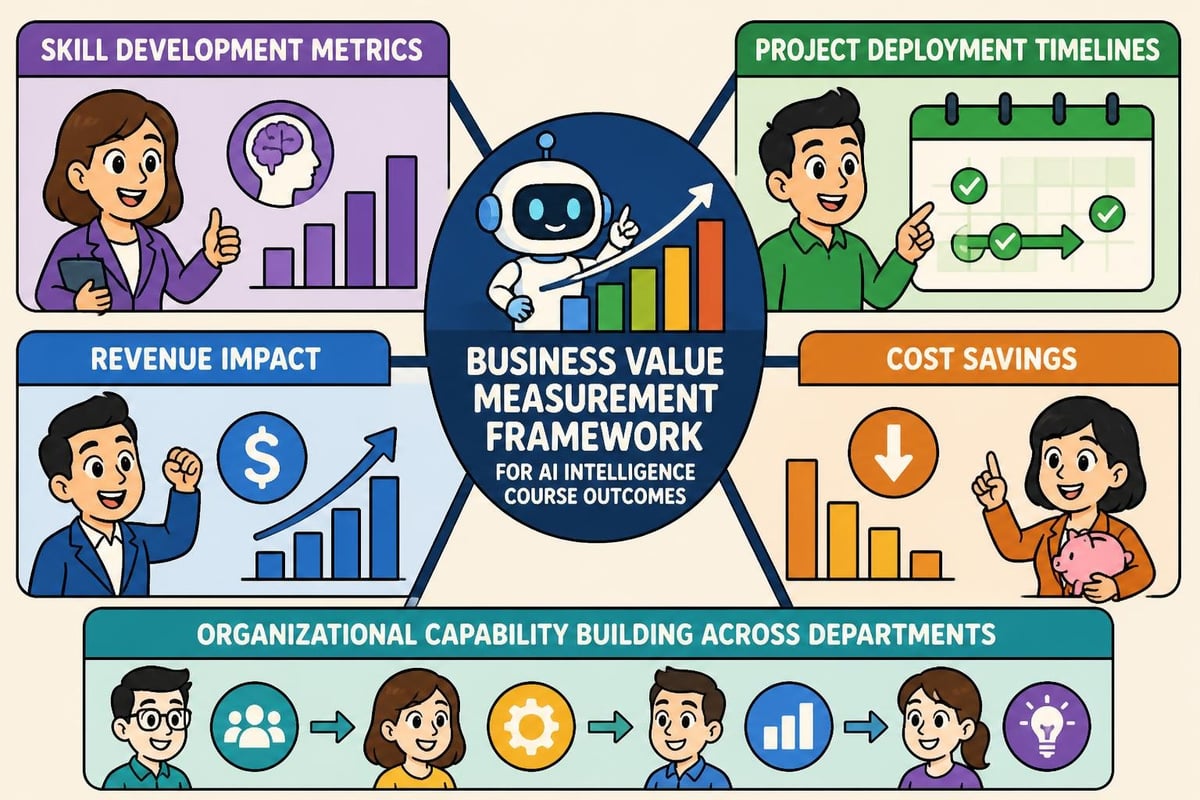
Organizations investing in AI training need frameworks for measuring return on investment beyond simple completion metrics. Effective measurement tracks skill acquisition, project delivery, and business outcomes.
Skill Acquisition Metrics
Quantifiable skill development provides accountability and helps refine curriculum design:
| Metric Category | Measurement Approach | Target Outcome |
|---|---|---|
| Technical proficiency | Coding assessments, project complexity | 80%+ pass rate on certification exams |
| Application speed | Time to first production model | 50% reduction in deployment timeline |
| Problem-solving | Novel use case identification | 3+ new AI initiatives per cohort |
| Knowledge retention | Post-training assessments at 3, 6, 12 months | >70% retention at 6 months |
Leading organizations tie these metrics to promotion criteria and project assignments, creating clear pathways from training to career advancement. This alignment increases engagement and completion rates.
Business Value Generation
The ultimate measure of training success is business impact. Track outcomes such as:
- Revenue generated by AI-powered features or products
- Cost savings from process automation and optimization
- Customer satisfaction improvements from personalization
- Risk reduction through better forecasting and fraud detection
Case studies from participants provide qualitative evidence of value. Documenting specific projects-such as a recommendation engine increasing conversion by 15% or a predictive maintenance model reducing downtime by 30%-builds institutional support for continued investment.
Implementation Strategies for Corporate Programs
Rolling out enterprise-wide AI training requires change management, resource allocation, and executive sponsorship. Successful implementations follow structured approaches that minimize disruption while maximizing participation.
Cohort Design and Peer Learning
Learning cohorts create accountability and enable collaborative problem-solving. Effective cohort strategies include:
- Cross-functional teams: mixing engineers, analysts, product managers
- Skill-based grouping: separating beginners from advanced practitioners
- Mentorship pairing: matching experienced AI practitioners with learners
- Project teams: real business problems as capstone requirements
Cohorts transform an ai intelligence course from isolated study into community learning. Participants report higher engagement when learning alongside colleagues facing similar challenges.
Infrastructure and Tool Provisioning
Technical requirements extend beyond course platform access:
- Cloud compute credits for model training (AWS, Azure, GCP)
- Version control and collaboration tools (GitHub, GitLab)
- Data storage and processing infrastructure
- Deployment environments for testing production readiness
Organizations should budget for infrastructure costs separately from course fees. Underestimating computational requirements creates frustration and limits practical learning.
Continuous Learning and Advanced Specialization
AI evolves rapidly, making continuous education essential. After completing foundational training, professionals should pursue specialized tracks aligned with career goals and organizational needs.
Specialization Pathways
Advanced learning follows several distinct paths:
- Computer vision: image classification, object detection, segmentation
- Natural language processing: language models, sentiment analysis, translation
- Reinforcement learning: game AI, robotics, optimization problems
- MLOps: production deployment, monitoring, CI/CD for ML systems
Platforms like MammothClub offer structured progression from foundational courses through advanced specializations. This scaffolded approach prevents overwhelming learners while enabling depth in chosen areas.
Staying Current with Research and Tools
The six-month knowledge half-life in AI requires systematic approaches to staying current:
- Follow key conferences (NeurIPS, ICML, CVPR) and read selected papers
- Experiment with new frameworks and tools in side projects
- Participate in Kaggle competitions or open-source contributions
- Join professional communities and discussion forums
- Attend workshops and bootcamps on emerging techniques
Organizations should allocate dedicated learning time-typically 4-6 hours per week-for practitioners to explore new developments. This investment prevents skill obsolescence and maintains competitive advantage.
Selecting the Right Program for Your Needs
The proliferation of AI courses creates decision paralysis. Evaluating programs systematically ensures alignment with learning objectives and maximizes return on investment.
Evaluation Criteria Framework
Assess potential programs across multiple dimensions:
Curriculum depth:
- Covers mathematical foundations through deployment
- Includes hands-on projects with real datasets
- Addresses ethics and governance comprehensively
Instructor expertise:
- Industry experience implementing production AI systems
- Research contributions or recognized thought leadership
- Teaching evaluations from previous cohorts
Platform capabilities:
- Integrated development environments for practice
- Progress tracking and competency dashboards
- Certificate recognition by employers
Support infrastructure:
- Instructor office hours and Q&A sessions
- Peer community and discussion forums
- Career services and job placement assistance
Programs offering interactive bootcamps typically provide more intensive support than self-paced courses. Consider learning preferences and available time when selecting formats.
Budget and Resource Planning
Total cost of ownership extends beyond tuition:
- Direct costs: course fees, certification exams, textbooks
- Infrastructure: cloud computing, development tools, data storage
- Time investment: 10-15 hours weekly for 12-16 weeks
- Opportunity cost: projects deferred during training period
Enterprise buyers should negotiate volume pricing and explore corporate packages that bundle multiple course access with administrative dashboards. These platforms provide visibility into completion rates and skill development across the organization.
Selecting and completing an ai intelligence course represents a strategic investment in professional capabilities and organizational competitiveness. The most effective programs combine rigorous technical foundations with practical application, ethical considerations, and business context. Whether you're an individual contributor seeking career advancement or an organization building AI capability at scale, MammothClub delivers comprehensive training through 3,000+ on-demand courses, interactive bootcamps, and AI-powered learning dashboards designed to transform knowledge into measurable business outcomes.