Artificial intelligence is transforming every industry at breakneck speed in 2026, making upskilling more urgent than ever. As organizations worldwide race to harness AI, the demand for expertise continues to surge, and millions are turning to online platforms for future-ready learning.
Choosing the right coursera artificial intelligence course can be a game changer for your career. This guide showcases the 7 top Coursera picks for 2026, curated for professionals, students, and teams who want to stay ahead.
We will compare features, pricing, benefits, and the ideal audience for each course, helping you make smart, informed decisions. Discover how these programs can boost your skills, unlock new opportunities, and keep you at the forefront of AI advancement.
Why Choose Coursera for Artificial Intelligence Learning in 2026?
Coursera has become a powerhouse in the world of online AI education, especially for anyone seeking a trusted coursera artificial intelligence course. In 2026, its impact is more significant than ever, thanks to strategic partnerships with top universities and leading tech companies. Collaborations with Stanford, IBM, Google, Microsoft, and DeepLearning.AI ensure that course content remains current, relevant, and practical.
With a vast and continually updated catalog, Coursera covers all dimensions of artificial intelligence. Learners can access foundational topics like machine learning and deep learning, as well as advanced subjects such as generative AI, prompt engineering, and MLOps. The platform’s flexible, self-paced structure makes it accessible for professionals, students, and organizations across the globe.
Affordability is another key advantage. Many courses offer free audit options, with paid certificates available for those seeking formal recognition. Employers increasingly value Coursera certificates, especially in AI, as they signal up-to-date skills aligned with market needs.
Coursera’s learning experience combines video lectures, real-world projects, hands-on labs, and peer-reviewed assignments. This blend supports a variety of learning styles and deepens understanding. The platform has helped millions upskill, with its global reach expanding year after year. According to Coursera's AI Course Enrollment Statistics 2025, AI course enrollments on Coursera soared, reflecting the urgent demand for these skills across industries.
Coursera’s Evolving Role in AI Education
Coursera’s unique value lies in its close connection to both academia and industry. Its partnerships bring together world-class instructors and real-world expertise, ensuring every coursera artificial intelligence course is built on the latest research and practical trends. The catalog features not only technical tracks but also business-focused and ethical AI programs.
Learners benefit from multiple formats:
- Video lectures for conceptual understanding
- Hands-on labs for skill application
- Peer-reviewed assignments for feedback and collaboration
- Capstone projects to showcase mastery
The platform’s accessibility means anyone can start learning AI, regardless of location or prior experience. Financial aid options further lower barriers, making top-tier AI education widely available.
Success stories highlight Coursera’s impact. Millions have transitioned into AI roles or advanced their careers after completing a coursera artificial intelligence course. Industry recognition of Coursera certificates continues to grow, with employers seeking candidates who demonstrate both knowledge and hands-on ability.
How to Evaluate the Best AI Courses on Coursera
Choosing the right coursera artificial intelligence course requires careful evaluation. Start by assessing course content depth, instructor expertise, and the balance of theory to hands-on learning. The most effective programs offer a mix of lectures, labs, and real-world projects.
Key criteria for evaluation include:
| Criteria | Why It Matters |
|---|---|
| Content Depth | Ensures comprehensive skill development |
| Instructor Expertise | Guarantees quality and up-to-date knowledge |
| Hands-On Projects | Builds practical, job-ready abilities |
| Peer Support | Encourages collaboration and problem-solving |
| Certification Value | Enhances employability and credibility |
Align your course choice with your career goals. For example, aspiring developers may seek technical certificates, while business leaders might opt for strategic or non-technical programs. Comparing beginner versus advanced tracks, or business-focused versus technical offerings, helps match learning paths to individual needs.
Coursera reports high completion rates and strong learner satisfaction for its top AI programs. Emerging trends, such as the integration of generative AI and cloud-based workflows, show that Coursera continually adapts to industry demands. This ensures each coursera artificial intelligence course remains relevant for the evolving job market.
7 Top Coursera Artificial Intelligence Course Picks for 2026
Choosing the right coursera artificial intelligence course is a pivotal step for anyone looking to thrive in the AI-driven world of 2026. With so many options available, it can be overwhelming to find the course that best matches your goals, experience, and learning preferences.
Below, we break down the seven most impactful Coursera artificial intelligence course options for this year. Each course is evaluated for its pricing, features, benefits, audience fit, and unique strengths, so you can make a confident decision for your upskilling journey.
IBM AI Engineering Professional Certificate
The IBM AI Engineering Professional Certificate stands out as a comprehensive coursera artificial intelligence course for those determined to master the full AI engineering pipeline.
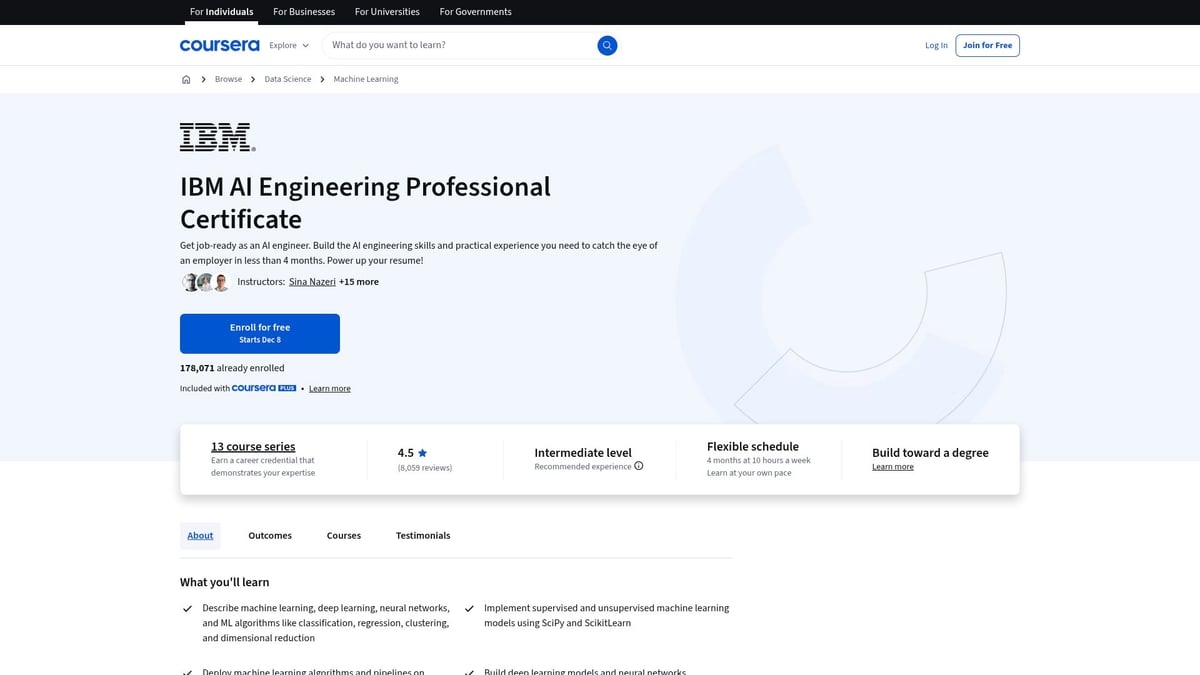
Pricing: Subscription model, typically $39–$59/month, with financial aid available. The duration depends on your study pace, but expect a significant time investment due to the depth of material.
Core Features:
- 13 interconnected courses covering machine learning, deep learning, NLP, computer vision, generative AI, large language models, Hugging Face, and LangChain.
- Hands-on labs and real-world projects using Python, TensorFlow, and PyTorch.
Benefits: This coursera artificial intelligence course delivers end-to-end expertise, equipping learners with the skills to build and deploy AI models in practical settings. The IBM credential is well recognized by employers.
Target Audience: Ideal for aspiring AI engineers, developers, and data scientists with a solid Python foundation.
Pros:
- Extensive real-world projects.
- Industry recognition.
- Python-focused curriculum.
Cons:
- Significant time commitment required.
- Intermediate Python skills recommended.
Example: Learners build and deploy deep learning models, gaining hands-on experience with TensorFlow and PyTorch.
Unique: Among the most complete AI engineer tracks, this coursera artificial intelligence course offers a robust, career-focused pathway from fundamentals to advanced deployment.
AI For Everyone – Andrew Ng (DeepLearning.AI)
If you are new to AI or a non-technical professional, this coursera artificial intelligence course by Andrew Ng is a smart introduction.
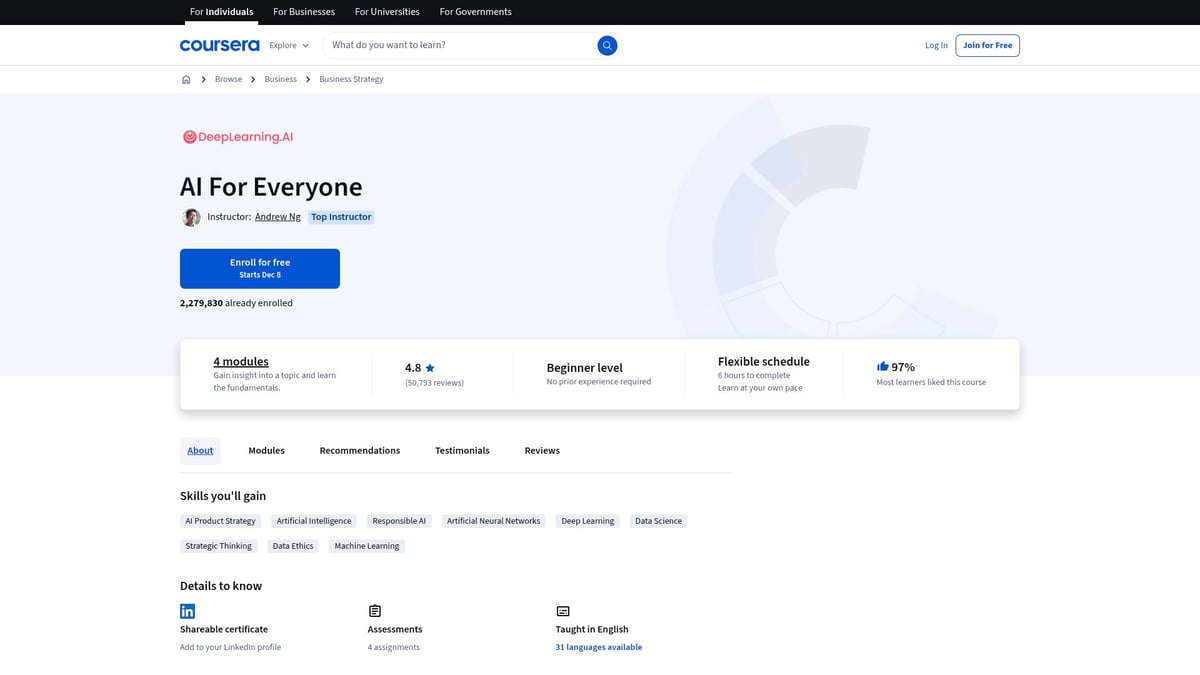
Pricing: Audit for free, or pay a fee for a certificate. The course is concise and manageable, making it accessible even for busy professionals.
Core Features:
- Non-technical, business-focused content.
- Explains AI strategy, terminology, and ethical considerations in clear, simple terms.
Benefits: The coursera artificial intelligence course demystifies AI for decision-makers, helping leaders and managers understand how to drive AI adoption.
Target Audience: Executives, product managers, entrepreneurs, and anyone new to AI.
Pros:
- No coding required.
- Renowned instructor.
- Clear, practical explanations.
Cons:
- Not technical.
- Limited hands-on activities.
Example: Case studies highlight AI adoption in industries such as healthcare, retail, and manufacturing.
Unique: This coursera artificial intelligence course is focused on AI’s organizational and societal impact, making it a must for leaders seeking clarity and confidence in the AI era.
Microsoft AI & ML Engineering Professional Certificate
For those aiming to integrate AI skills with cloud deployment, the Microsoft AI & ML Engineering Professional Certificate is a top coursera artificial intelligence course.
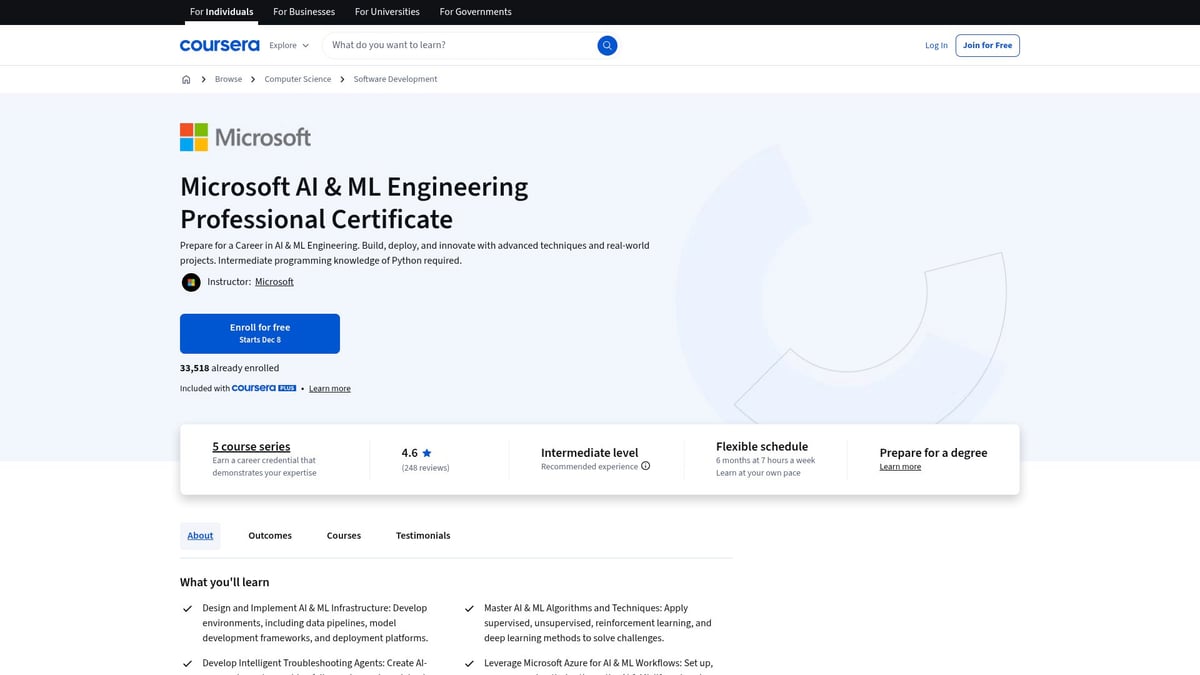
Pricing: Subscription-based at around $49/month, with financial aid options. The program is structured for intermediate learners, typically completed in several months.
Core Features:
- 5-course program spanning scalable AI/ML infrastructure, NLP, and cloud workflows with Azure.
- Includes a capstone project for hands-on experience.
Benefits: The coursera artificial intelligence course provides enterprise-ready skills and direct exposure to Microsoft’s cloud ecosystem, a vital asset for modern organizations.
Target Audience: Intermediate developers, IT professionals, and enterprise engineers.
Pros:
- Cloud-native skills development.
- Real-world projects.
- Up-to-date with Microsoft technology.
Cons:
- Azure experience helpful.
- Technical focus may not suit all learners.
Example: Deploying AI models on Microsoft Azure for real business applications.
Unique: This coursera artificial intelligence course uniquely merges AI/ML fundamentals with cloud deployment expertise, preparing learners for roles in enterprise environments.
Generative AI: Prompt Engineering Basics
Prompt engineering has become the most in-demand AI skill of 2026, and this coursera artificial intelligence course delivers exactly that.
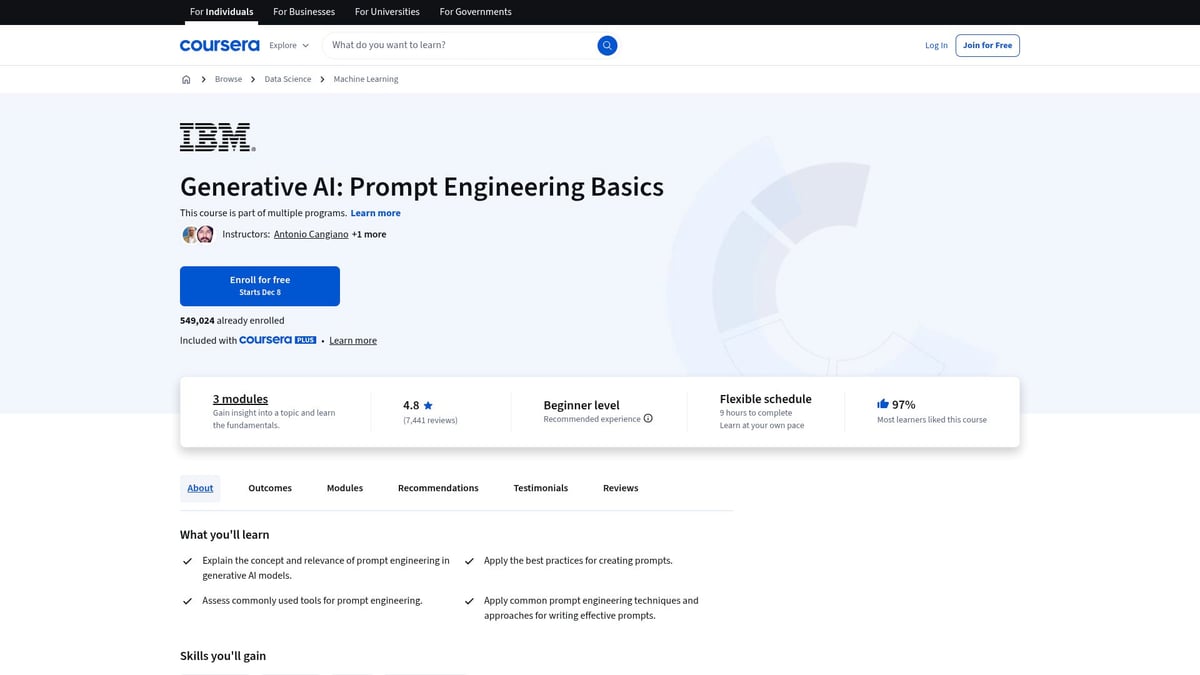
Pricing: Free to audit, with an optional paid certificate. The course is brief, making it easy to complete for busy professionals or students.
Core Features:
- In-depth exploration of prompt engineering for generative AI tools.
- Covers multimodal prompts, hands-on labs, text/image generation, and prompt evaluation.
Benefits: This coursera artificial intelligence course is practical, up-to-date, and accessible to non-coders, making it suitable for a broad range of learners.
Target Audience: AI enthusiasts, creatives, students, business users.
Pros:
- Practical, hands-on labs.
- Accessible to all backgrounds.
Cons:
- Limited to prompt engineering.
- Does not cover the full AI spectrum.
Example: Participants learn to craft effective prompts for tools like ChatGPT and advanced image generation models.
Unique: Focuses exclusively on maximizing generative AI productivity, regardless of technical background.
AI For Business Specialization (Wharton)
Business leaders seeking to harness AI’s power should consider this coursera artificial intelligence course from Wharton.
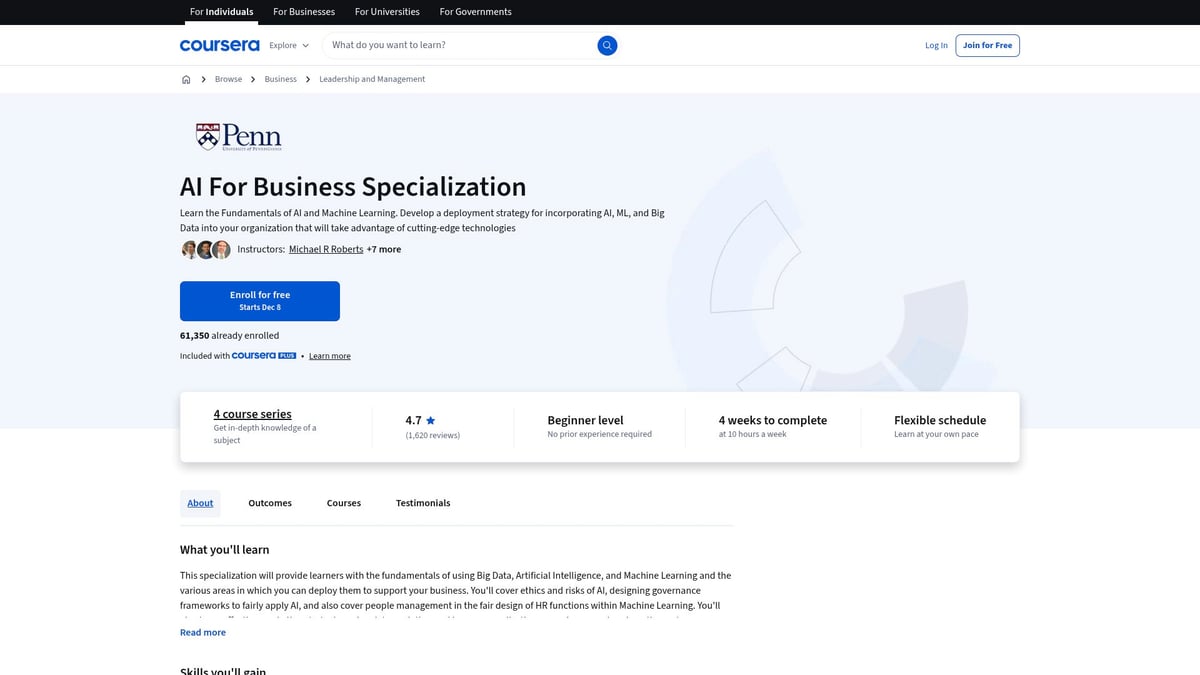
Pricing: Subscription model, about $49/month, with financial aid available. The specialization can be completed at your own pace.
Core Features:
- Explores AI applications in marketing, HR, ethics, and governance.
- Real-world case studies and actionable frameworks.
Benefits: The coursera artificial intelligence course bridges the gap between technical AI and business strategy, empowering leaders to make data-driven decisions.
Target Audience: Business leaders, consultants, product managers, MBAs.
Pros:
- Actionable, real-world frameworks.
- Industry insights from Wharton faculty.
Cons:
- Less technical.
- Not focused on programming or algorithms.
Example: Applying AI to customer lifecycle management and HR analytics to drive business value.
Unique: Emphasizes ethical, organizational, and strategic aspects of AI, making it essential for decision-makers.
Introduction to Artificial Intelligence (Google)
For those starting their AI journey, this coursera artificial intelligence course by Google offers a friendly and accessible entry point.
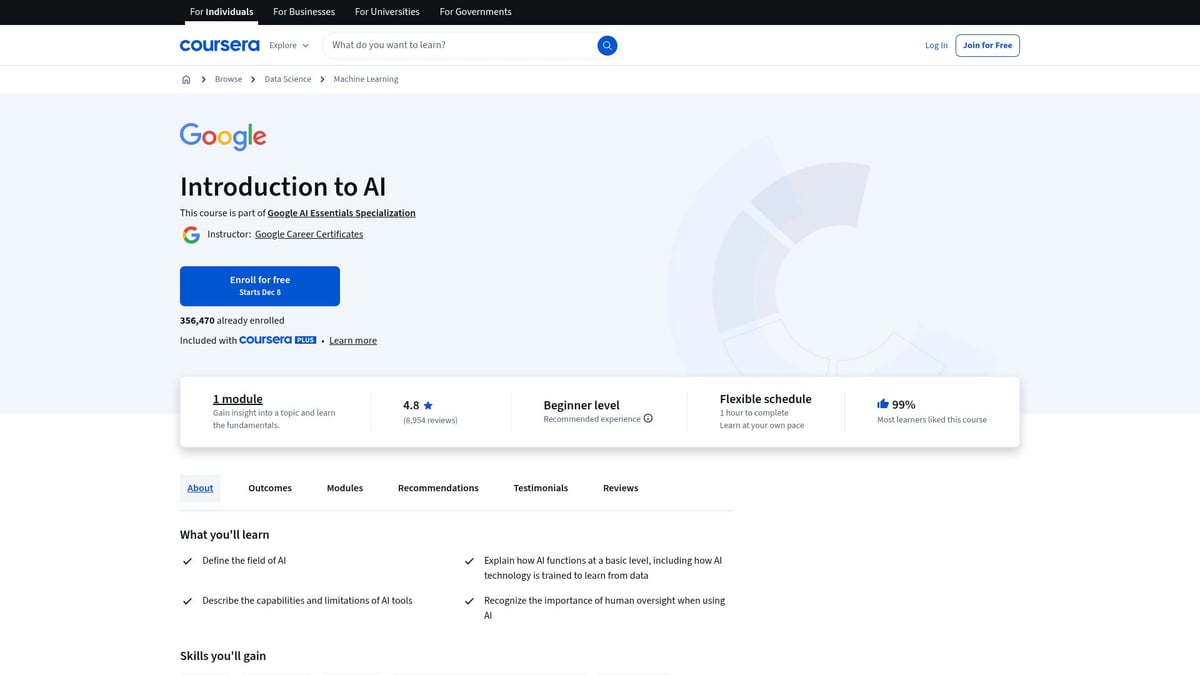
Pricing: Free to audit, with a certificate available for a fee. The course is designed for beginners and can be completed quickly.
Core Features:
- Covers AI fundamentals, machine learning, deep learning, neural networks, and generative AI.
- Hands-on labs and practical examples.
Benefits: This coursera artificial intelligence course provides up-to-date content and Google’s perspective on AI innovation.
Target Audience: Beginners, career switchers, business professionals.
Pros:
- No prerequisites.
- Practical, real-world examples.
Cons:
- Introductory level.
- Limited coverage of advanced topics.
Example: Learners explore the impact of generative AI on workplace innovation.
Unique: Features insights from Google experts and real-world AI use cases.
IBM AI Developer Professional Certificate
Aspiring AI developers aiming for job-ready skills will find this coursera artificial intelligence course a powerful choice.
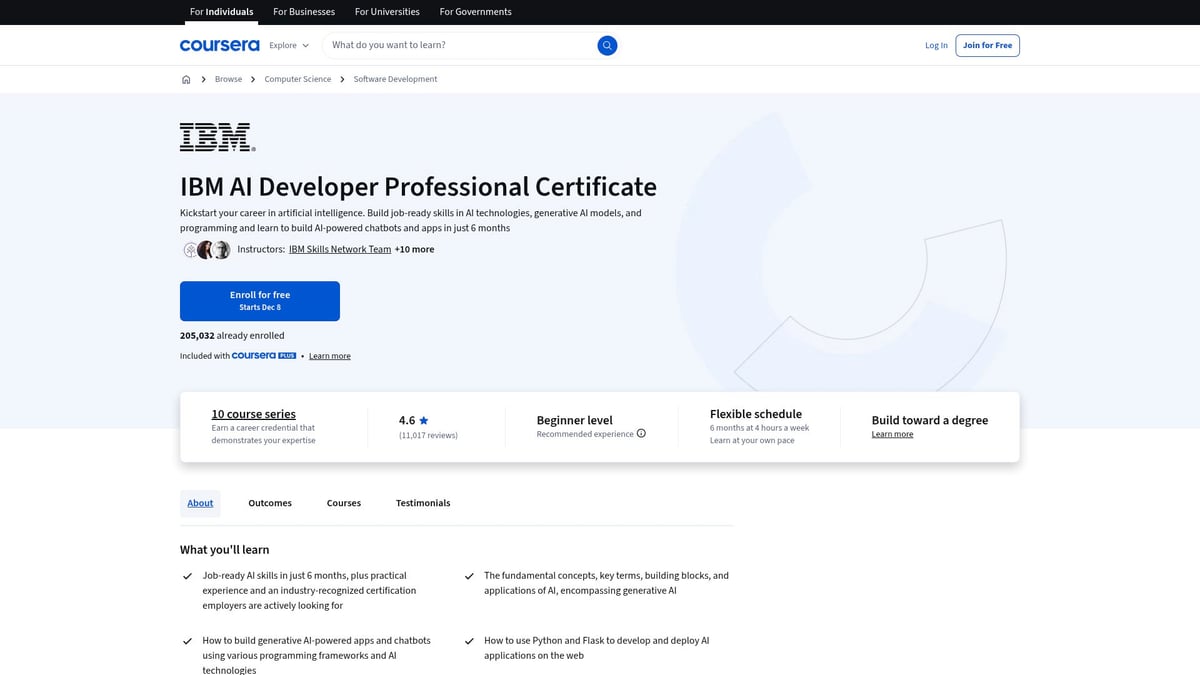
Pricing: Subscription model at $39–$59/month, with financial aid available. The course duration varies based on learner pace.
Core Features:
- Focuses on AI-powered app development, chatbots, sentiment analysis, large language models, and portfolio projects.
Benefits: This coursera artificial intelligence course is project-based, ensuring learners build a robust portfolio and gain practical, industry-relevant skills. It confers an IBM credential recognized by employers.
Target Audience: AI developers, software engineers, and career upskillers with Python and web basics.
Pros:
- Strong hands-on projects.
- Portfolio creation.
- Industry relevance.
Cons:
- Requires foundational Python and web knowledge.
Example: Learners build a voice assistant and a universal language translator using AI.
Unique: Prioritizes practical AI app development for immediate career impact.
At-a-Glance Comparison Table
| Course | Provider | Skill Level | Focus Area | Pricing | Certificate | Key Benefit |
|---|---|---|---|---|---|---|
| IBM AI Engineering | IBM | Intermediate/Advanced | Deep AI engineering | $39–$59/mo | Yes | End-to-end AI expertise |
| AI For Everyone | DeepLearning.AI | Beginner | Business, strategy | Free/$ | Yes | Non-technical, strategic |
| Microsoft AI & ML | Microsoft | Intermediate | Cloud AI/ML | $49/mo | Yes | Cloud deployment skills |
| Generative AI Prompt | DeepLearning.AI | All levels | Prompt engineering | Free/$ | Yes | GenAI productivity |
| AI For Business | Wharton | Intermediate | Business applications | $49/mo | Yes | Strategic business AI |
| Intro to AI | Beginner | AI fundamentals | Free/$ | Yes | Accessible entry point | |
| IBM AI Developer | IBM | Intermediate | AI app development | $39–$59/mo | Yes | Job-ready, portfolio-based |
For those comparing how long each coursera artificial intelligence course may take, refer to this resource on Artificial intelligence course duration for a detailed breakdown of typical study timelines.
No matter your background, there is a coursera artificial intelligence course tailored to your needs. Use the course features, benefits, and target audience insights above to select the best fit for your AI learning journey.
What to Consider When Selecting an AI Course on Coursera
Choosing the right coursera artificial intelligence course is a pivotal step in building a successful AI career. The abundance of options can be overwhelming, so a structured approach is essential.
Aligning Course Choice with Your AI Career Goals
Before enrolling in a coursera artificial intelligence course, clarify your desired role within the AI ecosystem. Are you aiming to become an AI engineer, a business leader, or a technical specialist? Defining this will help you focus on courses that align with your ambitions.
For technical roles, such as developer or engineer, look for programs that offer in-depth coding, hands-on projects, and advanced algorithms. Business leaders and strategists may benefit from courses that emphasize AI’s impact on organizations and decision-making rather than programming.
It is wise to assess your current AI knowledge before committing. Tools like the AI fluency assessment tool can help you gauge your proficiency and identify knowledge gaps, ensuring you choose a coursera artificial intelligence course that matches your experience.
Consider industry recognition and employability. Certificates from well-known platforms can boost your credibility and open doors to new opportunities. Real-world assignments and portfolio projects are crucial for demonstrating your capabilities to potential employers.
Matching Course Depth and Format to Your Needs
Not all coursera artificial intelligence course offerings are created equal. Evaluate the depth of content, instructor expertise, and the balance between theory and practical application. For those seeking technical mastery, prioritize courses with robust hands-on labs, coding exercises, and peer-reviewed projects.
Time commitment is another critical factor. Some programs require weeks of study, while others can be completed at your own pace. Ensure the course fits your schedule and learning preferences, whether you prefer self-paced video lectures or structured timelines.
Prerequisites matter. Advanced tracks often require prior knowledge in Python or statistics. If you are a beginner, start with foundational courses before progressing to specialized topics. Comparing course syllabi, reviews, and completion rates can help you select the most effective coursera artificial intelligence course for your level.
Continuous upskilling is now a necessity. According to the Stanford AI Index Report 2024: Education Chapter, the demand for AI professionals is rising rapidly, making ongoing education vital for career advancement. Choose courses that not only meet your current needs but also prepare you for future trends in AI.
FAQs About Coursera Artificial Intelligence Courses in 2026
Choosing the right coursera artificial intelligence course in 2026 can spark many questions for learners at every stage. Below, you will find clear answers to the most common queries, helping you make informed decisions about your AI education path.
Common Questions and Expert Answers
How long do top Coursera artificial intelligence course options take to complete in 2026?
Course lengths vary. Introductory programs like "AI For Everyone" can be finished in under 10 hours, while professional certificates such as IBM or Microsoft tracks often require 3 to 6 months at a pace of 5–8 hours per week. Many courses are self-paced, so you can adjust your schedule as needed.
Are Coursera AI certificates recognized by employers and industry leaders?
Yes, completion certificates from a coursera artificial intelligence course—especially those from partners like IBM, Microsoft, or Google—are highly valued in the tech industry. They signal verified skills and commitment to ongoing learning. Many employers specifically mention Coursera credentials in job postings for AI and machine learning roles.
Can you audit these courses for free, and what do you miss without a certificate?
Most Coursera artificial intelligence course offerings allow free auditing, which grants access to video lectures and some materials. However, graded assignments, hands-on labs, and the official certificate require payment. The certificate is essential for showcasing your achievement on LinkedIn or to employers.
What technical prerequisites are needed for advanced AI programs?
Entry-level courses require no prior experience. Advanced coursera artificial intelligence course tracks, especially those focused on engineering or development, often expect you to have a solid grasp of Python, basic math, and sometimes cloud computing fundamentals. For those targeting an AI engineering career, following an Azure AI Engineer career roadmap can be a strategic step.
How do Coursera courses compare to other platforms (edX, Udemy, MammothClub) for AI learning?
Coursera artificial intelligence course selections stand out for their strong university and industry partnerships, hands-on projects, and recognized certificates. Platforms like edX offer similar academic rigor, while Udemy provides a broader but less standardized range. MammothClub and others may focus on niche or foundational skills, but Coursera's wide catalog and employer recognition make it a top choice.
Are there financial aid and scholarship options available?
Absolutely. Most coursera artificial intelligence course programs offer financial aid or scholarships. You can apply directly through the Coursera platform, making high-quality AI education more accessible for global learners.
Can you share examples of learners transitioning to AI roles after Coursera programs?
Many learners have successfully launched AI careers after completing a coursera artificial intelligence course. For example, career switchers have moved from marketing or finance to roles like data scientist or machine learning engineer. The rapid growth in AI course enrollments, as reported in Coursera's AI Course Enrollment Growth in 2023, highlights this trend and the platform's global impact.
What is the value of continuous upskilling in AI through Coursera?
With AI evolving rapidly, ongoing education is a must. Completing more than one coursera artificial intelligence course allows professionals to stay relevant, increase job placement rates, and often secure higher salaries. Continuous upskilling is now a standard expectation across industries.
No matter your background, the right coursera artificial intelligence course can open doors to new opportunities, support career growth, and keep you ahead in the AI revolution.
As you consider which Coursera AI courses best fit your goals for 2026, remember that the journey doesn’t have to stop here. Investing in your AI education now means staying competitive and confident as the field rapidly evolves. If you’re looking to build a solid foundation and earn a credential that stands out, you don’t have to wait or risk a big upfront cost. You can start building your expertise at your own pace, with support and interactive tools to make learning stick. Ready to take that first step? Become a certified AI Foundation Specilaist. Start for free