
Managers today face unprecedented pressure to understand and implement artificial intelligence across their teams and operations. As AI reshapes business processes, decision-making frameworks, and competitive landscapes, the manager who lacks AI literacy risks becoming obsolete. An ai course for managers addresses this critical gap by equipping leaders with both technical understanding and strategic judgment needed to guide teams through AI transformation. Unlike technical training designed for engineers, management-focused AI education balances foundational concepts with practical application, enabling leaders to evaluate AI initiatives, communicate effectively with technical teams, and drive measurable business outcomes.
Why Traditional Management Skills Fall Short in the AI Era
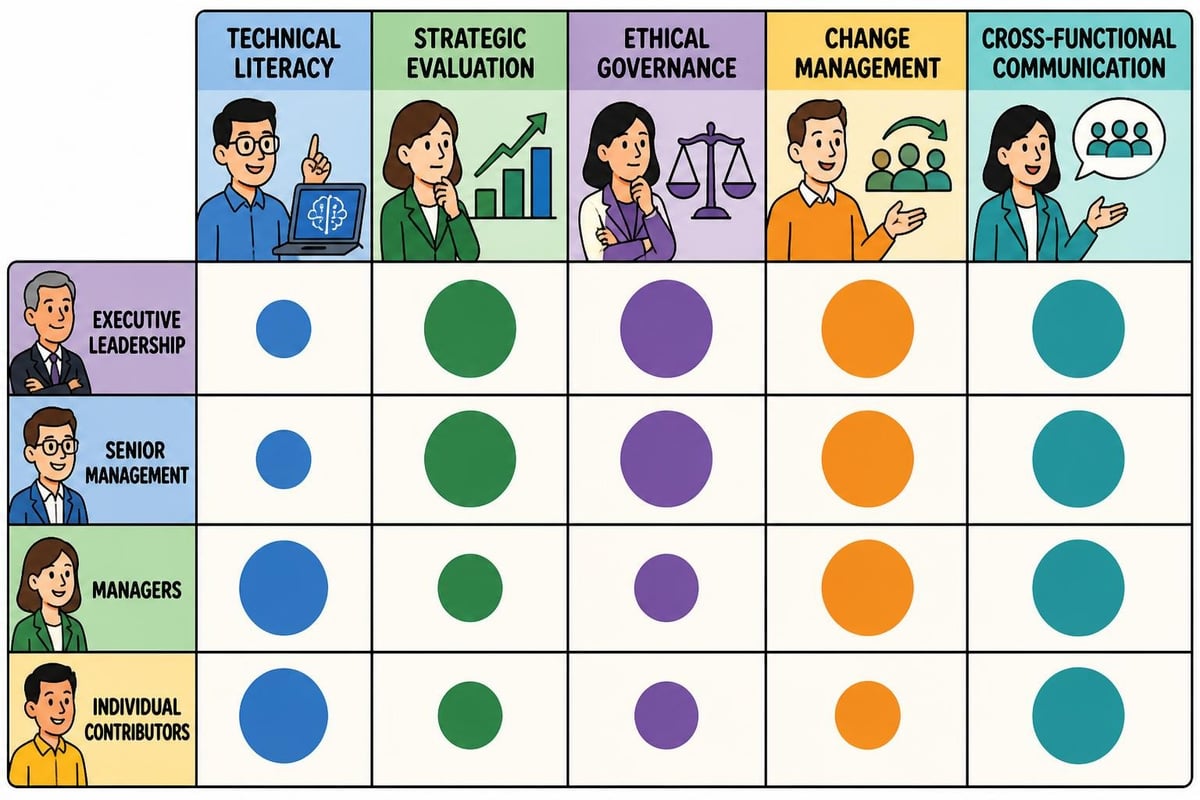
The managerial toolkit that served leaders well for decades no longer suffices in AI-driven organizations. Delegation, performance management, and strategic planning remain essential, but they must now incorporate AI-specific considerations that weren't part of traditional leadership training.
Modern managers need to understand algorithmic decision-making, data dependencies, and model limitations to make informed choices. When a data science team proposes implementing a predictive analytics system, managers must evaluate feasibility, ethical implications, and organizational readiness rather than simply approving technical recommendations. Research from Harvard Business Review shows how AI is fundamentally redefining managerial roles, requiring leaders to develop new competencies around human-machine collaboration.
The Knowledge Gaps Holding Managers Back
Most managers encounter specific knowledge barriers when engaging with AI initiatives:
- Technical vocabulary disconnect: Inability to communicate effectively with data scientists and AI engineers
- ROI evaluation challenges: Difficulty assessing the business value and resource requirements of AI projects
- Ethical and regulatory blindspots: Limited understanding of compliance requirements and responsible AI frameworks
- Change management deficiencies: Lack of strategies for managing workforce transitions and skill displacement
An ai course for managers directly addresses these gaps through structured curriculum that builds both conceptual understanding and practical application skills.
What Makes an Effective AI Course for Managers Different
Management-focused AI education differs fundamentally from technical training in scope, depth, and application. The most effective programs recognize that managers don't need to build neural networks but must understand how these systems create business value and organizational risk.
Curriculum Components That Matter
Strategic AI Fundamentals form the foundation, covering machine learning categories, natural language processing applications, computer vision use cases, and predictive analytics without requiring programming skills. Managers learn to recognize appropriate AI applications for specific business problems.
Use Case Analysis provides concrete examples across industries. Rather than theoretical explanations, effective courses examine real implementations: how retailers use recommendation engines, how manufacturers deploy predictive maintenance, and how financial institutions implement fraud detection systems.
| Learning Focus | Technical AI Course | Manager-Focused AI Course |
|---|---|---|
| Programming | Python, TensorFlow, PyTorch | No coding required |
| Mathematics | Linear algebra, calculus | Conceptual understanding only |
| Business Application | Limited | Primary focus |
| Team Leadership | Not covered | Core competency |
| Vendor Evaluation | Not covered | Critical skill |
| Ethics & Governance | Optional | Mandatory |
Vendor and Tool Evaluation equips managers to assess AI platforms, service providers, and build-versus-buy decisions. This practical skill directly impacts budget allocation and project success rates.
The World Economic Forum emphasizes that AI adoption requires investing in people, making manager education a strategic imperative rather than optional professional development.
Building AI Literacy Across Management Levels
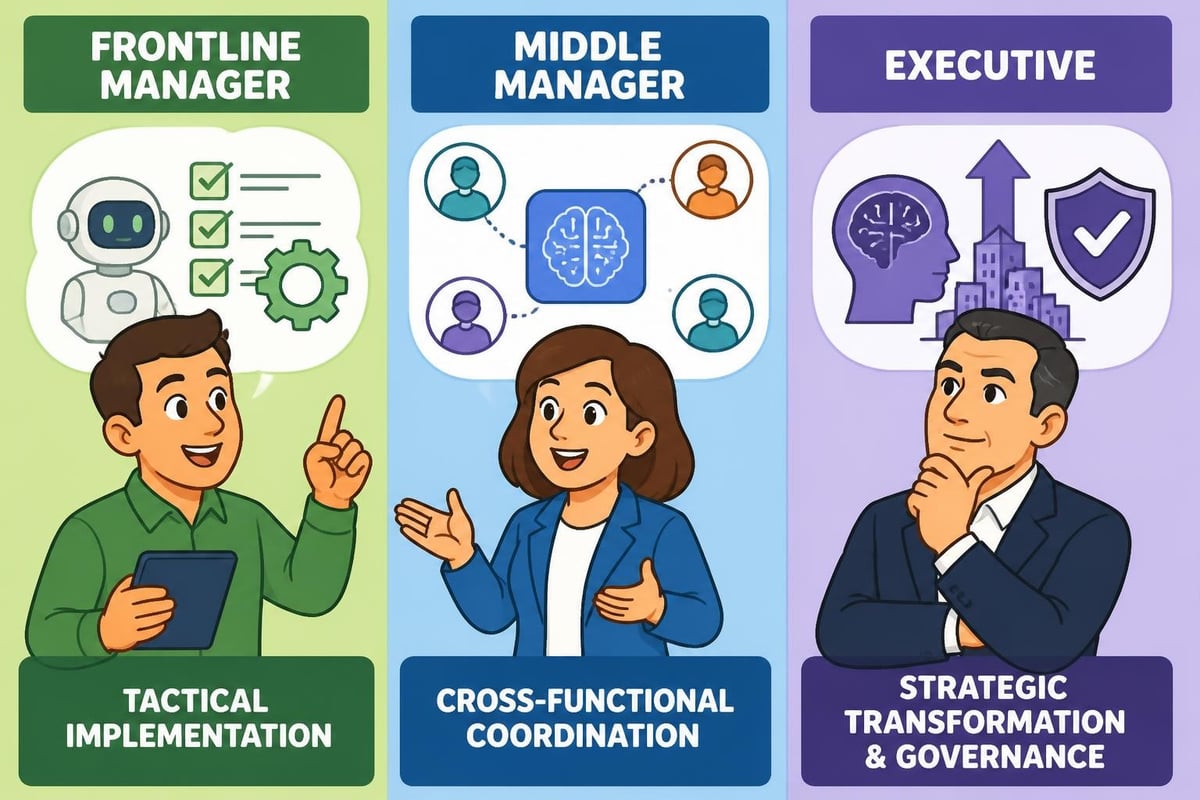
Different management tiers require tailored AI education that reflects their decision-making scope and organizational influence. A one-size-fits-all approach fails to address the distinct needs of frontline supervisors versus C-suite executives.
Frontline and Middle Management Focus
First-level managers need practical skills for immediate application:
- Identifying automation opportunities within their departments
- Managing hybrid teams where AI tools augment human work
- Interpreting AI-generated insights for tactical decisions
- Addressing employee concerns about AI displacement
- Measuring performance in AI-augmented workflows
Middle managers bridge strategy and execution, requiring deeper understanding of cross-functional AI initiatives, resource allocation for AI projects, and integration with existing systems.
Executive Leadership Requirements
Senior leaders need strategic perspective that an ai course for managers at the executive level provides. Harvard Business School's AI for Leaders program exemplifies this approach, focusing on competitive advantage, organizational transformation, and governance frameworks.
Executives must understand:
- Market disruption patterns created by AI competitors
- Talent strategy implications for recruiting and retaining AI-capable teams
- Board-level governance and risk management frameworks
- Partnership and acquisition opportunities in the AI ecosystem
Stanford HAI's professional education programs demonstrate how research-backed, human-centered approaches help leaders balance innovation with responsibility.
Practical Applications That Drive Business Results
The value of an ai course for managers becomes apparent through measurable business outcomes. Effective programs emphasize application over theory, ensuring participants can immediately deploy new knowledge.
Decision Framework Development
Managers learn structured approaches for evaluating AI opportunities:
Problem Definition: Articulate business challenges that AI might address, distinguishing between problems suitable for AI versus those better solved through traditional methods.
Data Readiness Assessment: Evaluate whether sufficient quality data exists to support proposed AI solutions, understanding data collection, cleaning, and governance requirements.
Risk and Compliance Analysis: Apply frameworks like the NIST AI Risk Management Framework to identify potential harms, biases, and regulatory considerations before project approval.
Building Cross-Functional Communication Skills
Managers trained in AI literacy become effective translators between technical teams and business stakeholders. They can:
- Translate technical capabilities into business value propositions
- Communicate project constraints and timelines to non-technical executives
- Facilitate productive discussions between data scientists and domain experts
- Set realistic expectations about AI capabilities and limitations
This bridging function accelerates project timelines and improves success rates significantly.
Selecting the Right AI Training for Your Management Team
Organizations face numerous options when sourcing AI education for managers, from university executive programs to corporate training platforms. The optimal choice depends on organizational maturity, budget constraints, and learning objectives.
Key Selection Criteria
Credibility and Authority matter significantly. Programs backed by recognized institutions or industry leaders provide frameworks that withstand scrutiny from boards and stakeholders. However, newer platforms often deliver more current content reflecting rapid AI advancement.
Practical Relevance should drive curriculum evaluation. The best ai course for managers includes case studies from your industry, addresses your organization's specific AI maturity level, and provides tools applicable to your business model.
Learning Format Flexibility impacts completion rates and knowledge retention:
- Self-paced online courses allow managers to learn around demanding schedules
- Cohort-based programs build peer networks and facilitate discussion
- Blended approaches combine asynchronous content with live application workshops
- In-house customized training addresses organization-specific challenges directly
Many organizations find comprehensive platforms like MammothClub's extensive AI course library offer the breadth needed to serve managers across different functions and seniority levels.
Certification and Credentialing Considerations
While certifications aren't mandatory for managers (unlike technical roles), they provide valuable signals:
- Demonstrate commitment to AI literacy to boards and stakeholders
- Establish baseline competency standards across management teams
- Create accountability for completing comprehensive training
- Support career advancement and role transitions
Organizations increasingly include AI literacy in performance expectations, making formal AI certifications valuable for career progression.
Implementing Manager AI Training at Scale
Rolling out AI education across an entire management population requires thoughtful planning and change management. Successful implementations follow proven patterns that maximize engagement and application.
Creating Organizational Buy-In
Executive Sponsorship proves essential. When senior leaders visibly participate in AI training and reference concepts in decision-making, middle management takes learning seriously.
Business Case Development should quantify expected benefits:
| Metric | Before AI Training | After AI Training | Improvement |
|---|---|---|---|
| AI Project Success Rate | 35% | 68% | +94% |
| Time to Decision on AI Proposals | 8 weeks | 3 weeks | -62% |
| Cross-Functional Collaboration Score | 6.2/10 | 8.4/10 | +35% |
| Manager Confidence in AI Decisions | 4.1/10 | 7.8/10 | +90% |
These projected improvements justify training investments and create accountability for measuring outcomes.
Designing Learning Pathways
Effective rollout sequences training to build momentum:
- Awareness Phase: Brief introductions and use case showcases (2-4 hours)
- Foundation Building: Core ai course for managers covering essential concepts (15-25 hours)
- Specialized Tracks: Department-specific applications and advanced topics (10-20 hours)
- Continuous Learning: Ongoing updates on emerging AI capabilities and case studies
AI learning pathways should accommodate varying baseline knowledge and learning speeds while ensuring all managers achieve minimum competency thresholds.
Measuring Training Impact and ROI
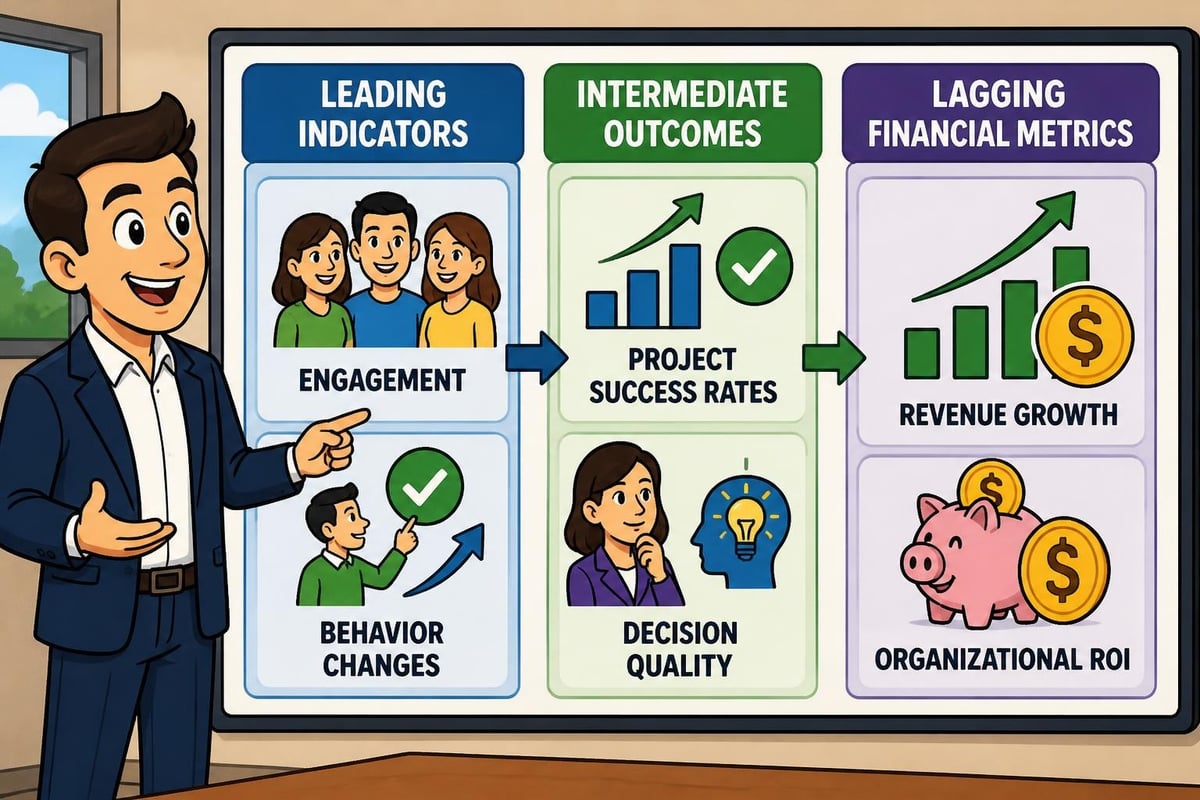
Organizations investing in manager AI education need frameworks for assessing effectiveness and calculating return on investment. Unlike technical training with clear skill demonstrations, management education requires different measurement approaches.
Leading Indicators of Success
Behavioral Changes signal knowledge application:
- Increased AI-related questions and proposals from managers
- Higher quality of AI project requests with clear business justification
- Improved vendor evaluation rigor and negotiation outcomes
- More sophisticated risk and ethical considerations in proposals
Engagement Metrics predict long-term adoption:
- Course completion rates above 80% indicate appropriate difficulty and relevance
- Time spent on optional advanced modules shows genuine interest
- Peer discussion quality and frequency demonstrate conceptual understanding
- Application of course frameworks in actual business situations
Lagging Indicators and Business Impact
Financial outcomes take longer to manifest but provide definitive ROI validation:
- AI Project Success Rates: Percentage of initiatives achieving stated objectives
- Time-to-Value: Duration from concept to production deployment
- Cost Efficiency: Reduced consulting spend as internal capability grows
- Innovation Velocity: Increased rate of AI experimentation and iteration
Organizations should establish baseline metrics before training deployment and track quarterly progress for at least 12 months.
Overcoming Common Implementation Challenges
Even well-designed AI training programs encounter predictable obstacles. Anticipating these challenges allows organizations to implement mitigation strategies.
Time and Attention Competition
Managers face constant demands on their schedules. Making AI education a priority requires:
- Protected learning time: Explicitly blocking calendars for course completion
- Performance integration: Including AI literacy in formal objectives and reviews
- Peer cohorts: Creating accountability through group learning commitments
- Microlearning options: Breaking content into 15-20 minute modules for flexibility
Some organizations mandate minimum training hours while others incentivize voluntary completion through recognition programs.
Varying Technical Backgrounds
Management populations span dramatic ranges in technical comfort. Some managers have engineering backgrounds while others avoided quantitative fields entirely. An effective ai course for managers addresses this through:
- Prerequisite assessments that route learners to appropriate starting points
- Glossaries and reference materials for technical terminology
- Optional deep-dive modules for technically inclined managers
- Non-technical analogies and explanations for complex concepts
The goal is baseline competency across all managers, not technical expertise.
Maintaining Currency in Rapidly Evolving Field
AI capabilities advance monthly, making static course content obsolete quickly. Solutions include:
- Quarterly content updates incorporating recent breakthroughs and case studies
- Supplement subscriptions: Monthly bulletins highlighting new developments
- Expert speaker series: Regular sessions with practitioners sharing current projects
- Community forums: Peer discussion spaces where managers share emerging practices
Platforms like MammothClub address currency through continuously updated course libraries that reflect the latest AI developments and applications.
Future-Proofing Management Careers Through AI Education
Investing in an ai course for managers represents more than skill development; it's career insurance in an AI-transformed economy. The managers who understand AI will lead organizations while those who don't risk marginalization.
Career Trajectory Implications
Promotion Readiness: Organizations increasingly require AI literacy for senior leadership roles. Managers without this foundation face career ceilings regardless of other competencies.
Strategic Influence: AI-literate managers contribute to strategy discussions rather than simply executing decisions made by others. This visibility accelerates advancement.
Adaptability Signaling: Completing AI training demonstrates learning agility and willingness to develop new competencies, qualities highly valued in dynamic environments.
Building Transferable Capabilities
The skills developed through manager-focused AI education extend beyond specific tools or techniques:
- Analytical thinking applicable to any data-driven decision context
- Technology evaluation useful for assessing emerging innovations beyond AI
- Change leadership transferable to various transformation initiatives
- Cross-functional collaboration valuable in increasingly matrixed organizations
These transferable capabilities make AI-trained managers attractive candidates across industries and roles.
Accessing Comprehensive Training Resources
Organizations seeking to develop AI-capable management teams benefit from platforms offering breadth, depth, and flexibility. MammothClub provides access to thousands of AI and technology courses alongside specialized programs designed specifically for different management levels and functional areas. The combination of self-paced learning, interactive elements, and measurable progress tracking creates effective pathways for busy managers to build essential AI competencies on their schedules.
Resources like the HBR Guide to Generative AI for Managers complement structured courses with practical frameworks for immediate application, while AWS's organizational leader resources provide vendor-neutral perspectives on implementation strategies.
Integrating AI Training with Broader Organizational Development
An ai course for managers delivers maximum value when integrated into comprehensive talent development strategies rather than treated as isolated training. This integration ensures knowledge application and cultural reinforcement.
Connecting to Leadership Development Programs
Organizations should position AI education as core leadership competency alongside traditional capabilities:
- Include AI literacy modules in emerging leader programs
- Require AI fundamentals before promotion to senior management
- Incorporate AI case studies into leadership simulations and exercises
- Assess AI understanding in 360-degree feedback processes
This elevation signals organizational commitment and normalizes AI as essential business knowledge.
Supporting Continuous Learning Culture
One-time training rarely produces lasting capability. Sustained development requires:
Learning Communities: Manager cohorts that continue meeting to discuss AI applications and share implementation experiences after formal training concludes.
Lunch-and-Learn Series: Regular sessions where managers present AI use cases from their departments, fostering peer learning and knowledge sharing.
Innovation Time: Dedicated hours for managers to experiment with AI tools and explore potential applications without immediate ROI pressure.
Expert Access: Ongoing channels to consult with AI specialists when evaluating specific opportunities or challenges.
Aligning Incentives and Recognition
Behavioral change requires reinforcement through formal and informal recognition:
- Celebrate managers who successfully implement AI initiatives
- Include AI project sponsorship in performance objectives
- Create innovation awards for creative AI applications
- Share success stories through internal communications channels
When organizational systems reward AI adoption, managers prioritize learning and application.
Managers who develop AI literacy position themselves and their organizations for sustained competitive advantage in an increasingly AI-driven business environment. The investment in structured AI education pays dividends through better decision-making, more effective team leadership, and accelerated innovation. Whether you're looking to upskill a single manager or transform an entire leadership team, MammothClub offers the comprehensive course library, interactive learning tools, and measurable progress tracking that make AI education accessible, engaging, and results-driven for busy professionals at every level.