The best way to learn machine learning online is to pick one structured path that matches your coding level, finish it with at least one portfolio project, and add a recognized credential once the fundamentals are solid. Free courses, subscription platforms and certificate programs all work, but they differ in hours, depth and the proof of skill they give you. This guide compares ten options on length, price and fit so you can choose by your goal and budget, not by popularity.
What to Know Before You Start
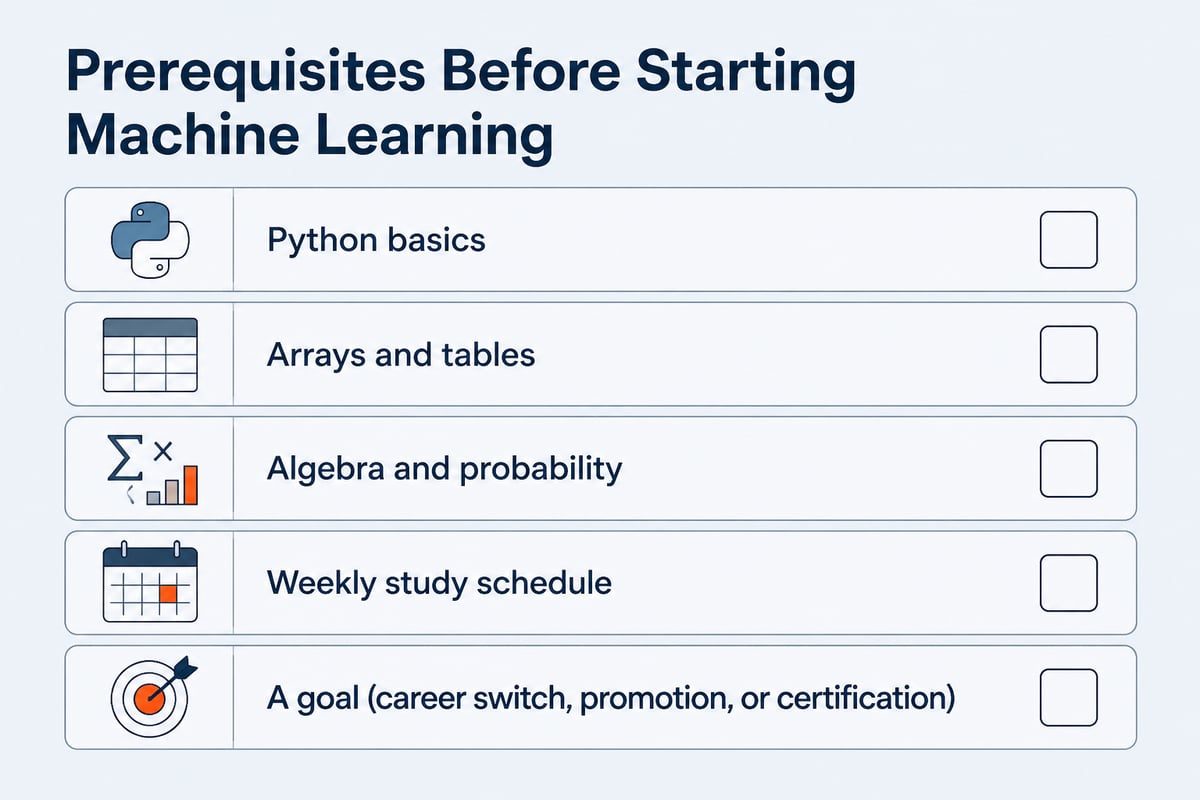
Most beginners need three things in place before any algorithm makes sense: basic Python, comfort with arrays and tables, and a working grasp of high school algebra and probability. You do not need advanced calculus on day one. Courses introduce the math as they go, but a weak Python foundation slows every later lesson.
If your Python is shaky, spend a week or two there first. A Python programming fundamentals learning path covers the syntax and data handling that machine learning courses assume.
Three decisions shape which course suits you:
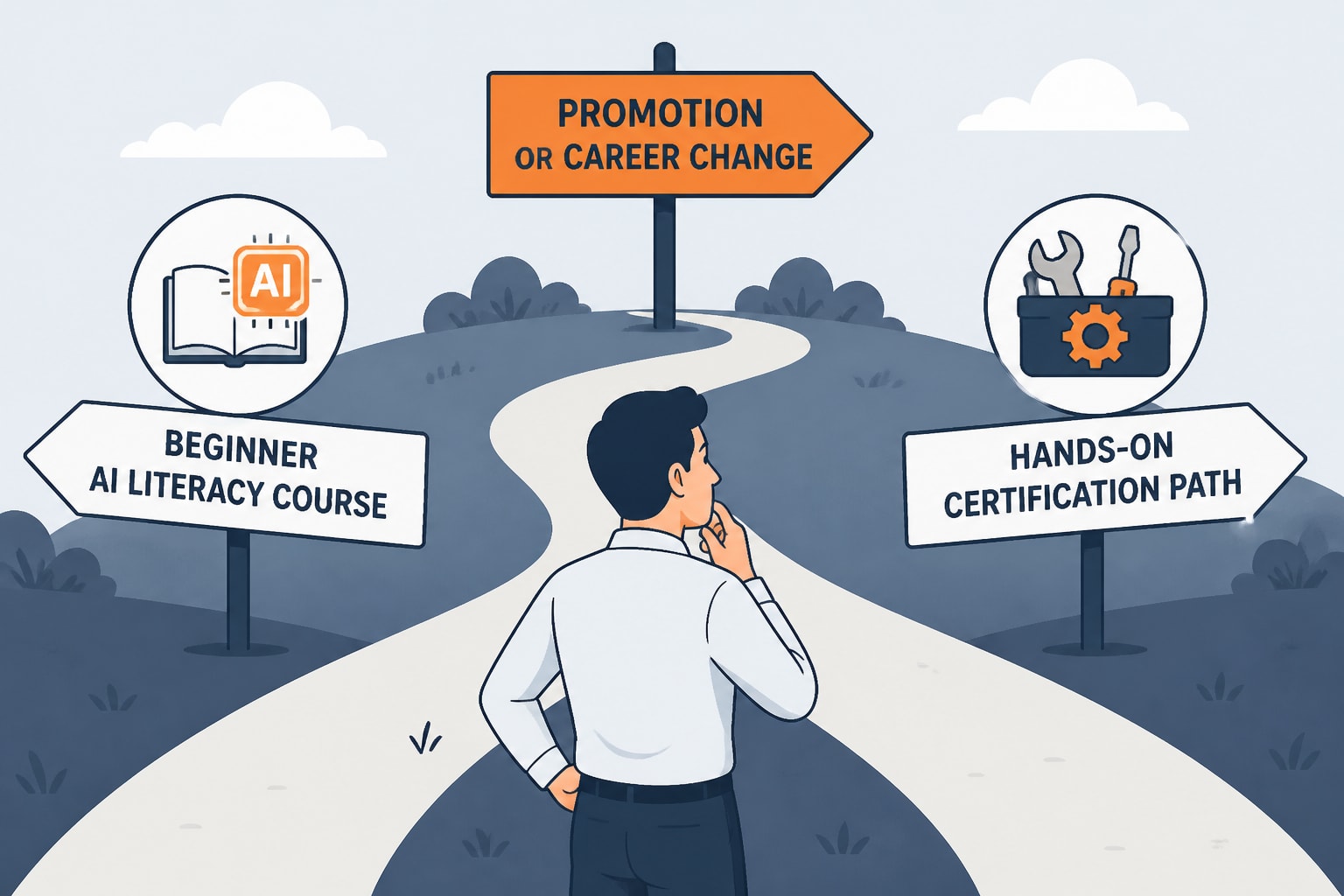
- Goal: a career switch toward data science, a promotion that needs ML literacy, or a certification for your resume.
- Time: weekly hours you can protect for two to six months.
- Proof of skill: a certificate, a project portfolio, or both. Employers reviewing career changers tend to look for evidence that you built something, not only that you watched videos.
1. Machine Learning Specialization (DeepLearning.AI and Stanford Online, on Coursera)
This three-course program is the most widely used structured starting point for beginners, and it begins with the core ideas before moving into code.
- Format: three courses, about 95 hours in total
- Level: beginner
- Tools: Python, NumPy, scikit-learn and TensorFlow
- Price: about $49 per month
- Pace: Dataquest lists it at about three months at five hours per week, with free auditing available
Suits: a beginner with basic Python who wants a clear sequence from regression to neural networks on a modest monthly budget.
Verdict: the safest first course when you want structure and a recognized name.
2. Google Machine Learning Crash Course
Google's crash course is a free, concise introduction built from self-paced modules and interactive exercises.
- Format: about 15 hours, self-paced, with interactive exercises
- Tools: TensorFlow
- Price: free
According to Dataquest, the course is free and takes about 15 hours to complete. The official Crash Course page hosts the lessons directly.
Suits: a short, no-cost first pass to confirm the subject interests you before committing money or months.
Verdict: an excellent sampler, though it is not a credential and it stays shallow on projects.
3. Practical Deep Learning for Coders (fast.ai)
This course teaches by building: you train working models first and study the theory behind them afterward.
- Format: video lessons and notebooks
- Length: about seven weeks at more than 20 hours per week
- Tools: PyTorch and fastai
- Price: free
The Dataquest listing puts the study load at more than 20 hours per week, which makes it a poor match for a busy work schedule.
Suits: people who already write code comfortably and can commit intensive weeks to a project-first approach to deep learning.
Verdict: rewarding and practical, but demanding on time and light on formal credentials.
4. Machine Learning A-Z (Kirill Eremenko and Hadelin de Ponteves, on Udemy)
A broad video course that surveys many algorithms in both Python and R at a low price.
- Length: about 44 hours
- Languages: Python and R
- Price: roughly $15 to $60 as of November 2026
- Access: lifetime access
Dataquest lists the course at about 44 hours with that price range and lifetime access.
Suits: a tight budget and a preference for self-paced video that covers many algorithm families without a subscription.
Verdict: strong value for breadth, with less guided feedback than a cohort program.
5. Machine Learning in Python (Dataquest)
Dataquest teaches in the browser, so you write code from the first lesson without setting up a local environment.
- Length: about 25 hours
- Format: interactive browser-based coding with hands-on projects
- Tools: scikit-learn and PyTorch
- Price: about $49 per month, with free introductory lessons
Dataquest states that the path runs about 25 hours, with a free introduction and full access at $49 per month.
Suits: learners who retain more by typing code than by watching video, and who want projects they can show in a portfolio.
Verdict: a compact, practice-heavy path that rewards consistent weekly sessions.
6. Machine Learning Scientist in Python (DataCamp)
A long, guided track that moves through the stages of a data-science workflow using interactive exercises.
- Length: about 85 hours
- Level: intermediate
- Format: interactive exercises, Python-focused
- Price: about $132 per year as a listed promotional price (regular price about $330 per year)
OnlineCourseing lists the track at about 85 hours. A DataCamp comparison of learning platforms is useful for weighing it against alternatives.
Suits: an intermediate learner who wants a guided route toward data-science work and prefers bite-sized exercises to long lectures.
Verdict: good depth for the annual price, provided you already know basic Python.
7. IBM Machine Learning Professional Certificate (IBM, on Coursera)
A six-course certificate that gives career changers a credential from a recognized employer.
- Format: six courses, about 132 hours
- Level: beginner to intermediate
- Price: about $59 per month, with an estimated total near $354 over six months
OnlineCourseing lists the certificate at six courses and about 132 hours.
Suits: professionals who need a named certificate on a resume and can sustain a six-month plan.
Verdict: the most resume-friendly option here, at the cost of the longest timeline.
8. Intro to Machine Learning with PyTorch (Udacity)
A project-based program that adds structured feedback to each stage.
- Length: about 49 hours with three projects
- Level: intermediate
- Tools: PyTorch
- Price: about $113 per month as a listed promotional price (regular price about $249 per month)
The program is listed at 49 hours with three projects.
Suits: learners who value reviewed projects and can absorb a higher monthly cost over a short, focused period.
Verdict: worthwhile if feedback matters to you, expensive if you progress slowly.
9. Mammoth Club Unlimited Membership
An annual all-access membership that places machine learning inside a wider library of tech and AI training.
- Scope: 3,000+ courses, certification paths, practice exams, tools and digital assets
- Price: from about $199 per year as of November 2026
- Structure: certification paths include built-in assessments, project portfolios and proctored final exams
- Content: text-first, AI-searchable lessons built to be applied the same day, updated monthly
For machine learning specifically, the Machine Learning Fundamentals course is a natural entry point, and the Complete Python Machine Learning, Bots and AI Mega Bundle extends into applied work. If you want business context, the lesson on real-world business applications of ML shows how models translate into outcomes. Details of what the membership includes are on the Mammoth Club Unlimited Membership page.
Suits: a professional who wants recognized certification paths and several adjacent skills, such as Python, automation and AI tooling, under one fee.
Verdict: best when you will use more than one course a year; a single narrow topic is cheaper elsewhere.
10. Mammoth Library Books
Certification prep and applied AI books, available as e-books, physical copies and audio.
- Formats: e-book, physical and audio
- Price: $19 to $19.99 per e-book as of November 2026
Books work as a companion to a course, giving you reference material for the topics you want to revisit. Browse the Mammoth Library Books listing for current titles.
Suits: reinforcing a course with offline reading or audio during a commute, not replacing a structured program.
Verdict: a useful supplement, not a stand-alone route to job-ready skills.
Side-by-Side Comparison
| Option | Approx. hours | Approx. price (Nov 2026) | Level | Credential or proof |
|---|---|---|---|---|
| Machine Learning Specialization | 95 | $49/month | Beginner | Course certificate |
| Google ML Crash Course | 15 | Free | Beginner | None listed |
| fast.ai Practical Deep Learning | 140+ (7 weeks, 20+ hrs/week) | Free | Coders | None listed |
| Machine Learning A-Z (Udemy) | 44 | $15–60 | Beginner | Course completion |
| Dataquest ML in Python | 25 | $49/month | Beginner to intermediate | Projects |
| DataCamp ML Scientist | 85 | $132/year promo | Intermediate | Track completion |
| IBM ML Professional Certificate | 132 | $59/month | Beginner to intermediate | Professional certificate |
| Udacity Intro to ML with PyTorch | 49 | $113/month promo | Intermediate | Three projects |
| Mammoth Club Unlimited Membership | Varies by path | From $199/year | All levels | Certification paths with proctored exams |
| Mammoth Library Books | Self-paced | $19–19.99 per e-book | All levels | None |
How to Choose a Path
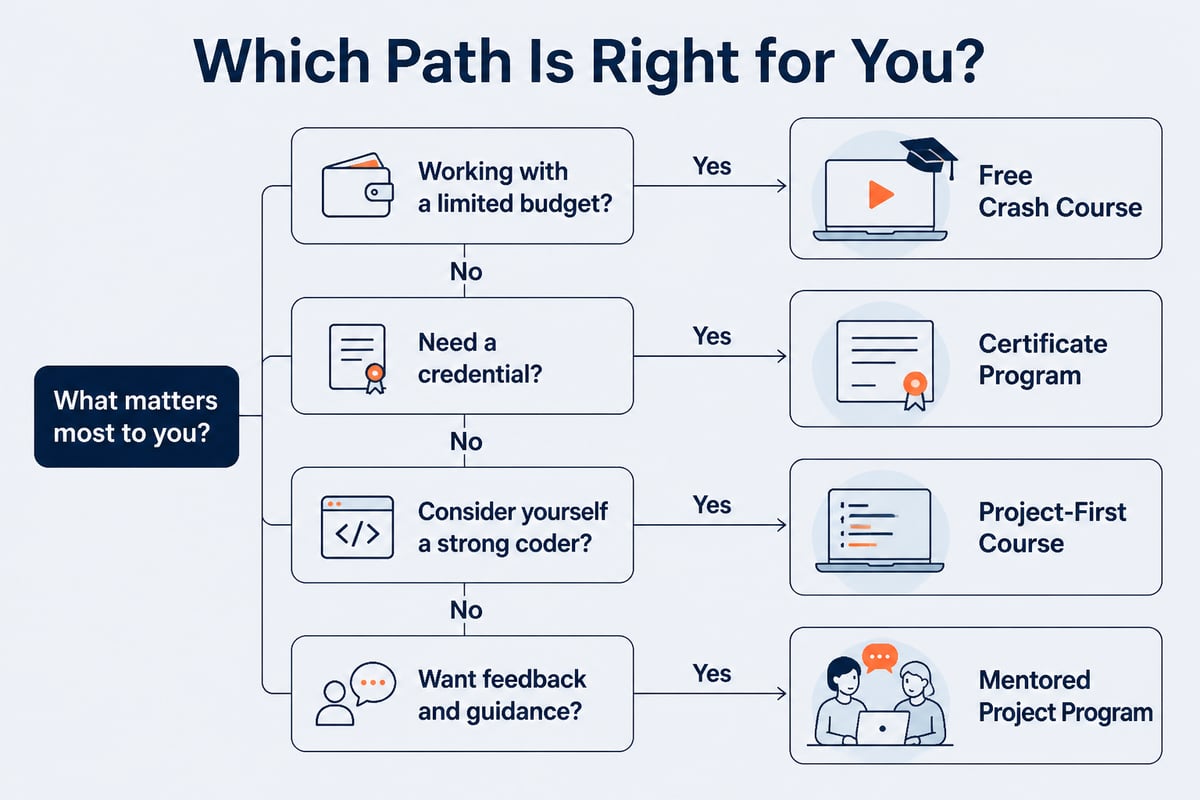
Match the course to your constraint, not to its reputation.
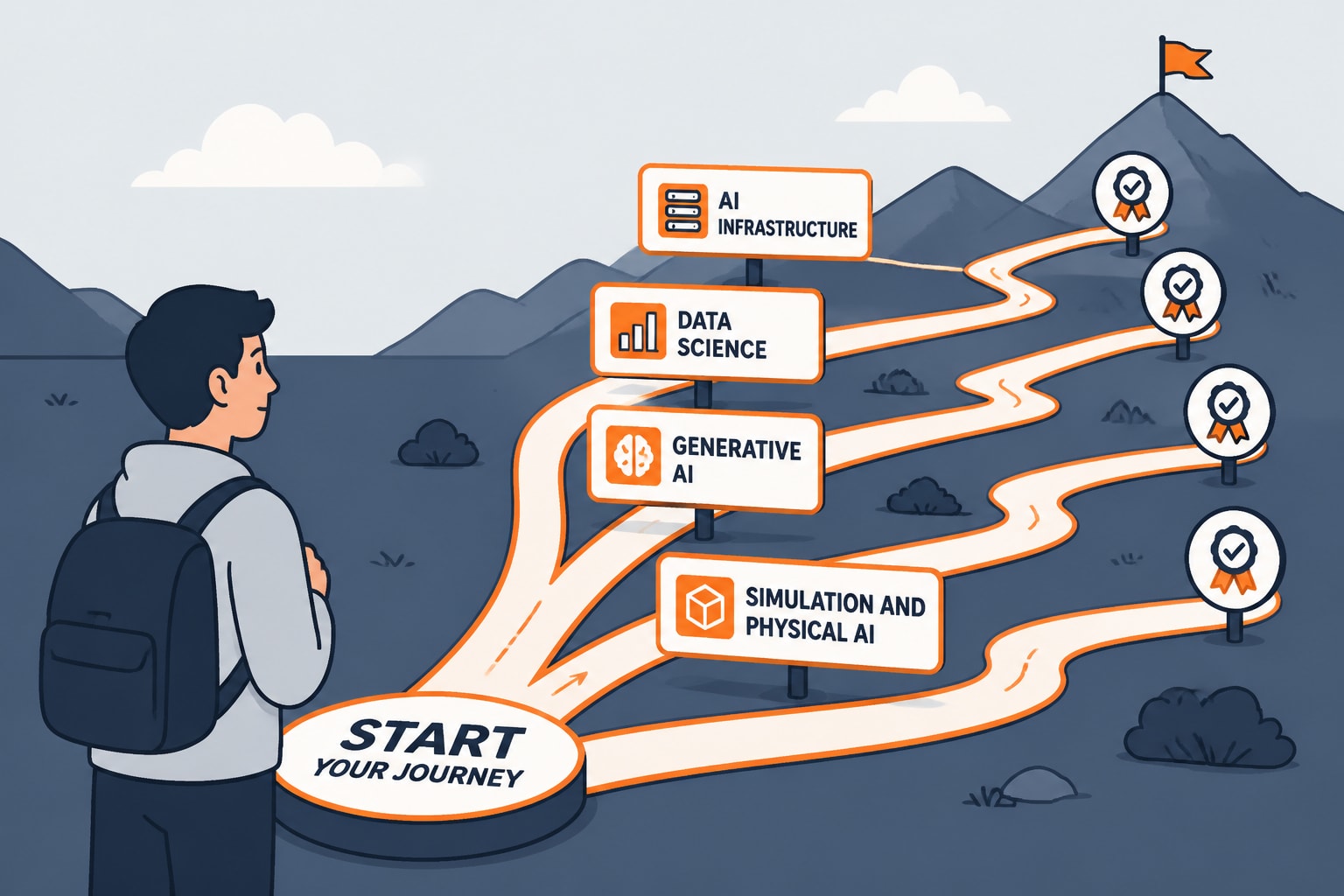
- Limited budget: start with the Google Crash Course, then add Machine Learning A-Z for breadth.
- Need a resume credential: the IBM certificate or a certification path with a proctored exam gives you something to list.
- Strong coder, short on patience for theory: fast.ai.
- Learn by typing code: Dataquest or DataCamp.
- Want feedback on projects: Udacity.
Hypothetical example: a learner moving into data roles might spend two weeks on Python, take a free course for a preview, then commit to one certificate path and build two projects on real business data. The sequence matters more than the individual platform.
A Realistic Study Plan for Working Professionals
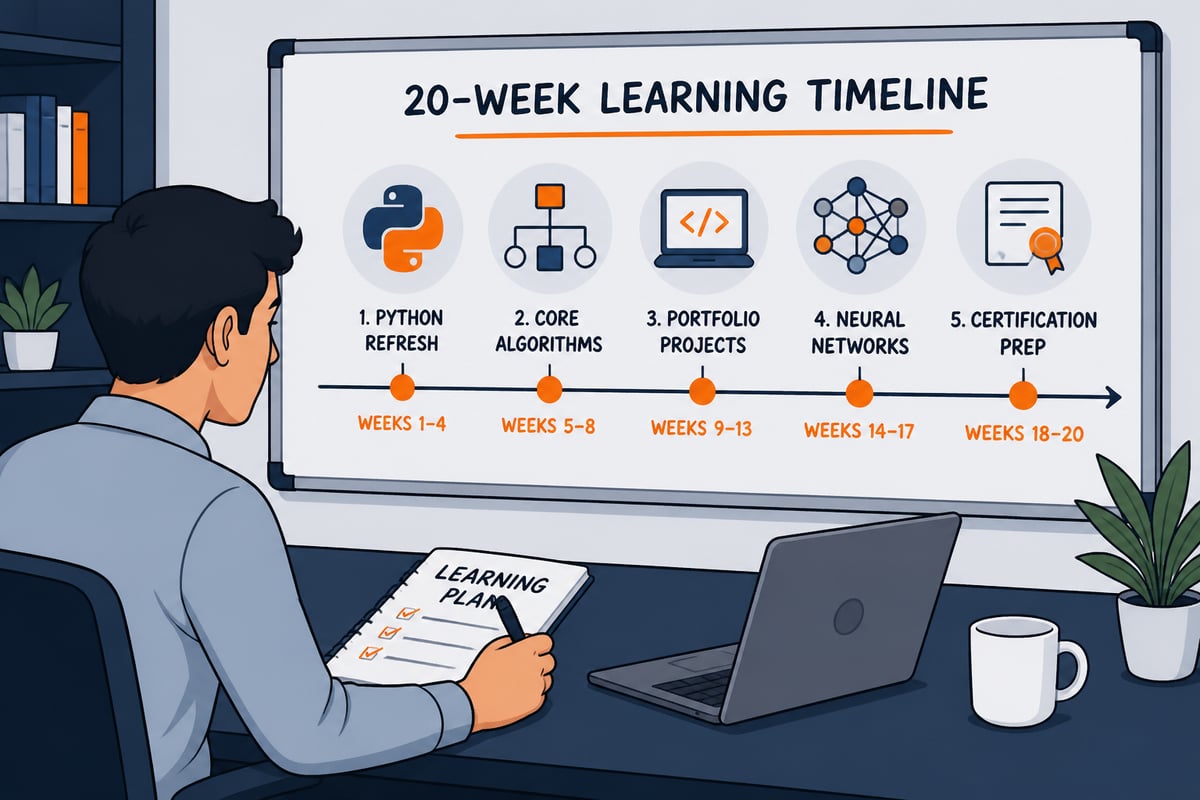
A plan of five to eight hours per week across three to six months is a realistic pace for finishing one program without burnout. Break it into stages:
- Weeks 1 to 2: Python and data handling refresh.
- Weeks 3 to 8: core algorithms such as regression, classification and clustering, with a first small project.
- Weeks 9 to 14: model evaluation, feature work and a second project on data from your own field.
- Weeks 15 onward: neural networks, then certification prep.
Applied practice is where most learners stall, so prioritize projects over extra videos. Lessons that connect a technique to a business case, like the regression models lesson in an AI foundations path, help turn concepts into something you can explain in an interview.
Treat certifications as a second step. A comparison of machine learning certifications is a useful way to check cost, duration and format before you commit to an exam.
Frequently Asked Questions
Can I learn machine learning online without a degree? Yes. The courses above assume basic Python and algebra, not a degree. A portfolio of projects and a recognized certificate carry more weight than the route you took.
How long does it take to learn machine learning online? A beginner studying five to eight hours per week can finish one structured program in roughly three to six months, depending on the course length listed above.
Do I need advanced math? Not at the start. Linear algebra, probability and basic calculus become useful as you move toward deep learning, and good courses teach them alongside the code.
Are free courses enough to get hired? Free courses build knowledge, but employers look for proof. Pair them with projects or a certification to show applied skill.
Python or R? Python is the more common choice in current courses and tooling, so choose it unless your workplace uses R.
What should I build first? Choose a small problem from your own job, such as predicting churn or classifying support tickets, and finish it end to end.
Your next step is to choose one program from this list, block out your weekly study hours, and finish a first project within the first month. If you want certification paths, practice exams and Python and AI courses under one fee, the Mammoth Club Unlimited Membership offers 3,000+ courses with proctored final exams, and the Mammoth Library Books add reading for the topics you want to revisit. MammothClub is a global AI learning platform that helps professionals and organizations upskill fast, so start with a membership and turn your study plan into a credential employers recognize.