The AI for Everyone course, taught by Andrew Ng, is worth taking if you need a non-technical foundation in AI vocabulary and project thinking, but it is not a certification path and it will not teach you to build anything. At roughly 7 hours and $49, it suits managers and career switchers who must speak credibly about AI. It is a weaker fit for anyone who needs a recognized, assessed credential to get hired or promoted.
This review covers what the course teaches, what it costs, where it falls short, and how it compares with four alternatives.
What the AI for Everyone Course Covers
The course is a non-technical program that covers AI terminology, machine-learning and data-science project workflows, organizational AI strategy, and AI's societal impact, according to DeepLearning.AI. It is aimed at people who will work alongside AI teams rather than write code.
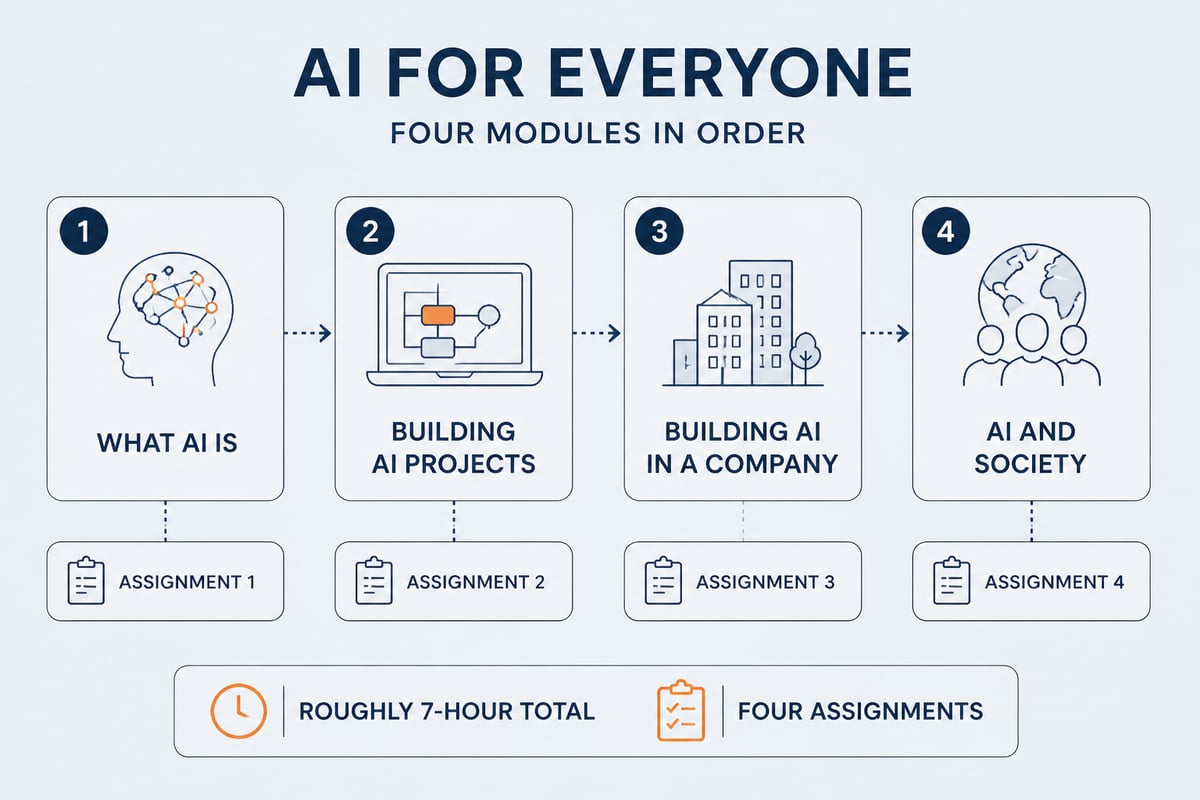
The structure is four modules, about 7 hours in total, with four assignments, per the Coursera course page. The modules run in this order:
- What is AI: core terms such as machine learning, neural networks, deep learning and data science, plus what AI can and cannot realistically do.
- Building AI projects: how a typical project is scoped, what data it needs, and how teams decide whether a problem suits AI.
- Building AI in a company: how to organize a team, choose pilot projects and build an AI strategy.
- AI and society: bias, fairness, discrimination, adversarial attacks and the effect on jobs.
The strength of this sequence is that it treats AI as a business capability instead of a programming topic. A product manager or operations lead finishes with a mental checklist for asking whether a proposed project is feasible, what data it requires and who must be involved.
Price, Time Commitment and Format
The course costs $49, and DeepLearning.AI lists that price as covering 180 days of certificate eligibility (DeepLearning.AI). Seven hours of content means most people can finish in a long weekend or spread it across two weeks of evenings.
Several format details matter for planning:
- Video-led lessons with short quizzes and four assignments.
- A completion certificate tied to the paid track, which signals initiative but is not a proctored professional credential.
- A defined access window of 180 days for certificate eligibility, so buying it and shelving it wastes the fee.
- No coding or math prerequisites, which keeps the barrier low.
The low cost and short length make the downside small. If it does not fit, you lose a modest fee and a weekend. The more relevant question is what you gain that a hiring manager will recognize.
Pros and Cons of the AI for Everyone Course
The main advantage is clarity: it gives non-technical professionals a shared vocabulary and a project framework in under a day of study. The main drawback is depth, since it stops at literacy and offers no hands-on tool practice or proctored assessment.
What works well
- Plain-language explanations that avoid code and heavy math.
- A practical framework for judging which AI projects are worth pursuing.
- A module on organizational strategy that few beginner courses address directly.
- A coverage of ethics and societal effects that helps in leadership conversations.
- A price and time cost low enough to treat as a trial.
Where it falls short
- No hands-on work with current generative AI tools, prompts or automation workflows.
- No proctored exam or project portfolio, which limits its weight on a resume.
- Content that stays conceptual, so it will not make you faster at day-to-day tasks by itself.
- A pace set at literacy level, which advanced learners will find slow.
Learners generally describe it as an accessible primer, and the common caution is that it is a starting point rather than a finish line. That matches the syllabus: it teaches you to talk about AI, not to do the work.
Who Should Take It and Who Should Skip It
Take this course if you are a manager, analyst, consultant or career switcher who needs to understand AI well enough to evaluate proposals and speak to technical teams. It also helps professionals preparing for an interview where AI strategy may come up.
Skip it, or treat it only as a warm-up, in these cases:
- You already work with AI tools daily and need advanced technique.
- You want a credential that employers can verify through a proctored exam.
- You need a portfolio of applied projects to show for a job change.
- You want deep technical grounding in models and deployment.
Context shows why literacy matters. A UK government report found that a minority of businesses currently use at least one AI technology, and among those using AI, natural-language processing and text-generation tools are the most common. Adoption is real but still early, which means professionals who can explain what these tools do and where they fail hold a visible advantage.
How It Compares With Other Beginner AI Courses
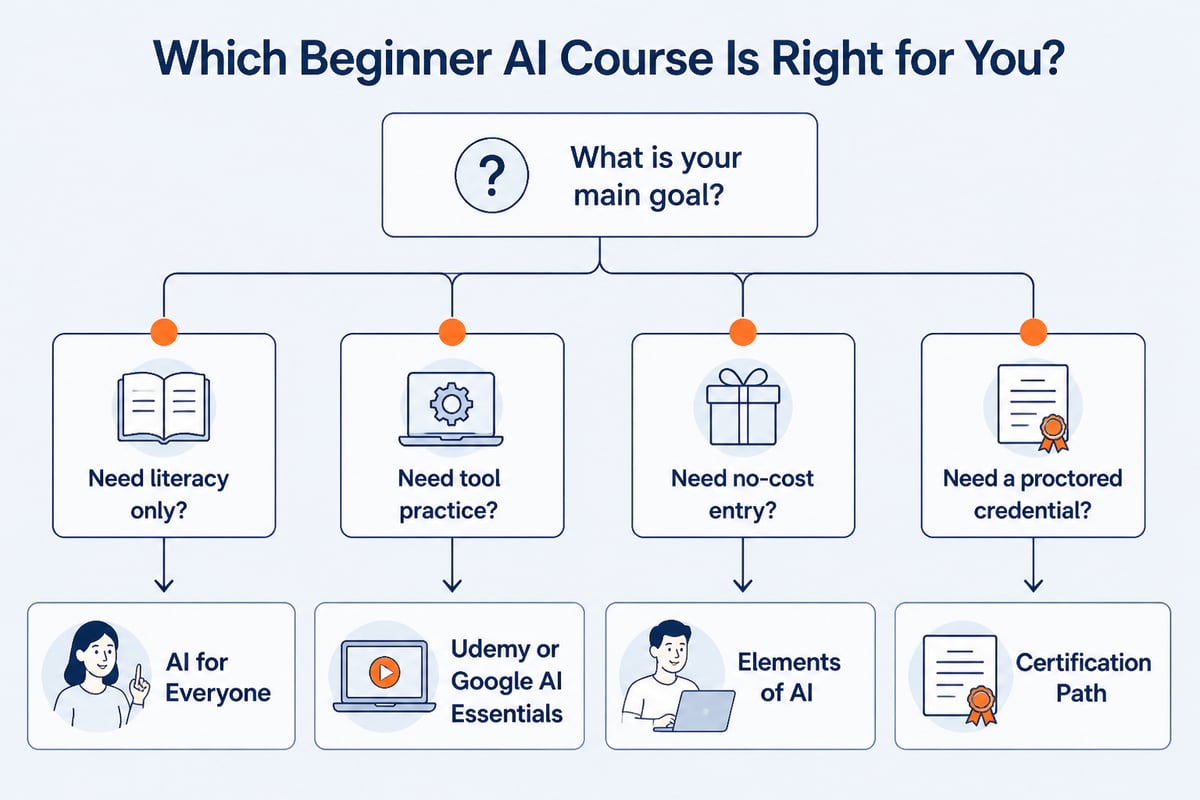
An AI for Everyone course is a crowded category, and the right pick depends on whether you want literacy, tool practice or a free credential. This table compares the five options researched, with prices as approximate as of November 2026.
| Course | Approx. price | Length | Best for |
|---|---|---|---|
| AI for Everyone (DeepLearning.AI) | $49 | About 7 hours, four modules | Non-technical decision-makers |
| Artificial Intelligence (AI) For Everyone, Udemy | $54.99 | 12.5 hours | Broader, tool-oriented intro |
| AI for Everyone: Understanding and Applying the Basics, Udemy | $74.99 or from $14 per month after trial | Not listed | Beginners wanting case studies |
| Elements of AI | Free, certificate included | About six weeks suggested | Self-directed learners |
| Google AI Essentials | $49 per month after a 7-day trial | About 5-10 hours | Busy professionals wanting work skills |
AI for Everyone (DeepLearning.AI)
The benchmark for conceptual clarity. Four modules, about 7 hours, four assignments, $49. It is the strongest choice for leaders who need a project-evaluation framework.
Artificial Intelligence (AI) For Everyone (Udemy)
At about $54.99 and 12.5 hours, this course covers AI, machine learning, deep learning, NLP and large language models, with quizzes and a project. It also touches chatbot and API topics, so it leans more practical than the Andrew Ng course. Its Udemy listing lists the stated topics.
AI for Everyone: Understanding and Applying the Basics (Udemy)
Priced at $74.99, with a subscription option from $14 per month after a trial. It covers AI, machine learning, deep learning and neural networks, with real-world case studies. It fits beginners who want applied examples before more technical study.
Elements of AI (University of Helsinki and MinnaLearn)
Free, including the certificate, and beginner level. It is self-paced with about six weeks suggested, and the certificate awards 2 ECTS credits. It is the best no-cost entry point for self-directed learners, though it is not a hiring-grade credential on its own.
Google AI Essentials
About $49 per month in the US after a 7-day free trial, running about 5-10 hours and ending in a Google certificate. It is aimed at busy professionals who want practical AI skills for work. If you prefer a Google-branded route, MammothClub's overview of the Google AI course explains how that option fits a learning plan.
When Literacy Is Not Enough: Certification Paths
A conceptual course proves you understand AI; a certification proves you can be assessed on it. Professionals whose goal is getting hired or promoted usually need the second, and that is where a literacy course alone stops short.
Mammoth Club Unlimited Membership is the option MammothClub offers for that next step, from $199 per year. It covers 3,000+ courses, certification paths, practice exams, tools and digital assets under one membership. Its certification paths include built-in assessments, project portfolios and proctored final exams, which supply the verification a 7-hour literacy course does not. Lessons are text-first and AI-searchable, built to be applied the same day, and courses, labs and assessments are updated monthly as tools change. Each course starts with a working practitioner and then passes editorial and technical review.
For teams, the Team Plan is listed at $159 per user per year, with shared access, progress tracking and certification management.
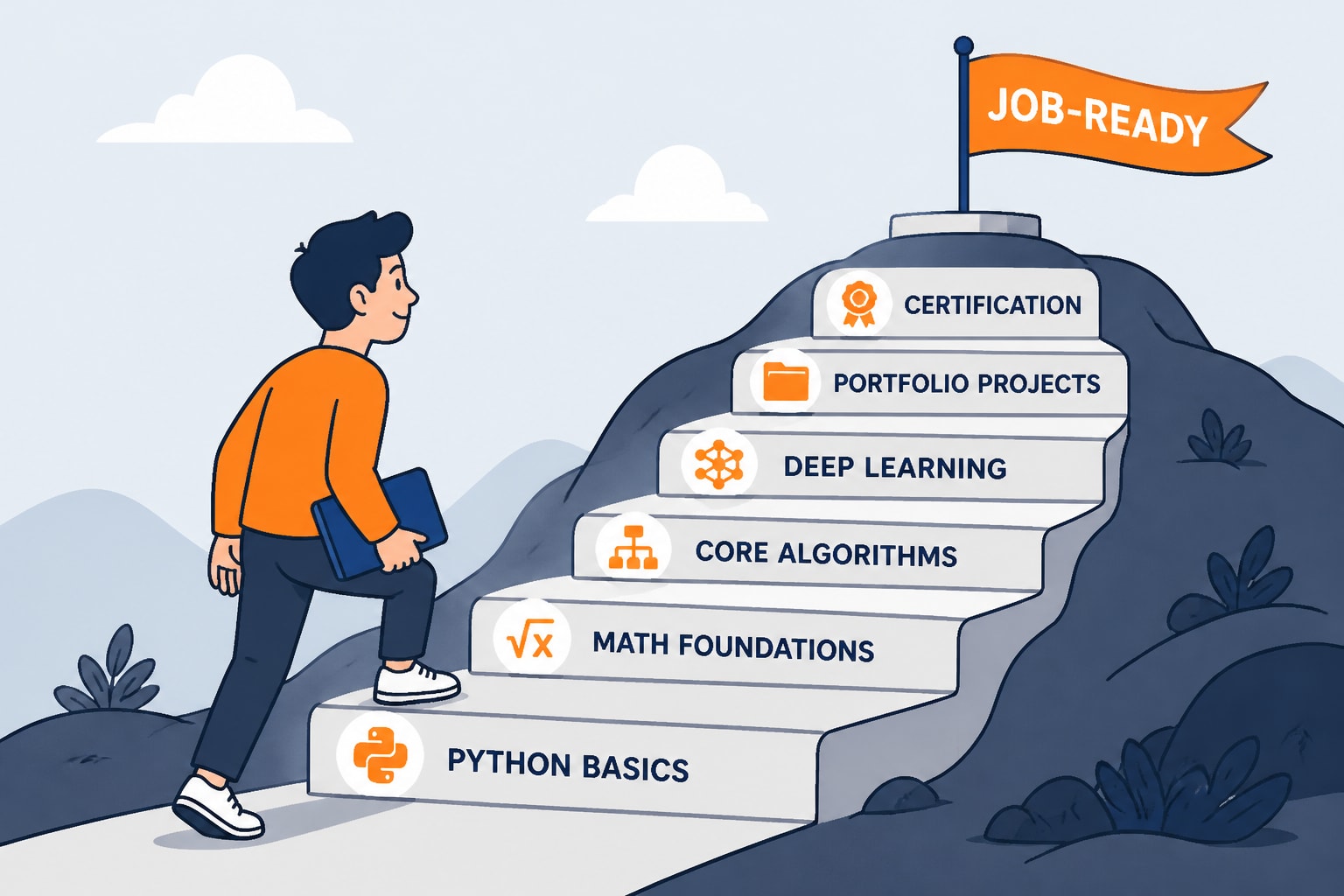
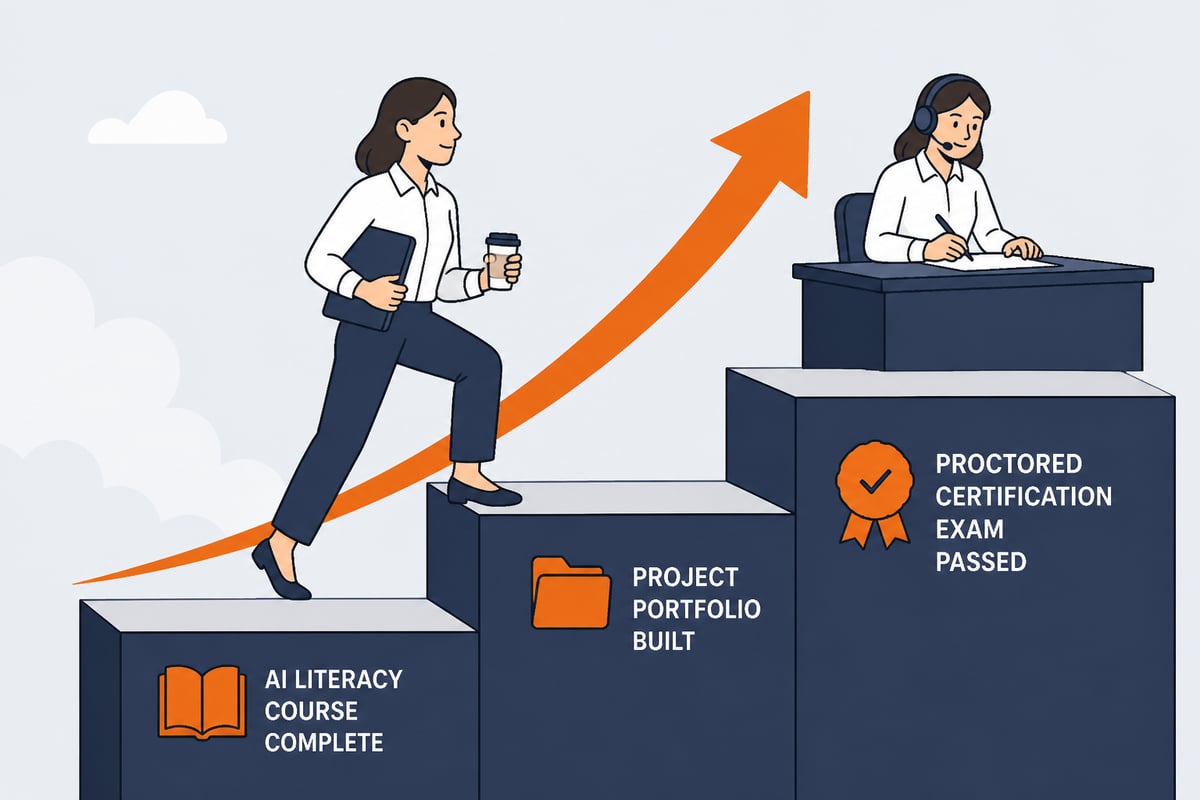
A sensible sequence for a career switcher might look like this:
- Complete a literacy course to learn the vocabulary and project framework.
- Move to a structured path that adds hands-on labs and a portfolio.
- Finish with a proctored exam so your credential can be verified.
Learners who want that second step can see how MammothClub frames it in its guide to AI certification online, or begin with a foundations lesson such as what AI is, its definition and scope. Readers who manage people rather than build systems may prefer MammothClub's AI for managers course overview.
This route is not for everyone. If you want only free content or a single short video, a no-cost course such as Elements of AI is the better match, and a paid membership is not.
How to Get the Most From the Course
Pairing the course with a same-week application turns passive viewing into retained skill. Treat the four assignments as the minimum and add one real task from your own work.
- Pick a live problem in your team and run it through the module 2 project framework.
- Write a one-page proposal for a pilot project using the module 3 guidance.
- List the data you would need and who owns it.
- Note two risks from the module 4 material on bias and societal effects.
- Record the outcome in your resume or performance review notes as a concrete deliverable.
Frequently Asked Questions
Is the AI for Everyone course worth it in 2026?
Yes, for non-technical professionals who want AI literacy and a project framework. At about $49 and 7 hours, the risk is low. It is not worth it if you need hands-on skills or a proctored credential.
How long does the AI for Everyone course take?
About 7 hours across four modules, with four assignments. Most learners finish in a few evenings or a weekend.
Do I need coding or math skills?
No. The course is designed as non-technical and requires no programming background.
Will the certificate help me get hired?
It shows initiative and baseline literacy, but it is a completion certificate rather than a proctored professional credential. Employers who want verified skills generally weigh assessed certifications and project portfolios more heavily.
Is there a free alternative?
Yes. Elements of AI from the University of Helsinki and MinnaLearn is free, including the certificate, and awards 2 ECTS credits.
What should I take after this course?
Choose based on your goal: a tool-focused course for daily productivity, or a structured certification path with assessments and projects for hiring and promotion.
Your next step is simple: decide whether you need literacy or a verifiable credential, then enroll in a course that matches that goal this week. If it is the credential, Mammoth Club Unlimited Membership gives you certification paths, practice exams and labs under one plan, and MammothClub's platform helps professionals and organizations upskill with measurable results. Take the first step toward a recognized certification and Start unlimited with a membership built for hiring and promotion goals.