MS Azure AI Fundamentals is Microsoft's entry-level certification for AI concepts and Azure AI services, earned by passing the AI-900 exam, and it requires no coding or data science background. One update matters before you plan anything: Microsoft's exam page confirms that AI-900 is being retired and replaced by AI-901, so your study plan should start from the current exam rather than an old syllabus. This guide explains what the certification covers, how the AI-900 blueprint was weighted, how AI-901 differs, and how to prepare so the credential helps your career.
What is MS Azure AI Fundamentals?
MS Azure AI Fundamentals is a foundational Microsoft credential that verifies you understand core AI workloads and know which Azure services fit each one. Microsoft describes the credential and its learning paths on its Azure AI Fundamentals certification page.
The certification tests recognition and judgment, not engineering. You are expected to read a business scenario, such as extracting text from invoices or classifying customer feedback, and identify the right type of AI capability and Azure service. That makes it a practical first credential for several groups:
- Career switchers moving into cloud or AI roles from other fields
- Business analysts, project managers and consultants who work alongside AI teams
- Sales and pre-sales professionals who need credible AI vocabulary
- Aspiring engineers who want a structured starting point before role-based Azure exams
It also works as a stepping stone. Many candidates use it to build confidence before attempting associate-level Azure certifications.
What did the AI-900 exam cover?
The AI-900 exam covered five domains. According to the Microsoft Learn AI-900 study guide, the final outline assigned 15 to 20 percent each to AI workloads and considerations, machine learning on Azure, computer vision, and natural language processing. The same guide shows that generative AI workloads accounted for 20 to 25 percent of the exam.
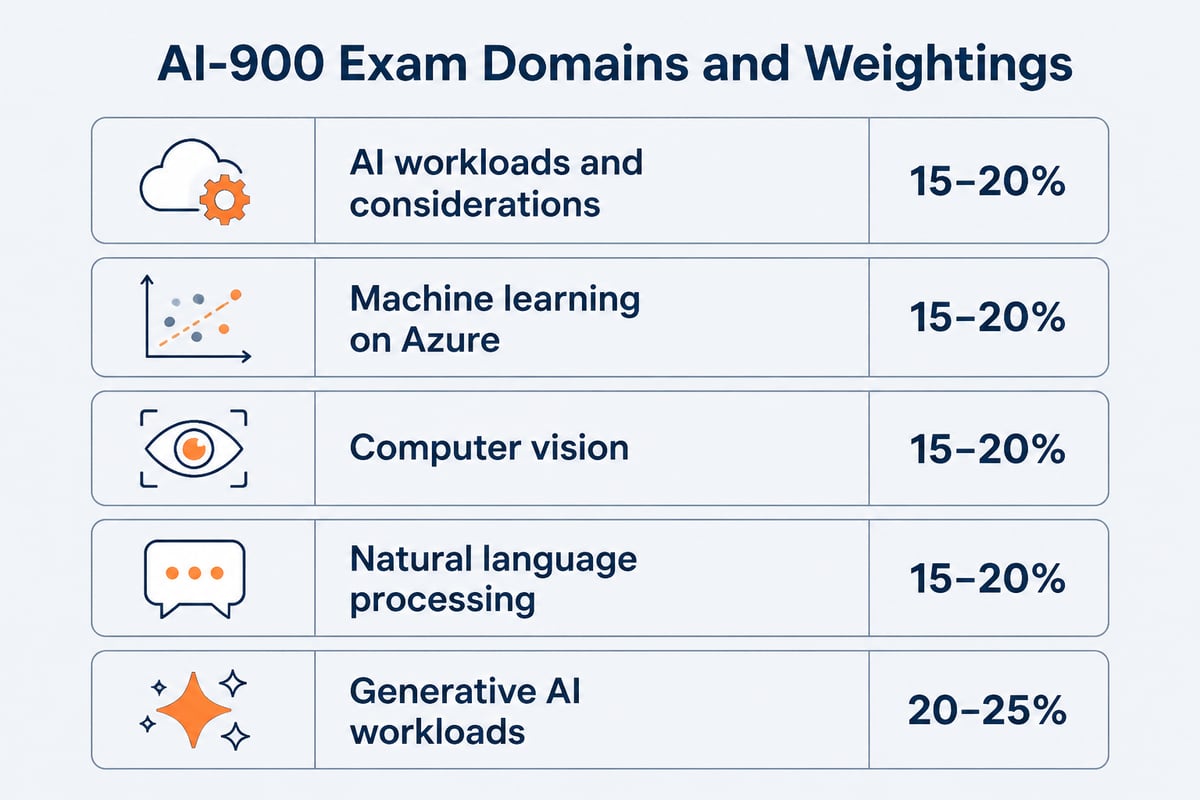
Here is what each domain asks of you.
AI workloads and considerations
This domain tests whether you can name the common AI workload types: prediction, anomaly detection, computer vision, language, document extraction and generative AI. It also covers responsible AI. Microsoft's outline lists fairness, reliability and safety, privacy and security, inclusiveness, transparency, and accountability as the guiding principles. Expect scenario questions that ask which principle is at stake when, for example, a hiring model disadvantages one group of applicants.
Machine learning on Azure
You need to distinguish regression, classification and clustering, and understand the basic training workflow: features, labels, training and validation data, and evaluation. You are not asked to write algorithms. You are asked to recognize which approach suits a problem and what Azure Machine Learning offers, including automated machine learning and designer tools.
Computer vision
This domain covers image classification, object detection, optical character recognition and facial analysis concepts. The skill being tested is matching a requirement, such as reading printed text from scanned forms, to the correct Azure capability.
Natural language processing
Expect questions on key phrase extraction, entity recognition, sentiment analysis, translation, speech-to-text, text-to-speech and conversational language understanding. Again, the emphasis is on choosing the right service for the scenario.
Generative AI workloads
At 20 to 25 percent, this was the heaviest domain. It covers large language models, copilots, prompt design, grounding and Azure OpenAI concepts, along with the risks that come with generated content.
Is AI-900 still available, and what replaced it?
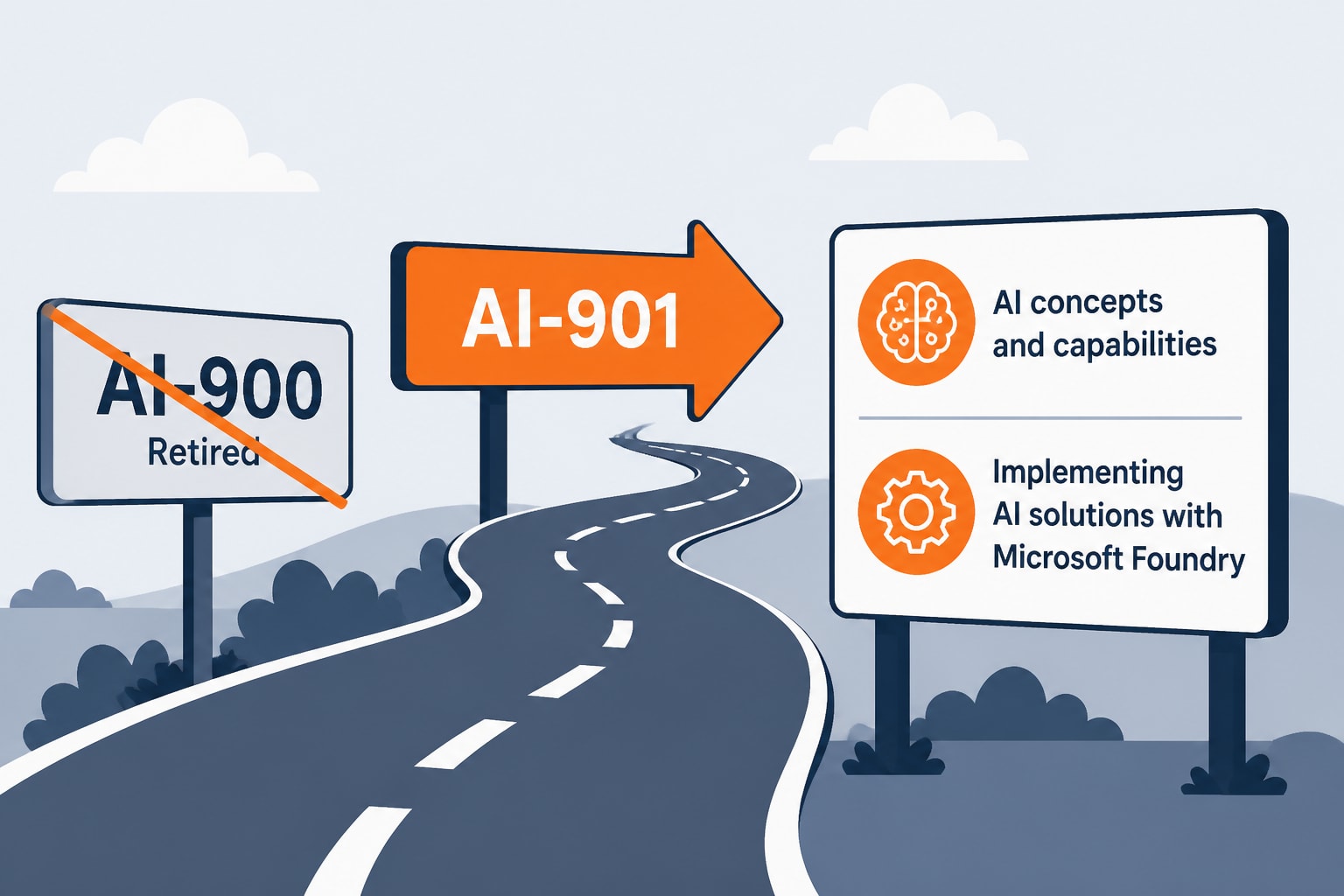
AI-900 is being retired, and Microsoft's AI-901 is the current exam on the Azure AI Fundamentals path. The Microsoft exam page states the replacement directly, so check it for retirement dates before you book anything.
The difference between the two exams is larger than a version number suggests. Per the AI-901 study guide, the exam splits into identifying AI concepts and capabilities (40 to 45 percent) and implementing AI solutions with Microsoft Foundry (55 to 60 percent). The same guide says candidates need Python coding syntax and programming techniques, as well as familiarity with Azure resources.
That is a real shift. AI-900 focused on conceptual recognition, while AI-901 expects hands-on implementation work.
| Aspect | AI-900 (retiring) | AI-901 (current) |
|---|---|---|
| Focus | Concepts and service selection | Concepts plus hands-on implementation |
| Platform emphasis | Azure AI services | Microsoft Foundry |
| Coding expectation | None required | Python syntax and techniques |
| Largest weighting | Generative AI, 20-25% | Implementing solutions, 55-60% |
If you hold an AI-900 pass, it remains a valid record of the knowledge you demonstrated. If you have not yet tested, plan for AI-901.
What score do you need to pass?
You need a score of 700 or higher on Microsoft's scaled 1 to 1,000 scoring system to pass. The AI-900 study guide states this threshold. A scaled score is not a straight percentage, so 700 does not map directly to a fixed share of questions answered correctly.
The practical takeaway is to aim for comfortable coverage of every domain instead of gambling on a few. With domains weighted this evenly, neglecting one can cost you the pass.
How should you prepare for it?
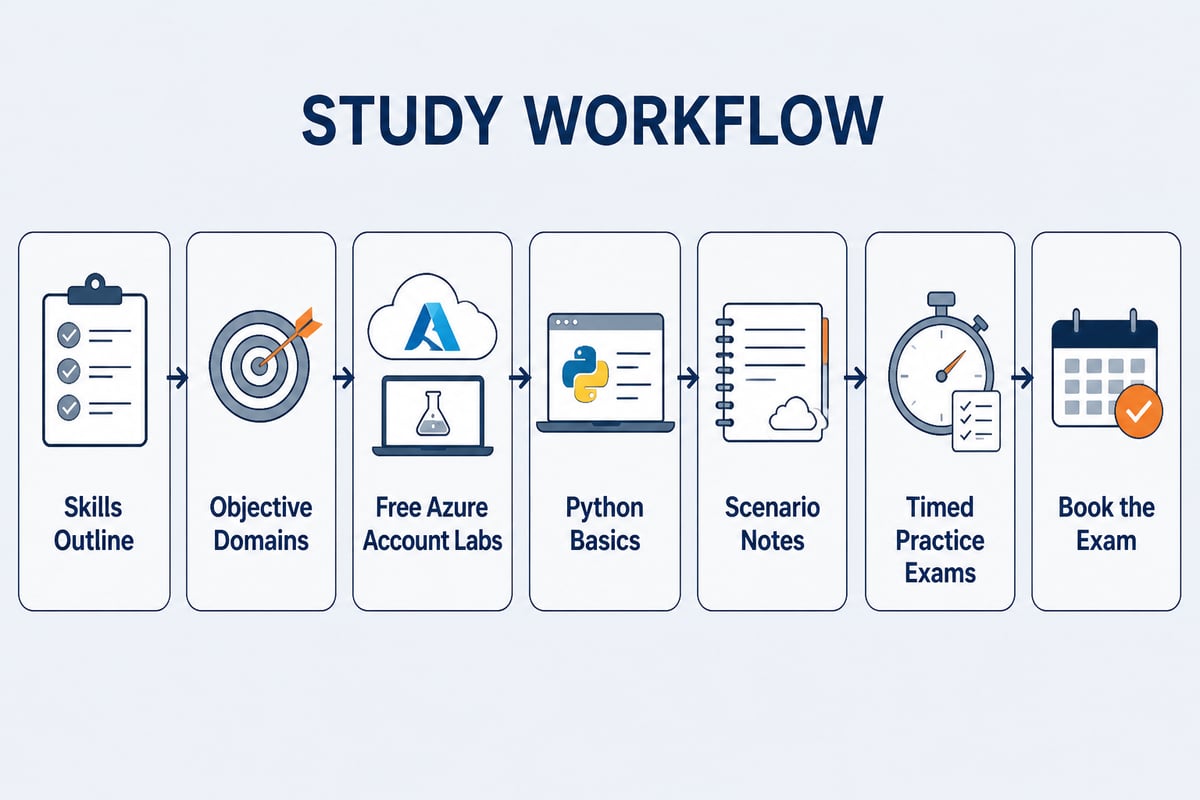
The most reliable preparation combines the official skills outline, hands-on practice and timed practice questions, in that order. A seven-step approach works for most working professionals:
- Download the skills outline for the exam you are taking and treat it as your checklist.
- Read the objective domains. Microsoft's objective domain module maps the learning paths to the exam topics, which helps you sequence your study.
- Create a free Azure account and open each service's studio. Seeing a vision or language service respond to your own input makes the concepts stick.
- Learn enough Python to read and modify short scripts if you are targeting AI-901. A Python programming fundamentals series is a reasonable place to build that base.
- Write your own scenario notes. For each service, record one sentence on when you would choose it and one on when you would not.
- Take timed practice exams and review every wrong answer, including the ones you guessed correctly.
- Book the exam only when you score consistently above your target on fresh questions.
A hypothetical example of a study week
Hypothetical example: a project manager with no technical background sets aside five evenings. Two evenings go to concepts and responsible AI, two to hands-on work in the Azure portal, and the final evening to a timed practice test followed by a review of weak domains. The point is the rhythm, not the exact hours: concepts, hands-on practice, then testing.
How do you get hands-on practice without a technical background?
Start with the no-code and low-code tools, because the exam rewards understanding what a service does, not how to program it. Azure's vision, language and speech studios let you upload a sample image or paste a paragraph of text and see the output immediately.
A useful exercise is to take one real document from your own work, such as a customer email, and run it through sentiment analysis and key phrase extraction. You will learn two things at once: how the service behaves and where its limits are. Noting where it misreads sarcasm or domain jargon prepares you for exam questions about reliability and transparency.
If you are preparing for the newer exam, add small implementation tasks: call a model from a short Python script, change a prompt, and observe how the output changes.
What common mistakes cost candidates points?
Most failed attempts trace back to a handful of avoidable habits:
- Memorizing service names without scenarios. Questions describe a need and ask you to choose; name recall alone does not help.
- Skipping responsible AI. It looks like soft material, yet it appears across domains.
- Confusing similar capabilities, such as image classification versus object detection, or key phrase extraction versus entity recognition.
- Studying from outdated material. Azure service names and features change often. Check that your resources match the current skills outline.
- Treating generative AI as a footnote. It carried the largest share of the AI-900 outline and remains central to the newer exam.
Is the certification worth it for your career?
The certification is worth it if you need a recognized, low-cost signal of AI literacy and plan to build on it. It will not qualify you for an AI engineering role on its own. What it does is demonstrate initiative, give you shared vocabulary with technical teams, and make cloud and AI job postings easier to read and respond to.
It pays off most in these situations:
- You are changing careers and need a credential for your resume and LinkedIn profile.
- You work in a role adjacent to AI and want credibility in project discussions.
- You intend to pursue Azure associate-level or AI engineer certifications next.
It pays off least if you already hold advanced Azure credentials, since the content would be a step backward.
Where can you find structured preparation?
Structured preparation helps most when you are balancing study with a full-time job. MammothClub's Microsoft Azure AI certification course with 10 practice exams is built around the exam domains. The Mammoth Club Unlimited Membership, from $199 per year, gives all-access to its courses, certification paths, practice exams, tools and digital assets, so you can pair Azure study with Python or machine learning foundations under one plan.
For broader context on where this credential fits, MammothClub's overview of Microsoft AI training and its guide to AI certifications online compare the options. Check each product page for current course details before you commit.
Key takeaways
- MS Azure AI Fundamentals validates conceptual AI knowledge and Azure service selection; it is aimed at beginners.
- AI-900 is being retired and replaced by AI-901, which adds hands-on Foundry work and Python expectations.
- The AI-900 outline balanced five domains, with generative AI at 20 to 25 percent and four others at 15 to 20 percent each.
- A score of 700 or higher was required to pass the AI-900 exam.
- Responsible AI principles appear throughout and deserve dedicated study time.
- Hands-on practice with Azure's studios beats passive reading.
Frequently asked questions
Do I need to know how to code for MS Azure AI Fundamentals?
Not for AI-900, which tested concepts. For AI-901, Microsoft's study guide says candidates need Python coding syntax and programming techniques, so some Python is required.
How long does it take to prepare?
Preparation time depends on your starting point. Professionals new to cloud and AI often plan several weeks of part-time study, while those with cloud experience may need less. Use practice exam scores, not the calendar, to decide when you are ready.
Does the certification expire?
Microsoft sets renewal policies per credential. Check the certification page for the current status before you plan around it.
Should I take AI-900 if it is retiring?
Confirm availability on Microsoft's exam page first. If AI-900 is no longer offered, the AI-901 path is the way forward, and studying for it builds the same conceptual base plus practical skills.
What should I do after earning it?
Build a small project, such as a document-processing or chat prototype, and add it to your portfolio. Then choose a role-based Azure certification that matches the job you want.
Your next step is to open the current skills outline for the exam you intend to take and mark each topic as confident, shaky or new. From there, a structured path saves time: MammothClub's Mammoth Club Unlimited Membership, from $199 per year, gives you certification paths, practice exams and tools in one place. If you want to prepare for the Azure AI credential without piecing resources together, MammothClub lets you start unlimited and build the skills that hiring managers look for.