An NVIDIA AI course is a self-paced or instructor-led training program, offered through NVIDIA's Deep Learning Institute, that teaches practical skills such as deep learning, large language model (LLM) applications, and GPU-accelerated computing. Some entry-level options are free, while the deeper technical courses are paid, and select courses offer certificates of competency. This guide explains which courses exist, what they cost, how to sequence them, and how to decide whether they fit your career or your team's training plan.
What Types of NVIDIA AI Courses Exist?
NVIDIA organizes its training into self-paced courses, instructor-led workshops, learning paths, and certifications. Each format serves a different goal, so choosing the right one first saves time and budget.
According to NVIDIA's self-paced training page, courses range from two hours for a focused technology or technique to eight hours for an end-to-end project, and select courses offer certificates of competency. The formats break down as follows:
- Self-paced courses: On-demand lessons with hands-on exercises, suited to individuals working around a job.
- Instructor-led workshops: Live sessions for teams that need guided practice and a fixed schedule.
- Learning paths: Curated sequences that group courses by role or topic, such as generative AI and LLMs.
- Certifications: Exams that validate skills after you have built experience with the tools.
NVIDIA also maintains a hub of learning paths and certification routes that covers generative AI credentials alongside other technical tracks. Browsing it first helps you see where a single course fits in a larger progression.
Is an NVIDIA AI Course Free?
Some NVIDIA AI courses are free, but most of the hands-on technical courses are paid. The free tier works well as a screening step before you commit money.
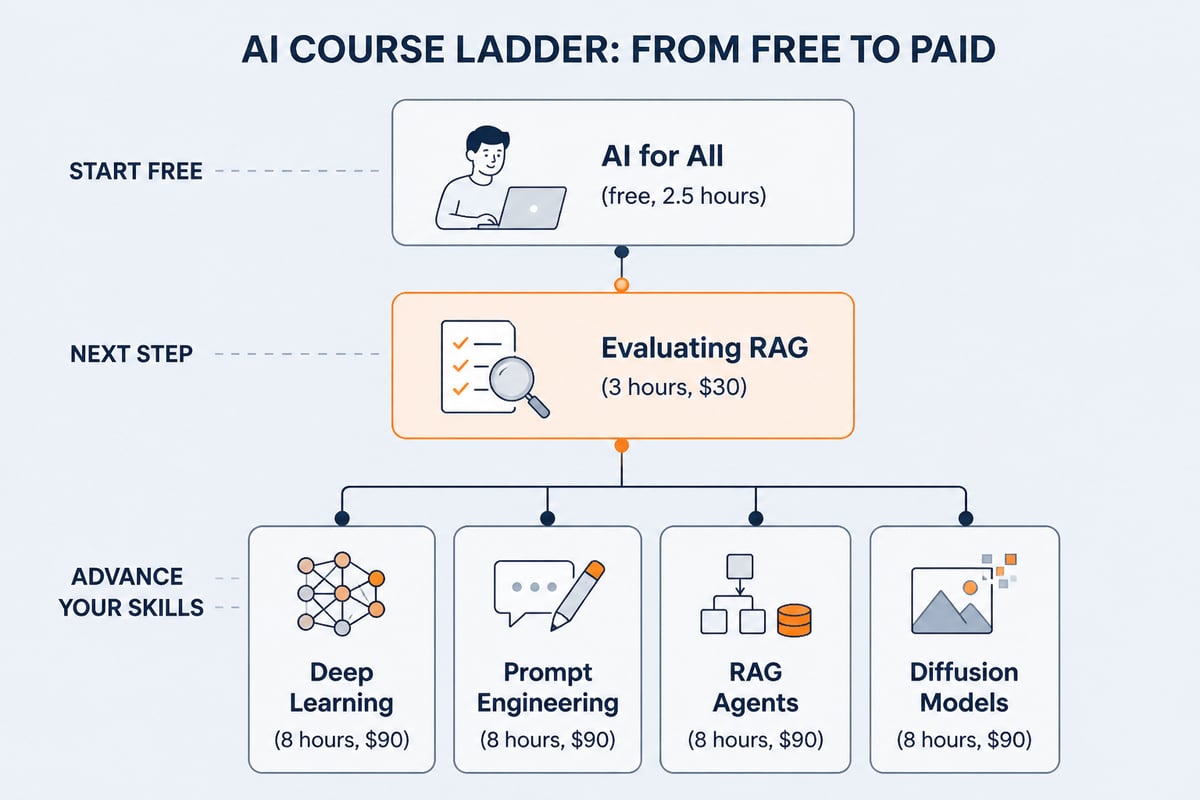
NVIDIA lists "AI for All: From Basics to Gen AI Practice" as a free 2.5-hour course. It covers foundations and is a sensible starting point for professionals who are new to the field or managers who need shared vocabulary before approving a larger training investment.
Paid courses follow a consistent price structure on the same learning path page. The table below summarizes the generative AI and LLM options listed there:
| Course | Length | Price | Certificate |
|---|---|---|---|
| AI for All: From Basics to Gen AI Practice | 2.5 hours | Free | Not listed |
| Getting Started With Deep Learning | 8 hours | $90 | Yes |
| Building LLM Applications With Prompt Engineering | 8 hours | $90 | Yes |
| Building RAG Agents With LLMs | 8 hours | $90 | Yes |
| Evaluating RAG and Semantic Search Systems | 3 hours | $30 | Not listed |
| Generative AI With Diffusion Models | 8 hours | $90 | Yes |
Prices and availability change, so confirm current details on NVIDIA's generative AI and LLM learning paths page before budgeting.
Which NVIDIA AI Course Should You Start With?
Start with the course that matches your current role, not the one with the most impressive title. A product manager, a software developer, and an infrastructure administrator need different first steps.
NVIDIA's own learning path draws one important line: training for developers building and optimizing solutions is separate from training for administrators configuring and supporting AI infrastructure. Pick a side of that line before you pick a course.
Use this decision guide:
- No technical background, or a manager evaluating AI: Begin with the free AI for All course, then review NVIDIA's AI learning essentials for agentic AI, physical AI, and other topic overviews.
- Developer new to machine learning: Take Getting Started With Deep Learning, then move to prompt engineering.
- Developer building LLM products: Go to Building LLM Applications With Prompt Engineering, then Building RAG Agents With LLMs.
- Developer with working RAG prototypes: Take Evaluating RAG and Semantic Search Systems to learn how to measure and improve retrieval quality.
- Creative or computer vision engineer: Choose Generative AI With Diffusion Models.
If you want a broader view of options before narrowing down, MammothClub's overview of NVIDIA AI training compares how vendor-led programs fit alongside other formats.
What Does the Generative AI and LLM Path Teach?
The generative AI and LLM path teaches you to move from model fundamentals to deployable applications, using retrieval and evaluation techniques that production systems rely on. Each course adds one layer to the previous one.
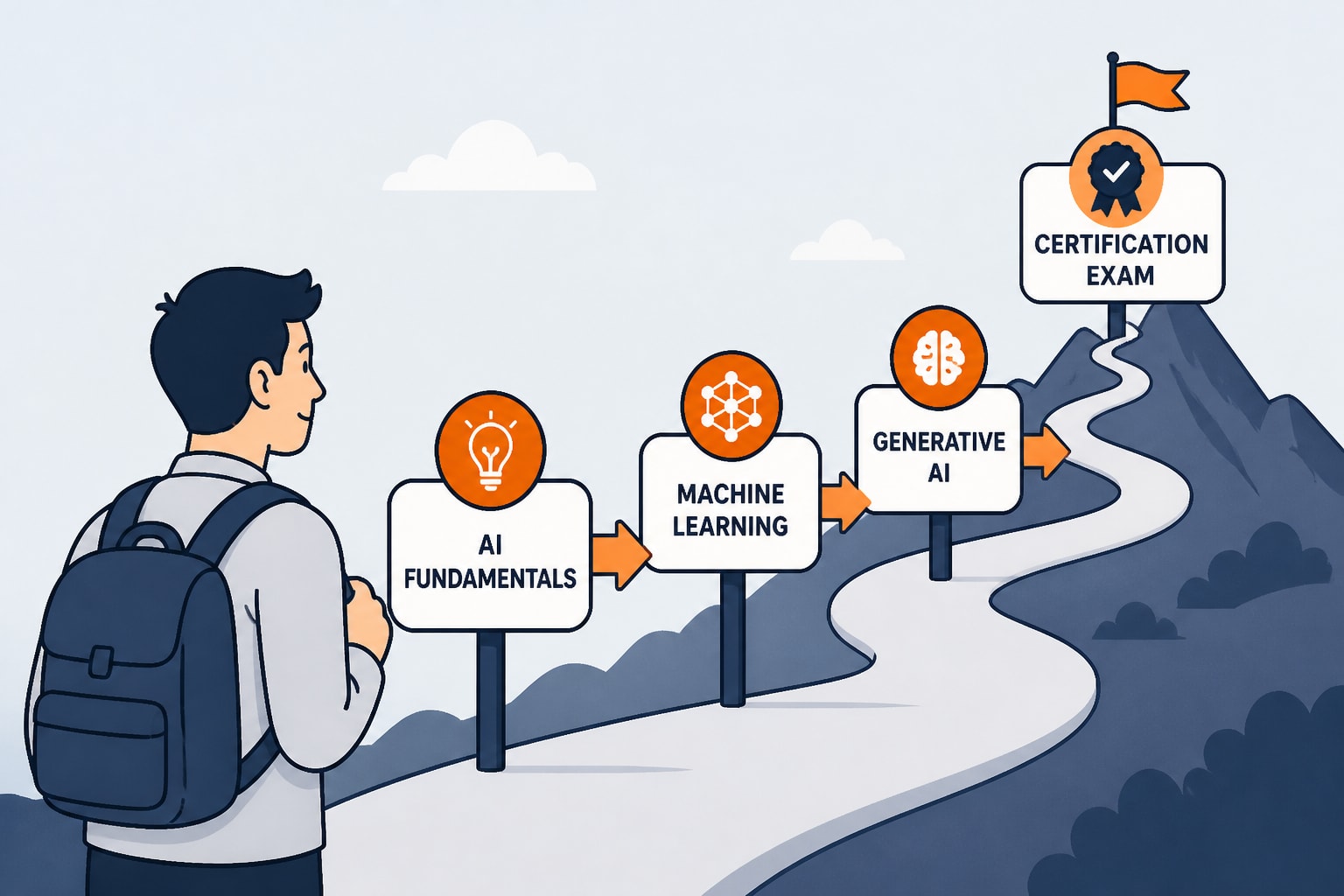
Deep learning foundations. Getting Started With Deep Learning, an 8-hour course at $90, builds the vocabulary of neural networks. Without it, later courses can feel like copying commands rather than understanding them.
Prompt engineering for applications. Building LLM Applications With Prompt Engineering, also 8 hours and $90, covers how to structure prompts and chain model calls inside software, rather than typing queries into a chat window.
Retrieval-augmented generation. Building RAG Agents With LLMs, again 8 hours and $90, shows how to connect a model to your own documents so answers are grounded in company data. NVIDIA's developer AI page groups related learning paths on building AI agents and RAG agents with its tools and technologies.
Evaluation. Evaluating RAG and Semantic Search Systems runs 3 hours at $30. This is the least glamorous course on the path and arguably the most useful for teams shipping real products, because an unmeasured retrieval system quietly degrades.
Image generation. Generative AI With Diffusion Models is an 8-hour, $90 course for those working with synthetic images rather than text.
How Do You Get NVIDIA AI Certification?
You earn NVIDIA certification by building hands-on experience with NVIDIA tools, choosing the credential that matches your role, and passing the associated exam. Course certificates and exam-based certifications are different things.
A certificate of competency, offered on select self-paced courses, confirms you completed the work. A certification exam validates your skills against a defined standard and carries more weight with employers. NVIDIA's learning path directory lists tracks across AI and data science, DGX and HGX platforms, networking, and software tools, so the certification you choose depends on whether you work in model development, infrastructure, or operations.
A practical sequence looks like this:
- Identify your target role and the certification that maps to it.
- Complete the relevant learning path courses and their labs.
- Build at least one small project that uses the tools in context.
- Review the exam objectives and fill gaps with practice questions.
- Schedule the exam only when practice results are consistently strong.
Check NVIDIA's current exam list and format before you plan your timeline, since credentials change over time.
Is NVIDIA AI Certification Worth It?
NVIDIA AI certification is worth it when your work touches NVIDIA hardware or software, and much less so when it does not. The credential signals vendor-specific competence, which is valuable in some hiring contexts and neutral in others.
It tends to pay off when:
- You target roles in AI infrastructure, GPU computing, or model optimization.
- Your employer or clients run on NVIDIA platforms.
- You need a recognized credential to support a move from a non-AI role into an AI-adjacent one.
It tends to matter less when:
- Your work is primarily no-code or prompt-based, with little contact with the underlying stack.
- You need a vendor-neutral credential for roles that span several cloud and model providers.
- You have not yet built the underlying skills and are hoping the badge substitutes for them.
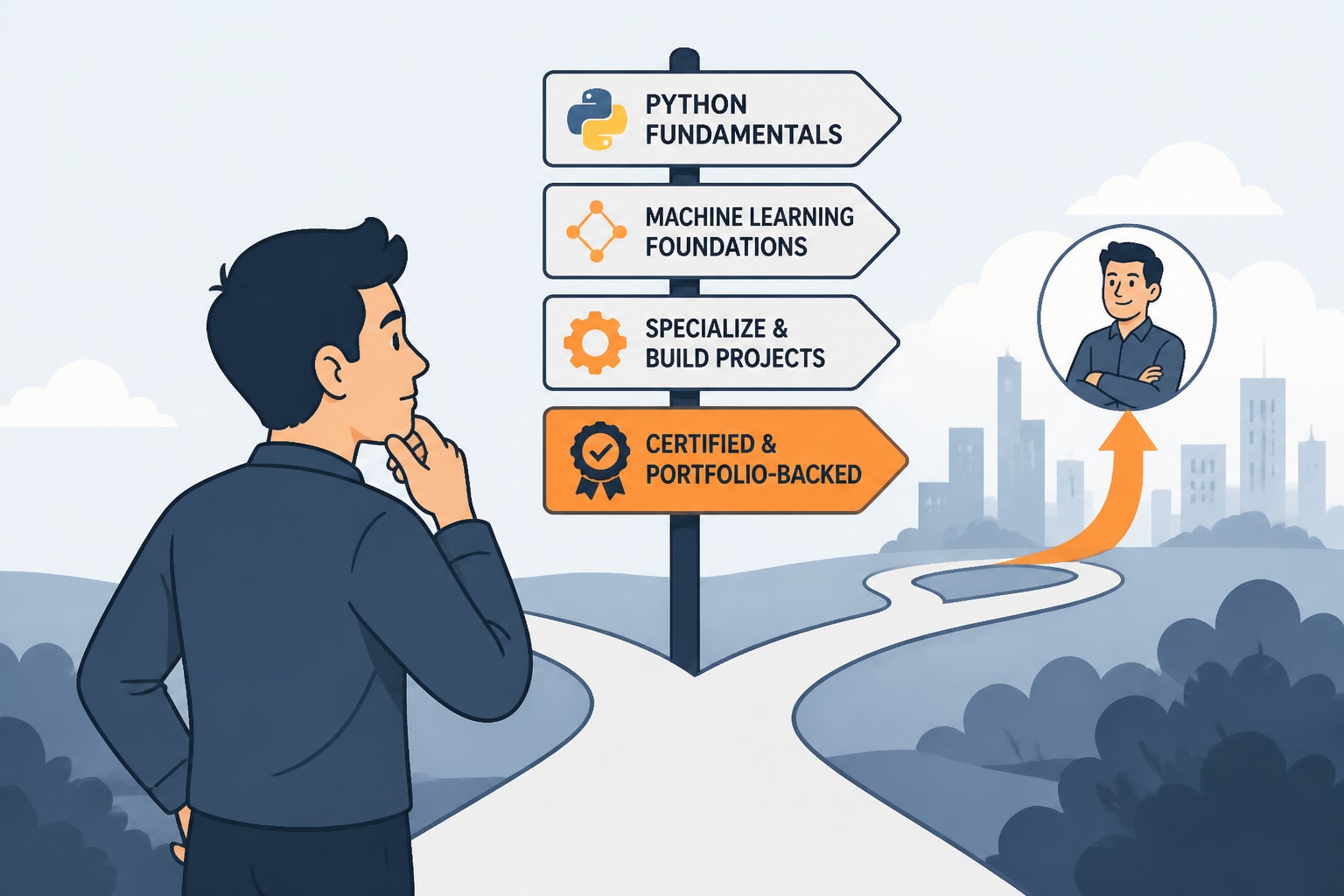
For career switchers, the strongest signal is a certification paired with a portfolio project that shows the skill working. A badge alone invites the follow-up question "what did you build?"
Which NVIDIA AI Certification Is Best?
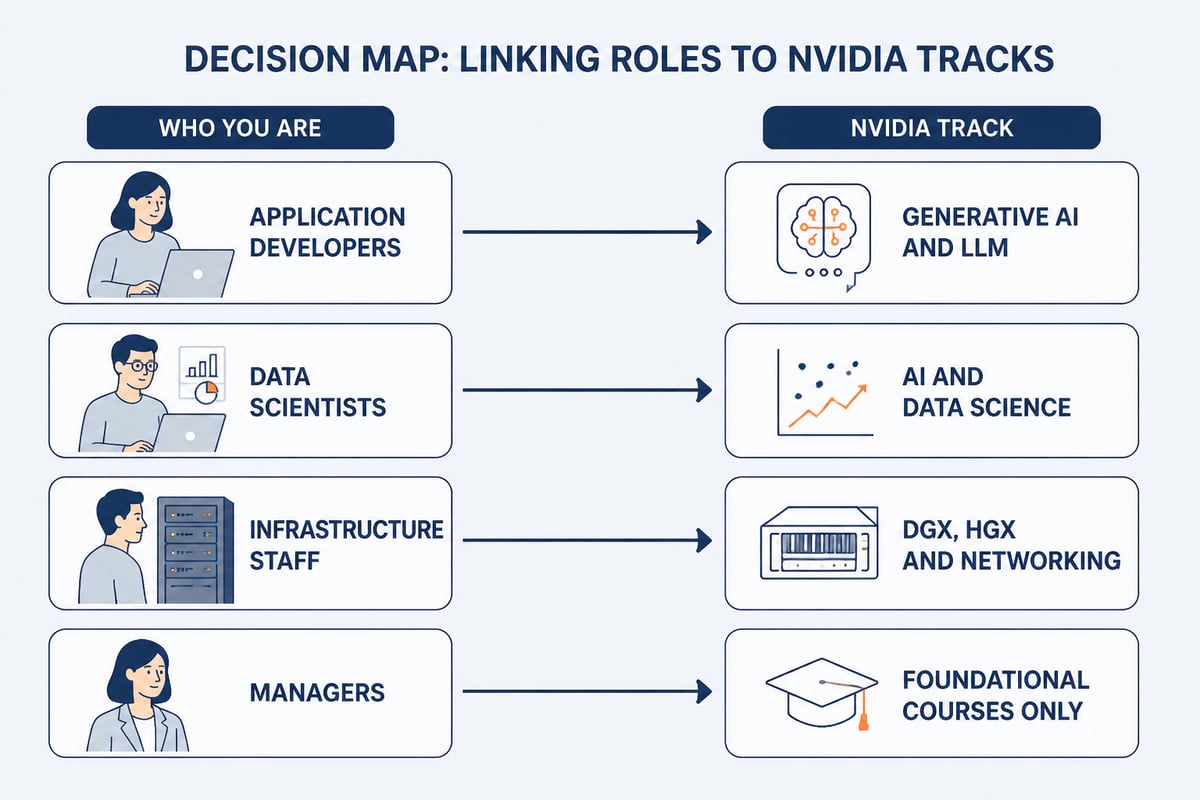
The best NVIDIA certification is the one that matches your job target, not a universal winner. A generative AI credential suits application developers, while infrastructure and networking credentials suit administrators.
Match the credential to your role:
- Application developers and ML engineers: Choose a generative AI or LLM track and build toward RAG and agent work.
- Data scientists: Favor the AI and data science tracks.
- Infrastructure and operations staff: Look at DGX, HGX, and networking tracks.
- Managers: A certification is rarely required. Foundational courses give you enough fluency to evaluate proposals and set realistic expectations.
Review the current exam list on NVIDIA's learning hub before choosing, since credentials are added and revised over time.
How Can Teams Roll Out NVIDIA Training at Scale?
Teams scale NVIDIA training best by sorting staff into role tiers, assigning a shared baseline, and tracking completion against a real project. Buying seats without a plan usually produces unfinished courses.
A workable rollout for a manager:
- Baseline everyone. Assign the free foundation course so the whole group shares terminology.
- Tier by role. Developers take the 8-hour technical courses, administrators take infrastructure tracks, and decision-makers stop at the overview level.
- Tie learning to a deliverable. A pilot such as an internal document assistant built with a RAG approach gives people a reason to finish and apply the material.
- Budget realistically. At $90 per 8-hour course, a four-course developer path costs roughly $300 to $360 per person before any workshops, so plan for hands-on time as well as fees.
- Measure outcomes. Track certificates earned, pilots shipped, and time saved rather than hours watched.
NVIDIA's learning hub also lists instructor-led workshops, which are worth considering when a whole team needs the same material on the same schedule.
What Gaps Do Vendor Courses Leave, and How Do You Fill Them?
Vendor courses teach the vendor's stack deeply, so you usually need separate practice in Python, prompting across several models, and automation to apply that knowledge on the job. Planning for that supporting skill set is what turns a certificate into employable ability.
Common gaps and ways to close them:
- Programming fluency. NVIDIA's technical courses assume you can read and write Python. If that is shaky, a structured Python programming fundamentals learning path gives you the base first.
- Model-agnostic prompting. Production teams often work across several providers. A course on Gemini prompt engineering broadens what you learned in an NVIDIA prompt engineering course.
- Workflow automation. Connecting a model to real systems is a skill of its own, covered in material such as AI automation with n8n, Python, and modern workflows.
- Exam practice. Practice questions and timed attempts help more than rereading notes. MammothClub's certification courses include practice-oriented material for credential preparation.
Learners comparing options across vendors may also find MammothClub's guide to the best AI and machine learning courses useful for deciding what to pair with an NVIDIA track.
For a structured way to cover those gaps, Mammoth Club Unlimited Membership provides one annual membership to more than 3,000 courses, certification paths, practice exams, tools, and digital assets.
How Should You Build a Study Plan Around an NVIDIA AI Course?
Build the plan backward from a deadline: pick a target outcome, divide the courses into weekly blocks, and finish each one with a small project. A fixed schedule beats open-ended intentions.
A sample eight-week plan for a developer:
- Week 1: Free foundations course and a review of the learning path.
- Weeks 2 to 3: Getting Started With Deep Learning, one sitting for lessons and another for exercises.
- Weeks 4 to 5: Prompt engineering course, ending with a small working application.
- Weeks 6 to 7: RAG agents course, using your own documents as the data source.
- Week 8: Evaluation course, then a written summary of what your system gets right and wrong.
Keep each 8-hour course to two or three sessions rather than a single marathon, because hands-on labs reward spacing. Keep notes on every error you hit, since the same mistakes recur in projects and in exam scenarios. Keep the final project public or presentable, because it becomes the evidence you show a recruiter or your own manager.
FAQ
Do NVIDIA course certificates carry weight with employers?
A certificate of competency shows you completed a course and its exercises, which is a positive signal but not proof of deep skill. Pairing it with a project you can demonstrate, or with an exam-based certification, strengthens the case considerably.
Can I take NVIDIA AI courses without a technical background?
Yes, for the foundational material. The free AI for All course is aimed at building basic fluency, but the 8-hour technical courses assume programming comfort, so build Python skills first if you plan to continue.
How long does it take to finish the full generative AI path?
The listed courses total roughly 35 hours of instruction, so most working professionals can finish within several weeks at a few hours per week. Allow extra time for projects and exam preparation.
Choose one course from the table above that matches your role, and put its first session on your calendar this week. If you want a single structured place to cover the Python, prompting, automation, and exam practice that surround vendor training, Mammoth Club Unlimited Membership gives you courses, labs, and practice exams under one annual plan. MammothClub is built for professionals and teams who want measurable progress, so start with a plan and turn each certificate into work you can show.