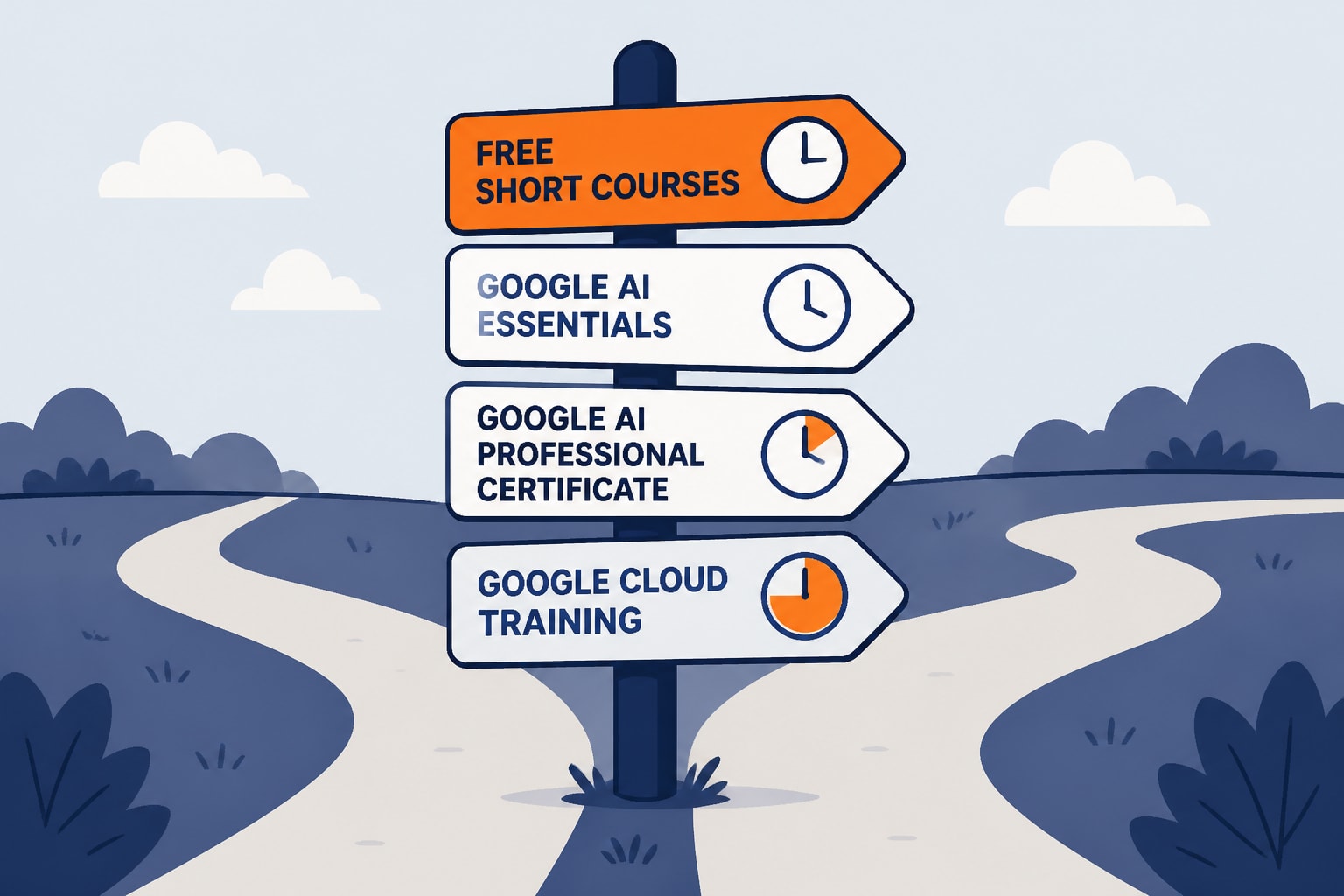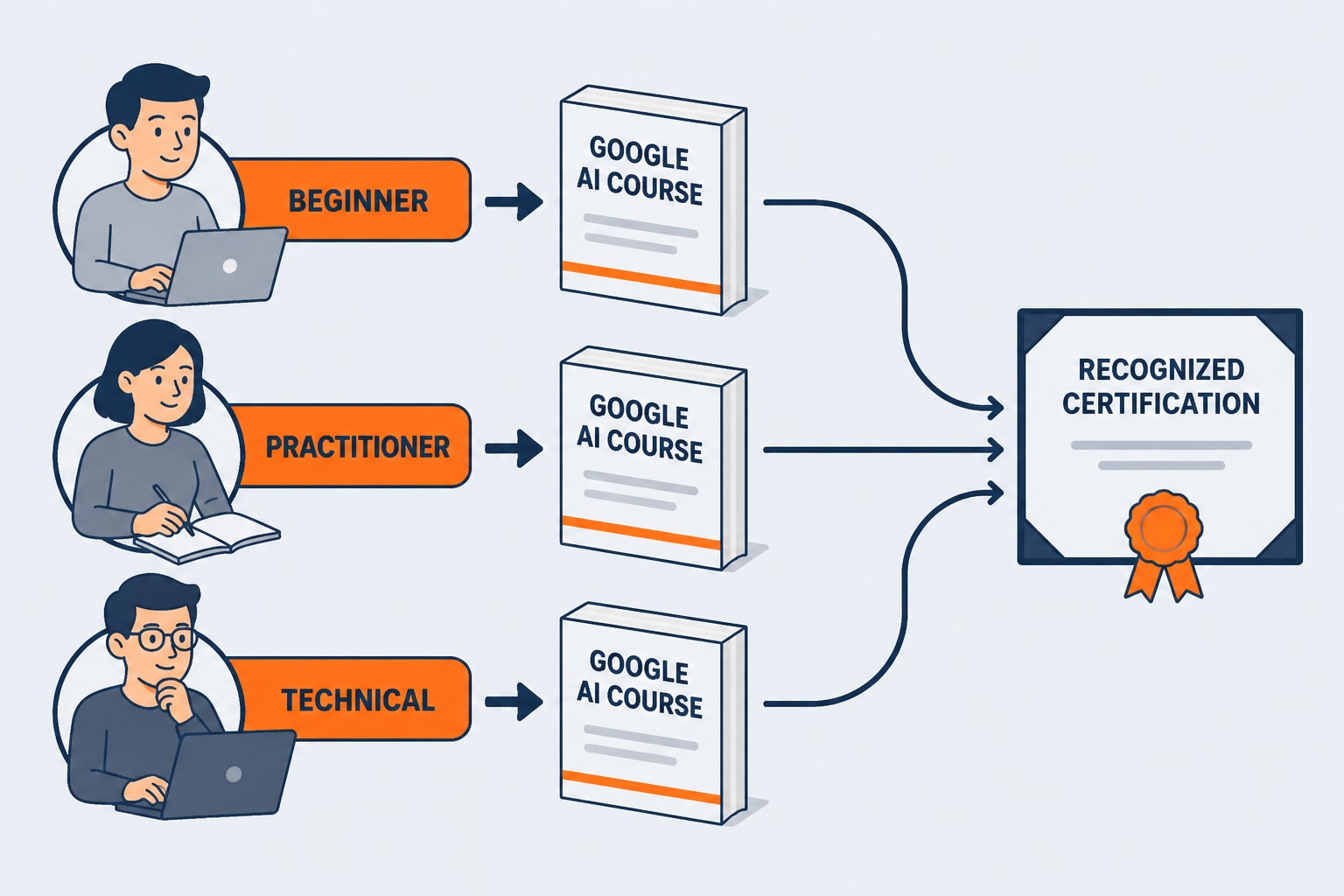
The best AI machine learning courses to start with depend on your goal: a university-backed program such as MIT Professional Education suits strategic or technical leaders, while a subscription or all-access membership suits learners who want broad coverage at a lower cost. This guide compares six options by length, price and focus, then explains how to match a course to a hiring, promotion or team upskilling goal.
Prices below are approximate. Confirm details on each provider's page before enrolling.
How to Choose Among AI Machine Learning Courses
Choose by outcome first and by brand second. A course should end in something you can show: a certificate, a project portfolio or a proctored exam result.
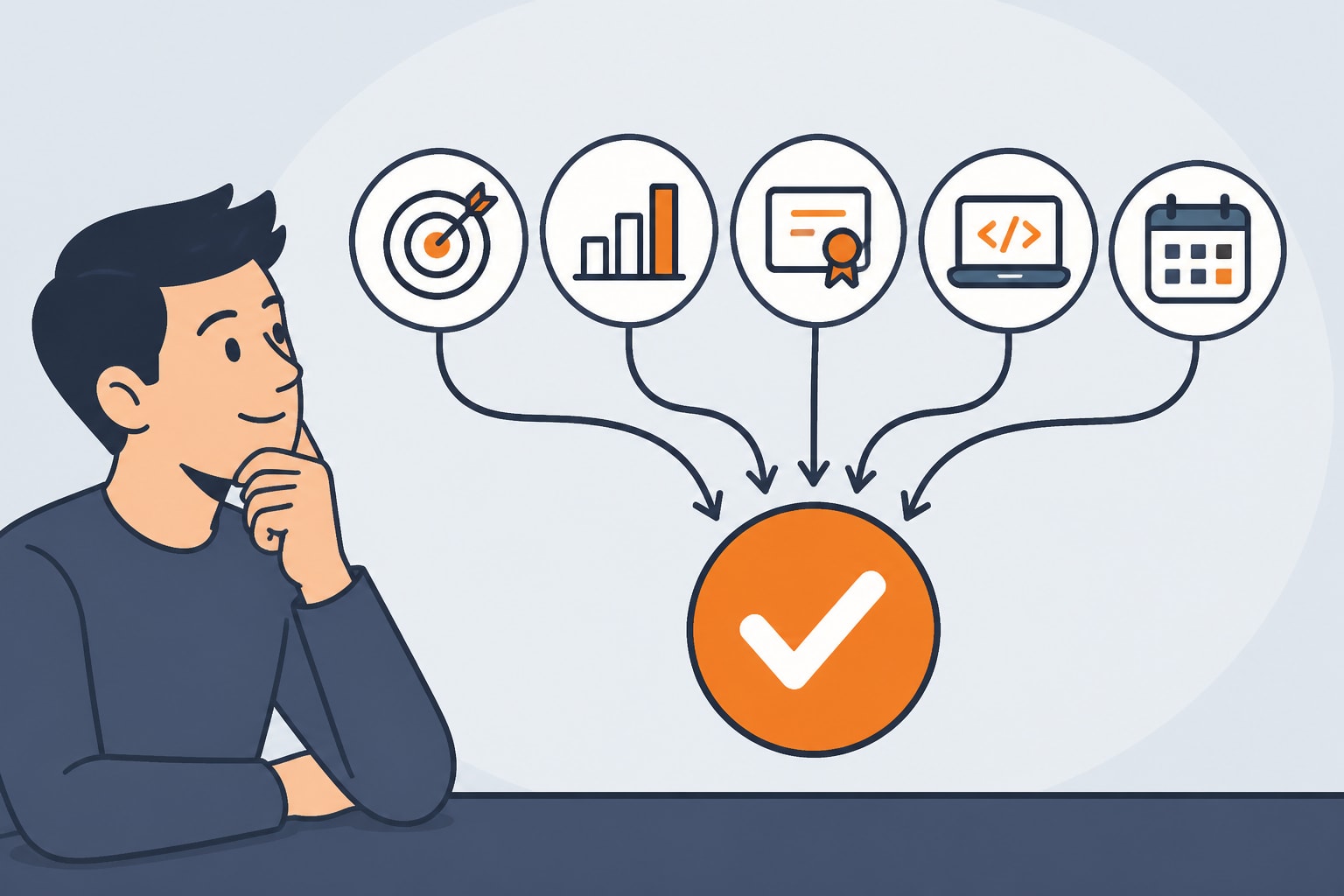
Use these four checks before paying:
- Depth required: Do you need to understand AI well enough to direct projects, or build models yourself?
- Time available: An 8-week program with 8 to 10 hours weekly is a different commitment than a self-paced library.
- Proof of skill: Look for graded projects, assessments or recognized credit units, not only video completion.
- Scale: Teams need dashboards and consistent content. Individuals need flexibility.
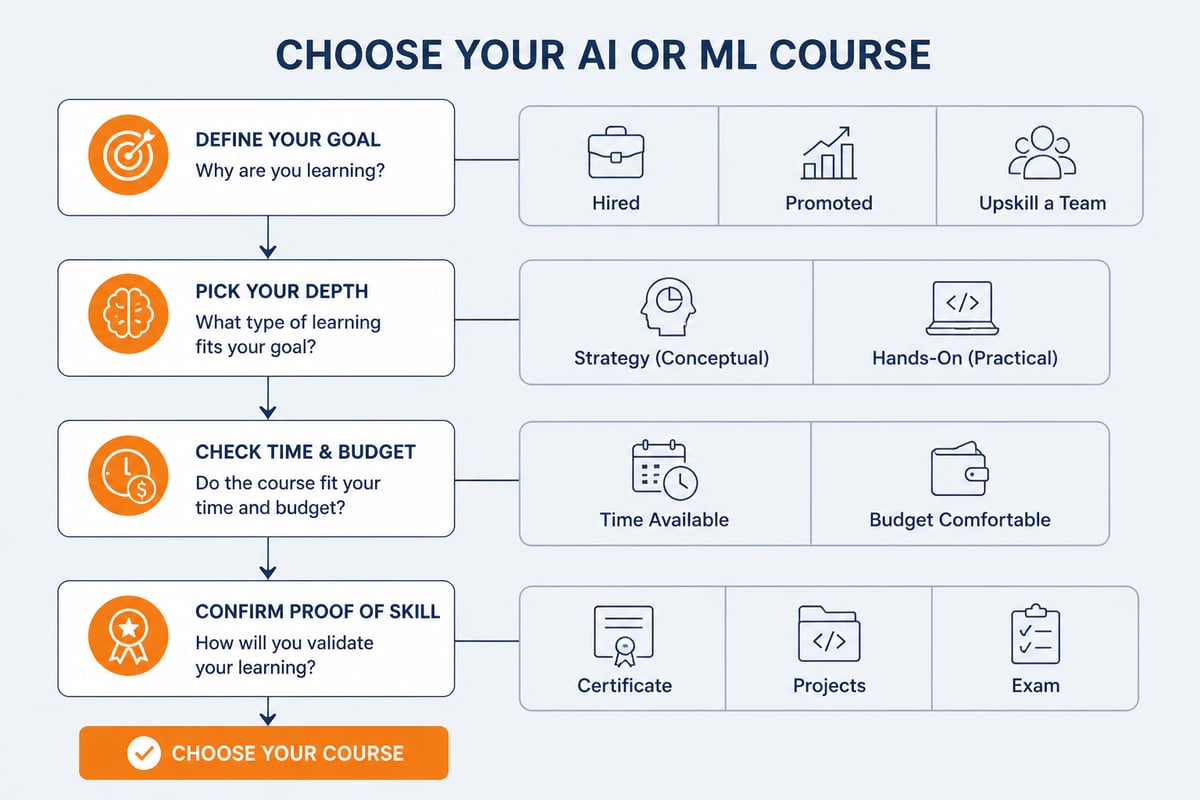
A practical rule: if your job title will not change but your decisions will, start with a strategy course. If you want a technical role, start with fundamentals and a project portfolio. Our overview of AI and ML courses online covers the wider landscape.
1. Applied AI for Digital Transformation (MIT Professional Education)
This MIT course is a strategic introduction to generative AI for people who guide organizations rather than write code. It runs 8 weeks, is delivered online, carries 6.4 CEUs and costs about $3,350, according to MIT Professional Education.
- Covers: generative AI applications, risks, ethical considerations and organizational adoption
- Format: online, 8 weeks
- Credit: 6.4 CEUs
- Approximate price: $3,350
Best use: A manager or director who must evaluate AI proposals, set governance rules and sponsor adoption projects, with a budget that allows a premium university credential. An overview of the curriculum and intended audience is published by MIT.
Verdict: A strong choice for strategic leaders, and a poor fit for anyone who wants to build models.
2. Machine Learning: From Data to Decisions (MIT Professional Education)
This is the most technical of the MIT options on this list, and it teaches machine learning as a tool for decisions. It is an 8-week online course that requires an estimated 8 to 10 hours of effort per week, per MIT Professional Education, and costs about $2,900.
- Covers: supervised learning, data classification, predictions and neural-network basics
- Format: online, in English, 8 weeks
- Weekly effort: 8 to 10 hours
- Approximate price: $2,900
Best use: An analyst, engineer or executive with some comfort with data who wants to understand how predictive models work and how to apply them to business questions, with roughly 70 to 80 hours available over two months.
Verdict: The best MIT entry point if you want machine learning fundamentals rather than a leadership overview.
3. No Code and Agentic AI (MIT Professional Education)
This program introduces generative and agentic AI without requiring you to program. It lasts 14 weeks, offers 10 CEUs and includes 14+ case studies and 3 hands-on projects, according to MIT Professional Education. The price is about $2,850.
- Covers: generative AI, agentic AI, no-code building
- Format: online, 14 weeks
- Credit: 10 CEUs
- Projects: 3 hands-on projects and 14+ case studies
- Approximate price: $2,850
Best use: Career switchers and business professionals who want practical projects to show an employer but have no coding background, and who can commit to a longer 14-week schedule.
Verdict: The most project-oriented MIT option here, and well suited to non-programmers who want something tangible to present.
4. Professional Certificate Program in Machine Learning & Artificial Intelligence (MIT)
This is a structured MIT certificate program that bundles machine learning and AI study under a single credential, priced at about $3,750. It is part of MIT's professional learning offerings.
- Format: professional certificate program
- Approximate price: $3,750
Best use: A professional who wants one recognizable certificate on a résumé and prefers a defined program over assembling individual courses, with the highest budget on this list.
Verdict: Worth considering when the credential itself matters to your employer. Check MIT's guide to its AI program options to see how it fits with the other tracks.
5. Mammoth Club Unlimited Membership
This is an annual all-access membership to 3,000+ courses, certification paths, practice exams, tools and digital assets, with pricing from $199 per year. It suits learners and teams who need breadth and recognized certification prep rather than one fixed course.
- Format: annual membership with courses, certification paths and practice exams
- Certification: structured certification paths with practice exams
- Resources: practice labs, templates and digital assets under one membership
- Quality: courses are designed for practical application
- Scale: over 1,400 organizations and libraries are on the platform, with over 500,000 practice exam questions and over 5,000 hours of content
- Approximate price: from $199 per year
Best use: A career switcher building a portfolio across AI, Python and certification prep, or a manager upskilling a team who needs measurable progress at a lower per-learner cost. Mammoth Club Unlimited Membership is a fit if you want structured certification paths, not a single short video.
Verdict: The broadest and most economical option here for ongoing, certification-focused learning.
6. Coursera Plus
Coursera Plus is a subscription to a broad catalog of AI courses from industry and education providers. Coursera advertises it at $239 for a year on its AI course exploration page.
- Format: annual subscription
- Catalog: AI courses from multiple industry and education providers
- Approximate price: $239 per year
Best use: A learner who wants to sample several providers and topics before committing to one specialty, on a modest annual budget.
Verdict: Good for exploration, though the credential value varies by the provider behind each course.
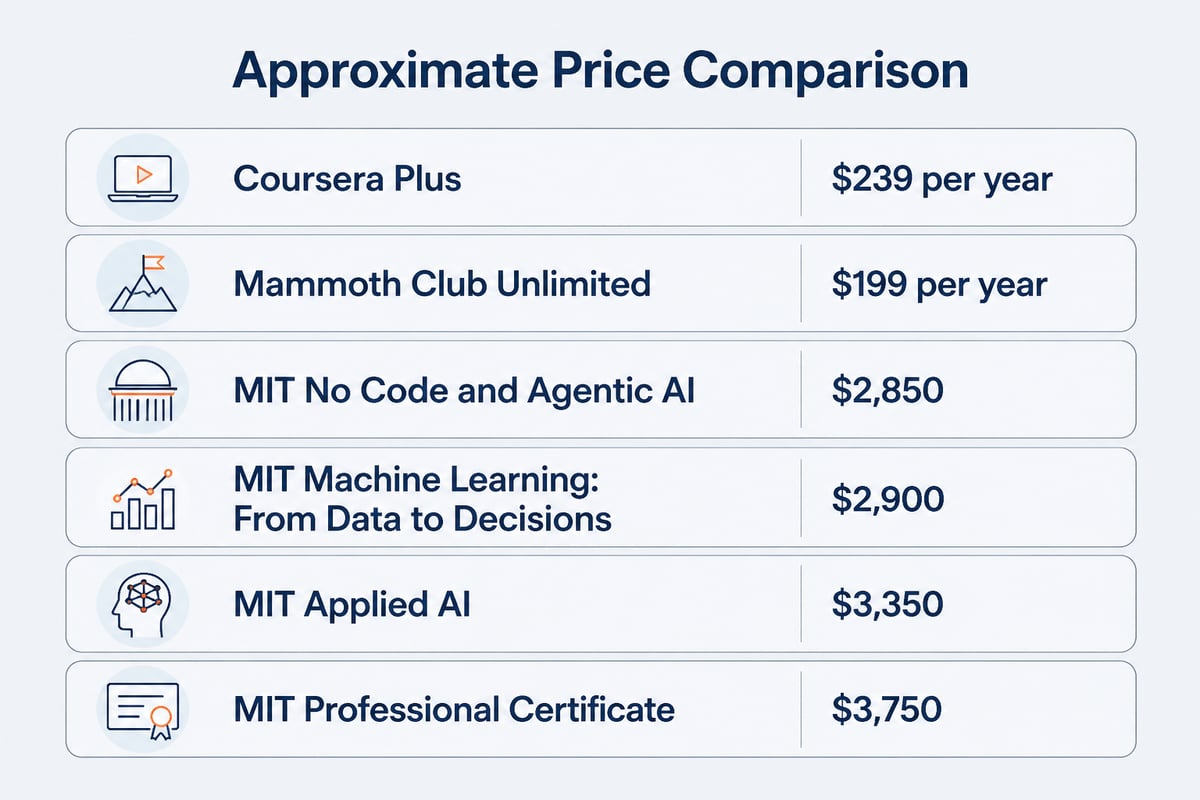
Comparison of the Best AI Machine Learning Courses
| Course | Approx. price | Length | Focus | Best for |
|---|---|---|---|---|
| Applied AI for Digital Transformation | $3,350 | 8 weeks | Generative AI strategy, risk, ethics | Organizational leaders |
| Machine Learning: From Data to Decisions | $2,900 | 8 weeks, 8-10 hrs/week | Supervised learning, neural networks | Technical professionals and executives |
| No Code and Agentic AI | $2,850 | 14 weeks | No-code generative and agentic AI | Non-programmers wanting projects |
| MIT Professional Certificate in ML & AI | $3,750 | Certificate program | Machine learning and AI | Credential seekers |
| Mammoth Club Unlimited Membership | From $199/year | Self-paced | Courses, certification paths, practice exams | Career switchers and teams |
| Coursera Plus | $239/year | Self-paced | Broad multi-provider catalog | Exploratory learners |
Which Path Fits a Hiring or Promotion Goal
Employers hiring for AI-adjacent roles generally want evidence of applied work, not only course completion. A project portfolio and a proctored exam result carry more weight than a list of watched videos.
For a promotion into AI oversight, a university-branded strategy course gives you vocabulary and credibility with senior stakeholders. For a move into a technical role, pair a fundamentals course with practical projects. MammothClub's guide to machine learning certifications explains how credentials map to roles, and its Python learning path covers the programming base most machine learning work depends on.
How Managers Can Upskill a Team in AI
Start with a shared baseline, then branch by role. A common pattern is a foundations course for everyone, followed by role-specific tracks for analysts, developers and decision makers.
- Audit skills: Identify who needs conceptual literacy and who needs hands-on ability.
- Set a baseline: Use an introductory course such as What is machine learning as common ground.
- Assign by role: Match depth to job function rather than giving everyone the same course.
- Measure progress: Use assessments and completion dashboards, not self-reported confidence.
- Apply immediately: Tie each learner to a real business problem within the first two weeks.
The relevance of this applies across industries. A real estate investment team using an AI platform such as Leni for underwriting and reporting workflows, for example, gains more when staff understand model limits and data quality, which is exactly what foundations courses teach.

Free Resources to Test Your Interest First
If you are unsure whether AI is for you, a short trial lowers the risk before a larger spend. MIT Learn's AI page lists free materials alongside paid professional programs, which helps you sample the subject before paying thousands of dollars.
Use the trial period to test fit, not only interest. Watch one or two introductory lectures on a topic you would study in a paid course, such as generative AI or supervised learning, and note whether the material feels too basic, too technical or about right. If you cannot follow the vocabulary around classification or neural networks, a fundamentals course is the safer starting point than a strategy program. If the material feels familiar, a leadership-focused course may be the better use of your money.
Pay attention to your schedule as well. Setting aside a few hours per week for free content shows whether you can sustain the 8 to 10 hours weekly that a course like Machine Learning: From Data to Decisions requires. A low-cost subscription such as Coursera Plus is another way to compare several providers before choosing one specialty.
Free content gives you exposure but rarely a recognized credential. If your goal is to get hired or promoted, plan to move to a structured program with assessments within a few weeks.
Frequently Asked Questions
What is the best course to start learning AI and machine learning?
For strategy, start with Applied AI for Digital Transformation. For fundamentals, start with Machine Learning: From Data to Decisions. For breadth on a smaller budget, a membership such as Mammoth Club's covers many topics under one fee.
Do I need to know how to code?
Not always. No Code and Agentic AI is designed for non-programmers. Machine learning fundamentals benefit from some Python and basic statistics.
How long does it take to finish a beginner course?
The MIT programs in this guide run from 8 to 14 weeks. Self-paced libraries vary with your schedule.
Are expensive courses worth the cost?
They are worth it when the credential matters to your employer or when structured feedback and projects accelerate your progress. Otherwise, a lower-cost membership can cover the same fundamentals.
Can a team use the same course?
Yes, but pair a shared foundation with role-based tracks and measurable assessments so training translates into applied work.
Key Takeaways
- Match depth to role: strategy courses for leaders, fundamentals for analysts and builders. Applied AI for Digital Transformation (8 weeks, about $3,350) covers generative AI risks, ethics and organizational adoption, while Machine Learning: From Data to Decisions (about $2,900) teaches supervised learning, classification, predictions and neural-network basics.
- Prefer programs with graded projects or assessments. No Code and Agentic AI, for example, includes 3 hands-on projects and 14+ case studies, which gives you work to show an employer.
- Budget ranges widely, from about $199 per year to about $3,750 per program. A university credential such as the MIT Professional Certificate costs far more than a membership, so decide whether the brand itself matters to your employer before paying the premium.
- Teams benefit from a shared baseline plus role-specific tracks. Give everyone the same foundations course, then assign deeper study by job function and measure progress with assessments rather than self-reported confidence.
- Account for time as well as money. An 8-week course at 8 to 10 hours weekly is a real commitment, and a 14-week program asks for sustained effort across more than three months.
If you also want hands-on AI tooling, MammothClub's AI agent development course is one example of an applied path worth reviewing.
Pick one goal this week, either a promotion, a role change or a team skills gap, and shortlist two courses from the list above that match it. If you want structured certification paths and practice exams under a single fee, review Mammoth Club Unlimited Membership and move from planning to practice.