The right AI class online is the one that matches a specific career outcome, includes graded hands-on work, and ends in a credential an employer can verify. Course titles are similar across the market, so the difference comes down to structure: who teaches it, how it is assessed, and how recently it was updated.
This guide walks through how to set your goal, compare course types, evaluate quality, and plan your study time, with a focus on professionals and career switchers who need recognized credentials to get hired or promoted.
What Should You Decide Before You Compare Courses?
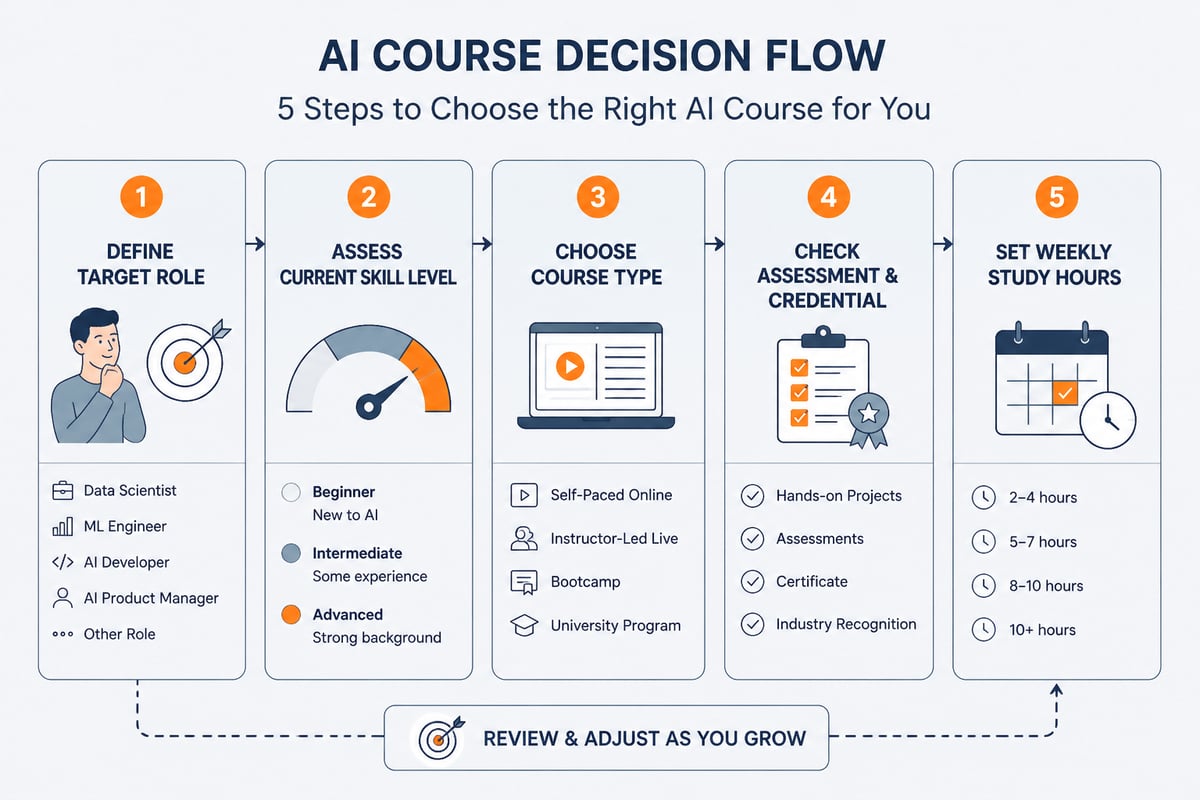
Decide your target role and your starting point first, because every other choice follows from those two answers. A marketing manager who wants to direct AI projects needs different material than a software developer moving into machine learning engineering.
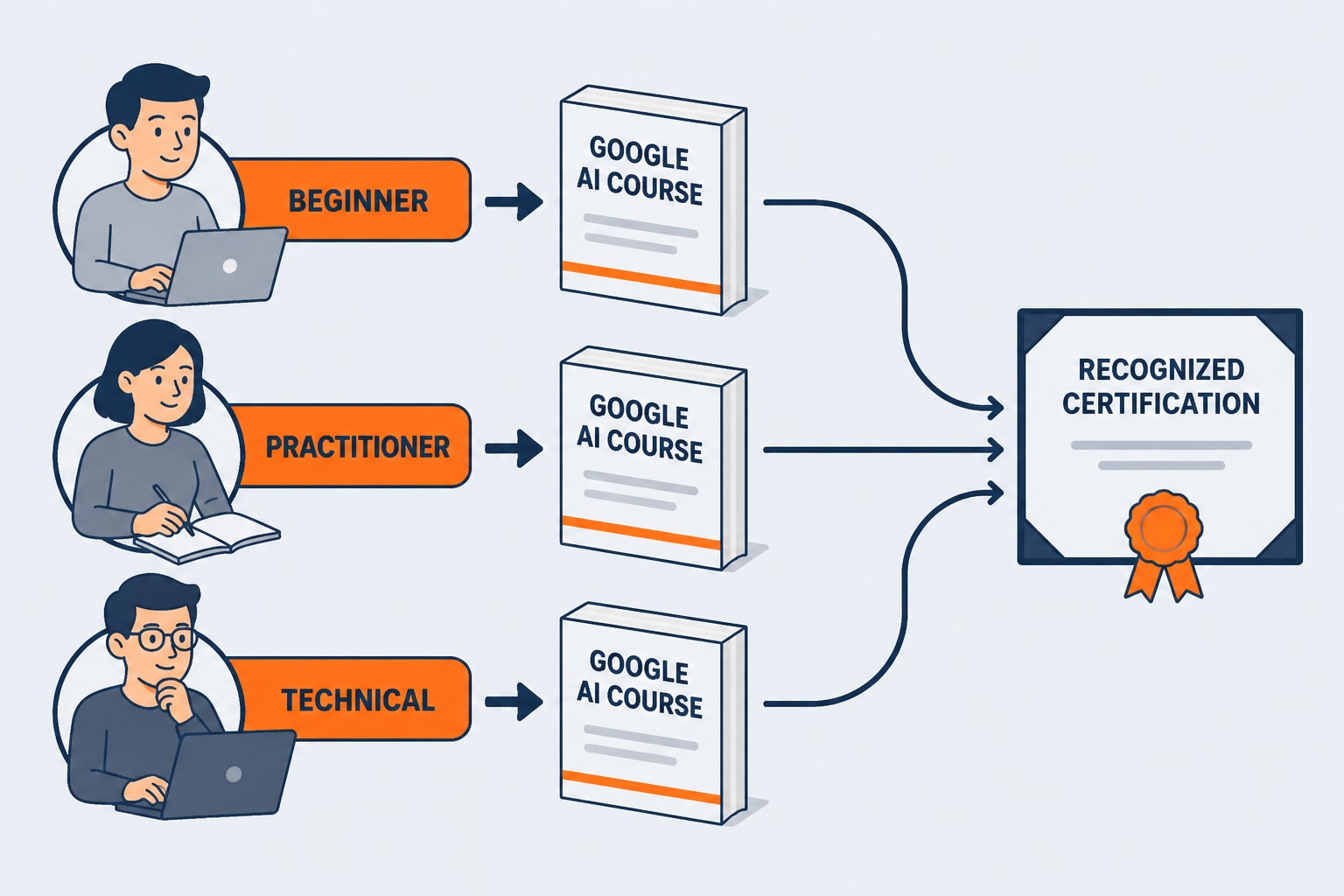
Start by placing yourself in one of three groups:
- AI-literate professional: You want to apply AI tools in your current role, evaluate vendors and speak credibly with technical teams.
- Technical upskiller: You already code or work with data and want to build and deploy models or AI-powered applications.
- Career switcher: You are moving from another field and need foundations, a portfolio and a credential to be considered for entry-level AI roles.
Then write one sentence describing the result you want, such as "earn a cloud AI certification within four months" or "ship two portfolio projects that use language models." A course that cannot be mapped to that sentence is probably not the right one.
The competency model from UNESCO is a useful reference for what balanced AI learning looks like. UNESCO's 2024 student AI competency framework outlines a set of competencies with progression levels of Understand, Apply, and Create. Even though it was written for students, the progression is a practical test for any course: does it only explain concepts, or does it move you toward applying and creating?
What Types of AI Classes Are Available Online?
Online AI classes fall into five main formats, and each suits a different goal and schedule. Knowing the format tells you how much structure, feedback and credential value to expect.
| Format | Typical length | Best for | Credential value |
|---|---|---|---|
| Self-paced video or text course | 3 to 40 hours | Learning one tool or concept quickly | Low to moderate, depends on provider |
| Structured certification path | 2 to 6 months | Career switchers and promotion seekers | High when assessments are proctored |
| Interactive bootcamp | 6 to 16 weeks | Intensive, deadline-driven learning | Moderate to high |
| Vendor certification prep (cloud, ML) | 4 to 12 weeks | Passing a specific exam | High, tied to the vendor |
| University-style program | 6 to 24 months | Deep theory and research orientation | High, but costly and slower |
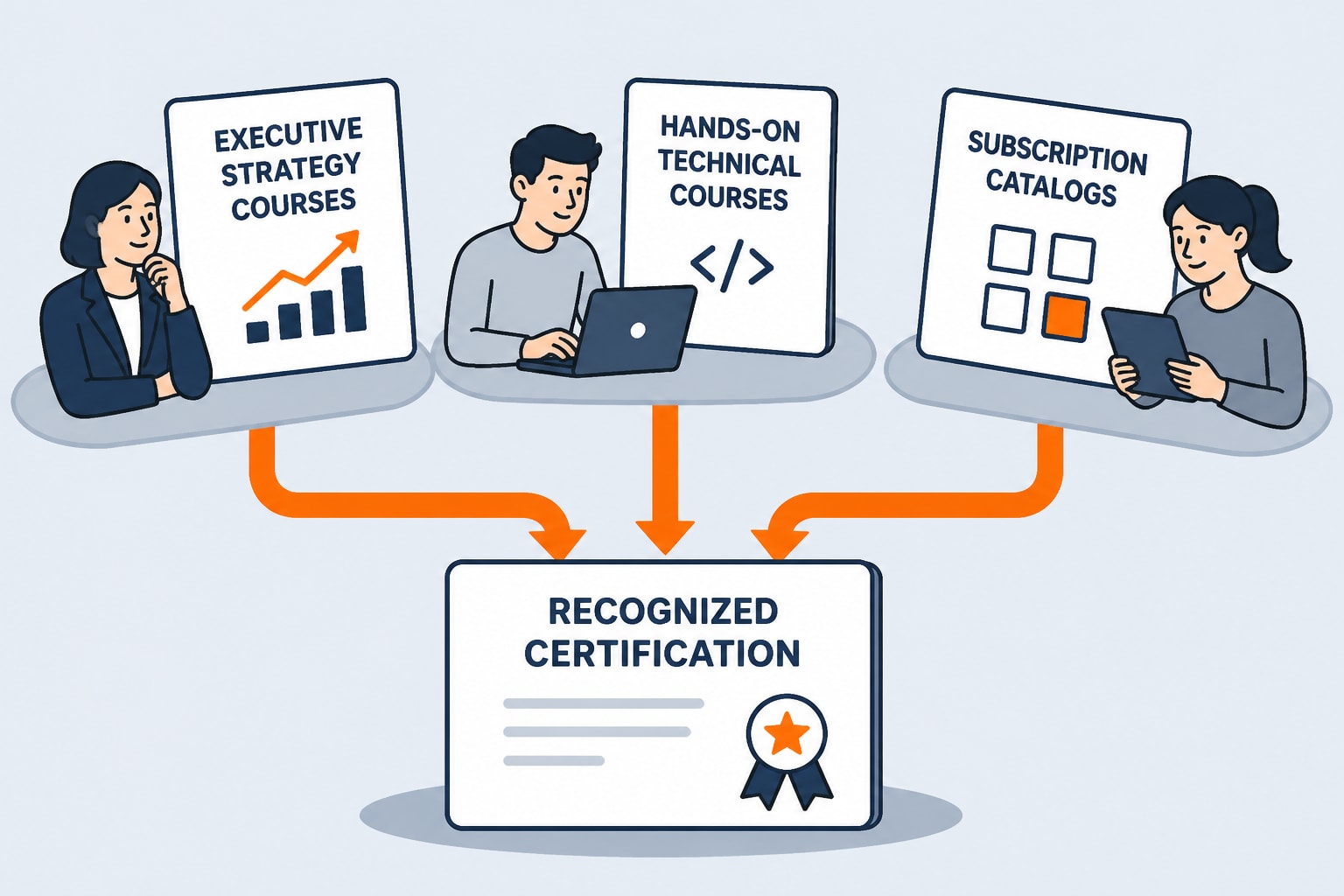
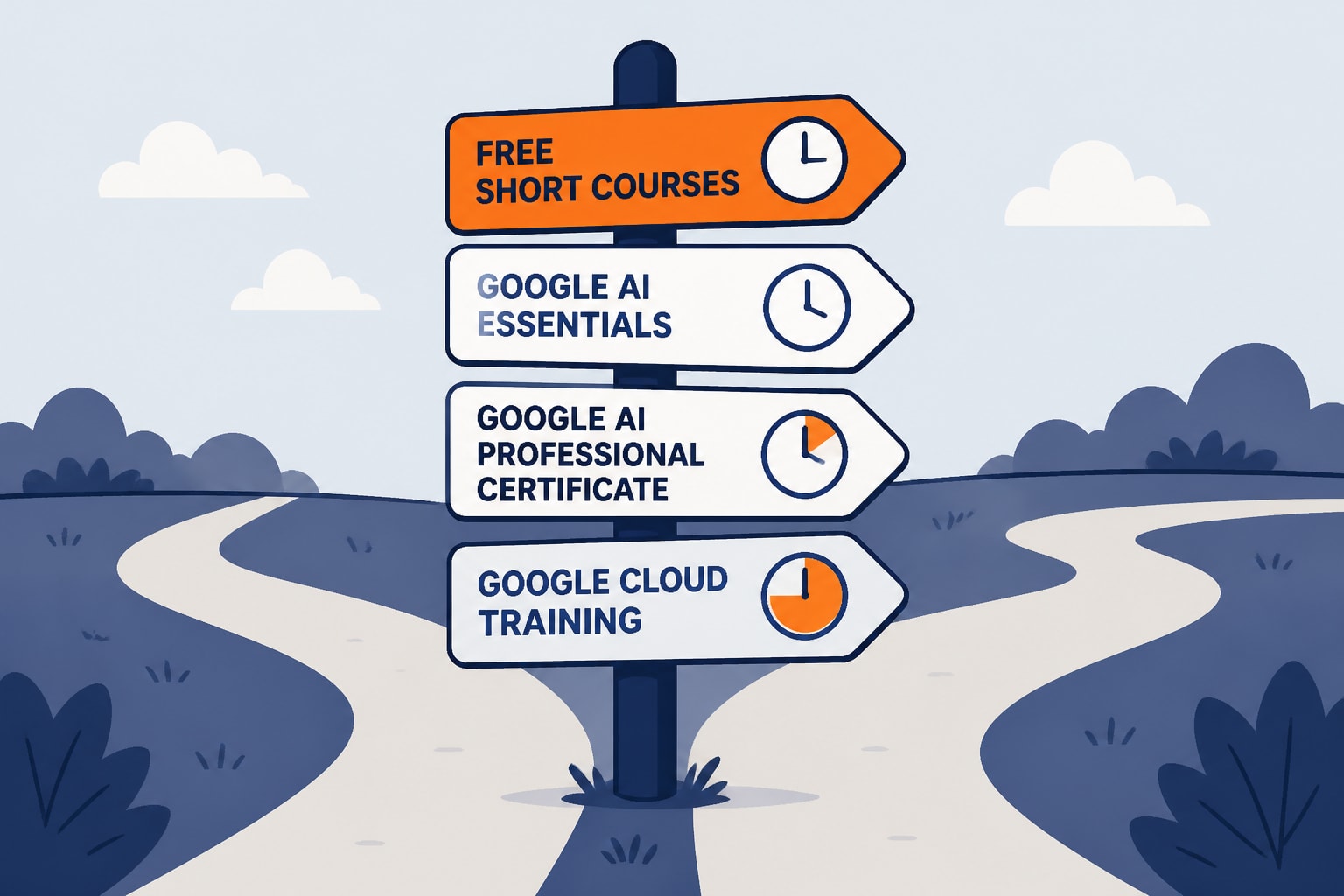
For most working professionals, a structured certification path or vendor exam prep offers the best balance of speed and recognition. Short courses are useful for filling a gap, but a single short course rarely changes how a hiring manager sees a resume. If you want a closer look at how short programs fit into a plan, the overview of a short course in artificial intelligence covers when they make sense.
How Do You Judge Course Quality Before Paying?
Judge quality by checking five things: instructor background, assessment design, project requirements, update frequency and credential verifiability. A polished landing page tells you very little, but these five factors reveal how seriously a course is built.
- Instructor background. Look for working practitioners rather than presenters who only summarize documentation. A practitioner explains why a model failed in production, not just how it was configured.
- Assessment design. Quizzes after each module are a baseline. Stronger programs add practice labs, graded projects and a final exam under controlled conditions.
- Portfolio output. A hiring manager can evaluate a finished project in minutes. A certificate alone is harder to interpret.
- Update frequency. AI tooling changes monthly. A course recorded two years ago may teach interfaces and model names that no longer exist.
- Verifiable credential. Ask whether an employer can confirm your result independently, and whether the exam was proctored.
A fast filter is to read the syllabus and count how many lessons end in something you produce, such as a prompt library, a working agent, a trained model or an evaluation report. If most lessons end in a quiz alone, expect knowledge without proof of skill.
Red Flags to Avoid
- No named instructor or no stated professional background
- No mention of when content was last revised
- "Certificate of completion" with no exam or project review
- Promises of job placement without describing how results are measured
- Content that covers tools only, with no discussion of risk, bias or evaluation
Which Skills Should a Good AI Class Cover?
A well-rounded AI class covers foundations, applied tooling, evaluation and responsible use, in roughly that order. Courses that skip any layer leave gaps that surface in interviews and on the job.
Foundations. You should understand what machine learning is, how large language models work at a conceptual level, and what data quality means for outputs. Technical learners add Python, statistics and model training basics.
Applied tooling. This includes prompt engineering, working with APIs, building simple agents and automating workflows. For an example of a practical, project-led format, see this 4-hour AI agent development course in Python and this prompt engineering course for Anthropic Claude.
Evaluation. Knowing how to test whether an AI output is correct, consistent and safe separates a user from a practitioner. Employers increasingly ask candidates how they validate results.
Responsible use and governance. Risk literacy is now a hiring signal. NIST's Generative AI Profile is a companion resource to its voluntary AI Risk Management Framework, and it proposes actions to help organizations govern, map, measure and manage risks associated with generative AI. A course that references frameworks like this, available through the NIST AI Risk Management Framework overview, prepares you for the questions compliance and security teams will ask.
How Do Certification Paths Compare With Individual Courses?
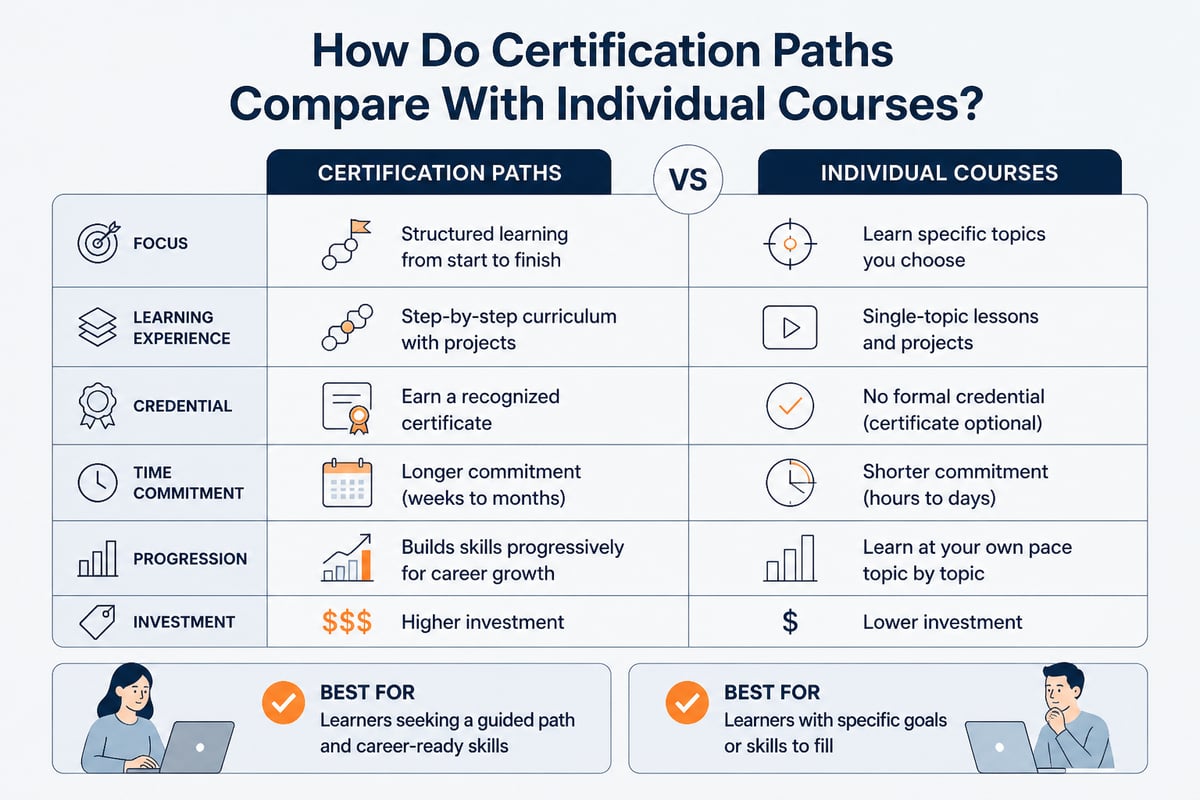
A certification path bundles courses, assessments and a final exam into one sequence, while an individual course teaches a single topic with no required proof of skill. For anyone whose goal is to get hired or promoted, the path usually carries more weight.
The advantages of a certification path:
- Sequenced learning. Topics build on each other, so you avoid the gaps that come from stitching together random videos.
- Built-in assessment. Graded work shows whether you actually retained the material.
- A recognizable endpoint. A proctored final exam gives employers a result they can trust.
The tradeoffs are real too. Paths take longer, they demand consistent weekly effort, and they cost more than a single course. If you only need to learn one tool for a project due next month, an individual course is the better fit.
Vendor certifications add another layer. Cloud-specific credentials, such as those covered in the guides to Azure AI certification and machine learning and AI certification, are tied to a platform that many employers already run. If your target employers are heavy users of one cloud, a matching credential can matter more than a general one.
How Much Time and Money Should You Plan For?
Plan for 5 to 8 hours per week over 8 to 16 weeks for a certification-level result, and budget for a membership or bundle rather than paying course by course. Costs add up quickly when you buy individual courses, practice exams and templates separately.
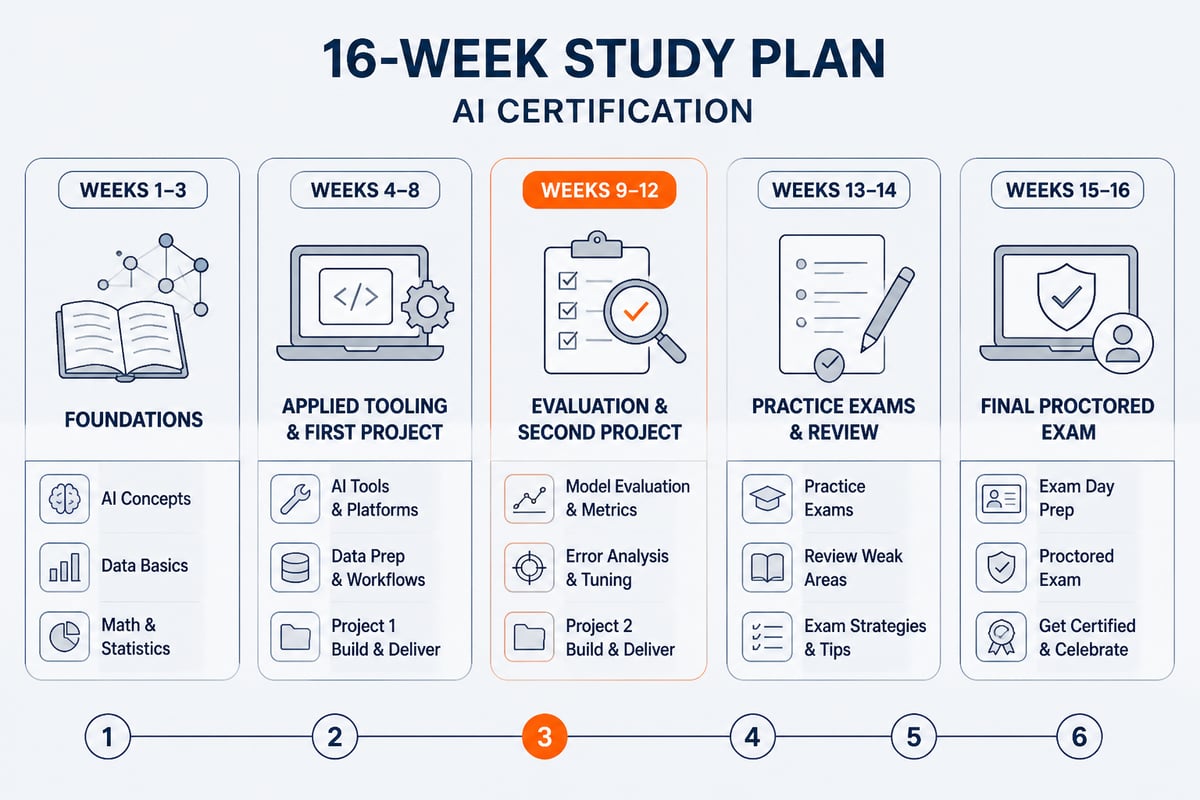
A realistic study plan for a working professional looks like this:
- Weeks 1 to 3: Foundations and vocabulary, with short daily sessions.
- Weeks 4 to 8: Applied tooling and the first portfolio project.
- Weeks 9 to 12: Evaluation, risk and a second project that solves a problem from your own job.
- Weeks 13 to 16: Practice exams, review of weak areas and the final proctored exam.
Practice exam volume matters when you target a certification. A large question bank lets you find weak areas before the real test, so look for programs that publish how many practice questions they include.
If you want broad access without per-course pricing, Mammoth Club Unlimited Membership gives annual all-access to 3,000+ courses, certification paths, practice exams, tools and digital assets, which suits learners who expect to move across several topics in a year. MammothClub's lessons are built to be applied the same day, and the platform offers 3,000+ courses and over 500,000 practice exam questions.
How Do You Turn an AI Class Into a Job or Promotion?
You turn coursework into career results by producing visible proof: a portfolio, a verifiable credential and a story about measurable impact. Completing lessons does not change your candidacy; showing applied results does.
Build a project portfolio tied to real work. Pick problems you know. A finance analyst might build a report-summarization workflow, and an operations lead might automate ticket triage. Document the problem, the approach, how you tested accuracy and the time saved.
Quantify outcomes. "Reduced weekly reporting time from six hours to two" is stronger than "used AI to improve reporting." Hiring managers and promotion committees respond to numbers.
Show governance awareness. Mention how you checked outputs for errors and protected sensitive data. The UNESCO framework emphasizes critical judgment of AI solutions, responsible citizenship, foundational AI knowledge, and inclusive, sustainable AI design, and those priorities now appear in employer expectations as well.
Choose a credential that can be verified. Programs with final exams and project portfolios give you evidence beyond a certificate PDF. Platforms with large certified cohorts and many organizational users also give employers more confidence that the credential is understood. MammothClub, for example, has more than 1,400 organizations and libraries on the platform, and its structured certification paths include built-in assessments and practice exams.
Do Your AI Skills Show Up in the Work You Ship?
Practical AI skill becomes visible in the products and communications you deliver, so your learning should connect to tools your team already uses. A few areas where this appears:
- Websites and content: Professionals who manage a web presence can apply AI skills with builders such as Avantiy, an AI-powered website builder that requires no coding.
- Customer communication: Teams handling support can practice evaluating conversational AI on platforms like TapTalk, an omnichannel customer messaging platform with a GenAI chatbot.
- Marketing operations: Agencies such as uovo, a digital marketing agency in Bern, show how AI-assisted workflows fit into paid advertising and social media management.
- Video and media: Filmmakers and communicators can look at Studio 1, a film school in Zurich that teaches video production including videos made with AI.
The point is not to copy these examples but to notice how AI skills attach to everyday deliverables. A course that never connects to real tools or workflows will be harder to apply.
What Mistakes Do Learners Make When Choosing an AI Class?
The most common mistakes are choosing by popularity, skipping the assessment details and starting with advanced material before foundations are secure. Each one costs weeks of effort.
- Choosing by brand alone. A familiar name does not guarantee that a specific course is current or well assessed. Check the revision date and the syllabus.
- Collecting certificates without a plan. Five unrelated short certificates read as scattered. One coherent path plus a portfolio reads as direction.
- Skipping the fundamentals. Jumping to agents or fine-tuning without understanding data and evaluation leads to fragile projects. An AI fundamentals course is a sensible first step if you are unsure of your base.
- Ignoring time-to-relevance. If tools change monthly, a course that updates yearly is already behind.
- Studying passively. Watching lessons without building anything produces recognition, not skill. Schedule hands-on time before you schedule viewing time.
For a broader comparison of what is on offer, the roundup of AI and ML courses online and the guide to an artificial intelligence class help you map options to your level.
Frequently Asked Questions
How long does an AI class online take?
Short courses take 3 to 40 hours, while certification paths usually take 2 to 6 months at 5 to 8 hours per week. The right length depends on whether you need a single skill or a credential.
Do I need to know how to code to take an AI class?
No, not for AI literacy, prompt engineering or business-focused tracks. Technical tracks in machine learning or engineering do require Python and basic statistics, so check the prerequisites.
Is an online AI certificate recognized by employers?
Recognition depends on verifiability. Credentials backed by proctored exams, graded projects and a large certified community are easier for employers to trust than a completion certificate alone.
Should I pick a vendor-specific or general AI certification?
Pick a vendor-specific one if your target employers rely on that cloud platform, and a general one if you want broad foundations or have not chosen a target yet. Many learners complete a general path first and add a vendor credential later.
How current does AI course content need to be?
Very current. Tools, model names and interfaces change quickly, so prefer programs that state a regular update schedule, such as monthly revisions, over those with no revision date.
Is free content enough to get certified?
Free content works for exploration, but it rarely includes proctored assessment, portfolio review or a verifiable credential. If you need recognition for hiring or promotion, a structured paid path is the more reliable route.
Your next step is to write your one-sentence career goal, then shortlist two paths and compare their assessments, project requirements and update schedules side by side. If you want one membership that covers courses, practice labs, templates and certification paths, Mammoth Club Unlimited Membership is built for that kind of structured progress. Start unlimited with MammothClub and work through a certified AI path with proctored exams and a project portfolio you can show to employers.