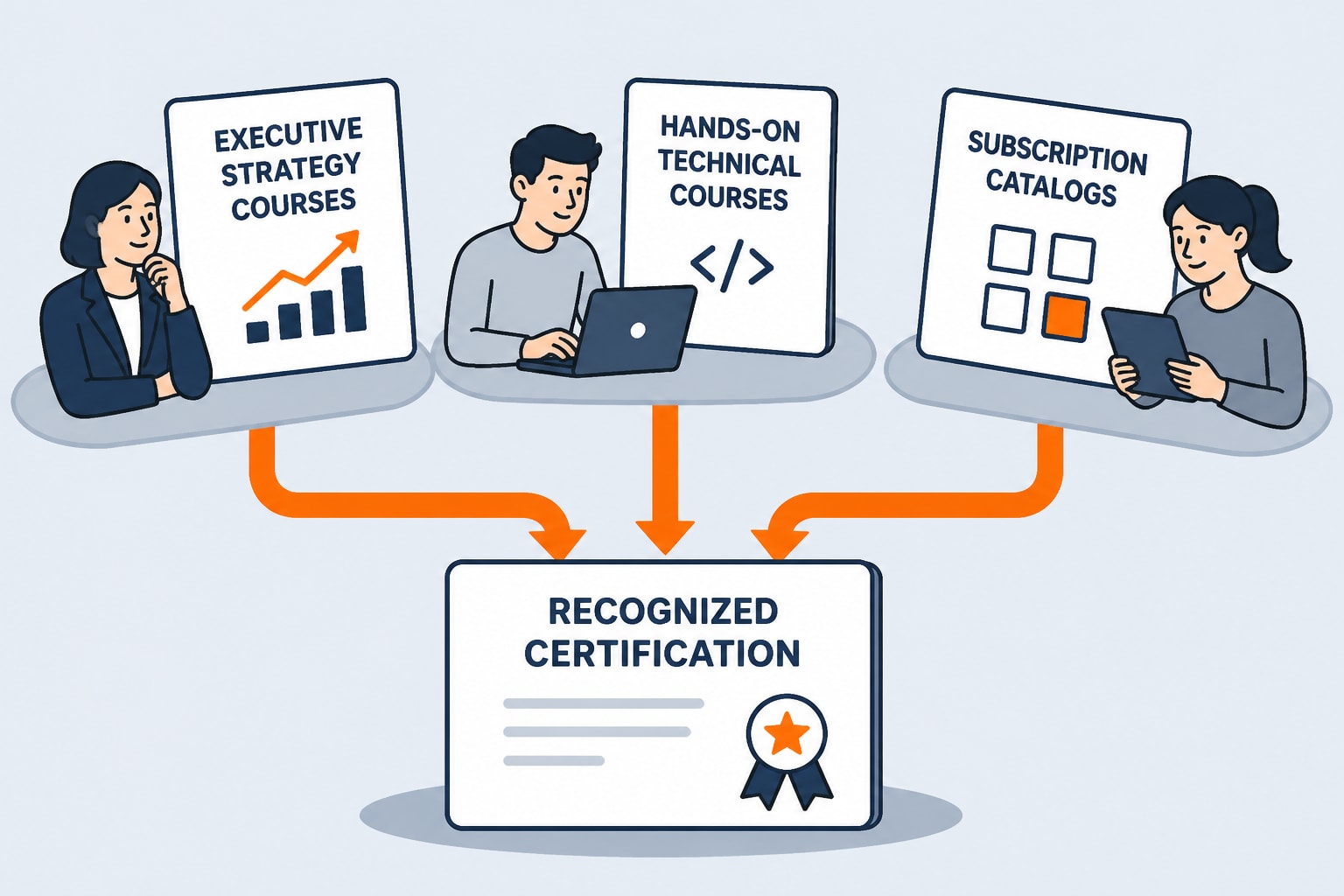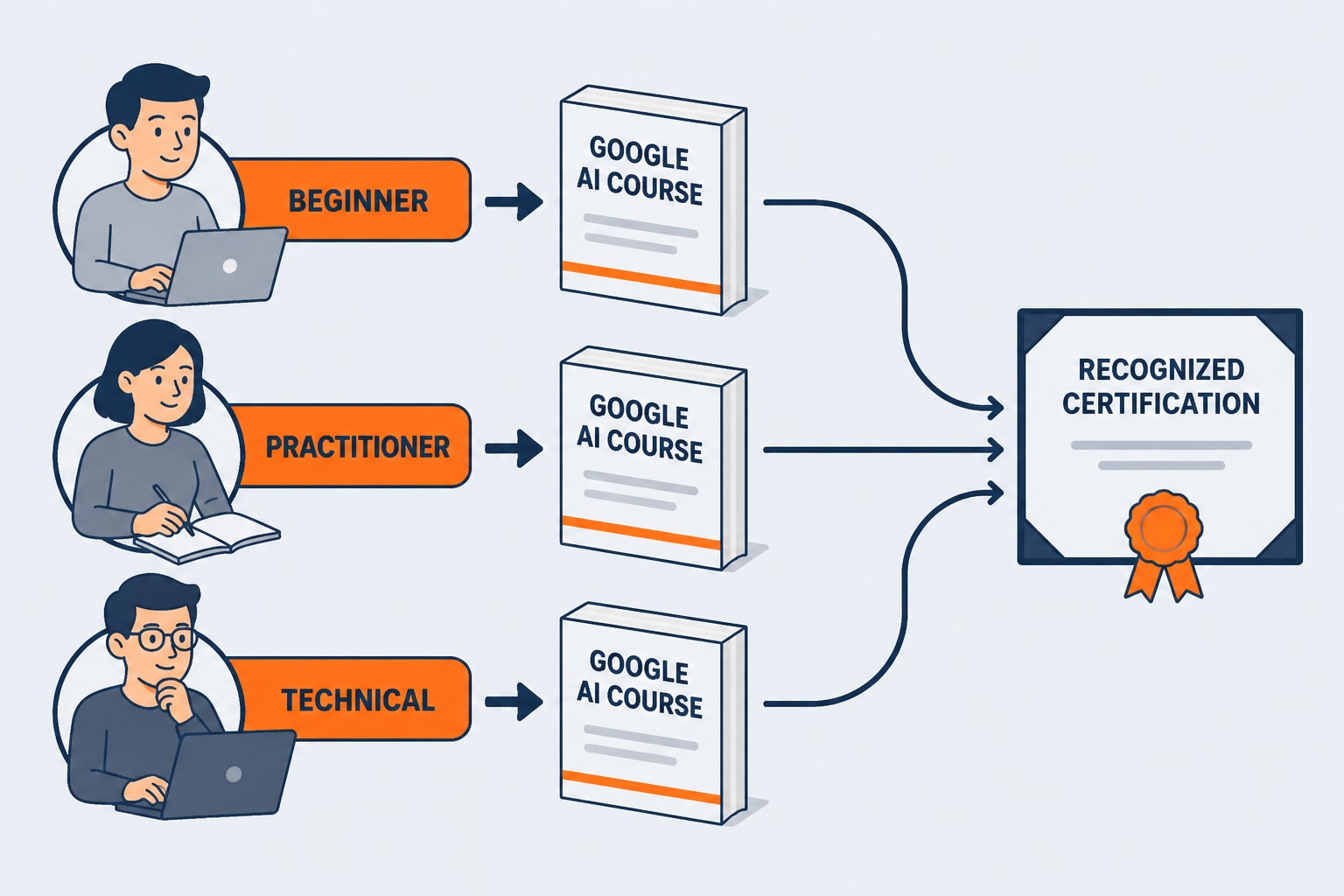
A Google AI class is any course Google offers on artificial intelligence, and the range runs from free sessions of under an hour to paid professional certificates that take several weeks. Most of them are introductory, which makes them useful for building literacy but less decisive for hiring managers than a structured, assessed credential. This guide explains what exists, what it costs, who each option suits, and how to choose in 2026.
What Google AI classes are available in 2026?
Google runs its AI training through several separate programs, each aimed at a different learner. The main ones are:
- Grow with Google courses for general professionals, including AI Essentials and the AI Professional Certificate.
- Google Cloud and Google Skills training for technical and nontechnical learners working with cloud AI tools.
- Google AI literacy resources, including a free educator series.
- Google Workspace training for teams already using Gemini inside their daily tools.
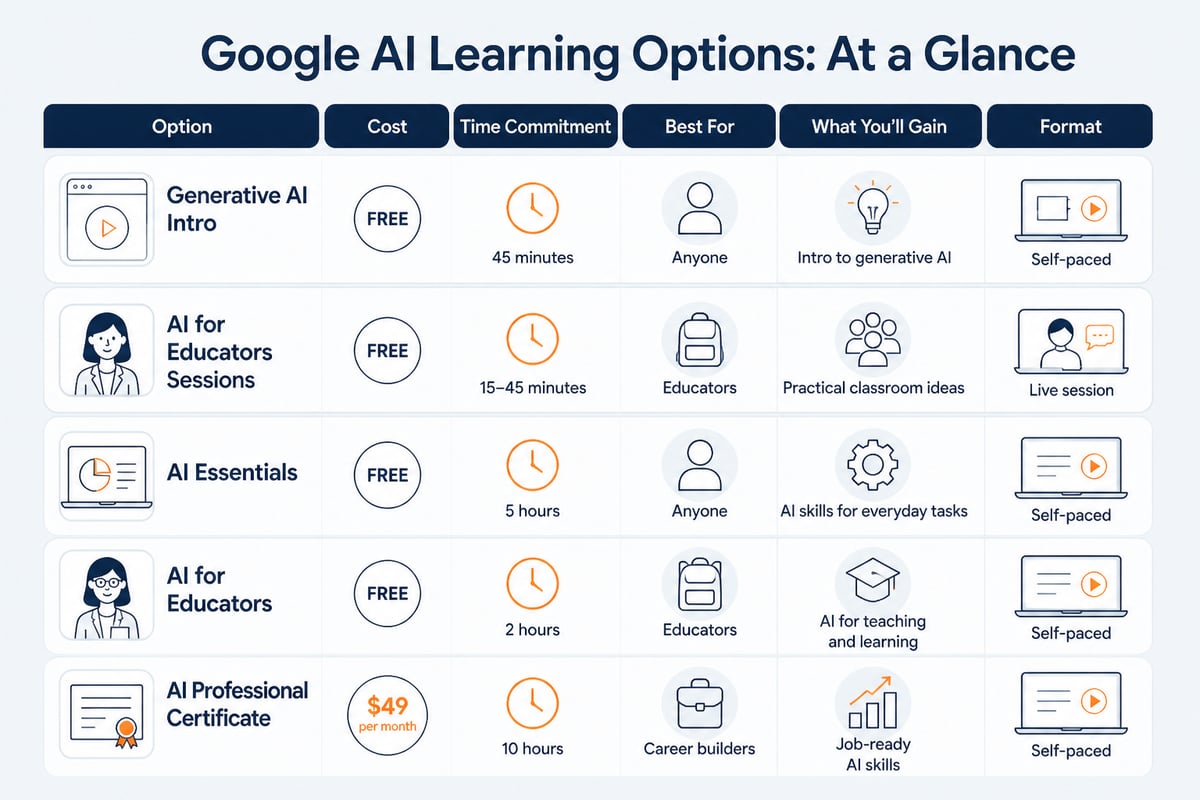
Google AI Essentials is a beginner course listed at 5 hours that covers generative AI fundamentals and practice using AI tools. Google AI for Educators is listed at 2 hours on the same page. The Google AI Professional Certificate comprises eight courses and is described as taking about 10 hours on Google's career-training page.
Google Cloud announced a new suite of AI training courses on September 19, 2025, aimed at intermediate and advanced technical learners as well as nontechnical users. That announcement shows Google building tiered paths rather than a single course.
Which Google AI classes are free?
Several Google AI classes cost nothing, though they are short and rarely carry weight as credentials. The best-known free options are:
- Introductory generative AI on Google Cloud. Google Cloud lists a no-cost introductory generative AI course with a duration of 45 minutes.
- The AI Educator Series. Google's AI literacy program offers free sessions lasting 15 to 45 minutes each.
- Generative AI learning path on Google Skills. A beginner learning path covers generative AI fundamentals, large language models, and responsible AI principles.
- Workspace help resources. Google's Workspace support page collects generative AI training material for Workspace users.
These suit anyone testing the subject before committing time or money. They teach vocabulary and basic tool use. They do not usually include proctored exams or portfolio projects, which is what recruiters tend to look for when screening for AI skills.
How much do paid Google AI classes cost?
The paid route is modest in price but runs on a subscription model. The Google AI Professional Certificate costs $49 per month in the U.S. and Canada, according to Coursera, and prices may differ elsewhere.
The cost you actually pay depends on pace. A learner who finishes the material quickly pays far less than one who stretches it over many months. Because billing is monthly, finishing faster is the main way to control spend. Learners should confirm current pricing on the provider's page before enrolling, since subscription terms change.
For teams, the math differs. Paying per seat per month across 40 employees, with no shared dashboard or completion tracking, becomes difficult to manage. That is where a company-level program usually makes more sense, a point covered later in this guide.
How do the main options compare?
The table below places the core options side by side so the differences in time, cost, and audience are clear.
| Option | Listed length | Cost | Best suited to |
|---|---|---|---|
| Intro generative AI (Google Cloud) | 45 minutes | Free | Quick orientation |
| AI Educator Series | 15-45 minutes per session | Free | Teachers and trainers |
| AI Essentials | 5 hours | See provider | Beginners at work |
| AI for Educators | 2 hours | See provider | Education staff |
| AI Professional Certificate | About 10 hours, 8 courses | $49/month (US, Canada) | Professionals wanting a credential |
Length figures come from Google's own listings, so treat them as guidance. Real completion time varies with prior experience and how much practice you add.
What will you actually learn?
Google's beginner classes teach practical use of generative AI tools, not model building. Expect these themes:
- How generative AI works at a conceptual level
- Writing effective prompts and refining outputs
- Using AI to draft, summarize, and analyze everyday work
- Responsible and ethical use, including bias and privacy concerns
This is valuable for someone whose job is changing because of AI tools. It is less suited to someone who wants to build or deploy models. For that, you would move toward Python, machine learning, and cloud certification content. The guide to AI and machine learning courses online outlines how those paths differ from literacy-level training.
Are Google AI certificates recognized by employers?
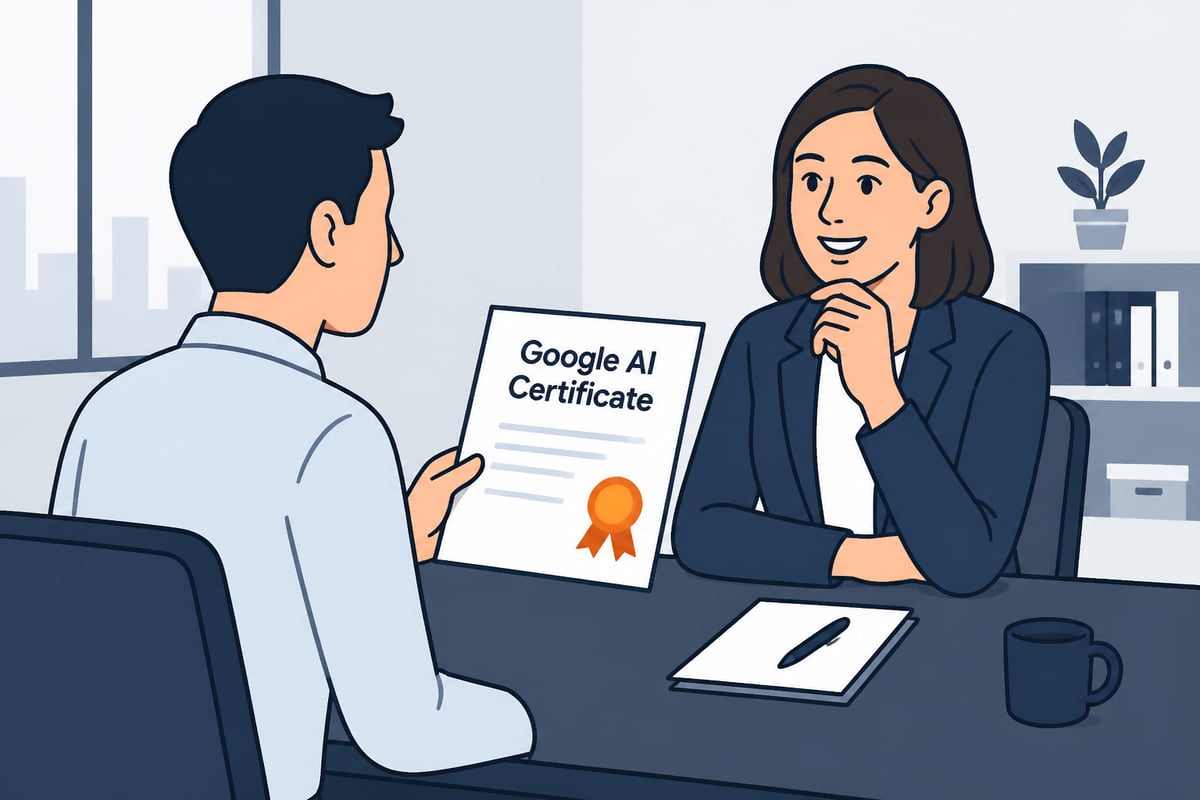
Google-branded certificates carry name recognition, but they signal familiarity rather than verified skill. A certificate earned through a short, unproctored course shows that a candidate completed material. It does not show that they can apply it under evaluation.
Hiring managers screening for AI roles tend to weigh three things more heavily: a portfolio of real projects, a credential tied to a specific technology or role, and some form of assessed performance. A short beginner badge works as a supporting line on a resume. It rarely works as the main qualification for a technical or AI-focused position.
That does not make Google's classes a poor choice. It means they work best as a first step, followed by something with more depth. Readers weighing credentials can compare options in the overview of AI certification online and the breakdown of the best machine learning certification routes.
How do you choose the right path?
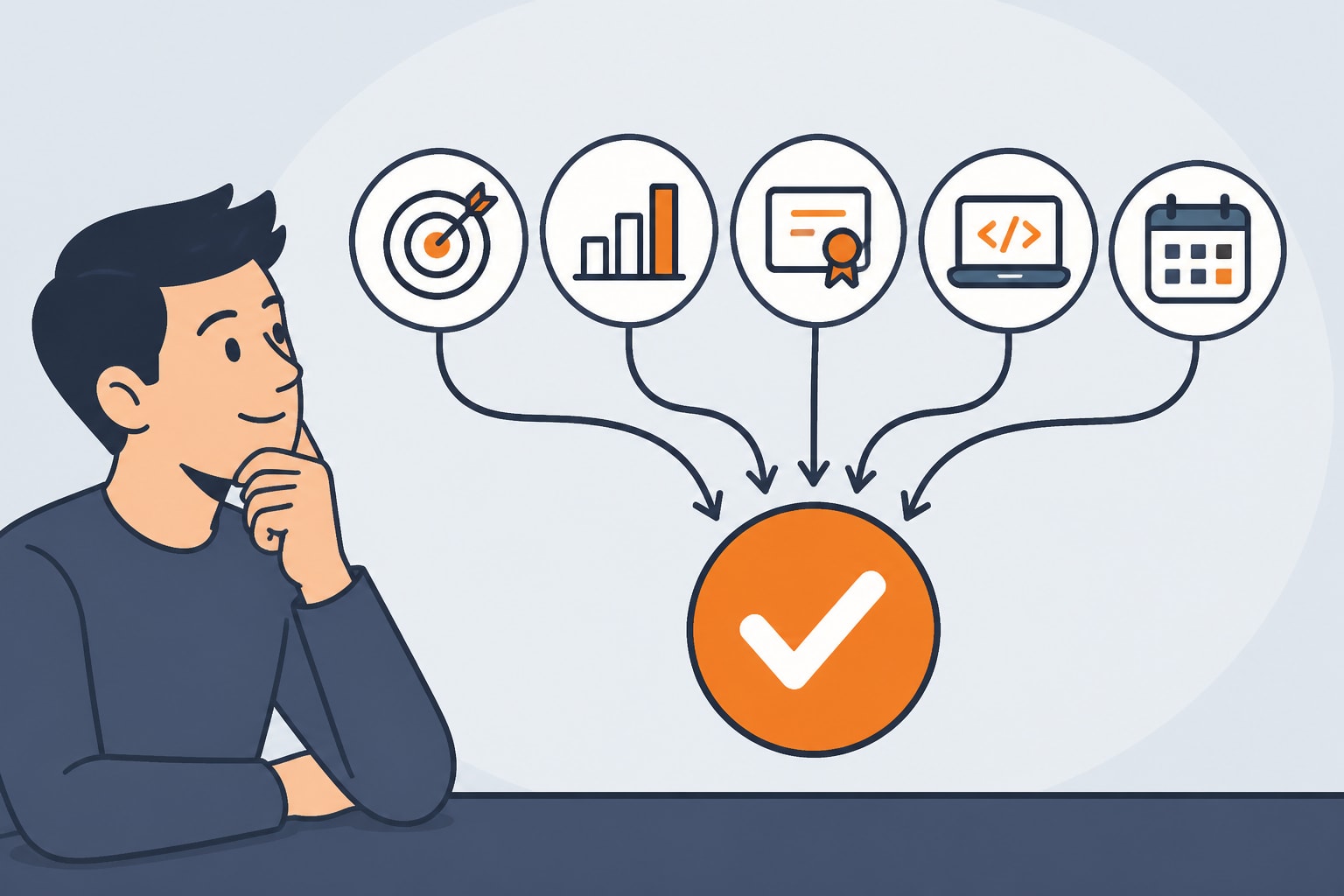
Match the class to the decision you need to make, not to the brand name. Use this sequence:
- Define the goal. Are you trying to be more productive in a current role, move into an AI-adjacent job, or qualify for a technical position?
- Pick the lightest tool that meets it. For productivity, a 5-hour beginner course may be enough. For a career change, you will need depth and proof.
- Check what is assessed. Look for graded projects, practice exams, or proctored finals. Completion alone is a weak signal.
- Look at update frequency. AI tools change within months. Material that is not refreshed regularly goes stale quickly.
- Plan the next step. Decide in advance what you will study after the first course, so momentum carries over.
A marketing manager who wants to draft campaigns faster has a different answer than a career switcher aiming for a machine learning analyst role. The first can stop at Google's introductory content. The second should treat it as a warm-up.
Where does a Google AI class stop being enough?
A Google AI class stops being enough once your goal moves from understanding AI to proving you can use it professionally. Three situations typically expose the gap:
- Career switching. You need a portfolio and a recognized credential, not just a completion badge.
- Technical roles. Writing code, working with APIs, or building applications requires hands-on labs well beyond a few hours of video.
- Team rollouts. A manager needs to see who finished, who passed, and where skills are weak.
This is the point at which a structured platform becomes useful. Mammoth Club Unlimited Membership gives annual access to 3,000+ courses, certification paths, practice exams, tools, and digital assets under one membership. Its certification paths include practice exams and digital assets, and it offers 3,000+ courses. Learners who want Google-specific depth can find Gemini prompt engineering material alongside paths for other AI platforms.
How should teams and managers approach AI upskilling?
Managers get better results by treating AI training as a program with measurable outcomes rather than a list of links sent to staff. Self-directed free courses produce uneven completion, and there is no easy way to confirm who gained a usable skill.
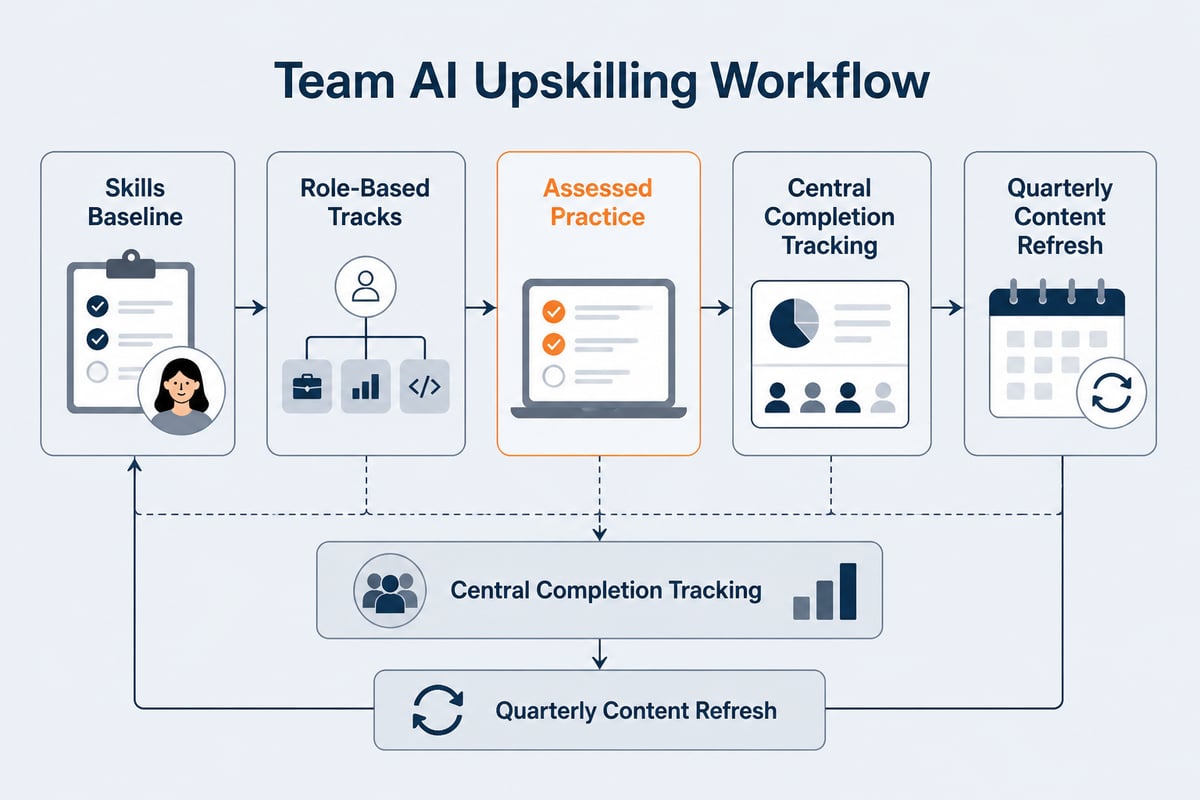
A practical rollout looks like this:
- Start with a skills baseline. Identify which roles use AI daily and which only need awareness.
- Set role-based tracks. Analysts, developers, and marketers need different content.
- Require assessment. Practice exams and graded projects show real progress.
- Track completion centrally. Dashboards save managers from chasing screenshots.
- Refresh quarterly. Retire outdated modules as tools change.
Google's short courses can serve as the awareness layer for all staff. Deeper, assessed training then goes to the people whose work depends on it. Organizations that want a centralized approach can review MammothClub's business offering, and those comparing manager-level content can read the guide to an AI course for managers.
What are the pros and cons of Google's AI classes?
Advantages
- Trusted brand and clear, beginner-friendly writing
- Several free entry points with no financial risk
- Short formats that fit a busy week
- Coverage of responsible AI, which many courses treat lightly
Limitations
- Short length limits depth
- Introductory badges carry modest weight with employers
- Subscription billing rewards fast completion and penalizes slow learners
- Limited support for tracking a whole team's progress
- Tied mainly to Google's own tools, so skills may not transfer to other platforms
None of these are flaws so much as boundaries. Knowing where they sit lets you use the courses for what they do well.
Can you build a realistic study plan around Google's classes?
A realistic plan combines a short Google course with a longer, assessed program, and finishes with a project you can show. Here is a four-week example for a career switcher:
- Week 1: Complete a free introductory generative AI course and the 5-hour AI Essentials class to build vocabulary.
- Week 2: Move into hands-on work. Practice prompting on real tasks from your current job.
- Weeks 3 and 4: Begin a structured certification path with graded labs, such as the options in the guide to AI programming courses or Python AI certification.
Document one project each week. A small, working example, such as an AI-assisted report workflow or a resume tool, is stronger evidence than any badge.
Learners in formal degree programs may also find that academic coursework pairs well with short industry courses, since academic study provides theory and short courses provide current tool practice.
Frequently asked questions
Is there a free Google AI class for beginners? Yes. Google Cloud offers a no-cost introductory generative AI course of about 45 minutes, and Google's AI literacy program offers free educator sessions of 15 to 45 minutes each.
How long does it take to finish the Google AI Professional Certificate? Google's career-training page describes it as taking about 10 hours across eight courses, though your pace and prior experience will change that.
Does a Google AI class lead to a job? It can support an application, but it is rarely sufficient alone. Pair it with a portfolio and an assessed credential.
Which is better for a team, Google's courses or a platform membership? Google's short courses work for awareness. For tracked, role-based training with assessments, a platform with centralized reporting is easier to manage.
Do I need coding skills first? Not for Google's beginner classes. Technical roles will require Python or similar skills later.
Pick one goal today, whether that is a 45-minute free intro or a certification you want to hold by the end of the quarter, and block the study time in your calendar before you enroll in anything. If you want structured paths with assessments, project portfolios, and proctored exams beyond a first beginner course, the Mammoth Club Unlimited Membership puts 3,000+ courses and practice labs under one plan. Teams can set up shared training the same way. Start unlimited with MammothClub and turn a first AI class into a credential you can show.