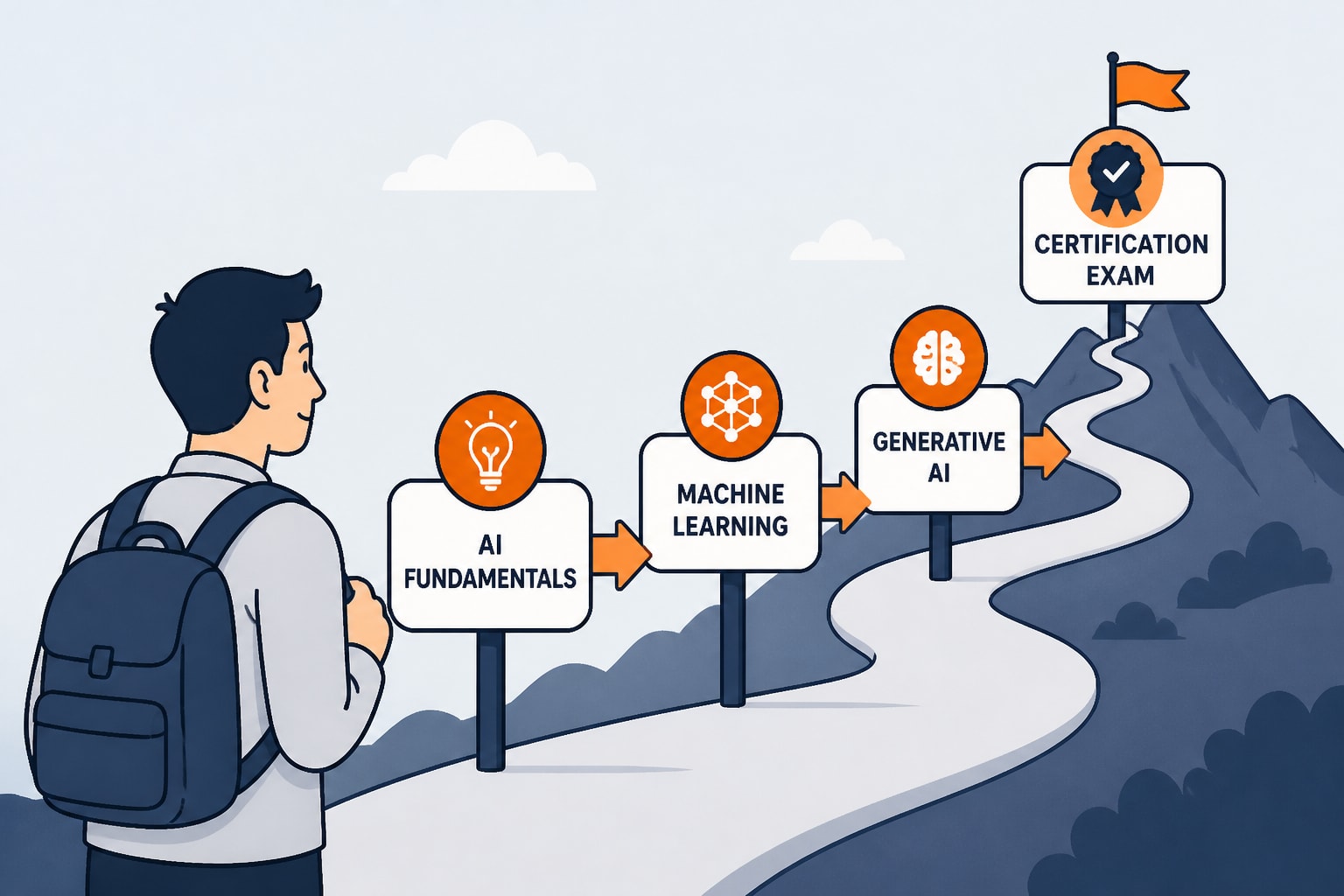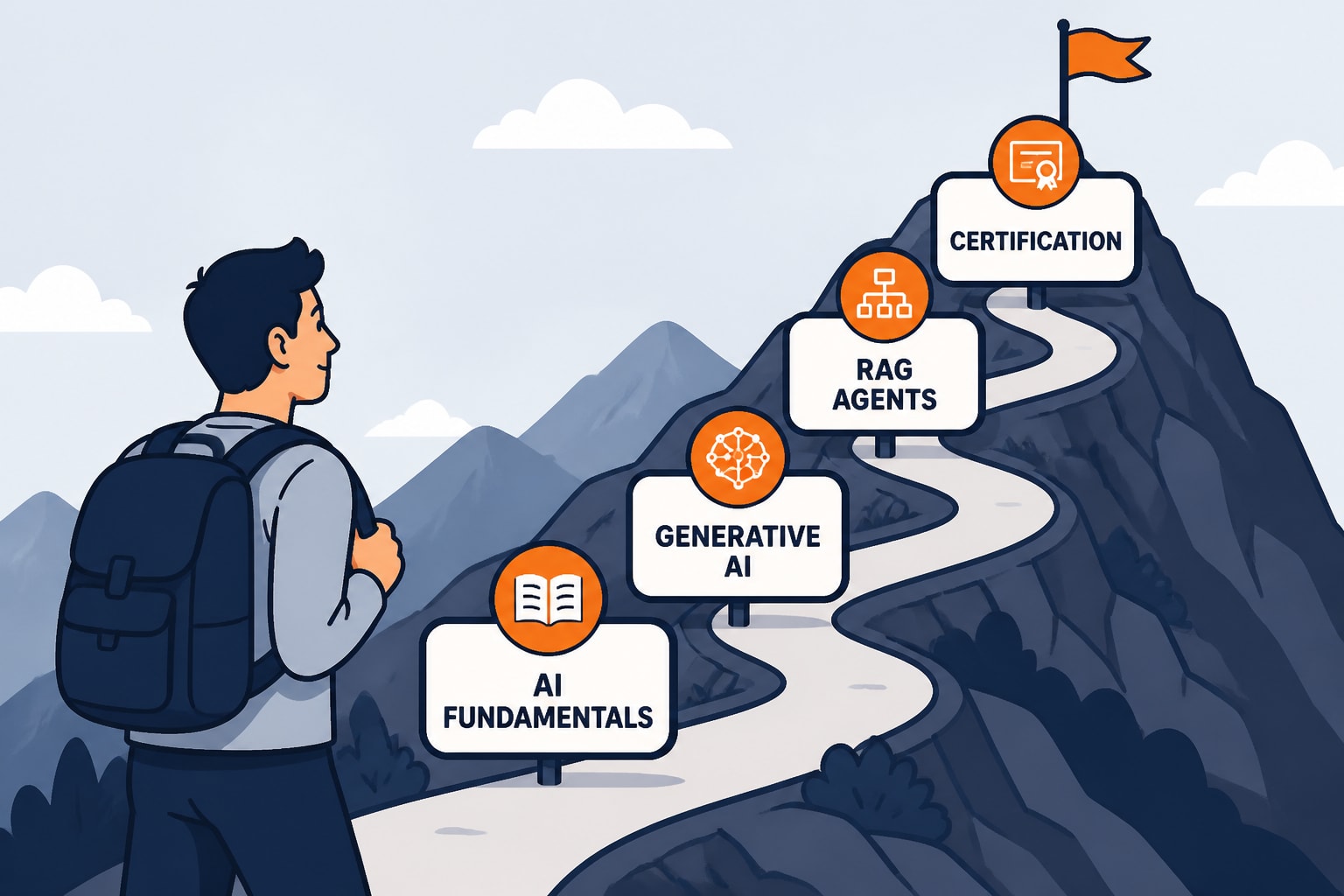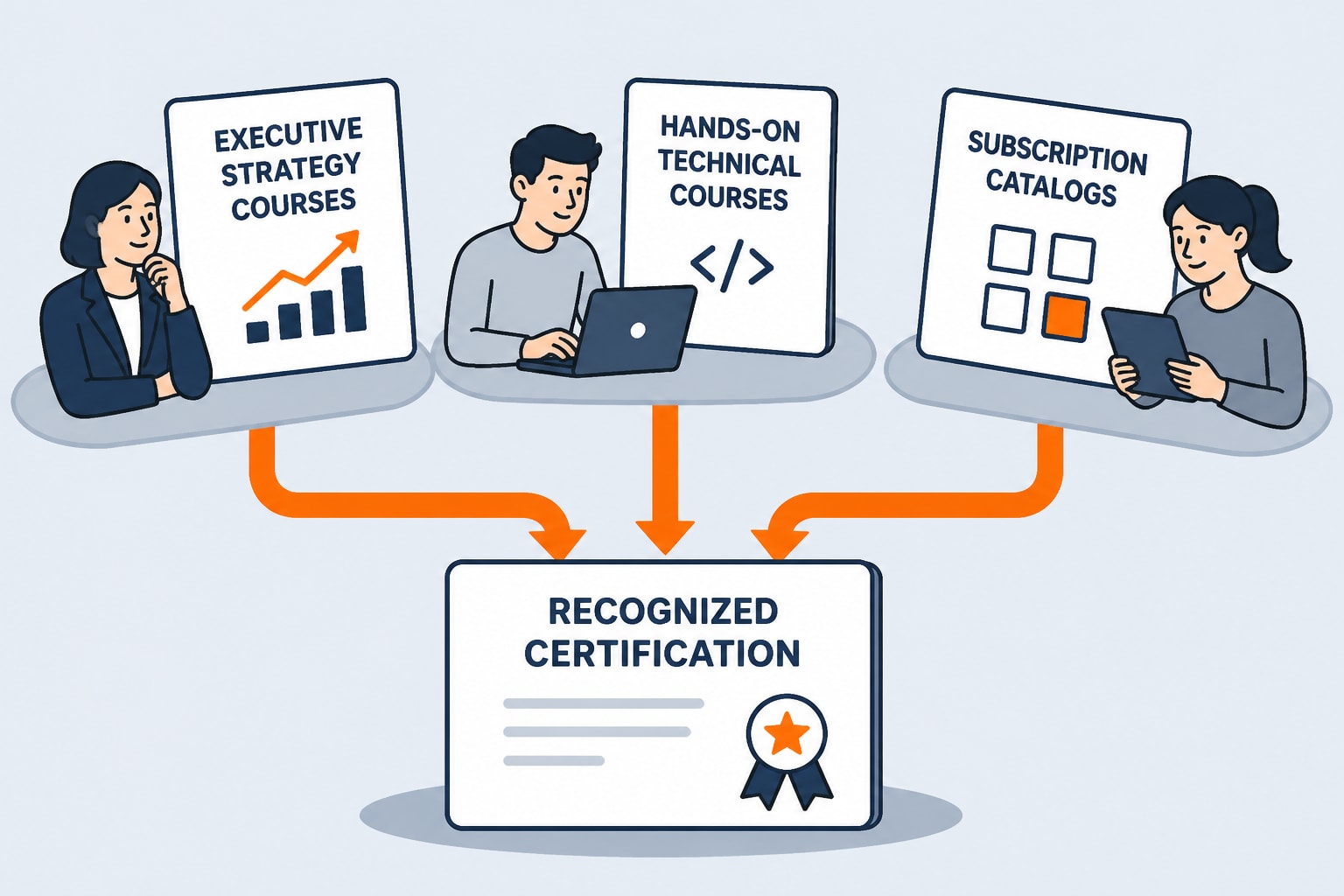
A good machine learning online class teaches the core workflow (data preparation, model training, evaluation, deployment), gives you hands-on projects, and ends in an assessment that employers recognize. If a class lacks any of those three elements, it is a tutorial, not a career asset. Professionals and career switchers should judge every option by one question: will this produce evidence I can show a hiring manager or a promotion committee?
The sections below cover what a class should teach, which prerequisites matter, how to compare formats and credentials, and how to verify that a program is worth the time before you commit.
What Should a Machine Learning Class Actually Teach?
A solid class covers the full model lifecycle, not just algorithms. At minimum, expect these topics in this order:
- Problem framing: deciding whether a business question needs machine learning at all.
- Data preparation: cleaning, feature engineering, and splitting data into training, validation and test sets.
- Core algorithms: linear and logistic regression, decision trees, ensembles, clustering, and an introduction to neural networks.
- Evaluation: precision, recall, ROC curves, cross-validation, and how to detect overfitting.
- Deployment and monitoring: moving a model into production and watching it for drift.
The last item separates a class that prepares you for a job from one that prepares you for a quiz. Employers rarely pay for a notebook that scores well on a clean dataset. They pay for someone who can ship a model, explain its limits, and keep it working.
A useful test: open the syllabus and look for the word "deployment" or an equivalent. If the curriculum stops at model training, you will need to fill that gap yourself.
Which Prerequisites Do You Need Before Enrolling?
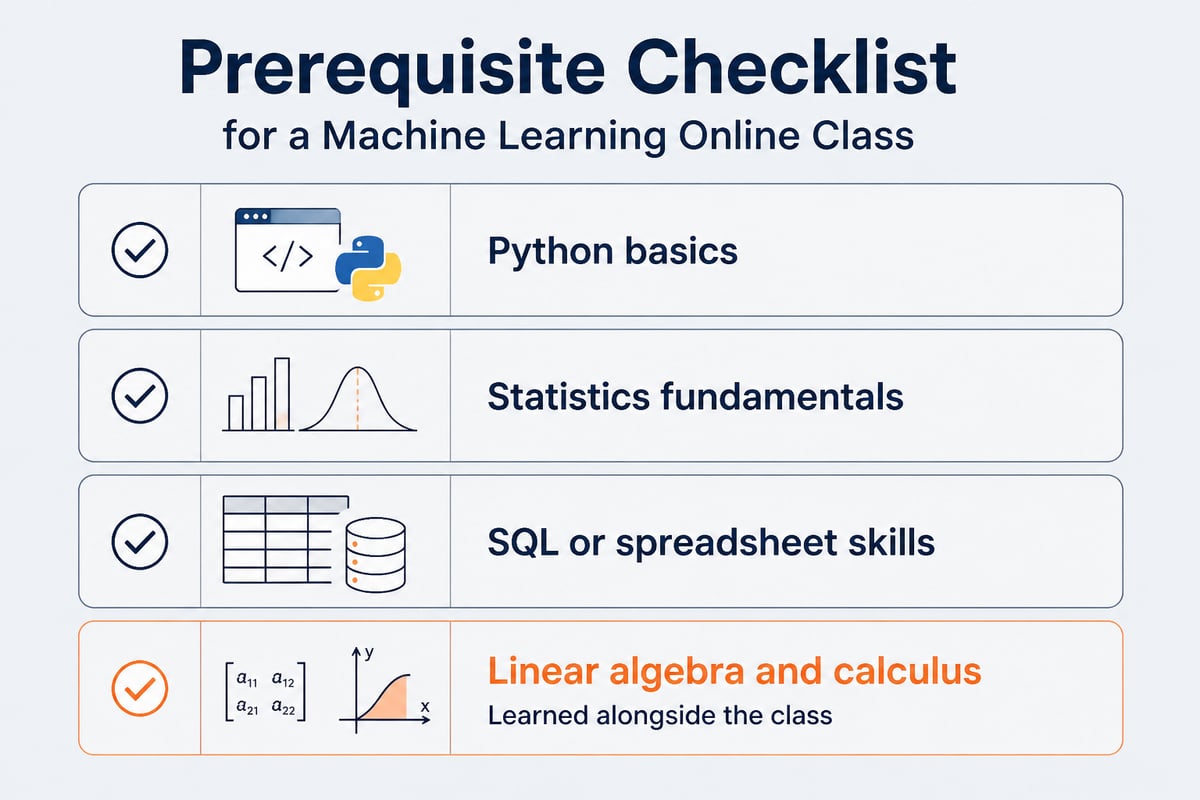
You need working Python, basic statistics, and comfort reading tabular data. Advanced mathematics helps but is rarely a gate for applied roles.
Here is a realistic readiness checklist:
- Python: loops, functions, lists, dictionaries, and reading files. A structured path such as Python Programming Fundamentals closes this gap before you start modeling.
- Statistics: mean, variance, distributions, and the idea of a confidence interval.
- Linear algebra and calculus: useful for understanding why gradient descent works, but you can learn them alongside the class.
- Spreadsheet or SQL skills: most real datasets arrive in tables, and filtering them is daily work.
Career switchers often delay enrollment while trying to master mathematics first. A better sequence is to start an applied class, then return to theory when a concept blocks your progress. Applied results keep motivation high, and motivation is the main reason people abandon technical study.
How Do Self-Paced, Instructor-Led and Bootcamp Formats Compare?
Self-paced classes suit people with unpredictable schedules, instructor-led classes suit people who need accountability, and bootcamps suit people who can commit full time for a short, intense period. The right choice depends on how you learn and how soon you need results.
| Format | Best for | Main advantage | Main risk |
|---|---|---|---|
| Self-paced, on demand | Working professionals | Flexible schedule and lower cost | Low completion without a plan |
| Instructor-led, scheduled | Learners who need structure | Live feedback and deadlines | Fixed times can conflict with work |
| Interactive bootcamp | Career switchers on a deadline | Fast, project-heavy progress | Heavy time commitment |
Whichever format you choose, check the update cadence. Machine learning tooling changes quickly, and a class recorded years ago may teach deprecated libraries. Ask any provider how often it updates its courses, labs and assessments, since that is the kind of maintenance signal worth checking.
Which Credentials Carry Weight With Employers?
Credentials that include a proctored exam or a vendor-recognized certification carry the most weight, because they verify skill rather than attendance. A certificate of completion proves you watched videos. A proctored exam proves you can answer under conditions you could not game.
Credential types, from weakest to strongest signal:
- Completion certificate: shows participation only.
- Assessed certificate with project portfolio: shows applied work.
- Proctored final exam: shows verified knowledge.
- Vendor certification: shows alignment with a specific cloud or platform that employers already use.
For vendor-aligned preparation, look at paths built around AWS Certified Machine Learning Specialty (MLS-C01) or the Microsoft Azure AI certification. If your target employer runs on AWS or Azure, matching the credential to their stack shortens the distance between your résumé and an interview. A broader view of options is available in this overview of AI certification online.
What Does a Strong Machine Learning Online Class Include?
A strong machine learning online class combines instruction, practice and proof of skill in one structured path. Use this list to audit any program before paying:
- Practitioner-authored lessons: instructors who have shipped models, with editorial and technical review behind the material.
- Hands-on labs: environments where you run code, not just watch it.
- Built-in assessments: quizzes and exams that expose weak spots before an employer does.
- A project portfolio: two or three finished projects you can link in an application.
- Practice exam banks: large question pools for certification preparation.
- Searchable, text-first lessons: material you can scan and apply the same day, rather than rewatching a forty-minute video to find one formula.
MammothClub's structured certification paths follow this pattern, with assessments, project portfolios and proctored final exams, and a library of over 500,000 practice exam questions across the platform. The text-first, AI-searchable format is designed for professionals who study in short windows between work obligations.
How Do You Verify a Class Is Worth the Money?
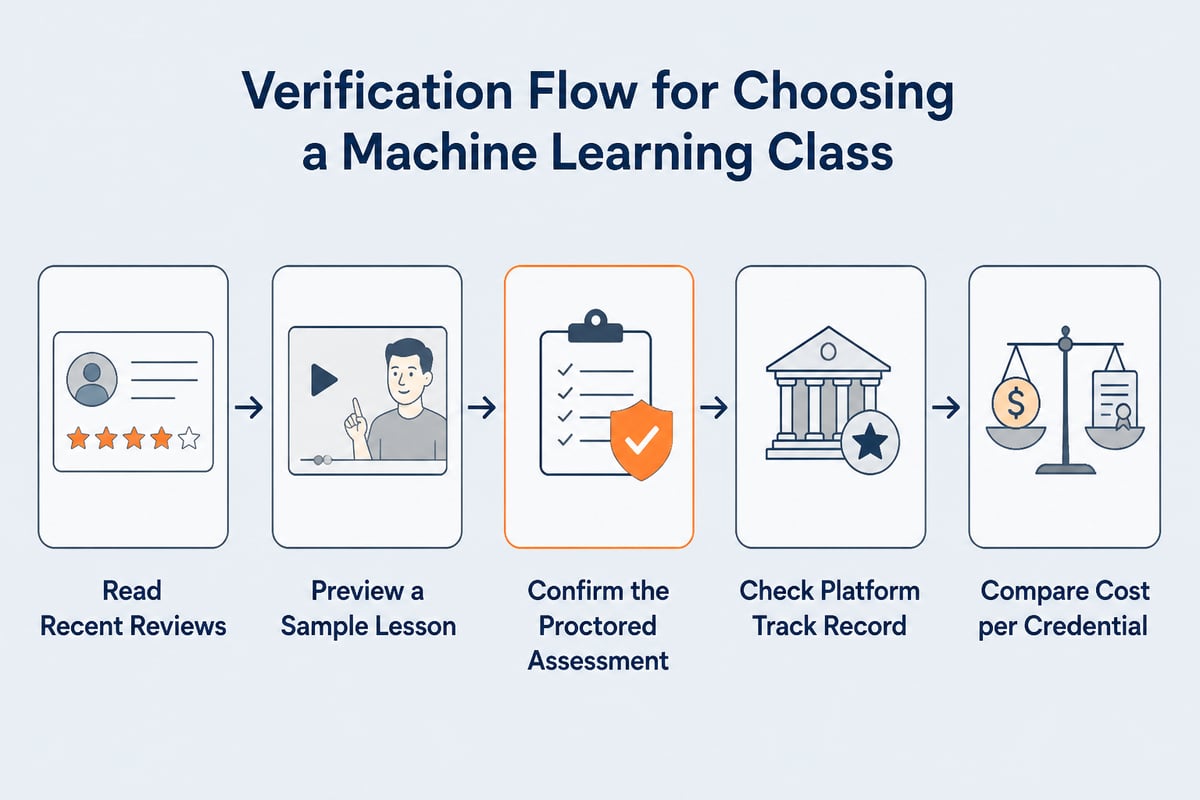
Verify a class by checking evidence outside the sales page: reviews, outcomes, instructor background and the actual syllabus. Marketing copy is easy to write, so rely on signals that are costly to fake.
Run through these checks:
- Read recent reviews, not only the aggregate score. Look for comments about job outcomes and about whether material felt current.
- Inspect a sample lesson before purchase. Judge the depth and the clarity of explanation.
- Confirm the final assessment format. Ask whether it is proctored and what score is required.
- Check scale and track record. Platforms with large learner populations generate more reliable review data. MammothClub reports over 9 million courses sold and over 40,000 positive reviews.
- Compare cost per credential, not cost per course. A cheap class that ends without a recognized exam may cost more in the long run.
Why Should Responsible AI Be Part of Your Training?
Responsible AI belongs in your training because employers increasingly expect practitioners to manage model risk, not only build models. This is the topic most course listings treat as optional, yet it shapes how senior roles are evaluated.
The NIST AI Risk Management Framework is intended for voluntary use to help incorporate trustworthiness considerations into the design, development, use and evaluation of AI systems. Its core guidance is organized into four functions: Govern, Map, Measure and Manage, and NIST states that risk management should be continuous throughout the AI system lifecycle. For a working practitioner, that translates into habits you can practice in any class project:
- Document the data source and known gaps in it.
- Record which metrics you chose and why.
- Test the model on subgroups, not only on the overall average.
- Define what happens when performance drops after launch.
NIST also cautions that addressing trustworthiness characteristics one at a time does not guarantee trustworthy AI, since tradeoffs can arise and priorities depend on the setting. A candidate who can articulate those tradeoffs in an interview stands apart from one who only reports accuracy.
Security awareness belongs here as well. NIST finalized a report on adversarial machine learning taxonomy and terminology in March 2025, as noted on its AI security and resilience page. If a class never mentions data poisoning, evasion attacks or model misuse, treat that as a curriculum gap and plan supplemental reading.

How Long Does It Take to Become Job-Ready?
Most working professionals need roughly three to six months of consistent part-time study to move from foundations to a certification-ready portfolio, though your starting point changes this considerably. Treat the figure as a planning range, not a promise, because prior coding experience is the largest variable.
A staged plan keeps the effort manageable:
- Weeks 1 to 4: Python, data handling and statistics refreshers.
- Weeks 5 to 10: core supervised and unsupervised algorithms, with one small project.
- Weeks 11 to 16: evaluation, deployment basics and a second, more realistic project.
- Weeks 17 to 24: certification preparation, practice exams and portfolio polishing.
Short daily sessions outperform weekend marathons for retention. A text-first lesson you can finish in twenty minutes fits this rhythm better than a long recorded lecture.
What Are the Pros and Cons of Taking a Class Online?
An online class gives you flexibility and breadth at lower cost, but it demands self-discipline and offers less spontaneous mentorship. Weigh both sides honestly before committing.
Pros
- Study around a full-time job.
- Access to current tools and labs without relocating.
- A wide choice of specializations, from fundamentals to advanced topics.
- Lower cost per hour of instruction than in-person programs.
Cons
- Completion depends on your own routine.
- Feedback can be slower unless the program includes assessed projects.
- Quality varies widely, so vetting is your responsibility.
To reduce the cons, choose a program with built-in assessments and a structured path. Both create external checkpoints that substitute for a classroom schedule.
Which Learning Path Fits Your Situation?
Match the path to your starting point and target role. Three common profiles illustrate the logic.
The analyst moving toward data science. You already work with data. Start with an applied foundations course such as What Is Machine Learning from the AI foundations series, then progress to modeling and a cloud certification.
The software engineer adding AI skills. You code comfortably. Skip basics and go directly to a cloud-aligned specialty exam, then build a deployment project. The AI engineer certification guide outlines the credential landscape for this route.
The career switcher from a non-technical field. Begin with Python, then a foundations bundle that shows how production products use machine learning, such as how billion-dollar apps apply ML to core features. Plan for the longer end of the timeline and prioritize portfolio projects, since they substitute for work history.
If you want to compare broader catalogs first, this roundup of AI and machine learning courses lays out the main categories.
One membership option fits learners who expect to move between several of these steps. The Mammoth Club Unlimited Membership covers 3,000+ courses, certification paths, practice exams, tools and digital assets under a single annual plan, starting from $199 per year, so you can add a Python course, a cloud exam path and practice labs without buying each separately. It suits structured, credential-focused learners rather than anyone seeking only free content or a single short video.
Frequently Asked Questions
Can I take a machine learning online class with no coding experience?
Yes, but add a Python fundamentals course first. Most applied machine learning work depends on Python, and a few weeks of preparation prevents the frustration that causes early dropout.
Is a certificate enough to get hired?
A certificate alone rarely decides a hiring outcome. Pair it with a portfolio of finished projects and be ready to explain your modeling choices. A proctored or vendor-recognized credential strengthens the case considerably.
How do I choose between a general class and a cloud-specific certification?
Choose based on your target employers. If job postings in your field name AWS or Azure, a matching certification signals immediate usefulness. If you are still exploring, start general and specialize after you see which stack your market favors.
Do I need advanced math?
For most applied roles, no. Comfort with statistics and a working intuition for how optimization behaves are enough to begin. Deeper mathematics becomes valuable if you move toward research or model architecture work.
What should I do after finishing the class?
Publish your projects, schedule your certification exam within a few weeks while the material is fresh, and apply to roles that list your target skills. Keep practicing on new datasets so your skills remain current as tools change.
Key Takeaways
- Choose a class that covers the full lifecycle, including deployment and monitoring.
- Favor programs that end in a proctored exam or a recognized vendor credential.
- Build two or three portfolio projects; they carry as much weight as the certificate.
- Add responsible AI practice, guided by frameworks such as NIST's, to stand out in interviews.
- Check how often content is updated, since tooling changes monthly.
Your next step is to pick one target credential, list the Python and statistics gaps standing between you and it, and schedule your first study block this week. When you are ready to follow a structured route, the Mammoth Club Unlimited Membership gives you courses, practice labs and certification paths in one place, so you can move from foundations to an exam without switching providers. MammothClub is built for professionals who want measurable progress, so start unlimited and turn your study time into a credential you can show.