The digital marketing landscape has transformed dramatically with artificial intelligence becoming the cornerstone of successful campaigns. Marketing professionals who fail to adapt risk obsolescence as AI tools reshape everything from customer segmentation to content creation. An ai digital marketing course provides the strategic foundation needed to leverage these technologies effectively, combining practical skills with theoretical knowledge that drives measurable business outcomes. Whether you're a seasoned marketer looking to modernize your skillset or a business leader preparing your team for the AI revolution, understanding what makes an effective AI marketing education program is essential for maintaining competitive advantage in 2026.
What an AI Digital Marketing Course Actually Teaches
Modern ai digital marketing course programs go far beyond surface-level tool demonstrations. They provide comprehensive frameworks for understanding how artificial intelligence fundamentally changes marketing strategy, execution, and measurement.
Core Curriculum Components
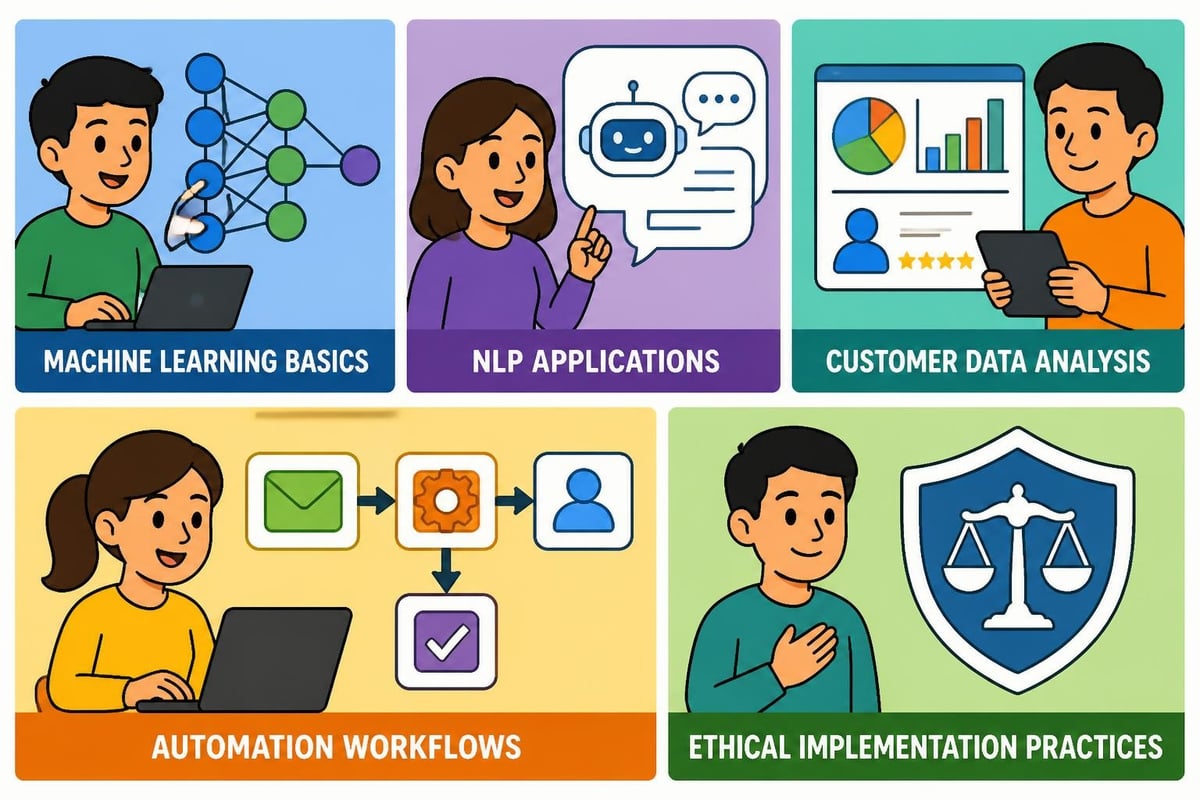
The foundation of quality AI marketing education includes several critical knowledge areas that work together to create competent practitioners:
- Machine learning fundamentals for understanding recommendation engines and predictive analytics
- Natural language processing applications for chatbots, sentiment analysis, and content optimization
- Customer data platforms and how AI enhances segmentation and personalization
- Marketing automation workflows powered by intelligent decision-making algorithms
- Ethical AI implementation including bias detection, privacy compliance, and transparency requirements
Programs like AI in Digital Marketing from Coursera demonstrate this comprehensive approach by covering customer engagement, personalization strategies, and content optimization through structured modules that build upon each other progressively.
Practical Application Focus
Theory alone doesn't prepare marketers for real-world implementation. The most effective programs emphasize hands-on experience with actual AI marketing tools and platforms.
| Learning Method | Business Impact | Skill Development |
|---|---|---|
| Case study analysis | Understanding real ROI scenarios | Strategic thinking |
| Tool demonstrations | Platform familiarity | Technical proficiency |
| Project-based learning | Portfolio development | Problem-solving |
| Live campaign simulations | Risk-free experimentation | Decision-making |
Quality programs incorporate practical exercises where students build customer segments using machine learning, create AI-generated content variations, or design automated email sequences that adapt based on user behavior. This experiential learning approach ensures knowledge transfer from classroom to boardroom.
Why Marketing Professionals Need AI Training Now
The urgency surrounding AI education in marketing stems from three converging factors: technological acceleration, competitive pressure, and changing consumer expectations.
Marketing teams without AI capabilities face significant disadvantages. Competitors using predictive analytics identify high-value prospects faster. Brands leveraging generative AI produce more content at lower costs. Organizations with intelligent automation respond to customer inquiries 24/7 without additional headcount.
The Skills Gap Crisis
Research consistently shows a widening gap between available AI marketing talent and organizational demand. Companies struggle to find professionals who can bridge technical AI knowledge with marketing strategy.
Key competency areas experiencing talent shortages:
- Data interpretation and actionable insights generation
- AI tool selection and vendor evaluation
- Cross-functional collaboration between data science and marketing teams
- Privacy-compliant personalization strategies
- Performance measurement for AI-driven campaigns
An ai digital marketing course addresses these gaps systematically, providing structured learning pathways that would take years to acquire through trial and error. The American Marketing Association's AI course specifically targets these professional development needs by covering both machine learning and generative AI applications.
ROI Justification for Training Investment
Organizations investing in AI marketing education see tangible returns across multiple dimensions. Training costs pale in comparison to hiring specialized talent or making expensive technology decisions without proper knowledge foundation.
Businesses report improved campaign performance, reduced customer acquisition costs, and enhanced customer lifetime value after team members complete comprehensive AI marketing training. The ability to evaluate AI vendor claims critically alone saves organizations from costly implementation mistakes.
For professionals exploring broader AI capabilities beyond marketing, MammothClub's AI management courses provide leadership-focused perspectives on organizational AI transformation.
Selecting the Right Program for Your Career Stage
Not all ai digital marketing course offerings serve the same audience or learning objectives. Matching program characteristics to your current expertise level and career goals ensures maximum value from your educational investment.
Beginner-Friendly Foundations
Professionals new to both AI and digital marketing need introductory programs that establish fundamental concepts without overwhelming technical jargon. These courses typically assume no prior programming knowledge and focus on strategic application rather than algorithm development.
UC San Diego's AI in Digital Marketing course exemplifies this approach with emphasis on prompt engineering and practical tool usage, making AI accessible to marketing generalists.
Beginner programs should cover:
- AI terminology and concept definitions that enable informed conversations with technical teams
- Platform demonstrations showing AI capabilities in action through familiar marketing scenarios
- Ethical considerations presented as decision frameworks rather than technical compliance requirements
- Quick-win implementations that deliver visible results without extensive technical resources
Intermediate Skill Development
Marketers with digital experience but limited AI exposure benefit from programs bridging existing marketing knowledge with advanced analytical capabilities. These courses assume familiarity with marketing metrics, customer journey mapping, and campaign management.

Intermediate learners should prioritize programs offering:
- Integration strategies for connecting AI tools with existing marketing technology stacks
- A/B testing methodologies specific to AI-driven personalization and content
- Customer data platform management with AI-enhanced segmentation
- Attribution modeling using machine learning for multi-touch campaigns
Advanced Specialization Tracks
Senior marketing professionals and strategists require programs exploring cutting-edge applications and implementation leadership. Harvard's AI Marketing program focuses on generative AI, hyper-personalization, and predictive analytics at this advanced level.
Advanced courses distinguish themselves through:
| Feature | Standard Programs | Advanced Programs |
|---|---|---|
| Depth | Tool usage | Strategic architecture |
| Audience | Individual contributors | Decision-makers |
| Outcomes | Task completion | Business transformation |
| Duration | Weeks | Months with ongoing support |
These programs prepare participants to lead AI transformation initiatives, evaluate emerging technologies critically, and build business cases for significant AI investments.
Certification Value and Career Impact
Completing an ai digital marketing course delivers benefits beyond knowledge acquisition. Formal certification demonstrates commitment to professional development and validates expertise to employers and clients.
Market Recognition of AI Marketing Credentials
The certification landscape remains fragmented, with varying levels of industry recognition across providers. University-affiliated programs generally carry more weight than vendor-specific certifications, though both serve different purposes.
Certification considerations for career advancement:
- University credentials signal theoretical foundations and strategic thinking
- Platform-specific certifications demonstrate tool proficiency for immediate productivity
- Industry association programs (like AMA) indicate professional commitment and networking
- Microcredentials offer focused expertise without full degree program commitment
For professionals considering broader AI certification paths, exploring top artificial intelligence certifications provides valuable comparative analysis across industries and specializations.
Salary Impact and Promotion Potential
Marketing professionals with verified AI skills command premium compensation. Salary data consistently shows 15-25% higher earnings for marketers demonstrating AI proficiency compared to peers with equivalent experience but traditional skillsets.
Certifications accelerate internal promotions by positioning professionals for newly created roles like AI Marketing Manager, Marketing Technology Specialist, or Customer Intelligence Director. These positions didn't exist five years ago but now represent fast-growing career paths.
Organizations increasingly require AI competency for senior marketing leadership positions. Completing a comprehensive ai digital marketing course proactively positions professionals for these opportunities before they become mandatory requirements.
Platform-Based Learning vs. University Programs
Prospective students face fundamental choices about learning modality and credential type. Each approach offers distinct advantages depending on career stage, learning preferences, and organizational support.
Online Learning Platform Advantages
Platforms like Coursera, edX, and specialized AI training providers offer flexibility and cost-effectiveness that traditional programs struggle to match. The edX course from DavidsonX and GalileoX demonstrates how universities leverage these platforms for broader accessibility.
Key benefits of platform-based learning:
- Self-paced progression accommodating work schedules
- Lower costs with frequent promotional pricing
- Rapid curriculum updates reflecting latest AI developments
- Global instructor access without geographic limitations
- Stackable credentials building toward comprehensive certifications
These platforms excel for self-directed learners who thrive with structured content but minimal live interaction. The trade-off involves less networking opportunity and reduced personalized feedback compared to cohort-based programs.
University Program Differentiators
Traditional academic institutions provide depth, rigor, and credential prestige that platforms find difficult to replicate. Northern Illinois University's AI in Digital Marketing course integrates machine learning and NLP within established marketing frameworks, reflecting academic thoroughness.
University programs distinguish themselves through:
- Theoretical foundations enabling critical evaluation of AI vendor claims and emerging technologies
- Peer networking with cohort members facing similar organizational challenges
- Faculty expertise combining academic research with industry consulting experience
- Institutional reputation carrying weight in competitive job markets
- Career services including job placement support and alumni networks
The investment typically exceeds platform courses by 3-10x, but credential durability and networking value justify costs for many professionals.
Hybrid Approaches and Corporate Training
Forward-thinking organizations increasingly adopt hybrid models combining platform courses for foundational knowledge with customized workshops addressing specific business challenges. MammothClub's corporate certification programs exemplify this approach by delivering scalable training with measurable business outcomes.
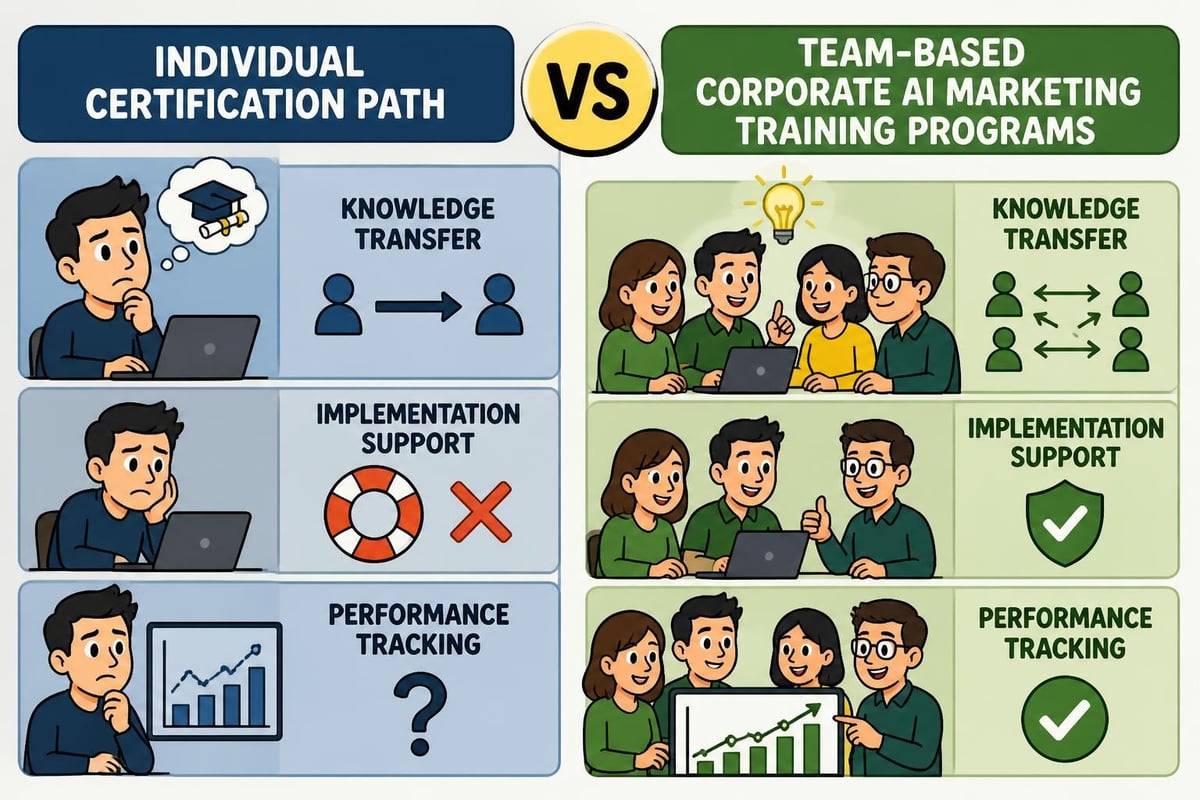
Corporate programs provide advantages neither platforms nor universities can match individually:
- Context-specific applications using actual company data and campaigns
- Team alignment ensuring consistent AI implementation across marketing functions
- Executive sponsorship connecting training to strategic business objectives
- Ongoing support extending beyond course completion into implementation phases
Implementation Strategies After Course Completion
Completing an ai digital marketing course represents a beginning rather than an endpoint. Translating education into business impact requires intentional implementation strategies and continuous skill application.
Building Your AI Marketing Tech Stack
Course knowledge enables informed technology selection, but implementation requires strategic planning. Prioritize AI tools addressing specific business challenges rather than acquiring capabilities without clear use cases.
Strategic implementation sequence:
| Phase | Focus Area | Success Metrics |
|---|---|---|
| 1 | Data foundation | Clean, accessible customer data |
| 2 | Quick-win automation | Time savings, consistency improvements |
| 3 | Predictive analytics | Forecast accuracy, early trend identification |
| 4 | Personalization engines | Engagement rates, conversion improvements |
| 5 | Generative content | Production volume, quality maintenance |
This phased approach prevents overwhelm while building organizational confidence in AI applications. Each phase demonstrates value before requesting additional investment.
Creating Internal Knowledge Transfer
Individuals completing ai digital marketing course programs become valuable organizational assets when they share knowledge effectively. Creating documentation, conducting lunch-and-learn sessions, and mentoring colleagues multiplies training ROI.
Effective knowledge transfer strategies include:
- Use case libraries documenting successful AI implementations with results data
- Decision frameworks helping teams evaluate when AI solutions are appropriate
- Tool demonstrations reducing intimidation and encouraging experimentation
- Regular office hours where colleagues can ask implementation questions
Organizations see exponential returns when training investments cascade beyond individual participants to entire teams.
Staying Current in a Rapidly Evolving Field
AI marketing capabilities evolve monthly, not annually. Course completion provides foundational knowledge, but professional relevance requires ongoing learning habits.
Professionals maintain cutting-edge expertise through multiple channels:
- Following AI research publications and marketing technology blogs
- Participating in professional communities and forums
- Attending industry conferences featuring AI applications
- Experimenting with new tools through free trials and beta programs
- Contributing to open-source marketing AI projects
For those seeking continuous learning infrastructure, MammothClub's 3,000+ on-demand courses provide ongoing skill development beyond initial certification, with AI-powered learning tools tracking progress and recommending relevant content.
Measuring Training Success and Business Impact
Investing in an ai digital marketing course demands accountability through measurable outcomes. Establishing clear success metrics before training begins ensures alignment between educational objectives and business needs.
Individual Performance Indicators
Personal skill development manifests through observable capability improvements:
- Tool proficiency measured by independent task completion without external support
- Strategic thinking demonstrated through AI solution recommendations addressing business challenges
- Cross-functional collaboration shown by effective communication with data science and IT teams
- Innovation contribution reflected in new AI application proposals and pilot programs
Documentation of these capabilities through project portfolios or internal presentations validates training investment and supports promotion discussions.
Organizational Impact Metrics
Business leaders evaluate training ROI through campaign performance improvements and operational efficiency gains. Establishing baseline metrics before training enables accurate impact attribution.
Key business metrics influenced by AI marketing capabilities:
- Customer acquisition cost reductions through better targeting
- Conversion rate improvements from personalized experiences
- Content production efficiency gains via generative AI
- Customer service response time decreases using chatbots
- Predictive model accuracy for campaign performance forecasting
Organizations tracking these metrics consistently demonstrate training ROI exceeding 300% within the first year post-completion.
Long-Term Career Development Tracking
AI marketing education represents one component of comprehensive career development. Tracking progression over 2-3 year horizons reveals compounding benefits beyond immediate skill acquisition.
Long-term success indicators include:
- Expanded role responsibilities incorporating AI strategy
- Participation in high-visibility AI implementation projects
- Speaking opportunities at conferences or internal events
- Mentorship requests from colleagues seeking AI guidance
- Job offers reflecting increased market value
Professionals documenting this progression create compelling narratives for future career opportunities and compensation negotiations.
Overcoming Common Implementation Barriers
Even well-trained professionals encounter obstacles when applying AI marketing knowledge in organizational contexts. Anticipating these challenges and developing mitigation strategies accelerates impact realization.
Data Quality and Accessibility Challenges
AI tools deliver value proportional to data quality. Many marketers complete ai digital marketing course programs only to discover their organizations lack the data infrastructure required for sophisticated applications.
Practical approaches to data challenges:
- Start with available data rather than waiting for perfect datasets
- Implement gradual data quality improvement programs alongside AI initiatives
- Partner with IT and data teams early in implementation planning
- Use AI projects to justify data infrastructure investments
- Explore third-party data enrichment services for quick capabilities
Organizational Resistance and Change Management
Colleagues unfamiliar with AI capabilities often resist implementation through skepticism or fear of job displacement. Successful professionals address these concerns through education and inclusive implementation approaches.
Effective change management tactics include:
- Demonstrating AI as augmentation rather than replacement
- Involving skeptics in pilot program design and evaluation
- Celebrating early wins publicly with team recognition
- Providing basic AI literacy training to broader teams
- Addressing concerns transparently rather than dismissively
Budget Constraints and ROI Justification
Finance teams require compelling business cases before approving AI tool investments. Course knowledge enables sophisticated ROI modeling that addresses executive concerns.
Building persuasive proposals involves:
- Quantifying current state costs including manual effort, opportunity costs, and competitive disadvantages
- Projecting specific improvements based on vendor case studies and industry benchmarks
- Recommending phased implementations reducing initial investment risk
- Defining clear success metrics enabling objective progress evaluation
- Planning pilot programs demonstrating value before full-scale deployment
For professionals seeking deeper technical foundations supporting these business discussions, exploring AI and ML learning paths provides complementary knowledge bridging marketing strategy and technical implementation.
Mastering AI digital marketing requires structured education, practical application, and continuous learning commitment. The right ai digital marketing course accelerates this journey by providing frameworks, tools, and strategic perspectives that transform marketing effectiveness. MammothClub delivers this comprehensive AI education through 3,000+ on-demand courses, interactive bootcamps, and corporate certification programs designed for measurable results. Our AI-powered learning platform helps marketing professionals and teams build the capabilities needed to compete successfully in 2026 and beyond.