ChatGPT has fundamentally transformed how professionals work, learn, and solve problems. From automating customer service to accelerating content creation and software development, generative AI is no longer optional for competitive organizations. A well-designed chatgpt course equips teams and individuals with the practical skills needed to harness this technology effectively, moving beyond basic experimentation to production-ready implementations. Whether you're a business leader planning organizational upskilling or an individual contributor aiming to enhance your technical toolkit, understanding what makes a chatgpt course valuable is essential for maximizing your investment in AI education.
What Defines a Quality ChatGPT Course
A comprehensive chatgpt course goes far beyond teaching users how to write simple prompts. Quality programs integrate technical depth, business application, and ethical considerations into a cohesive learning experience.
Core Curriculum Components
The most effective chatgpt course offerings cover five essential domains. Prompt engineering forms the foundation, teaching learners how to craft instructions that consistently produce desired outputs. This includes understanding temperature settings, role-based prompting, chain-of-thought reasoning, and few-shot learning techniques supported by recent systematic surveys of prompt engineering research.
API integration and development represents the next layer, where learners discover how to embed ChatGPT capabilities into applications, workflows, and business systems. Microsoft's Azure OpenAI documentation provides technical foundations that advanced courses often build upon, showing real implementation paths for enterprise environments.
Use case development transforms theoretical knowledge into practical value. Top-tier programs include modules on content creation, code generation, data analysis, customer support automation, and research assistance. Learners work through industry-specific scenarios that mirror their actual job responsibilities.
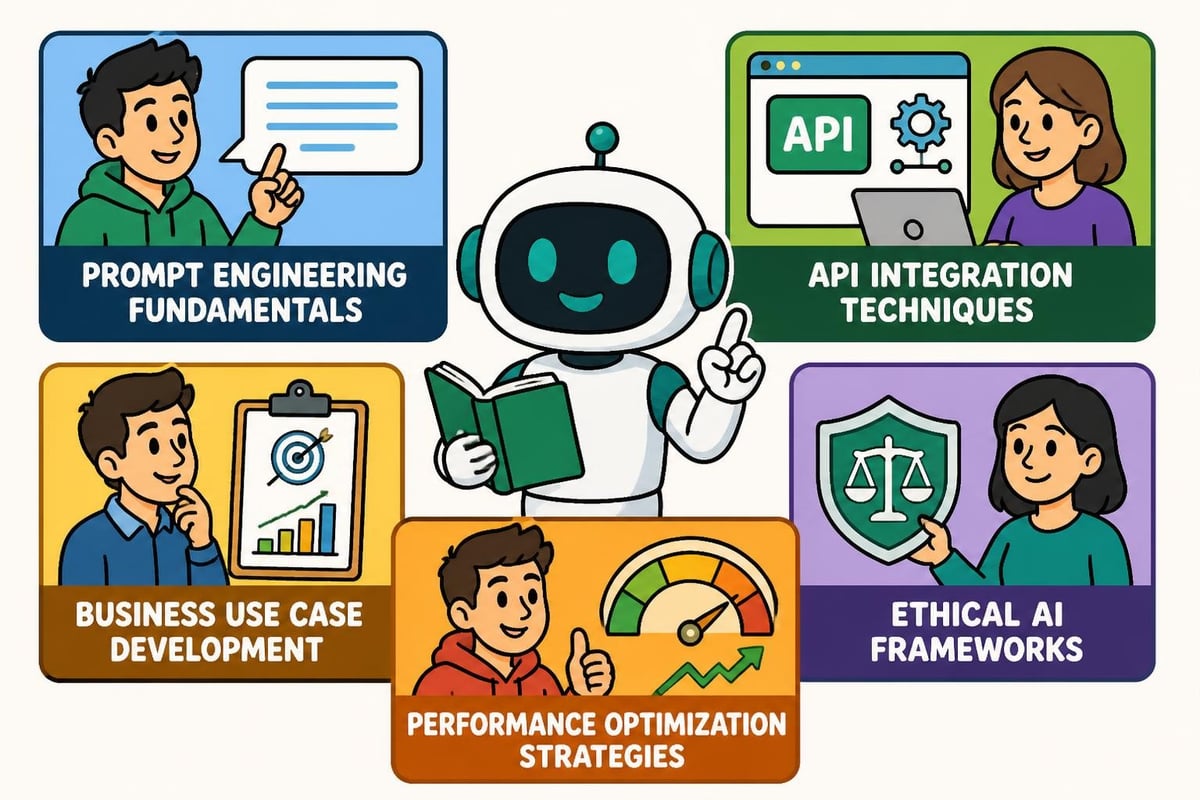
Ethical AI and governance has become non-negotiable in professional training. UNESCO's guidance on generative AI in education outlines competency frameworks that responsible chatgpt course providers incorporate, covering bias mitigation, privacy protection, transparency requirements, and regulatory compliance.
Performance optimization rounds out the curriculum, teaching learners how to evaluate model outputs, reduce costs through efficient prompting, implement fallback strategies, and measure business impact. This separates casual users from professionals who deliver measurable ROI.
Hands-On Learning Architecture
Lecture-based learning alone fails to develop practical ChatGPT skills. Effective courses require:
- Interactive labs where learners experiment with prompts in real-time environments
- Project-based assessments that simulate workplace challenges
- Code repositories with working examples learners can modify and deploy
- Feedback loops through automated grading or instructor review
- Version tracking so learners see how prompt refinements improve outcomes
Many professionals find that AI management courses complement technical training by addressing implementation strategy, change management, and team adoption considerations that extend beyond individual skill development.
Choosing the Right ChatGPT Course for Your Goals
Not all chatgpt course programs serve the same audience or objectives. Selecting the right fit requires matching course characteristics to your specific needs.
Skill Level Considerations
| Experience Level | Recommended Focus | Typical Duration | Key Outcomes |
|---|---|---|---|
| Beginners | Prompt basics, common use cases, safety | 8-15 hours | Confident daily ChatGPT use |
| Intermediate | Advanced prompting, light API work, workflows | 20-35 hours | Workflow automation, basic integrations |
| Advanced | Custom implementations, fine-tuning, production deployment | 40-60 hours | Enterprise-grade solutions |
| Developers | API mastery, embeddings, function calling, system design | 50-80 hours | Full-stack AI applications |
Beginners benefit most from courses emphasizing practical applications with immediate workplace value. These programs prioritize getting results quickly over deep technical understanding.
Intermediate learners need exposure to comprehensive prompt engineering research and real integration examples. They're ready to move beyond the web interface and start building custom solutions.
Advanced practitioners and developers require courses that address production concerns like error handling, cost optimization, security, monitoring, and scaling. These programs often overlap with broader AI and ML learning paths that cover the full technology stack.
Industry-Specific vs. General Training
General chatgpt course programs provide foundational skills applicable across sectors. Industry-specific courses offer deeper relevance but narrower transferability.
General programs excel at:
- Building portable skills that work in any role
- Teaching principles that adapt to new AI models
- Serving diverse teams with varied responsibilities
- Providing career flexibility as roles evolve
Industry-specific courses deliver:
- Pre-built prompts and templates for your sector
- Compliance guidance for regulated industries
- Case studies from similar organizations
- Networking with peers facing identical challenges
Financial services professionals might prioritize courses covering regulatory compliance, data privacy, and risk assessment. Healthcare workers need training emphasizing HIPAA compliance, clinical decision support limitations, and patient safety. Marketing teams benefit from modules on content creation, SEO optimization, and campaign personalization.
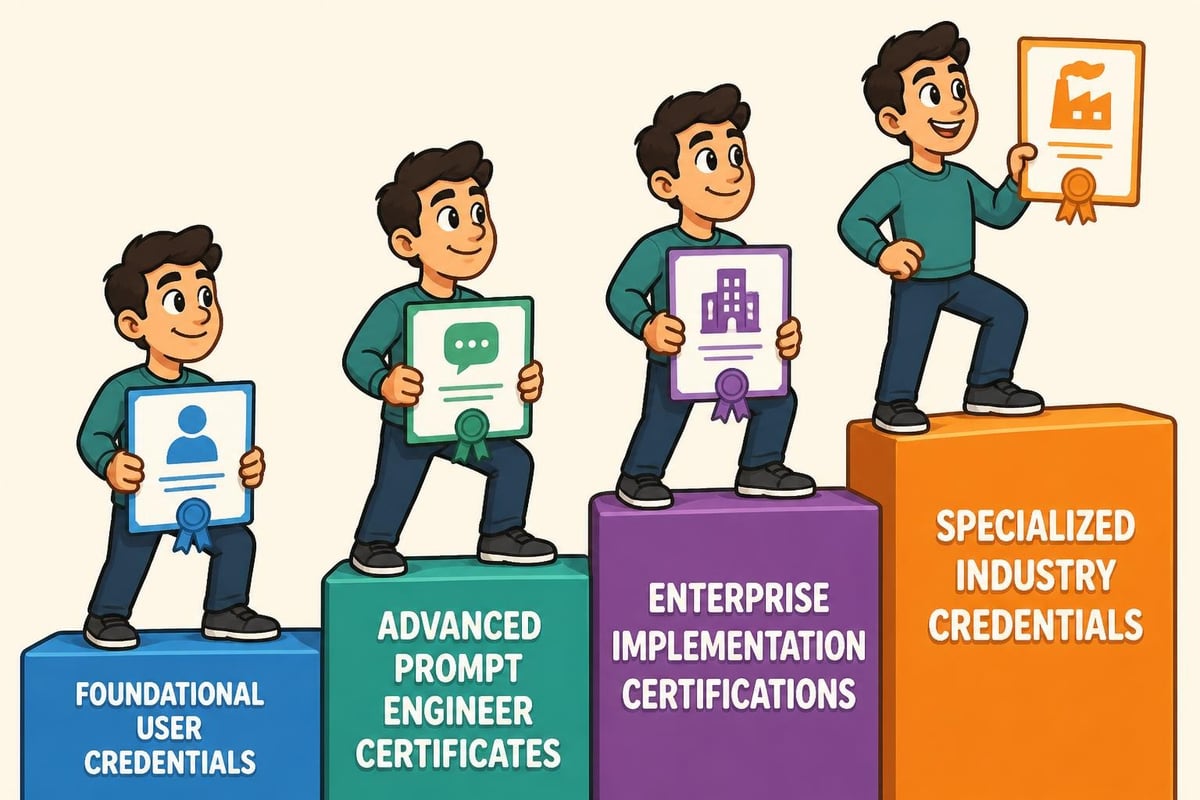
Professional Certification and Credentials
Certification adds formal recognition to chatgpt course completion, signaling competency to employers and clients.
Certification Value Proposition
Professional certifications serve three primary functions. They validate skills through standardized assessments that test practical application rather than memorization. They differentiate candidates in competitive job markets where AI literacy increasingly determines hiring decisions. They demonstrate commitment to continuous learning, particularly valuable as AI workplace adoption accelerates.
However, certification quality varies dramatically. The most credible programs require:
- Proctored examinations that prevent cheating
- Regular recertification ensuring knowledge stays current
- Practical assessments, not just multiple-choice tests
- Recognition from industry associations or major employers
- Clear competency frameworks aligned to job roles
Some chatgpt course providers offer certificates of completion with minimal assessment. While these document participation, they carry less weight than rigorous certifications during hiring processes or promotion considerations.
Integration with Broader AI Credentials
Standalone ChatGPT certifications demonstrate specific tool proficiency. Broader credentials show comprehensive AI literacy. Many professionals pursue both simultaneously.
Platform-specific certifications like Azure AI credentials prove enterprise deployment skills across Microsoft's ecosystem. Combined with chatgpt course certifications, they position professionals as implementation specialists capable of architecting complete solutions.
General AI engineer certifications establish foundational machine learning knowledge, while chatgpt course credentials add current generative AI expertise. This combination particularly appeals to employers seeking versatile technical talent.
Implementation Strategies for Organizations
Corporate chatgpt course deployments require different approaches than individual learning journeys.
Building Internal AI Literacy Programs
Successful organizational implementations start with skills assessment. Survey employees to understand current AI exposure, identify early adopters, and recognize skill gaps requiring immediate attention.
Tiered learning paths work better than one-size-fits-all approaches:
- Executive awareness sessions (2-4 hours) covering business impact, competitive risks, and investment priorities
- Manager enablement tracks (10-15 hours) focusing on team implementation, productivity measurement, and change leadership
- Power user intensives (25-40 hours) creating internal experts who support broader rollouts
- Technical specialist programs (50+ hours) developing implementation teams for custom solutions
Rolling out training in phases prevents overwhelming employees while building momentum through early success stories. Start with volunteer cohorts, gather feedback, refine content, then expand systematically.
Measuring Training ROI
Organizations investing in chatgpt course programs need frameworks proving value. Effective measurement combines leading and lagging indicators.
Leading indicators (measurable immediately):
- Course completion rates and time-to-completion
- Assessment scores and skill progression
- Employee confidence surveys pre/post training
- Engagement metrics within learning platforms
Lagging indicators (measurable after implementation):
- Productivity improvements in trained vs. untrained teams
- Cost savings from automated workflows
- Quality metrics for AI-assisted outputs
- Employee retention among upskilled workers
- Time savings on repetitive tasks
One financial services firm tracked that employees completing their chatgpt course reduced report generation time by 40% while improving accuracy by 15%. These quantifiable outcomes justified expanding training budget and accelerated adoption across additional departments.
Advanced Topics and Specialized Skills
Beyond foundational competencies, specialized chatgpt course modules address emerging professional needs.
Multimodal AI Capabilities
ChatGPT has evolved beyond text-only interactions. Advanced courses now cover vision capabilities, allowing professionals to analyze images, extract information from diagrams, and process visual data alongside text prompts.
Image generation integration represents another frontier. Courses teaching how to combine ChatGPT's planning capabilities with DALL-E or other image generators enable creative professionals to streamline workflows from concept to execution.
Audio processing through Whisper integration opens transcription, translation, and voice interface possibilities. Professionals in media, education, and accessibility fields particularly benefit from training on these multimodal applications.
Custom GPT Development
Creating specialized GPTs for specific workflows has become a critical professional skill. Advanced chatgpt course modules teach:
- Configuration best practices for instructions, knowledge bases, and behavior constraints
- Knowledge file preparation ensuring GPTs access accurate, relevant organizational information
- Action integration connecting GPTs to external APIs, databases, and business systems
- Testing methodologies that validate GPT performance before deployment
- Governance frameworks controlling who can create, modify, and access custom GPTs
Organizations deploying custom GPTs report 60-70% reductions in training time for specialized tasks, as domain-specific GPTs encode expert knowledge accessible to entire teams.
Enterprise Architecture and Security
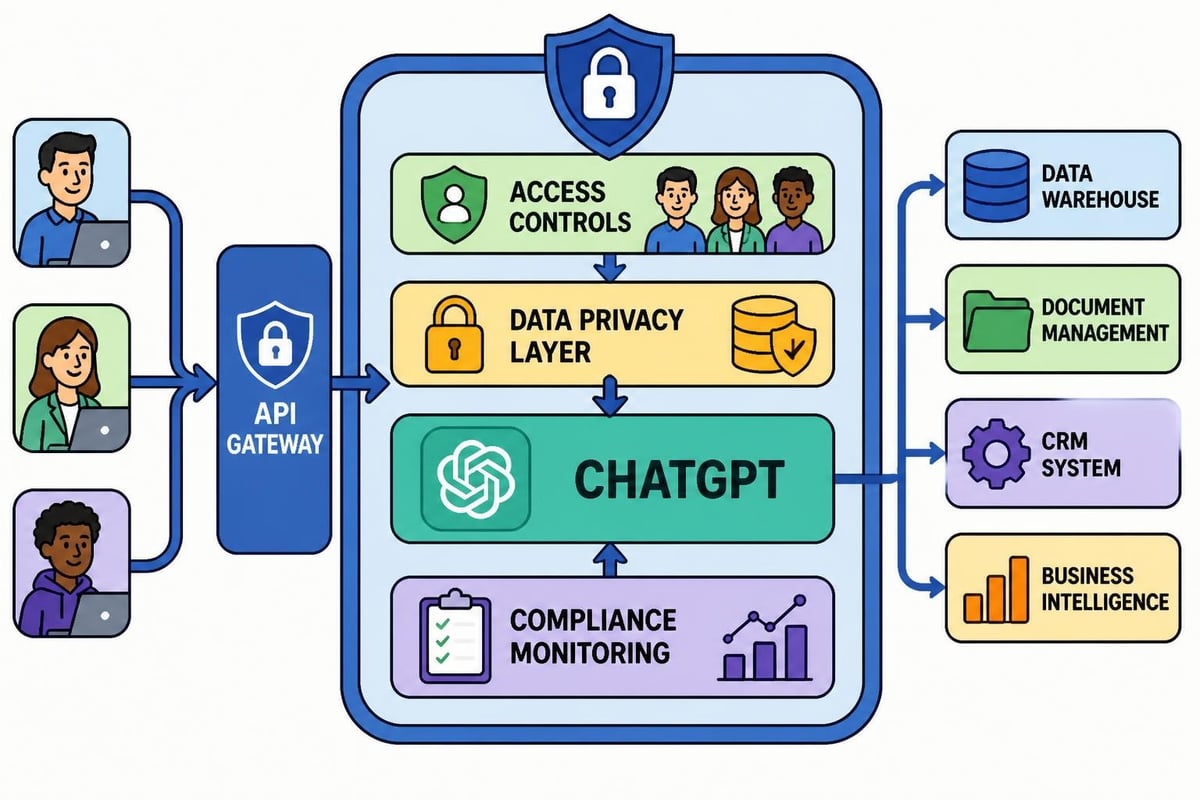
Production ChatGPT deployments demand enterprise-grade considerations rarely covered in basic courses. Stanford's NLP course materials provide academic foundations, but practical implementation requires additional training on:
| Security Concern | Training Focus | Implementation Example |
|---|---|---|
| Data privacy | Input sanitization, output filtering | Remove PII before API calls |
| Access control | Role-based permissions, audit logging | Track who prompts what systems |
| Cost management | Token optimization, rate limiting | Set departmental spending caps |
| Vendor lock-in | Abstraction layers, model switching | Design prompts portable across providers |
| Compliance | Industry regulations, data residency | Ensure GDPR, HIPAA, SOC2 alignment |
Continuous Learning and Skill Maintenance
Generative AI capabilities evolve rapidly, making continuous education essential.
Staying Current with Model Updates
OpenAI releases significant ChatGPT updates quarterly, each introducing new capabilities or modifying existing behaviors. A one-time chatgpt course becomes outdated quickly without ongoing learning support.
Top training platforms provide:
- Update webinars whenever major model changes release
- Documentation libraries tracking capability evolution
- Community forums where practitioners share discoveries
- Newsletter digests summarizing research and best practices
- Refresher modules maintaining certification currency
Professionals who establish ongoing learning routines through subscriptions, professional communities, and regular practice maintain competitive advantage over peers who treat AI training as one-time events.
Building a Practice Discipline
Knowledge without application atrophies quickly. Effective learners establish deliberate practice routines:
- Daily prompt challenges testing new techniques on real work tasks
- Weekly experiments exploring unfamiliar ChatGPT capabilities
- Monthly portfolio reviews documenting successful implementations
- Quarterly skill assessments identifying gaps requiring additional training
This practice-focused approach mirrors how professionals maintain skills in AI management and other rapidly evolving domains. It transforms passive course consumption into active skill development.
Practical Applications Across Professional Domains
Different roles extract different value from chatgpt course training.
Software Development and Engineering
Developers leverage ChatGPT for code generation, debugging assistance, documentation writing, and architecture planning. Advanced courses teach prompt patterns that maximize code quality while minimizing review overhead.
High-value developer applications:
- Translating requirements into implementation plans
- Generating boilerplate code for common patterns
- Explaining legacy code and suggesting refactoring approaches
- Writing unit tests and edge case scenarios
- Creating API documentation from code comments
Developers often combine chatgpt course training with specialized technical programs covering agent-based coding, automation workflows, and integration architectures.
Marketing and Content Creation
Marketing professionals use ChatGPT for campaign ideation, content drafting, audience research, and performance analysis. Training focuses on maintaining brand voice consistency while accelerating production.
Content creators learn techniques for:
- Generating topic ideas aligned to search intent
- Drafting outlines that balance SEO and readability
- Adapting content across formats and channels
- Personalizing messaging for audience segments
- Analyzing competitor content and identifying gaps
The most successful content teams develop custom GPTs encoding brand guidelines, style preferences, and audience insights, ensuring AI assistance enhances rather than homogenizes output.
Business Analysis and Strategy
Analysts apply ChatGPT to market research, competitive intelligence, financial modeling, and scenario planning. Courses emphasize critical evaluation of AI outputs and integration with traditional analytical methods.
Strategic applications include:
- Synthesizing research reports into executive summaries
- Generating hypotheses for data exploration
- Modeling business scenarios with varying assumptions
- Drafting strategy documents from outline frameworks
- Translating technical findings for non-technical stakeholders
Research perspectives from educators highlight how AI augments rather than replaces analytical thinking, making training focus on judgment and verification as much as prompt engineering.
Selecting Your Learning Platform
Platform choice significantly impacts chatgpt course effectiveness and completion rates.
Evaluation Criteria
When comparing providers, assess:
Content quality and currency measured through syllabus review, sample lessons, and update frequency. Look for courses revised within the past three months given rapid AI evolution.
Instructor credentials including practical AI implementation experience, teaching background, and industry recognition. The best instructors balance technical depth with clear communication.
Learning support infrastructure encompassing discussion forums, office hours, project feedback, and technical assistance. Asynchronous courses need robust support compensating for lack of live interaction.
Practical exercise quality evaluated through complexity, real-world relevance, and skill progression. Weak courses rely on theoretical examples rather than applicable business scenarios.
Certification rigor determined by assessment difficulty, proctoring requirements, and industry acceptance. Research whether employers recognize the credential before investing time.
Platform Ecosystems and Integration
Standalone courses teach specific skills. Platform ecosystems provide comprehensive learning journeys. MammothClub exemplifies this approach, offering chatgpt course options alongside 3,000+ complementary tech and AI programs, creating clear progression from foundational to advanced capabilities.
Ecosystem advantages include:
- Learning path curation guiding progression across related skills
- Unified progress tracking showing overall competency development
- Cross-course projects applying multiple technologies simultaneously
- Bundled pricing reducing per-course costs
- Consistent quality through platform-wide instructional standards
Organizations particularly benefit from platform partnerships enabling company-wide access, custom learning paths aligned to business objectives, and consolidated reporting across all employee training activities.
Mastering ChatGPT through structured training delivers immediate productivity gains while building essential skills for an AI-driven future. The right chatgpt course combines technical depth, practical application, and continuous learning support, transforming theoretical knowledge into measurable business value. MammothClub provides exactly this combination through our comprehensive AI learning platform, featuring expertly designed courses, hands-on bootcamps, and certification programs tailored for professionals and organizations committed to AI excellence. Start your AI upskilling journey today and discover how our interactive learning tools and personalized dashboards make mastering ChatGPT engaging, measurable, and results-driven.