The Microsoft AI certification path starts with the AI-901 fundamentals exam, then branches into role-based associate credentials such as AI-103 for developers and AI-300 for MLOps engineers, and ends at expert-level architecture. The right route depends on your job, not on a fixed order. Professionals who build, secure or manage AI systems each need a different second step, and some people can skip the fundamentals entirely.
This guide explains each stage, which exam fits which role, how to prepare, and how to avoid paying for a credential that does not match your next career move.
What changed in the Microsoft AI certification lineup for 2026?
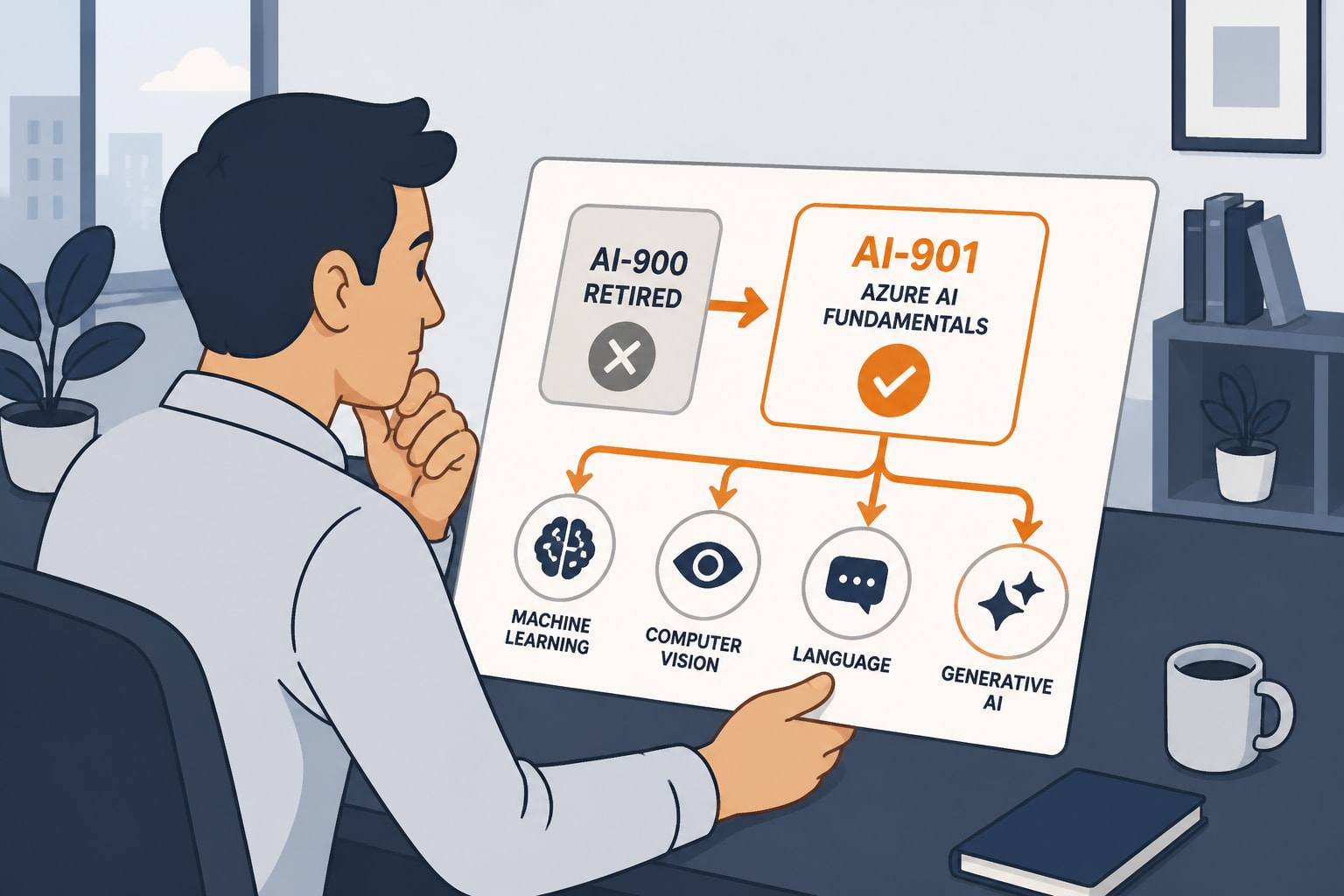
Microsoft replaced its entry exam and refreshed the developer exam, so older study plans may no longer apply. The AI-900 exam retired on June 30, 2026, and Microsoft identifies AI-901 as its replacement. Microsoft's certification update also lists AI-103 as the replacement for AI-102.
Two practical consequences follow:
- Any course, book or practice test built around AI-900 or AI-102 is out of date for exam purposes, even if the underlying concepts still help.
- Microsoft states that learning paths or modules for AI-901 are not yet available, so third-party structured material matters more than usual right now.
Check the exam page on Microsoft Learn before you book anything. Skills outlines are revised, and the exam page is the final authority on what is tested.
Which stages make up a Microsoft AI certification path?
A Microsoft AI certification path has three stages: fundamentals, role-based associate credentials, and expert or architect-level work. Each stage answers a different question about where you are in your career.
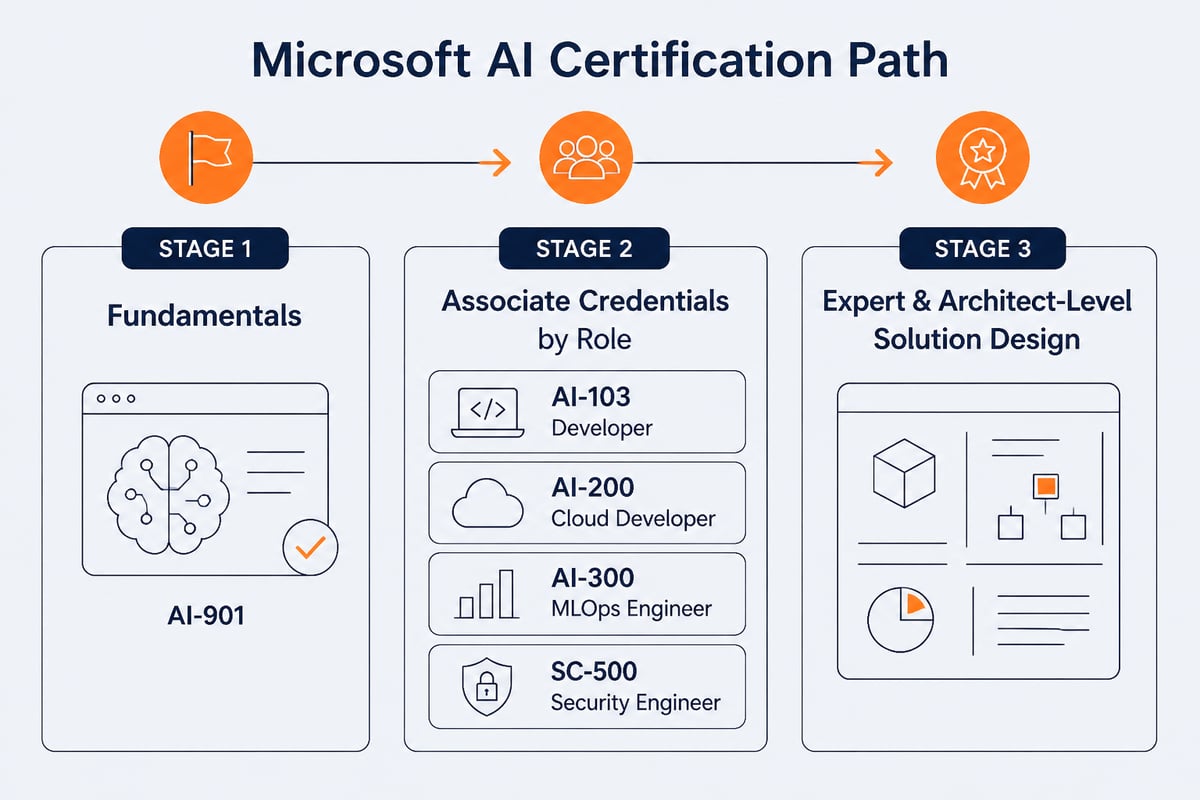
Stage 1: Fundamentals. AI-901 confirms you understand AI concepts and Azure AI services without needing to build anything. It suits career switchers, analysts, project managers and anyone who needs a recognized baseline.
Stage 2: Associate credentials. These validate that you can do a job: build AI applications, operate machine learning pipelines or secure AI workloads. This is where most hiring value sits.
Stage 3: Expert and architect work. Here the question shifts from "can you build it" to "can you design it for a business." Microsoft's agentic business solution credentials, such as AB-100, sit in this territory.
Microsoft is explicit that fundamentals are optional. Its study guide states that AI-900 is not a prerequisite for role-based certifications such as Azure Data Scientist Associate or Azure AI Engineer Associate, and the same logic applies to the newer exams.
Do you need AI-901 before anything else?
No. AI-901 is the right starting point only if you lack a working vocabulary for AI workloads, machine learning, computer vision, language and generative AI.
Before retirement, the AI-900 study guide covered AI workloads, machine learning principles, computer vision, NLP and generative AI, with generative AI carrying the largest share. AI-901 is the successor, so expect similar breadth with the exact weights defined on its current exam page.
Take AI-901 first if you:
- Are switching from a non-technical field and need structured exposure to AI terminology.
- Work in sales, product or operations and must discuss AI projects credibly.
- Plan to apply for associate exams later and want a low-stakes first pass at Microsoft's exam format.
Skip it if you already write code against AI APIs or run machine learning workloads. Your time is better spent on an associate exam, where the credential carries more weight with employers.
Which associate certification matches your role?
Choose the associate credential that mirrors the work you do or want to do, because hiring managers read these titles as job signals. The table below compares the main options.
| Exam | Role it fits | Core focus | Typical starting point |
|---|---|---|---|
| AI-103 | AI apps and agents developer | Building Azure AI applications and agents | Programming experience, API familiarity |
| AI-200 | Cloud developer working with AI | Integrating AI into cloud-based applications | Azure development background |
| AI-300 | MLOps and GenAIOps engineer | Deploying, monitoring and governing models | DevOps or data science experience |
| SC-500 | Cloud and AI security engineer | Securing cloud and AI workloads | Security or infrastructure background |
| AB-410 | Low-code builder | Intelligent apps on the Power Platform | Power Apps or Power Automate exposure |
| AB-620 | Copilot Studio specialist | Building agents in Copilot Studio | Business process knowledge |
Developers: AI-103 or AI-200
Pick AI-103 if your daily work is building AI-powered applications and agents. Pick AI-200 if you are a cloud developer whose main job is something else and AI is one service you wire in. If you are undecided, ask which describes your next job title.
Engineers operating AI at scale: AI-300
AI-300 fits people responsible for taking models and generative AI solutions into production and keeping them reliable. Employers increasingly separate "someone who can prototype" from "someone who can operate," and this credential speaks to the second group.
Security specialists: SC-500
Securing AI workloads is its own discipline. SC-500 is the adjacent route for anyone already in cloud security who needs to cover model endpoints, data exposure and agent permissions.
Low-code and business builders: AB-410 and AB-620
These suit professionals who build with Power Platform and Copilot Studio rather than writing application code. They are practical for analysts and consultants who want a recognized credential without a software engineering background.
How should career switchers sequence their first 90 days?
Career switchers should treat the first 90 days as three short phases: vocabulary, one hands-on project, then one associate exam. A sequence only makes sense when each credential adds a new responsibility, not when it repeats the last one.
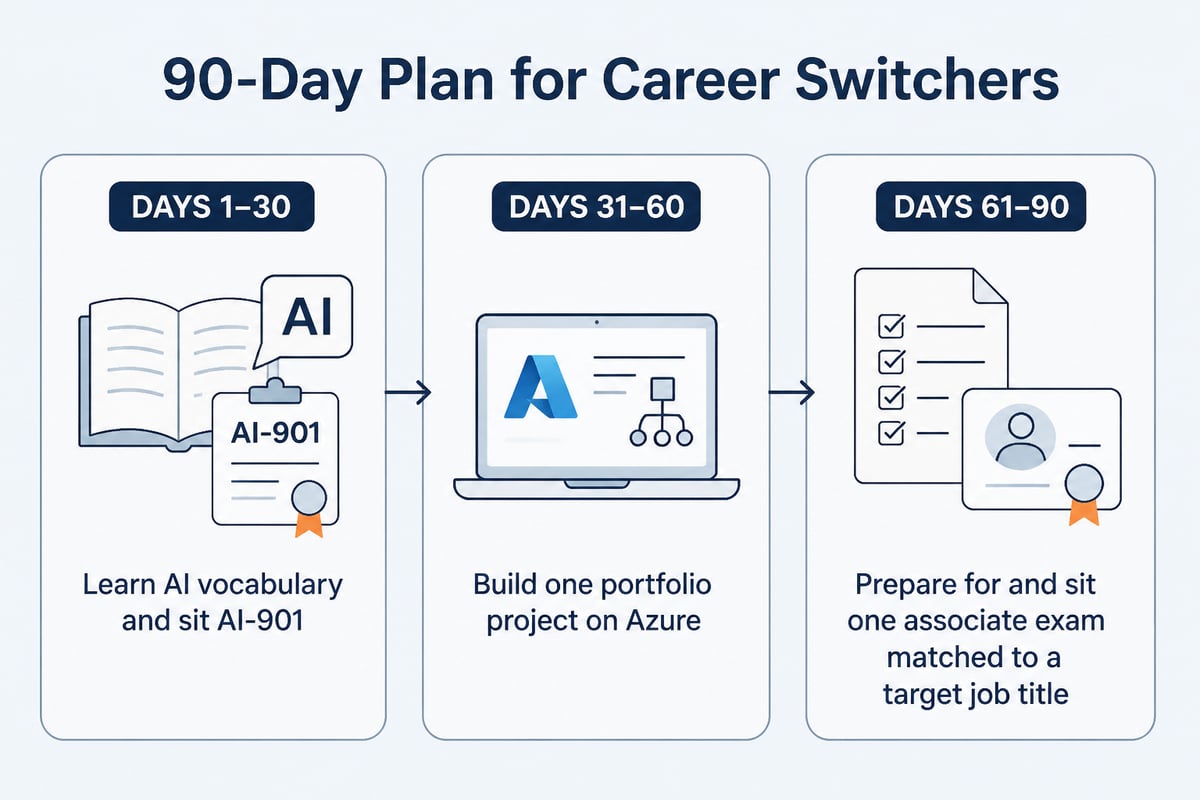
Days 1 to 30. Learn the vocabulary and sit AI-901. Because Microsoft has no official learning modules for it yet, rely on the skills outline and a structured third-party course.
Days 31 to 60. Build one small project that mirrors your target role. A developer might build a document question-answering agent; an MLOps candidate might deploy and monitor a model; a security candidate might document threats to an AI endpoint. A project proves you can apply the material and gives you something to discuss in interviews.
Days 61 to 90. Study for one associate exam and book it with a firm date. Open-ended preparation tends to drift.
Hypothetical example: a business analyst targeting a Copilot Studio specialist role might take AI-901, build one agent as a portfolio piece, then sit AB-620.
How do you prepare for a Microsoft AI exam?
Prepare by working from the official skills outline, practicing in a real Azure environment, and testing yourself with timed questions before the exam date. Reading alone rarely holds up against scenario-based questions.
A workable routine:
- Download the skills outline for your exam and turn each line into a checklist item you can explain aloud.
- Spend at least half your study time in hands-on labs, not video or reading.
- Take timed practice exams to find weak domains, then revisit only those.
- Keep notes on service limits, naming and configuration choices, which scenario questions often hinge on.
- Book the exam two to three weeks out so the date creates urgency.
A structured platform can shorten this loop. MammothClub's Unlimited Membership bundles courses, practice labs, templates and certification paths with built-in assessments and proctored final exams, and its lessons are text-first and searchable so you can apply a concept the same day. Courses and assessments are updated monthly as tools change, which matters while Microsoft's exam lineup is still shifting. For a broader view of how structured programs compare, see this overview of a diploma in artificial intelligence, and review membership pricing before committing.

Is a Microsoft credential enough, or should you add others?
A Microsoft credential is strongest when paired with proof that you can apply it, and sometimes with a vendor-neutral or hardware-specific skill. Employers read the certification as a signal of baseline competence and the portfolio as evidence of judgment.
Consider adding:
- A project portfolio that shows deployed work, not only exam passes.
- Complementary vendor training where your target employers use it, such as GPU and infrastructure skills covered in NVIDIA training.
- A business-focused credential if you guide AI adoption rather than build it. Microsoft offers the AI Transformation Leader certification, which it describes as not requiring coding skills.
Avoid stacking credentials that cover the same ground. A second associate exam in the same domain adds little; one in an adjacent domain, such as security after development, adds a new capability.
What does the Microsoft AI certification path cost in time and effort?
Study time depends heavily on your background, so plan your own timeline around the exam's skills outline. Exam fees vary by country and change over time, so confirm current pricing on the exam page when you register.
Three factors move the timeline most:
- Prior hands-on experience. Someone who already deploys Azure resources needs far less lab time.
- Exam breadth. Developer and MLOps exams span more services than a fundamentals exam.
- Retake policy and renewal. Associate and expert credentials expire unless renewed, so build a yearly refresh into your plan rather than treating certification as one-time.
Frequently asked questions
What is the first Microsoft AI certification to take?
AI-901 (Azure AI Fundamentals) is the entry credential for people new to AI. If you already build or operate AI systems, start with the associate exam that matches your role.
Is AI-900 still available?
No. AI-900 retired on June 30, 2026, and AI-901 replaces it. Material written for AI-900 may still teach concepts, but it will not match the current exam.
Which exam replaced AI-102?
AI-103 replaces AI-102, according to Microsoft's certification update. It targets developers building Azure AI applications and agents.
Do I need coding skills for Microsoft AI certifications?
Not for all of them. AI-901 and the low-code credentials AB-410 and AB-620 do not require software engineering, while AI-103, AI-200 and AI-300 assume programming or DevOps familiarity.
Can I take an associate exam without the fundamentals?
Yes. Microsoft treats fundamentals as optional, so you can sit a role-based exam directly if you have the experience.
How do I choose between AI-103, AI-200 and AI-300?
Match the exam to your job: AI-103 for building AI apps and agents, AI-200 for cloud developers integrating AI, and AI-300 for engineers operating models in production.
Are these certifications worth it for getting hired?
They signal verified skills, but they work best alongside a portfolio project. Hiring managers tend to weigh demonstrated, deployed work heavily next to the credential.
Pick one target job title this week and map it to a single exam from the table above, then book a date three to four weeks out. If you want structured courses, practice labs and proctored assessments in one place, the Mammoth Club Unlimited Membership covers certification paths alongside 3,000+ on-demand courses. You can start unlimited and build your Microsoft AI preparation around the role you actually want.