The microsoft azure ai 102 certification represents a critical milestone for AI professionals seeking to validate their expertise in designing and implementing Azure-based artificial intelligence solutions. As organizations accelerate their AI adoption in 2026, this intermediate-level credential has become essential for developers, solution architects, and data scientists who build production-ready AI systems. The AI-102 exam tests your ability to integrate Azure Cognitive Services, implement computer vision and natural language processing solutions, deploy conversational AI, and operationalize machine learning models within enterprise environments.
Understanding the Microsoft Azure AI 102 Certification Scope
The microsoft azure ai 102 certification validates competencies across five primary domains that reflect real-world AI implementation challenges. Microsoft structures the exam to assess both theoretical knowledge and practical application skills.
Core Exam Domains and Weight Distribution
The certification measures your proficiency in planning, creating, deploying, and managing Azure AI solutions. Each domain carries specific weight in the overall assessment:
| Domain | Weight | Focus Areas |
|---|---|---|
| Plan and manage Azure Cognitive Services | 15-20% | Resource provisioning, security, monitoring |
| Implement Computer Vision solutions | 20-25% | Image analysis, custom vision, video processing |
| Implement Natural Language Processing | 20-25% | Text analytics, language understanding, translation |
| Implement knowledge mining | 15-20% | Azure Cognitive Search, enrichment pipelines |
| Implement conversational AI | 15-20% | Bot Framework, QnA Maker, language models |
These percentages reflect Microsoft's current exam blueprint and help candidates prioritize study efforts effectively. The distribution emphasizes hands-on implementation over theoretical concepts.
Technical Prerequisites and Background
Before pursuing microsoft azure ai 102, candidates should possess foundational Azure knowledge and programming skills. Microsoft recommends completing the AI-900 fundamentals certification first, though it's not mandatory.
Essential technical skills include:
- Proficiency in Python or C# for Azure SDK integration
- REST API consumption and JSON data manipulation
- Understanding of Azure subscription management and resource groups
- Basic familiarity with machine learning concepts and model lifecycle
- Experience with cloud security principles and authentication patterns
The certification assumes you've worked with Azure services for at least six months and understand how to translate business requirements into technical AI implementations.
Implementing Computer Vision Solutions at Scale
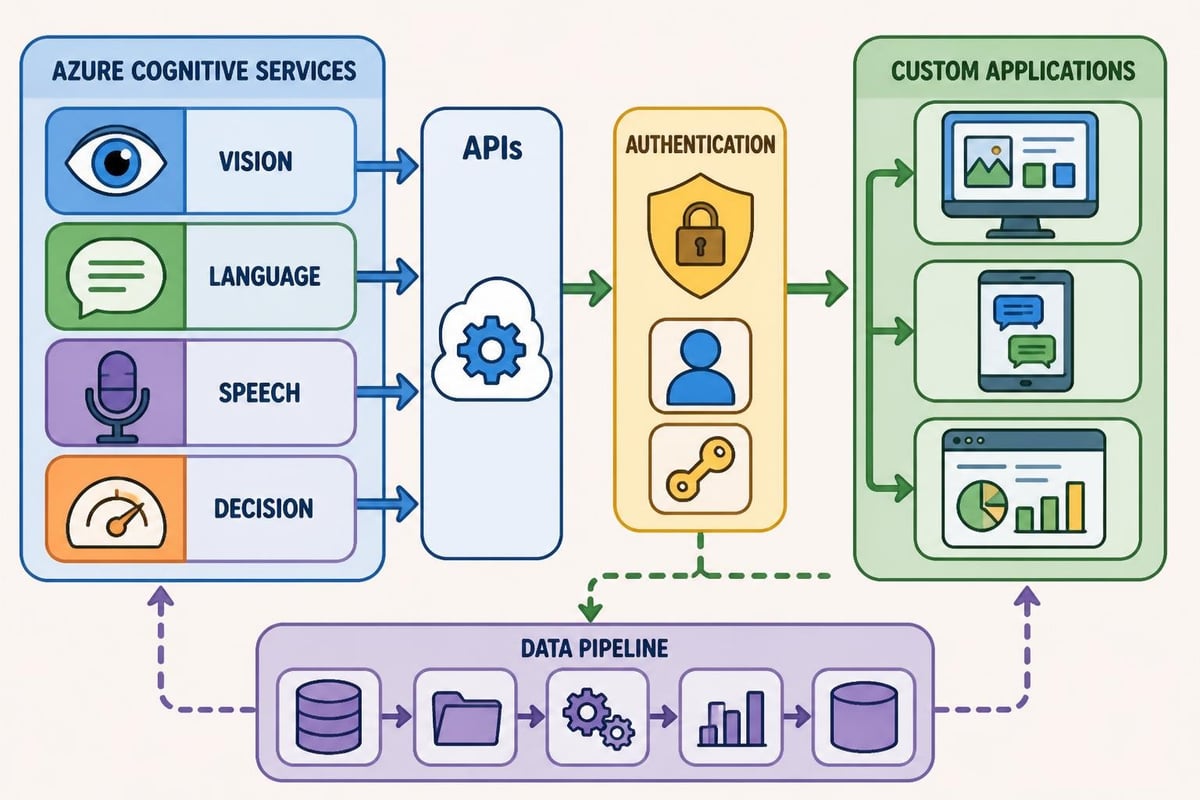
Computer vision represents one of the most practically applicable domains in the microsoft azure ai 102 curriculum. The exam tests your ability to configure Azure Computer Vision, Custom Vision, and Face API services for production scenarios.
Azure Computer Vision API Integration
The Computer Vision API provides pre-trained models for image analysis, optical character recognition, and spatial analysis. Successful candidates demonstrate expertise in selecting appropriate API operations for specific business needs.
Key implementation patterns include:
- Image classification and tagging for content moderation and digital asset management
- OCR and document processing for invoice extraction and form digitization
- Spatial analysis for retail analytics and occupancy monitoring
- Brand and landmark detection for marketing intelligence applications
When integrating Computer Vision APIs, understanding request throttling, regional endpoints, and pricing tiers becomes critical. The exam includes scenario-based questions about optimizing API calls and managing costs effectively.
Custom Vision Model Development
Custom Vision enables training specialized image classification and object detection models without deep machine learning expertise. The microsoft azure ai 102 exam emphasizes practical model training workflows.
| Development Phase | Key Considerations | Common Pitfalls |
|---|---|---|
| Dataset preparation | Minimum 50 images per tag, balanced classes | Insufficient variety, poor image quality |
| Model training | Iteration management, performance metrics | Overfitting, inappropriate domain selection |
| Model evaluation | Precision vs. recall tradeoffs | Accepting first iteration without refinement |
| Deployment | Prediction endpoint configuration, versioning | Not testing latency requirements |
Training effective custom vision models requires understanding when to use classification versus object detection, how to handle imbalanced datasets, and strategies for continuous model improvement based on production feedback.
Professionals preparing for the certification should explore AI and ML courses that provide hands-on experience with these Azure services in realistic scenarios.
Natural Language Processing and Text Analytics
Natural language processing capabilities form a substantial portion of microsoft azure ai 102 exam content. Azure provides multiple services for text analysis, each optimized for specific use cases.
Azure Text Analytics and Language Understanding
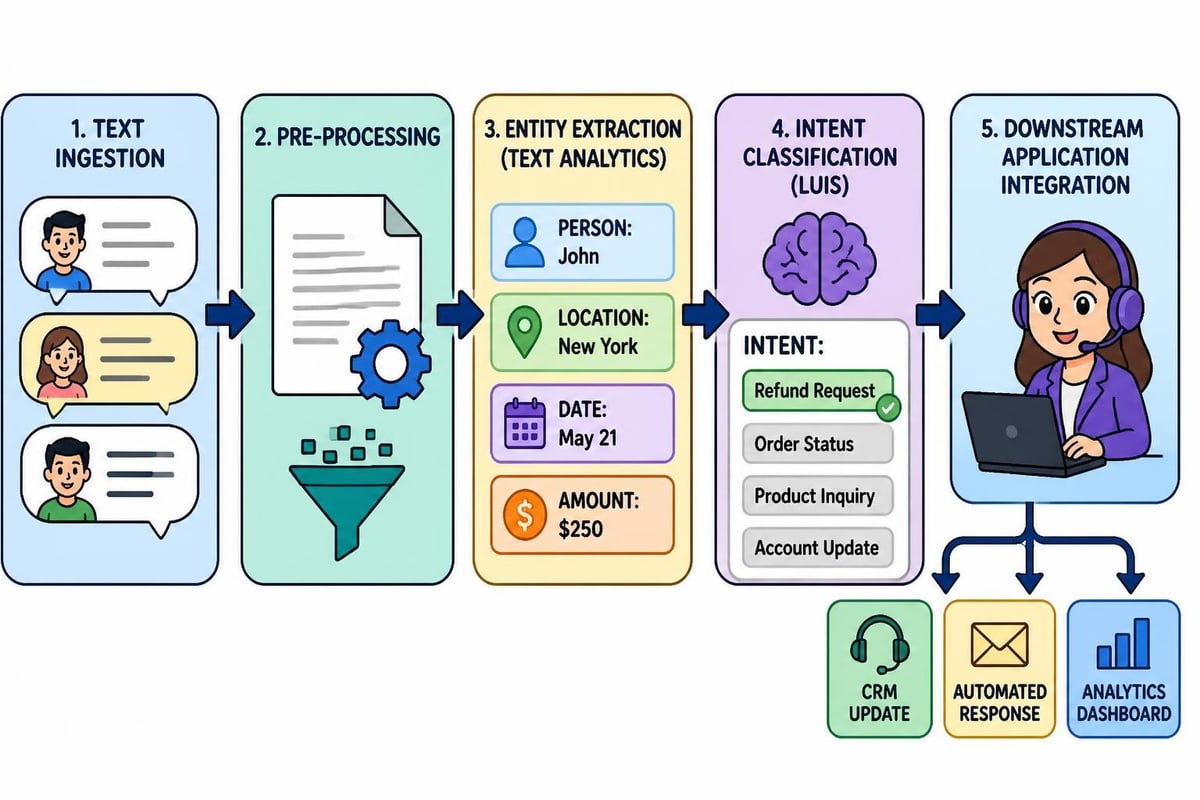
Text Analytics API delivers sentiment analysis, key phrase extraction, named entity recognition, and language detection. The exam tests your ability to chain these capabilities into comprehensive text processing pipelines.
Production implementation considerations:
- Handling multi-language content with appropriate language codes
- Processing batch requests for throughput optimization
- Implementing custom entity extraction for domain-specific terminology
- Managing personally identifiable information (PII) detection and redaction
Language Understanding (LUIS) enables building custom natural language understanding models for intent classification and entity extraction. The certification requires demonstrating proficiency in designing LUIS schemas, training utterances, and managing model versions.
Translator and Speech Services Integration
Azure Translator supports text and document translation across 100+ languages. The microsoft azure ai 102 exam includes scenarios requiring translation workflow design, including custom terminology integration and format preservation.
Speech services encompass speech-to-text, text-to-speech, and speech translation capabilities. Exam questions assess your understanding of:
- Acoustic model customization for specialized vocabularies
- Real-time versus batch transcription selection criteria
- Neural voice integration for natural text-to-speech output
- Pronunciation assessment for language learning applications
Integrating these services requires understanding latency requirements, audio format compatibility, and authentication patterns across different Azure regions.
Knowledge Mining and Cognitive Search Architecture
Knowledge mining represents Azure's approach to extracting insights from unstructured content at scale. The microsoft azure ai 102 certification dedicates significant focus to Azure Cognitive Search implementation.
Cognitive Search Enrichment Pipelines
Azure Cognitive Search combines full-text search with AI enrichment capabilities. The exam tests your ability to design indexing pipelines that extract, transform, and enrich content from diverse data sources.
Pipeline components include:
- Data sources: Azure Blob Storage, Cosmos DB, SQL Database, SharePoint
- Skillsets: Built-in cognitive skills and custom skill integration
- Indexers: Scheduled or on-demand execution with change tracking
- Indexes: Field mapping, analyzers, and scoring profiles
- Knowledge stores: Projected enrichments for downstream analytics
Effective pipeline design requires understanding when to use built-in skills versus custom skills, how to optimize indexing performance, and strategies for handling large document volumes.
Custom Skill Development and Integration
Custom skills extend cognitive search with specialized processing logic. The certification requires demonstrating ability to develop Azure Functions that implement the custom skill interface.
| Custom Skill Use Case | Implementation Pattern | Integration Complexity |
|---|---|---|
| Industry-specific entity extraction | Azure Function with ML model endpoint | Medium |
| Proprietary document format parsing | Container-based processing service | High |
| Business rule-based content filtering | Lightweight Azure Function | Low |
| Third-party API enrichment | HTTP-based integration | Medium |
Custom skills must handle batch processing, implement appropriate error handling, and maintain performance SLAs. The exam includes troubleshooting scenarios where candidates identify and resolve common integration issues.
Understanding responsible AI frameworks becomes critical when implementing knowledge mining solutions that process sensitive or regulated content.
Conversational AI and Bot Framework Implementation
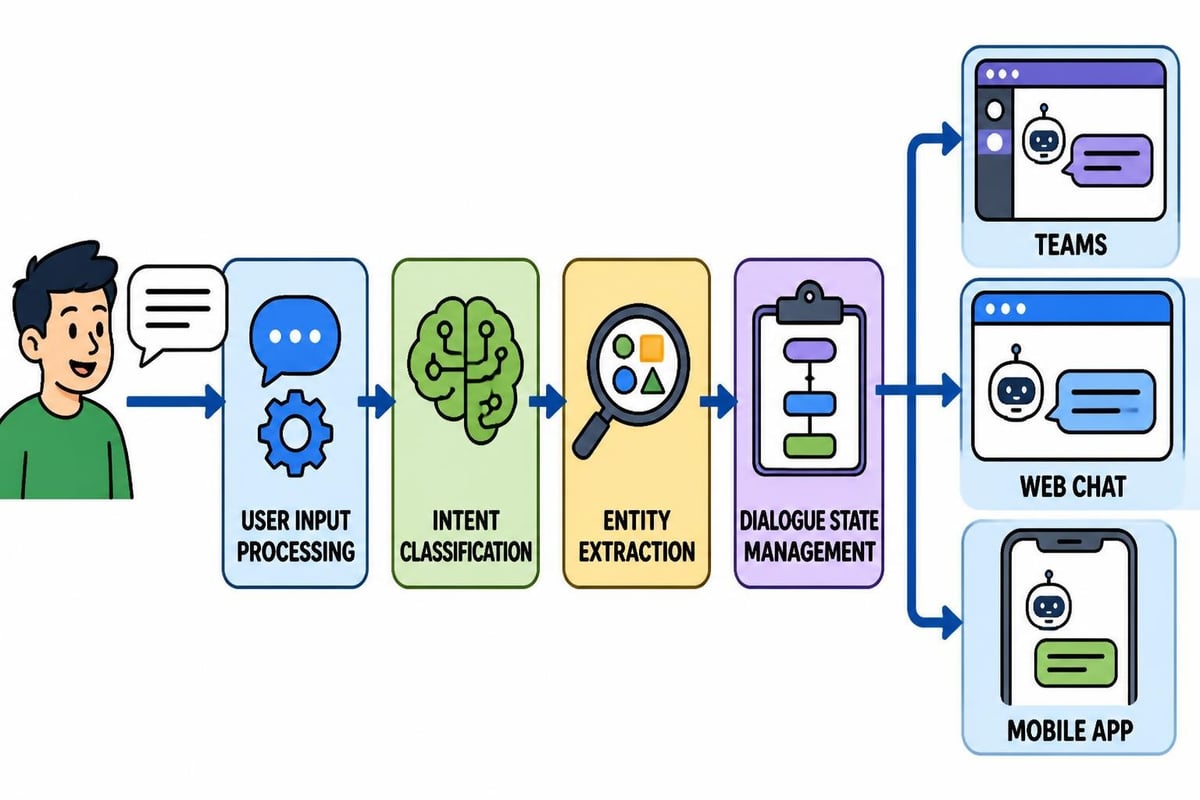
Conversational AI capabilities enable natural dialogue experiences across multiple channels. The microsoft azure ai 102 exam emphasizes practical bot development using Azure Bot Service and related frameworks.
Azure Bot Service Architecture
Azure Bot Service provides managed infrastructure for deploying conversational interfaces. Exam candidates must understand bot registration, channel configuration, and activity processing patterns.
Key architectural decisions include:
- Selecting appropriate messaging schemas for different channel requirements
- Implementing state management strategies for multi-turn conversations
- Designing dialogue flows that handle interruptions and context switching
- Integrating authentication and authorization for secure bot interactions
The Bot Framework SDK supports multiple programming languages, but Python and C# remain the most common implementation choices for enterprise scenarios.
QnA Maker and Conversational Language Understanding
QnA Maker enables building knowledge base-driven conversational experiences without explicit dialogue management code. The microsoft azure ai 102 certification tests your ability to create, train, and deploy QnA Maker knowledge bases.
Advanced implementations combine QnA Maker with LUIS for hybrid conversational experiences. This pattern routes user inputs to appropriate knowledge bases or custom dialogue logic based on detected intents.
- User utterance arrives through Bot Service channel
- LUIS classifies intent and extracts entities
- Routing logic selects between QnA Maker lookup or custom logic
- Response generation adapts to channel capabilities
- State persistence maintains conversation context
Microsoft's evolving language services now incorporate conversational language understanding that supersedes some traditional LUIS capabilities. Exam content reflects these service transitions.
Professionals can supplement their preparation with specialized AI training courses that provide scenario-based bot development experience.
MLOps and Production Deployment Strategies
The microsoft azure ai 102 certification increasingly emphasizes operational aspects of AI solution deployment. Understanding MLOps principles and Azure Machine Learning integration has become essential.
Azure Machine Learning Integration Patterns
While AI-102 focuses primarily on Cognitive Services, production implementations often require custom model deployment through Azure Machine Learning. The exam tests understanding of when to use pre-built services versus custom models.
Decision criteria for custom model deployment:
- Domain specificity: Highly specialized use cases not covered by pre-built models
- Data sensitivity: Requirements to train on proprietary datasets
- Performance requirements: Specific accuracy or latency targets
- Regulatory compliance: Industry-specific model governance requirements
Azure Machine Learning provides managed endpoints for real-time and batch inference. The MLOps technical guidance from Microsoft details architectural patterns for production deployments.
Continuous Integration and Model Management
Production AI solutions require robust CI/CD pipelines for model versioning, testing, and deployment. The microsoft azure ai 102 exam includes scenarios about managing model lifecycles and implementing automated testing.
| MLOps Component | Azure Service | Key Capabilities |
|---|---|---|
| Version control | Azure DevOps, GitHub | Code and model versioning |
| Training pipeline | Azure ML Pipelines | Automated retraining workflows |
| Model registry | Azure ML Model Registry | Version tracking, lineage |
| Deployment | Azure ML Endpoints | A/B testing, blue-green deployment |
| Monitoring | Application Insights | Performance metrics, drift detection |
The Azure MLOps v2 repository provides reference implementations that align with exam scenarios. Understanding these patterns helps candidates answer deployment architecture questions.
Modern LLM workflows introduce additional operational considerations. Resources like Databricks LLMOps documentation provide complementary perspectives on operationalizing large language models, though vendor-neutral principles apply across platforms.
Responsible AI and Governance Implementation
Responsible AI principles pervade the microsoft azure ai 102 exam content. Microsoft requires candidates to demonstrate understanding of fairness, reliability, privacy, security, inclusiveness, and transparency in AI system design.
Azure AI Content Safety and Moderation
Content Safety services detect harmful content across text and images. The exam tests implementation of content moderation workflows that balance automation with human review.
Content moderation implementation patterns:
- Automated filtering: Block high-confidence harmful content automatically
- Human review queue: Route ambiguous content to human moderators
- Feedback loop: Use moderation decisions to improve model performance
- Compliance reporting: Generate audit trails for regulatory requirements
Effective content moderation requires understanding regional legal requirements, cultural context, and appropriate confidence thresholds for different use cases.
Model Transparency and Explainability
Azure Machine Learning provides interpretability tools for understanding model predictions. The microsoft azure ai 102 certification includes scenarios about explaining model decisions to stakeholders.
Key explainability techniques include:
- Feature importance calculation for understanding input influence
- SHAP (SHapley Additive exPlanations) values for individual predictions
- Counterfactual explanations showing how inputs affect outcomes
- Model debugging for identifying bias and fairness issues
The NIST AI Risk Management Framework provides structured guidance for implementing these governance practices in production systems.
Organizations pursuing AI certifications should consider comprehensive certification programs that cover both technical implementation and governance frameworks.
Hands-On Practice and Exam Preparation Strategies
Success in the microsoft azure ai 102 exam requires extensive hands-on practice with Azure services. Microsoft Learn provides official learning paths, but supplementary resources accelerate skill development.
Lab Environment Setup and Practice Scenarios
Azure free tier and trial subscriptions enable cost-effective practice environments. Candidates should create dedicated resource groups for exam preparation to manage costs and maintain organization.
Recommended practice progression:
- Complete basic service integration tutorials for each Cognitive Service
- Build end-to-end solutions combining multiple services
- Implement MLOps workflows with automated testing and deployment
- Practice troubleshooting common integration errors and performance issues
The AI-102 hands-on labs repository provides community-maintained practice materials aligned with current exam objectives.
Effective Study Techniques and Resource Allocation
The microsoft azure ai 102 exam covers substantial technical breadth. Efficient study strategies help candidates master content within reasonable timeframes.
| Study Phase | Duration | Focus Activities | Success Metrics |
|---|---|---|---|
| Foundations | 2-3 weeks | Complete Microsoft Learn paths | 80%+ knowledge checks |
| Hands-on practice | 4-6 weeks | Build sample projects | Deploy working solutions |
| Exam simulation | 1-2 weeks | Practice tests, weak area review | 85%+ practice scores |
| Final review | 1 week | Documentation review, scenario walkthroughs | Confident readiness |
Practice exams help identify knowledge gaps and familiarize candidates with question formats. However, memorizing practice questions without understanding underlying concepts leads to exam failure.
The evolving nature of prompt engineering and LLM integration requires staying current with industry trends. Resources like IEEE Spectrum's analysis provide valuable context about how AI development roles are evolving.
Career Impact and Professional Development Pathways
The microsoft azure ai 102 certification significantly impacts career trajectories for AI professionals. Organizations increasingly require validated Azure AI expertise for senior development and architecture roles.
Salary Impact and Market Demand
Certified Azure AI professionals command premium compensation in the current market. The certification demonstrates practical implementation capabilities beyond theoretical knowledge.
Average salary ranges for AI-102 certified professionals (2026 U.S. market):
- Junior AI Developer: $85,000 - $110,000
- Mid-level AI Engineer: $110,000 - $145,000
- Senior AI Solutions Architect: $145,000 - $190,000
- AI Practice Lead: $180,000 - $250,000+
Geographic location, industry sector, and complementary skills influence actual compensation. Professionals who combine AI-102 certification with cloud architecture credentials or domain expertise achieve highest earning potential.
Advanced Certification Pathways
The microsoft azure ai 102 serves as foundation for advanced Microsoft certifications. Strategic certification planning accelerates career progression.
Post-AI-102 certification options:
- Azure Solutions Architect Expert: Broader cloud architecture credential
- Azure Data Engineer Associate: Complementary data platform expertise
- Azure AI Engineer Associate: Specialized AI engineering focus (when released)
- Specialty certifications: Specific technology deep-dives
Combining technical certifications with business-focused AI training creates well-rounded professionals capable of bridging technical implementation and business strategy.
Organizations seeking to upskill teams should consider structured learning platforms that provide comprehensive AI curriculum beyond individual certifications. The breadth of Azure AI services requires ongoing education to maintain cutting-edge expertise.
Mastering the microsoft azure ai 102 certification requires balancing theoretical knowledge with extensive hands-on practice across Azure's comprehensive AI service portfolio. Success demands understanding not just individual service capabilities but architectural patterns for integrating multiple services into production-ready solutions. Whether you're pursuing career advancement or organizational AI capabilities, MammothClub provides 3,000+ on-demand courses, interactive bootcamps, and AI-powered learning tools designed to accelerate your journey from certification preparation to confident implementation. Our corporate programs and practice exams help professionals and teams stay competitive in the rapidly evolving AI landscape.