The great learning ai ml course has become a focal point for professionals seeking to pivot into artificial intelligence and machine learning careers. As we approach the end of 2026, the landscape of AI education has evolved dramatically, with platforms competing to offer the most comprehensive, career-relevant training. Understanding what differentiates a strong AI ML program from basic introductions requires examining curriculum depth, practical application opportunities, and post-completion outcomes that translate directly to workplace value.
Understanding the Great Learning AI ML Course Structure
The great learning ai ml course typically spans several months and covers foundational through advanced machine learning concepts. Most programs begin with Python programming fundamentals, statistical foundations, and data manipulation before progressing to supervised and unsupervised learning algorithms.
Core curriculum components include:
- Linear regression, logistic regression, and decision trees
- Neural networks and deep learning architectures
- Natural language processing and computer vision
- Model deployment and MLOps practices
- Capstone projects with real-world datasets
The structure emphasizes hands-on learning through coding exercises and project work rather than purely theoretical instruction. This approach mirrors what institutions like Stanford's CS229 have proven effective, balancing mathematical rigor with practical implementation.
How Great Learning Differs from Traditional Programs
Unlike university courses that may emphasize research over application, the great learning ai ml course targets working professionals who need immediately applicable skills. The curriculum accelerates through fundamentals to reach production-ready techniques faster than academic alternatives.
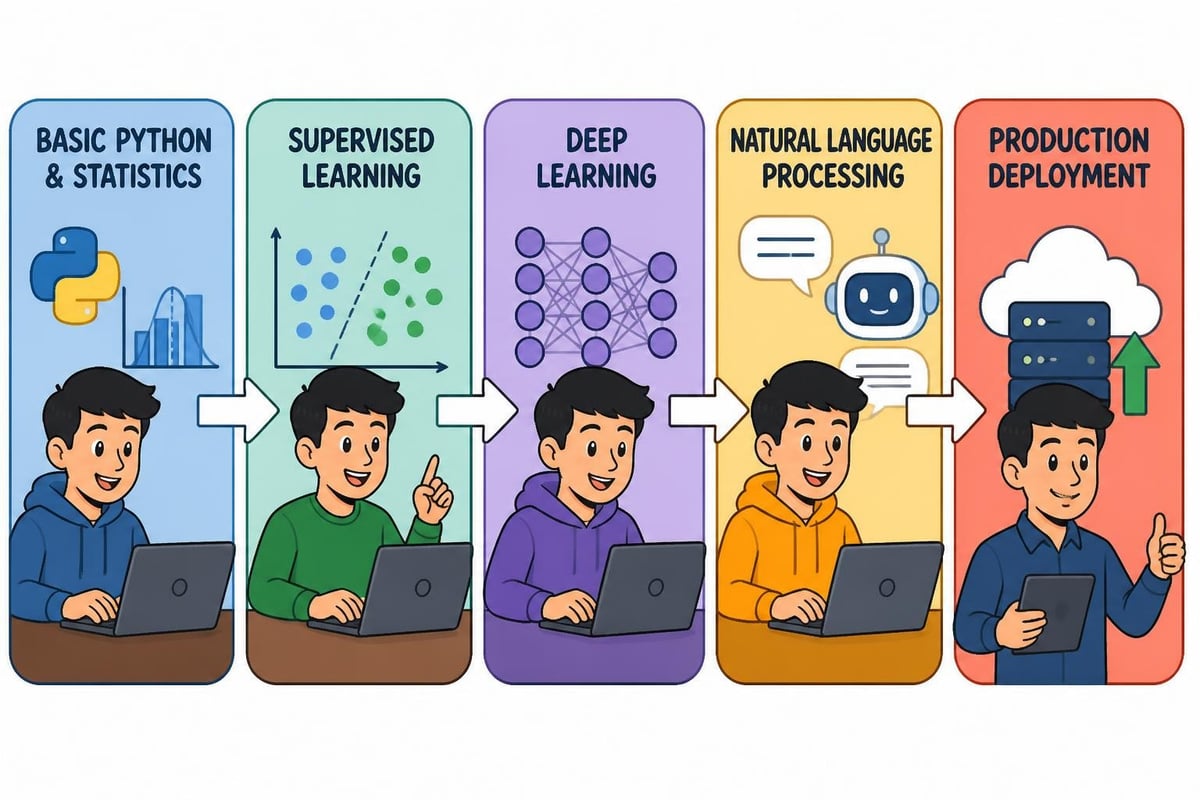
Most iterations include live sessions with industry practitioners, peer collaboration opportunities, and career support services. These elements address what recent research on teaching ML to software engineers identifies as critical gaps between academic training and industry requirements.
| Feature | Great Learning Approach | Traditional University Course | Self-Paced Online Course |
|---|---|---|---|
| Duration | 6-12 months part-time | 15 weeks full-time | Unlimited |
| Focus | Industry applications | Theory and research | Variable |
| Support | Mentors and career services | Teaching assistants | Forums only |
| Certification | Professional credential | Academic credit | Completion certificate |
| Cost | Mid-range ($2,000-5,000) | High (tuition) | Low to free |
Curriculum Deep Dive and Learning Outcomes
The technical depth of the great learning ai ml course positions graduates to handle real-world machine learning challenges. The program typically divides into distinct modules that build progressively.
Module progression typically follows:
- Foundations: Python for data science, NumPy, Pandas, Matplotlib
- Statistics and Probability: Distributions, hypothesis testing, Bayesian thinking
- Supervised Learning: Regression, classification, ensemble methods
- Unsupervised Learning: Clustering, dimensionality reduction, anomaly detection
- Deep Learning: CNNs, RNNs, transformers, transfer learning
- Specialization: NLP, computer vision, or reinforcement learning tracks
- Deployment: Model serving, monitoring, MLOps pipelines
Each module incorporates coding assignments that mirror tasks data scientists encounter daily. For professionals exploring AI and ML courses, this practical orientation proves more valuable than courses heavy on mathematics without implementation context.
Projects That Build Portfolio Value
The capstone component distinguishes serious programs from introductory overviews. Great Learning's approach typically requires students to complete an end-to-end project encompassing data collection, feature engineering, model selection, evaluation, and deployment planning.
Common project domains include:
- Customer churn prediction for subscription businesses
- Sentiment analysis of product reviews or social media
- Image classification for quality control or medical diagnosis
- Recommendation systems for e-commerce or content platforms
- Time series forecasting for demand planning or financial markets
These projects provide tangible artifacts for portfolios and interview discussions. The business context embedded in assignments helps students understand how ML creates organizational value, not just technical achievement.
Comparing Great Learning to Alternative Learning Paths
When evaluating the great learning ai ml course against alternatives, consider learning objectives, time constraints, and budget. Several paths serve different needs effectively.
Google's Machine Learning Crash Course offers excellent free fundamentals with interactive exercises and Google's production ML perspectives. However, it lacks the structured progression, mentorship, and certification that formal programs provide. The recently updated curriculum addresses modern topics like fairness and interpretability.
For those seeking university-caliber rigor without enrollment, MIT's 6.036 course materials provide outstanding lecture notes and problem sets. The mathematical depth exceeds most professional programs but requires significant self-discipline and background preparation.
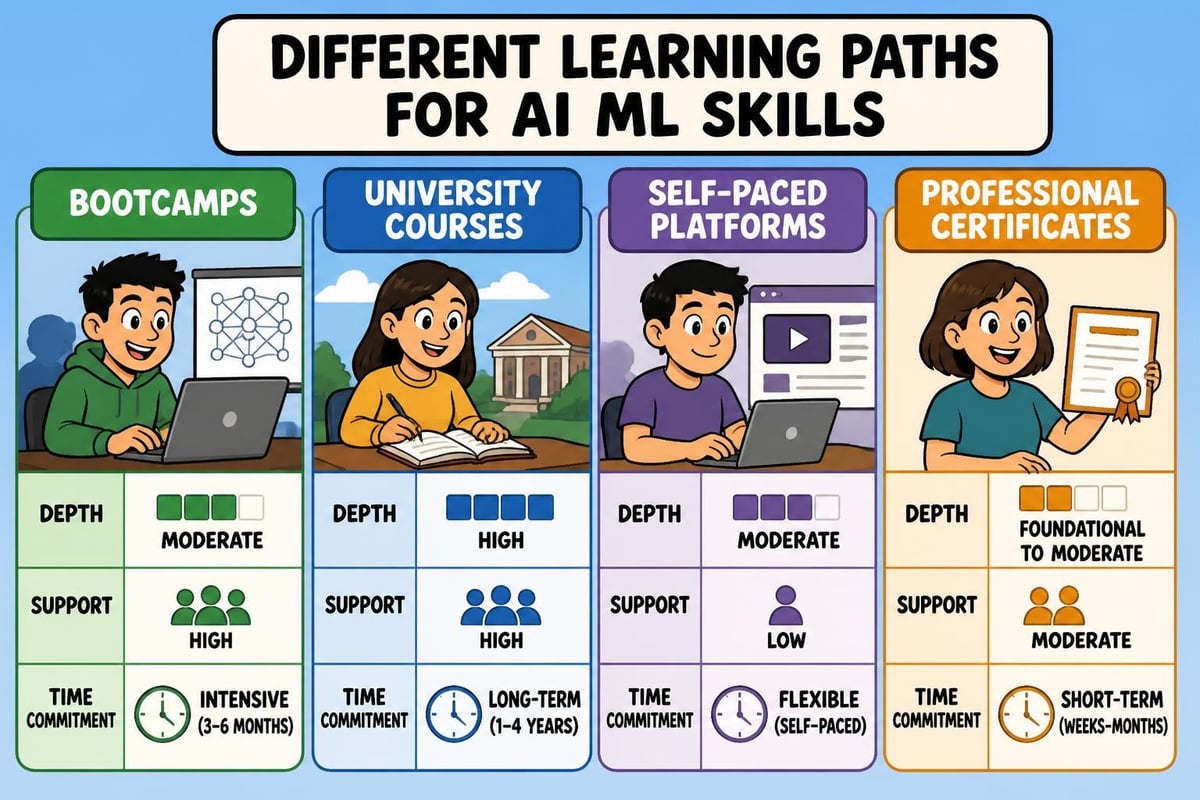
The fast.ai Practical Deep Learning course emphasizes rapid prototyping and getting models working quickly, then understanding theory retrospectively. This top-down approach suits developers who learn best through building rather than theory-first instruction.
Industry-Focused Alternatives Worth Considering
Microsoft Learn's Azure Machine Learning paths excel for professionals working in Azure environments or targeting cloud ML engineering roles. The integration with Azure services provides production deployment experience that abstract courses cannot match.
Platforms like MammothClub differentiate through AI-powered learning tools that adapt to individual progress and knowledge gaps. With over 3,000 courses spanning AI fundamentals through specialized applications, learners can create customized paths that address their specific career goals without rigid program structures.
For those interested in applied AI courses that emphasize business outcomes, exploring options beyond Great Learning reveals programs focused on specific industries like finance, healthcare, or manufacturing. Specialization early can accelerate career transitions for professionals with domain expertise.
Skills Assessment and Career Readiness
Completing the great learning ai ml course should result in demonstrable competencies that employers recognize. Effective programs measure progress through coding assessments, project evaluations, and peer reviews rather than multiple-choice quizzes alone.
Expected competencies upon completion:
- Data Preparation: Clean, transform, and engineer features from raw data sources
- Model Selection: Choose appropriate algorithms based on problem characteristics and data properties
- Training and Tuning: Implement cross-validation, hyperparameter optimization, and regularization techniques
- Evaluation: Apply appropriate metrics, understand bias-variance tradeoffs, and interpret model decisions
- Communication: Explain model results to non-technical stakeholders and document work clearly
- Ethics: Recognize fairness issues, privacy concerns, and responsible AI principles
These competencies align with what effective ML teaching strategies identify as critical learning outcomes. Programs that emphasize these skills through project-based assessment rather than memorization produce more job-ready graduates.
Bridging the Theory-Practice Gap
The gap between knowing algorithms and deploying models remains significant. The great learning ai ml course addresses this through modules on model serving, monitoring, and maintenance that many academic programs omit.
Understanding how to containerize models, create APIs, implement A/B testing frameworks, and monitor for data drift represents the difference between research knowledge and production skills. Programs incorporating MLOps and deployment pipelines prepare students for complete lifecycle responsibilities rather than just model development.
For professionals considering AI training online, prioritizing courses that include deployment and monitoring components ensures skills transfer directly to workplace challenges.
Cost-Benefit Analysis for Working Professionals
Investing several thousand dollars and hundreds of hours in the great learning ai ml course requires careful evaluation of expected returns. For professionals earning $70,000-90,000 annually in non-technical roles, successfully pivoting to ML engineering or data science roles averaging $110,000-140,000 offers clear financial justification.
Financial considerations include:
| Factor | Typical Range | Notes |
|---|---|---|
| Course Cost | $2,500-4,500 | Often includes career services |
| Time Investment | 300-500 hours | Spread over 6-12 months |
| Opportunity Cost | Variable | Evening/weekend study minimizes |
| Salary Increase | $20,000-50,000 | First role after transition |
| Long-term Premium | $30,000-70,000 | Mid-career AI/ML specialist |
Beyond direct compensation, ML skills provide optionality and career resilience as AI transforms more industries. The GPU requirements for AI training highlight how infrastructure knowledge complements algorithmic understanding for comprehensive competency.
Time-to-Value Considerations
Most graduates begin seeing career benefits 9-15 months after starting the great learning ai ml course, accounting for program completion and job search time. This timeline assumes consistent effort and active portfolio building throughout the program.
Accelerating outcomes requires supplementing coursework with personal projects, open-source contributions, or Kaggle competitions that demonstrate initiative and problem-solving beyond structured assignments. Employers value candidates who show curiosity and continuous learning rather than just credential collection.
Maximizing Learning Outcomes and Retention
Success in the great learning ai ml course correlates with study habits, practice consistency, and application of concepts to personal projects. Passive video watching without coding practice produces minimal retention or skill development.
Strategies that enhance learning effectiveness:
- Code every concept: Implement algorithms from scratch before using libraries
- Teach others: Explain concepts in study groups or blog posts to solidify understanding
- Build parallel projects: Apply techniques to personal datasets alongside coursework
- Read source code: Study scikit-learn and TensorFlow implementations to understand best practices
- Engage deeply: Ask questions in forums, challenge assumptions, and explore edge cases
The spacing effect suggests distributing study across time rather than cramming before deadlines. Consistent daily practice of 1-2 hours outperforms weekend marathon sessions for both retention and skill integration.
Complementary Resources and Learning Extensions
Supplementing the great learning ai ml course with external resources fills knowledge gaps and provides alternative explanations. Different instructors' perspectives on the same concept often clarify confusion that single-source learning creates.
Research papers, technical blogs, and conference talks expose learners to cutting-edge developments beyond course curricula that update annually at best. Following researchers on Twitter, subscribing to ArXiv alerts in relevant categories, and watching conference presentations maintains currency as the field evolves rapidly.
For specialized applications like AI robotics or AI trading, domain-specific courses complement general ML foundations with application context and industry-specific challenges.
Certification Value in the 2026 Job Market
The certification awarded upon completing the great learning ai ml course carries weight with employers familiar with the program's rigor. However, credentials alone do not guarantee interviews without supporting evidence of practical skills.
Employers evaluate candidates on:
- Portfolio projects: Depth of work, problem selection, and documentation quality
- GitHub activity: Code quality, collaboration, and contribution patterns
- Technical interviews: Coding ability, algorithm knowledge, and problem-solving approach
- Domain knowledge: Understanding of business context and ML application strategy
- Communication skills: Ability to explain technical concepts to varied audiences
Certifications signal commitment and baseline knowledge but cannot substitute for demonstrated capability. The most successful graduates combine credentials with portfolios showcasing 3-5 substantial projects across different ML domains.
Certification vs. Degree Considerations
For career changers without computer science degrees, professional certifications like those from Great Learning provide alternative pathways into ML roles. While top research positions still prefer advanced degrees, applied ML engineering and data science roles increasingly accept certification plus portfolio combinations.
The credential value varies by geography and company type. Startups and smaller companies often emphasize skills and projects over formal credentials, while large enterprises may require degrees for certain level bands regardless of demonstrated capability.
Integration with Organizational AI Initiatives
Companies investing in employee AI literacy increasingly sponsor enrollment in programs like the great learning ai ml course as part of strategic upskilling initiatives. This trend reflects recognition that AI capabilities require widespread ML understanding, not just specialist data science teams.
Organizations benefit when product managers, business analysts, and engineers understand ML capabilities and limitations. This shared knowledge improves cross-functional collaboration and helps teams identify appropriate AI applications rather than forcing ML solutions to unsuitable problems.
Corporate AI training programs often combine technical courses like Great Learning's with business-focused AI strategy and ethics modules. This comprehensive approach builds organizational AI maturity across technical implementation and strategic deployment dimensions.
Building Internal ML Capabilities
For companies developing internal ML capabilities, sending multiple employees through the great learning ai ml course creates shared vocabulary and collaborative potential. Teams that learn together can cross-reference knowledge and accelerate implementation when they return to applied work.
The investment in formal training accelerates capability development compared to purely self-directed learning, especially for organizations without existing ML expertise to mentor and guide employees. Structured curricula ensure comprehensive coverage rather than fragmented learning that leaves critical knowledge gaps.
Selecting the Right Program for Your Goals
Choosing between the great learning ai ml course and alternatives requires clarity on career objectives, learning preferences, and practical constraints. No single program optimally serves all learners.
Decision framework questions:
- Do you prefer structured schedules or flexible self-pacing?
- How important is instructor access and peer interaction?
- Are you targeting general ML competency or specific domains like NLP or computer vision?
- Does your employer support professional development financially or with time?
- Do you learn better through theory-first or application-first approaches?
For professionals seeking comprehensive foundations with career support, structured programs like Great Learning provide accountability and guidance. Self-motivated learners comfortable with ambiguity may prefer assembling custom curricula from free resources like those from deeplearning.ai or OpenAI courses.
The optimal choice aligns program structure with personal learning style while delivering skills that match career goals. Testing commitment through free introductory courses before investing in comprehensive programs reduces risk of expensive false starts.
Mastering AI and machine learning in 2026 requires combining theoretical understanding with practical implementation skills across the full model lifecycle. Whether you choose the great learning ai ml course or alternative paths, success depends on consistent practice, project-based learning, and continuous engagement with the evolving field. MammothClub accelerates your AI journey with 3,000+ courses, interactive bootcamps, and AI-powered learning tools that adapt to your progress. Our corporate certification programs and measurable dashboards help professionals and teams build career-ready AI skills efficiently while staying competitive in today's rapidly evolving technology landscape.