Artificial intelligence is revolutionizing the field of computer science, reshaping everything from software development to data analysis. As organizations in every industry race to adopt cutting-edge technology, mastering a computer science ai course is quickly becoming essential for anyone seeking a future-ready career.
In this article, discover the top 7 essential courses designed to equip you with in-demand AI skills for 2026. From deep learning and NLP to ethical AI and reinforcement learning, we break down each option’s features, benefits, and ideal audience.
Ready to upskill and stay ahead? Explore your best course picks and take the next step toward AI expertise.
The Growing Demand for AI Expertise in Computer Science
The landscape of technology is rapidly evolving, and the need for a strong computer science ai course has never been more urgent. As artificial intelligence becomes embedded in every aspect of computing, professionals and students alike must adapt to stay relevant in this dynamic field.
AI’s Expanding Role in Tech Careers
Artificial intelligence is now a core pillar across industries, shaping the future of work. According to recent AI investment statistics 2024, 97% of companies are planning to increase their investment in AI technologies. This surge is transforming job requirements, making AI literacy a fundamental expectation for anyone considering a computer science ai course.
Job postings for AI-related roles have soared on platforms like LinkedIn and Indeed. Employers are seeking candidates who can contribute to automation, data analysis, and intelligent software development. Both tech giants and agile startups are competing for AI-savvy talent, driving up demand for specialized skills in machine learning and beyond.
As organizations automate processes and harness big data, professionals equipped with AI expertise are becoming indispensable. Choosing the right computer science ai course can open doors to these emerging opportunities.
Key Skills Taught in Modern AI Courses
A well-designed computer science ai course delivers more than just theory. Today’s top programs teach essential skills such as machine learning, deep learning, natural language processing, and computer vision. These competencies are the backbone of modern AI applications, from speech recognition to automated decision-making.
Hands-on, project-based learning is a central feature. Students work on real-world problems, building models and deploying AI solutions that mirror industry needs. Collaboration and ethical decision-making are emphasized, reflecting the complex environments graduates will enter.
A recent Coursera Industry Report found that 85% of employers value project-based AI learning. By mastering these skills, learners position themselves to build innovative solutions and drive progress in the AI sector. The right computer science ai course ensures both practical expertise and a strong ethical foundation.
How to Evaluate a Great AI Course
Selecting a top-tier computer science ai course requires careful evaluation. Accreditation and industry recognition are crucial indicators of quality. Look for programs with up-to-date curriculums, reflecting the latest AI trends and tools.
Instructor expertise and industry connections can enhance your learning experience. Interactive elements, such as labs, capstone projects, and peer reviews, provide opportunities for applied learning. Flexibility is another key factor, whether you prefer self-paced or cohort-based formats, online or hybrid delivery.
Alumni outcomes and access to career support services can signal a program’s effectiveness. For example, Stanford’s AI program boasts a 90% placement rate in tech roles. By considering these criteria, you can choose a computer science ai course that aligns with your career goals and maximizes your success.
7 Essential Computer Science AI Course Picks for 2026
Choosing the right computer science ai course can define your path in this fast-moving field. Whether you want to specialize in deep learning, ethical AI, NLP, or reinforcement learning, these seven standout courses offer the skills and credentials to make you future-ready.
1. Deep Learning Specialization by DeepLearning.AI (Coursera)
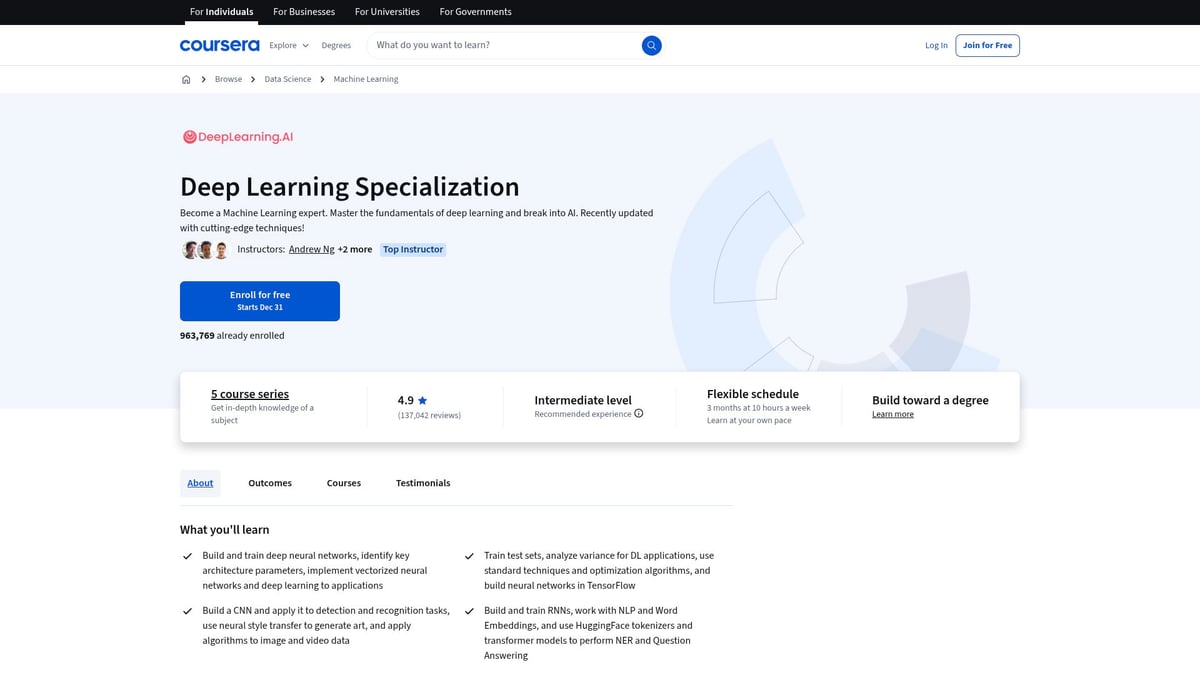
The Deep Learning Specialization is a leading computer science ai course for professionals wanting to master neural networks and deep learning fundamentals. Priced at $49 per month, this five-course sequence covers everything from basic neural networks to convolutional and sequence models.
Core Features:
- Five comprehensive modules.
- Real-world case studies and industry applications.
- Assignments using Python and TensorFlow.
Benefits:
- Taught by Andrew Ng, a global AI authority.
- Hands-on projects build practical expertise.
- Active community for peer learning.
Unique Selling Points:
- Recognized by tech employers worldwide.
- Includes guidance on structuring AI projects.
- Access to a vast alumni network.
Target Audience: Intermediate learners, aspiring AI engineers, and developers with some machine learning background.
Use Cases: Image classification, speech recognition, and building scalable AI models.
Pros:
- Flexible schedule allows learning at your own pace.
- Strong industry reputation.
- Respected certificate upon completion.
Cons:
- Requires prior Python and machine learning knowledge.
- Can be challenging for true beginners.
For a deeper look at how this course and similar options perform, see this Coursera artificial intelligence course review.
2. CS50’s Introduction to Artificial Intelligence with Python (edX)
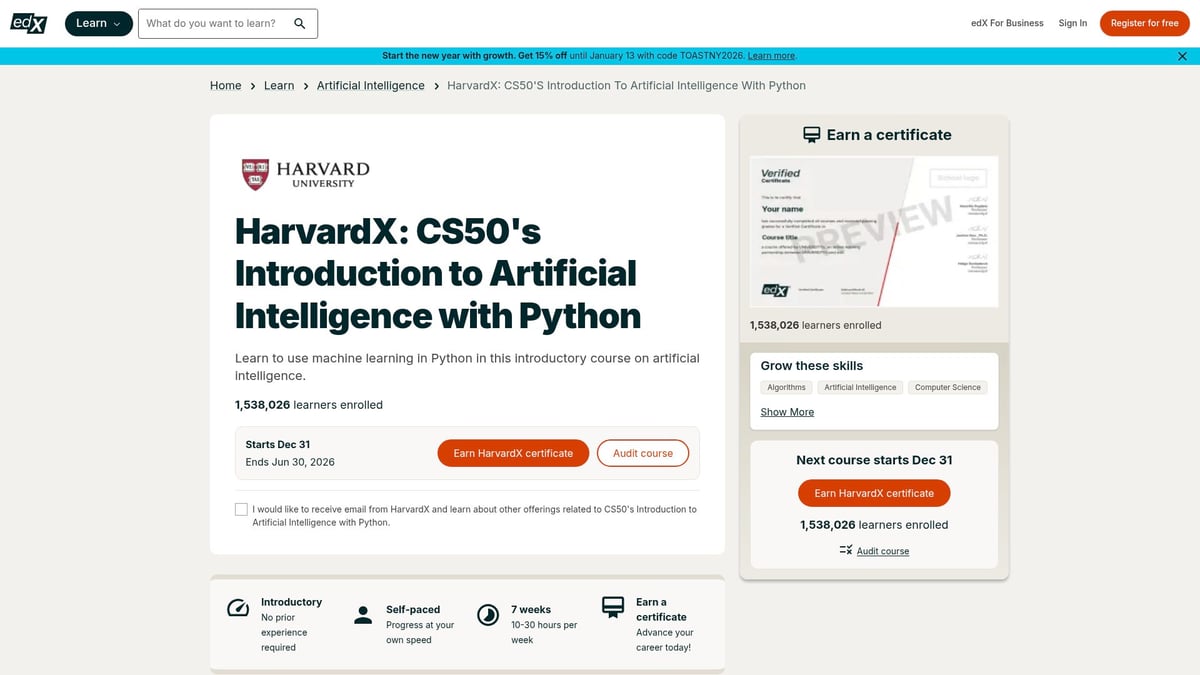
CS50’s Introduction to Artificial Intelligence with Python is a versatile computer science ai course from Harvard, accessible for free or $199 for a certificate. This course offers a foundational dive into AI, focusing on core concepts and practical, project-based learning.
Core Features:
- Covers search algorithms, knowledge representation, neural networks, NLP, and reinforcement learning.
- Python-centric curriculum.
- Project-driven structure.
Benefits:
- Harvard-backed credibility.
- Beginner-friendly, yet thorough.
- Supportive online community.
Unique Selling Points:
- No-cost option for auditing.
- Emphasis on hands-on coding assignments.
- Accessible to those with basic programming experience.
Target Audience: Students and professionals new to AI wanting a robust computer science ai course.
Use Cases: Building AI-powered games, chatbots, and intelligent agents.
Pros:
- Practical projects reinforce concepts.
- Flexible pace.
- Encourages experimentation.
Cons:
- Less depth on advanced AI topics.
- Requires consistent time investment.
This course is ideal if you want a strong AI foundation before progressing to more advanced studies.
3. AI for Everyone by DeepLearning.AI (Coursera)
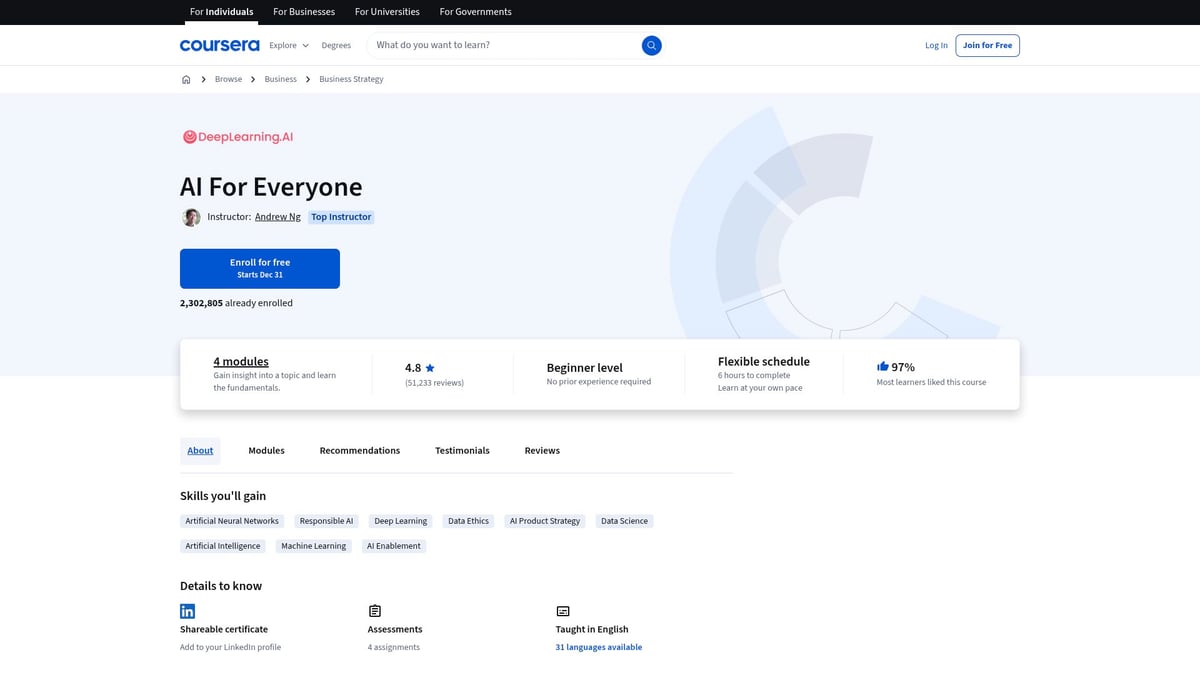
AI for Everyone is a unique computer science ai course designed for non-technical professionals and business leaders. Free to audit, or $49 for a certificate, it offers a broad overview of AI concepts, business applications, and ethical considerations.
Core Features:
- Four concise modules.
- No coding experience required.
- Focus on strategic AI thinking.
Benefits:
- Boosts AI literacy for all backgrounds.
- Clear frameworks for business adoption.
- Emphasizes ethical and societal impacts.
Unique Selling Points:
- Business-centric, rather than technical.
- Ideal for managers, executives, or anyone leading AI initiatives.
- Short, digestible lessons.
Target Audience: Non-technical professionals, leaders, or anyone seeking an introduction to AI’s impact.
Use Cases: Leading AI transformation, understanding responsible AI, and bridging tech-business gaps.
Pros:
- Highly accessible.
- Quick to complete.
- Immediately applicable in business contexts.
Cons:
- Lacks technical depth and coding practice.
- Not suitable if you seek hands-on AI development.
This computer science ai course is a top pick for those guiding AI strategy rather than building AI systems.
4. Natural Language Processing Specialization (Coursera)
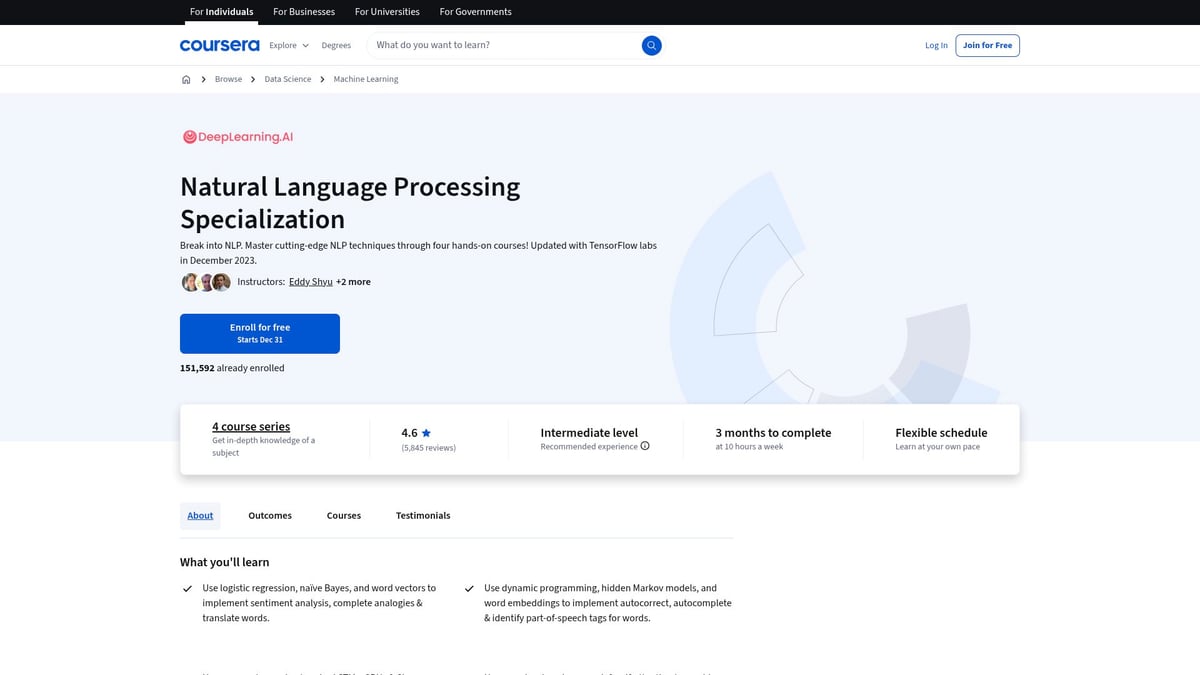
The Natural Language Processing Specialization stands out among computer science ai course options for those focused on language technologies. For $49 per month, it offers a four-course sequence on NLP fundamentals, sentiment analysis, translation, and conversational AI.
Core Features:
- Hands-on projects using TensorFlow.
- Focus on practical NLP applications.
- Taught by leading researchers.
Benefits:
- Industry-relevant skills in high demand.
- Builds a strong portfolio with real-world projects.
Unique Selling Points:
- Direct application to text analysis, language modeling, and chatbots.
- Regularly updated content.
Target Audience: Developers, data scientists, and engineers wanting to specialize in language AI.
Use Cases: Building chatbots, language models, and automated text analysis tools.
Pros:
- Project-driven learning.
- Up-to-date curriculum.
- Strong portfolio value.
Cons:
- Requires Python and machine learning experience.
- Time-intensive for those balancing work and study.
This computer science ai course is ideal for those who want to build expertise in NLP and conversational AI.
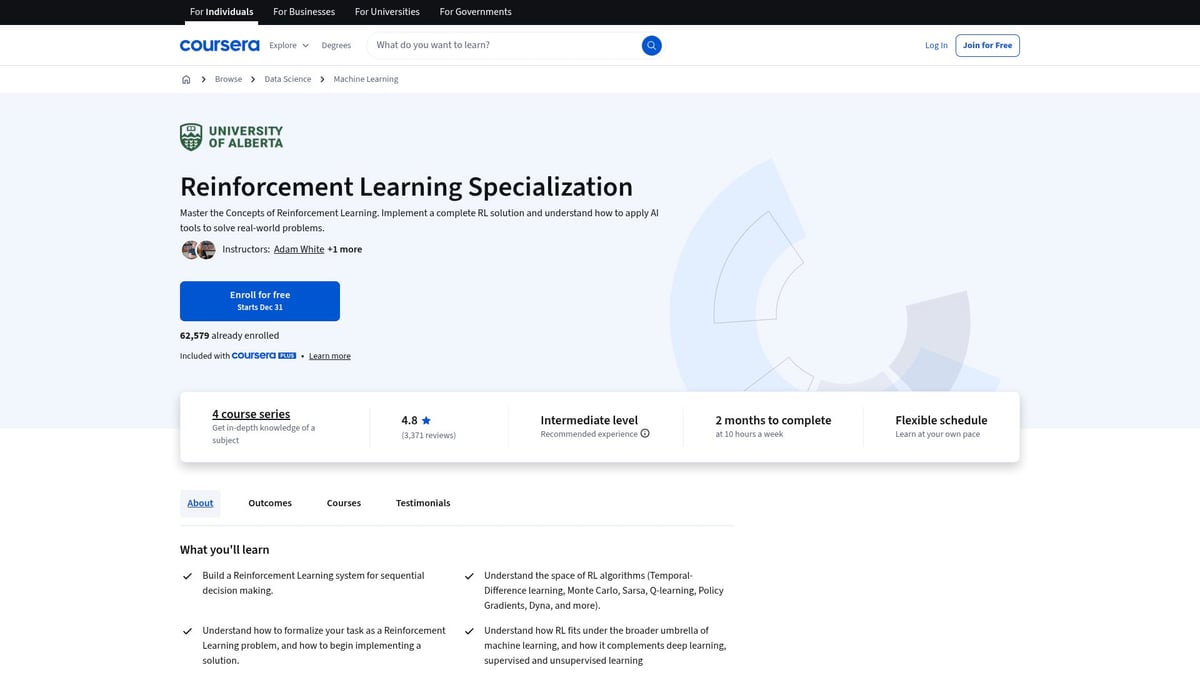
5. Reinforcement Learning Specialization (Coursera)
For learners seeking advanced skills, the Reinforcement Learning Specialization is a targeted computer science ai course. Priced at $49 per month, it covers foundational RL principles, deep reinforcement learning, and practical implementation.
Core Features:
- Developed by University of Alberta experts.
- Theoretical and hands-on coding assignments.
- Real-world RL applications in robotics and game AI.
Benefits:
- Depth in both theory and practice.
- Excellent instructor support.
- Strong academic reputation.
Unique Selling Points:
- Focus on practical RL systems.
- Exposure to decision-making frameworks.
Target Audience: Advanced learners, AI researchers, and game developers.
Use Cases: Robotics, game AI, and autonomous agents.
Pros:
- Comprehensive RL coverage.
- Insightful, structured learning path.
Cons:
- Challenging for beginners.
- Requires solid math and programming foundation.
This computer science ai course equips you to tackle some of the most complex problems in AI.
6. Responsible AI: Building Fair, Safe and Transparent Systems (edX)
Responsible AI: Building Fair, Safe and Transparent Systems is a timely computer science ai course focusing on ethics, fairness, and accountability. Free to audit or $249 for a certificate, it addresses the growing need for responsible AI development.
Core Features:
- Explores ethical AI, bias mitigation, and transparency.
- Case studies from Microsoft experts.
- Regulatory compliance best practices.
Benefits:
- Essential for anyone designing or managing AI systems.
- Practical frameworks for real-world application.
Unique Selling Points:
- Societal impact focus.
- Policy and governance orientation.
Target Audience: AI practitioners, policymakers, and tech leaders looking for a computer science ai course with an ethical lens.
Use Cases: Designing fair AI, compliance with AI regulations, and leading ethical AI initiatives.
Pros:
- Timely, relevant content.
- Industry case studies.
Cons:
- Limited coding practice.
- More policy-focused than technical.
This course is vital for those shaping the future of responsible AI in organizations.
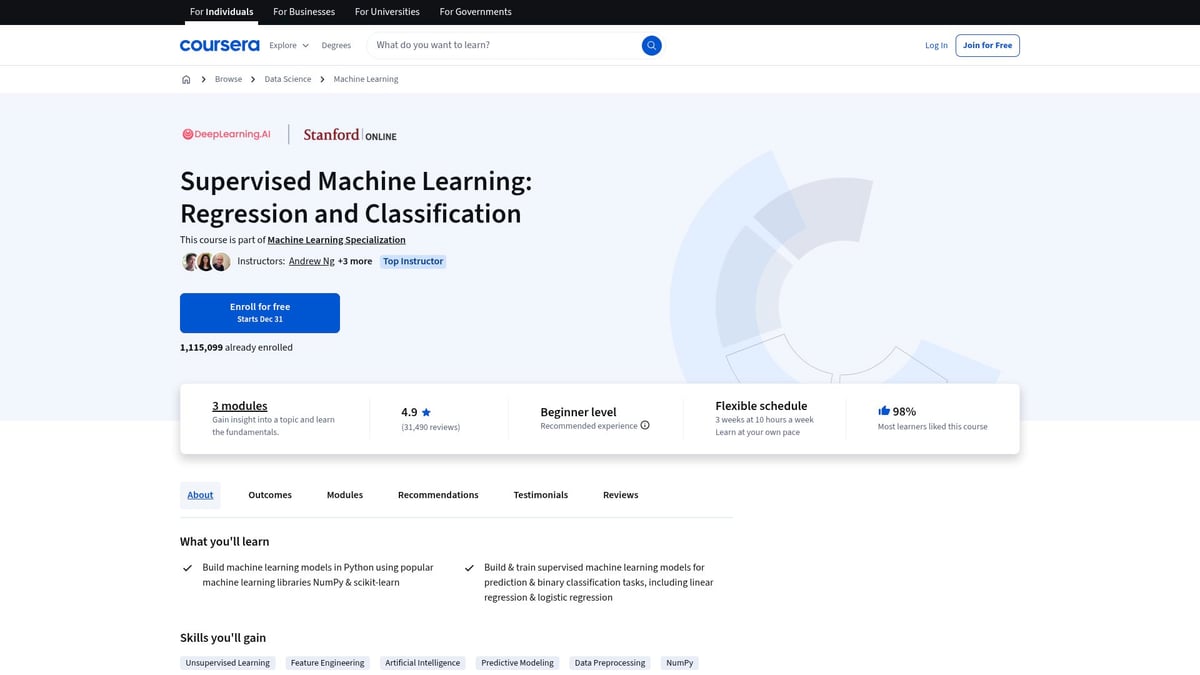
7. Machine Learning by Stanford University (Coursera)
Stanford’s Machine Learning is the quintessential computer science ai course, perfect for beginners and those looking to solidify their AI foundation. Free to audit or $79 for a certificate, it covers supervised and unsupervised learning, best practices, and real-world AI applications.
Core Features:
- Taught by Andrew Ng, a pioneer in AI education.
- Clear explanations of algorithms and concepts.
- Practical assignments and quizzes.
Benefits:
- Globally recognized certificate.
- Builds a strong base for advanced AI topics.
Unique Selling Points:
- Most popular ML course worldwide.
- Extensive alumni network.
Target Audience: Beginners to intermediate learners, aspiring data scientists, and professionals switching to AI.
Use Cases: Predictive analytics, recommendation systems, and clustering.
Pros:
- Step-by-step instruction.
- Practical, hands-on projects.
Cons:
- Some content may be dated in tool coverage.
- Basic programming required.
This computer science ai course remains a trusted choice for launching an AI-focused career.
How to Choose the Right AI Course for Your Career Goals
Choosing the right computer science ai course can be pivotal for your professional journey. With so many options, it’s important to align your choice with your background, ambitions, and learning preferences.
Self-Assessment: Skills, Interests, and Career Path
Begin by evaluating your current abilities and long-term aspirations. Are you new to programming, or do you already have experience in Python and machine learning? Understanding your starting point helps narrow down the most suitable computer science ai course for you.
Think about your desired specialization. Do you see yourself as a data scientist, an AI product manager, or perhaps an AI ethicist? Each path may require a different focus, whether technical depth or a broader understanding of AI’s societal impact.
If you’re deciding between AI and data science, resources like the AI and data science course comparison can clarify the distinctions and help you select the right fit.
Comparing Course Formats and Learning Experiences
Next, consider which learning experience matches your schedule and preferences. Some computer science ai course options are self-paced, letting you learn at your own speed, while others follow a cohort-based format with set deadlines and peer interaction.
Live mentorship, peer collaboration, and access to vibrant communities can enhance your learning. Cohort-based models often lead to higher completion rates and deeper engagement. According to Class Central, 72% of learners complete courses in a cohort setting.
If you’re just beginning, exploring the Best AI courses for beginners might help you find supportive environments with structured guidance.
Evaluating Certification Value and Industry Recognition
Certification can play a crucial role in advancing your career. A recognized certificate from a top computer science ai course can strengthen your resume and improve your chances during job applications or promotions.
Employers often value certificates from well-known platforms and universities. For instance, recruiters may prefer Stanford or Harvard-backed credentials when filling AI roles. When comparing programs, look at the reputation of the issuing institution and the recognition it holds in the industry.
For those weighing AI versus data science credentials, the AI and data science course comparison provides valuable insights into industry preferences.
Budget, Flexibility, and Support Services
Finally, align your choice with your financial situation and time commitments. Many computer science ai course options offer both free and paid tracks, with financial aid or scholarships available for eligible learners.
Flexible scheduling is vital for working professionals, so look for courses with asynchronous content or modular structures. Also, consider the additional support you may need, such as access to alumni networks, career services, or job placement assistance.
By thoughtfully weighing these factors, you’ll be better positioned to choose a computer science ai course that matches your goals and sets you up for long-term success.
Future Trends in Computer Science AI Education
The landscape of computer science ai course offerings is rapidly evolving, keeping pace with the demands of tomorrow's workforce. As we look ahead, several key trends are shaping how learners acquire AI expertise and build future-proof careers.
Personalized and Adaptive AI Learning
Modern computer science ai course platforms are harnessing artificial intelligence to personalize learning experiences. Adaptive systems analyze student progress and tailor content, ensuring each learner advances at the optimal pace. Features like real-time feedback, personalized quizzes, and dynamic learning paths are now commonplace.
According to the Coursera Industry Report 2025, adaptive learning increases course completion rates by 30 percent, reflecting the tangible benefits of this approach. Students receive targeted support, which boosts engagement and understanding. As these technologies mature, expect even greater customization in computer science ai course modules.
Integration of Real-World Projects and Industry Partnerships
Another defining trend in computer science ai course design is the integration of real-world projects and collaborations with industry leaders. Capstone projects, virtual hackathons, and internships are increasingly embedded within curricula.
Major tech companies like Google and IBM are partnering with educational platforms to bring hands-on, industry-relevant experiences directly to learners. The Stanford AI Index Report 2025 highlights this shift, noting that practical exposure is vital for building job-ready AI skills. Learners not only gain technical proficiency but also develop teamwork and communication abilities valued in the workplace.
Emphasis on Ethics, Fairness, and Societal Impact
With the widespread adoption of AI, there is a growing emphasis on responsible development within every computer science ai course. Ethical considerations, bias mitigation, and regulatory compliance are now standard topics in AI curricula.
Universities and online platforms are updating content to include frameworks for fairness and transparency, reflecting new regulations and societal expectations. The adoption of responsible AI practices ensures that graduates are equipped to create trustworthy and inclusive AI systems. This focus prepares students to navigate the complex ethical landscape of modern technology.
Lifelong Learning and Continuous Upskilling
AI is an ever-evolving field, making lifelong learning a necessity for professionals at all stages. Micro-credentials, stackable certificates, and modular courses allow learners to continually update their skills.
A recent study found that 65 percent of AI professionals enroll in a new computer science ai course every two years, ensuring they remain competitive in the job market. Embracing continuous upskilling is key to long-term success in AI careers.
As you’ve seen, building future-ready AI skills starts with choosing the right course—whether you’re aiming for hands-on projects, industry-recognized certificates, or foundational knowledge that stands out to employers. If you’re eager to turn insights from these top picks into real career growth, why not take the next step and solidify your expertise with a globally respected certification You can Become a certified AI Foundation Specilaist. Start for free and start building your AI journey today. It’s a smart way to gain practical, measurable skills and set yourself apart in the evolving world of computer science.