The artificial intelligence skills gap continues to widen in 2026, creating urgent demand for verified AI expertise. Organizations worldwide are prioritizing candidates with formal credentials that demonstrate practical AI capabilities. A google artificial intelligence certification validates your knowledge through structured learning paths, hands-on projects, and recognized assessments that employers trust. Whether you're entering the AI field or advancing your technical career, understanding which Google certification aligns with your goals determines your success trajectory.
Understanding Google's AI Certification Landscape
Google offers two distinct certification tracks for AI professionals, each serving different audiences and career stages. The confusion between these programs often leads learners to choose the wrong path for their objectives.
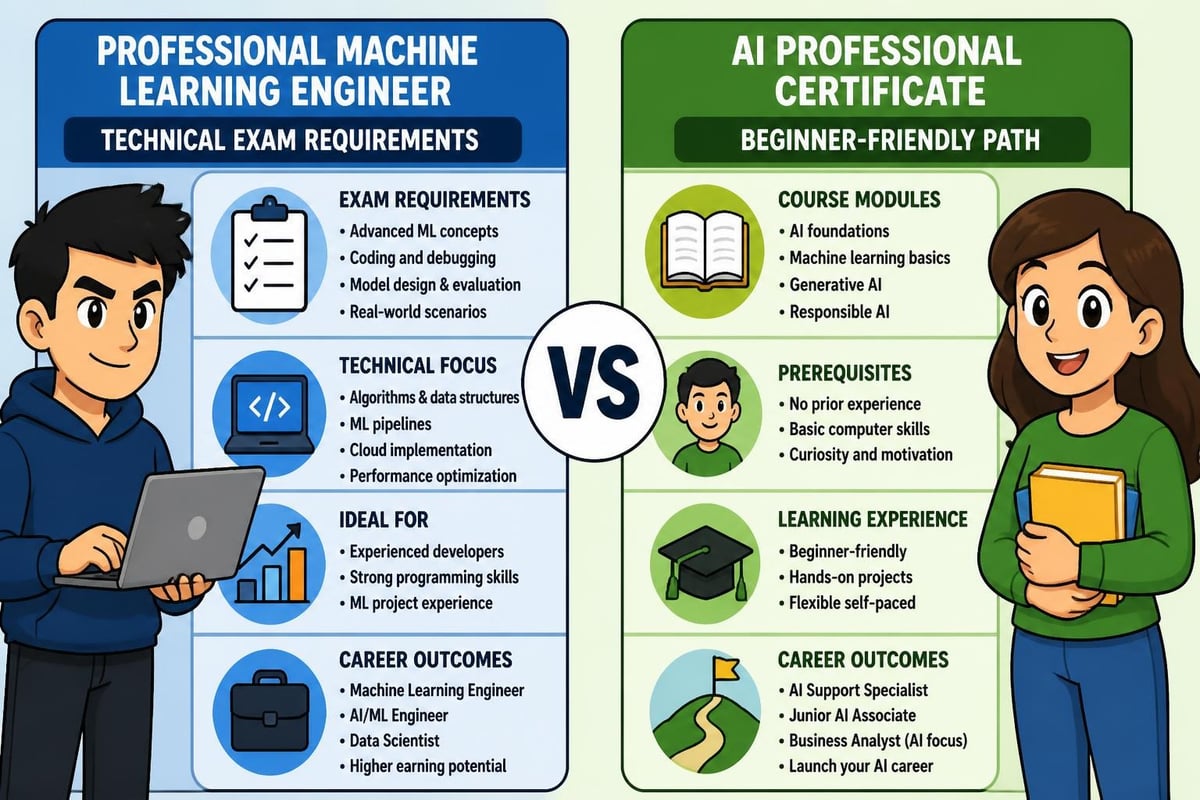
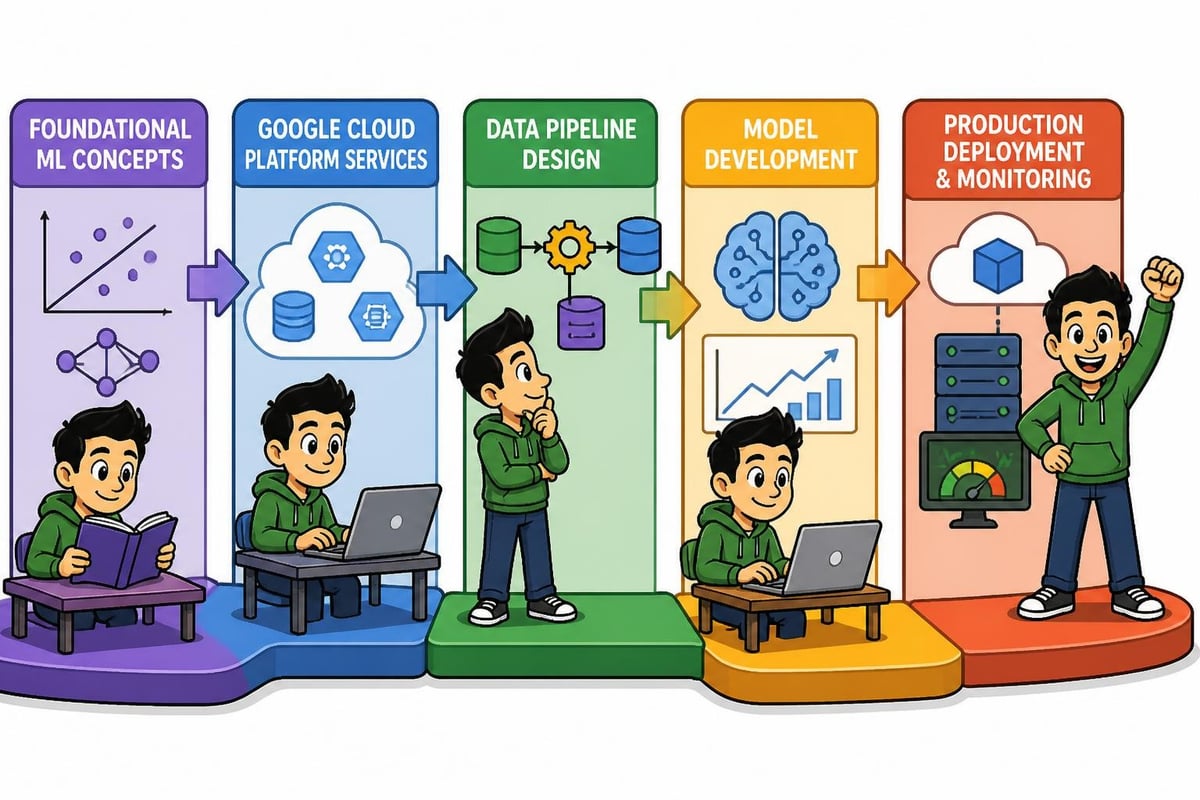
The Google Cloud Professional Machine Learning Engineer certification targets experienced practitioners who design, build, and productionize ML models using Google Cloud Platform. This technical certification requires deep knowledge of TensorFlow, Vertex AI, data engineering pipelines, and MLOps practices. Candidates typically possess 3+ years of industry experience and understand distributed computing, model optimization, and production deployment.
Conversely, the Google AI Professional Certificate introduced through the Grow with Google initiative serves beginners and mid-level professionals seeking foundational AI literacy. This program teaches AI concepts, prompt engineering, responsible AI practices, and practical applications without requiring coding expertise or cloud infrastructure knowledge.
Key Differences Between Certification Paths
| Feature | Professional ML Engineer | AI Professional Certificate |
|---|---|---|
| Target Audience | Experienced ML practitioners | Beginners to intermediate professionals |
| Prerequisites | 3+ years ML/data experience | None required |
| Technical Depth | Advanced (model architecture, deployment) | Foundational (concepts, applications) |
| Platform | Google Cloud exam centers | Coursera online learning |
| Duration | 100-200 hours prep | 20-30 hours total |
| Cost | $200 exam fee | ~$49/month Coursera subscription |
| Validity | 2 years (recertification required) | Permanent certificate |
The official Google Cloud certification overview outlines all available certifications, helping you map your current skills to the appropriate credential. Understanding these distinctions prevents wasted time and ensures your certification investment matches your career objectives.
Google AI Professional Certificate: Comprehensive Breakdown
The Google AI Professional Certificate launched in 2026 as part of Google's workforce development strategy to democratize AI knowledge. Available exclusively through Coursera's professional certificate program, this credential emphasizes practical AI applications over theoretical mathematics.
The program comprises five courses delivered sequentially over approximately six weeks at 5 hours per week. Each module builds progressively:
- Introduction to Artificial Intelligence – Core concepts, AI history, machine learning basics, and ethical considerations
- Applied AI Fundamentals – Practical use cases across industries, AI tool evaluation, and implementation planning
- Prompt Engineering Essentials – Crafting effective prompts for large language models, optimization techniques, and iterative refinement
- Responsible AI Practices – Bias detection, fairness frameworks, transparency requirements, and governance protocols
- AI Career Strategies – Portfolio development, job search tactics, and communicating AI value to stakeholders
Hands-On Projects and Assessments
Each course includes graded assignments where you apply concepts to realistic scenarios. Projects range from designing AI adoption strategies for fictional companies to conducting bias audits on language model outputs. The final capstone requires developing a comprehensive AI implementation proposal addressing business objectives, technical requirements, risk mitigation, and success metrics.
Unlike traditional certifications with proctored exams, this google artificial intelligence certification uses continuous assessment through quizzes, peer-reviewed projects, and practical exercises. You must achieve 80% or higher on all assessments to earn your certificate.
According to the Coursera blog announcement, Google partnered with small businesses to provide initial free access, recognizing that AI literacy drives competitive advantage across all organization sizes. This accessibility focus distinguishes it from premium technical certifications requiring significant financial investment.
The completed credential appears on Credly's digital badge platform, enabling easy sharing on LinkedIn profiles, resumes, and professional portfolios. Employers can verify authenticity through the unique badge ID, reducing credential fraud concerns.
Professional Machine Learning Engineer Certification Deep Dive
For technical practitioners, the google artificial intelligence certification through Google Cloud Professional Machine Learning Engineer represents the gold standard in ML expertise validation. This advanced credential assesses your ability to design ML solutions, prepare data pipelines, develop models, automate ML workflows, and monitor production systems.
Exam Structure and Topics
The 120-minute exam contains 50-60 multiple-choice and multiple-select questions covering six domains:
- Framing ML Problems (15%) – Translating business requirements into ML objectives, determining appropriate ML approaches
- Architecting ML Solutions (21%) – Designing data processing systems, selecting Google Cloud ML services
- Data Preparation and Processing (15%) – Feature engineering, data validation, handling imbalanced datasets
- ML Model Development (18%) – Choosing algorithms, hyperparameter tuning, model training optimization
- ML Pipeline Automation (19%) – Implementing CI/CD for ML, orchestrating workflows with Vertex AI Pipelines
- Monitoring and Optimization (12%) – Performance monitoring, model retraining strategies, troubleshooting production issues
Questions present realistic scenarios requiring you to select optimal solutions considering cost, scalability, latency, and accuracy trade-offs. You might analyze a case study about fraud detection and determine the best sampling strategy for imbalanced transaction data, or design a feature store architecture for a recommendation system serving millions of users.
Preparation Resources and Strategy
Google Cloud recommends 200+ hours of hands-on experience with their ML products before attempting the exam. Effective preparation combines:
Official Documentation Study – Deep familiarity with Vertex AI, BigQuery ML, TensorFlow Enterprise, AutoML, and AI Platform services through Google's technical documentation.
Practice Labs – Building end-to-end ML pipelines in Google Cloud Console, implementing batch and real-time prediction systems, and deploying models with monitoring.
Sample Questions – Working through official practice exams to understand question formats and difficulty levels.
For professionals seeking comprehensive exam preparation beyond Google's materials, platforms like MammothClub offer structured courses combining video instruction, hands-on labs, and practice exams. The Microsoft Azure AI certification course demonstrates similar certification preparation approaches applicable to Google Cloud credentials.
Career Impact and ROI Analysis
Earning a google artificial intelligence certification delivers measurable career benefits when aligned with your professional goals. The value proposition differs significantly between entry-level and advanced credentials.
Salary Expectations and Advancement
According to IT Pro's analysis of AI certifications, professionals holding Google Cloud ML certifications command 15-25% salary premiums over non-certified peers in similar roles. Machine Learning Engineers with the Professional certification report average salaries between $135,000-$180,000 in major tech markets during 2026.
The AI Professional Certificate impacts career trajectories differently. While it doesn't command immediate salary increases for experienced professionals, it accelerates career transitions for individuals moving into AI-adjacent roles. Marketing managers, product owners, and business analysts leveraging this credential report 30-40% faster progression into AI product management and strategy positions.
Employer Recognition and Demand
Organizations increasingly require formal AI credentials in job postings. Analysis of 2026 LinkedIn job data shows 43% of ML Engineer positions explicitly requesting Google Cloud certifications, while 67% of AI Product Manager roles prefer candidates with demonstrated AI literacy through credentials like the Google AI Professional Certificate.
For companies investing in team upskilling, the cost-benefit calculation favors structured certification programs over ad-hoc training. The AI Professional Certificate costs approximately $294 total (6 months at $49/month), compared to $2,000-5,000 per employee for equivalent corporate training workshops. This efficiency explains why organizations send teams through Coursera artificial intelligence courses as part of systematic capability building.
Building Complementary Skills
A single certification rarely provides complete job readiness. Successful professionals stack credentials strategically:
For ML Engineering Roles – Combine the Google ML certification with AWS Machine Learning Specialty to demonstrate multi-cloud expertise, plus programming foundations through Python fundamentals courses.
For AI Product Management – Pair the AI Professional Certificate with an AI Product Manager specialization and prompt engineering training to balance technical understanding with business strategy.
For Data Science Transition – Start with the AI Professional Certificate, then progress to machine learning foundations before attempting technical certifications.
This stacking approach creates comprehensive skill profiles that differentiate candidates in competitive hiring processes.
Choosing Your Certification Path: Decision Framework
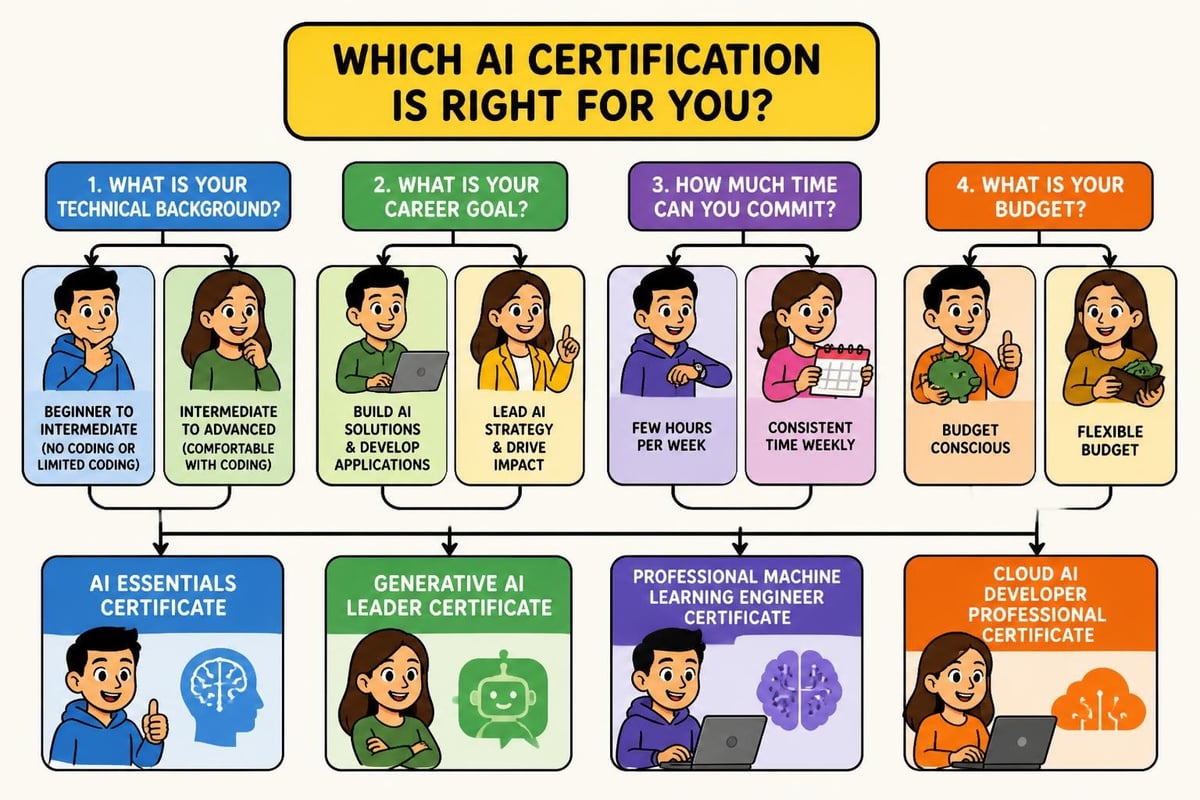
Selecting the right google artificial intelligence certification requires honest assessment of your current capabilities, career objectives, and available time. Misalignment leads to frustration, wasted resources, and incomplete credentials.
Assessment Questions for Path Selection
Answer these questions to identify your optimal certification:
Current Technical Level
- Can you write Python code to implement machine learning algorithms?
- Do you understand concepts like cross-validation, regularization, and feature engineering?
- Have you deployed production ML systems or only experimented with tutorials?
Career Direction
- Are you pursuing hands-on ML engineering roles or strategic AI leadership positions?
- Does your target job require coding skills or emphasizes AI strategy and governance?
- Will you implement technical solutions or guide teams building AI products?
Available Resources
- Can you dedicate 15-20 hours weekly for 2-3 months to intensive study?
- Do you have access to Google Cloud credits for hands-on practice ($300-500 recommended)?
- Does your employer support certification costs or require self-funding?
Learning Preferences
- Do you learn better through structured courses or self-directed exploration?
- Do hands-on labs motivate you more than video lectures and readings?
- Can you maintain momentum through self-paced study or need deadline accountability?
Path Recommendations by Profile
| Professional Profile | Recommended Certification | Timeline | Investment |
|---|---|---|---|
| Software developer entering ML | Professional ML Engineer | 3-4 months | $200 exam + $400 practice credits |
| Business analyst adding AI skills | AI Professional Certificate | 6-8 weeks | $294 Coursera subscription |
| Product manager in AI company | AI Professional Certificate → advanced PM training | 2-3 months | $600 total |
| Data scientist seeking cloud skills | Professional ML Engineer | 2-3 months | $200 exam + existing experience |
| Career switcher to AI field | AI Professional Certificate → ML foundations → certification | 6-12 months | $1,500-2,000 |
For organizations planning team certifications, platforms like MammothClub provide corporate pricing for bulk enrollment, learning analytics dashboards, and customized learning paths that combine multiple certification programs with proprietary content.
Preparation Strategies That Actually Work
Generic study advice fails for AI certifications because these credentials test applied problem-solving, not memorized facts. Effective preparation requires deliberate practice with realistic scenarios.
For AI Professional Certificate Success
Week 1-2: Foundation Building Complete the first two courses without rushing. Take detailed notes on AI terminology, applications, and limitations. Create a personal knowledge base documenting how AI concepts apply to your industry.
Week 3-4: Application Practice As you progress through prompt engineering and responsible AI modules, practice daily with free tools like ChatGPT, Claude, or Gemini. Document what prompts produce desired outputs and analyze failures. Build a portfolio of 10-15 prompt examples demonstrating different techniques.
Week 5-6: Capstone Preparation Draft your capstone project proposal early. Select a realistic business problem from your workplace or industry. Research existing AI solutions addressing similar challenges. Design your implementation proposal using frameworks taught throughout the program, emphasizing responsible AI considerations.
Peer Learning Join study groups through Coursera's discussion forums or LinkedIn communities. Teaching concepts to others solidifies your understanding and reveals knowledge gaps.
For Professional ML Engineer Mastery
Months 1-2: Hands-On Product Expertise Build 3-5 complete ML projects using Google Cloud services:
- Image classification with Vertex AI AutoML
- Custom model training with TensorFlow on Vertex AI Training
- Real-time prediction API with Cloud Functions
- Batch prediction pipeline with BigQuery ML
- Model monitoring dashboard with Cloud Logging and Monitoring
Document each project's architecture decisions, challenges encountered, and trade-off analyses. These experiences translate directly to exam scenarios.
Month 3: Weak Area Focus Review practice exam results to identify knowledge gaps. If data preprocessing questions cause difficulty, build additional data pipeline projects. If model optimization confuses you, implement hyperparameter tuning experiments comparing grid search, random search, and Bayesian optimization.
Study Google's technical documentation like API references and best practice guides rather than third-party summaries. Exam questions often reference specific service features and configuration options found only in official docs.
Month 4: Exam Simulation Take full-length practice exams under timed conditions. Analyze incorrect answers to understand not just the right answer but why other options were wrong. Many questions test your ability to eliminate suboptimal solutions rather than identify perfect answers.
For professionals needing structured exam preparation beyond self-study, specialized courses offering practice exams and detailed explanations significantly improve pass rates by familiarizing candidates with question formats and time management strategies.
Maintaining and Expanding Your Credential
Earning your google artificial intelligence certification represents the beginning of continuous learning, not the endpoint. The AI field evolves rapidly, making credential maintenance and skill expansion essential for sustained career value.
Recertification Requirements
The Google Cloud Professional Machine Learning Engineer certification expires after two years. Recertification requires either:
- Passing the current exam version – Demonstrating continued competency as Google updates the exam to reflect new services and best practices
- Earning qualifying continuing education credits – Completing approved training courses, contributing to open-source ML projects, or achieving other Google Cloud certifications
Recertification costs another $200 exam fee but validates your skills remain current with evolving Google Cloud ML capabilities. The 2026 exam version includes expanded coverage of Generative AI services, model explanability features, and federated learning capabilities absent from earlier versions.
The AI Professional Certificate requires no recertification but becomes less relevant over time without supplementary learning. Professionals who earned this credential in early 2026 should consider adding technical courses or specialized certifications by 2028 to maintain competitive positioning.
Continuing Education Pathways
Smart professionals view certifications as foundation layers requiring continuous expansion:
Deepen Technical Expertise After the AI Professional Certificate, progress to hands-on machine learning courses teaching model development with Python, scikit-learn, and modern ML frameworks. Understanding implementation details enhances your ability to evaluate vendor claims, manage technical teams, and identify feasible solutions.
Explore Adjacent Technologies ML Engineers benefit from studying prompt engineering best practices, AI agent development, and workflow automation to expand solution capabilities beyond traditional supervised learning.
Pursue Vendor-Specific Depth Complement your Google certification with Oracle AI credentials or AWS Machine Learning Specialty to position yourself as a multi-cloud AI architect capable of designing solutions across enterprise technology stacks.
Stay Current with AI Advances Subscribe to Google's AI research publications, attend Cloud Next conferences, and participate in Kaggle competitions to maintain awareness of emerging techniques. Following prompt engineering updates for new models ensures your skills evolve with the technology.
Common Mistakes and How to Avoid Them
Understanding where candidates typically fail helps you prepare more effectively and maximize your certification investment.
Mistake 1: Choosing Based on Prestige Rather Than Fit
Many professionals attempt the Professional ML Engineer certification because it appears more impressive than the AI Professional Certificate, despite lacking prerequisite experience. This results in failed attempts, wasted exam fees, and discouragement.
Solution: Honestly assess your current capabilities. If you cannot independently implement a logistic regression model in Python or explain bias-variance tradeoff without reviewing notes, you need foundational learning before technical certifications.
Mistake 2: Passive Learning Without Application
Reading documentation or watching videos without hands-on practice creates false confidence. You might understand concepts intellectually but struggle applying them to novel scenarios presented in exams.
Solution: Build projects forcing you to make architectural decisions, debug implementation issues, and optimize for real constraints. Struggling through challenges teaches more than consuming perfectly structured tutorials.
Mistake 3: Ignoring Time Management in Exams
The Professional ML Engineer exam provides approximately 2 minutes per question. Many candidates spend 5-7 minutes on complex scenarios, leaving insufficient time for easier questions later.
Solution: During practice exams, track time per question. Develop the discipline to flag difficult questions, answer what you can, and move forward. Return to flagged items if time permits at the end.
Mistake 4: Underestimating Soft Skills
Technical certifications test not just your ML knowledge but your ability to translate business requirements into technical solutions. Candidates with strong algorithms knowledge but weak business acumen struggle with problem framing questions.
Solution: Study case studies showing how companies apply ML to business challenges. Practice articulating technical trade-offs in business terms. Understand how to evaluate ML solutions based on ROI, not just accuracy metrics.
Mistake 5: Certification Without Portfolio
A credential proves you passed an assessment. A portfolio proves you can deliver results. Employers value both, but portfolios often matter more for final hiring decisions.
Solution: Document every project completed during certification preparation. Publish code repositories on GitHub, write blog posts explaining your solutions, and present case studies in interviews. The google artificial intelligence certification opens doors; your portfolio closes deals.
Beyond Individual Certification: Enterprise Implications
Organizations increasingly view AI certifications as strategic workforce development tools rather than individual achievements. Forward-thinking companies build systematic certification programs yielding measurable business impact.
Building a Certified AI Team
Companies implementing enterprise AI strategies face a fundamental challenge: hiring fully-skilled AI talent costs $150,000-300,000 per role, yet most projects require teams of 5-10 specialists. Training existing employees through certification programs costs 60-70% less than external hiring while building institutional knowledge.
Successful enterprise certification initiatives include:
- Role-Based Learning Paths – Different tracks for data scientists (technical certifications), product managers (AI Professional Certificate + business strategy), and executives (AI literacy only)
- Cohort-Based Learning – Groups progressing through certifications together create peer accountability and knowledge sharing
- Applied Capstones – Requiring certification projects address actual business challenges rather than generic scenarios
- Credential Verification – Formal processes confirming completion and validating skills through post-certification assessments
Measuring Training ROI
Organizations track multiple metrics to evaluate certification program success:
| Metric | Measurement Approach | Target Benchmark |
|---|---|---|
| Completion Rate | Percentage finishing within 6 months | >75% |
| Time to Productivity | Weeks until certified employees contribute to AI projects | <12 weeks |
| Internal Mobility | Employees moving into AI roles post-certification | >40% |
| Project Success Rate | AI initiatives led by certified teams vs. uncertified | +25% |
| Retention Improvement | Turnover reduction among trained employees | -15% |
Companies report strongest ROI when certification programs integrate with career progression frameworks. Employees view credentials as pathways to promotion rather than optional professional development, driving higher completion rates and better business outcomes.
Platforms offering corporate training solutions, like MammothClub's enterprise programs, provide learning analytics dashboards tracking these metrics in real-time. Visibility into learner progress, knowledge gaps, and completion rates enables training managers to intervene early when employees struggle, improving overall program effectiveness.
Integration with Broader AI Learning Ecosystems
No single google artificial intelligence certification provides complete AI mastery. Strategic learners integrate certifications within broader learning ecosystems combining formal credentials, practical projects, and continuous experimentation.
Complementary Learning Resources
Open-Source Contributions Contributing to ML projects on GitHub demonstrates practical skills that certifications cannot fully validate. Reviewing pull requests, fixing bugs, and implementing features in established libraries like TensorFlow, scikit-learn, or Hugging Face Transformers builds real-world experience hiring managers value.
Specialized Technical Skills Google certifications cover cloud ML platforms but don't deeply teach underlying mathematics, advanced algorithms, or research-level techniques. Supplement with Python programming fundamentals, statistical learning theory, and deep learning architectures through academic courses or specialized training.
Domain Expertise ML expertise matters less without understanding your application domain. Healthcare ML engineers need medical knowledge, financial analysts require understanding of market dynamics, and game developers benefit from studying game development with modern engines. Domain expertise differentiates you from generic ML practitioners.
Generative AI Specialization 2026's AI landscape emphasizes large language models and generative AI. While traditional certifications cover these topics broadly, specialists need deeper knowledge of prompt engineering, AI agent architectures, and application development with foundation models.
Creating Your Personal Learning Roadmap
Effective AI professionals plan multi-year learning journeys rather than treating certifications as isolated achievements:
Year 1: Foundations and First Certification Build core competencies through the AI Professional Certificate or foundational ML courses. Focus on breadth over depth, understanding the full AI landscape before specializing.
Year 2: Technical Depth and Advanced Certification For technical roles, pursue the Professional ML Engineer certification while building substantial project portfolio. For strategic roles, add product management and business strategy training.
Year 3: Specialization and Thought Leadership Develop expertise in a specific domain (computer vision, NLP, recommendation systems) or industry application. Begin contributing through blog posts, conference talks, or open-source projects. Consider advanced certifications in specialized areas.
Year 4+: Continuous Innovation Maintain credentials through recertification while exploring emerging techniques. Mentor junior practitioners, lead technical initiatives, and shape organizational AI strategies.
This progression transforms you from certification holder to recognized expert, unlocking senior roles and leadership opportunities unavailable to those viewing credentials as endpoints rather than milestones.
A google artificial intelligence certification-whether the beginner-friendly Professional Certificate or the advanced Machine Learning Engineer credential-accelerates your AI career when chosen strategically and integrated with continuous learning. These credentials validate expertise employers trust while providing structured pathways through complex technologies. Ready to transform your AI capabilities? MammothClub offers 3,000+ courses, interactive bootcamps, and corporate certification programs with AI-powered learning tools that make skill development engaging and measurable. Start building the expertise that keeps you competitive in the AI era.