Marketing professionals face unprecedented pressure to deliver personalized experiences at scale, predict customer behavior accurately, and optimize campaigns in real time. Traditional marketing skills alone no longer suffice in an environment where artificial intelligence analyzes billions of data points, generates content, and predicts trends before they emerge. A comprehensive marketing AI course equips professionals with the technical knowledge and strategic frameworks needed to harness these powerful tools effectively, transforming how businesses connect with customers and drive revenue growth.
Why Marketing Professionals Need AI Training Now
The marketing landscape has shifted dramatically over the past three years. AI tools now handle tasks that once required entire teams: audience segmentation, content creation, predictive analytics, and campaign optimization. However, the gap between available technology and actual implementation remains wide. Most marketing teams struggle not from lack of access to AI tools, but from insufficient knowledge about how to deploy them strategically.
Organizations investing in AI-enabled marketing see measurable advantages:
- 47% improvement in customer engagement rates
- 32% reduction in customer acquisition costs
- 3.5x faster campaign deployment cycles
- 28% increase in marketing ROI within the first year
These numbers represent more than efficiency gains. They reflect fundamental shifts in how businesses understand and serve their customers. A well-designed marketing AI course bridges the knowledge gap between traditional marketing expertise and technical AI capabilities.
The Skills Gap Creating Opportunity
Marketing departments worldwide report critical shortages in AI-literate professionals. While 78% of CMOs recognize AI's importance, only 23% feel their teams possess adequate skills to implement AI solutions effectively. This disparity creates exceptional opportunities for professionals who invest in comprehensive training.
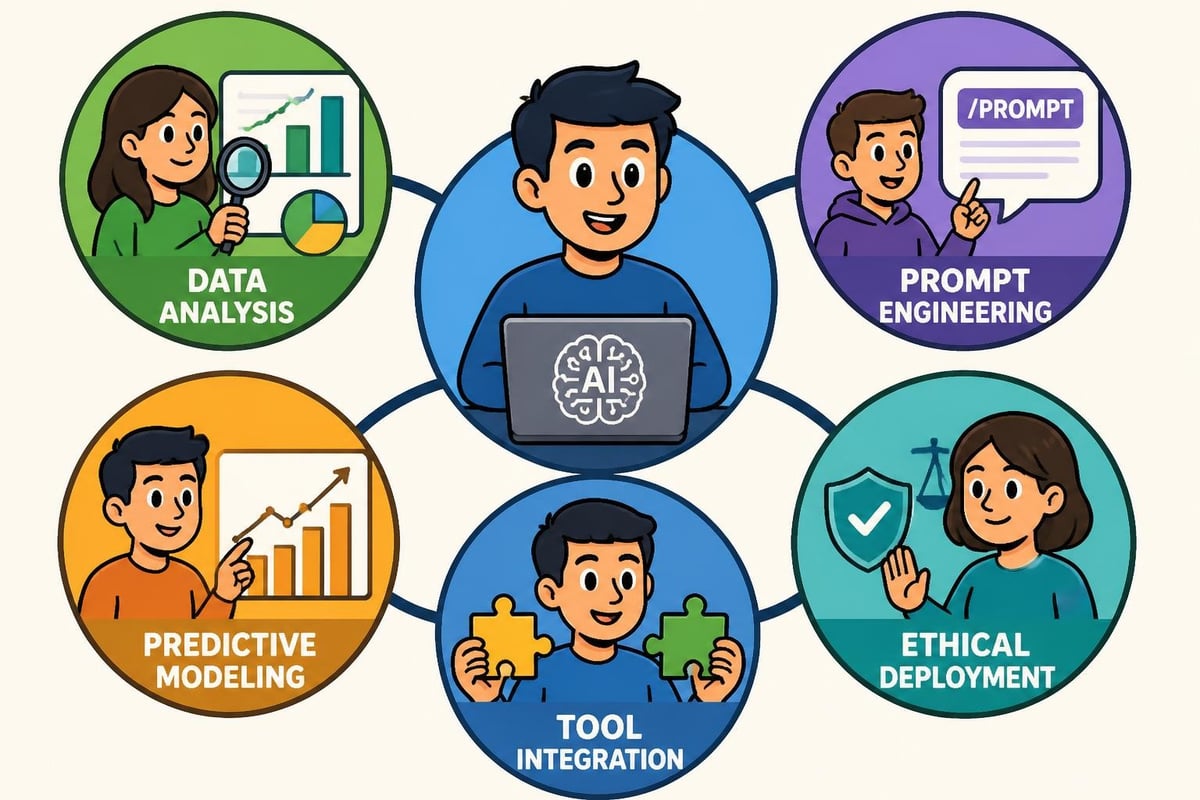
The most valuable marketing AI skills in 2026 include:
- Prompt engineering for generative AI content tools
- Predictive modeling for customer behavior analysis
- Algorithm literacy to interpret AI recommendations
- Ethical AI deployment ensuring brand safety and compliance
- Integration strategy connecting AI tools with existing marketing stacks
What Top Marketing AI Courses Cover
Quality programs go beyond introducing AI concepts. They provide hands-on experience with tools marketers actually use, frameworks for strategic implementation, and real-world case studies demonstrating measurable results. The AI digital marketing course offerings available today range from foundational overviews to specialized deep-dives in specific applications.
Foundational Concepts and Frameworks
Every comprehensive marketing AI course begins with essential technical literacy. Professionals need to understand how machine learning models work, what training data means, and why certain algorithms excel at specific tasks. This foundation enables informed decisions about which tools solve which problems.
Core technical topics include:
- Machine learning fundamentals - supervised vs. unsupervised learning, classification, regression
- Natural language processing - how AI understands and generates text
- Computer vision applications - image recognition, visual search, creative analysis
- Predictive analytics - forecasting models, customer lifetime value prediction
- Recommendation systems - personalization engines and content matching
Programs like the American Marketing Association's AI course excel at translating complex technical concepts into practical marketing applications. Understanding these fundamentals prevents costly mistakes and enables strategic tool selection.
Practical Application and Tool Mastery
Technical knowledge means little without implementation skills. Advanced programs dedicate substantial time to hands-on practice with leading AI platforms. Students learn to configure tools, interpret outputs, and integrate AI capabilities into existing workflows.
| Application Area | Key Tools | Primary Use Cases |
|---|---|---|
| Content Creation | GPT-4, Claude, Jasper | Blog posts, ad copy, email campaigns |
| Customer Insights | Tableau AI, DataRobot | Segmentation, behavior prediction |
| Campaign Optimization | Google Performance Max, Meta Advantage+ | Automated bidding, creative testing |
| Personalization | Dynamic Yield, Segment | Real-time content adaptation |
| Analytics | Heap, Amplitude | User journey analysis, attribution |
The Harvard AI in Marketing program stands out for its emphasis on connecting multiple tools into cohesive systems rather than treating them as isolated capabilities. This systems-thinking approach mirrors how successful marketing departments actually operate.
Comparing Educational Approaches and Formats
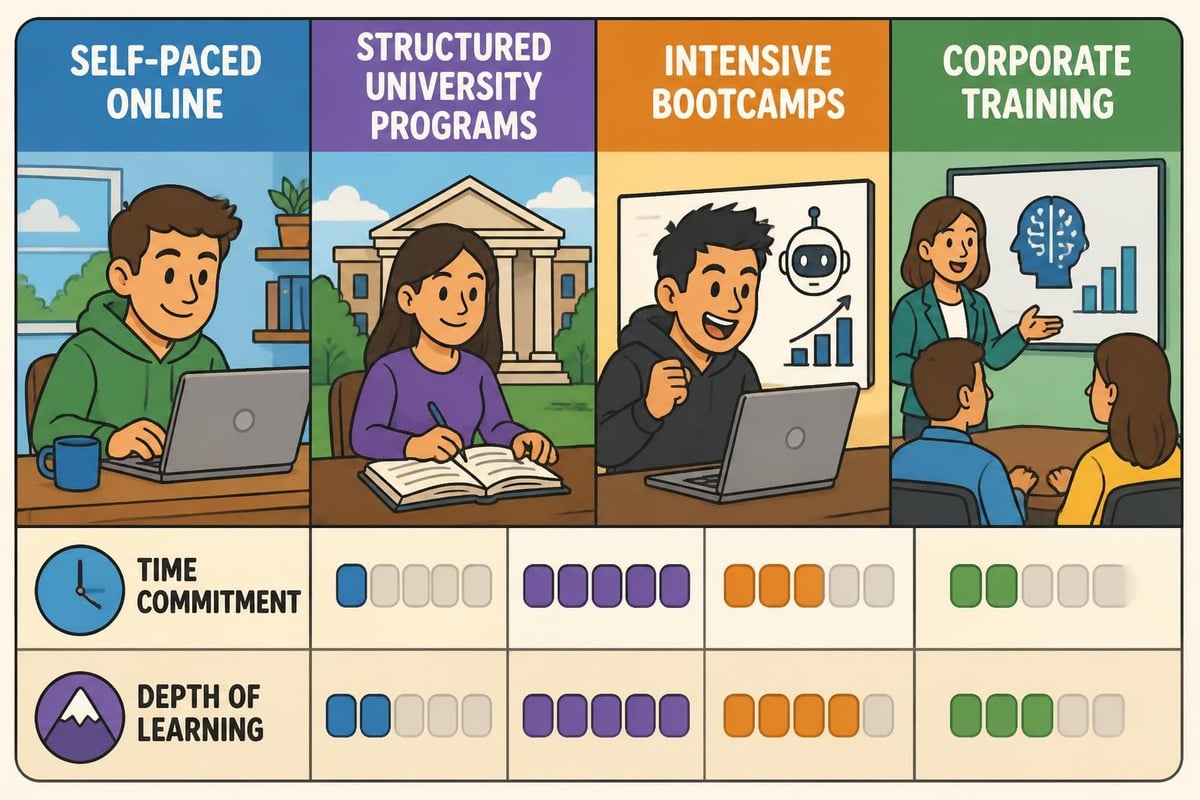
Marketing AI course options span multiple formats, each serving different learning preferences and professional circumstances. Understanding these distinctions helps professionals select programs aligned with their goals and constraints.
University Programs vs. Platform Courses
Traditional universities offer structured curricula with academic rigor and recognized credentials. Programs from institutions like the University of Virginia through Coursera combine theoretical foundations with practical applications, often including capstone projects.
University program advantages:
- Recognized credentials enhancing professional credibility
- Structured learning paths reducing decision fatigue
- Peer cohorts enabling networking and collaboration
- Faculty expertise providing depth in specialized topics
Platform-based courses through providers like MammothClub emphasize flexibility and breadth. With access to thousands of courses, professionals can customize learning paths addressing specific skill gaps or emerging opportunities.
Platform course benefits:
- Self-paced learning accommodating busy schedules
- Immediate access to updated content reflecting rapid AI evolution
- Lower cost structures removing financial barriers
- Practical, implementation-focused instruction
Neither approach is universally superior. The optimal choice depends on career stage, learning style, available time, and specific skill objectives. Many successful professionals combine both approaches, using platform courses for continuous skill development and university programs for formal credentials.
Bootcamps and Intensive Programs
Accelerated formats compress learning into weeks rather than months, appealing to professionals needing rapid upskilling. These intensive experiences typically involve full-time commitment for short periods, combining lectures, hands-on projects, and mentorship.
The Harvard Division of Continuing Education's hands-on program exemplifies this approach, pairing AI tools with actual marketing challenges. Participants work through realistic scenarios, making implementation decisions and analyzing results in compressed timeframes.
Bootcamp characteristics:
- Immersive learning accelerating skill acquisition
- Project-based assessments demonstrating practical competency
- Industry connections through guest speakers and mentors
- High intensity requiring dedicated time commitment
Essential Topics Every Marketing AI Course Should Address
Comprehensive programs cover both technical capabilities and strategic considerations. The most valuable courses help professionals understand not just how AI works, but when to deploy it, how to measure its impact, and how to avoid common pitfalls that waste resources or damage brand reputation.
Generative AI for Content and Creative
Generative AI has transformed content creation workflows. Tools like GPT-4 and Claude produce blog posts, social copy, email campaigns, and even video scripts in seconds. However, effective use requires more than typing prompts. Quality training covers prompt engineering techniques, output evaluation, brand voice consistency, and content optimization.
The Coursera specialization on AI for marketing and sales dedicates substantial coverage to generative tools, teaching professionals to create effective prompts, refine outputs, and integrate AI-generated content into broader strategies.
Critical generative AI skills:
- Crafting precise prompts yielding desired outputs
- Evaluating AI content for accuracy, tone, and brand alignment
- Combining human creativity with AI efficiency
- Managing workflows integrating multiple content tools
- Maintaining authenticity while scaling production
Marketing teams leveraging generative AI effectively report 60% faster content production without sacrificing quality. The key lies not in replacing human creativity but augmenting it strategically.
Predictive Analytics and Customer Intelligence
Understanding future customer behavior enables proactive marketing rather than reactive campaigns. Predictive models analyze historical data to forecast purchase likelihood, churn risk, optimal messaging timing, and lifetime value. A solid marketing AI course teaches professionals to build, interpret, and act on these predictions.
Predictive analytics applications:
- Churn prediction - identifying at-risk customers before they leave
- Purchase propensity - scoring leads by conversion likelihood
- Optimal timing - determining when individuals are most receptive
- Lifetime value forecasting - prioritizing acquisition and retention investments
- Trend detection - spotting emerging patterns before competitors
Programs like Oregon State University's AI marketing strategy course emphasize translating predictive insights into actionable strategies. Technical accuracy matters less than business impact when predictive models inform actual marketing decisions.
Personalization at Scale
Modern customers expect personalized experiences across every touchpoint. AI enables this personalization without manually creating thousands of variations. Advanced courses teach dynamic content assembly, behavioral triggering, and real-time personalization engines that adapt messaging based on individual actions.
The Harvard transforming strategies course explores hyper-personalization techniques that go beyond inserting first names in emails. Students learn to create adaptive customer journeys that respond to behaviors, preferences, and predicted needs in real time.
| Personalization Level | Traditional Approach | AI-Enabled Approach |
|---|---|---|
| Basic | Segment-based content | Individual behavior modeling |
| Messaging | Manual A/B testing | Automated multivariate optimization |
| Timing | Scheduled sends | Predictive engagement windows |
| Channel | Marketer-selected | AI-recommended based on preferences |
| Content | Static variations | Dynamically assembled components |
Professionals skilled in AI-powered personalization create marketing experiences that feel individually crafted while operating efficiently at massive scale. This combination drives engagement rates that traditional approaches cannot match.
Selecting the Right Marketing AI Course for Your Goals
The proliferation of AI training options creates decision paralysis. Professionals must evaluate programs against specific criteria ensuring the investment delivers tangible career value. Not all courses serve all goals equally well, making strategic selection essential.
Assessing Your Current Skill Level
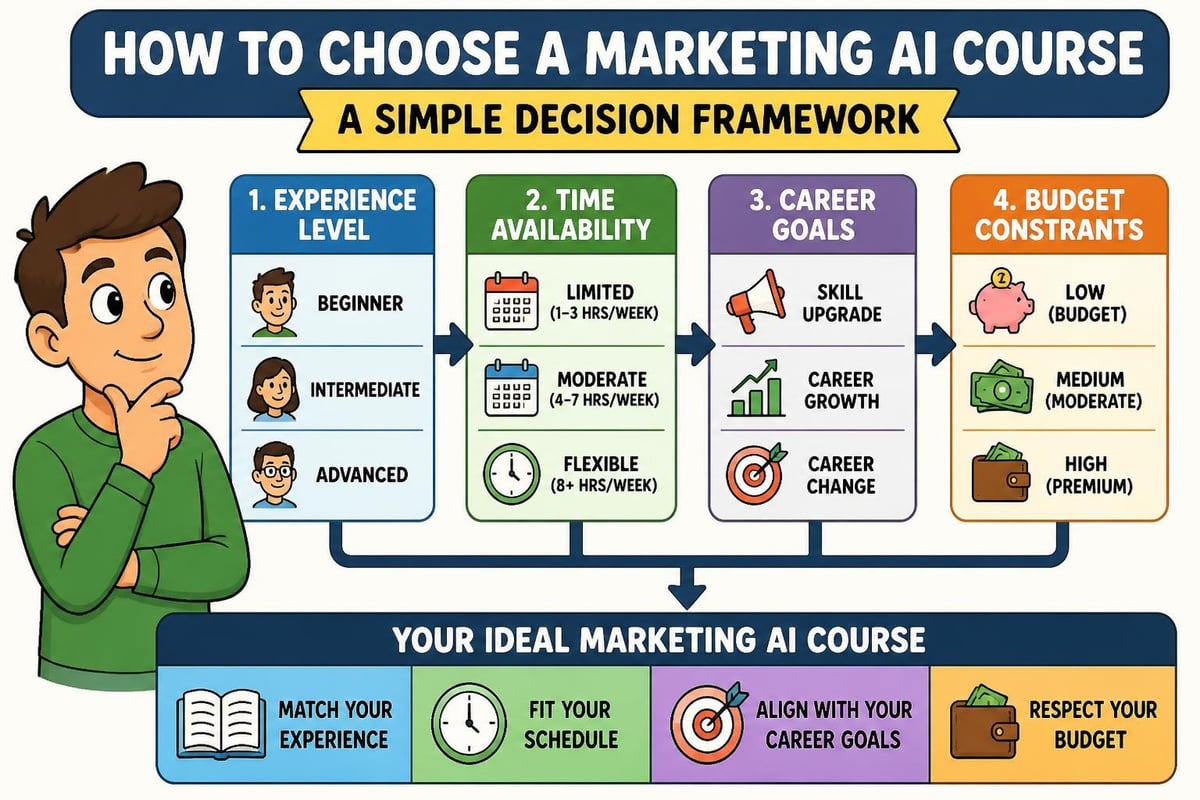
Honest self-assessment prevents wasting time on material too basic or struggling through content requiring prerequisite knowledge. Marketing AI courses typically serve three experience levels, each with distinct learning objectives.
Beginner programs suit marketing professionals with minimal technical background. These courses explain AI fundamentals without assuming coding knowledge or statistical expertise. The focus remains on understanding capabilities, evaluating vendors, and implementing pre-built tools. AI for beginners courses provide accessible entry points for marketing professionals new to artificial intelligence.
Intermediate courses target professionals familiar with basic AI concepts seeking deeper implementation skills. These programs cover prompt engineering, model evaluation, integration strategies, and performance optimization. Students typically have experience using AI tools but want to maximize their effectiveness.
Advanced programs serve technical marketers or those transitioning into marketing data science roles. Content includes model building, algorithm selection, custom integration development, and advanced analytics. Programs like Emory's Goizueta Business School offering provide sophisticated frameworks for leveraging AI strategically across entire marketing organizations.
Matching Learning Formats to Professional Constraints
Career stage and personal circumstances dramatically influence optimal learning formats. A junior marketer with flexible time might thrive in an intensive bootcamp, while a senior director needs self-paced options fitting around leadership responsibilities.
Consider these factors:
- Available time - daily, weekly, or project-based commitment capacity
- Learning style - preference for structure vs. flexibility
- Career goals - credential requirements for advancement
- Budget - investment capacity and employer support
- Implementation timeline - urgency of applying new skills
Platforms like MammothClub address diverse needs through varied formats. The complete AI prompt engineering bundle enables focused skill development in specific areas, while comprehensive programs provide end-to-end coverage. This flexibility allows professionals to build customized learning paths rather than forcing one-size-fits-all solutions.
Implementing What You Learn: From Theory to Results
The ultimate measure of any marketing AI course is implementation success. Knowledge becomes valuable only when applied effectively to drive measurable business outcomes. The best programs emphasize practical application throughout, ensuring students develop deployable skills rather than theoretical understanding alone.
Building Your First AI-Enhanced Campaign
Most effective learning comes from doing. Quality courses include project-based assignments mirroring real marketing challenges. Students might optimize ad targeting using predictive models, create content variations with generative AI, or build customer segmentation using clustering algorithms.
Successful implementation follows structured processes:
- Define clear objectives - specific metrics and success criteria
- Select appropriate tools - matching capabilities to requirements
- Prepare data foundations - ensuring quality inputs for AI systems
- Configure and test - iterative refinement before full deployment
- Monitor and optimize - continuous improvement based on performance
- Document learnings - capturing insights for future projects
Programs offered through HubSpot Academy excel at guiding professionals through complete campaign cycles, from strategy through execution to analysis. This hands-on approach builds confidence and competence simultaneously.
Measuring AI Impact on Marketing Performance
Demonstrating ROI justifies continued AI investment and builds organizational support for expanded implementation. Effective measurement requires establishing baselines, selecting appropriate metrics, and attributing improvements accurately to AI interventions rather than confounding factors.
Key performance indicators for AI marketing initiatives:
- Efficiency metrics - time saved, cost per output, resource utilization
- Engagement metrics - click rates, time on site, content interactions
- Conversion metrics - lead quality, conversion rates, deal velocity
- Revenue metrics - customer acquisition cost, lifetime value, marketing ROI
- Experience metrics - satisfaction scores, retention rates, referral likelihood
The SMU course on applied generative AI emphasizes measurement frameworks that connect AI activities to business outcomes. This analytical rigor proves value to stakeholders and guides strategic decisions about where to invest further.
Staying Current as AI Marketing Evolves
Artificial intelligence advances rapidly, making continuous learning essential. A marketing AI course taken today provides foundations, but professionals must commit to ongoing education maintaining relevance as capabilities expand and new tools emerge. The most valuable programs teach learning frameworks enabling self-directed skill development beyond formal instruction.
Building a Continuous Learning Practice
Successful AI marketers allocate regular time to experimenting with new tools, reading research, and sharing knowledge with peers. This disciplined approach prevents skills from becoming obsolete as the field evolves.
Effective continuous learning strategies include:
- Weekly experimentation with emerging AI tools
- Monthly review of industry publications and research
- Quarterly assessment of skill gaps and learning needs
- Participation in professional communities and forums
- Teaching others to reinforce and deepen understanding
Platforms offering constantly updated content libraries support continuous learning better than static programs. The 3,000+ courses available through comprehensive AI training platforms enable professionals to explore emerging topics as they gain relevance rather than waiting for formal programs to catch up.
Ethical Considerations and Responsible AI Use
As AI capabilities expand, so do potential harms from misuse or unintended consequences. Responsible marketers must understand bias in algorithms, privacy implications of data collection, transparency requirements, and brand risks from inappropriate AI applications. Leading programs dedicate substantial coverage to these critical topics.
Essential ethical considerations:
- Data privacy and customer consent requirements
- Algorithmic bias and fairness in automated decisions
- Transparency about AI use in customer interactions
- Intellectual property in AI-generated content
- Environmental impact of large-scale AI deployment
Quality training helps professionals navigate these complex issues proactively rather than reactively after problems emerge. The investment in ethical frameworks protects both customers and organizational reputation.
Career Advancement Through AI Marketing Expertise
Professionals who combine marketing expertise with AI proficiency command significant career advantages. Organizations desperately seek leaders who can bridge technical and strategic perspectives, making AI marketing skills among the most valuable in modern business.
In-Demand Roles and Compensation Trends
The job market has created entirely new positions that didn't exist five years ago. AI-focused marketing roles command premium compensation reflecting their strategic importance and talent scarcity.
| Role | Average Salary (2026) | Key Responsibilities |
|---|---|---|
| AI Marketing Strategist | $135,000 - $180,000 | Define AI implementation roadmaps |
| Marketing Data Scientist | $145,000 - $195,000 | Build predictive models and analytics |
| Marketing Automation Architect | $125,000 - $165,000 | Design and implement AI-powered systems |
| Growth AI Specialist | $115,000 - $155,000 | Optimize acquisition using AI tools |
| Content AI Manager | $105,000 - $145,000 | Scale content production with generative AI |
Beyond specialized roles, AI proficiency accelerates advancement in traditional marketing positions. CMOs increasingly require AI literacy, making relevant training essential for reaching senior leadership.
Building a Competitive Professional Profile
Completing a comprehensive marketing AI course represents the beginning, not the end, of professional development. Building a compelling profile requires demonstrating applied skills through projects, certifications, and measurable results.
Profile-building strategies:
- Document case studies of successful AI implementations
- Earn recognized certifications from reputable institutions
- Contribute to professional communities through content and speaking
- Build a portfolio showcasing diverse AI applications
- Develop thought leadership on emerging AI marketing trends
The AI artificial intelligence course certifications and project portfolios created through quality programs provide tangible evidence of capabilities that resumes alone cannot convey. This demonstrated competence opens doors traditional credentials cannot.
The integration of artificial intelligence into marketing represents a fundamental transformation rather than a temporary trend. Professionals who invest in comprehensive training position themselves at the forefront of this evolution, capable of driving measurable business results while advancing their careers. Whether you're just beginning your AI journey or seeking to deepen existing expertise, MammothClub offers the resources, flexibility, and depth needed to succeed in an AI-powered marketing landscape. With over 3,000 courses, interactive bootcamps, and AI-powered learning tools, you can build the precise skills your career demands at a pace that fits your life.