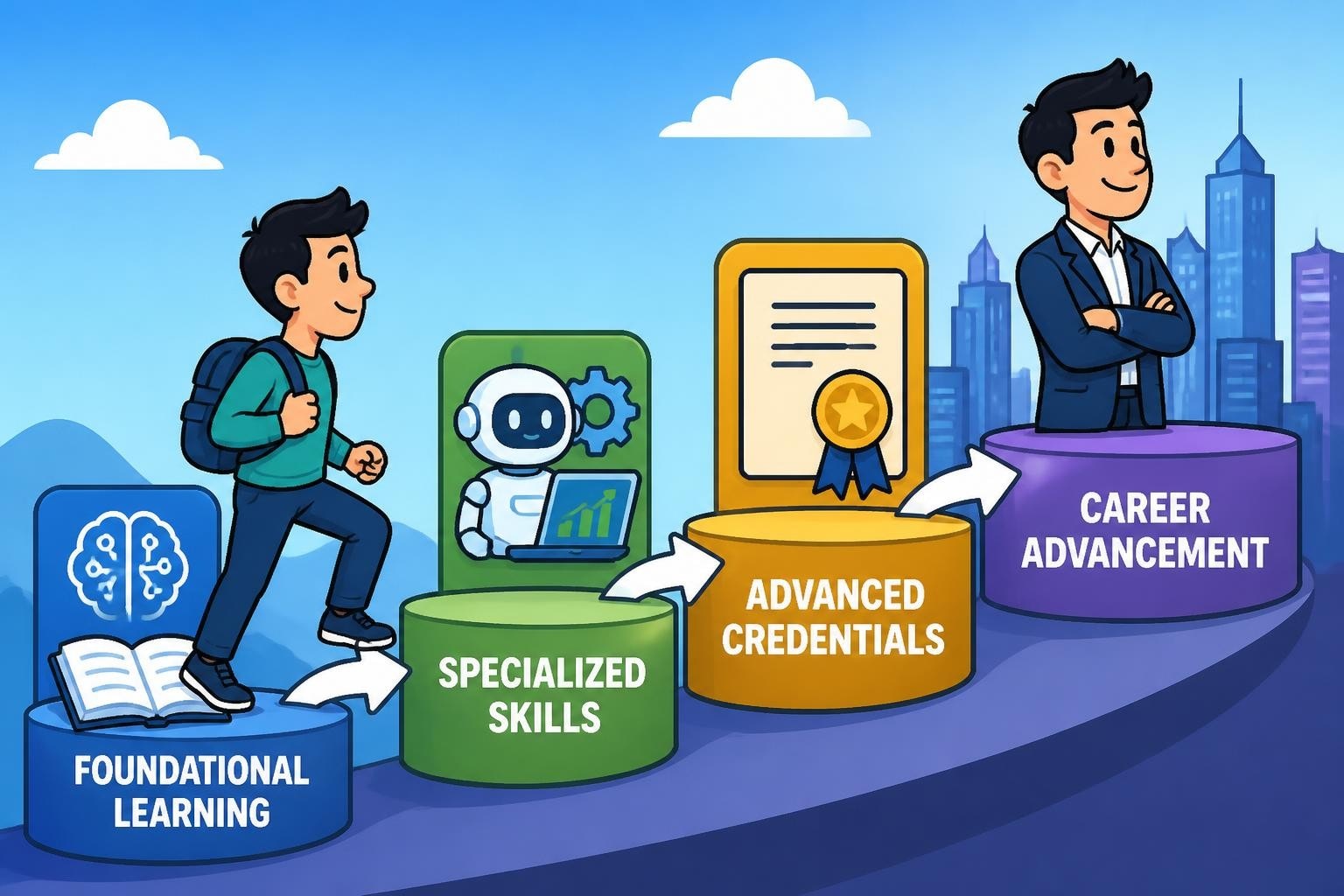
Artificial intelligence and machine learning are transforming industries at an unprecedented pace, opening doors to high-impact careers as we approach 2026. Whether you are just starting or aiming to advance, having a clear ai ml learning path is essential for staying ahead in this fast-evolving field.
This guide lays out a structured, actionable roadmap designed to take you from beginner to expert. You will explore foundational concepts, core machine learning, deep learning, engineering skills, specialized tracks, and portfolio building.
Ready to secure your future with a future-proof skillset? Follow this step-by-step journey and unlock your potential in the world of AI and ML.
Step 1: Building Strong Foundations in Math, Programming, and Data
Entering the world of AI and ML requires more than just curiosity—it demands a solid grasp of the basics. The ai ml learning path begins with building unwavering foundations in mathematics, programming, and data handling. Without this groundwork, even the most advanced algorithms can seem insurmountable.

Why Foundations Matter
A successful ai ml learning path is rooted in foundational knowledge. Mathematics forms the backbone of AI and ML, with linear algebra, calculus, probability, and statistics shaping nearly every model and algorithm. Concepts like vectors and matrices are essential for neural networks, while calculus powers optimization algorithms that enable learning.
Python stands as the dominant language for this field, favored for its readability and rich ecosystem. Frameworks like TensorFlow, PyTorch, and Scikit-learn all rely on Python. This makes programming fluency a must-have for anyone on the ai ml learning path.
Data literacy is equally vital. Cleaning, analyzing, and interpreting datasets is a daily task for practitioners. Courses from Coursera, MIT OCW, and Fast.ai consistently highlight math and programming as non-negotiable prerequisites. For example, understanding matrix multiplication directly supports building neural networks.
According to Quora’s 2023 survey, over 80% of machine learning professionals identify math and Python as critical entry skills. This reflects industry expectations and the practical realities faced by newcomers.
If you’re just starting, consider exploring the AI Foundation Course Overview to see how foundational skills are structured in a comprehensive curriculum. Typically, dedicating 2–4 months of part-time study is enough to master the basics and confidently progress along the ai ml learning path.
Key Skills and Resources
To advance on the ai ml learning path, focus on acquiring the following core skills:
| Skill Area | Key Concepts | Application in AI/ML |
|---|---|---|
| Linear Algebra | Vectors, matrices, eigenvalues, SVD | Neural network architecture |
| Calculus | Derivatives, gradients, chain rule | Model optimization and training |
| Probability/Statistics | Distributions, Bayes’ theorem | Model evaluation, hypothesis testing |
| Python Programming | Functions, OOP, libraries | Data processing, model development |
| Data Handling | Cleaning, EDA, visualization | Preprocessing and feature engineering |
Recommended resources include:
- Essence of Linear Algebra (3Blue1Brown) for visual intuition
- Automate the Boring Stuff with Python for practical coding
- Khan Academy for probability and statistics fundamentals
Practical exercises are crucial. Start with beginner datasets on Kaggle, or tackle assignments from MIT OpenCourseWare. For example, try this simple matrix multiplication in Python:
import numpy as np
A = np.array([[1, 2], [3, 4]])
B = np.array([[5, 6], [7, 8]])
result = np.dot(A, B)
print(result)
Mastery at this stage means you can manipulate data, solve relevant math problems, and code basic algorithms. Regular self-assessment will keep your ai ml learning path on track and prepare you for more advanced topics.
Step 2: Mastering Core Machine Learning Concepts and Tools
Embarking on the ai ml learning path means gaining a deep understanding of the core machine learning concepts that power real-world applications. At this stage, you move beyond theory and start applying algorithms, evaluating models, and building your own projects. This step is where foundational knowledge transforms into practical skill, setting the stage for advanced AI work.
Essential ML Algorithms and Techniques
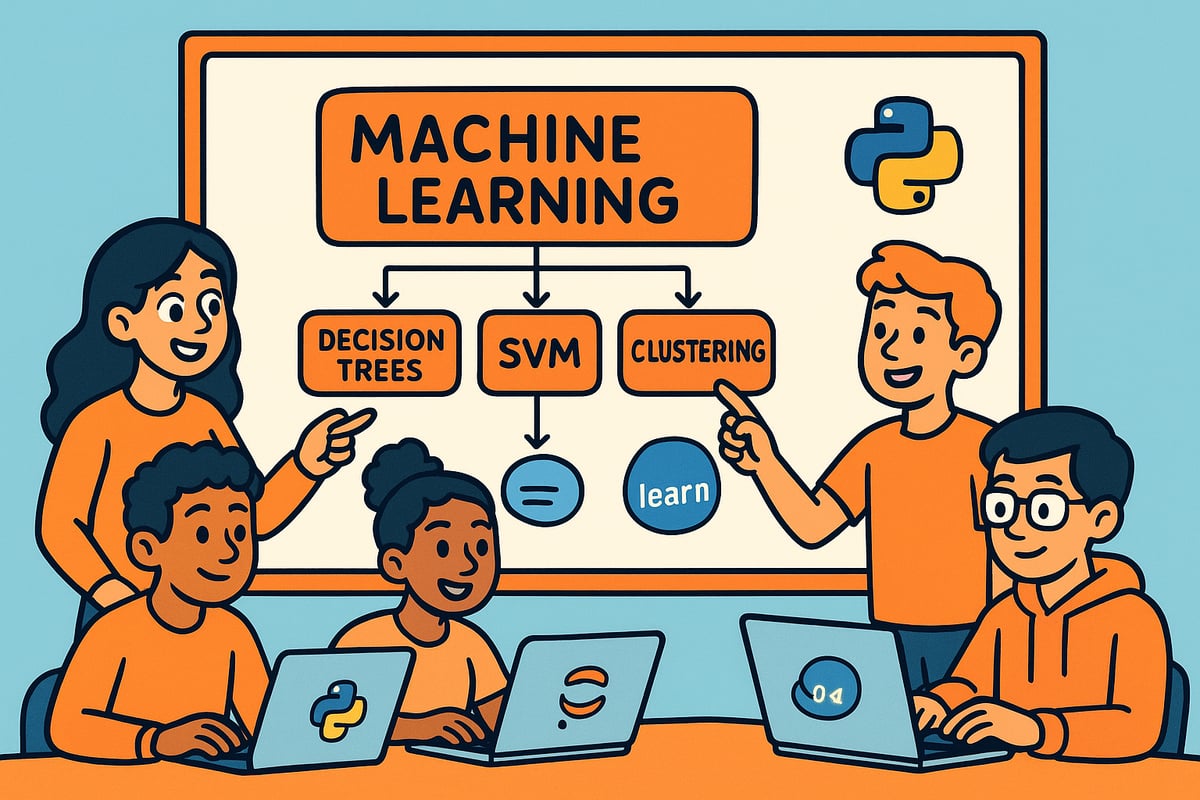
To progress on the ai ml learning path, you must first grasp the essential machine learning algorithms that form the backbone of data-driven solutions. Supervised learning techniques, such as linear regression, logistic regression, support vector machines, decision trees, and ensemble methods like random forest and XGBoost, are vital for tasks where labeled data is available. These algorithms enable you to predict outcomes and classify data accurately.
Unsupervised learning methods, including k-means clustering, hierarchical clustering, and dimensionality reduction techniques like principal component analysis (PCA), help you uncover patterns and structure in unlabeled datasets. Mastering both supervised and unsupervised approaches expands your problem-solving toolkit and prepares you for diverse AI challenges.
Model evaluation is another crucial aspect of the ai ml learning path. Understanding metrics like cross-validation, confusion matrix, ROC/AUC, precision, recall, and the bias-variance tradeoff allows you to assess model performance effectively. Feature engineering—transforming and selecting the right data features—often makes the difference between mediocre and high-performing models.
Regularization techniques, such as L1 and L2 penalties, prevent overfitting and improve generalization. A classic example is the Kaggle Titanic competition, where applying supervised learning algorithms and careful feature selection can significantly boost your model’s accuracy.
Most ML job postings now require hands-on experience with tools like scikit-learn and pandas, highlighting the importance of practical skills. Project-based learning is essential; building end-to-end pipelines from data ingestion to evaluation cements your understanding and prepares you for real-world roles. For those seeking a structured, actionable curriculum, the Comprehensive Machine Learning Roadmap 2026 provides a step-by-step guide aligned with the ai ml learning path.
Practical Tools and Platforms
The ai ml learning path continues with mastering the practical tools and platforms that streamline development and experimentation. Python remains the language of choice, and proficiency with its core libraries is a must. Scikit-learn, pandas, and NumPy are fundamental for data manipulation, modeling, and analysis. Visualization tools like Matplotlib and Seaborn help you interpret results and communicate findings effectively.
Interactive development environments such as Jupyter Notebook and Google Colab have become industry standards for reproducibility and collaboration. These platforms allow you to document your workflow, share results, and experiment with code in a flexible, user-friendly setting.
A key step in the ai ml learning path is gaining familiarity with machine learning frameworks like TensorFlow and PyTorch. While these are more commonly used for deep learning, early exposure helps you transition smoothly to advanced topics later. Practice building classification models with scikit-learn, visualizing predictions, and tweaking hyperparameters to see the impact on performance.
Recommended courses like Andrew Ng’s Machine Learning on Coursera and “Hands-On Machine Learning with Scikit-Learn, Keras, and TensorFlow” by Aurélien Géron provide structured, project-focused learning. Completing small projects with clear objectives, data preparation, model training, and evaluation is the best way to assess your progress.
By consistently applying these tools and frameworks, you’ll develop the confidence and competence needed to advance along the ai ml learning path. Each project you complete adds to your portfolio and demonstrates your readiness for industry or research roles.
Step 3: Diving into Deep Learning and Neural Networks
Deep learning is a pivotal milestone on any ai ml learning path. After mastering core machine learning, this stage unlocks the ability to solve complex problems in vision, language, and decision-making. Deep learning models power today’s most advanced AI systems, making them essential for anyone aspiring to become an AI specialist.
Deep Learning Fundamentals
To advance along the ai ml learning path, you must understand the building blocks of neural networks. At the core are perceptrons, which are simple units that combine input features, apply weights, and pass the result through activation functions like ReLU or sigmoid. These units form layers, creating networks that can learn representations from data.
Feedforward networks process data in one direction, while backpropagation enables learning by adjusting weights based on error gradients. This process is foundational in training models to minimize loss functions.
Optimization algorithms are key to effective learning. Stochastic Gradient Descent (SGD) is the most basic, updating weights with each batch. Adam and RMSProp offer adaptive learning rates, often leading to faster convergence in deep models.
Regularization techniques help networks generalize beyond their training data. Dropout randomly deactivates neurons during training, reducing overfitting. Batch normalization stabilizes learning by normalizing activations within layers.
Different architectures serve unique roles along the ai ml learning path:
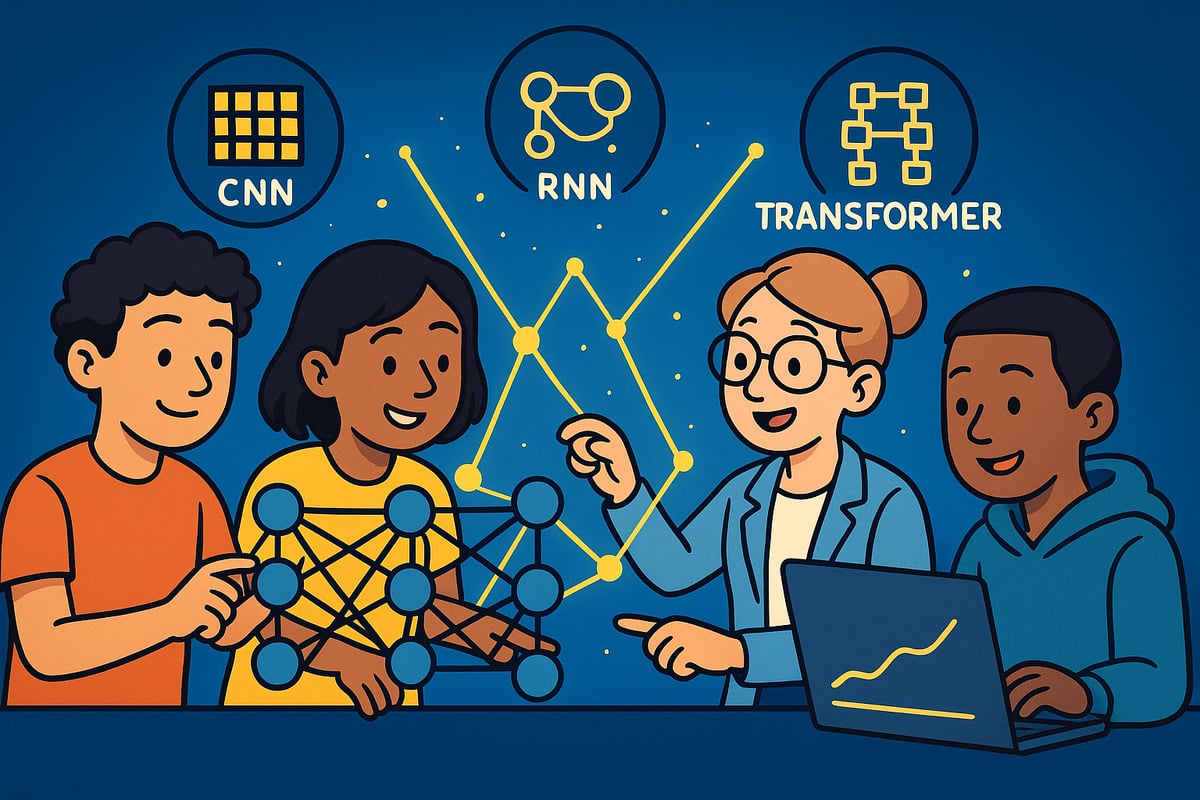
- Convolutional Neural Networks (CNNs): Excel at image and video tasks by capturing spatial hierarchies.
- Recurrent Neural Networks (RNNs), LSTMs, and Transformers: Designed for sequential data like language or time series.
- Transformers: Revolutionized NLP with self-attention mechanisms, enabling models like BERT and GPT.
Transfer learning accelerates progress by leveraging pre-trained models. For example, using a pre-trained ResNet for image classification on a new dataset drastically reduces required training time and data.
Here is a simple code snippet illustrating transfer learning in PyTorch:
import torchvision.models as models
model = models.resnet18(pretrained=True)
for param in model.parameters():
    param.requires_grad = False  # Freeze layers
model.fc = nn.Linear(512, num_classes)  # Adapt output for new task
In 2023, over 70% of AI research breakthroughs leveraged deep learning, highlighting its centrality to the ai ml learning path. Recommended resources include the Deep Learning Specialization on Coursera, Fast.ai’s practical courses, and the authoritative “Deep Learning” by Goodfellow, Bengio, and Courville.
Frameworks and Hands-On Projects
Selecting the right framework is vital as you move forward on your ai ml learning path. PyTorch is favored in research for its flexibility and dynamic computation graph, while TensorFlow and Keras see widespread industry adoption for scalable deployment.
Here’s a comparison table of the two leading frameworks:
| Feature | PyTorch | TensorFlow/Keras |
|---|---|---|
| Learning Curve | Easier, intuitive | Moderate |
| Debugging | Dynamic, Pythonic | Static, less flexible |
| Deployment | Improving | Strong, mature |
| Community | Research-focused | Industry-focused |
Building hands-on projects is the best way to solidify your learning. Start with data loading and augmentation, move to defining and training networks, then evaluate performance. Real-world projects include:
- Object Detection: Implement YOLO for locating multiple objects in images.
- Text Classification: Fine-tune a BERT model for sentiment analysis of reviews or tweets.
A practical example is using Hugging Face Transformers to fine-tune BERT:
from transformers import BertForSequenceClassification, Trainer
model = BertForSequenceClassification.from_pretrained('bert-base-uncased')
# Prepare data and train
Assessment is crucial on the ai ml learning path. Aim to build and deploy a deep learning model, either on cloud platforms or your local machine. Hosting a web demo or API for your model demonstrates both technical and engineering skills.
For those seeking a structured curriculum and deeper insights into deep learning, see the Deep Learning and AI Course Details, which offers a curated list of courses and resources tailored to every stage of the ai ml learning path.
By integrating theory with hands-on implementation, you ensure your ai ml learning path leads to expertise that is ready for real-world impact.
Step 4: Applied ML Engineering and Real-World Deployment
Mastering the ai ml learning path means going beyond theory and algorithms. To truly make an impact, you must build the engineering skills needed to deliver robust AI and ML solutions in real-world environments. This step is where your technical expertise transforms into measurable business value.
Engineering Skills for Production AI
The ai ml learning path requires you to bridge the gap between successful experiments and reliable products. Engineering skills are vital for operationalizing models, ensuring that your solutions are scalable, secure, and maintainable.
A staggering 60% of machine learning projects never reach production due to missing engineering expertise. This highlights the importance of learning model deployment, system integration, and continuous delivery.
Key production skills include:
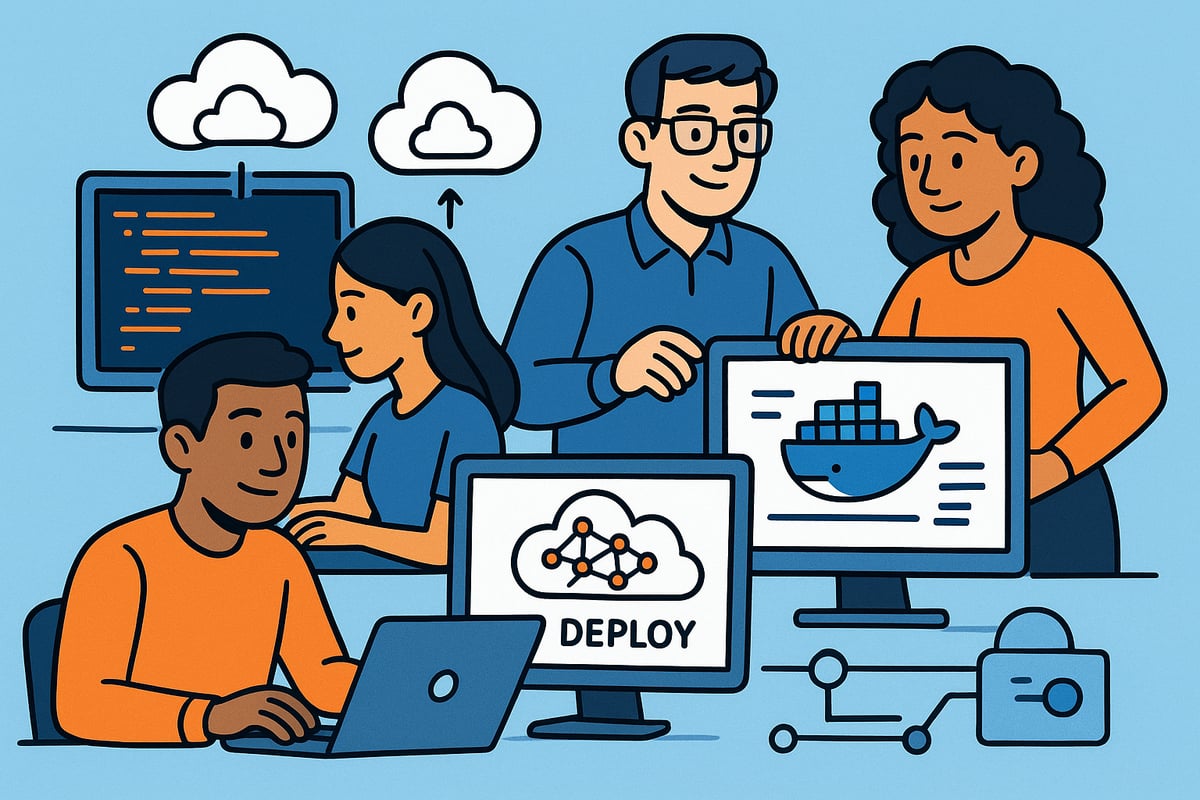
- Designing REST APIs to serve models for real-time predictions.
- Using Docker to containerize ML workloads for portability and consistency.
- Implementing CI/CD pipelines for automated testing and deployment.
By developing these skills, you position yourself as a valuable asset on the ai ml learning path, ready to tackle real-world challenges.
Model Deployment and Data Engineering
Deploying a machine learning model is not just about writing code. It involves orchestrating data pipelines, handling large-scale data, and ensuring seamless integration with existing systems. On your ai ml learning path, you will learn to build Extract, Transform, Load (ETL) pipelines, process streaming data, and manage feature stores for reproducibility.
For example, a typical end-to-end workflow includes:
- Ingesting raw data from multiple sources.
- Cleaning and transforming data for model readiness.
- Training a model and saving it as a deployable artifact.
- Wrapping the model in a REST API using Flask or FastAPI.
- Containerizing the service with Docker for deployment on AWS, GCP, or Azure.
Here’s a simple code snippet to serve a trained model with Flask:
from flask import Flask, request, jsonify
import joblib

app = Flask(__name__)
model = joblib.load('model.pkl')

@app.route('/predict', methods=['POST'])
def predict():
    data = request.json
    prediction = model.predict([data['features']])
    return jsonify({'prediction': prediction.tolist()})
Mastering these steps is essential along the ai ml learning path, as organizations expect end-to-end solutions.
Best Practices for Real-World AI/ML
To succeed in production environments, you must adopt best practices that ensure reliability and scalability. The ai ml learning path includes learning how to:
- Monitor deployed models for accuracy, latency, and drift.
- Log predictions and system metrics for traceability.
- Run A/B tests to compare model versions and validate improvements.
- Scale workloads using GPUs or TPUs for large datasets.
Consider this table summarizing best practices and associated tools:
| Best Practice | Tool/Platform |
|---|---|
| Monitoring | MLFlow, Prometheus |
| A/B Testing | Custom, Optimizely |
| Logging | ELK Stack, MLFlow |
| Scalability | Kubernetes, Spark |
By following these guidelines, you can deliver AI/ML solutions that stand up to real-world demands, a crucial milestone on the ai ml learning path.
Tools and Assessment
A robust toolkit is essential for success. As you progress along the ai ml learning path, become familiar with:
- Flask/FastAPI for serving models as APIs.
- Docker for containerization.
- Kubernetes for orchestration and scaling.
- MLFlow for model tracking and lifecycle management.
- Airflow for automating data and ML pipelines.
Assessment is key: deploy a model, containerize it, and monitor its performance in a cloud or on-premise environment. This hands-on experience is central to advancing on the ai ml learning path.
For a deeper dive into the core skills required for deployment and production, consult the AI Engineer Training Guide, which provides actionable insights for the next phase of your journey.
With practical engineering skills, you are prepared to move forward on the ai ml learning path and deliver solutions that make a real difference.
Step 5: Specialization Tracks and Advanced Topics
Advancing on your ai ml learning path means embracing specialization. As you reach higher levels, targeted expertise becomes crucial. With AI/ML specialist roles expanding rapidly, now is the perfect time to tailor your learning and stand out in a competitive field.
Choosing a Specialization
The ai ml learning path branches into several advanced domains. Choosing a specialization aligns your skills with industry demand and personal interests. The most popular tracks include:
| Specialization | Key Skills/Tools | Example Use Cases |
|---|---|---|
| Computer Vision | CNNs, OpenCV, Detectron2 | Image recognition, object detection |
| Natural Language Processing (NLP) | Transformers, Hugging Face, spaCy | Chatbots, sentiment analysis |
| Reinforcement Learning | DQN, PPO, OpenAI Gym | Game AI, robotics |
| Probabilistic Modeling | Bayesian inference, PyMC, Stan | Uncertainty modeling, forecasting |
Demand for experts in NLP and computer vision has doubled since 2022, driven by breakthroughs in generative AI and real-world applications. According to AI/ML Specialist Roles Expand by 142% in the U.S., companies are urgently seeking talent who can deliver impact in these niches.
To maximize your ai ml learning path, start by selecting one or two tracks that resonate with your career goals. For example, you might fine-tune a large language model for domain-specific Q&A if you choose NLP, or build an object detection system if computer vision excites you.
A successful specialization journey should end with a capstone project. This project demonstrates your command of advanced tools and concepts, serving as a strong portfolio piece for future opportunities on your ai ml learning path.
Research, Theory, and Continuous Learning
Mastery in the ai ml learning path requires more than technical skills. Staying at the forefront means engaging with cutting-edge research and theory. Make it a habit to read both seminal and current papers from conferences like NeurIPS, ICML, and ICLR.
Implementing key papers from scratch deepens your understanding of novel architectures and algorithms. For those eager to push boundaries, exploring topics like integrating exploration and reasoning, as discussed in ML-Master: Integrating Exploration and Reasoning in AI, can spark innovation.
Set aside time each week to read papers, build mini-projects, and replicate new advancements. This commitment ensures your ai ml learning path remains dynamic and future-focused.
Continuous learning also involves following developments in optimization, architectures, and theory. Reproducing results from recent state-of-the-art research not only builds credibility but also prepares you for evolving challenges.
In summary, specialization and research are essential steps on the ai ml learning path. By choosing the right track and embracing ongoing learning, you position yourself as an expert ready for tomorrow’s AI breakthroughs.
Step 6: Building a Portfolio and Advancing Your AI ML Career
Building a successful career in artificial intelligence and machine learning goes beyond theoretical knowledge. To stand out on your ai ml learning path, you need a portfolio that demonstrates both your technical mastery and your problem-solving skills.
Developing a Standout Portfolio
A strong portfolio is your passport to opportunities along the ai ml learning path. Aim to develop six to ten polished projects. Each project should include a clear problem statement, a well-chosen dataset, baseline and improved models, and thorough evaluation.
Break your projects into digestible sections. Use Jupyter notebooks or code repositories with descriptive READMEs. Make your work reproducible with files like requirements.txt or Docker configurations. Add live demos or simple APIs for interactive experiences.
Participate in competitions to sharpen your skills. Platforms like Kaggle offer beginner-friendly challenges such as Titanic or House Prices. Placing highly or even just documenting your approach can make your ai ml learning path more visible to employers.
Consider the elements that hiring managers value most:
| Portfolio Element | Why It Matters |
|---|---|
| Real-world projects | Show applied skills and initiative |
| Public repositories | Demonstrate transparency and teamwork |
| Clear documentation | Enable others to understand your work |
| Live demos/APIs | Prove practical deployment abilities |
| Competition results | Highlight problem-solving and drive |
According to the Stack Overflow Developer Survey (2023), hiring managers prioritize candidates whose portfolios feature real-world projects and accessible public code. Sharing your projects on LinkedIn, writing technical blog posts, and presenting at local meetups can amplify your presence on the ai ml learning path.
If you are looking for curated resources to boost your expertise, review these Machine Learning Course Recommendations. They can guide you toward high-impact courses as you create and refine your portfolio.
Career Pathways and Next Steps
Once you have a robust portfolio, you can pursue diverse roles on your ai ml learning path. For industry positions, focus on applied projects, production deployment, and developing domain expertise. Roles may include machine learning engineer, data scientist, or AI product manager. For research-oriented roles, emphasize original contributions, paper authorship, and conference presentations.
Assess your readiness by reproducing classic papers, deploying systems in real or simulated environments, or mentoring others. Continuous improvement is critical—maintain a learning log, set clear milestones, and adapt to emerging trends.
Networking accelerates career growth. Connect with peers and experts on LinkedIn, contribute to open-source projects, and attend hackathons or conferences. These activities broaden your understanding and expose you to new opportunities within the ai ml learning path.
The demand for AI talent is rapidly increasing. The AI in Career Development Market to Reach $15.8 Billion by 2033 report highlights the explosive growth in this sector, emphasizing the importance of upskilling and building a visible portfolio.
Transitioning from self-study to a full-time AI engineer or researcher becomes achievable when you combine a strong portfolio, active networking, and continuous learning. By following this ai ml learning path, you position yourself at the forefront of innovation and open doors to a future-proof career.
As you follow this roadmap to mastering AI and ML, remember that a strong foundation is the key to unlocking future opportunities. Whether you’re just starting out or looking to solidify your understanding of core concepts, it’s essential to build confidence in math, programming, and data skills before tackling advanced topics. If you’re ready to take the first step and gain a recognized credential, you can join thousands of learners worldwide and Become a certified AI Foundation Specilaist. Start for free. This is your chance to start strong and set yourself up for long-term success.