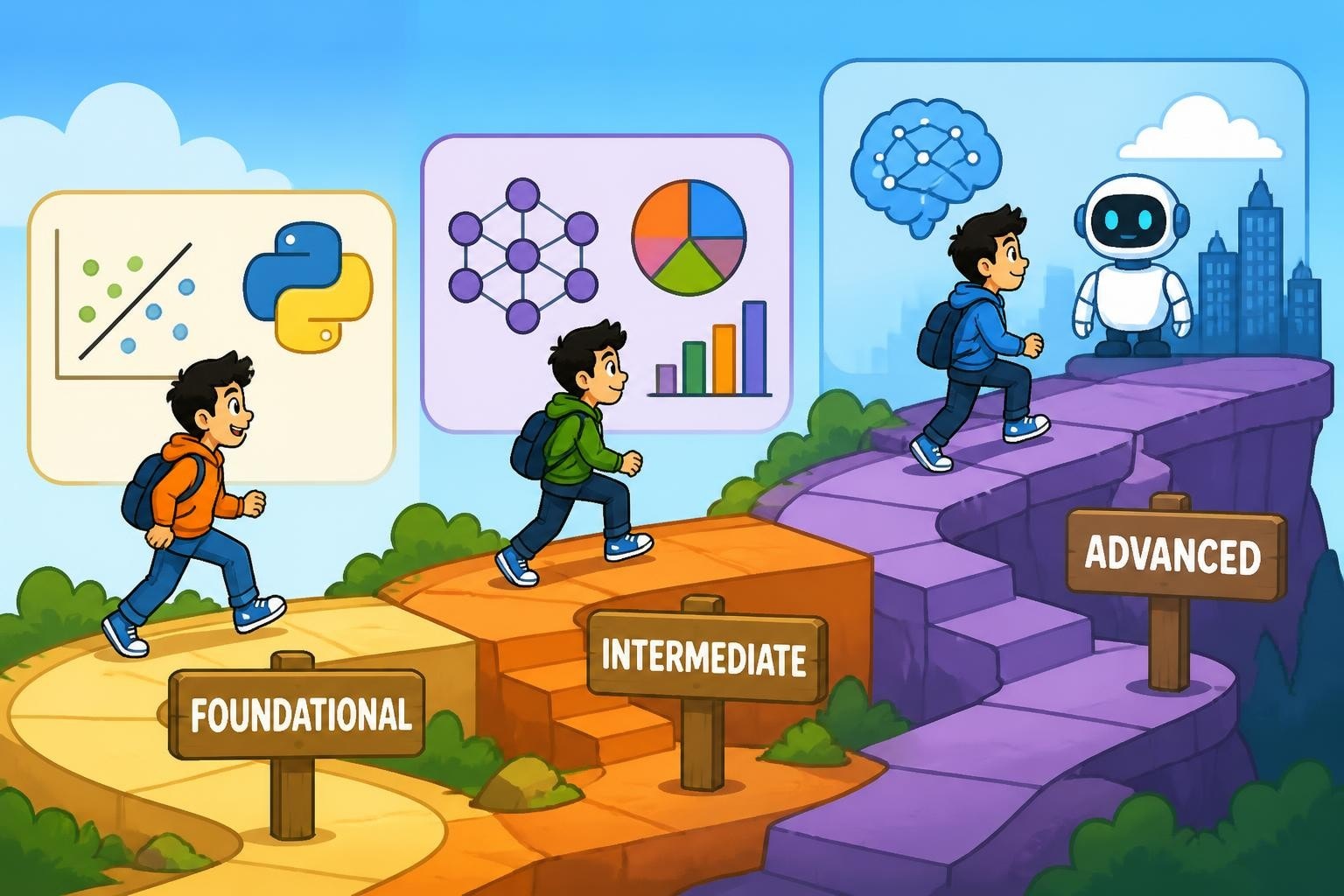
Artificial intelligence and machine learning certifications have become essential credentials for professionals navigating the rapidly evolving tech landscape in 2026. With global AI adoption accelerating across industries, choosing the best AI and ML certification for your career trajectory requires understanding not just vendor endorsements but also market demand, skill validation, and long-term value. Whether you're transitioning into AI from another field, deepening existing expertise, or building organizational capability, the right certification can distinguish you in a competitive market while providing structured, verified knowledge that employers recognize and reward.
Understanding the AI and ML Certification Landscape
The certification ecosystem for artificial intelligence and machine learning has matured significantly over the past three years. Unlike traditional IT certifications that focus primarily on tool proficiency, modern AI credentials balance theoretical foundations with practical implementation skills and increasingly address governance, ethics, and responsible AI deployment.
Three distinct certification categories have emerged to serve different career objectives:
- Vendor-specific credentials from cloud providers (AWS, Google Cloud, Microsoft Azure) that validate platform expertise
- Vendor-neutral certifications covering fundamental concepts, algorithms, and universal best practices
- Specialized governance certifications focused on AI ethics, compliance, and risk management
Platform-specific certifications like the AWS Certified Machine Learning credential remain highly valued because they demonstrate immediate operational capability. Organizations investing in specific cloud infrastructures prioritize candidates who can deploy models, optimize pipelines, and manage costs within their chosen ecosystem. These certifications typically require hands-on experience with data preparation, model training, deployment, and monitoring using platform-native tools.
Vendor-neutral certifications offer broader applicability across different tech stacks. They emphasize mathematical foundations, algorithm selection, model evaluation, and problem-solving frameworks that translate across platforms. For professionals uncertain about long-term platform commitments or those working in multi-cloud environments, these credentials provide flexibility while establishing core competency.
Market Demand Signals for AI Certifications
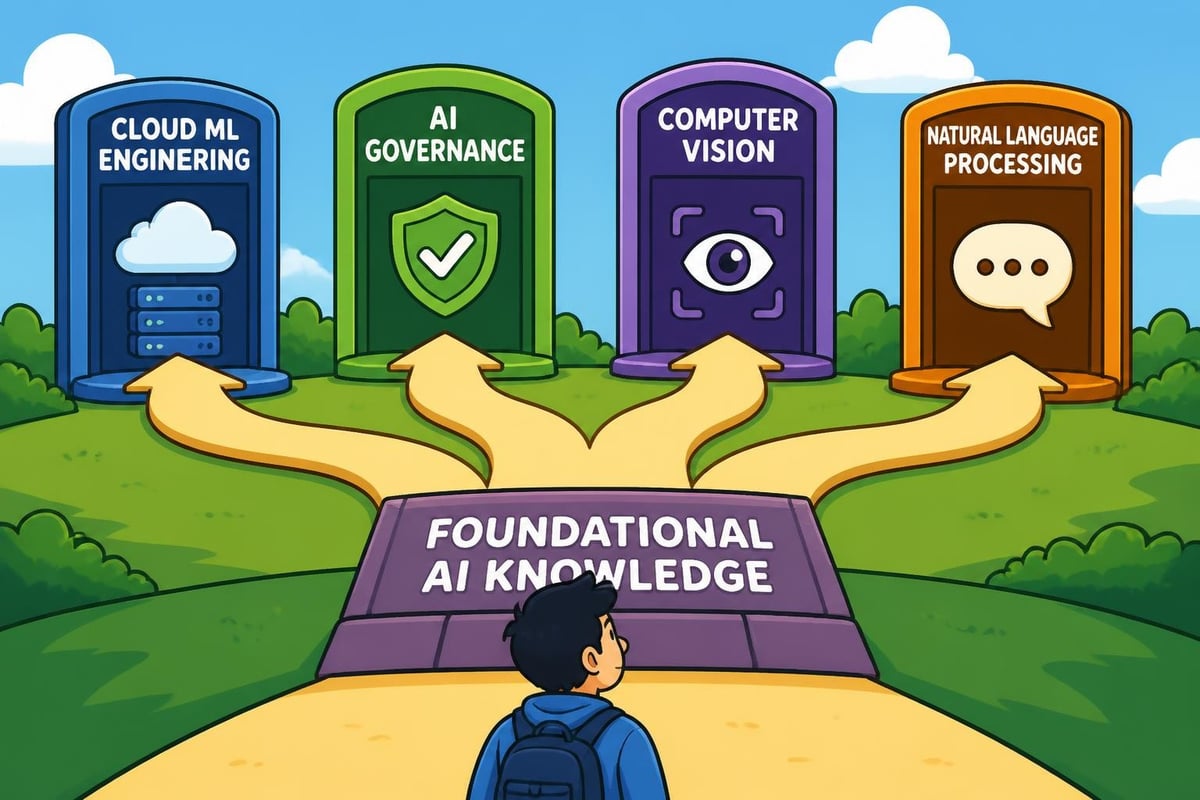
Employer demand for certified AI professionals has shifted noticeably in 2026. Analysis of job postings reveals that certifications focusing on responsible AI, model governance, and explainability now appear in 40% more senior-level positions compared to 2024. This reflects regulatory pressures, brand reputation concerns, and the maturation of AI from experimental to mission-critical status.
Organizations increasingly require proof that AI practitioners understand not just model performance but also bias detection, privacy preservation, and compliance frameworks. The NIST AI Risk Management Framework has become a reference standard, and certifications incorporating these principles demonstrate alignment with enterprise governance requirements.
| Certification Focus | 2024 Job Posting Mentions | 2026 Job Posting Mentions | Growth Rate |
|---|---|---|---|
| Cloud ML Engineering | 32% | 38% | +18.8% |
| AI Governance/Ethics | 14% | 24% | +71.4% |
| Deep Learning/NLP | 28% | 31% | +10.7% |
| MLOps/Deployment | 22% | 29% | +31.8% |
MLOps certifications have seen particularly strong growth as organizations struggle with the model lifecycle gap between data science experimentation and production reliability. Credentials demonstrating expertise in continuous integration/continuous deployment for ML, model monitoring, and automated retraining address critical operational challenges.
Top-Tier Cloud Provider Certifications
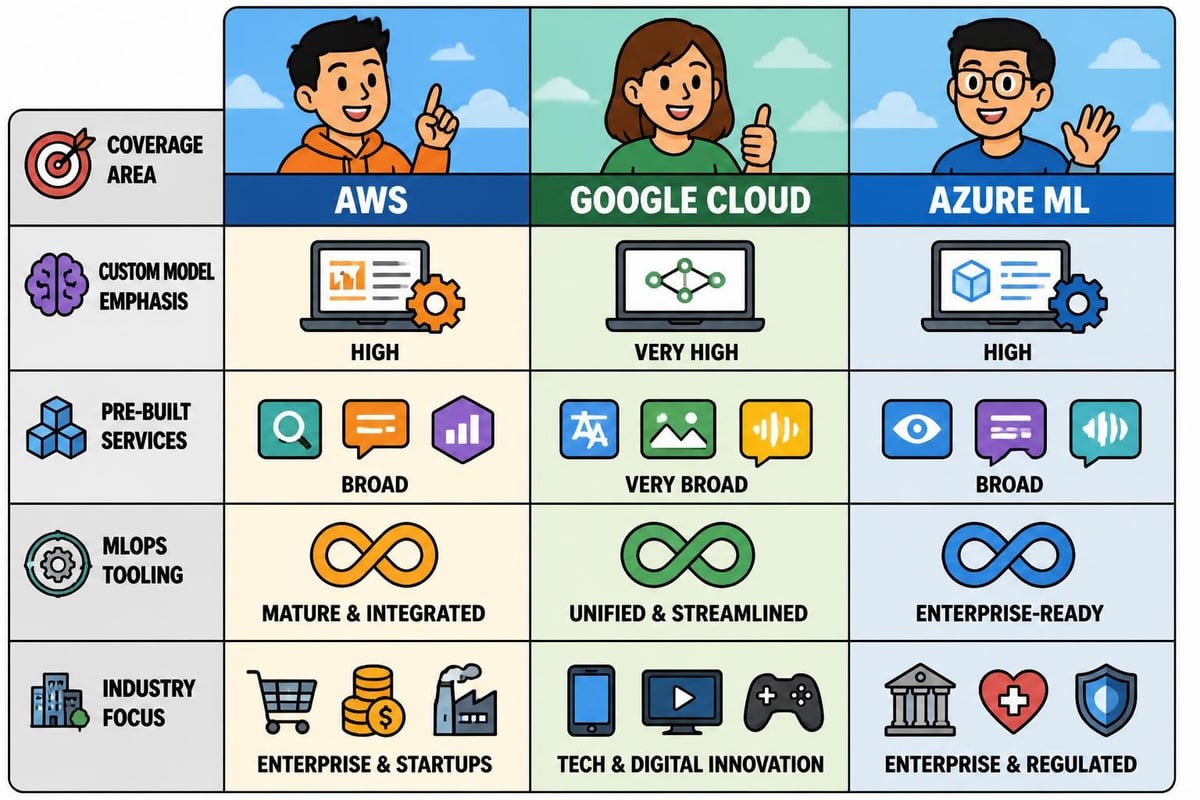
Cloud platform certifications represent the most direct path to demonstrating deployable skills in enterprise environments. Each major provider offers AI and ML credentials tailored to their service ecosystem, with distinct advantages depending on organizational technology choices.
AWS Certified Machine Learning – Specialty
Amazon Web Services maintains market leadership in cloud infrastructure, making their ML certification particularly valuable for professionals working in AWS-heavy environments. The certification validates expertise across data engineering, exploratory data analysis, modeling, and machine learning implementation using services like SageMaker, Comprehend, and Rekognition.
Key strengths of this certification include:
- Comprehensive coverage of the complete ML pipeline from data ingestion to deployment
- Strong emphasis on cost optimization and service selection
- Recognition across diverse industries due to AWS market penetration
- Regular updates reflecting new services and best practices
The exam requires practical experience with AWS-specific tools but also tests fundamental ML concepts. Candidates must demonstrate understanding of algorithm selection, hyperparameter tuning, model evaluation metrics, and production deployment strategies. For those exploring best AI courses to prepare, combining theoretical knowledge with hands-on AWS practice delivers the strongest outcomes.
Google Cloud Professional Machine Learning Engineer
Google Cloud's ML certification focuses heavily on TensorFlow, Vertex AI, and Google's approach to scalable model training and serving. This credential particularly appeals to organizations leveraging Google's data analytics stack or those prioritizing advanced deep learning capabilities.
The Google Cloud certification path emphasizes production ML systems rather than research-focused skills. Exam topics include designing ML solutions aligned to business objectives, building and operationalizing ML models, automating and orchestrating ML pipelines, and monitoring ML solutions.
Distinguishing characteristics include:
- Strong integration with BigQuery for data preparation at scale
- Emphasis on MLOps practices using Vertex AI Pipelines
- Coverage of responsible AI practices and model explainability
- Integration with Google's pre-trained APIs for vision, language, and recommendation tasks
This certification suits professionals working in data-intensive environments where Google's analytics and ML infrastructure provides strategic advantage. The exam difficulty assumes candidates have designed and deployed multiple production ML systems.
Microsoft Azure AI Engineer Associate
Microsoft's Azure AI Engineer certification targets professionals implementing AI solutions using Azure Cognitive Services, Azure Machine Learning, and knowledge mining pipelines. The credential validates ability to analyze solution requirements, design solutions, integrate AI models, and deploy responsible AI solutions.
This certification differs from AWS and Google credentials through its emphasis on pre-built cognitive services for vision, speech, language, and decision-making. Rather than focusing exclusively on custom model development, it covers orchestrating complete AI solutions that may combine custom and pre-trained components.
The Microsoft certification appeals particularly to enterprise developers integrating AI capabilities into existing applications rather than building standalone ML systems. Coverage of Azure Bot Service, Form Recognizer, and other application-focused services reflects this practical orientation.
Vendor-Neutral and Specialized Certifications
While cloud platform certifications dominate employer recognition, vendor-neutral credentials offer distinct advantages for professionals seeking platform independence or specialized expertise that transcends specific tooling.
AI Governance and Ethics Certifications
The Artificial Intelligence Governance Professional (AIGP) certification from the International Association of Privacy Professionals addresses the critical governance gap in AI deployment. This credential validates understanding of AI governance frameworks, risk assessment, privacy considerations, bias mitigation, and compliance requirements.
Why governance certifications matter in 2026:
- Regulatory frameworks like the EU AI Act create compliance obligations requiring specialized knowledge
- Board-level concerns about AI reputational risk drive demand for governance expertise
- Organizations seek professionals who can balance innovation with responsible deployment
- Cross-functional roles bridging legal, technical, and business domains require multidisciplinary understanding
The AIGP certification particularly suits professionals in compliance, risk management, product management, and leadership roles overseeing AI initiatives. For technical professionals, pairing an AIGP credential with a technical ML certification demonstrates comprehensive capability spanning implementation and governance.
Deep Learning and Research-Oriented Certifications
Specialized certifications focusing on deep learning, computer vision, natural language processing, and reinforcement learning serve professionals pursuing research roles or working on cutting-edge applications. These credentials typically demand stronger mathematical foundations and familiarity with academic literature.
Many professionals preparing for advanced certifications benefit from structured learning paths. Exploring AI-related courses that combine theoretical depth with implementation practice provides essential preparation for credential exams requiring both conceptual understanding and coding proficiency.
Research-oriented certifications often require:
- Demonstrated understanding of neural network architectures and training dynamics
- Familiarity with recent papers and state-of-the-art techniques
- Ability to implement algorithms from scratch, not just use high-level libraries
- Experience with model optimization, regularization, and hyperparameter tuning
| Certification Type | Target Audience | Time Investment | Prerequisites | Career Impact |
|---|---|---|---|---|
| Cloud Platform (AWS/GCP/Azure) | ML Engineers, Data Scientists | 40-80 hours | Cloud experience, basic ML | High (immediate job market value) |
| AI Governance (AIGP) | Product Managers, Compliance, Leaders | 30-50 hours | Business/policy background | Growing (regulatory drivers) |
| Deep Learning Specialist | Research Engineers, PhD candidates | 100-150 hours | Strong math, programming | Specialized (research/advanced roles) |
| MLOps/Production | DevOps Engineers, Platform Teams | 50-90 hours | Software engineering, cloud | High (operational necessity) |
Selecting the Best AI and ML Certification for Your Career Goals
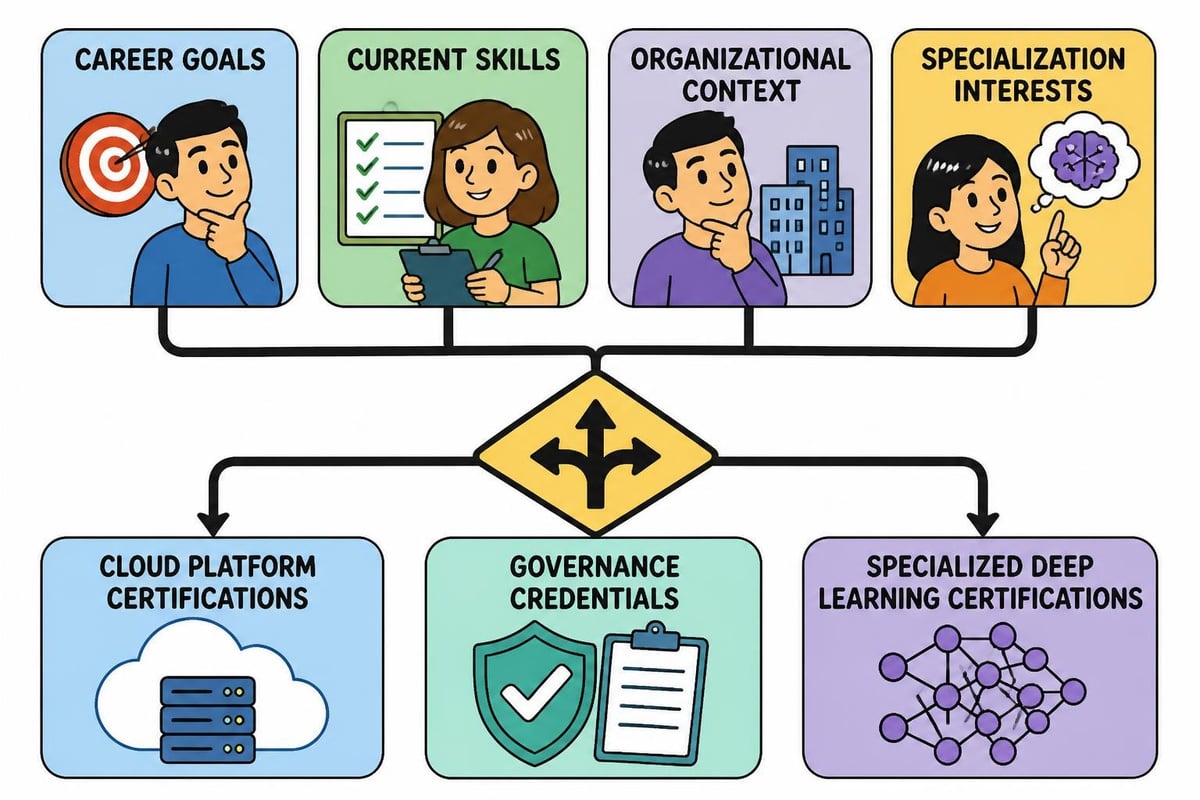
Choosing among the dozens of available AI and ML certifications requires aligning credential characteristics with your specific career objectives, current skill level, and organizational context. The best AI and ML certification for one professional may represent a poor investment for another with different goals.
Start with clear role definition. Are you targeting individual contributor roles implementing models, engineering roles building ML infrastructure, or leadership positions governing AI strategy? Technical implementation roles prioritize cloud platform certifications demonstrating hands-on capability. Infrastructure and MLOps positions value credentials showing deployment expertise and operational excellence. Leadership and cross-functional roles increasingly require governance certifications addressing responsible AI practices.
Consider your organization's technology commitments. If your employer has standardized on AWS, Azure, or Google Cloud, platform-specific certifications deliver immediate applicability and often receive internal recognition for promotions or project assignments. Multi-cloud environments or consulting roles benefit more from vendor-neutral credentials demonstrating portable knowledge.
Evaluation Criteria for Certification Quality
Not all certifications carry equal weight in the job market. Recent analysis from Forbes highlights that employer recognition, skill validation rigor, and community reputation separate valuable credentials from low-impact certificates.
Apply these quality indicators when evaluating certifications:
- Issuing organization credibility – Major cloud providers, established professional associations, and recognized academic institutions carry more weight than unknown training companies
- Exam rigor and failure rates – Certifications with 40-60% pass rates validate meaningful expertise; those with 90%+ pass rates often lack discriminatory value
- Recertification requirements – Credentials requiring renewal through continuing education or re-examination maintain relevance in fast-moving fields
- Job posting mentions – Search current job listings in your target roles to quantify how often specific certifications appear in requirements or preferences
- Community recognition – Active communities, user groups, and peer discussion indicate sustained professional value
Academic research on certification design emphasizes the importance of inclusive assessment practices that validate diverse learning paths while maintaining rigorous standards. Studies on AI certification design suggest that well-constructed credentials balance theoretical knowledge, practical application, and ethical considerations rather than focusing narrowly on tool proficiency.
Budget and Time Investment Considerations
The best AI and ML certification must fit within realistic time and budget constraints while delivering proportional career value. Certification costs typically range from $150 for entry-level credentials to $500+ for advanced professional certifications, with preparation time varying from 30 to 150+ hours depending on background and credential difficulty.
Most professionals underestimate total certification investment by focusing only on exam fees. Comprehensive budgeting should include:
- Exam registration fees ($150-$500 per attempt)
- Preparation materials (courses, practice exams, textbooks: $0-$500)
- Retake costs if first attempt fails (same as registration fee)
- Time opportunity cost (40-150 hours that could be allocated to other activities)
- Recertification expenses every 1-3 years for credentials requiring renewal
For professionals seeking structured preparation, platforms offering comprehensive learning paths reduce total investment by consolidating preparation materials. Exploring specialized programs like NVIDIA AI certification preparation or IBM AI certification tracks can streamline study while ensuring coverage of exam objectives.
Certification Preparation Strategies That Work
Effective certification preparation balances conceptual understanding, hands-on practice, and exam-specific strategy. The most successful candidates approach certification as skill development rather than exam memorization, building genuine expertise that translates into job performance.
Structured Learning Paths
Begin with official exam guides that outline tested topics and skill domains. Cloud provider certifications include detailed blueprints specifying the percentage weight of each exam section, allowing focused study on high-value areas. Use this blueprint to assess current knowledge gaps through diagnostic practice exams.
Effective preparation sequences typically follow this pattern:
- Foundation building – Address any gaps in prerequisite knowledge (statistics, programming, cloud fundamentals) before advanced topics
- Conceptual learning – Study core concepts, algorithms, and frameworks through courses, documentation, and textbooks
- Hands-on practice – Implement examples, complete labs, and build projects that mirror exam scenarios
- Exam familiarization – Take practice exams under timed conditions to identify remaining weak areas and build stamina
- Targeted reinforcement – Deep-dive into topics where practice exam performance was weakest
Professionals without strong mathematical backgrounds should invest extra time in foundational statistics, linear algebra, and calculus concepts that underpin ML algorithms. Many certification exams test not just tool usage but understanding of why certain approaches work and when to apply specific techniques.
Hands-On Project Requirements
Most valuable AI and ML certifications require demonstrating practical capability, not just theoretical knowledge. Building portfolio projects that align with certification objectives serves dual purposes: exam preparation and career advancement through tangible work examples.
Cloud platform certifications particularly benefit from project-based preparation. Deploy end-to-end ML pipelines on your target platform, experiment with different services and features, and document decisions and trade-offs. This hands-on experience builds the contextual understanding tested in scenario-based exam questions.
For specialized certifications in areas like computer vision or natural language processing, implement key algorithms from research papers rather than relying exclusively on high-level libraries. This deeper engagement builds intuition about model behavior, debugging strategies, and optimization approaches that separate strong candidates from those with superficial understanding.
Community Resources and Study Groups
Certification communities provide valuable resources including study guides, practice questions, experience reports, and peer support. Major platforms host forums, Discord channels, and LinkedIn groups where candidates share preparation strategies and exam experiences.
Leverage community resources strategically:
- Read recent pass/fail reports to understand current exam difficulty and content emphasis
- Join study groups for accountability, collaborative learning, and diverse perspectives
- Contribute answers to others' questions to reinforce your own understanding through teaching
- Attend local meetups or virtual sessions where certified professionals share career impact and preparation advice
Be cautious about "brain dump" sites that claim to offer actual exam questions. Beyond ethical concerns, relying on memorized answers rather than genuine understanding leads to poor job performance and difficulty with recertification. Legitimate practice exams test concepts in varied ways rather than providing literal exam content.
Integration With Career Development Plans
The best AI and ML certification functions as one component of a comprehensive career development strategy rather than a standalone credential. Integrate certification with complementary activities that build reputation, expand networks, and demonstrate applied expertise.
Position certification within broader professional development:
- Before certification: Build foundational projects and GitHub repository demonstrating practical skills
- During preparation: Document learning through blog posts, tutorials, or presentations that establish thought leadership
- After certification: Apply new knowledge to work projects with measurable business impact
- Ongoing: Engage with professional communities, contribute to open source, and pursue continuous learning
Organizations increasingly value professionals who combine technical credentials with communication skills, business acumen, and collaborative capability. Supplement technical certifications with training in presentation skills, project management, stakeholder communication, and domain expertise in your industry vertical.
For professionals in specialized industries, domain-specific applications of AI create unique value. Consider pairing general ML certifications with domain expertise in areas like healthcare, finance, manufacturing, or retail. Understanding industry-specific constraints, regulatory requirements, and business models differentiates you from generic ML practitioners.
Emerging Certification Trends for 2026 and Beyond
The AI certification landscape continues evolving rapidly in response to technological advances, regulatory developments, and shifting employer priorities. Several emerging trends will shape certification value through 2027 and beyond.
Multimodal AI and generative models are becoming standard exam topics rather than cutting-edge specializations. Certifications updated in 2026 increasingly test understanding of transformer architectures, prompt engineering, fine-tuning strategies, and responsible deployment of large language models. Professionals pursuing the best AI and ML certification should ensure content coverage reflects these contemporary capabilities.
Edge AI and deployment optimization receive growing attention as organizations deploy models to resource-constrained devices and prioritize inference efficiency. Certifications covering model quantization, pruning, knowledge distillation, and edge-specific frameworks address critical production requirements often overlooked in traditional ML curricula.
Governance and responsible AI content is being integrated into technical certifications rather than remaining siloed in specialized credentials. Cloud platform exams now include questions about bias detection, model explainability, data privacy, and compliance frameworks. This integration reflects employer expectations that all AI practitioners understand responsible deployment principles.
Cross-functional AI literacy certifications designed for non-technical professionals are proliferating. Product managers, marketers, executives, and other business roles increasingly need structured understanding of AI capabilities, limitations, and strategic implications without deep technical implementation skills. These credentials serve different purposes than engineering certifications but address genuine organizational needs.
Selecting the best AI and ML certification requires balancing your career goals, current expertise, organizational context, and market demand trends. Whether you pursue cloud platform credentials demonstrating operational capability, governance certifications addressing responsible AI deployment, or specialized qualifications in cutting-edge techniques, the right certification accelerates career progression while validating expertise that drives real business value. MammothClub provides comprehensive preparation resources across 3,000+ AI and ML courses, interactive bootcamps, and corporate certification programs designed to help you master exam objectives while building practical skills that translate directly into workplace impact.