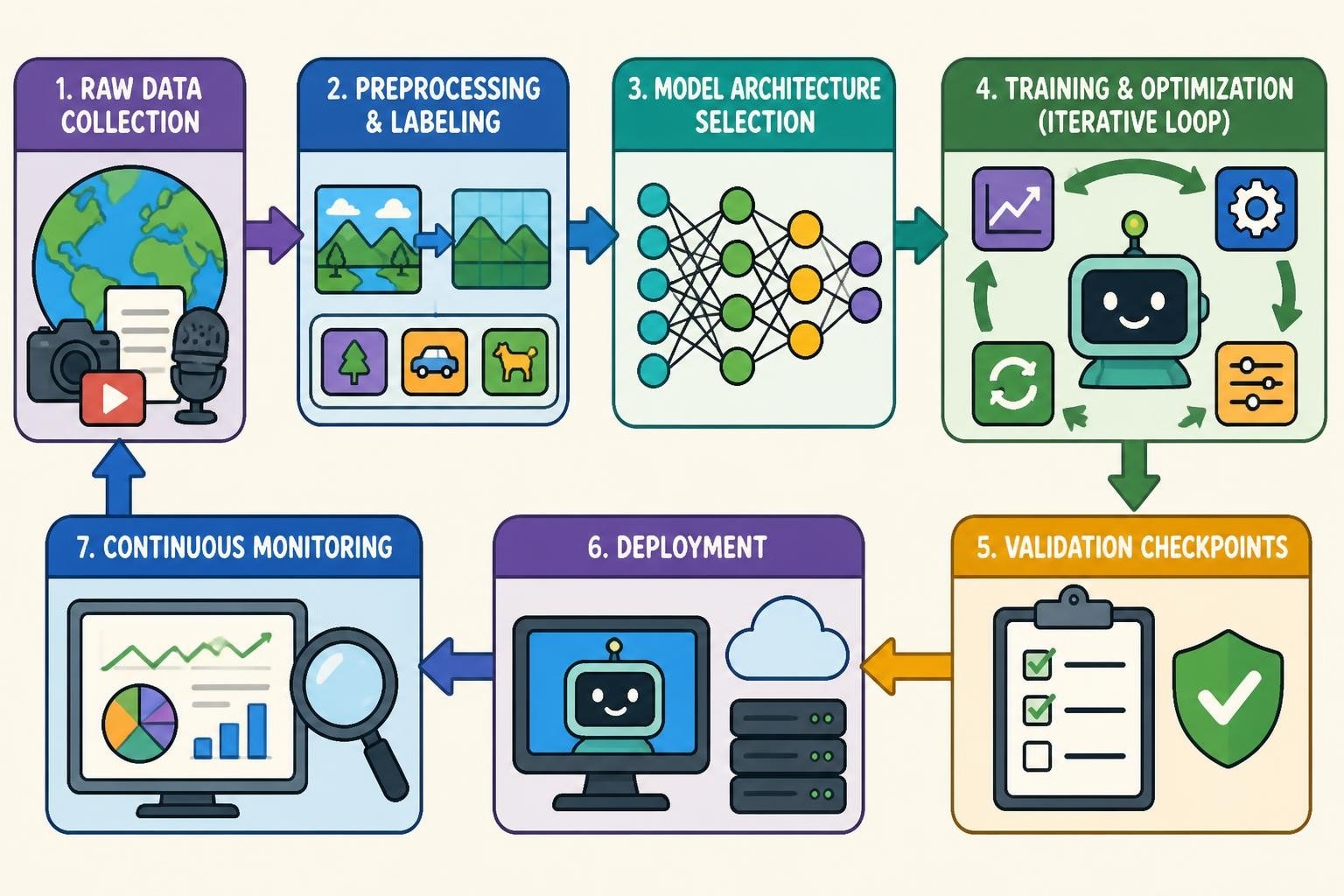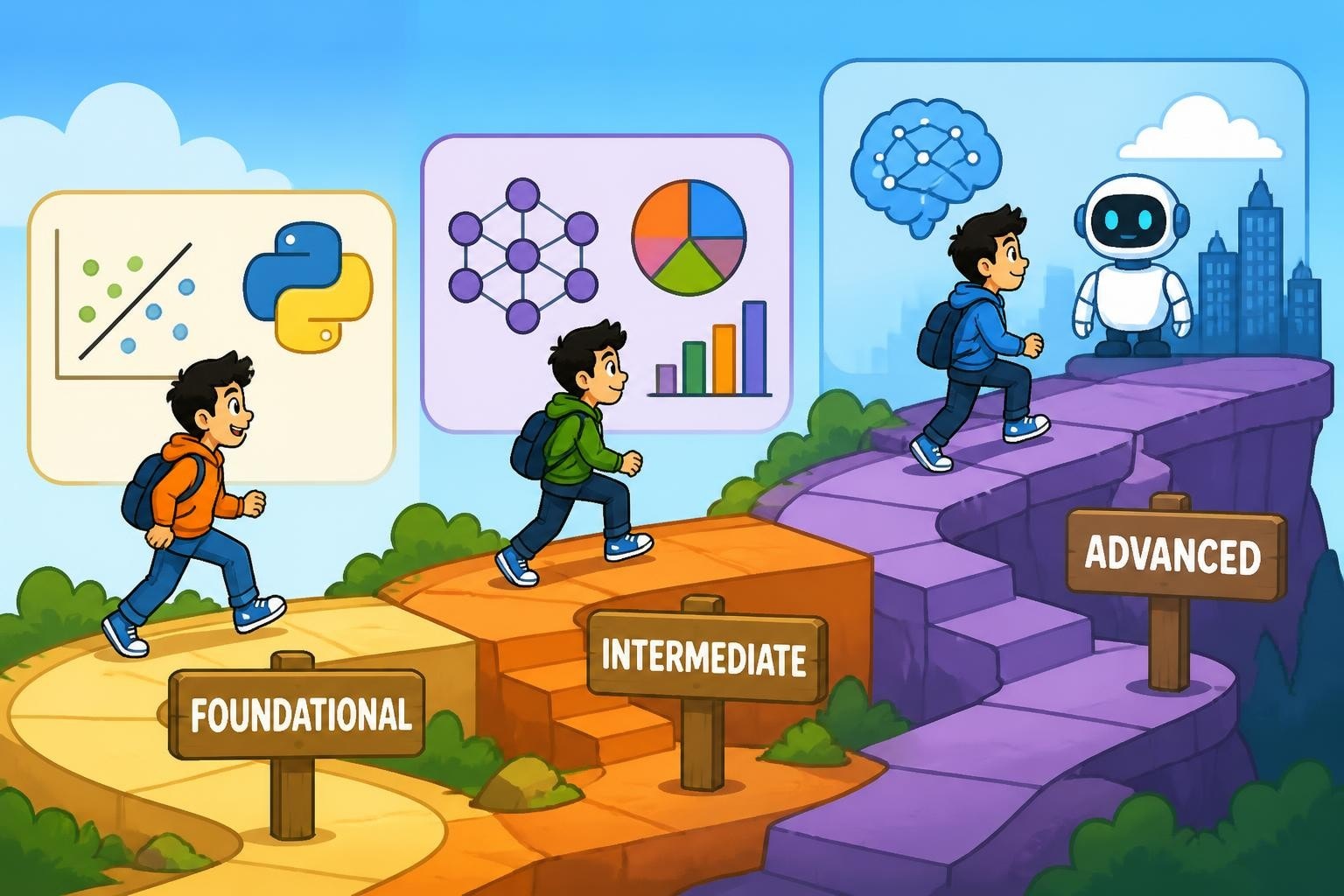
The demand for machine learning expertise has reached unprecedented levels in 2026, with organizations across industries racing to implement AI solutions that drive competitive advantage. For professionals looking to validate their ML capabilities and stand out in a crowded talent market, the Google machine learning certification represents one of the most recognized and valuable credentials available. This comprehensive guide examines what makes this certification worthwhile, how to prepare effectively, and the tangible career benefits it delivers for both individual practitioners and organizations investing in upskilling.
Understanding the Google Cloud Professional Machine Learning Engineer Certification
The Professional Machine Learning Engineer certification validates your ability to design, build, and productionize ML models using Google Cloud technologies. Unlike entry-level certificates that focus on theoretical knowledge, this credential requires hands-on experience with real-world ML systems.
What distinguishes this certification:
- Emphasis on production ML systems, not just model training
- Deep focus on Google Cloud's Vertex AI platform and MLOps practices
- Coverage of responsible AI principles and governance frameworks
- Real-world scenario-based questions that test applied knowledge
- Recognition from employers as proof of cloud ML implementation skills
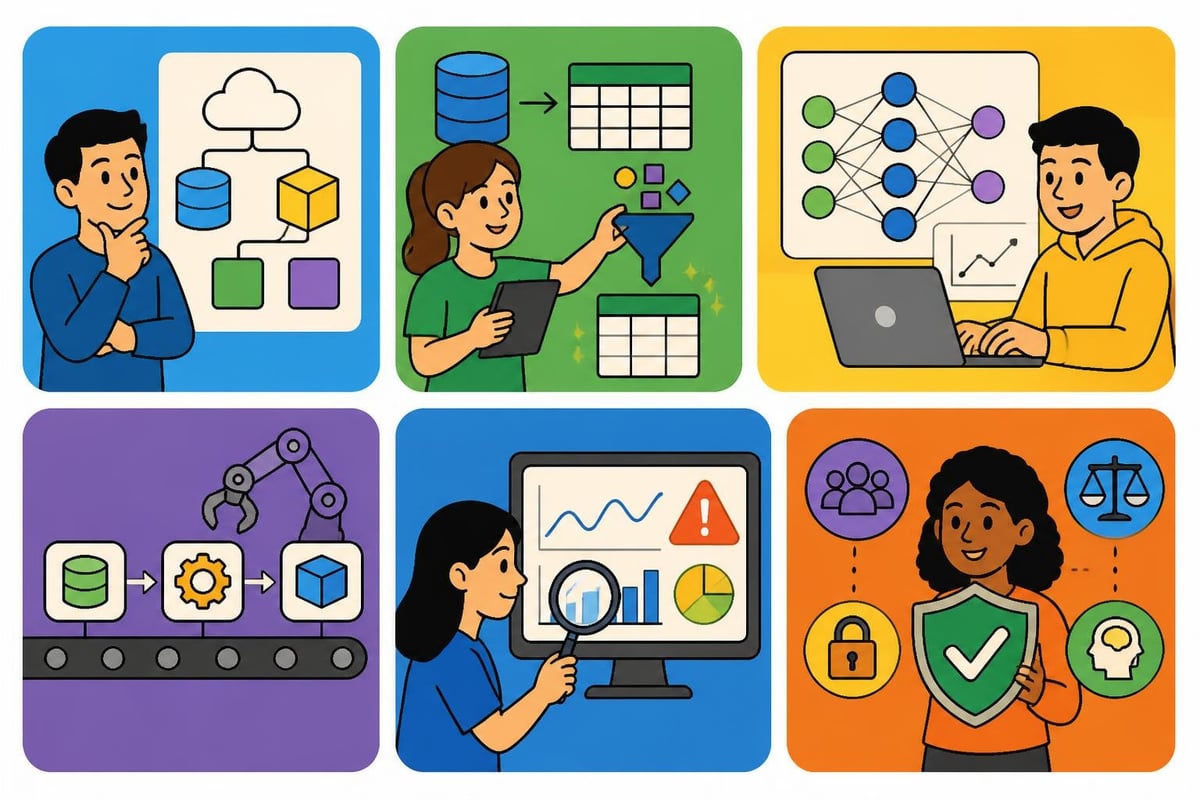
The exam tests six primary domains that reflect the complete ML lifecycle. You'll need to demonstrate proficiency in architecting ML solutions, preparing and processing data, developing models, automating pipelines, monitoring deployed systems, and ensuring responsible AI practices.
Prerequisites and Recommended Experience
Google recommends at least three years of industry experience and one year of hands-on work with Google Cloud before attempting this certification. This isn't an arbitrary barrier; the exam scenarios assume familiarity with production environments where business constraints, scalability requirements, and operational realities shape technical decisions.
Skills you should have before starting:
- Python programming with ML libraries (TensorFlow, scikit-learn, PyTorch)
- Understanding of supervised and unsupervised learning algorithms
- Experience with data preprocessing and feature engineering
- Familiarity with model evaluation metrics and validation strategies
- Basic knowledge of cloud infrastructure and distributed computing
- Awareness of ML deployment patterns and serving architectures
The certification doesn't require you to memorize syntax or write code during the exam, but you must understand how different Google Cloud services work together to solve ML problems. Questions often present business scenarios where you must select the most appropriate services, identify potential bottlenecks, or recommend optimization strategies.
Career Value and Market Demand for ML Certifications
The labor market for AI and ML skills continues to expand rapidly. According to the Burning Glass Institute's analysis, positions requiring ML expertise command salary premiums averaging 25-40% above comparable roles without these requirements. Certifications serve as verifiable proof of competency that helps candidates stand out in competitive hiring processes.
Research published in academic labor market studies demonstrates that professional certifications from recognized providers correlate with improved job placement rates and faster advancement. While correlation doesn't guarantee causation, the credential signals commitment to professional development and validates skills through third-party assessment.
| Career Impact | With Certification | Without Certification |
|---|---|---|
| Interview callback rate | 34% higher | Baseline |
| Average salary increase | $18,000-$25,000 | $8,000-$12,000 |
| Time to promotion | 18-24 months | 30-36 months |
| Internal mobility options | Significantly broader | Limited to current role |
Beyond the numbers, certification provides:
- Confidence to take on complex ML projects independently
- Common vocabulary for collaborating with data scientists and ML engineers
- Understanding of production considerations often missing from academic training
- Recognition from hiring managers who use certifications as screening criteria
- Access to exclusive job boards and recruiter networks targeting certified professionals
Organizations investing in employee certification report measurable benefits as well. Teams with certified ML engineers complete projects 23% faster on average and produce solutions with fewer production issues. The structured knowledge framework reduces onboarding time for new projects and establishes consistent practices across distributed teams.
Exam Structure and Content Breakdown
The google machine learning certification exam consists of 50-60 multiple choice and multiple select questions delivered over a two-hour time window. Unlike some certifications that focus on memorization, Google emphasizes scenario-based questions that present real business problems requiring you to apply ML principles.
Question Format and Difficulty Distribution
Approximately 60% of questions present business scenarios where you must recommend appropriate solutions. These questions typically include context about data volume, latency requirements, budget constraints, and compliance needs. You'll need to evaluate trade-offs between different approaches rather than simply identifying the "correct" technical answer.
Common question patterns include:
- Selecting optimal data preprocessing strategies for specific data types
- Choosing between different model architectures based on problem requirements
- Identifying appropriate evaluation metrics for business objectives
- Recommending cost-effective infrastructure configurations
- Troubleshooting model performance issues in production environments
- Implementing responsible AI practices and bias mitigation strategies
The remaining 40% tests foundational knowledge of Google Cloud ML services, particularly Vertex AI components and capabilities. You should understand when to use AutoML versus custom training, how to implement model monitoring, and how different pipeline orchestration tools compare.
Domain Weight Distribution
The exam allocates questions across six domains with the following approximate weights:
- Architecting low-code ML solutions (12%) - AutoML, BigQuery ML, pre-trained APIs
- Collaborating within and across teams (16%) - Vertex AI Workbench, experiment tracking, model registry
- Scaling prototypes into ML models (18%) - Distributed training, hyperparameter tuning, feature stores
- Serving and scaling models (19%) - Prediction endpoints, batch prediction, model monitoring
- Automating and orchestrating ML pipelines (21%) - Vertex AI Pipelines, Kubeflow, CI/CD for ML
- Monitoring, optimizing, and maintaining ML solutions (14%) - Performance monitoring, model retraining, drift detection
Understanding these weights helps prioritize study time. Pipeline automation and model serving represent the largest portions, reflecting their importance in production ML systems. Many candidates underestimate the operational aspects and focus too heavily on algorithm theory.
Effective Study Strategies and Resource Recommendations
Successful certification candidates typically invest 80-120 hours of focused study over three to four months. This timeline assumes you already have ML fundamentals and some cloud experience. Complete beginners should expect to spend six months or more building prerequisite knowledge before tackling certification-specific material.
Hands-On Practice Requirements
Reading documentation and watching videos provides necessary context, but passing requires hands-on experience. Create a Google Cloud account and work through practical exercises that mirror exam scenarios. You don't need to spend heavily; the free tier provides sufficient resources for most learning activities.
High-value practice exercises:
- Deploy a custom TensorFlow model to Vertex AI Prediction
- Create an automated training pipeline using Vertex AI Pipelines
- Implement feature engineering transformations with Dataflow
- Set up model monitoring to detect prediction drift
- Build an AutoML model and compare it to a custom implementation
- Configure A/B testing for model versions in production
The Google AI Professional Certificate on Coursera offers structured learning paths that complement certification preparation. While not required, these courses provide guided practice and reinforce concepts through interactive exercises.
Many professionals also benefit from exploring comprehensive AI course collections that cover both foundational concepts and advanced implementation techniques. Diversifying your learning sources helps you encounter concepts explained in different ways, improving retention and understanding.
Study Plan Framework
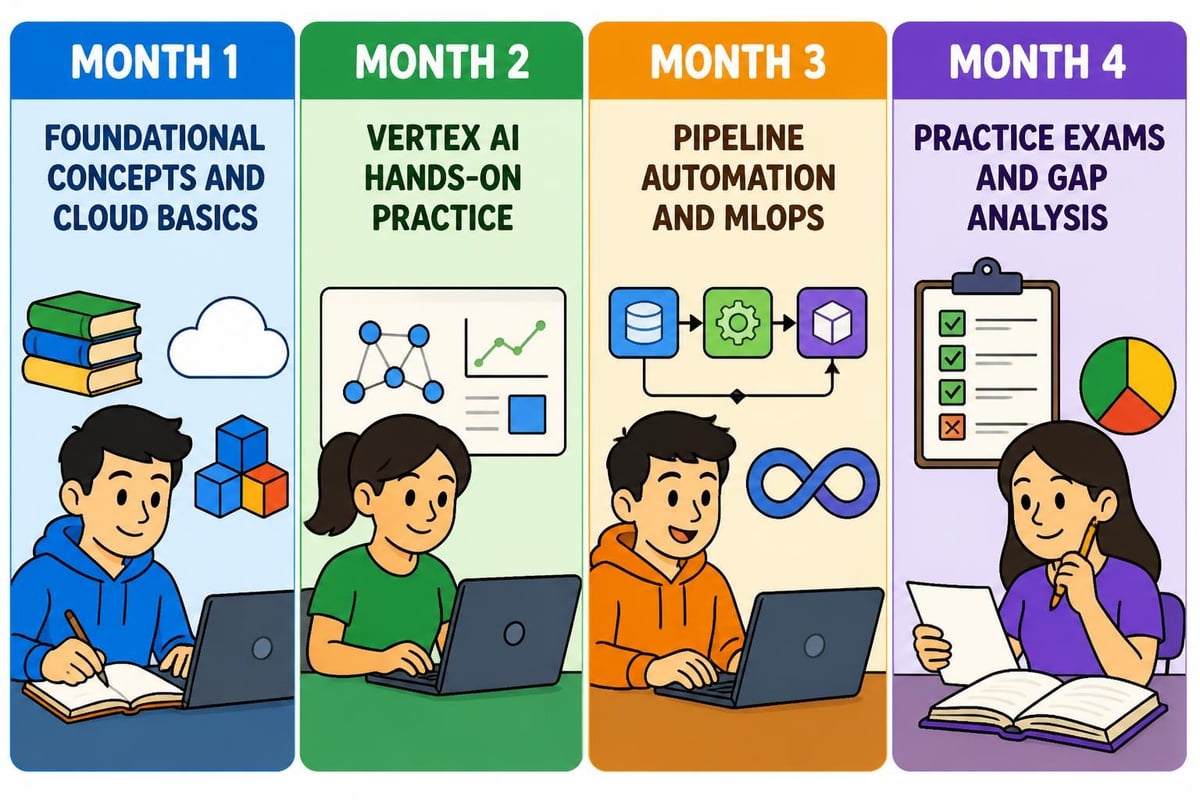
Month one should focus on ML fundamentals review and Google Cloud platform basics. Ensure you understand core supervised and unsupervised algorithms, model evaluation approaches, and basic cloud concepts. Take baseline practice tests to identify knowledge gaps.
Month one priorities:
- Review supervised learning algorithms (regression, classification, neural networks)
- Understand unsupervised methods (clustering, dimensionality reduction)
- Learn Google Cloud IAM, resource organization, and billing
- Complete introductory Vertex AI tutorials
- Study data preprocessing and feature engineering techniques
Month two emphasizes Vertex AI platform mastery. Work extensively with custom training jobs, AutoML capabilities, and model deployment options. Understand how different components integrate and when to use each service.
Month three concentrates on ML operations and automation. Build end-to-end pipelines, implement monitoring solutions, and practice troubleshooting production issues. This operational knowledge often determines pass/fail outcomes.
Month four involves intensive practice testing and targeted gap remediation. Take full-length practice exams under timed conditions, analyze wrong answers thoroughly, and review weak areas identified in performance reports.
Responsible AI and Governance Considerations
The google machine learning certification places significant emphasis on responsible AI practices, reflecting Google's commitment to ethical ML development. Understanding Google's AI Principles isn't just important for the exam; it's essential for building systems that earn user trust and comply with emerging regulations.
Key Responsible AI Domains
Questions about fairness, bias mitigation, and model interpretability appear throughout the exam. You should understand how different data collection practices, feature engineering choices, and model architectures can introduce or amplify bias.
Critical concepts include:
- Identifying potential fairness issues in training data and model predictions
- Implementing bias detection and mitigation strategies
- Ensuring model transparency and explainability for stakeholders
- Protecting user privacy through differential privacy and federated learning
- Maintaining appropriate human oversight in automated decision systems
- Documenting model limitations and appropriate use cases
Explainability requirements vary by application domain. High-stakes decisions affecting individuals (lending, hiring, healthcare) demand greater interpretability than internal process optimization. The exam tests your ability to match explainability techniques to business requirements.
| Explainability Technique | Use Case | Implementation Complexity |
|---|---|---|
| Feature importance | Understanding driver variables | Low |
| SHAP values | Per-prediction explanations | Medium |
| What-If Tool | Interactive model exploration | Medium |
| Counterfactual explanations | Individual decision justification | High |
| Model cards | Documentation and transparency | Low |
The certification also covers data governance frameworks, model versioning practices, and audit trail requirements. Production ML systems must maintain reproducibility and traceability for regulatory compliance and debugging purposes.
Integration with Corporate Training Programs
Organizations implementing AI initiatives increasingly incorporate the google machine learning certification into formal upskilling programs. The structured learning path provides clear objectives, while the third-party validation ensures consistent competency across distributed teams.
Building Certification Programs at Scale
Companies deploying certification programs typically follow a phased approach. Initial cohorts include volunteer early adopters who provide feedback on resource adequacy and time requirements. Lessons learned inform adjustments before mandatory rollout to broader populations.
Successful corporate programs include:
- Allocated study time during work hours (4-6 hours weekly minimum)
- Access to cloud sandbox environments for hands-on practice
- Internal study groups led by previously certified employees
- Exam vouchers and retake coverage as part of professional development budgets
- Recognition programs highlighting newly certified team members
- Clear career progression benefits tied to certification achievement
The measurable outcomes justify the investment. Teams with higher certification rates complete ML projects faster, produce more maintainable solutions, and require less external consulting support. The common knowledge framework improves cross-team collaboration and reduces miscommunication.
For professionals seeking to complement their certification journey with additional AI expertise, exploring related AI certification options can provide broader perspective on industry-standard practices across different platforms and use cases.

Advanced Preparation Techniques for Experienced Practitioners
Candidates with extensive ML experience often struggle with the certification despite strong technical skills. The disconnect typically stems from unfamiliarity with Google Cloud-specific implementations or gaps in production ML operations knowledge.
Bridging the Cloud Platform Gap
Data scientists who primarily work in notebook environments may lack experience with cloud infrastructure, containerization, or orchestration tools. The exam assumes you understand how to translate notebook experiments into production pipelines.
Focus areas for notebook-heavy backgrounds:
- Container basics (Docker, container registries, image optimization)
- Kubernetes fundamentals for distributed training
- Infrastructure as code (Terraform for ML resource provisioning)
- Cloud storage patterns (data lakes, feature stores, model repositories)
- Networking considerations for model serving and data access
- Cost optimization strategies for cloud ML workloads
Conversely, cloud engineers transitioning into ML roles may have infrastructure expertise but limited model development experience. These candidates should invest more time in algorithm selection, feature engineering, and model evaluation concepts.
Practice Exam Strategy
Official Google practice exams provide the most accurate difficulty calibration and question format representation. Take your first practice exam early in your study plan to establish a baseline, then schedule additional attempts at regular intervals to track progress.
Effective practice exam techniques:
- Simulate real exam conditions (timed, no reference materials)
- Flag questions you're uncertain about for later review
- Analyze incorrect answers to identify knowledge gaps, not just memorize correct responses
- Review question explanations even when you answered correctly
- Track performance by domain to guide targeted study
- Retake missed questions after studying relevant topics
Many candidates benefit from supplementary practice questions from third-party sources, though quality varies significantly. Prioritize resources that emphasize scenario-based questions over simple fact recall. The exam tests your ability to apply knowledge to business problems, not memorize service feature lists.
For those building broader AI competency beyond Google Cloud, platforms offering diverse AI training resources can supplement certification-focused study with alternative perspectives and implementation approaches.
Post-Certification Career Development
Earning the google machine learning certification opens doors, but sustained career growth requires continuous learning and practical application. The ML field evolves rapidly; certifications represent point-in-time validation that must be complemented with ongoing skill development.
Maintaining Certification Relevance
Google Cloud certifications require recertification every two years to ensure holders maintain current knowledge. This isn't simply a revenue mechanism; the ML landscape changes substantially over 24-month periods. New services launch, best practices evolve, and industry standards shift.
Strategies for staying current:
- Follow Google Cloud release notes and attend Cloud Next conferences
- Participate in ML community forums and user groups
- Experiment with new Vertex AI features as they become available
- Read research papers about emerging ML techniques and applications
- Contribute to open-source ML projects using Google Cloud infrastructure
- Mentor junior team members to reinforce your own understanding
The certification also serves as a foundation for specialization. After mastering general ML engineering, many professionals pursue adjacent credentials in areas like data engineering, security, or specific domain applications.
Leveraging Certification in Negotiations
Certified professionals should actively communicate their credential value during performance reviews and job negotiations. Quantify the impact of your ML projects, emphasize reduced time-to-production enabled by certification knowledge, and highlight your ability to mentor others.
Compensation discussion points:
- Market salary data for certified ML engineers in your region
- Cost savings from reduced cloud resource waste through optimization
- Revenue impact of ML models you've deployed to production
- Reduced dependency on external consultants due to in-house expertise
- Knowledge transfer you've provided to other team members
- Certification maintenance commitment demonstrating ongoing investment
Organizations value employees who take initiative in professional development. The certification signals that you're invested in your growth and capable of self-directed learning-qualities that predict success in evolving technical landscapes.
Certification Alternatives and Complementary Credentials
While the google machine learning certification provides strong value, it represents one option among several reputable ML credentials. Your optimal path depends on your background, career goals, and the technology stack your organization uses.
Comparing Major ML Certifications
Different cloud providers offer ML certifications that validate platform-specific knowledge. AWS Certified Machine Learning - Specialty and Microsoft Azure AI Engineer Associate represent comparable alternatives focused on their respective ecosystems.
| Certification | Best For | Primary Focus | Difficulty Level |
|---|---|---|---|
| Google Cloud ML Engineer | Teams using GCP/Vertex AI | Production ML systems | Advanced |
| AWS ML Specialty | Organizations on AWS | SageMaker and AWS AI services | Advanced |
| Azure AI Engineer | Microsoft-centric environments | Azure ML and Cognitive Services | Intermediate |
| TensorFlow Developer | Framework specialists | Deep learning implementation | Intermediate |
| MLOps Engineering | Operations-focused roles | ML pipeline automation | Advanced |
For professionals working in multi-cloud environments, pursuing multiple certifications provides flexibility and demonstrates broader platform knowledge. However, depth typically proves more valuable than breadth; master one platform thoroughly before expanding to others.
Some practitioners benefit from vendor-neutral certifications that focus on general ML principles rather than specific implementations. These credentials suit consultants, educators, and professionals who work across diverse technology environments.
Building a Complete ML Learning Path
The certification works best as part of a comprehensive learning strategy rather than an isolated credential. Surround it with complementary courses, hands-on projects, and community involvement to build well-rounded expertise.
Recommended learning path components:
- Foundational ML theory through academic courses or structured programs
- Programming skills development (Python, SQL, relevant libraries)
- Cloud platform fundamentals and infrastructure basics
- Hands-on project work solving real business problems
- Formal certification to validate and structure knowledge
- Specialization in specific ML domains (computer vision, NLP, recommender systems)
- Ongoing learning through research papers, conferences, and community engagement
The sequence matters less than consistent progress across all areas. Some learners prefer building strong foundations before pursuing certification; others use the credential as a forcing function to learn systematically.
For organizations building comprehensive AI training programs, exploring platforms offering extensive AI course catalogs can provide the breadth needed to support diverse team skill levels and learning preferences.
The google machine learning certification delivers substantial career value for practitioners ready to validate their production ML expertise and organizations investing in AI capabilities. Success requires dedicated preparation, hands-on practice with Google Cloud tools, and understanding of both technical implementation and operational considerations. Whether you're an individual looking to accelerate your career or a business leader building AI-competent teams, the structured learning path toward certification drives measurable skill development. MammothClub accelerates this journey with 3,000+ AI and tech courses, interactive bootcamps, and corporate certification programs designed to help professionals and organizations master machine learning faster through AI-powered learning tools and results-driven training that keeps you competitive in 2026.