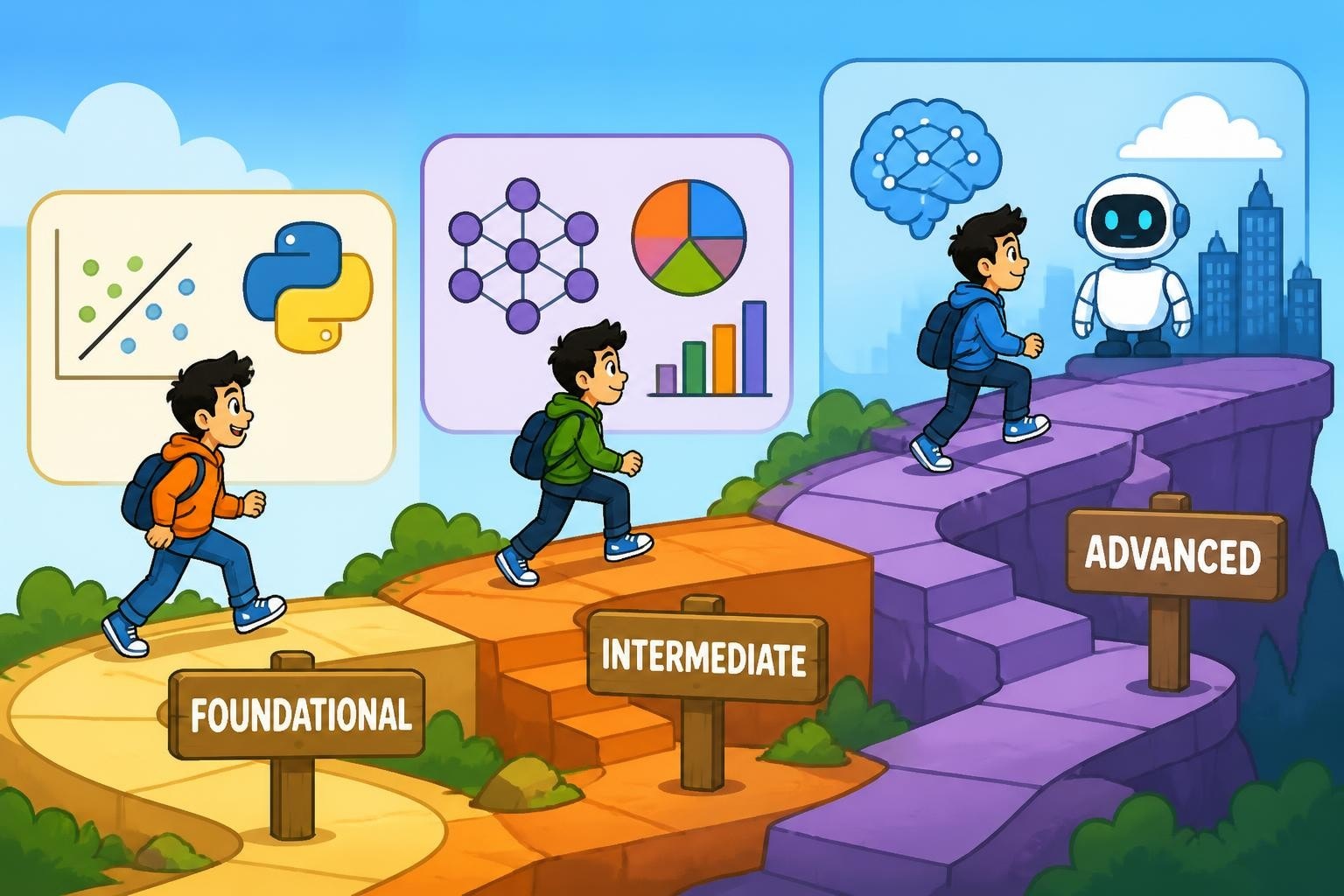
Training an AI model represents one of the most transformative capabilities professionals can develop in 2026. The process involves feeding data into algorithms, adjusting parameters through optimization techniques, and iterating until the model learns patterns that generalize to new situations. Whether you're building recommendation systems, computer vision applications, or natural language processors, understanding the fundamentals of training an AI determines the difference between models that deliver business value and those that consume resources without meaningful returns. This comprehensive guide walks through every stage of the training lifecycle, from data preparation through deployment considerations.
Understanding the AI Training Lifecycle
Training an AI follows a structured methodology that balances theoretical principles with practical engineering constraints. The lifecycle begins long before the first training epoch and extends well beyond achieving acceptable validation metrics.
Data Collection and Curation
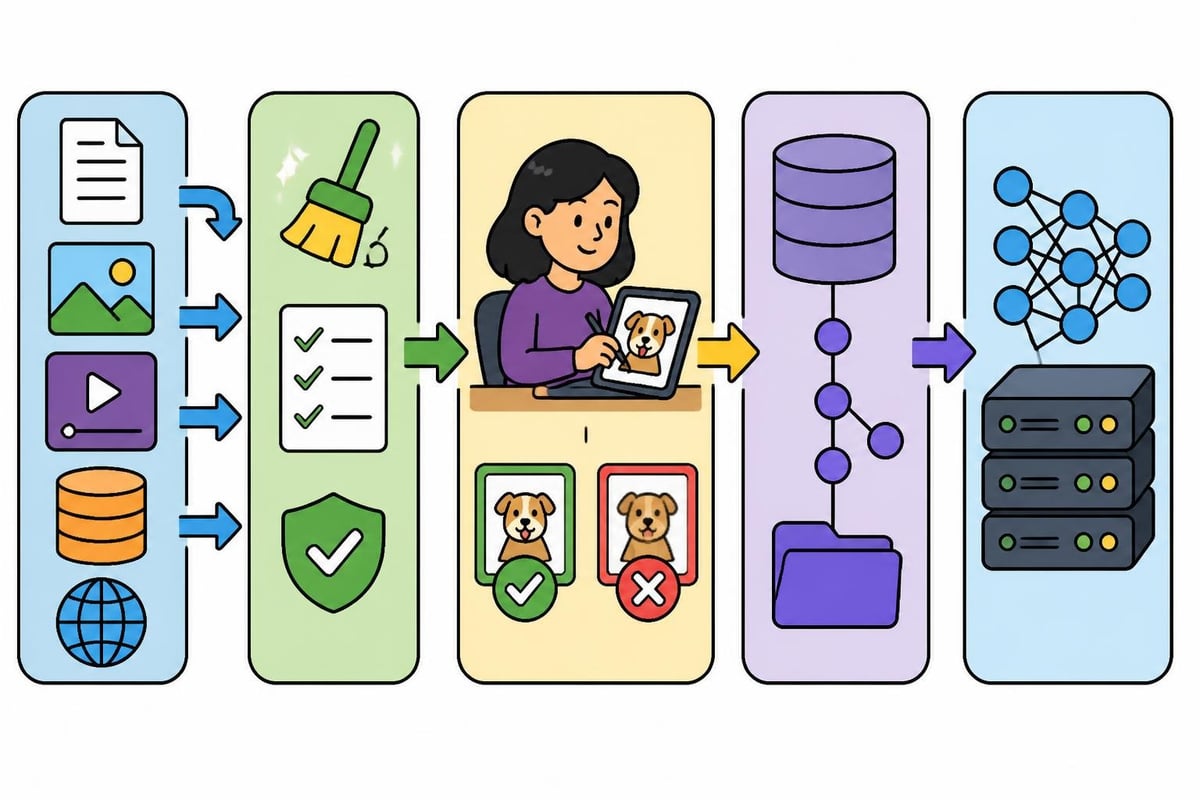
High-quality training data serves as the foundation for any successful AI project. Organizations often underestimate the effort required to assemble, clean, and label datasets that accurately represent the problem domain. For large-scale language models, practitioners frequently leverage resources like Common Crawl, which provides petabytes of web-scraped text data with clear licensing terms and access patterns.
The data curation process typically includes:
- Source identification: Determining which data repositories, databases, or collection methods align with your use case
- Quality assessment: Evaluating completeness, accuracy, consistency, and representativeness
- Bias detection: Identifying potential fairness issues or systematic gaps in coverage
- Labeling strategy: Designing annotation guidelines and quality control processes for supervised learning
- Version control: Maintaining reproducible snapshots of datasets as they evolve
Most professionals discover that data work consumes 60-80% of total project time. Organizations that invest in robust data infrastructure and clear documentation standards accelerate every subsequent training cycle.
Architecture Selection and Design
Choosing the right model architecture requires balancing task requirements, computational constraints, and maintenance considerations. Neural network architectures continue evolving rapidly, with transformers dominating natural language and vision tasks while convolutional networks remain efficient for specific computer vision applications.
| Architecture Type | Best For | Training Complexity | Inference Speed |
|---|---|---|---|
| Transformers | Language, multimodal tasks | High (requires substantial GPU resources) | Moderate |
| CNNs | Image classification, object detection | Moderate | Fast |
| RNNs/LSTMs | Sequential data with long dependencies | Moderate to High | Slower |
| Graph Neural Networks | Relational data, molecular structures | Moderate | Variable |
Understanding these tradeoffs helps teams avoid common technical debt patterns that emerge when architecture choices conflict with production requirements.
Essential Training Techniques and Optimization
Training an AI effectively requires mastering optimization algorithms, regularization strategies, and hyperparameter tuning methodologies that directly impact model performance and convergence speed.
Initialization and Optimization Fundamentals
Proper weight initialization prevents vanishing or exploding gradients that can stall training before learning begins. Stanford's CS231n lecture materials provide rigorous coverage of initialization strategies, from Xavier to He initialization, along with their mathematical justifications.
Modern optimization typically employs Adam or AdamW optimizers rather than vanilla stochastic gradient descent, offering adaptive learning rates per parameter while maintaining computational efficiency. Key considerations include:
- Learning rate schedules: Warmup periods followed by cosine decay or step reduction
- Gradient clipping: Preventing unstable updates in recurrent architectures or large batch training
- Mixed precision training: Leveraging FP16 computations to reduce memory footprint and accelerate training
- Gradient accumulation: Simulating larger batch sizes when GPU memory constrains batch dimensions
The MLPerf Training benchmarks establish reference implementations and performance targets across common model types, helping organizations understand realistic training timelines and resource requirements for their infrastructure.
Regularization and Generalization
Preventing overfitting remains a central challenge when training an AI, particularly with models containing millions or billions of parameters. Effective regularization combines multiple complementary techniques:
- Dropout: Randomly deactivating neurons during training to prevent co-adaptation
- Weight decay (L2 regularization): Penalizing large parameter values in the loss function
- Data augmentation: Artificially expanding training sets through transformations
- Early stopping: Monitoring validation metrics and halting before overfitting begins
- Ensemble methods: Combining predictions from multiple independently trained models
Practitioners should track both training and validation metrics throughout the optimization process. Divergence between these curves signals overfitting and indicates the need for stronger regularization or additional training data.
Hyperparameter Optimization Strategies
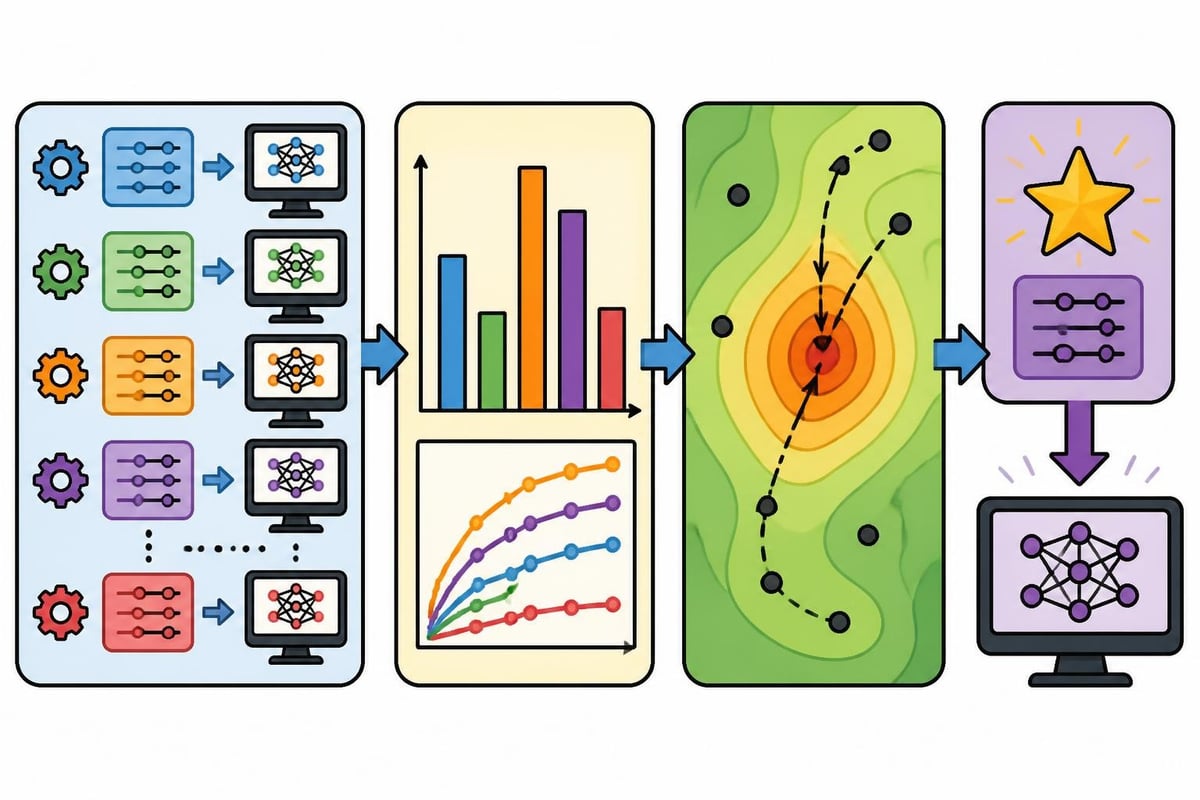
Training an AI involves dozens of hyperparameter choices that dramatically affect final performance. Rather than manual trial-and-error, systematic approaches include:
- Grid search: Exhaustively evaluating discrete hyperparameter combinations
- Random search: Sampling from hyperparameter distributions (often more efficient than grid search)
- Bayesian optimization: Using probabilistic models to guide search toward promising regions
- Population-based training: Evolving hyperparameters during training through genetic algorithms
Most organizations find that investing 10-20% of compute budget in hyperparameter search yields substantial improvements in final model quality compared to using default values or intuition alone.
Infrastructure and Computational Considerations
The computational demands of training an AI have grown exponentially, with state-of-the-art language models requiring thousands of GPU-hours or petaFLOP-days of computation. Understanding infrastructure tradeoffs helps organizations allocate resources effectively.
Hardware Selection and Scaling
Graphics processing units (GPUs) remain the dominant hardware for training neural networks, though specialized accelerators like TPUs and custom ASICs gain traction for specific workloads. For professionals evaluating GPU options for AI training, key specifications include:
| Specification | Impact on Training | Typical Range (2026) |
|---|---|---|
| Memory bandwidth | Data transfer speed between GPU memory and compute cores | 900GB/s - 3TB/s |
| Tensor core count | Specialized matrix multiplication throughput | 320 - 640 cores |
| VRAM capacity | Maximum batch size and model parameters fitting in memory | 24GB - 96GB |
| NVLink/interconnect | Multi-GPU communication speed | 600GB/s - 900GB/s |
Distributed training across multiple GPUs or nodes becomes necessary for large models. Data parallelism replicates the model across devices with different data batches, while model parallelism splits the model itself when it exceeds single-device memory capacity.
Monitoring and Debugging Training Runs
Training an AI involves numerous potential failure modes: numerical instability, gradient explosions, poor convergence, or unexpected performance degradation. Comprehensive monitoring tracks:
- Loss curves (both training and validation)
- Gradient norms and statistics
- Learning rate schedules
- Memory utilization and throughput
- Weight distributions across layers
- Activation statistics
Implementing checkpointing every N iterations protects against hardware failures and enables experimentation with different continuation strategies. Recent optimization case studies demonstrate how systematic profiling and iterative refinement can reduce training time by 40-60% compared to baseline implementations.
Evaluation, Validation, and Testing
Rigorous evaluation separates models that perform well in controlled settings from those robust enough for production deployment. Training an AI without comprehensive evaluation risks deploying systems that fail unexpectedly or exhibit harmful biases.
Performance Metrics and Benchmarks
Selecting appropriate evaluation metrics depends entirely on the task and business requirements. Classification tasks might emphasize accuracy, precision, recall, or F1 scores, while regression problems focus on mean squared error or mean absolute error.
Beyond aggregate metrics, professionals should examine:
- Per-class or per-category performance to identify systematic weaknesses
- Performance across demographic subgroups to detect fairness issues
- Calibration (whether predicted probabilities reflect actual likelihoods)
- Robustness to input perturbations or adversarial examples
The Springer survey on adversarial robustness and trustworthy AI provides comprehensive coverage of evaluation methodologies that go beyond standard accuracy measurements.
Validation Set Strategy
Proper validation set construction prevents overoptimistic performance estimates that don't generalize to real-world deployment. Best practices include:
- Hold-out validation: Reserving 10-20% of data exclusively for validation
- Cross-validation: Rotating through multiple train/validation splits to reduce variance in estimates
- Temporal splits: For time-series data, validating on future periods rather than random samples
- Stratified sampling: Ensuring validation sets maintain the same class distributions as training data
Organizations often maintain three distinct data partitions: training for optimization, validation for hyperparameter selection and early stopping, and a final test set touched only once for reporting final performance.
Compliance, Documentation, and Risk Management
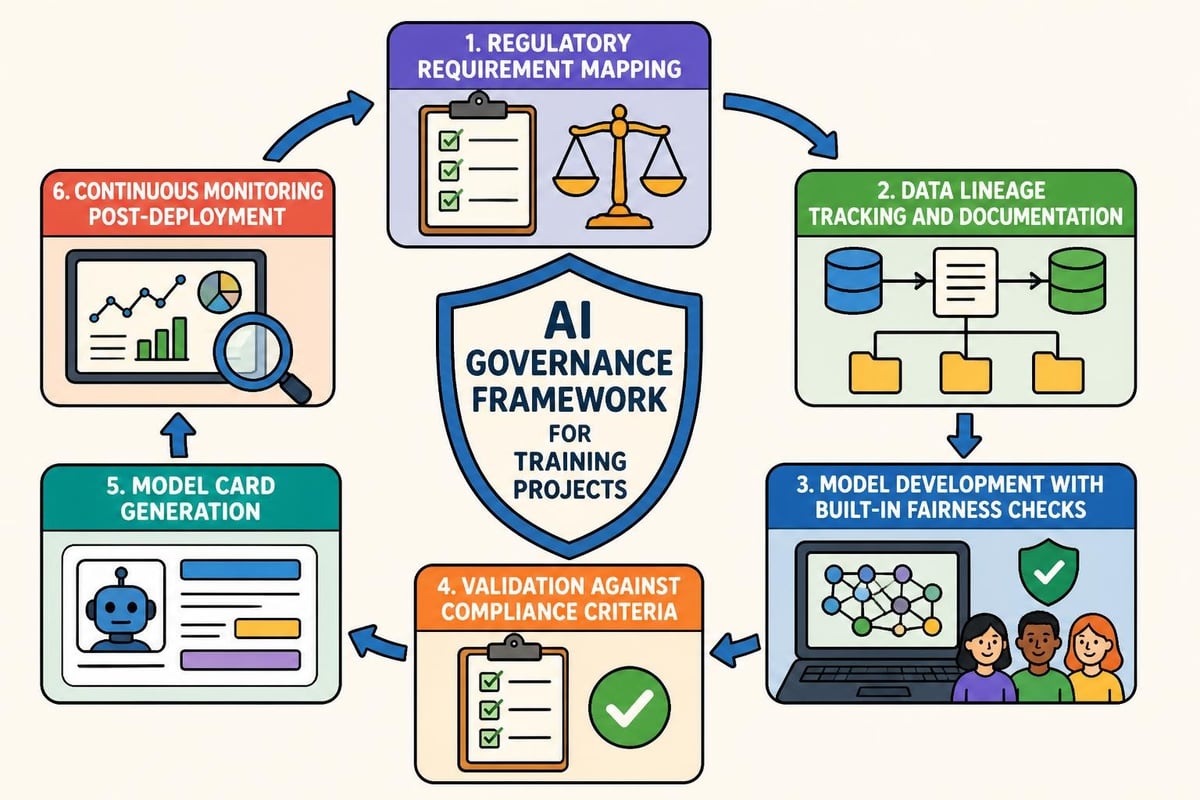
Training an AI in 2026 requires navigating increasing regulatory requirements and establishing governance frameworks that ensure responsible development and deployment.
Regulatory Frameworks and Requirements
The European Union's AI Act, which entered force in August 2024, establishes risk-based obligations for AI systems deployed in the EU. High-risk applications require extensive documentation of training data, model architecture, performance metrics, and validation procedures.
Organizations must maintain comprehensive records including:
- Training data provenance and preprocessing steps
- Model architecture specifications and hyperparameter choices
- Performance metrics across protected demographic groups
- Known limitations and failure modes
- Intended use cases and explicitly prohibited applications
The NIST AI Risk Management Framework offers practical guidance for establishing governance processes that satisfy regulatory requirements while enabling innovation.
Model Cards and Documentation Standards
Model cards provide standardized documentation summarizing model details, intended use, performance characteristics, and ethical considerations. When training an AI for production deployment, comprehensive model cards should address:
- Model details: Architecture, training procedure, and hyperparameters
- Intended use: Specific applications the model was designed for
- Factors: Variables affecting performance (demographic, environmental, technical)
- Metrics: Performance measures across relevant subgroups
- Training data: Sources, collection methods, preprocessing, and known limitations
- Ethical considerations: Potential biases, fairness analysis, and recommended mitigations
Maintaining this documentation throughout the training process, rather than retroactively, ensures accuracy and completeness while reducing compliance overhead.
Practical Implementation and Tooling
Modern AI training leverages extensive ecosystems of frameworks, libraries, and platforms that abstract low-level complexity while providing flexibility for custom implementations.
Framework Selection
Popular deep learning frameworks each offer distinct advantages:
PyTorch provides dynamic computation graphs, intuitive debugging, and extensive research community adoption. Its eager execution model simplifies development and experimentation.
TensorFlow offers comprehensive production deployment tools, superior mobile and edge device support, and tight integration with Google Cloud infrastructure.
JAX enables functional programming approaches with automatic differentiation and just-in-time compilation, appealing for researchers pushing performance boundaries.
Most professionals find that mastering one framework thoroughly proves more valuable than superficial familiarity with several. Organizations building AI courses and certification programs increasingly emphasize hands-on project work over theoretical coverage alone.
Experiment Tracking and MLOps
Training an AI generates vast quantities of experimental data: model checkpoints, hyperparameter configurations, performance metrics, and training logs. Effective experiment tracking systems enable:
- Reproducing past results precisely
- Comparing performance across dozens or hundreds of training runs
- Identifying optimal hyperparameter configurations
- Sharing insights across team members
- Auditing training procedures for compliance
Popular tools include Weights & Biases, MLflow, TensorBoard, and Neptune, each offering different balances of features, ease of use, and integration capabilities.
Establishing MLOps practices early prevents technical debt accumulation and smooths the transition from research prototypes to production systems. Key practices include version controlling both code and data, automating training pipelines, implementing continuous integration testing, and maintaining model registries.
Advanced Topics and Emerging Techniques
The field of AI training continues evolving rapidly, with new techniques emerging that challenge established practices and enable previously impossible applications.
Transfer Learning and Fine-tuning
Rather than training an AI from scratch, transfer learning leverages models pretrained on large general datasets and adapts them to specific tasks through fine-tuning. This approach dramatically reduces computational requirements and data needs while often achieving superior performance.
Fine-tuning strategies include:
- Feature extraction: Freezing pretrained layers and training only final task-specific layers
- Full fine-tuning: Updating all model parameters with lower learning rates
- Layer-wise learning rates: Applying different learning rates to different network depths
- Adapter modules: Inserting small trainable components while keeping pretrained weights frozen
Organizations pursuing specialized certifications like NVIDIA's AI programs gain practical experience with transfer learning workflows that reflect industry best practices.
Few-Shot and Zero-Shot Learning
Large language models demonstrate remarkable few-shot learning capabilities, adapting to new tasks from just a handful of examples without parameter updates. This paradigm shift reduces the traditional data collection burden for certain applications.
Prompt engineering becomes critical when leveraging few-shot capabilities, requiring careful example selection, formatting, and instruction design to elicit desired behaviors.
Continual Learning and Model Updates
Production AI systems require periodic retraining to maintain performance as data distributions shift over time. Continual learning techniques aim to incorporate new information without forgetting previously learned knowledge:
- Elastic weight consolidation: Protecting important parameters from large updates
- Rehearsal methods: Mixing old and new training examples
- Progressive neural networks: Adding new capacity while preserving old
- Knowledge distillation: Compressing ensemble knowledge into single models
Establishing monitoring systems that detect performance degradation triggers retraining workflows automatically, maintaining model quality without manual intervention.
Business Applications and ROI Considerations
Training an AI delivers tangible business value only when aligned with clear objectives and measured against relevant success criteria.
Defining Success Metrics
Technical metrics like accuracy or F1 score rarely correspond directly to business outcomes. Effective AI projects establish connections between model performance and business KPIs:
- Revenue impact: Increased conversion rates, customer lifetime value, or transaction volumes
- Cost reduction: Automated processes replacing manual labor or reducing error rates
- User experience: Faster response times, personalized recommendations, or improved satisfaction scores
- Risk mitigation: Reduced fraud losses, compliance violations, or safety incidents
Setting realistic expectations through pilot projects and phased deployments prevents disappointment when initial results require iteration and refinement.
Build vs. Buy Decisions
Organizations face choices between training custom models, fine-tuning existing models, or consuming AI capabilities through APIs and SaaS platforms. Factors influencing this decision include:
| Factor | Favor Custom Training | Favor Third-Party Solutions |
|---|---|---|
| Data sensitivity | Highly proprietary or regulated | General-purpose applications |
| Customization needs | Highly specific requirements | Standard use cases |
| Scale | Very large deployment | Small to medium scale |
| Expertise | Strong in-house ML capabilities | Limited ML expertise |
| Time to market | Long-term competitive advantage | Rapid deployment priority |
Many organizations adopt hybrid approaches, using third-party solutions for commodity capabilities while training custom models for core differentiators. Platforms like MammothClub's corporate certification programs help teams develop the skills necessary to make informed build-vs-buy decisions.
Team Skills and Training Requirements
Training an AI effectively requires cross-functional teams combining data engineering, machine learning, domain expertise, and software engineering capabilities. Critical skill areas include:
- Data engineering: Building robust pipelines for collection, cleaning, and versioning
- ML fundamentals: Understanding optimization, regularization, and evaluation
- Domain knowledge: Identifying relevant features and interpreting model behaviors
- Software engineering: Implementing reproducible, maintainable training code
- Ethics and governance: Ensuring fairness, transparency, and compliance
Organizations investing in comprehensive upskilling programs through platforms offering AI-related courses across multiple specializations build sustainable competitive advantages in the AI era.
Training an AI successfully in 2026 requires balancing theoretical understanding with practical engineering discipline, regulatory awareness, and business alignment. The journey from raw data to production-ready models demands expertise across data curation, architecture selection, optimization techniques, rigorous evaluation, and comprehensive documentation. Whether you're building your first classifier or scaling to foundation models, mastering these fundamentals determines whether AI initiatives deliver measurable business value or become expensive experiments. MammothClub provides the comprehensive learning pathways, hands-on bootcamps, and corporate certification programs that transform AI training concepts into practical capabilities, helping professionals and organizations stay competitive as artificial intelligence reshapes every industry.