The demand for AI expertise continues to surge across industries, making foundational certifications more valuable than ever. The microsoft azure ai 900 certification serves as the gateway credential for professionals looking to validate their understanding of artificial intelligence concepts and Azure AI services. This fundamental certification demonstrates your knowledge of machine learning, computer vision, natural language processing, and conversational AI within the Microsoft Azure ecosystem, positioning you for growth in an AI-driven job market.
Understanding the Microsoft Azure AI-900 Certification
The microsoft azure ai 900 exam, officially titled "Microsoft Azure AI Fundamentals," targets individuals seeking to establish their baseline knowledge of AI and machine learning concepts. Microsoft designed this certification for technical and non-technical professionals alike, including business stakeholders, data scientists, software developers, and IT professionals who need to understand how AI services integrate into modern solutions.
Key attributes of the certification:
- No prerequisites required for taking the exam
- Entry-level certification ideal for career changers
- 60-minute exam with 40-50 questions
- Passing score typically around 700 out of 1000
- Valid for life with no recertification requirements
The exam costs $99 USD globally, making it an accessible starting point for professionals exploring AI careers. According to the official AI-900 exam page, the certification validates your ability to describe AI workloads, fundamental principles of machine learning on Azure, features of computer vision workloads, features of Natural Language Processing workloads, and features of conversational AI workloads.
Exam Structure and Domains
The microsoft azure ai 900 certification exam divides into four primary domains, each weighted differently to reflect their importance in real-world AI implementations.
| Domain | Weight | Focus Areas |
|---|---|---|
| Describe AI workloads and considerations | 15-20% | AI concepts, responsible AI principles |
| Describe fundamental principles of machine learning | 20-25% | ML types, core concepts, Azure ML tools |
| Describe features of computer vision workloads | 15-20% | Image classification, object detection, facial recognition |
| Describe features of NLP and conversational AI | 15-20% | Text analysis, translation, bot services |
This distribution ensures candidates develop comprehensive knowledge across all major AI domains rather than specializing prematurely. The exam emphasizes understanding services and capabilities over deep technical implementation, making it perfect for those exploring AI fundamentals certification pathways.
Core AI Concepts Covered in the Certification
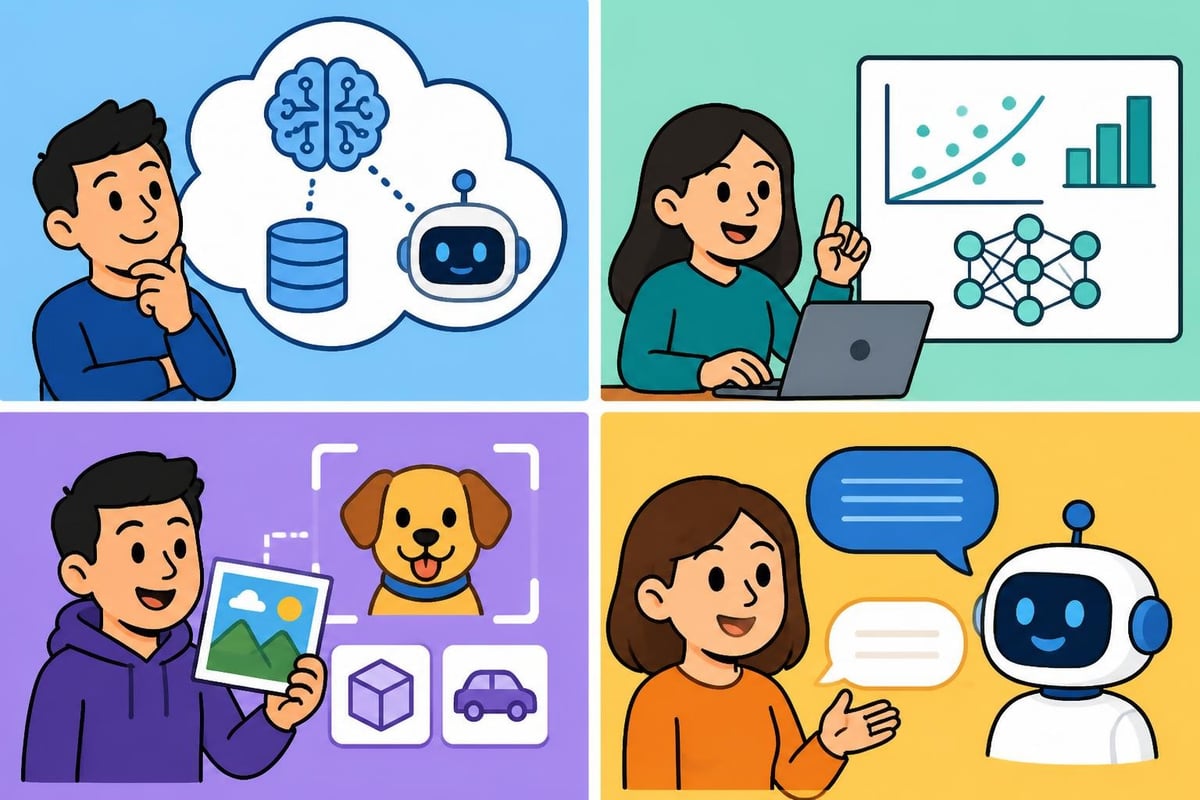
The microsoft azure ai 900 exam begins with establishing your understanding of artificial intelligence fundamentals and how they apply to business scenarios. This foundation proves critical for anyone involved in AI project decision-making or implementation.
AI Workloads and Responsible AI
Understanding different AI workload types helps professionals identify appropriate solutions for business challenges. The certification covers:
- Machine Learning workloads: Predicting outcomes based on historical data
- Computer Vision workloads: Interpreting visual information from images and videos
- Natural Language Processing workloads: Understanding and generating human language
- Conversational AI workloads: Creating intelligent chatbots and virtual assistants
- Knowledge Mining workloads: Extracting insights from large volumes of unstructured data
Responsible AI principles form a crucial component of the exam. Microsoft emphasizes six key principles that should guide AI development: fairness, reliability and safety, privacy and security, inclusiveness, transparency, and accountability. These principles ensure AI systems benefit society while minimizing potential harm.
Machine Learning Fundamentals
The machine learning section represents the heaviest weighted domain in the microsoft azure ai 900 exam. Candidates must understand supervised learning (using labeled data), unsupervised learning (finding patterns in unlabeled data), and reinforcement learning (learning through trial and error).
Common machine learning tasks include:
- Classification: Categorizing data into predefined groups
- Regression: Predicting numeric values
- Clustering: Grouping similar data points
- Forecasting: Predicting future values based on time-series data
Azure Machine Learning service provides tools for building, training, and deploying models. The exam tests your knowledge of automated machine learning (AutoML), which streamlines model creation for users without extensive data science expertise. For professionals seeking deeper machine learning knowledge, exploring AI and ML courses online provides comprehensive training beyond certification basics.
Azure AI Services and Practical Applications
Microsoft Azure offers pre-built AI services that eliminate the need for custom model development in many scenarios. The microsoft azure ai 900 certification requires familiarity with these services and when to apply them.
Computer Vision Services
Azure Computer Vision services enable applications to interpret visual content without requiring deep learning expertise. Key services include:
- Azure Computer Vision API: Analyzes images to extract tags, descriptions, and text
- Custom Vision: Creates custom image classification and object detection models
- Face API: Detects and recognizes human faces in images
- Form Recognizer: Extracts text, key-value pairs, and tables from documents
Real-world applications span industries. Retail companies use computer vision for automated checkout systems, healthcare providers analyze medical imagery, and manufacturing facilities implement quality control through visual inspection. Understanding these use cases helps candidates answer scenario-based questions effectively.
Natural Language Processing Capabilities
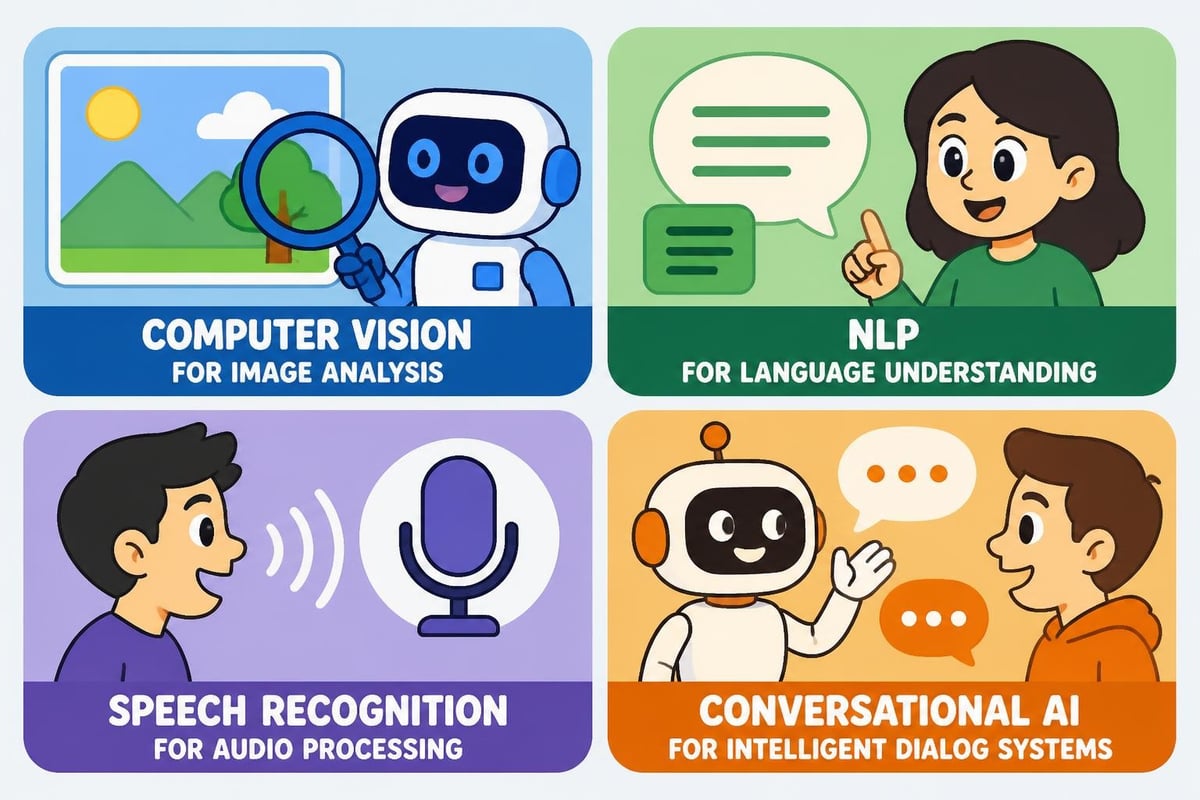
Azure's NLP services transform how applications interact with text and speech. The microsoft azure ai 900 exam covers:
| Service | Primary Function | Common Use Cases |
|---|---|---|
| Language Service | Text analysis and understanding | Sentiment analysis, key phrase extraction |
| Translator | Multi-language translation | Global content localization, real-time translation |
| Speech Service | Speech-to-text and text-to-speech | Voice assistants, transcription services |
| Language Understanding (LUIS) | Intent recognition | Command interpretation, chatbot intelligence |
These services power customer service automation, content moderation, and accessibility features across platforms. The exam emphasizes understanding capabilities rather than implementation details, though practical exposure significantly aids retention.
Exam Preparation Strategies That Work
Success on the microsoft azure ai 900 exam requires structured preparation combining theoretical knowledge with hands-on experience. Based on successful candidate experiences, a 4-6 week study plan typically proves sufficient for motivated learners.
Official Learning Resources
Microsoft provides comprehensive free learning paths that align perfectly with exam objectives. The official study guide for AI-900 outlines every topic tested and links to relevant Microsoft Learn modules. These interactive modules include:
- Video demonstrations of Azure services
- Hands-on sandbox environments
- Knowledge checks after each section
- Downloadable resources and documentation
Supplementing official materials with diverse learning formats increases retention. Visual learners benefit from video-based exam preparation content that demonstrates concepts dynamically. Platforms like MammothClub complement Microsoft's resources with interactive courses and practice scenarios designed for accelerated learning.
Hands-On Practice Requirements
Understanding Azure AI services theoretically differs significantly from using them practically. Creating a free Azure account provides $200 in credits for 30 days, sufficient for exploring all services covered in the microsoft azure ai 900 exam.
Recommended hands-on activities:
- Create a Computer Vision resource and analyze sample images
- Build a simple chatbot using Azure Bot Service
- Train a Custom Vision model with your own image dataset
- Use the Translator service to convert text between languages
- Experiment with Language Service to analyze sentiment in reviews
These exercises cement abstract concepts into practical knowledge. Many candidates report that hands-on experience helped them answer scenario-based questions more confidently. For those seeking structured guidance, AI specialization courses often include curated lab exercises that mirror exam scenarios.
Study Timeline and Practice Exams
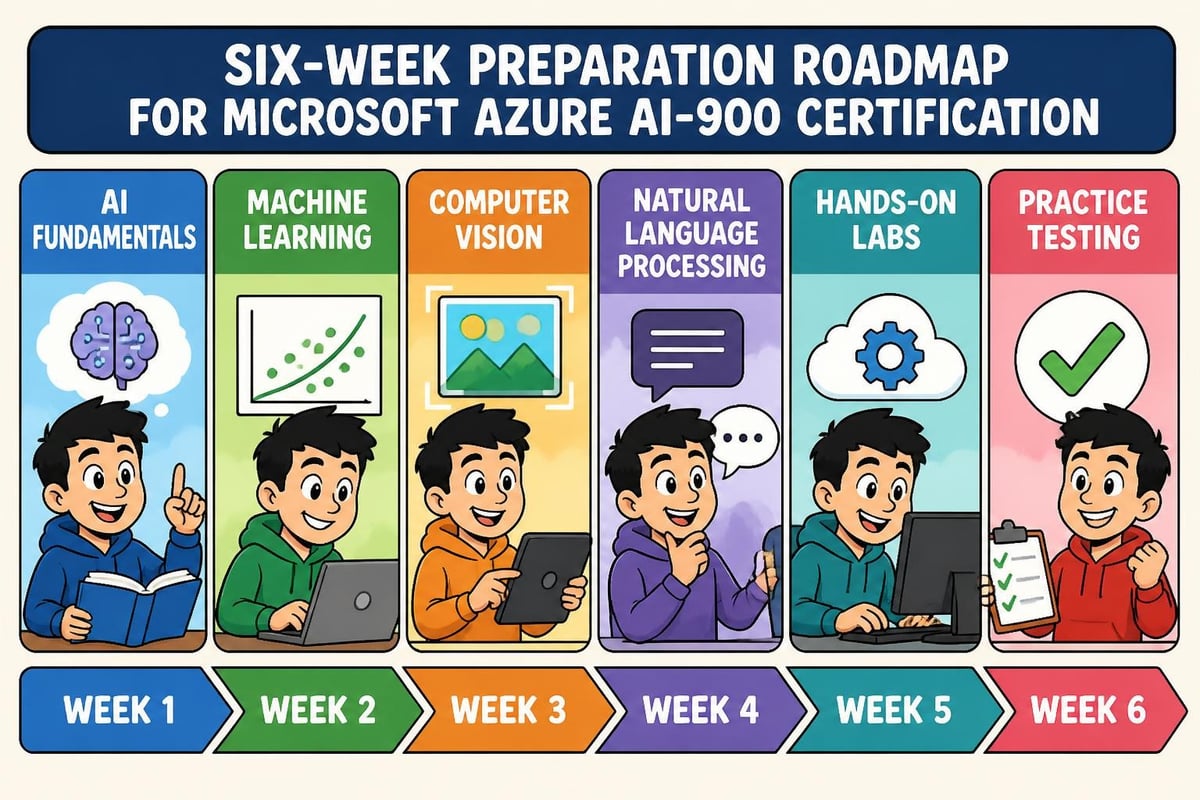
A typical preparation timeline for the microsoft azure ai 900 spans four to six weeks, depending on your existing knowledge and available study time.
| Week | Focus Area | Hours/Week |
|---|---|---|
| 1-2 | AI concepts and ML fundamentals | 5-7 hours |
| 3 | Computer vision and NLP services | 5-7 hours |
| 4 | Conversational AI and hands-on labs | 6-8 hours |
| 5-6 | Practice exams and weak area review | 4-6 hours |
Practice exams serve dual purposes: identifying knowledge gaps and building exam stamina. Microsoft offers official practice assessments, while third-party platforms provide additional question banks. Aim to consistently score above 85% on practice exams before scheduling your actual test. According to research on industry certifications and employability, candidates who complete at least three full-length practice exams demonstrate significantly higher pass rates.
Career Benefits and Professional Development
The microsoft azure ai 900 certification delivers tangible career advantages beyond knowledge validation. As organizations increasingly adopt AI solutions, professionals who understand AI capabilities become invaluable regardless of their specific role.
Salary Impact and Job Opportunities
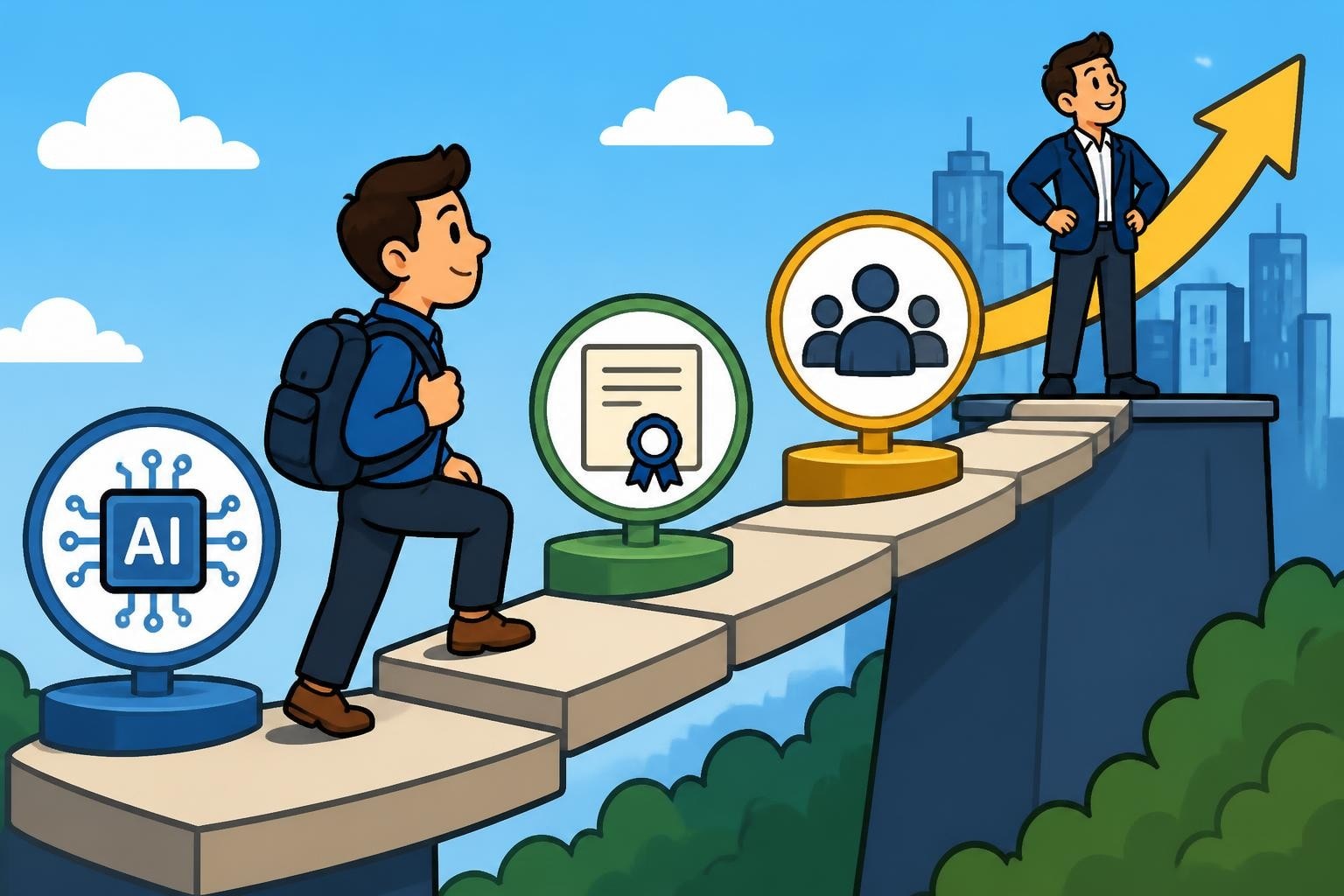
Entry-level AI certifications like AI-900 demonstrate initiative and foundational competence to employers. While this certification alone may not command premium salaries, it serves as a stepping stone to more advanced credentials and roles. Professionals holding the microsoft azure ai 900 certification report:
- 15-20% increase in interview callbacks for AI-adjacent roles
- Enhanced credibility when proposing AI solutions to stakeholders
- Stronger foundation for pursuing advanced Azure AI certifications
- Improved ability to communicate with data science teams
The certification proves particularly valuable for business analysts, project managers, and sales professionals who need to understand AI capabilities without becoming practitioners. It bridges the communication gap between technical teams and business decision-makers.
Progression Pathways
The microsoft azure ai 900 serves as the foundation for several career trajectories within the Azure ecosystem. Common progression paths include:
For technical roles:
- Azure AI Engineer Associate (AI-102)
- Azure Data Scientist Associate (DP-100)
- Azure Solutions Architect Expert
For business roles:
- Azure Data Fundamentals (DP-900)
- Microsoft Power Platform Fundamentals (PL-900)
- Industry-specific Azure certifications
Organizations increasingly value professionals who can bridge technical and business perspectives. Combining AI-900 with complementary certifications creates a powerful credential stack that demonstrates comprehensive cloud and AI knowledge. Professionals exploring broader AI education often pursue top artificial intelligence certifications to build comprehensive expertise.
Common Challenges and How to Overcome Them
Even well-prepared candidates encounter specific challenges when pursuing the microsoft azure ai 900 certification. Recognizing these obstacles beforehand allows for proactive mitigation strategies.
Technical vs. Conceptual Understanding
The exam tests conceptual knowledge rather than hands-on implementation skills, which confuses candidates with strong technical backgrounds. Technical professionals often dive too deep into service architecture when the exam simply requires understanding service capabilities and appropriate use cases.
Solution approach:
- Focus on "what" and "when" rather than "how"
- Understand service limitations and appropriate scenarios
- Practice explaining services to non-technical audiences
- Review scenario-based questions that test decision-making
Non-technical candidates face the opposite challenge. Abstract AI concepts without practical context prove difficult to internalize. These learners benefit from analogies, real-world examples, and simplified explanations before exploring technical documentation.
Time Management During the Exam
The microsoft azure ai 900 exam provides 60 minutes for approximately 40-50 questions, averaging 72-90 seconds per question. This tight timeframe challenges candidates who overthink or second-guess their answers.
Effective strategies include:
- Answer confidently known questions immediately
- Flag uncertain questions for later review
- Eliminate obviously incorrect answers first
- Don't spend more than two minutes on any single question
- Reserve 10 minutes for reviewing flagged questions
Many candidates benefit from simulating exam conditions during practice tests, including strict time limits and minimizing distractions. This preparation builds the mental stamina needed for sustained focus during the actual exam.
Keeping Current with Azure Updates
Microsoft regularly updates Azure services, occasionally affecting exam content. While the microsoft azure ai 900 exam focuses on fundamentals that change slowly, staying informed about major service updates ensures your knowledge remains current.
Subscribe to:
- Azure Updates blog for service announcements
- Microsoft Learn's AI learning paths for content revisions
- Azure AI Community forums for candidate discussions
- LinkedIn groups focused on Azure certifications
The certification itself remains valid indefinitely, but maintaining practical knowledge requires ongoing learning. Many certified professionals dedicate 2-3 hours monthly to exploring new Azure AI features and capabilities.
Enterprise Training and Team Certification
Organizations investing in AI capabilities increasingly require foundational AI literacy across teams. The microsoft azure ai 900 certification provides an ideal baseline for enterprise-wide AI education initiatives.
Corporate Certification Programs
Forward-thinking companies implement structured certification programs that align employee development with business AI strategies. These programs typically include:
- Sponsored exam fees and preparation materials
- Dedicated study time during work hours
- Internal study groups and mentorship
- Recognition and incentives for certification achievement
- Career pathing that values AI competency
Corporate buyers benefit from volume licensing agreements with training providers that bundle learning content with practice exams and instructor-led sessions. These programs demonstrate measurable ROI through improved AI project success rates and reduced vendor dependency.
Building AI-Literate Teams
The microsoft azure ai 900 serves as a common language foundation for cross-functional teams working on AI initiatives. When marketing, sales, operations, and technical teams share baseline AI knowledge, collaboration improves significantly. Common vocabularies eliminate miscommunication, realistic expectations reduce project failures, and informed stakeholders make better decisions.
Organizations often begin with leadership certification, followed by cascading requirements through departments most impacted by AI adoption. This approach creates AI champions throughout the organization who can identify opportunities and drive innovation from within their domains. Companies seeking comprehensive AI training solutions can explore corporate certification programs that scale across large teams efficiently.
Alternative and Complementary Learning Paths
While the microsoft azure ai 900 provides excellent foundational knowledge, complementary certifications and courses enhance your AI expertise from different angles. Understanding how AI-900 fits within the broader certification landscape helps you chart an optimal learning journey.
Comparing Cloud Provider AI Certifications
Microsoft's AI-900 competes with similar foundational certifications from other cloud providers. Each offers unique perspectives on AI implementation:
| Certification | Provider | Focus | Best For |
|---|---|---|---|
| AI-900 | Microsoft Azure | Azure AI services, ML Studio | Azure ecosystem professionals |
| AWS AI Practitioner | Amazon | AWS AI/ML services | AWS-focused organizations |
| Google Cloud AI Fundamentals | Google Cloud | Google AI Platform, AutoML | GCP environment users |
The microsoft azure ai 900 particularly benefits professionals in organizations already invested in the Microsoft ecosystem or those targeting Azure-specific roles. However, understanding multiple cloud platforms increases marketability in diverse environments.
Broader AI Education Considerations
Certification proves your knowledge at a specific point in time, but comprehensive AI competency requires ongoing education across multiple dimensions. Successful AI professionals typically combine certifications with:
- Practical machine learning courses covering algorithms and model building
- Programming skills in Python, R, or similar languages
- Data analytics and visualization capabilities
- Domain-specific AI applications in their industry
- Ethics and governance frameworks for responsible AI
Platforms offering AI courses for beginners provide structured pathways that complement certification studies with hands-on projects and real-world applications. This combination of theoretical certification knowledge and practical skill development creates well-rounded AI professionals.
Vendor-Neutral AI Knowledge
While the microsoft azure ai 900 focuses specifically on Azure services, understanding AI concepts independently of specific platforms proves valuable for long-term career flexibility. Vendor-neutral knowledge includes:
- Core machine learning algorithms regardless of implementation platform
- Statistical foundations underlying AI decision-making
- Data preparation and feature engineering principles
- Model evaluation and validation techniques
- AI ethics frameworks applicable across all implementations
This foundational knowledge transfers seamlessly between platforms and remains relevant despite rapid technological changes. Many professionals pursue vendor-neutral AI education alongside platform-specific certifications to maximize their adaptability and value.
The microsoft azure ai 900 certification provides an accessible entry point into AI and machine learning, validating foundational knowledge that proves increasingly essential across all business functions. Whether you're a technical professional seeking cloud AI expertise or a business stakeholder needing to understand AI capabilities, this certification establishes the baseline competency that modern organizations demand. MammothClub accelerates your certification journey with our comprehensive AI learning platform, offering interactive courses, hands-on labs, and certification prep materials designed to help you master AI-900 concepts efficiently and prepare for advanced AI roles with confidence.