The intersection of artificial intelligence and robotics represents one of the most transformative fields in technology today. As organizations race to integrate intelligent automation into their operations, the demand for professionals skilled in both AI algorithms and robotic systems has reached unprecedented levels. Whether you're a software engineer looking to transition into robotics, a mechanical engineer wanting to add AI capabilities to your skill set, or a business leader seeking to understand how these technologies can drive innovation, selecting the right ai and robotics courses can accelerate your career trajectory and keep your organization competitive in an increasingly automated world.
Why AI and Robotics Skills Matter in 2026
The robotics industry has evolved dramatically over the past few years. Unlike traditional industrial robots that performed repetitive tasks in controlled environments, modern robotic systems leverage artificial intelligence to perceive their surroundings, make autonomous decisions, and adapt to changing conditions. This convergence has created entirely new career paths and business opportunities.
Organizations investing in AI-powered robotics are seeing measurable returns:
- Manufacturing facilities reduce production errors by 40-60% with vision-guided robots
- Logistics companies cut warehouse operating costs by 30% through autonomous mobile robots
- Healthcare providers improve surgical precision and patient outcomes with AI-assisted robotic systems
- Agriculture operations increase yield while reducing resource consumption using autonomous field robots
The AI Index 2022 Annual Report highlights that robotics researchers consistently rank AI integration as the most critical factor for advancing the field. This data underscores why professionals need training that bridges both disciplines rather than treating them as separate domains.
For those just beginning their journey, understanding AI basics provides essential context before diving into robotics-specific applications.
Core Competencies Covered in AI and Robotics Courses
Quality ai and robotics courses address multiple knowledge areas that work together to create functional autonomous systems. Understanding this curriculum structure helps you identify programs that match your goals and current skill level.
Fundamental AI Techniques for Robotics
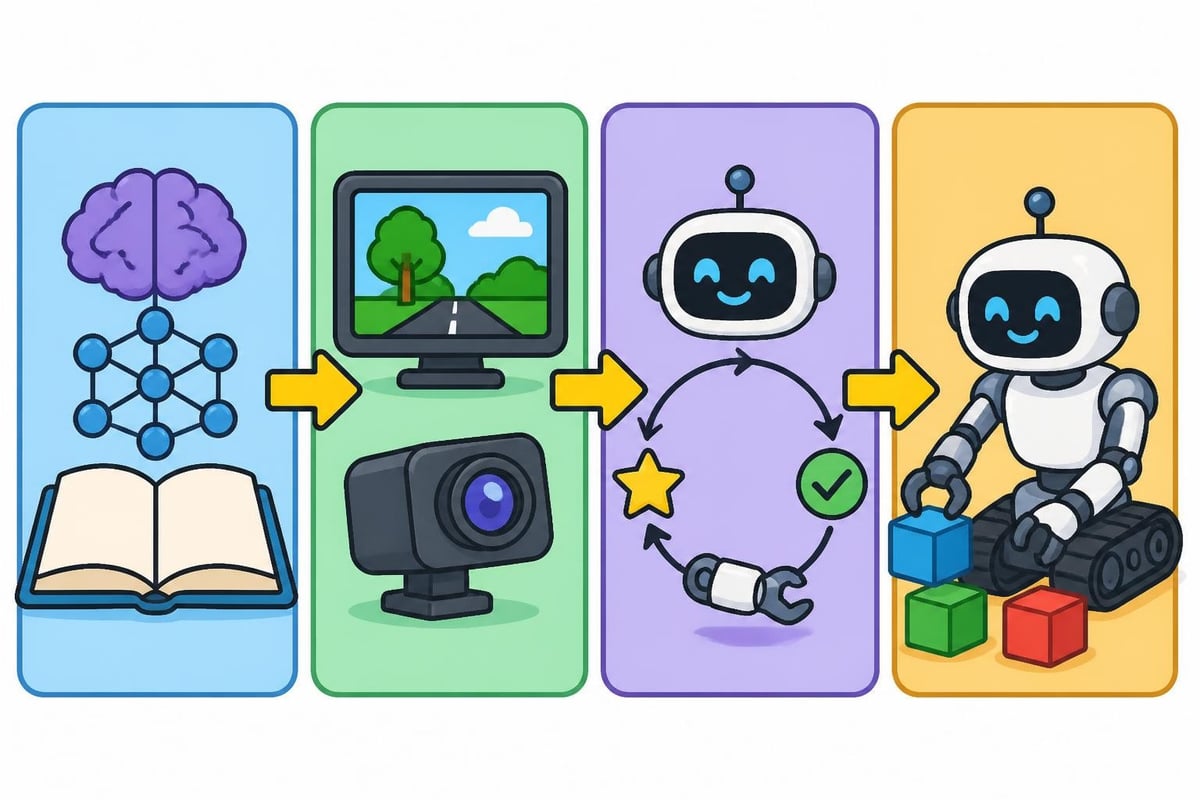
Modern robotics relies heavily on specific AI methodologies that enable machines to interpret sensor data and make decisions. These include:
- Computer Vision: Object detection, semantic segmentation, depth estimation, and visual tracking
- Reinforcement Learning: Training robots to optimize behaviors through trial-and-error interaction with environments
- Motion Planning: Path finding, trajectory optimization, and collision avoidance algorithms
- Natural Language Processing: Enabling human-robot interaction through voice commands and conversational interfaces
MIT's professional course on AI robotics dedicates significant attention to how generative AI is revolutionizing robot design, allowing systems to simulate and optimize movements before physical deployment.
Robotic Systems and Control
Beyond software algorithms, effective robotics professionals understand the physical systems they're programming. Comprehensive ai and robotics courses integrate hardware concepts including:
| Component | Key Learning Areas | Practical Applications |
|---|---|---|
| Sensors | LIDAR, cameras, IMUs, force/torque sensors | Environment mapping, object manipulation |
| Actuators | Motors, servos, hydraulic systems | Precise movement control, force application |
| Control Systems | PID controllers, state estimation, Kalman filters | Stability, accuracy, responsive behavior |
| Power Systems | Battery management, energy efficiency | Autonomous operation duration |
This hardware knowledge becomes critical when debugging why a robot behaves differently in production than in simulation.
Simulation and Digital Twins
Before deploying expensive hardware, robotics teams extensively test in simulated environments. NVIDIA's Physical AI Learning platform offers free courses on building digital twins using Isaac Sim and OpenUSD workflows, allowing learners to practice robot programming in realistic virtual environments.
Simulation competency reduces development costs and accelerates iteration cycles. Teams can test thousands of scenarios overnight that would take months to evaluate with physical robots.
Types of AI and Robotics Courses Available
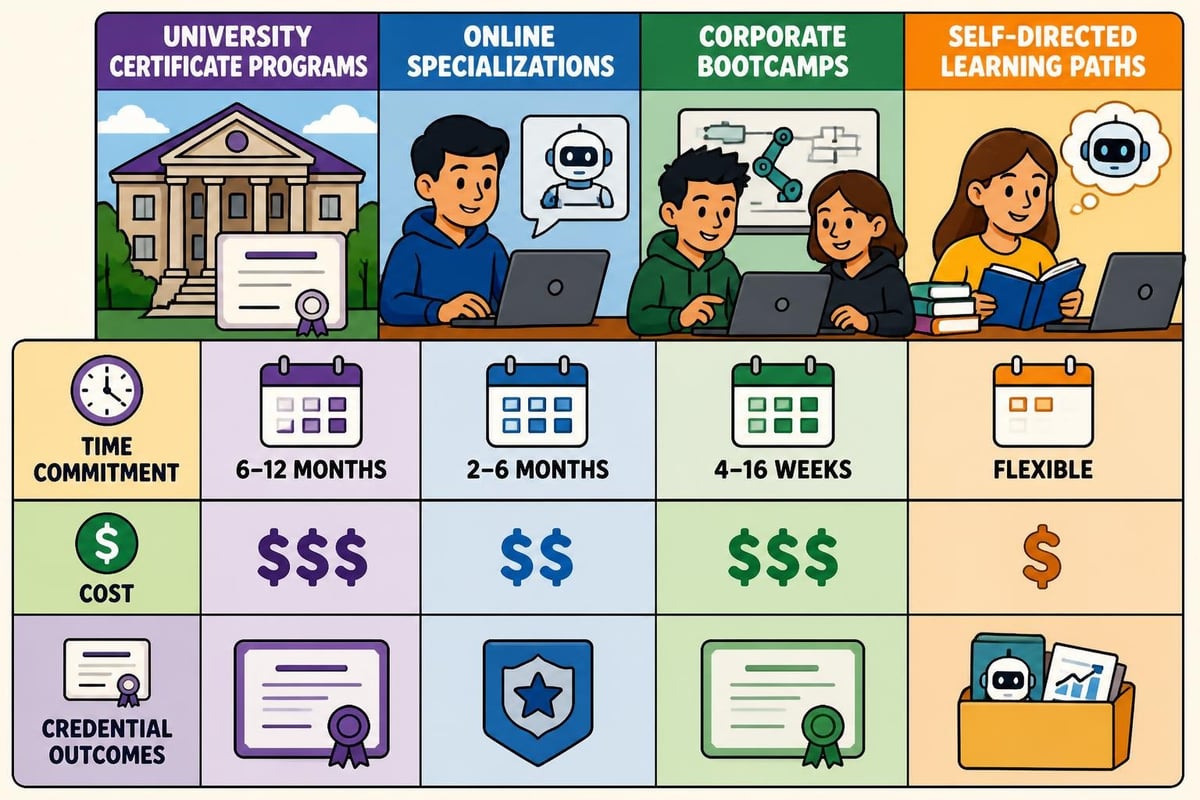
The educational landscape offers diverse formats for learning ai and robotics courses, each suited to different learning styles, schedules, and career objectives.
University Certificate Programs
Traditional academic institutions provide rigorous, research-backed curricula. Harvard's robotics course explores autonomous vehicles and drones alongside core robotics concepts, while Stanford's CS333 focuses specifically on algorithms for interactive robotics where machines collaborate with humans.
Benefits of university programs:
- Access to cutting-edge research and faculty expertise
- Networking with peers and potential employers
- Structured curriculum with verified credentials
- Hands-on lab access to advanced equipment
Considerations:
- Higher cost investment ($3,000-$15,000+ per program)
- Fixed schedules that may conflict with work commitments
- Slower pace to accommodate academic calendars
Online Platforms and Specializations
Digital learning platforms have democratized access to high-quality robotics education. Coursera's Robotics & Robots specialization provides comprehensive coverage of perception, reasoning, and interaction systems, while curated resources like those at AZ Robots aggregate courses from multiple top institutions.
These platforms excel at flexibility and variety. Professionals can learn at their own pace while maintaining full-time employment. For those interested in broader AI specialization courses, combining robotics training with general AI competencies creates powerful career advantages.
Corporate Training and Bootcamps
Organizations increasingly invest in team-wide robotics upskilling through intensive bootcamp formats. These programs compress essential knowledge into focused timeframes while emphasizing practical implementation over theoretical foundations.
MammothClub's approach to corporate AI training exemplifies this model, offering interactive bootcamps that combine on-demand coursework with hands-on projects. Companies report faster time-to-competency when employees learn through structured corporate programs with measurable outcomes.
Self-Directed Learning Paths
For self-motivated learners, structured pathways provide guidance without formal enrollment. MAXimuz Learn and HumanoidHub offer curated collections from institutions like MIT and Stanford, organizing over 288 guides into coherent learning journeys.
This approach works best for those with prior technical backgrounds who need to fill specific knowledge gaps rather than building foundational understanding.
Essential Topics for Professional Applications
While foundational courses cover broad concepts, professionals working on real-world implementations need deeper expertise in specialized areas. Advanced ai and robotics courses address these critical domains.
Autonomous Navigation and Mapping
Robots operating in dynamic environments must build spatial understanding while moving through unfamiliar spaces. This requires mastery of:
- SLAM (Simultaneous Localization and Mapping): Creating maps while determining position within them
- Sensor Fusion: Combining data from multiple sensors for robust environmental understanding
- Obstacle Avoidance: Real-time path replanning when encountering unexpected barriers
- Localization: Determining precise position using GPS, visual landmarks, or radio beacons
Delivery robots, warehouse automation systems, and autonomous vehicles all rely on these capabilities. Courses emphasizing ROS2 (Robot Operating System 2) provide industry-standard frameworks for implementing navigation stacks.
Human-Robot Interaction and Safety
As robots move from isolated factory floors into shared human spaces, interaction design becomes paramount. Safety certification and collaborative robotics training cover:
- Force limiting and collision detection to prevent injuries
- Intuitive control interfaces for non-technical operators
- Predictable behavior patterns that humans can anticipate
- Fail-safe mechanisms and emergency stop protocols
Purdue's professional master's program includes dedicated coursework on IoT integration and safety systems, preparing graduates for roles deploying robots in hospitals, retail stores, and public facilities.
Machine Learning for Perception
Computer vision drives most robotic perception capabilities. Advanced ai and robotics courses dedicate substantial time to:
| Technique | Application | Training Approach |
|---|---|---|
| Object Detection | Identifying items for manipulation | YOLO, Faster R-CNN, RetinaNet |
| Semantic Segmentation | Understanding scene composition | U-Net, DeepLab, Mask R-CNN |
| Depth Estimation | 3D spatial understanding | Stereo vision, monocular depth networks |
| Instance Segmentation | Distinguishing individual objects | Mask R-CNN, SOLO, PointRend |
Understanding which models work best for specific hardware constraints (edge devices vs. cloud processing) separates competent practitioners from experts. For professionals interested in expanding beyond robotics, AI and ML courses online provide complementary knowledge.
Choosing the Right Course for Your Goals
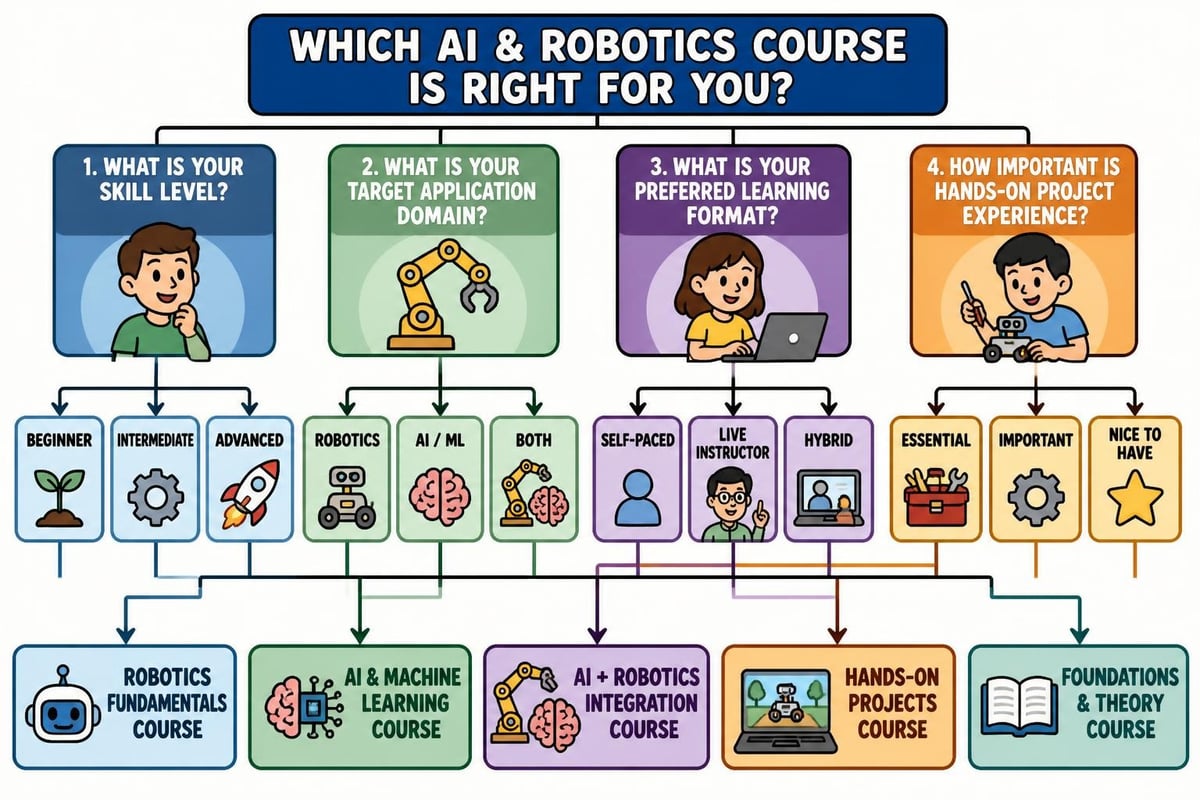
With hundreds of ai and robotics courses available, selecting the optimal path requires clarifying your objectives and evaluating programs against specific criteria.
Assess Your Current Skill Level
Honest self-assessment prevents frustration and wasted time. Consider these questions:
Programming Experience:
- Can you write Python functions and classes confidently?
- Do you understand object-oriented programming concepts?
- Have you worked with libraries like NumPy, pandas, or TensorFlow?
Mathematics Background:
- Are you comfortable with linear algebra (matrices, vectors, transformations)?
- Can you work with calculus concepts (derivatives, gradients)?
- Do you understand probability and statistics fundamentals?
Hardware Experience:
- Have you worked with microcontrollers or embedded systems?
- Can you read circuit diagrams or schematics?
- Do you understand basic physics (forces, motion, energy)?
Beginners should seek courses with minimal prerequisites that build foundations systematically. Experienced developers might skip introductory material and focus on specialized applications.
Define Your Target Application
Different robotics domains emphasize different skills. Manufacturing automation requires different competencies than autonomous vehicles or surgical robots.
Industrial Robotics: Focus on repeatability, speed, and reliability. Look for courses covering industrial protocols (OPC UA, PROFINET) and safety standards (ISO 10218).
Service Robotics: Emphasizes interaction, navigation in human environments, and adaptability. Prioritize courses with strong human-robot interaction components.
Autonomous Vehicles: Requires deep perception capabilities and real-time decision-making. Seek programs with extensive computer vision and sensor fusion coverage.
Research and Development: Demands theoretical foundations and cutting-edge techniques. University programs with research components provide advantages.
Evaluate Practical Components
Robotics learning without hands-on practice produces theoretical knowledge that doesn't transfer to real implementations. Quality programs include:
- Simulation Projects: Virtual environments where you program and test robots safely
- Hardware Kits: Physical robots (even simple ones) for experiencing real-world constraints
- Capstone Projects: Substantial final projects demonstrating integrated competencies
- Industry Case Studies: Real implementations showing how concepts apply in production
MammothClub's interactive approach combines these elements with AI-powered learning tools that adapt to individual progress, ensuring learners master practical skills rather than just passing assessments.
Career Paths and Certifications
Completing ai and robotics courses opens diverse career trajectories across industries. Understanding the landscape helps you align training with professional goals.
High-Demand Robotics Roles
The robotics job market has expanded beyond traditional engineering positions. Current high-demand roles include:
- Robotics Software Engineer: Develops control systems, perception algorithms, and integration layers
- Computer Vision Engineer: Specializes in visual perception for robotic applications
- Autonomous Systems Engineer: Focuses on decision-making, planning, and autonomous behavior
- Robot Learning Researcher: Develops new AI techniques for robotic learning and adaptation
- Robotics Systems Integrator: Implements and maintains robotic solutions in operational environments
Average compensation for mid-level robotics engineers ranges from $95,000 to $165,000 annually depending on location and specialization. Senior roles and research positions can exceed $200,000.
Certification Value and Recognition
While university degrees provide comprehensive credentials, professional certifications demonstrate specific competencies. Consider these factors:
Vendor-Specific Certifications:
- NVIDIA certifications in robotics and autonomous machines
- ROS (Robot Operating System) developer certifications
- Industrial robot manufacturer credentials (ABB, FANUC, KUKA)
These prove expertise with specific platforms widely used in industry. For those interested in vendor training, exploring NVIDIA AI certification provides insight into hardware-specific learning paths.
Academic Certificates:
- University professional certificates from MIT, Stanford, Harvard
- Graduate certificates in robotics or autonomous systems
- Micro-credentials from recognized institutions
These carry academic weight and signal rigorous training, though they typically require larger time and financial investments.
Building a Competitive Portfolio
Certifications matter, but demonstrated capability through projects often weighs more heavily in hiring decisions. Strong portfolios include:
- GitHub repositories with well-documented robot control code
- Video demonstrations of robots performing tasks you programmed
- Technical blog posts explaining your implementation decisions and lessons learned
- Competition participation in robotics challenges (RoboCup, DARPA challenges, etc.)
Employers value candidates who can articulate design tradeoffs and troubleshooting approaches, skills best demonstrated through substantive project work.
Integrating AI and Robotics Training Into Organizations
While individual learning drives career development, organizational adoption of ai and robotics courses creates competitive advantages through systematic upskilling.
Building Internal Robotics Competency
Companies implementing automation often struggle with the build-versus-buy decision for talent. Training existing employees offers advantages:
Benefits of Internal Development:
- Employees understand business context and specific operational challenges
- Knowledge stays within the organization
- Creates career advancement paths that improve retention
- More cost-effective than recruiting scarce specialized talent
Implementation Approach:
- Assess Current Skills: Identify employees with relevant technical backgrounds or strong learning aptitude
- Define Target Competencies: Map specific skills needed for planned robotics initiatives
- Create Learning Cohorts: Group employees for peer support and knowledge sharing
- Provide Hands-On Projects: Align training projects with real business challenges
- Measure Progress: Track competency development through assessments and project milestones
MammothClub's corporate certification programs address these needs through customizable learning paths and dashboards that make training progress measurable and results-driven.
Return on Investment Considerations
Executive leadership requires business justification for training investments. Quantifying ROI for ai and robotics courses involves multiple factors:
| Investment Category | Cost Range | Measurable Returns |
|---|---|---|
| Course Fees | $500-$5,000 per employee | Reduced recruitment costs vs. hiring specialists |
| Learning Time | 40-200 hours per employee | Accelerated project implementation timelines |
| Practice Hardware | $2,000-$20,000 one-time | Internal prototyping capability |
| Ongoing Support | $100-$500 monthly per learner | Reduced dependency on external consultants |
Organizations report that employees completing robotics training deliver automation projects 30-50% faster than teams relying solely on external contractors. Knowledge transfer to internal teams also reduces long-term maintenance costs.
Staying Current With Rapid Advancement
Robotics technology evolves continuously. One-time training becomes obsolete without ongoing learning mechanisms. Organizations achieving sustained success implement:
- Monthly learning hours allocated for employees to explore new techniques
- Internal knowledge sharing where employees present learnings to colleagues
- Conference attendance at major robotics events (ICRA, IROS, Robotics Summit)
- Vendor partnership programs providing early access to emerging platforms
Platforms offering continuously updated course libraries help organizations maintain current knowledge without repeatedly purchasing new training programs.
Practical Implementation Strategies
Knowledge gained from ai and robotics courses only creates value when applied to real-world challenges. Successful learners follow specific strategies to translate education into capability.
Start With Simulation Before Hardware
Physical robots are expensive and time-consuming to work with. Modern simulation environments allow extensive practice before touching hardware:
Recommended Simulation Tools:
- Gazebo: Open-source robot simulator with physics engine integration
- NVIDIA Isaac Sim: High-fidelity simulation with photorealistic rendering
- Webots: Cross-platform simulator supporting multiple programming languages
- CoppeliaSim: Versatile simulation for various robot types and scenarios
Simulation projects teach 80% of necessary concepts at 10% the cost of hardware-based learning. Once fundamentals are solid, hardware work proceeds much more efficiently.
Incremental Complexity Progression
Attempting complex projects too early leads to frustration. Structure learning through progressive challenges:
- Basic Movement: Program a robot to move in specific patterns (squares, circles, figure-eights)
- Sensor Integration: Add obstacle detection and avoidance behaviors
- Environment Mapping: Build maps of spaces using SLAM techniques
- Object Manipulation: Implement visual detection and grasping of objects
- Autonomous Tasks: Combine capabilities into complete autonomous missions
Each level builds on previous competencies while introducing new complexity. This approach mirrors how professional ai and robotics courses structure curricula.
Join Communities and Collaborate
Robotics development rarely happens in isolation. Active communities provide support, feedback, and collaboration opportunities:
- ROS Discourse: Official forum for Robot Operating System questions
- Reddit communities: r/robotics, r/ROS, r/computervision
- Discord servers: Real-time chat with other learners and professionals
- Local robotics clubs: Hands-on collaboration and hardware sharing
Explaining your projects to others clarifies your own understanding and often reveals better approaches. Communities also provide motivation during challenging learning periods.
Future Directions in AI and Robotics Education
The field continues evolving rapidly, with emerging trends shaping how ai and robotics courses will develop over the next few years.
Embodied AI and Foundation Models
Recent breakthroughs in large language models (LLMs) are now being applied to robotics. Embodied AI enables robots to understand natural language instructions and translate them into physical actions. Courses incorporating this cutting-edge research prepare learners for the next generation of human-robot interaction.
Organizations like Google DeepMind and OpenAI are developing foundation models for robotics that learn general manipulation skills from massive datasets. Understanding how to fine-tune these models for specific applications will become essential.
Edge Computing and On-Device AI
Cloud connectivity limitations drive demand for on-device AI inference. Modern ai and robotics courses increasingly cover:
- Model optimization techniques (quantization, pruning, knowledge distillation)
- Edge AI frameworks (TensorFlow Lite, NVIDIA TensorRT, OpenVINO)
- Hardware acceleration using GPUs, TPUs, and specialized AI chips
- Power-efficient AI architectures for battery-powered robots
For professionals interested in the hardware aspects, understanding GPU for AI training provides foundation for deployment optimization.
Ethical Considerations and Responsible Robotics
As robots gain autonomy and operate in human spaces, ethical training becomes mandatory. Progressive programs address:
- Bias in perception systems and decision-making algorithms
- Privacy concerns with robotic surveillance and data collection
- Accountability frameworks when autonomous systems cause harm
- Transparency requirements for AI-driven robotic behaviors
These considerations move beyond technical implementation into societal impact. Courses incorporating AI ethics prepare professionals for responsible deployment.
The convergence of artificial intelligence and robotics is reshaping industries and creating unprecedented opportunities for skilled professionals. Selecting the right ai and robotics courses depends on your current expertise, career objectives, and the specific applications you want to pursue, whether that's autonomous vehicles, industrial automation, or service robotics. As technology continues advancing rapidly, the most successful professionals combine foundational knowledge with hands-on practice and continuous learning. MammothClub provides the comprehensive AI and robotics training infrastructure organizations need to transform their teams, offering 3,000+ courses, interactive bootcamps, and AI-powered learning tools that deliver measurable results and keep your workforce competitive in the automation era.