
The artificial intelligence revolution has created unprecedented demand for certified professionals who can design, deploy, and manage AI systems responsibly. An ai certification course provides structured learning paths that validate your expertise, demonstrate practical competency, and position you competitively in an evolving job market. Whether you're transitioning into AI from another field, deepening existing technical skills, or leading organizational AI adoption, the right certification program transforms theoretical knowledge into measurable career outcomes. The challenge lies in navigating hundreds of available programs to find credentials that align with your goals, industry requirements, and learning preferences.
Understanding the AI Certification Landscape
The AI certification ecosystem has expanded dramatically since 2024, with major technology vendors, academic institutions, and professional organizations offering credentials across diverse specialization areas. Unlike traditional degrees that require multi-year commitments, an ai certification course typically delivers focused, competency-based learning in weeks or months.
Three primary certification categories dominate the market:
- Vendor-specific credentials from Microsoft, AWS, Google Cloud, and NVIDIA that validate proficiency with proprietary platforms
- Domain-focused certifications addressing specialized applications like healthcare AI, cybersecurity, or governance
- Foundation-level programs covering AI ethics, machine learning fundamentals, and core concepts
The IEEE CertifAIEd™ program exemplifies the growing emphasis on ethical AI practices, offering globally recognized certification in transparency, accountability, and algorithmic bias mitigation. This reflects industry-wide recognition that technical competency alone proves insufficient without understanding responsible AI development.
Vendor Credentials vs. Independent Certifications
Choosing between vendor-specific and vendor-neutral certifications depends on your career trajectory. Cloud platform certifications demonstrate operational expertise with tools your organization already uses. If your company deploys Azure AI services, completing an AI Azure Fundamentals program directly translates to job performance improvements.
Independent certifications offer broader applicability across technologies and employers. The Trusted AI Safety Expert (TAISE) certificate, developed by the Cloud Security Alliance and Northeastern University, equips professionals to lead safe AI deployment regardless of platform choice.
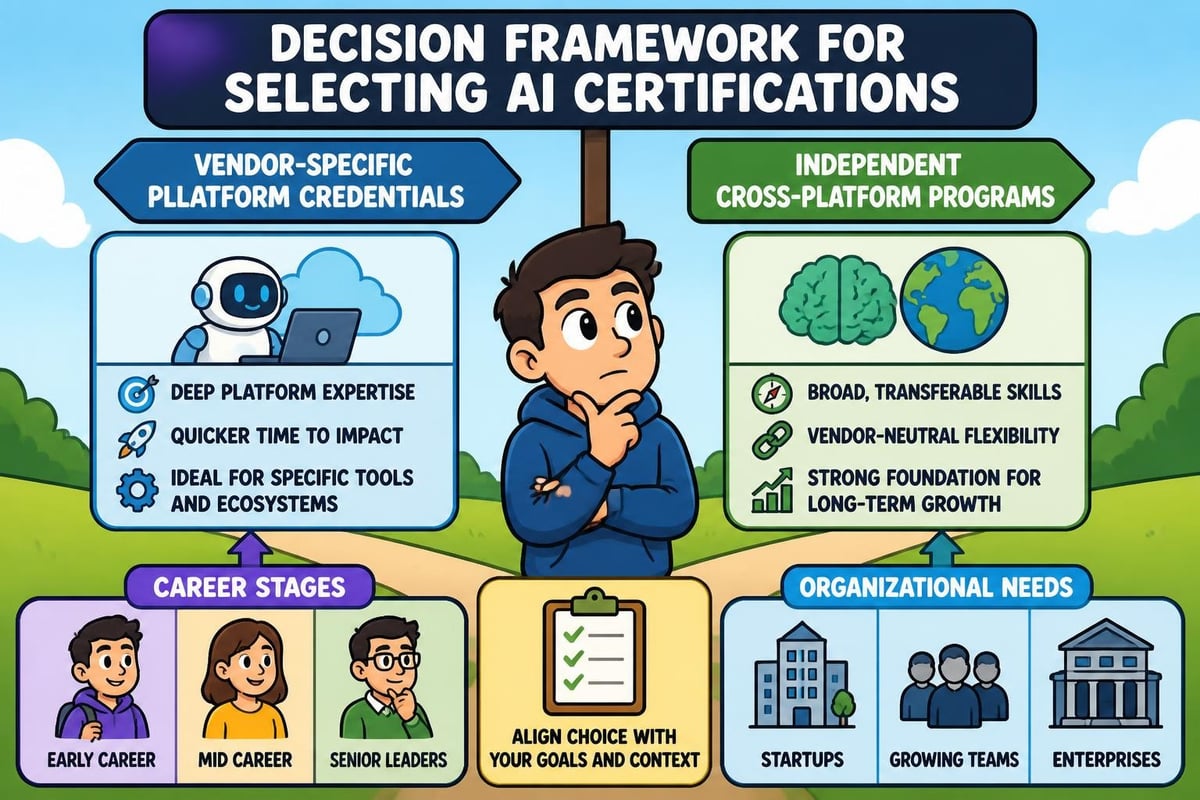
| Certification Type | Best For | Typical Duration | Primary Benefit |
|---|---|---|---|
| Vendor Platform | Cloud engineers, DevOps professionals | 4-8 weeks | Immediate job applicability |
| Domain Specialist | Healthcare, finance, legal professionals | 8-16 weeks | Industry-specific expertise |
| Foundation | Career changers, managers, beginners | 2-6 weeks | Broad conceptual understanding |
| Advanced Technical | ML engineers, AI researchers | 12-24 weeks | Deep algorithmic knowledge |
Selecting the Right AI Certification Course for Your Goals
Effective certification selection begins with honest assessment of your current skills, available time, and desired outcomes. A beginner-focused AI course provides essential foundation, while experienced developers benefit from specialized programs in generative AI, computer vision, or natural language processing.
Critical selection criteria include:
- Prerequisite requirements - Some programs assume programming proficiency, statistical knowledge, or cloud platform experience
- Hands-on project components - The best certifications require building functional AI applications, not just passing multiple-choice exams
- Industry recognition - Employer awareness of the credential significantly impacts career value
- Ongoing validity - Annual renewal requirements and continuing education expectations
The Arcitura AI & Cloud AI Professional Academy demonstrates comprehensive curriculum design, covering predictive AI, generative AI, and cloud-based deployment across formal accreditation programs that employers increasingly recognize.
Matching Certifications to Career Stages
Entry-level professionals benefit from foundational certifications that establish credibility without requiring extensive technical backgrounds. Programs emphasizing AI literacy, ethical considerations, and business applications provide accessible entry points. MammothClub's AI basics courses offer structured paths for professionals starting their AI journey.
Mid-career specialists should pursue certifications demonstrating advanced competency in their domains. Healthcare professionals might explore the American Board of Artificial Intelligence in Medicine for medical AI credentials, while cybersecurity professionals could target governance and risk-focused programs through organizations like the CACE Institute.
Senior leaders and executives require different certification approaches focused on strategic AI adoption, governance frameworks, and organizational change management rather than technical implementation details.
Technical Foundations in Modern AI Certification Programs
Contemporary ai certification course curricula reflect rapid technological evolution, particularly the 2023-2025 generative AI revolution. Programs now balance classical machine learning foundations with large language models, diffusion models, and multimodal AI systems.
Core Technical Components
Most comprehensive certifications cover these fundamental areas:
- Machine learning algorithms including supervised, unsupervised, and reinforcement learning approaches
- Neural network architectures from basic perceptrons through transformers and attention mechanisms
- Data preparation and feature engineering for real-world datasets with quality issues
- Model evaluation metrics and techniques for preventing overfitting and ensuring generalization
- Deployment strategies including API design, scalability considerations, and monitoring
Wolfram U's AI courses provide solid grounding in these foundational technologies while introducing practical tools for implementation. Their curriculum spans machine learning, neural networks, natural language processing, and computer vision with hands-on computational approaches.
The rise of prompt engineering as a distinct skill category has transformed certification requirements. Understanding how to effectively interact with large language models now appears in both technical and non-technical certification paths. MammothClub offers specialized AI prompt engineering courses that develop this increasingly valuable competency.

Platform-Specific Certifications and Career Impact
Major technology vendors have developed sophisticated certification tracks that validate expertise with their AI and machine learning platforms. These credentials carry significant weight when organizations already use those ecosystems.
Cloud Provider AI Certifications
Microsoft Azure AI certifications span foundational to expert levels, addressing cognitive services, machine learning operations, and conversational AI. The Azure AI Fundamentals credential provides entry-level validation, while Azure AI Engineer Associate demonstrates production deployment capabilities.
AWS machine learning certifications emphasize practical experience building, training, and deploying models using SageMaker and related services. The specialty certification requires deep understanding of data engineering, exploratory data analysis, modeling, and implementation.
Google Cloud Professional Machine Learning Engineer certification validates ability to design, build, and productionize ML models using Google Cloud technologies. The exam tests architectural decisions, model optimization, and automated pipeline development.
Organizations investing heavily in specific cloud platforms often prefer or require corresponding certifications. When evaluating top AI certification options, consider your organization's technology stack and strategic direction.
NVIDIA's Growing Certification Ecosystem
NVIDIA has established itself as a leader in AI hardware and software, making its certifications particularly valuable for professionals working with deep learning and GPU-accelerated computing. The NVIDIA AI certification programs cover deep learning fundamentals, accelerated computing, and specialized applications.
These credentials prove especially relevant for roles involving:
- High-performance computing and AI infrastructure
- Computer vision applications requiring real-time processing
- Large-scale model training and optimization
- Edge AI deployment scenarios
Emerging Specializations in AI Certification
The AI field continues fragmenting into specialized domains requiring distinct knowledge bases. Generic "AI expert" credentials give way to focused certifications addressing specific application areas, ethical considerations, or technical challenges.
AI Governance and Ethics Certifications
Regulatory pressure and corporate responsibility concerns have elevated AI governance from peripheral concern to core competency. Programs focusing on ethical AI development, bias detection, explainability, and regulatory compliance attract professionals in legal, compliance, and policy roles.
The CACE Institute's executive education in AI governance provides internationally recognized certification for professionals managing AI risk and compliance. Similarly, IEEE CertifAIEd emphasizes trustworthy AI practices essential for organizations deploying AI in regulated industries.
Key governance topics include:
- Algorithmic fairness and bias mitigation strategies
- Explainability requirements for high-stakes decisions
- Privacy-preserving machine learning techniques
- Regulatory compliance across jurisdictions
- AI audit methodologies and frameworks
Understanding AI ethics has become essential even for technical practitioners. MammothClub's AI ethics course offerings prepare professionals to navigate these increasingly important considerations.
Industry-Specific AI Certifications
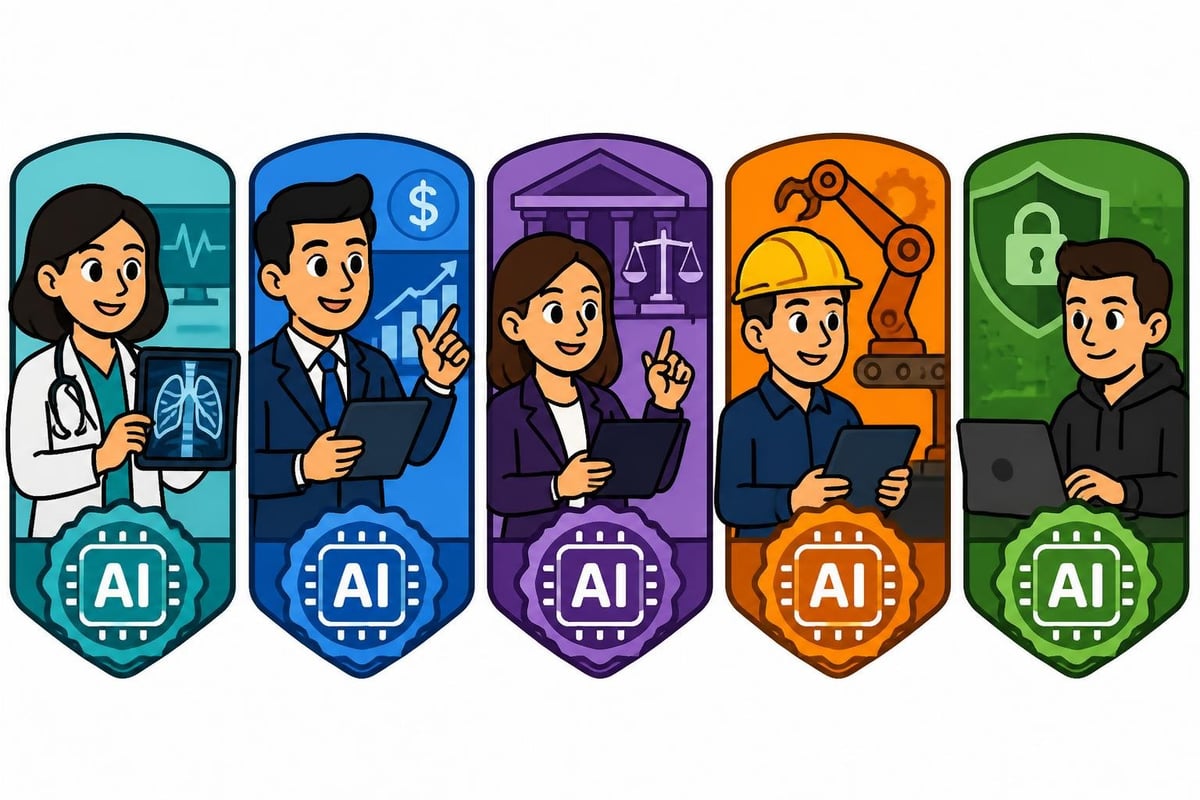
Vertical industry certifications address unique requirements in healthcare, finance, manufacturing, and other sectors. Medical AI certifications cover regulatory pathways, clinical validation, and integration with electronic health records. Financial services certifications emphasize fraud detection, algorithmic trading, and regulatory compliance.
The American Board of Artificial Intelligence in Medicine provides virtual courses specifically designed for healthcare professionals integrating AI into clinical practice. This specialization reflects recognition that general AI knowledge alone proves insufficient for domain-specific applications.
Comparing Certification Programs and Making Informed Choices
With hundreds of ai certification course options available, systematic comparison prevents costly mistakes. The AI Cert Index provides curated directory comparing official AI credentials across major vendors, helping professionals evaluate options based on standardized criteria.
Evaluation Framework for AI Certifications
Assess programs across these dimensions:
| Criteria | What to Evaluate | Red Flags |
|---|---|---|
| Curriculum Depth | Hours of instruction, project requirements, assessment rigor | Completion certificates without evaluation |
| Industry Recognition | Employer awareness, job posting mentions, alumni outcomes | Unknown providers with no track record |
| Cost vs. Value | Total investment including materials, exams, renewals | Extremely low prices suggesting inadequate content |
| Learning Format | Live instruction, self-paced, hands-on labs, mentorship | Passive video-only programs |
| Credential Portability | Platform independence, transferable skills, resume value | Narrow tool-specific training |
NicoTech Global's accredited AI CERTs™ programs demonstrate comprehensive approaches suitable for both individual professionals and organizational capability development, offering structured paths with measurable competency milestones.
Hidden Costs and Time Commitments
Published course durations often underestimate actual time requirements. A "40-hour certification" might require 80+ hours when including prerequisite review, hands-on practice, project completion, and exam preparation. Factor in:
- Preparation time for foundational knowledge gaps
- Lab and practice hours beyond lecture content
- Project development for portfolio-building requirements
- Exam retake fees if initial attempts are unsuccessful
- Renewal costs for maintaining credential validity
Understanding total investment prevents mid-course surprises and supports realistic planning.
Corporate AI Training and Team Certification
Organizations increasingly pursue team-wide AI literacy rather than individual expert development. Corporate certification programs address this need through customized curricula, cohort learning experiences, and organizational competency frameworks.
Benefits of Organizational Certification Programs
Companies implementing structured AI certification initiatives report:
- Faster AI adoption through reduced knowledge gaps
- Improved project success rates from standardized approaches
- Enhanced recruitment and retention of technical talent
- Measurable skill development for performance management
- Reduced vendor dependency through platform-agnostic expertise
MammothClub's corporate certification programs provide organizations with scalable AI training solutions, combining on-demand courses, interactive bootcamps, and customized learning paths. The platform's AI-powered dashboards enable training managers to track progress, identify knowledge gaps, and demonstrate ROI.
Effective corporate programs include:
- Role-based learning paths for different job functions
- Hands-on projects using organizational data and systems
- Mentorship from experienced AI practitioners
- Assessment mechanisms validating skill acquisition
- Integration with career development frameworks
The Cloud Native Computing Foundation's training programs exemplify effective approaches to organizational capability building, particularly for teams deploying AI within cloud-native architectures and Kubernetes environments.
Practical Implementation and Post-Certification Career Development
Completing an ai certification course represents the beginning rather than end of professional development. Maximum career impact requires strategic certification application, continuous learning, and active professional community participation.
Translating Certification to Career Advancement
Leverage new credentials through:
- Updating professional profiles with specific competencies demonstrated
- Seeking internal projects applying newly acquired skills
- Contributing to open-source AI projects showcasing practical ability
- Speaking at meetups or conferences on specialized topics
- Publishing articles or tutorials demonstrating expertise
Technical certifications carry greatest weight when accompanied by demonstrable project experience. Build a portfolio showcasing real-world applications of certified competencies, even if based on personal or volunteer work.
Organizations value professionals who bridge technical and business domains. Combining technical AI certifications with domain expertise in finance, healthcare, legal, or other verticals creates particularly marketable skill combinations. Legal professionals, for instance, might enhance traditional expertise with AI-focused programs while maintaining core competencies through specialized education providers like M2Law S.r.l., which offers accredited training in procedural law and professional development.
Maintaining Certification Relevance
AI's rapid evolution makes ongoing learning essential for credential maintenance. Most certifications require periodic renewal through:
- Completing continuing education credits
- Passing updated examinations reflecting new capabilities
- Demonstrating continued professional practice
- Participating in professional community activities
Develop sustainable learning habits including:
- Regular engagement with AI research papers and industry publications
- Experimentation with emerging tools and frameworks
- Participation in online communities and discussion forums
- Attendance at conferences and workshops
- Contribution to knowledge sharing through teaching or mentoring
MammothClub's 3,000+ on-demand courses enable continuous skill refreshment as technologies evolve, supporting long-term career development beyond initial certification.
Addressing Common Certification Challenges and Concerns
Professionals pursuing AI certifications encounter predictable obstacles. Anticipating these challenges and developing mitigation strategies increases completion rates and learning outcomes.
Time Management for Working Professionals
Balancing certification studies with full-time employment requires disciplined approaches. Successful learners typically:
- Schedule dedicated study blocks as non-negotiable calendar commitments
- Leverage commute time for video lectures or reading
- Break large programs into manageable weekly milestones
- Communicate learning goals with managers for potential workload adjustments
- Form study groups for accountability and knowledge sharing
Consider program formats matching your circumstances:
- Self-paced courses for irregular schedules
- Intensive bootcamps for focused immersion
- Part-time cohort programs providing structure with flexibility
- Weekend or evening formats designed for working professionals
Overcoming Prerequisite Knowledge Gaps
Many AI certifications assume mathematical foundations in linear algebra, calculus, probability, and statistics. Professionals without these backgrounds should:
- Complete prerequisite courses before starting certification programs
- Choose beginner-focused certifications building foundations gradually
- Allocate extra time for conceptual review and practice
- Leverage supplementary resources addressing specific knowledge gaps
- Focus initially on applied programs emphasizing implementation over theory
MammothClub offers AI specialization courses spanning beginner through advanced levels, enabling progressive skill building without prerequisite anxiety.
Global Perspectives and Regional Certification Considerations
AI certification value varies across geographic markets based on regional industry development, regulatory environments, and employer familiarity with credential providers. Understanding these variations helps professionals make location-appropriate choices.
North American Certification Trends
U.S. and Canadian employers heavily favor vendor certifications from major technology companies, particularly in cloud computing and enterprise software contexts. Startup ecosystems value practical implementation experience and portfolio demonstrations alongside or instead of formal credentials.
Regional preferences include:
- Strong emphasis on hands-on project portfolios
- Growing recognition of ethics and governance certifications
- Preference for accredited programs from recognized institutions
- Increasing value placed on specialized domain certifications
European AI Certification Landscape
European markets demonstrate stronger regulatory awareness, making governance and ethics certifications particularly valuable. GDPR compliance knowledge enhances technical AI credentials significantly. Professional bodies and academic institutions carry greater weight than in North American markets.
Asia-Pacific Considerations
Rapidly growing AI adoption in Asia-Pacific creates strong demand for certified professionals. Government-backed certification programs in countries like Singapore, South Korea, and Japan carry particular regional weight. Multilingual capabilities combined with AI expertise create distinctive career opportunities.
Financial Investment and ROI Analysis
AI certification costs range from free community programs through premium executive education exceeding $10,000. Understanding total investment and expected returns supports informed decision-making.
Cost Components Beyond Tuition
Complete financial picture includes:
- Course or program fees
- Examination costs and potential retakes
- Required software licenses or cloud computing credits
- Reference materials and textbooks
- Hardware upgrades for local development
- Travel and accommodation for in-person components
- Opportunity costs of study time
- Renewal fees for credential maintenance
Compare these investments against potential salary increases, promotion opportunities, and career transition possibilities. Industry data suggests AI-certified professionals command 15-30% salary premiums compared to non-certified peers in similar roles, though outcomes vary significantly by role, industry, and geographic market.
Free and Low-Cost Certification Options
Budget constraints shouldn't prevent AI skill development. Numerous high-quality free and low-cost options exist:
- University MOOCs offering audit tracks without certification fees
- Vendor introductory certifications at no cost
- Open-source community programs and tutorials
- Government-funded workforce development initiatives
- Employer-sponsored training programs
While free programs may lack the credential weight of premium certifications, they provide genuine learning value and can serve as stepping stones toward more recognized credentials.
Integration with Formal Education and Academic Programs
AI certifications complement rather than replace formal degrees in computer science, data science, or related fields. Understanding how these credentials interact helps professionals design optimal learning pathways.
Certifications as Graduate Degree Supplements
Graduate students enhance theoretical knowledge with practical certifications demonstrating implementation capabilities. Combining a master's degree with relevant vendor certifications signals both conceptual depth and operational readiness to employers.
Effective integration strategies:
- Pursue certifications in technologies used for thesis or capstone projects
- Time certification completion to coincide with graduation for maximum resume impact
- Select certifications addressing employer requirements in target job markets
- Use certification preparation as forcing function for hands-on practice
Alternative Credentials vs. Traditional Degrees
The "certification vs. degree" debate oversimplifies complex career optimization decisions. Optimal approaches typically involve both:
- Degrees provide foundational theory, research capabilities, and broad problem-solving skills
- Certifications demonstrate current practical competencies and specific tool proficiencies
- Combined credentials signal comprehensive preparation for complex technical roles
Career changers and professionals without technical degrees particularly benefit from combining foundational certifications with portfolio development, using credentials to compensate for lack of formal computer science education.
Selecting and completing the right ai certification course accelerates your AI career by validating expertise, demonstrating practical competency, and differentiating you in competitive markets. Whether pursuing vendor-specific platform credentials, domain-focused specializations, or foundational programs covering AI ethics and governance, strategic certification choices aligned with career goals deliver measurable professional returns. Ready to advance your AI capabilities with industry-recognized credentials? Explore MammothClub's comprehensive AI certification programs and join thousands of professionals transforming their careers through our interactive bootcamps, on-demand courses, and AI-powered learning tools designed for measurable results.