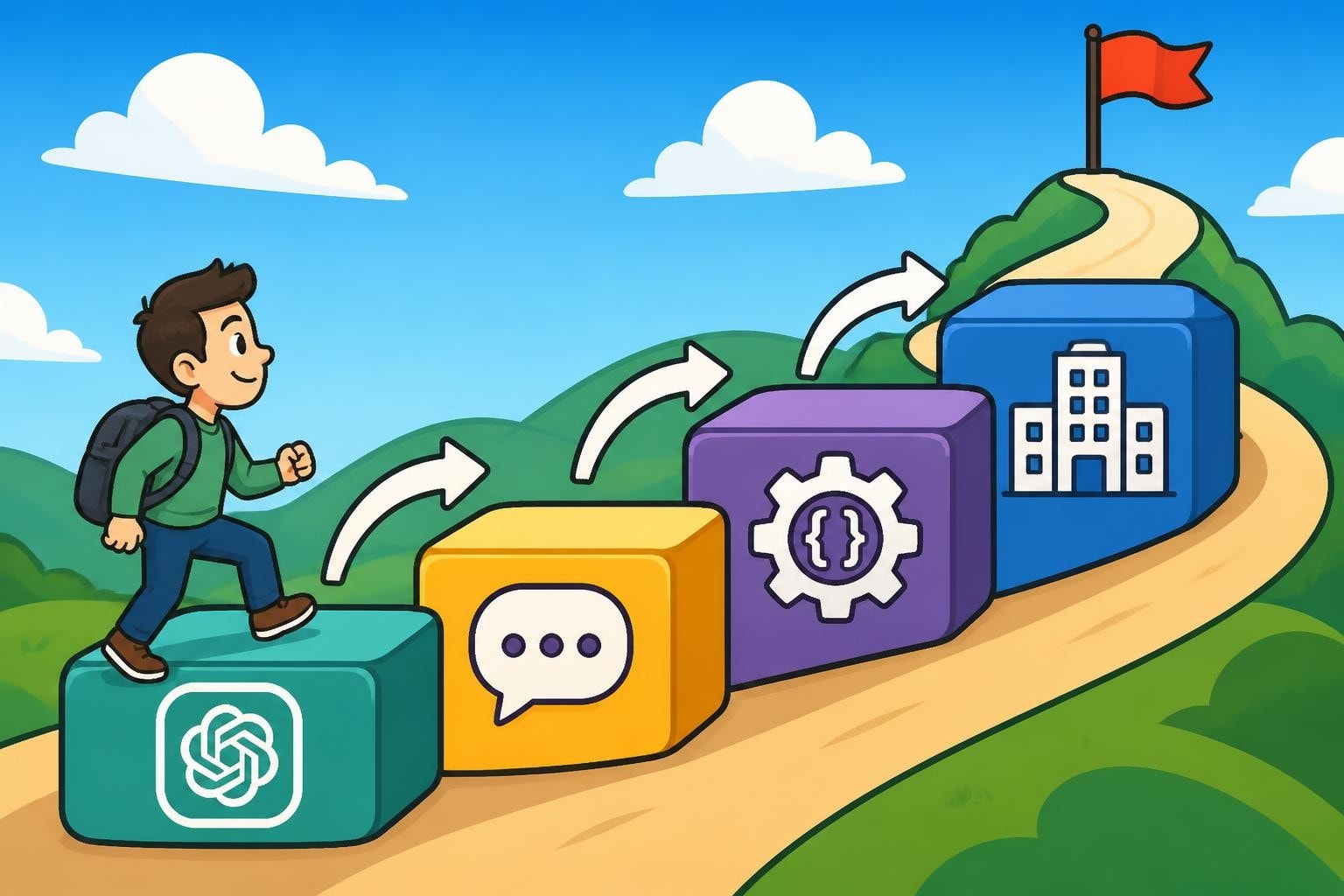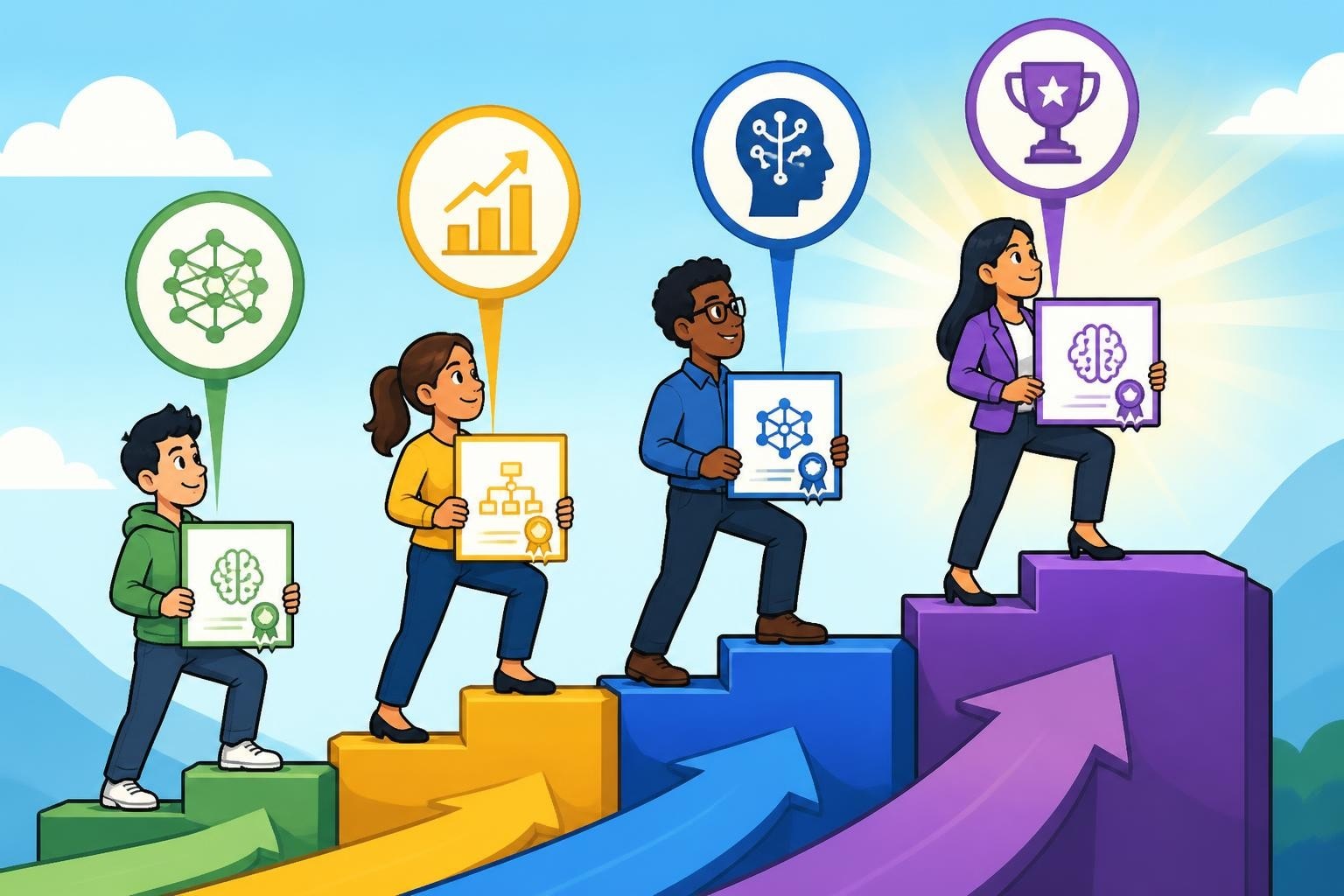
The artificial intelligence and machine learning (AIML) skills gap continues to widen in 2026, with organizations across every sector scrambling to find qualified professionals who can implement, manage, and innovate with AI technologies. Whether you're a software developer pivoting into machine learning, a data analyst seeking to expand your capabilities, or a business leader who needs to understand AI's strategic implications, aiml online courses offer accessible, flexible pathways to acquire these critical competencies. The landscape of AIML education has evolved dramatically, moving beyond theoretical lectures to embrace hands-on projects, real-world datasets, and industry-recognized certifications that employers actually value.
Understanding the AIML Education Landscape in 2026
The market for aiml online courses has matured significantly, offering learners unprecedented choice in content depth, teaching methodology, and credential value. Today's platforms deliver everything from introductory awareness training to specialized bootcamps in transformer architectures and reinforcement learning.
Modern AIML courses typically fall into four distinct categories:
- Foundational courses that introduce core concepts like supervised learning, neural networks, and model evaluation
- Platform-specific training focused on tools like TensorFlow, PyTorch, Azure AI, or AWS SageMaker
- Domain specialization in areas such as computer vision, natural language processing, or generative AI
- Applied business courses that emphasize AI strategy, ethics, and organizational implementation
The best aiml online courses balance theoretical understanding with practical application. Google's Machine Learning Crash Course exemplifies this approach by combining conceptual videos with interactive coding exercises that reinforce learning through practice.
How Learning Paths Have Changed
Traditional computer science programs required years of study before touching actual machine learning projects. Contemporary aiml online courses reverse this model, introducing practical implementations early while building theoretical foundations progressively.
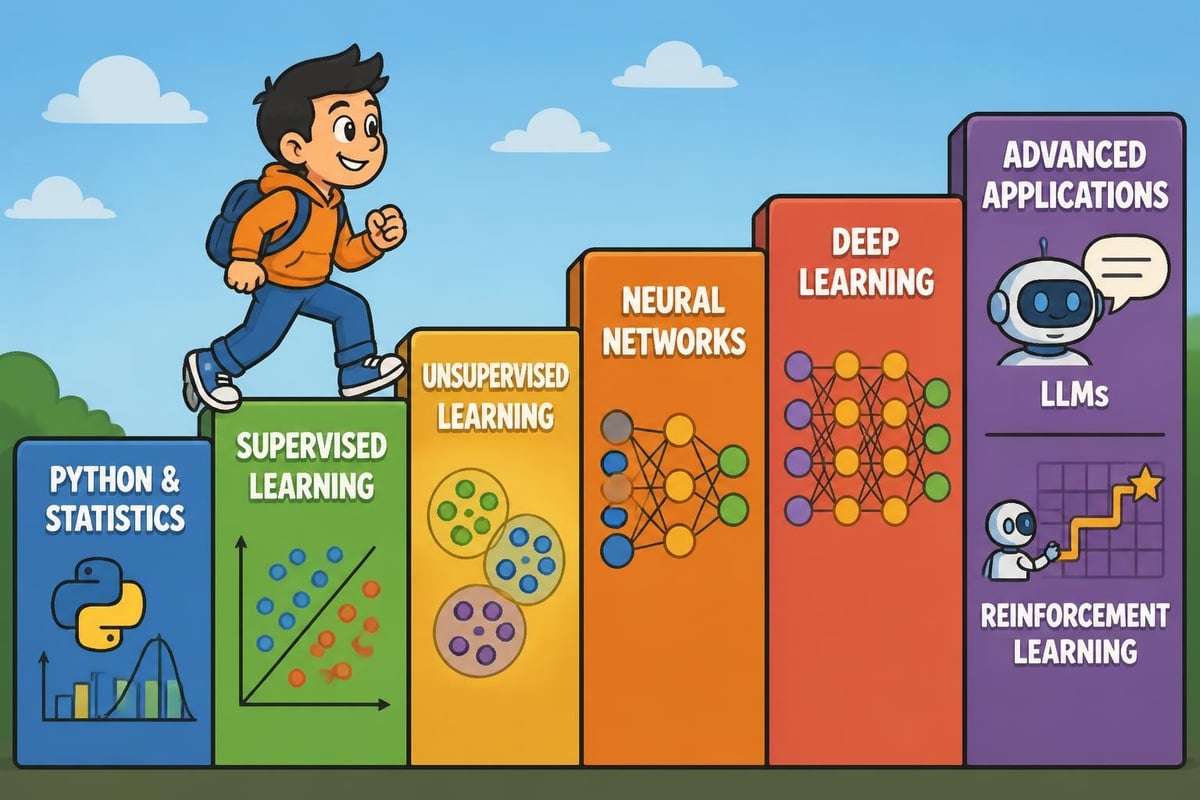
This pedagogical shift reflects industry needs. Employers value practitioners who can deploy models, interpret results, and communicate findings more than those who can derive backpropagation equations from first principles (though both skills remain important at advanced levels).
Evaluating Course Quality and Credibility
Not all aiml online courses deliver equivalent value. The explosion of AI interest has attracted both exceptional educators and opportunistic content creators, making quality assessment essential before investing time and money.
Critical Quality Indicators
| Quality Factor | What to Look For | Red Flags |
|---|---|---|
| Instructor credentials | Published research, industry experience, verified teaching history | Anonymous instructors, unverifiable claims |
| Curriculum recency | 2025-2026 content updates, current frameworks | Pre-2023 materials, deprecated libraries |
| Hands-on components | Projects with real datasets, code repositories, environment setup | Theory-only lectures, no practical assignments |
| Community support | Active forums, peer reviews, instructor engagement | Abandoned discussion boards, unanswered questions |
| Career outcomes | Employment statistics, alumni testimonials, hiring partnerships | Vague success claims, no verifiable data |
The Microsoft Learn AI hub demonstrates enterprise-grade quality with role-based learning paths, hands-on labs in Azure environments, and clear skill progression frameworks. Their structured approach helps learners understand exactly what competencies each module develops.
Certification Value and Recognition
Professional certifications carry varying weight depending on issuer reputation and industry acceptance. Vendor-specific credentials like the Azure AI Fundamentals (AI-900) certification validate platform expertise valued by organizations using those ecosystems.
Academic certificates from universities often emphasize theoretical rigor. Stanford's CS229 materials represent graduate-level depth that prepares learners for research roles or advanced engineering positions requiring mathematical sophistication.
Platform-neutral certifications from professional organizations focus on practical competencies and ethical considerations, aligning with frameworks like NIST's AI Risk Management guidance that emphasizes responsible AI development and deployment.
Choosing Between Self-Paced and Instructor-Led Programs
The format of aiml online courses significantly impacts learning effectiveness, completion rates, and skill retention. Your choice should align with learning style, schedule flexibility, and accountability needs.
Self-paced advantages:
- Learn during optimal personal productivity windows
- Replay difficult concepts multiple times
- Progress faster through familiar material
- Lower costs compared to cohort programs
- No geographic or timezone constraints
Instructor-led benefits:
- Structured deadlines improve completion rates
- Real-time Q&A clarifies confusion immediately
- Peer collaboration on projects and assignments
- Networking opportunities with classmates and instructors
- External accountability drives consistent progress
Many professionals find hybrid models most effective, combining self-paced video content with scheduled live sessions for project reviews and advanced topics. Platforms like MammothClub integrate both approaches through on-demand course libraries supplemented by interactive bootcamps and corporate training programs.
Time Investment Realities
Acquiring functional AIML skills requires substantial time commitment. Foundational competency typically demands 150-300 hours spread across 3-6 months, while specialization adds another 100-200 hours depending on domain complexity.
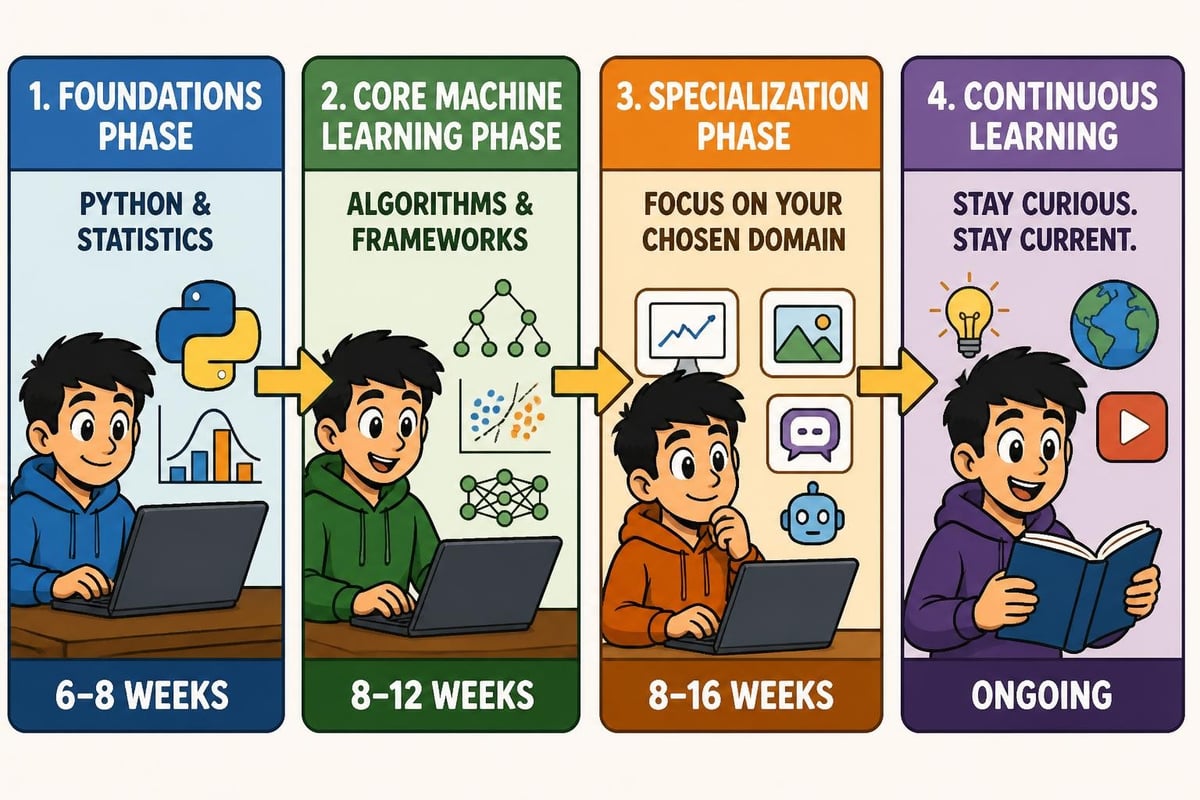
Effective aiml online courses help learners allocate time efficiently by prioritizing high-impact skills first. Understanding data preprocessing, feature engineering, and model evaluation delivers more immediate value than mastering every algorithm's mathematical derivation.
Technical Prerequisites and Preparation
Starting aiml online courses without adequate preparation wastes time and creates frustration. Most successful learners possess foundational knowledge in specific areas before beginning formal AI training.
Essential Background Knowledge
- Programming proficiency in Python, including data structures, functions, and libraries like NumPy and Pandas
- Statistical fundamentals covering probability distributions, hypothesis testing, and correlation analysis
- Linear algebra basics including matrix operations, vectors, and transformations
- Calculus concepts particularly derivatives and gradient descent (for deep learning paths)
- Data manipulation skills using SQL or equivalent database query languages
MIT's OpenCourseWare exemplifies courses that assume strong mathematical foundations, delivering advanced content for learners ready to engage with complex architectures and theoretical proofs.
Conversely, business-focused programs minimize technical prerequisites, emphasizing AI literacy, strategic applications, and governance frameworks over implementation details. These courses suit leaders who need to make informed decisions about AI investments without writing production code.
Specialized Learning Paths Worth Considering
The breadth of AIML applications means learners should specialize based on career goals rather than attempting comprehensive mastery across all domains simultaneously.
Computer Vision Track
Core competencies: Convolutional neural networks, image preprocessing, object detection, semantic segmentation, transfer learning
Applications: Medical imaging analysis, autonomous vehicles, manufacturing quality control, facial recognition systems, satellite imagery interpretation
Key tools: OpenCV, YOLO, ResNet architectures, PyTorch Vision, TensorFlow Image APIs
Computer vision specialists remain in high demand across healthcare, automotive, retail, and security sectors. The field combines algorithmic understanding with domain expertise in optics, cameras, and image formation.
Natural Language Processing Specialization
| Skill Area | Foundational Topics | Advanced Topics |
|---|---|---|
| Text processing | Tokenization, stemming, TF-IDF | Subword encoding, byte-pair encoding |
| Models | Word2Vec, RNNs, LSTMs | Transformers, BERT, GPT architectures |
| Applications | Sentiment analysis, classification | Question answering, summarization, translation |
| Tools | NLTK, spaCy, Hugging Face | LangChain, custom fine-tuning, RAG systems |
Fast.ai's Practical Deep Learning course excels at teaching NLP through project-based learning, getting students building functional models quickly before diving into architectural details.
Reinforcement Learning and Decision Systems
This advanced specialization focuses on agents learning optimal behaviors through trial and error, applicable to robotics, game AI, resource optimization, and autonomous systems. Prerequisites typically include strong programming skills and comfort with Markov decision processes.
Few aiml online courses cover reinforcement learning comprehensively at the introductory level due to its mathematical complexity and computational requirements. Most successful learners approach this domain after mastering supervised and unsupervised methods.
Platform-Specific Versus Framework-Agnostic Training
Career objectives should drive your choice between vendor-specific aiml online courses and platform-neutral training programs.
Cloud Platform Certifications
Organizations committed to specific cloud ecosystems value specialists who understand native AI services, infrastructure integration, and platform best practices. The Azure AI Engineer Associate certification represents one such credential, validating skills in deploying conversational AI, computer vision, and NLP solutions within Azure environments.
Benefits of platform-specific training:
- Direct applicability to existing enterprise infrastructure
- Managed services reduce operational complexity
- Built-in scalability and security features
- Career advancement within ecosystem-committed organizations
Limitations to consider:
- Skills may not transfer fully to alternative platforms
- Vendor lock-in concerns for long-term career flexibility
- Platform evolution can obsolete specific knowledge quickly
Framework-Agnostic Fundamentals
Learning core machine learning principles independent of specific tools creates maximum career flexibility. Understanding gradient descent, regularization, cross-validation, and model evaluation techniques applies regardless of whether you implement in TensorFlow, PyTorch, JAX, or future frameworks.
MIT's Deep Learning course materials emphasize transferable knowledge over framework-specific syntax, preparing learners to adapt as the technological landscape evolves.
Cost Structures and Financial Planning
Investment in aiml online courses ranges from free to over $15,000 for comprehensive bootcamp programs. Understanding cost drivers helps learners optimize spending.
Free options provide:
- Foundational knowledge and theoretical understanding
- Self-paced learning without credential verification
- Access to lectures and reading materials
- Community support through forums
Paid programs add:
- Verified certificates and credentials
- Graded assignments with instructor feedback
- Dedicated support and mentorship
- Career services and hiring partnerships
- Hands-on labs with cloud computing resources
Many professionals begin with free resources to validate interest and aptitude before investing in credentialed programs. The best machine learning courses often combine free foundational content with optional paid certifications.
Corporate Training ROI
Organizations investing in team upskilling through aiml online courses should calculate return based on productivity gains, innovation capacity, and talent retention. Companies report 25-40% faster project delivery and 30-50% reduction in external consulting costs after systematic AIML training programs.
MammothClub's corporate certification programs include learning analytics dashboards that quantify skill acquisition, knowledge gaps, and training effectiveness across teams, enabling data-driven decisions about continued investment.
Responsible AI and Ethics Integration
The most valuable aiml online courses in 2026 integrate ethical considerations, bias mitigation, and responsible AI practices throughout technical training rather than treating these topics as isolated modules.
UNESCO's guidance on AI and the futures of learning emphasizes incorporating fairness, accountability, and transparency principles from initial concept introduction, ensuring learners develop both technical competence and ethical judgment simultaneously.
Critical Ethical Competencies
Modern AI practitioners must understand:
- Bias detection and mitigation across data collection, feature engineering, and model selection
- Privacy preservation techniques including differential privacy, federated learning, and secure multi-party computation
- Explainability methods such as SHAP values, LIME, and attention visualization
- Fairness metrics appropriate to different application domains
- Governance frameworks aligning with organizational policies and regulatory requirements
Courses emphasizing these competencies prepare learners for the responsible AI challenges that define professional practice in regulated industries like healthcare, finance, and public services.
Staying Current in a Rapidly Evolving Field
Completing aiml online courses represents the beginning of continuous learning rather than a final destination. The field evolves so rapidly that practitioners must dedicate 5-10 hours monthly to staying current with new techniques, frameworks, and best practices.
Effective strategies for ongoing education include:
- Following top research labs and reading selected papers from major conferences (NeurIPS, ICML, CVPR)
- Participating in Kaggle competitions or similar practical challenges
- Contributing to open-source AI projects on GitHub
- Attending local meetups and virtual conferences
- Experimenting with newly released models and frameworks
- Teaching or mentoring others to reinforce understanding
The AI in teaching and learning approach recognizes that explaining concepts to others often reveals gaps in one's own knowledge, creating valuable feedback loops for deeper mastery.
Emerging Topics to Monitor
Generative AI, particularly large language models, dominated 2024-2025 developments. The comprehensive guide to local LLMs with Ollama represents specialized training in deploying these powerful models locally, addressing privacy and cost concerns that cloud-based solutions present.
Looking ahead, multimodal AI, neuromorphic computing, quantum machine learning, and AI-assisted software development will likely define the next wave of innovation, with corresponding demand for specialized education in these domains.
Building a Practical Learning Portfolio
Employers evaluate AIML candidates primarily through demonstrated capabilities rather than certificate collections. Strategic learners complement formal coursework with public portfolio projects that showcase applied skills.
Portfolio Project Categories
| Project Type | Skills Demonstrated | Time Investment |
|---|---|---|
| Kaggle competition | Data preprocessing, feature engineering, model optimization | 40-80 hours |
| Open-source contribution | Collaboration, code quality, documentation | 20-60 hours |
| End-to-end application | Full ML pipeline, deployment, monitoring | 60-120 hours |
| Research replication | Paper comprehension, implementation from specifications | 30-50 hours |
| Domain-specific solution | Business understanding, stakeholder communication | 50-100 hours |
The most compelling portfolios combine technical depth with clear communication, explaining problem definition, approach rationale, results interpretation, and limitations honestly.
Integration with Traditional Computer Science Education
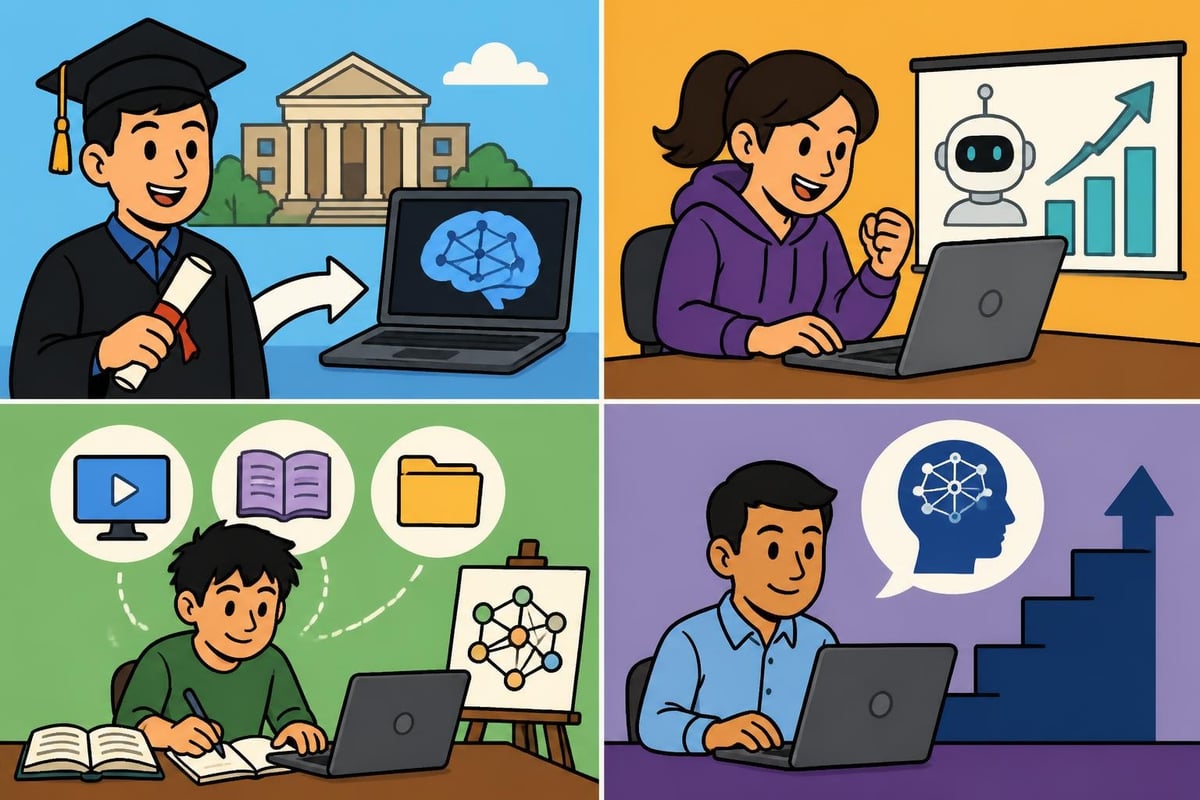
Students and recent graduates often wonder whether aiml online courses substitute for or complement formal computer science degrees. The relationship is complementary rather than competitive.
University programs provide structured fundamentals in algorithms, data structures, systems design, and theoretical computer science that underpin effective AI engineering. AIML courses offer specialized, current content that academic curricula struggle to update quickly enough given the field's rapid evolution.
The AI specialization courses approach works particularly well for computer science graduates who possess strong programming foundations but need domain-specific AI knowledge to transition into machine learning roles.
Career Transition Strategies for Non-Technical Backgrounds
Professionals from non-technical fields increasingly pursue AIML competencies, recognizing AI's transformative impact across industries. Successful transitions typically require 12-18 months of focused study and portfolio development.
Recommended progression for career changers:
- Build programming fundamentals through introductory Python courses (8-12 weeks)
- Develop statistical thinking and data analysis skills (6-8 weeks)
- Complete foundational machine learning coursework (12-16 weeks)
- Specialize in domain-relevant applications (8-12 weeks)
- Create portfolio projects demonstrating capabilities (ongoing)
- Network within target industry to understand employer needs (ongoing)
The AI certification from Google and similar vendor programs offer structured paths suitable for professionals without CS backgrounds, emphasizing practical application over theoretical depth.
Implementation Support and Community Resources
Learning AIML effectively requires more than consuming video lectures and completing exercises. Engagement with practitioner communities provides troubleshooting help, career advice, and exposure to real-world challenges beyond sanitized course datasets.
Valuable community resources include:
- Stack Overflow for specific technical questions and debugging help
- Reddit communities (r/MachineLearning, r/learnmachinelearning) for discussions and resource sharing
- GitHub for examining production code and contributing to projects
- LinkedIn groups for professional networking and job opportunities
- Local meetups for face-to-face learning and collaboration
NIST's AI research resources provide authoritative guidance on measurement, standards, and trustworthy AI practices valuable for professionals working in regulated environments or government sectors.
Measuring Learning Progress and Competency
Unlike traditional academic programs with standardized exams, aiml online courses require learners to self-assess progress and demonstrate mastery through practical applications.
Competency Checkpoints
Foundational competency exists when you can:
- Implement common algorithms from scratch (linear regression, decision trees, k-means)
- Clean and prepare real-world datasets for modeling
- Evaluate models using appropriate metrics and validation techniques
- Explain tradeoffs between different approaches to non-technical stakeholders
Intermediate competency includes:
- Building neural networks for classification and regression tasks
- Implementing transfer learning with pre-trained models
- Deploying models to production environments with monitoring
- Debugging training issues like vanishing gradients or overfitting
Advanced competency encompasses:
- Reading and implementing recent research papers
- Designing custom architectures for novel problems
- Optimizing models for specific hardware or latency constraints
- Leading AI projects from conception through deployment
The AI engineer certification programs assess these competency levels through practical projects, code reviews, and architectural decision explanations.
Navigating the landscape of aiml online courses requires clarity about your learning objectives, honest assessment of prerequisites, and commitment to hands-on practice beyond video consumption. The investment in quality education delivers compounding returns as AI capabilities become increasingly central to competitive advantage across every industry. Whether you're beginning your journey into machine learning or advancing toward specialized expertise, MammothClub offers the comprehensive course library, interactive bootcamps, and AI-powered learning tools to accelerate your progress and deliver measurable results in 2026's competitive job market.