The azure ai 900 certification represents Microsoft's foundational credential in artificial intelligence, designed for professionals seeking to validate their understanding of AI concepts and Azure AI services. This entry-level certification serves as a gateway into the rapidly expanding field of AI implementation, requiring no programming experience while establishing critical knowledge about machine learning principles, computer vision capabilities, natural language processing applications, and conversational AI technologies. Whether you're transitioning into AI-focused roles, strengthening your technical foundation, or demonstrating AI literacy to employers, the AI-900 exam provides a structured framework for understanding how organizations leverage Azure's AI ecosystem.
Understanding the Azure AI 900 Certification Structure
The azure ai 900 certification exam follows a specific format that candidates must understand before beginning preparation. Microsoft structures this 45-minute assessment to evaluate foundational knowledge across four primary domains, each carrying distinct weight in the overall scoring methodology.
Exam Domain Breakdown
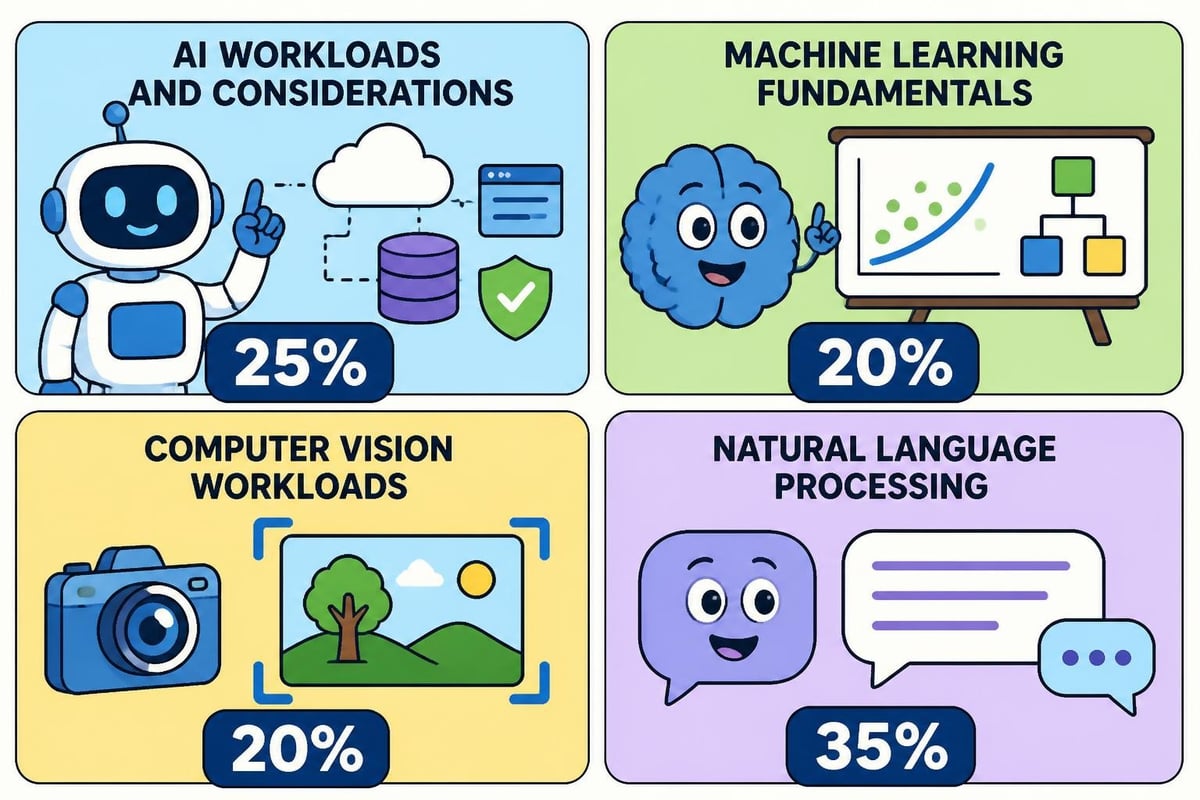
The AI-900 exam from Microsoft tests candidates across these weighted areas:
- AI Workloads and Considerations (15-20%): Understanding machine learning principles, responsible AI practices, and ethical considerations
- Fundamental Principles of Machine Learning (30-35%): Regression, classification, clustering concepts, and Azure Machine Learning capabilities
- Computer Vision Workloads (15-20%): Image classification, object detection, facial recognition, and Azure Computer Vision services
- Natural Language Processing and Conversational AI (30-35%): Text analysis, language understanding, speech recognition, and Azure Bot Service
The exam typically contains 40-60 questions presented in various formats including multiple choice, drag-and-drop scenarios, case studies, and interactive demonstrations. Candidates receive scores on a scale from 100 to 1,000, requiring a minimum passing score of 700 points.
| Exam Component | Details |
|---|---|
| Duration | 45 minutes |
| Question Count | 40-60 questions |
| Passing Score | 700/1,000 |
| Cost | $99 USD |
| Prerequisites | None required |
Core Knowledge Areas for AI-900 Success
Mastering the azure ai 900 certification requires comprehensive understanding across multiple AI disciplines. Each knowledge domain builds upon fundamental concepts while introducing Azure-specific implementations.
Machine Learning Foundations
The machine learning section constitutes the largest portion of the exam content. Candidates must demonstrate understanding of supervised learning approaches including regression for predicting continuous values and classification for categorical outcomes. Unsupervised learning concepts such as clustering algorithms for grouping similar data points also receive significant emphasis.
Key machine learning concepts include:
- Training, validation, and testing dataset purposes
- Feature engineering and selection processes
- Model evaluation metrics (accuracy, precision, recall, F1 score)
- Overfitting and underfitting recognition
- Azure Machine Learning workspace components
Azure Machine Learning designer provides a visual interface for building ML models without code, representing a critical exam topic. Understanding how to configure automated machine learning (AutoML) experiments and interpret their results demonstrates practical knowledge that exam scenarios frequently assess.
Computer Vision Applications
Computer vision workloads leverage neural networks to extract information from images and videos. The azure ai 900 certification examines understanding of common computer vision scenarios and their Azure implementations.
Candidates should recognize when to apply specific computer vision solutions:
- Image Classification: Assigning labels to entire images based on content
- Object Detection: Identifying and locating specific objects within images
- Semantic Segmentation: Classifying individual pixels within images
- Optical Character Recognition: Extracting text from images and documents
- Facial Detection and Analysis: Locating faces and determining attributes
Azure's Custom Vision service enables organizations to train specialized image classification models without deep learning expertise. The exam tests knowledge of how to create projects, upload training images, label data, train models, and publish iterations for consumption through APIs.
Natural Language Processing Capabilities
Natural language processing (NLP) enables computers to understand, interpret, and generate human language. This domain covers text analysis, language understanding, speech services, and translation capabilities within Azure's ecosystem.
Azure AI Language services include:
| Service | Primary Function | Common Use Cases |
|---|---|---|
| Text Analytics | Sentiment analysis, key phrase extraction | Customer feedback analysis, content categorization |
| Language Understanding (LUIS) | Intent recognition, entity extraction | Chatbots, voice commands, automated routing |
| Translator | Multi-language text translation | Content localization, real-time communication |
| Speech Services | Speech-to-text, text-to-speech | Transcription, accessibility, voice assistants |
Understanding conversational AI implementation through Azure Bot Service represents another crucial component. The certification assesses knowledge of bot development concepts, channels for bot deployment, and integration with Azure Cognitive Services for enhanced capabilities.
Strategic Preparation Approaches for the AI-900 Exam
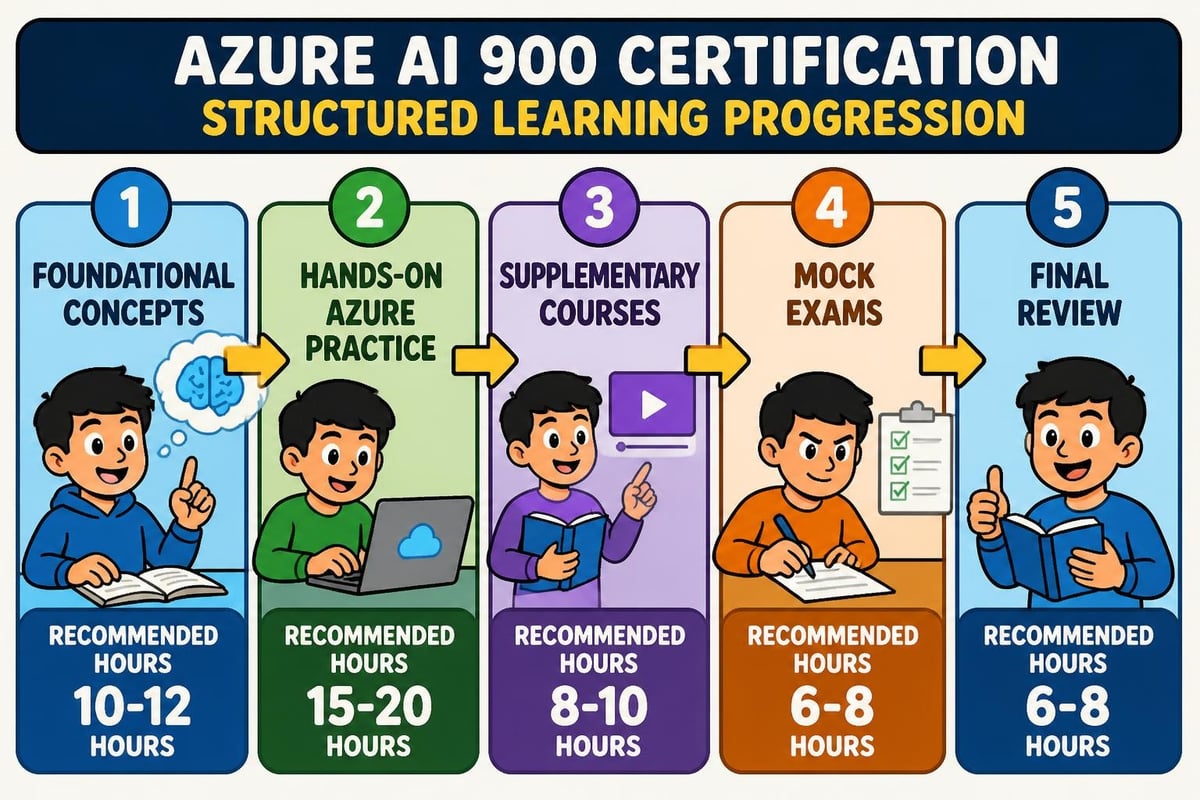
Successful azure ai 900 certification candidates typically invest 15-30 hours in structured preparation, though requirements vary based on existing AI knowledge. The official Microsoft study guide provides a comprehensive roadmap aligned with exam objectives.
Learning Path Development
Building an effective study plan requires balancing theoretical knowledge with hands-on practice. Microsoft Learn offers free, self-paced modules specifically designed for AI-900 preparation, featuring interactive exercises and knowledge checks.
Recommended preparation sequence:
- Complete Microsoft Learn's AI-900 learning paths (6-8 hours)
- Explore Azure AI services through free tier accounts (4-6 hours)
- Review additional resources like Pluralsight's AI-900 insights (3-4 hours)
- Practice with sample questions and mock exams (3-5 hours)
- Review weak areas and reinforce understanding (2-4 hours)
Platforms like MammothClub offer structured AI training programs that align with certification objectives while providing interactive learning experiences. Their AI-powered dashboards track progress and identify knowledge gaps, making preparation more efficient and targeted.
Hands-On Practice Requirements
Theoretical knowledge alone proves insufficient for certification success. The exam includes scenario-based questions requiring practical understanding of Azure AI service configuration and implementation. Creating a free Azure account enables exploration of AI services without financial commitment during the initial trial period.
Essential hands-on exercises:
- Create and train a Custom Vision model for image classification
- Build a Language Understanding application with intents and entities
- Deploy a Text Analytics solution for sentiment analysis
- Configure a Speech service for text-to-speech conversion
- Implement a QnA Maker knowledge base
Candidates should document their hands-on experiences, noting configuration options, service limitations, and integration patterns. This documentation becomes valuable reference material during final review sessions before the exam.
Career Impact and Professional Applications
The azure ai 900 certification delivers measurable career benefits across multiple professional contexts. Research indicates that industry certifications bridge skills gaps in technology roles, with AI credentials becoming increasingly valuable as organizations accelerate digital transformation initiatives.
Role-Specific Advantages
Different professional roles derive distinct benefits from AI-900 certification achievement:
Business Analysts and Project Managers gain credibility when discussing AI initiatives with technical teams and stakeholders. Understanding AI capabilities and limitations enables more realistic project scoping and requirement gathering.
Sales and Marketing Professionals working with AI products or services strengthen their technical conversations with prospects. Certification demonstrates genuine knowledge rather than superficial familiarity with AI terminology.
IT Professionals and Help Desk Staff better support users of AI-enabled applications and services. Foundational AI knowledge helps diagnose issues and communicate effectively with specialized support teams.
Aspiring AI Engineers establish foundational knowledge before pursuing advanced certifications like Azure AI Engineer certification. The AI-900 serves as a stepping stone toward more technical credentials requiring programming proficiency.
Organizational Benefits
Companies investing in azure ai 900 certification for employees report improved cross-functional communication about AI projects. When diverse teams share common AI vocabulary and conceptual frameworks, implementation discussions become more productive and aligned.
| Organizational Impact | Measurable Outcomes |
|---|---|
| Faster AI Adoption | 25-40% reduction in implementation timelines |
| Improved Project Success | 30-50% fewer AI initiative failures |
| Enhanced Team Collaboration | 35-45% better technical-business alignment |
| Reduced Training Costs | Standardized baseline knowledge across teams |
Organizations using platforms like MammothClub's corporate certification programs can track employee progress, measure competency development, and ensure teams maintain current AI knowledge as Azure services evolve.
Advanced Preparation Resources and Study Materials
Beyond Microsoft's official materials, numerous resources enhance azure ai 900 certification preparation. Strategic resource selection ensures comprehensive coverage without overwhelming candidates with redundant content.
Supplementary Learning Platforms
Codecademy's AI-900 course provides interactive exercises complementing Microsoft's documentation-heavy approach. The platform's hands-on coding environment helps solidify abstract concepts through practical application.
Community resources like TechExam Lexicon's FAQ section address common candidate concerns about exam logistics, question formats, and preparation strategies. Reading experiences from previous test-takers helps set realistic expectations and identify potential preparation gaps.
Recommended study resource mix:
- Official Microsoft documentation (40% of study time)
- Hands-on Azure portal practice (30% of study time)
- Third-party courses and tutorials (20% of study time)
- Practice exams and question banks (10% of study time)
Professionals seeking broader AI education beyond certification often benefit from exploring comprehensive AI and ML courses that contextualize Azure services within the larger AI ecosystem.
Practice Exam Strategy
Mock exams serve dual purposes: identifying knowledge gaps and building exam-taking confidence. Quality practice tests mirror actual exam question formats, difficulty levels, and time constraints.
Effective practice exam utilization requires strategic timing. Taking a baseline assessment early in preparation reveals weak areas requiring additional study. Mid-preparation practice exams track progress and validate learning effectiveness. Final practice tests one week before the actual exam build confidence and fine-tune time management strategies.
Analyzing incorrect answers proves more valuable than reviewing correct ones. Understanding why wrong answers appeared plausible and how to eliminate them systematically improves exam performance more than memorizing facts.
Common Preparation Mistakes and Avoidance Strategies
Even well-intentioned candidates make predictable errors during azure ai 900 certification preparation. Recognizing these patterns enables proactive mitigation strategies.
Overemphasis on Memorization
The AI-900 exam tests conceptual understanding and practical application rather than memorized definitions. Candidates who focus exclusively on terminology without understanding underlying principles struggle with scenario-based questions.
Instead of memorizing that "regression predicts continuous values," successful candidates understand when regression applies to business problems and which Azure services implement regression models. This deeper comprehension enables answering questions framed from unfamiliar angles.
Neglecting Azure-Specific Implementation
Understanding AI concepts theoretically while ignoring Azure's specific service implementations creates preparation gaps. The exam extensively tests knowledge of Azure AI service names, capabilities, configuration options, and appropriate use cases.
Azure service knowledge requirements:
- Recognizing which service solves specific scenarios
- Understanding pricing tiers and capability differences
- Knowing integration points between services
- Identifying service limitations and constraints
Candidates should create comparison tables mapping AI capabilities to Azure services, facilitating quick reference during study sessions.
Inadequate Hands-On Experience
Reading about Azure AI services without actually using them leaves candidates unprepared for practical scenario questions. The exam includes questions requiring knowledge of portal navigation, configuration workflows, and service output interpretation.
Creating a structured hands-on practice schedule ensures coverage of all major services. Even 30 minutes of focused Azure portal exploration proves more valuable than hours of passive reading about service capabilities.
Integration with Broader AI Learning Pathways
The azure ai 900 certification represents one component of comprehensive AI education rather than a complete learning endpoint. Professionals should consider how this credential fits within their larger career development strategy.
Certification Progression Routes
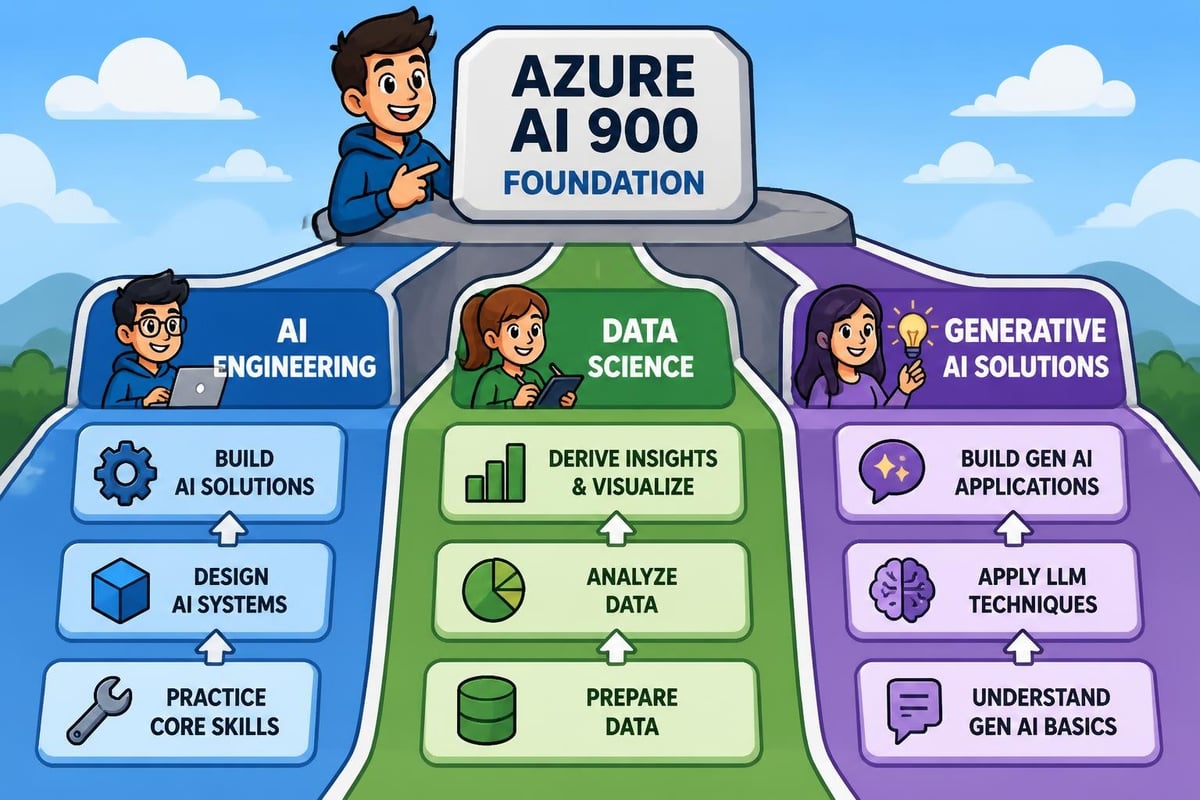
Microsoft offers several advanced AI certifications building upon AI-900 foundations:
- AI-102: Designing and Implementing an Azure AI Solution - Requires programming skills and deeper technical knowledge
- DP-100: Designing and Implementing a Data Science Solution - Focuses on machine learning model development
- AI-050: Develop Generative AI Solutions with Azure OpenAI Service - Specializes in large language model implementation
Candidates pursuing Microsoft AI certification pathways should plan their learning sequence strategically, ensuring each credential builds relevant skills for their target roles.
Complementary Skill Development
AI certification alone doesn't guarantee career success. Professionals maximize certification value by developing complementary capabilities:
- Data literacy: Understanding data collection, cleaning, and preparation processes
- Business acumen: Translating technical AI capabilities into business value
- Communication skills: Explaining AI concepts to non-technical stakeholders
- Ethical awareness: Recognizing AI bias, privacy concerns, and responsible implementation practices
Platforms offering AI ethics courses help professionals understand the broader implications of AI deployment, complementing technical certification knowledge with critical thinking about AI's societal impact.
Exam Day Preparation and Testing Strategies
Successfully completing the azure ai 900 certification requires more than knowledge acquisition. Effective exam-taking strategies and proper preparation for testing day significantly impact results.
Technical Setup for Online Testing
Microsoft offers both in-person testing centers and online proctored exams. Online testing provides convenience but requires specific technical preparation to avoid complications on exam day.
Online exam requirements:
- Stable internet connection (minimum 1 Mbps download/upload)
- Webcam and microphone functionality
- Quiet, private testing environment
- Government-issued identification
- Clear desk space (no reference materials, phones, or notes)
Running the system check provided by the testing platform 2-3 days before the exam identifies potential technical issues while leaving time for resolution. Testing on the actual computer used for exam day ensures compatibility and reduces unexpected problems.
Time Management During the Exam
The 45-minute exam duration allows roughly one minute per question, though actual time allocation should account for review periods. Strategic time management prevents rushing through final questions or running out of time completely.
Effective candidates employ the "two-pass" approach: answering confident questions immediately during the first pass while marking uncertain questions for review. This strategy ensures all easy points are secured before investing extra time in challenging scenarios.
Questions including case studies or detailed scenarios require additional time investment. Budgeting 2-3 minutes for complex questions while maintaining one minute for straightforward questions balances thorough analysis with time efficiency.
Stress Reduction Techniques
Exam anxiety undermines performance even for well-prepared candidates. Implementing stress management strategies before and during the exam maintains focus and cognitive performance.
The night before the exam should emphasize rest rather than last-minute cramming. Reviewing high-level notes or flashcards for 30-60 minutes helps activate relevant knowledge without inducing stress from encountering unfamiliar material.
During the exam, brief breathing exercises between question sections reset focus and reduce anxiety accumulation. Taking 10-15 seconds to breathe deeply after completing each case study or challenging scenario cluster prevents stress from compounding throughout the testing session.
Real-World Application Scenarios
Understanding how azure ai 900 certification knowledge applies to actual business situations reinforces learning and demonstrates certification value to employers.
Customer Service Enhancement
Organizations implement Azure AI services to transform customer service operations. A retail company might deploy Azure Bot Service integrated with Language Understanding to handle common customer inquiries automatically, reducing support team workload while maintaining 24/7 availability.
The bot uses Language Understanding to recognize customer intents like "track my order," "return an item," or "find product information." Entity extraction identifies specific order numbers, product names, or account details from customer messages, enabling personalized responses without human intervention.
Text Analytics integration provides sentiment analysis on customer interactions, flagging frustrated or angry customers for immediate human escalation. This prevents negative experiences from escalating while allowing automated systems to handle routine queries efficiently.
Content Moderation and Safety
Media platforms leverage Computer Vision and Content Moderator services to automatically review user-generated content for inappropriate material. Image classification models identify potentially problematic content categories while facial recognition capabilities detect unauthorized use of personal images.
Custom Vision models trained on company-specific guidelines provide more nuanced moderation than generic systems. A social platform for professional networking might train models to recognize business-appropriate attire, workplace settings, and professional imagery while flagging content violating community standards.
These implementations demonstrate practical application of AI-900 concepts including supervised learning for classification tasks, model training workflows, and responsible AI considerations around bias and fairness in content moderation decisions.
Document Processing Automation
Financial services organizations utilize Form Recognizer and Text Analytics to automate document processing workflows. Loan applications, insurance claims, and account opening forms that previously required manual data entry now process automatically through OCR and entity extraction.
The system extracts key information like names, addresses, account numbers, and monetary values from scanned documents. Text Analytics identifies document types and routes them to appropriate processing queues while sentiment analysis on attached letters or explanations provides context for human reviewers handling exceptions.
This scenario illustrates practical application of computer vision for OCR, natural language processing for entity extraction, and machine learning classification for document routing-all core azure ai 900 certification topics.
Certification Maintenance and Continuing Education
Unlike some Microsoft certifications requiring periodic renewal, the azure ai 900 certification does not expire. However, Azure AI services evolve continuously, making ongoing learning essential for maintaining practical relevance.
Staying Current with Azure AI Updates
Microsoft announces new AI service capabilities, pricing changes, and feature deprecations quarterly. Professionals leveraging their azure ai 900 certification for daily work should monitor these updates to maintain accurate knowledge.
Recommended staying current practices:
- Subscribe to Azure AI services update notifications
- Review quarterly Azure AI capability announcements
- Participate in AI-focused Microsoft Learn modules as they release
- Engage with Azure community forums and user groups
- Experiment with new service features in sandbox environments
Organizations using AI training platforms like MammothClub benefit from continuously updated course content reflecting latest Azure capabilities, ensuring teams maintain current knowledge without individual tracking efforts.
Advanced Learning Opportunities
Professionals finding value in their AI-900 foundation often pursue deeper specialization through advanced certifications, specialized courses, or practical project implementation.
Technical professionals might progress toward the AI-102 certification, which requires programming proficiency in Python or C# and deeper understanding of AI solution architecture. Business professionals might explore AI in business courses focusing on strategic AI implementation and ROI measurement.
Hands-on project experience provides learning opportunities that certifications cannot replicate. Building production AI solutions exposes professionals to integration challenges, performance optimization requirements, and stakeholder management aspects that enhance certification knowledge with practical wisdom.
The azure ai 900 certification provides accessible entry into AI fundamentals while delivering meaningful career benefits across technical and business roles. Whether you're validating existing knowledge, transitioning into AI-focused positions, or strengthening your organization's AI capabilities, strategic preparation combining Microsoft's official resources with hands-on practice ensures certification success. MammothClub offers comprehensive AI training programs with interactive bootcamps, certification preparation courses, and AI-powered learning tools that make mastering Azure AI concepts engaging and measurable-helping professionals and organizations build the AI expertise needed to thrive in 2026 and beyond.