Microsoft has positioned itself as a leader in enterprise AI training, offering a comprehensive ecosystem of courses that range from foundational concepts to advanced implementation strategies. As organizations race to integrate artificial intelligence into their operations, professionals need structured learning paths that combine theoretical knowledge with practical Azure cloud experience. A microsoft ai course typically encompasses Microsoft's cloud-based AI services, machine learning frameworks, and responsible AI principles, all designed to prepare learners for real-world deployment scenarios and industry-recognized certifications.
Understanding the Microsoft AI Learning Ecosystem
Microsoft's approach to AI education differs significantly from traditional academic programs or standalone online courses. The company has built an integrated training system that connects learning content directly to Azure cloud services, allowing students to practice with production-grade tools during their studies.
The microsoft ai course catalog includes multiple entry points depending on your current skill level and career objectives. Microsoft Learn serves as the primary hub, offering free learning paths that guide students through specific role-based curricula. These paths align directly with certification exams, ensuring that study time translates into measurable credentials.
Core Learning Platforms and Delivery Channels
Microsoft distributes its AI training through several channels, each serving different audience needs:
- Microsoft Learn: Free, self-paced modules with sandbox environments for hands-on practice
- Instructor-led training: Virtual and in-person classes through Microsoft Learning Partners
- University partnerships: Degree programs incorporating Microsoft curriculum and tools
- MOOC platforms: Courses on Coursera and edX offering professional certificates
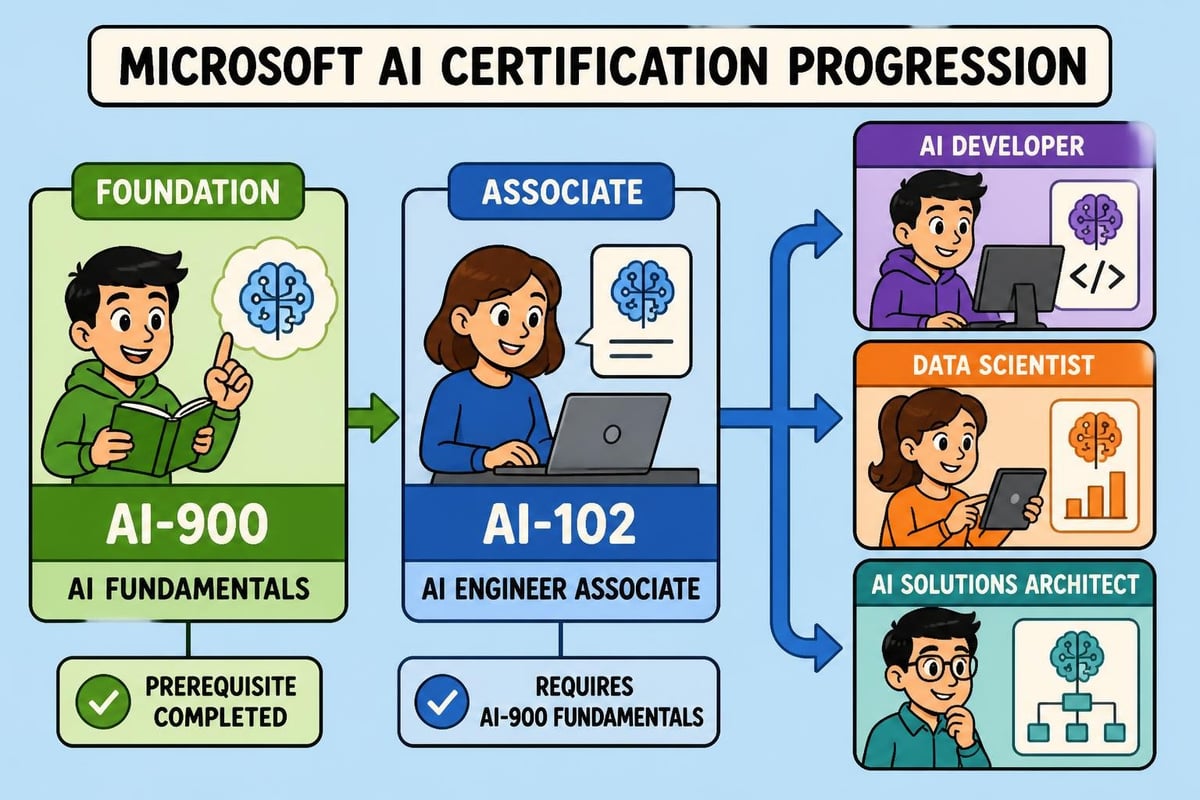
The official study guide for AI-900 provides a detailed example of how Microsoft structures foundational content, breaking down exam objectives into specific skill measurements that map to practical competencies.
| Certification | Level | Primary Focus | Typical Duration |
|---|---|---|---|
| AI-900 | Fundamentals | AI concepts, Azure AI services | 1-2 weeks |
| AI-102 | Associate | Building AI solutions on Azure | 6-8 weeks |
| DP-100 | Associate | Data science on Azure ML | 8-10 weeks |
| AI-3004 | Applied Skills | Specific AI implementation tasks | 2-4 weeks |
Foundational Microsoft AI Course Content
The entry-level microsoft ai course begins with AI-900: Azure AI Fundamentals, designed for professionals who need to understand AI capabilities without necessarily building systems themselves. This certification validates knowledge across computer vision, natural language processing, and conversational AI.
What makes this foundational course valuable:
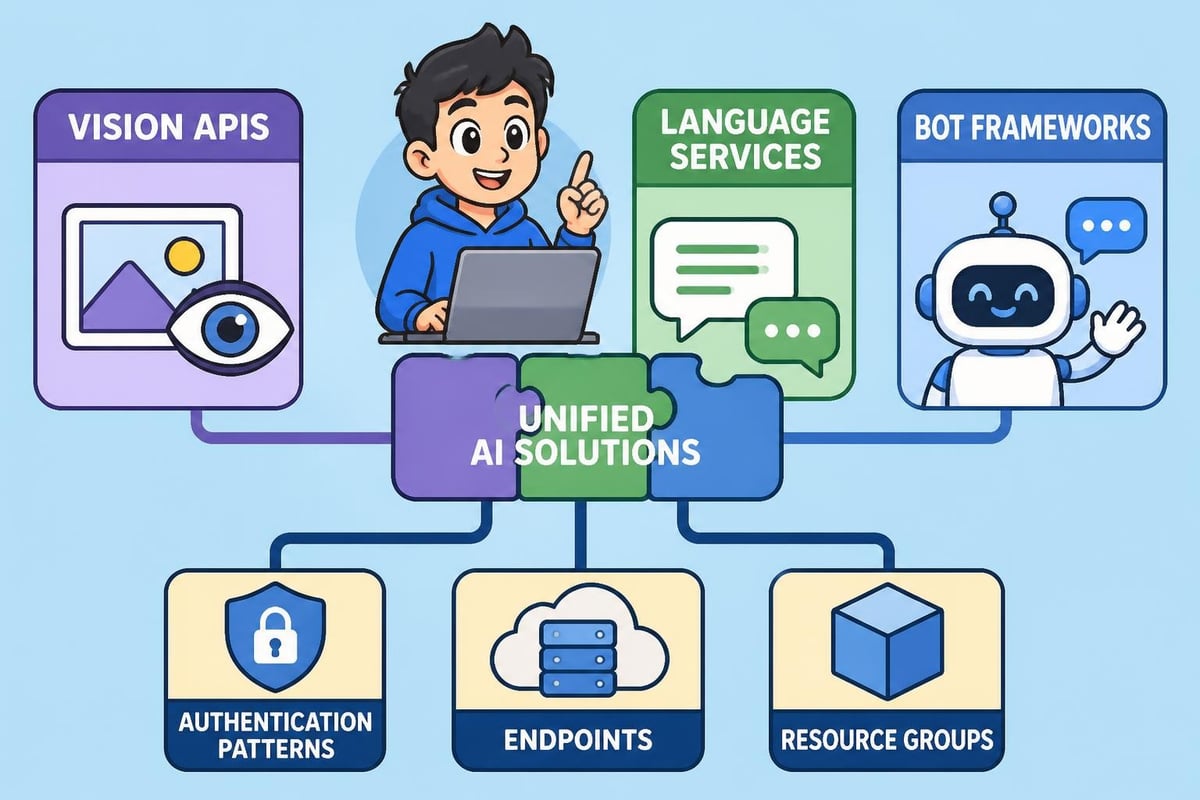
The curriculum introduces Azure's AI portfolio through a service-oriented lens. Rather than diving into algorithm mathematics, students learn how to evaluate pre-built AI services for business scenarios. You explore Azure Cognitive Services for vision and language, understand bot frameworks for conversational interfaces, and gain exposure to Azure Machine Learning for custom model scenarios.
Microsoft structures this content around workload categories rather than theoretical concepts. Students encounter real scenarios like automating document processing, implementing customer service chatbots, or adding visual search to applications. This practical framing helps business analysts, project managers, and technical decision-makers understand when and how to apply AI solutions.
Hands-On Labs and Practice Environments
Every microsoft ai course includes significant hands-on components. Microsoft provides temporary Azure subscriptions through learning sandboxes, eliminating cost barriers for students. The mslearn-ai-studio repository contains lab files that walk through specific scenarios step-by-step.
These labs cover:
- Provisioning Azure AI services through the portal and CLI
- Calling REST APIs for vision, speech, and language analysis
- Building conversational experiences with Language Studio
- Creating custom computer vision models with minimal code
- Implementing responsible AI practices in production scenarios
The browsable lab instructions provide an accessible reference that students can revisit after completing the formal course content.
Advanced Engineering and Implementation Courses
For professionals moving beyond fundamentals, the AI-102: Azure AI Engineer Associate certification represents the core microsoft ai course for practitioners who build and deploy AI solutions. This intermediate-level program assumes programming experience and focuses on implementation details.
Curriculum Deep Dive
The AI-102 course covers five major domains that reflect the actual responsibilities of an Azure AI engineer:
Solution Planning and Architecture: Students learn to select appropriate Azure AI services based on requirements, estimate costs, design for scalability, and implement security controls. This domain emphasizes decision-making frameworks rather than just technical skills.
Computer Vision Solutions: The curriculum explores Azure Computer Vision, Custom Vision, and Face API in depth. Labs guide students through building object detection systems, implementing facial recognition with privacy controls, and extracting insights from video streams. The AI-102 course on Coursera packages this content for MOOC delivery with additional support structures.
Natural Language Processing: Students work with Azure Language services to extract entities, analyze sentiment, build custom classification models, and translate content. Advanced modules cover question answering systems and conversational language understanding.
Knowledge Mining and Document Intelligence: This section teaches Azure Cognitive Search configuration, skillset creation for enrichment pipelines, and Form Recognizer implementation for structured data extraction from documents.
Conversational AI Development: The course culminates in building sophisticated bots using Azure Bot Service and Bot Framework, integrating multiple AI services, and implementing multi-turn conversations with context management.
Specialized Learning Paths and Emerging Topics
Beyond the core certification tracks, Microsoft offers specialized microsoft ai course content addressing specific technologies and use cases. These targeted learning paths typically don't lead to separate certifications but provide focused skills development.
AI Agents and Autonomous Systems
The mslearn-ai-agents repository contains emerging curriculum on building AI agents that can perceive environments, make decisions, and take actions autonomously. This advanced content explores:
- Agent architectures combining perception, reasoning, and action
- Integration patterns for connecting agents to business systems
- Multi-agent coordination and communication protocols
- Monitoring and governance for autonomous AI systems
Responsible AI and Ethics
Microsoft embeds responsible AI principles throughout its training, but dedicated modules provide deeper coverage. The responsible AI documentation outlines Microsoft's framework, which courses translate into practical implementation guidance.
Students learn to use Azure's responsible AI dashboard for model interpretability, fairness assessment, and error analysis. These tools help practitioners identify bias, explain predictions to stakeholders, and document AI system behavior for compliance purposes. For organizations seeking comprehensive ethics training, platforms like MammothClub's responsible AI course complement Microsoft's technical content with broader governance frameworks.
Comparing Microsoft AI Courses Across Platforms
While Microsoft Learn provides the official curriculum, multiple platforms deliver microsoft ai course content with different pedagogical approaches and support structures. Understanding these options helps learners choose the format that matches their learning style and schedule constraints.
| Platform | Strengths | Limitations | Best For |
|---|---|---|---|
| Microsoft Learn | Free, always current, direct Azure integration | Self-discipline required, minimal instructor support | Self-motivated learners, certification prep |
| Coursera | Structured timelines, peer interaction, university credit options | Subscription cost, slower content updates | Degree seekers, structured learners |
| edX | Audit options available, academic partnerships | Variable content quality across courses | Budget-conscious learners exploring options |
| Learning Partners | Expert instructors, networking opportunities | High cost, rigid schedules | Corporate teams, intensive bootcamp preference |
The choice between platforms often depends on organizational requirements. Companies pursuing Azure AI Engineer Associate certification for entire teams typically prefer instructor-led formats with cohort-based learning, while individual professionals often start with free Microsoft Learn resources before investing in premium options.
Integration with Broader AI Learning Paths
A microsoft ai course rarely exists in isolation. Most professionals combine Microsoft training with complementary content covering AI fundamentals, programming skills, and specialized techniques.
Those new to AI concepts benefit from starting with general AI learning paths for beginners before diving into platform-specific content. Conversely, experienced data scientists might supplement Microsoft courses with advanced topics like local large language models to understand deployment options beyond cloud services.
Practical Implementation and Career Impact
Completing a microsoft ai course delivers value beyond certification credentials. The practical skills acquired translate directly into measurable career advancement and organizational capabilities.
Real-World Application Scenarios
Graduates apply their Microsoft AI training to diverse business challenges:
Customer Service Automation: Implementing Azure Bot Service to handle tier-one support inquiries reduces response times and operational costs. Organizations report 30-50% reduction in support ticket volume after deploying well-designed conversational AI systems built using skills from AI-102 training.
Document Processing Pipelines: Financial services companies use Azure Form Recognizer, covered extensively in microsoft ai course content, to extract data from loan applications, invoices, and compliance documents. One implementation reduced processing time from 15 minutes per document to under 30 seconds.
Predictive Maintenance: Manufacturing firms combine Azure Machine Learning with IoT sensor data to predict equipment failures. The DP-100 certification curriculum provides the foundation for building these time-series prediction models.
Content Personalization: Media companies leverage Azure Cognitive Services for automatic content tagging, recommendation engines, and accessibility features like automated captioning. These implementations draw directly from computer vision and NLP modules in Microsoft's curriculum.
Career Progression and Salary Impact
Industry data shows measurable career benefits from Microsoft AI certifications:
- Entry-level positions: AI-900 certification helps business analysts and project managers transition into AI-focused roles, typically seeing 15-20% salary increases
- Mid-career advancement: AI-102 certification qualifies professionals for Azure AI Engineer positions with average salaries ranging from $95,000 to $135,000 annually
- Specialized expertise: DP-100 and advanced certifications position candidates for senior data scientist and ML engineer roles exceeding $150,000 in major tech markets
The certification also signals commitment to continuous learning, a critical factor as AI technologies evolve rapidly. Employers increasingly value professionals who maintain current credentials through Microsoft's recertification requirements.
Staying Current with Microsoft AI Education
Microsoft updates its AI training content quarterly to reflect new Azure services and evolving best practices. The rapid pace of AI innovation requires ongoing education beyond initial certification.
Continuous Learning Resources
Microsoft provides several mechanisms for staying current:
- Monthly updates to Microsoft Learn: New modules appear regularly covering preview services and emerging capabilities
- Microsoft AI Blog: Technical deep-dives explain new features and implementation patterns
- Azure AI Community: Forums and user groups share real-world implementations and troubleshooting advice
- Annual recertification: Certifications expire after one year, requiring renewal exams that cover updated content
Recent updates have expanded coverage of generative AI, reflecting OpenAI integration into Azure services. New modules cover prompt engineering, GPT model fine-tuning, and responsible deployment of large language models. These additions ensure that microsoft ai course content remains relevant as the industry shifts toward foundation models and agent-based architectures.
Academic Research and Curriculum Design
Microsoft's curriculum development incorporates findings from educational research. A recent paper on generative AI education explores effective teaching methods for AI concepts, informing how Microsoft structures hands-on labs and assessment strategies.
The company collaborates with universities worldwide to validate learning outcomes and ensure industry alignment. This academic partnership means that microsoft ai course certifications carry weight with both employers and educational institutions, facilitating career transitions and further academic study.
Corporate Training and Team Upskilling
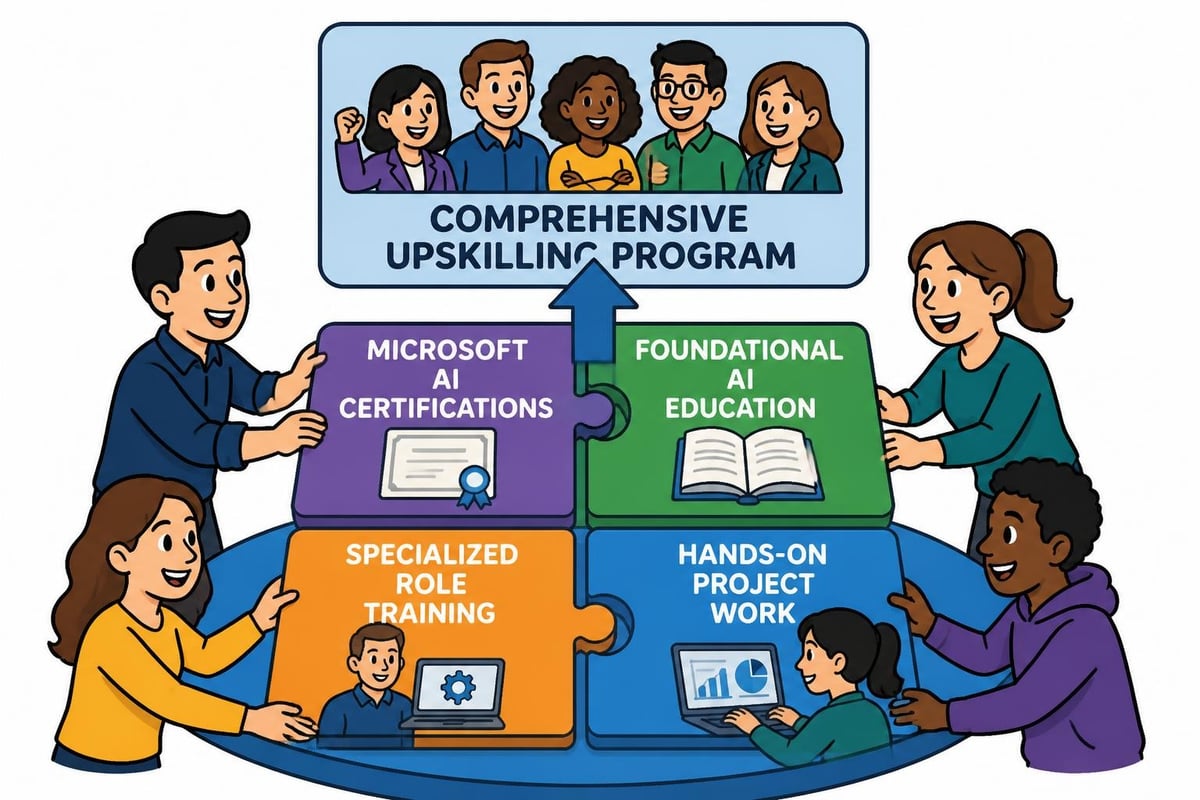
Organizations face unique challenges when implementing AI training programs at scale. A successful microsoft ai course deployment for enterprise teams requires coordination across learning and development, IT, and business units.
Building an Organizational AI Competency
Companies typically follow a phased approach:
Phase 1: Leadership Awareness: Executive teams complete foundational AI courses to understand capabilities and strategic implications. The AI-900 curriculum serves this audience well, providing business context without overwhelming technical detail.
Phase 2: Practitioner Development: Technical teams pursue AI-102 and DP-100 certifications based on role requirements. Organizations often establish internal study groups, provide dedicated lab time, and set certification targets tied to performance reviews.
Phase 3: Specialized Skills: As AI initiatives mature, companies invest in advanced training for specific use cases. This might include AI for business leaders courses for strategic planning or specialized technical training for niche applications.
Measuring Training ROI: Successful programs establish clear metrics for skill development and business impact:
- Percentage of technical staff holding current AI certifications
- Number of AI projects moved from pilot to production
- Cost savings or revenue generated from AI implementations
- Time-to-deployment for new AI capabilities
Organizations working with platforms like MammothClub can access consolidated dashboards tracking certification progress, skill assessments, and learning engagement across their entire workforce, making it easier to measure training effectiveness.
Choosing the Right Microsoft AI Course for Your Goals
With multiple certification paths and delivery options available, selecting the optimal microsoft ai course requires honest assessment of your current skills, career objectives, and learning preferences.
Decision Framework
For absolute beginners: Start with AI-900 regardless of your ultimate goal. The foundational concepts and terminology provide essential context for all subsequent learning. Budget 15-20 hours for study and hands-on practice.
For developers and engineers: AI-102 represents the most valuable certification for building production AI systems. Ensure you have solid programming skills (Python preferred) and basic cloud computing knowledge before starting. Plan for 40-60 hours of study including significant lab time.
For data scientists: DP-100 aligns with existing machine learning knowledge, teaching Azure-specific implementation patterns. Professionals with experience in scikit-learn, TensorFlow, or PyTorch can typically complete this certification in 30-40 hours.
For business analysts and consultants: AI-900 combined with solution-specific training (like bot development or computer vision) provides practical skills without requiring deep technical expertise. Supplement with business-focused AI strategy content.
For corporate teams: Implement a blended learning approach combining self-paced Microsoft Learn content, instructor-led bootcamps for complex topics, and internal knowledge sharing sessions. Establish clear timelines and support systems to maintain momentum.
Budget and Time Considerations
Microsoft Learn provides free access to all core learning content, significantly reducing cost barriers. Exam fees ($99-165 per attempt) represent the primary direct expense for individual learners. Corporate volume licensing reduces per-exam costs for organizations certifying multiple employees.
Time investment varies based on prior experience:
- AI-900: 1-2 weeks part-time for technical professionals; 3-4 weeks for non-technical learners
- AI-102: 6-8 weeks with 8-10 hours weekly study time
- DP-100: 8-10 weeks for engineers new to data science; 4-6 weeks for experienced ML practitioners
Setting realistic timelines prevents burnout and improves retention. Most successful learners dedicate specific weekly time blocks rather than attempting irregular, intensive study sessions.
Microsoft's comprehensive AI training ecosystem offers clear pathways for professionals at every skill level, from foundational concepts through advanced implementation expertise. The combination of free learning resources, hands-on Azure labs, and industry-recognized certifications creates measurable career value while building practical skills that organizations need today. Whether you're starting your AI journey or advancing specialized expertise, structured learning through Microsoft's curriculum accelerates your progress and validates your capabilities. MammothClub enhances this learning experience with 3,000+ on-demand AI courses, interactive bootcamps, and AI-powered dashboards that help both individuals and organizations track progress, measure outcomes, and achieve certification goals faster in the competitive AI landscape.