The artificial intelligence landscape has transformed dramatically over the past few years, with OpenAI at the forefront of developing sophisticated language models and multimodal systems. Understanding how openai training works has become essential for businesses and professionals looking to leverage AI capabilities effectively. This comprehensive guide explores the methodologies, techniques, and practical implications of OpenAI's training approaches, providing actionable insights for organizations seeking to stay competitive in an AI-driven marketplace.
The Foundation of OpenAI Training Methodologies
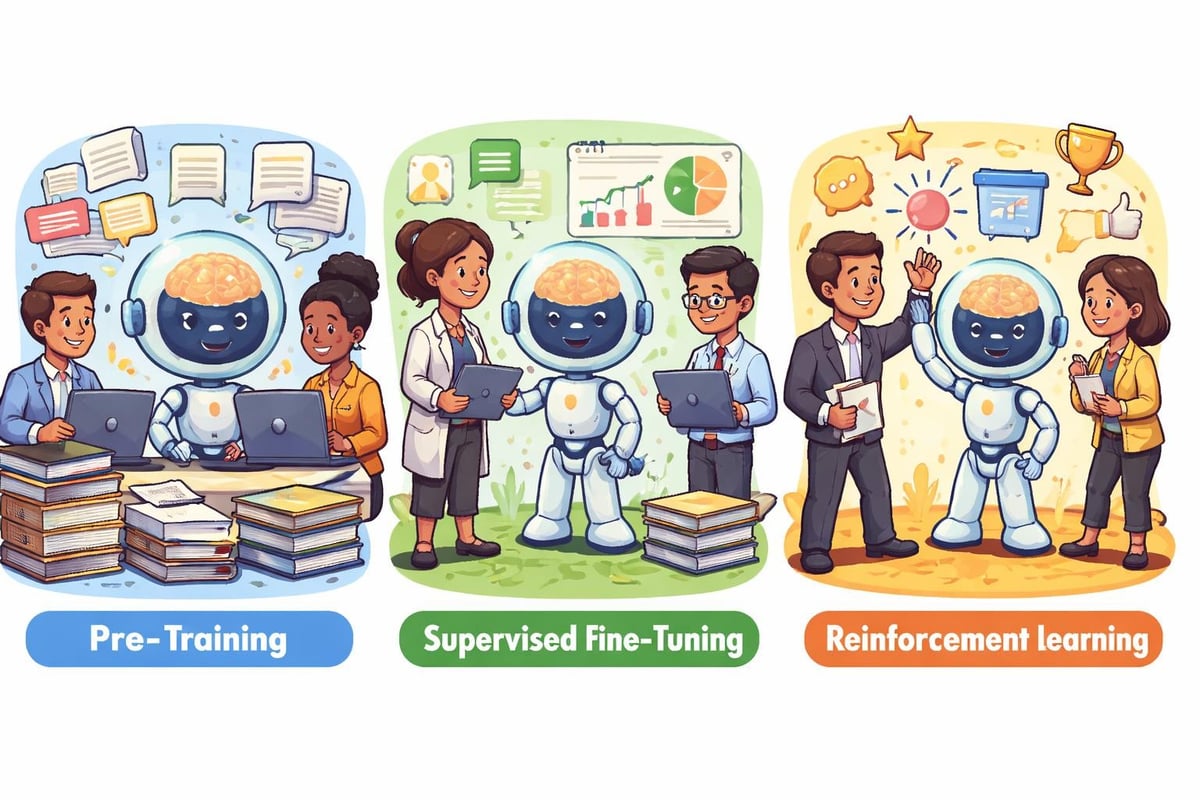
OpenAI training represents a sophisticated combination of computational power, carefully curated datasets, and innovative algorithmic approaches. The process begins with pre-training, where models learn from vast amounts of text data to understand language patterns, context, and relationships between concepts.
The Generative Pre-trained Transformer architecture forms the backbone of OpenAI's most prominent models. This approach allows systems to develop a broad understanding of language before being fine-tuned for specific tasks. The pre-training phase involves exposing the model to diverse internet text, books, articles, and other written content spanning billions of words.
Pre-Training at Scale
Pre-training occurs across multiple stages, each requiring substantial computational resources and careful orchestration:
- Data collection and curation: Filtering and organizing massive datasets while removing harmful or biased content
- Tokenization processes: Breaking down text into manageable units the model can process
- Architecture optimization: Configuring transformer layers, attention mechanisms, and parameter counts
- Distributed computing: Coordinating thousands of GPUs to process information simultaneously
The scale of openai training operations continues to expand each year. Modern models require compute resources measured in petaflop-days, representing an investment that few organizations can replicate independently. This reality makes understanding these training methodologies valuable for professionals who need to work with or build upon these systems.
Reinforcement Learning from Human Feedback
One of the most significant innovations in openai training involves Reinforcement Learning from Human Feedback (RLHF). This technique bridges the gap between raw language understanding and practical usefulness by incorporating human preferences directly into the training process.
RLHF operates through a multi-step procedure that transforms a base model into an assistant capable of following instructions and producing helpful responses. The process begins with collecting demonstration data, where human trainers provide examples of desired outputs for various prompts.
The RLHF Training Pipeline
| Training Stage | Purpose | Human Involvement |
|---|---|---|
| Supervised Fine-Tuning | Teach initial instruction-following | High - trainers write demonstrations |
| Reward Model Training | Learn human preferences | Medium - trainers rank outputs |
| Proximal Policy Optimization | Refine model behavior | Low - automated using reward model |
After collecting demonstrations, trainers rank multiple model outputs for the same prompt, indicating which responses are more helpful, accurate, or appropriate. These rankings train a separate reward model that predicts human preferences. The openai training process then uses this reward model to guide further refinement through reinforcement learning algorithms.
This approach has proven remarkably effective at aligning AI systems with human values and preferences. Models trained with RLHF demonstrate improved performance on tasks requiring nuanced judgment, creativity, and adherence to safety guidelines. For businesses considering AI and ML courses online, understanding RLHF provides crucial context for how modern AI systems achieve their capabilities.
Multimodal Training Approaches
OpenAI training has expanded beyond text to encompass images, audio, and other data modalities. Contrastive Language-Image Pre-training (CLIP) represents a breakthrough in teaching models to understand relationships between visual and textual information.
CLIP trains by examining millions of image-text pairs collected from the internet. The system learns to predict which text descriptions match which images, developing a joint understanding of both modalities. This approach enables capabilities like:
- Generating images from text descriptions
- Understanding visual content without task-specific training
- Classifying images using natural language categories
- Identifying objects and concepts across modalities
Speech Recognition Training
The Whisper speech recognition system demonstrates another dimension of openai training focused on audio processing. Whisper was trained on 680,000 hours of multilingual and multitask supervised data collected from the web. This massive dataset enables robust performance across languages, accents, and acoustic environments.
Unlike earlier speech recognition systems that required careful acoustic modeling and pronunciation dictionaries, Whisper uses an end-to-end approach. The model learns to map audio directly to text through exposure to diverse examples, developing internal representations that handle variations in speech patterns naturally.
Professionals interested in conversational AI applications will find that exploring conversational AI courses provides practical context for implementing these technologies in business environments.
Data Quality and Curation Strategies
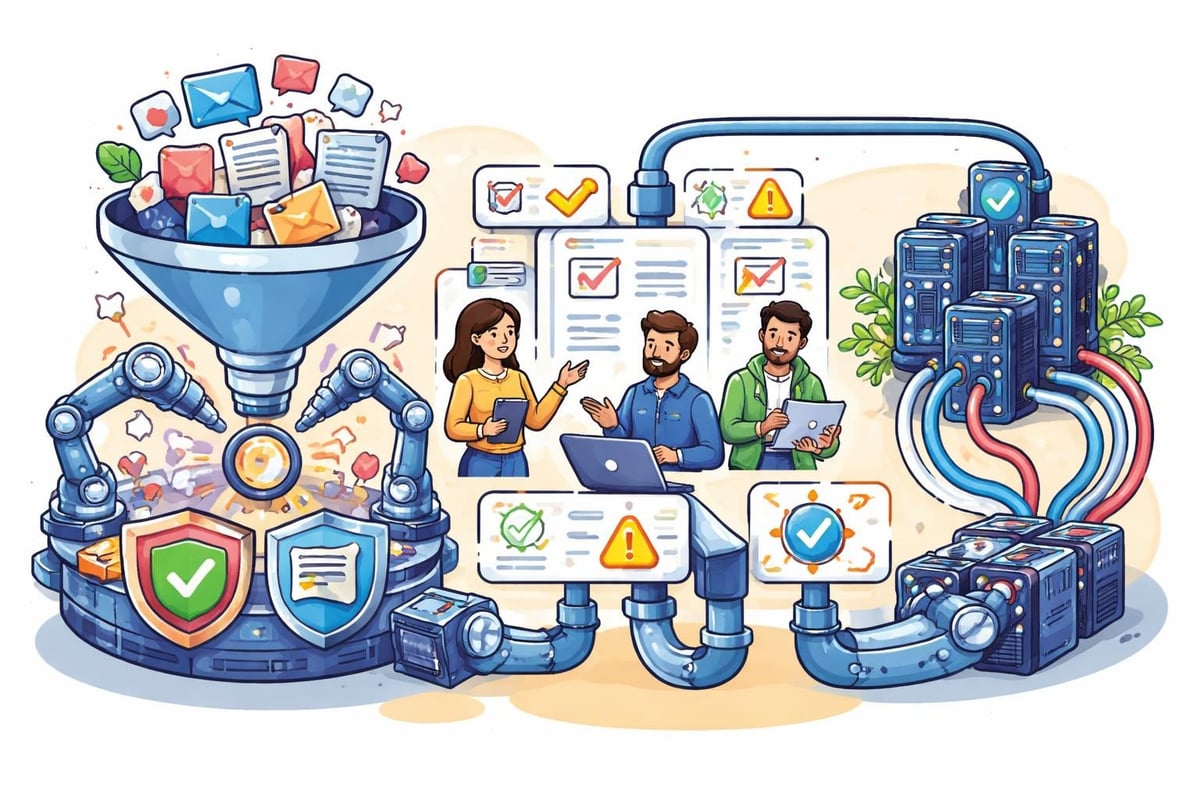
The effectiveness of openai training depends heavily on data quality, not just quantity. OpenAI employs sophisticated filtering and curation techniques to ensure training data meets high standards for accuracy, diversity, and safety.
Data curation involves multiple considerations:
- Removing duplicates: Eliminating repeated content that could cause overfitting
- Filtering harmful content: Identifying and excluding toxic, violent, or inappropriate material
- Balancing representation: Ensuring diverse perspectives and demographics appear in training data
- Verifying accuracy: Prioritizing factually correct information over misinformation
- Addressing bias: Identifying and mitigating systematic biases in data sources
These processes require both automated systems and human review. Machine learning classifiers can flag potentially problematic content, while human evaluators make nuanced judgments about edge cases and context-dependent appropriateness.
Model Architecture and Parameter Scaling
The architecture underlying openai training has evolved considerably since early GPT models. GPT-2, released in 2019, demonstrated that scaling transformer models to 1.5 billion parameters yielded significant capability improvements. Subsequent iterations have pushed parameter counts far higher, with corresponding increases in performance.
Parameter scaling follows observable patterns captured in scaling laws. These mathematical relationships predict how model performance improves with increased parameters, training data, and computational resources. Understanding these laws helps organizations make informed decisions about which models suit their needs and budgets.
Computing Infrastructure Requirements
| Model Size | Parameters | GPU Requirements | Training Duration |
|---|---|---|---|
| Small | 125M-350M | 8-16 GPUs | Days to weeks |
| Medium | 1B-3B | 64-128 GPUs | Weeks to months |
| Large | 7B-20B | 256-512 GPUs | Months |
| Extra Large | 70B+ | 1000+ GPUs | Months to years |
For businesses exploring GPU requirements for AI training, these benchmarks provide reference points for understanding infrastructure needs at different scales. Most organizations leverage pre-trained models rather than conducting openai training from scratch, making knowledge of these systems valuable for selection and fine-tuning decisions.
Fine-Tuning and Transfer Learning
While base openai training creates general-purpose models, fine-tuning adapts them for specific applications. This process requires significantly fewer resources than training from scratch while achieving specialized performance.
Fine-tuning typically involves:
- Domain-specific datasets: Curating examples relevant to the target application
- Task formatting: Structuring data to match desired input-output patterns
- Hyperparameter optimization: Adjusting learning rates and training schedules
- Evaluation protocols: Testing performance on held-out validation sets
Transfer learning enables organizations to benefit from OpenAI's massive pre-training investments while customizing models for unique requirements. A customer service application might fine-tune on historical support conversations, while a medical application could specialize using clinical documentation.
The concept of AI distillation extends these efficiency gains further. Distillation trains smaller, faster models to mimic larger ones, enabling deployment in resource-constrained environments without sacrificing too much performance. This technique has become increasingly important as businesses seek to run AI models on mobile devices, embedded systems, and edge computing platforms.
Safety and Alignment in Training
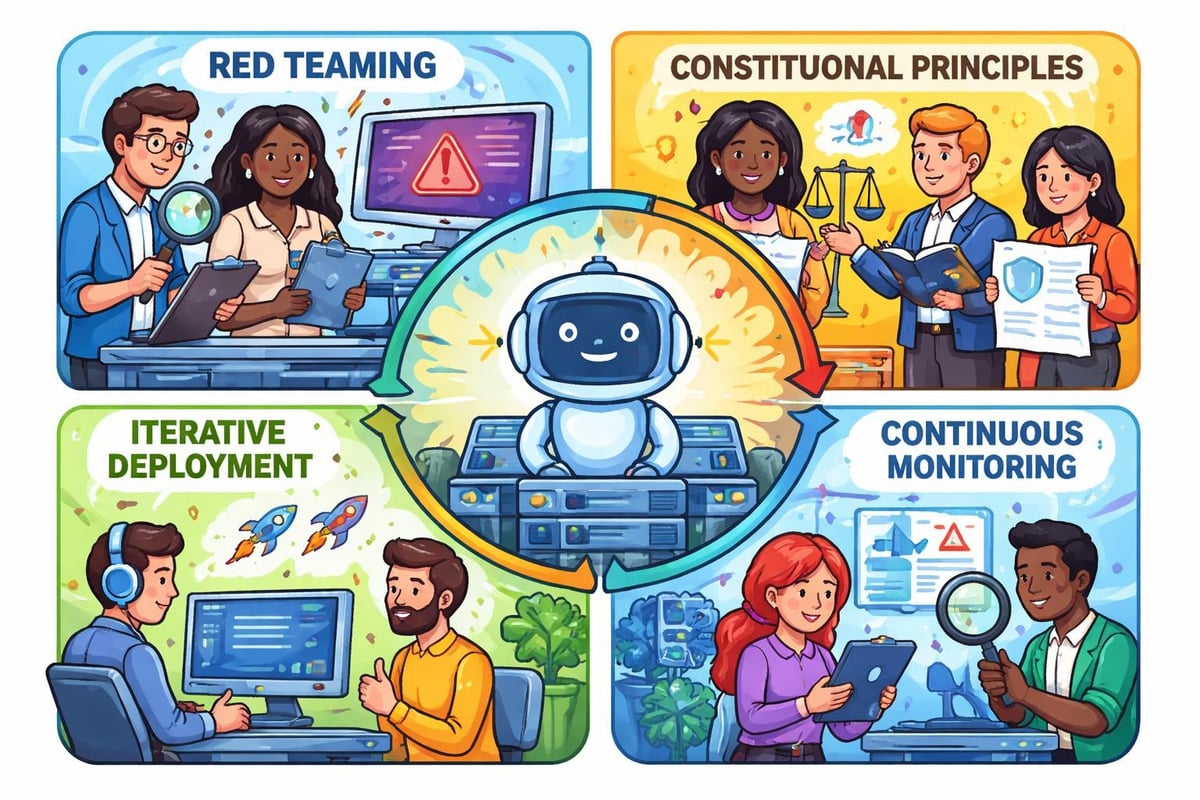
OpenAI has formed safety committees to oversee training of their latest models, reflecting growing awareness that powerful AI systems require careful governance. Safety considerations permeate every stage of openai training, from data curation through deployment monitoring.
Key safety practices include:
- Red teaming exercises to identify potential misuse patterns
- Constitutional AI approaches that encode principles into training objectives
- Iterative deployment strategies that gather feedback before wide release
- Ongoing monitoring systems that detect emerging issues
- Transparency reporting about model capabilities and limitations
These practices ensure that as AI systems become more capable, they remain aligned with human values and societal norms. Organizations implementing AI solutions should consider similar safety frameworks appropriate to their use cases and risk profiles.
Ethical Considerations in Model Development
Ethical openai training addresses concerns about bias, fairness, privacy, and societal impact. Models inherit biases present in training data, potentially amplifying harmful stereotypes or discriminatory patterns. Addressing these issues requires:
- Bias auditing: Systematic testing for unfair treatment of protected groups
- Diverse training teams: Including perspectives from varied backgrounds in development
- Stakeholder engagement: Consulting affected communities about AI system design
- Transparent documentation: Clearly communicating model limitations and appropriate uses
Professionals pursuing the best certification for artificial intelligence should prioritize programs that address ethical AI development alongside technical skills. The intersection of capability and responsibility defines successful AI implementation in 2026.
Business Applications and Use Cases
Understanding openai training methodologies enables organizations to leverage these technologies effectively across diverse applications. Common business use cases include:
Customer Service and Support
- Automated response generation for common inquiries
- Sentiment analysis and ticket routing
- Knowledge base creation and maintenance
- Multilingual support without translation overhead
Content Creation and Marketing
- Draft generation for blogs, emails, and social media
- SEO optimization and keyword research
- Product description writing at scale
- Creative brainstorming and ideation support
Data Analysis and Insights
- Natural language queries against databases
- Report summarization and key finding extraction
- Trend identification in unstructured feedback
- Predictive analytics through pattern recognition
Organizations investing in AI specialization courses for their teams position themselves to capitalize on these capabilities. The practical application of AI requires both technical understanding and strategic thinking about where automation delivers the most value.
Training Costs and Resource Optimization
The financial implications of openai training extend beyond computational expenses to include data acquisition, human feedback, infrastructure management, and ongoing maintenance. While exact costs remain proprietary, industry estimates suggest that training cutting-edge models requires investments ranging from hundreds of thousands to tens of millions of dollars.
Most organizations optimize resources by:
- Leveraging pre-trained models through API access
- Fine-tuning smaller models for specific tasks
- Implementing prompt engineering before custom training
- Using model distillation for deployment efficiency
- Batching inference requests to maximize throughput
These strategies allow businesses to benefit from state-of-the-art AI without bearing full training costs. Companies exploring machine learning and AI certification programs should ensure their training covers both model development and practical deployment considerations.
Future Directions in OpenAI Training
The trajectory of openai training points toward several emerging trends that will shape AI capabilities in coming years. Multimodal integration will deepen, enabling models that seamlessly process text, images, audio, video, and structured data within unified architectures.
Efficiency improvements will make training more accessible through:
- Sparse models: Activating only relevant parameters for each task
- Mixture of experts: Routing inputs to specialized sub-networks
- Continual learning: Updating models with new information without full retraining
- Few-shot adaptation: Achieving specialization from minimal examples
Safety research will advance alongside capabilities, developing more robust alignment techniques and interpretability tools. Understanding why models produce specific outputs remains a critical challenge, with significant research focused on making AI decision-making more transparent and controllable.
For professionals planning their learning journey, exploring comprehensive AI beginner courses provides foundational knowledge that remains relevant as technologies evolve. The principles underlying openai training translate across different model architectures and application domains.
Practical Skills for Working with Trained Models
While few professionals will conduct openai training from scratch, many will work with trained models in various capacities. Essential skills include:
- Prompt engineering: Crafting inputs that elicit desired outputs
- API integration: Connecting AI services to existing systems
- Performance evaluation: Measuring accuracy, relevance, and safety
- Cost management: Optimizing token usage and request batching
- Error handling: Managing edge cases and unexpected behaviors
These practical competencies enable effective AI implementation regardless of industry or role. Teams that develop these skills can rapidly prototype AI-enhanced features, evaluate their business impact, and iterate based on real-world performance.
Organizations supporting employee development through platforms like MammothClub ensure their workforce maintains competitive AI literacy as the technology landscape evolves. The combination of technical knowledge and hands-on practice accelerates the journey from understanding to implementation.
Mastering the principles behind openai training empowers professionals and organizations to make informed decisions about AI adoption, implementation, and governance. Whether you're evaluating pre-trained models, planning fine-tuning projects, or developing AI strategy, this knowledge provides essential context for navigating the AI landscape. MammothClub offers comprehensive AI training programs designed to transform theoretical understanding into practical skills, with 3,000+ courses, interactive bootcamps, and certification programs that help professionals and teams stay ahead in the rapidly evolving world of artificial intelligence.