Cloud computing has fundamentally transformed how organizations develop, deploy, and scale artificial intelligence solutions. As companies increasingly migrate their AI workloads to the cloud, professionals with AWS AI expertise have become indispensable. An aws ai course offers more than technical training; it provides the framework for understanding how to architect, implement, and optimize AI systems on the world's most comprehensive cloud platform. Whether you're a data scientist looking to productionize models or a cloud engineer expanding into AI, structured AWS AI training accelerates your ability to deliver business value through intelligent applications.
Understanding AWS AI Services Architecture
Amazon Web Services provides a three-tiered approach to artificial intelligence that accommodates different skill levels and use cases. This architecture enables professionals to engage with AI at the layer that matches their expertise and business requirements.
At the foundation level, AI services offer pre-trained models accessible through simple API calls. These include Amazon Rekognition for image analysis, Amazon Comprehend for natural language processing, and Amazon Polly for text-to-speech conversion. These services require minimal machine learning knowledge and allow developers to integrate sophisticated AI capabilities into applications quickly.
The middle tier features ML services like Amazon SageMaker, which provides end-to-end machine learning workflows. SageMaker supports data preparation, model training, hyperparameter tuning, deployment, and monitoring. This level requires deeper understanding of machine learning concepts but offers greater customization and control over model development.
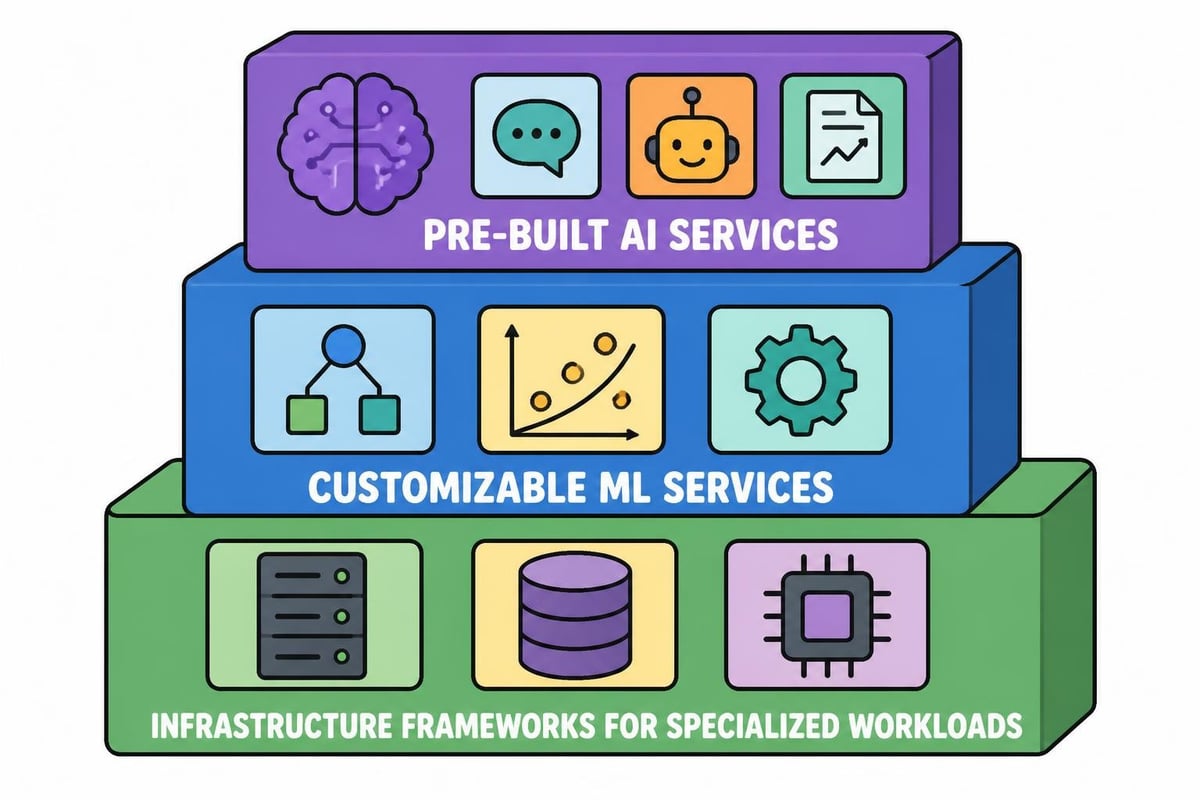
The infrastructure level includes frameworks and interfaces for building custom solutions using deep learning frameworks like TensorFlow, PyTorch, and Apache MXNet on AWS compute resources. This tier provides maximum flexibility for organizations with specialized requirements and in-house data science teams.
Key AWS AI Services Covered in Training Programs
A comprehensive aws ai course typically addresses these core services and their practical applications:
| Service Category | Primary Tools | Best Used For |
|---|---|---|
| Computer Vision | Amazon Rekognition, Lookout for Vision | Image classification, object detection, content moderation |
| Natural Language | Amazon Comprehend, Translate, Transcribe | Sentiment analysis, entity extraction, language translation |
| Forecasting | Amazon Forecast | Time-series predictions, demand planning |
| Personalization | Amazon Personalize | Recommendation engines, targeted content |
| ML Platform | Amazon SageMaker | Custom model development, training, deployment |
| Generative AI | Amazon Bedrock | Foundation models, chatbots, content generation |
Understanding which service solves specific business problems represents a critical learning outcome. Many professionals begin their journey with best AI courses that provide foundational concepts before specializing in cloud-specific implementations.
Building Machine Learning Workflows on AWS
The machine learning lifecycle on AWS encompasses several distinct phases, each supported by specific tools and services. Training programs dedicate substantial time to these workflows because they mirror real-world project requirements.
Data preparation forms the foundation of successful ML projects. Amazon S3 provides scalable storage for training datasets, while AWS Glue automates ETL (extract, transform, load) processes. SageMaker Data Wrangler offers visual interfaces for data cleaning, transformation, and feature engineering without extensive coding.
During the model development phase, SageMaker Studio provides an integrated development environment where data scientists can write code, visualize data, and experiment with algorithms. Built-in algorithms handle common use cases like classification, regression, and clustering, while custom algorithms can leverage any framework.
- Training optimization through automatic model tuning
- Distributed training across multiple instances for large datasets
- Experiment tracking to compare model versions and hyperparameters
- Managed spot training to reduce costs by up to 90%
The fundamentals of AWS AI and ML solutions course on Coursera provides hands-on experience with these workflows, emphasizing practical implementation over theoretical concepts.
Deployment and MLOps Practices
Moving models from development to production requires understanding deployment patterns and operational best practices. An aws ai course should thoroughly cover these critical transition points.
Real-time inference endpoints serve predictions with low latency for applications requiring immediate responses. SageMaker creates auto-scaling endpoints that adjust capacity based on traffic patterns, ensuring consistent performance during demand fluctuations.
Batch transform jobs process large datasets asynchronously when immediate results aren't necessary. This approach optimizes costs for scenarios like monthly reporting or overnight data processing.
Edge deployment extends ML capabilities to IoT devices and mobile applications through AWS IoT Greengrass and SageMaker Neo. These tools compile models for specific hardware, reducing latency and enabling offline functionality.
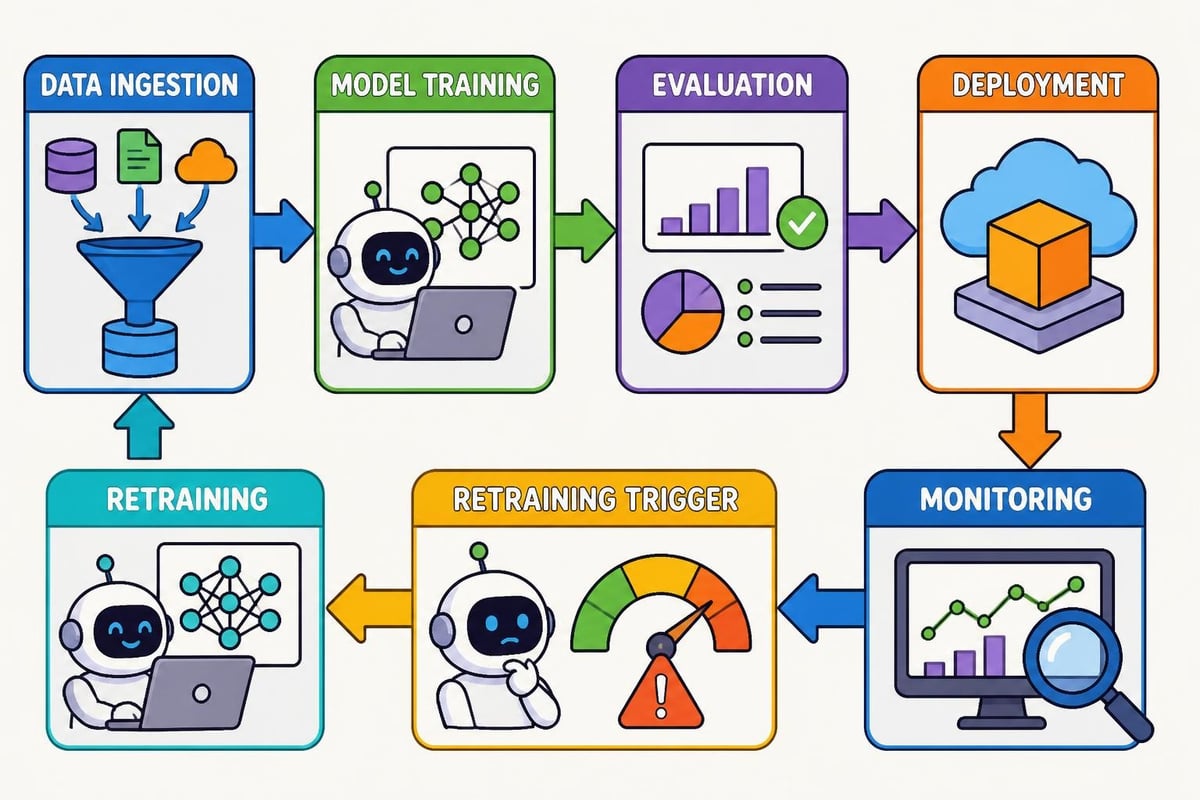
MLOps practices ensure models remain accurate and reliable over time. SageMaker Model Monitor detects data drift, concept drift, and bias in production models, triggering retraining workflows when performance degrades. CI/CD pipelines automate testing and deployment, reducing manual intervention and human error.
Generative AI and Foundation Models
The explosion of generative AI has created unprecedented demand for professionals who understand how to implement these technologies responsibly and effectively. Modern AWS AI training increasingly emphasizes generative capabilities alongside traditional machine learning.
Amazon Bedrock democratizes access to foundation models from leading AI companies including Anthropic, Stability AI, AI21 Labs, and Amazon's own Titan models. Rather than training massive models from scratch, organizations can customize pre-trained models through fine-tuning or retrieval-augmented generation (RAG).
Fine-tuning adapts foundation models to specific domains or tasks using smaller, specialized datasets. This approach balances customization with the efficiency of leveraging pre-trained knowledge. Organizations might fine-tune models on their proprietary documentation, customer interactions, or industry-specific content.
RAG architectures combine foundation models with knowledge bases, allowing models to reference current, domain-specific information during inference. This approach addresses the "knowledge cutoff" limitation of static models and reduces hallucinations by grounding responses in verified sources.
The GenAI and LLMs on AWS course explores these advanced topics, preparing professionals to architect solutions using cutting-edge generative technologies.
Responsible AI Implementation
Enterprise adoption of AI requires governance frameworks that ensure ethical, transparent, and compliant deployments. AWS provides tools and guidance for implementing responsible AI practices.
Model explainability through SageMaker Clarify helps teams understand prediction logic, crucial for regulated industries and high-stakes decisions. These insights identify which features most influence model outputs, supporting debugging and stakeholder communication.
Bias detection and mitigation occurs both during training and inference. Pre-training bias analysis examines dataset composition, while post-training analysis evaluates prediction distributions across demographic groups. Automated mitigation techniques can improve fairness metrics without complete retraining.
Privacy and security measures protect sensitive data throughout the ML lifecycle. Encryption at rest and in transit, VPC isolation, IAM policies, and AWS PrivateLink ensure data protection. SageMaker supports differential privacy techniques and federated learning for scenarios requiring enhanced privacy guarantees.
Those interested in ethical considerations should explore responsible AI courses that complement technical AWS training with governance frameworks.
Certification Paths and Career Advancement
AWS offers a structured certification program that validates cloud and AI expertise at progressive skill levels. These certifications provide measurable credentials that employers recognize when evaluating candidates.
AWS AI Practitioner Certification
Introduced in 2024, the AWS Certified AI Practitioner targets professionals who need foundational understanding of AI concepts, AWS AI services, and responsible AI practices. This entry-level certification requires no prior AWS certification and serves as an excellent starting point.
The exam covers:
- AI fundamentals and terminology
- AWS AI services and their use cases
- Responsible AI principles
- Security and compliance considerations
Preparation typically involves 20-30 hours of study through an aws ai course, hands-on labs, and practice exams. The AWS AI Practitioner Power Hour provides concentrated preparation specifically designed for this certification.
Machine Learning Specialty Certification
The AWS Certified Machine Learning - Specialty represents advanced expertise in designing, implementing, and maintaining ML solutions on AWS. This certification requires deeper technical knowledge and typically builds on foundational AWS certifications like Solutions Architect or Developer Associate.
| Certification | Target Audience | Prerequisites | Avg. Study Time |
|---|---|---|---|
| AI Practitioner | Business analysts, managers, entry-level developers | None | 20-30 hours |
| ML Specialty | Data scientists, ML engineers, solution architects | AWS experience recommended | 60-100 hours |
| Solutions Architect Pro | Senior architects implementing AI systems | Associate certification | 100-150 hours |
Professionals often combine certifications with specialized training in areas like deep learning AI courses to develop comprehensive skill sets that span cloud infrastructure and advanced algorithms.
Practical Implementation Scenarios
Theoretical knowledge becomes valuable only when applied to real business challenges. Effective AWS AI training emphasizes hands-on scenarios that mirror production environments.
Computer Vision Application
Consider building an automated quality inspection system for manufacturing. Amazon Rekognition Custom Labels allows teams to train custom image classification models with minimal labeled data. The workflow involves:
- Uploading sample images to S3 buckets organized by defect categories
- Training custom models through the Rekognation console (typically 1-2 hours)
- Deploying inference endpoints with auto-scaling capabilities
- Integrating predictions into existing manufacturing execution systems via API calls
This approach reduces inspection time by 70% while improving consistency compared to manual inspection. Implementation requires understanding data preparation, model evaluation metrics, and API integration patterns covered in comprehensive training programs.
Natural Language Processing for Customer Service
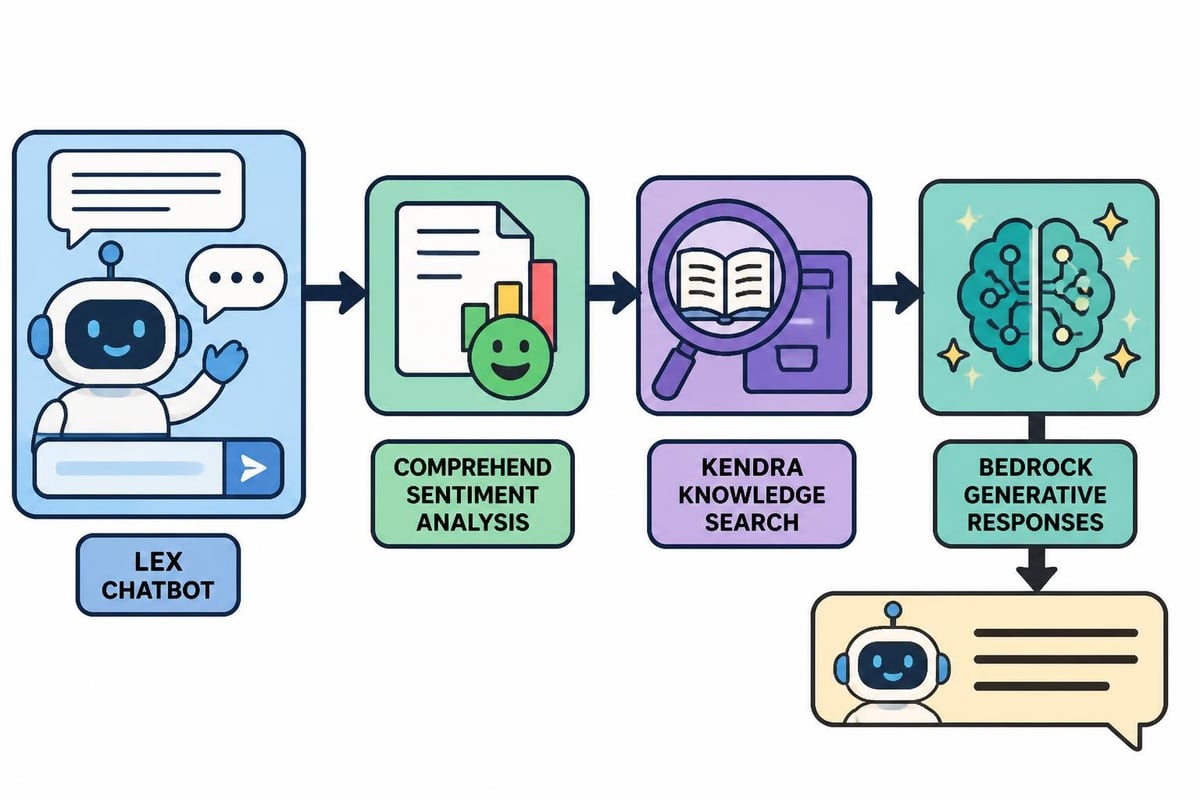
Organizations implementing AI-powered customer support benefit from AWS services that handle common NLP tasks without extensive data science expertise. A typical architecture combines:
- Amazon Lex for conversational interfaces (chatbots)
- Amazon Comprehend for sentiment analysis and entity extraction
- Amazon Kendra for intelligent search across knowledge bases
- Amazon Bedrock for generative responses to complex queries
The AI fundamentals and the cloud course demonstrates these integrations, showing how services work together to create cohesive solutions rather than operating in isolation.
Predictive Analytics for Business Forecasting
Amazon Forecast applies machine learning to time-series data without requiring deep expertise in forecasting algorithms. Retail, finance, and supply chain organizations use Forecast for:
- Demand planning and inventory optimization
- Financial forecasting and budget planning
- Resource capacity planning
- Energy consumption prediction
The service automatically selects appropriate algorithms, handles missing data, and accounts for seasonal patterns. Training data imports from S3, models train automatically, and predictions export for downstream systems. This automation allows business analysts to leverage sophisticated ML without data science backgrounds.
Cost Optimization and Resource Management
Effective AWS AI implementation requires balancing performance requirements with budget constraints. Training programs should address cost management strategies that prevent unexpected expenses.
On-demand vs. spot instances represents a fundamental decision for training workloads. Spot instances offer up to 90% savings but may interrupt when AWS needs capacity. For non-time-sensitive training jobs, spot instances with checkpointing dramatically reduce costs without impacting final model quality.
Right-sizing inference endpoints prevents over-provisioning that wastes resources. Auto-scaling policies adjust instance counts based on actual traffic patterns, scaling down during low-usage periods and up during peaks. CloudWatch metrics inform these decisions with data rather than guesses.
Data transfer costs accumulate when moving large datasets between regions or out of AWS. Strategic S3 bucket placement, VPC endpoints, and data lifecycle policies minimize unnecessary transfers. Processing data where it resides rather than moving it centrally often proves more economical.
Monitoring and Budget Controls
AWS provides several mechanisms for tracking and limiting AI-related expenses:
- AWS Cost Explorer visualizes spending patterns and identifies cost drivers
- Budget alerts notify stakeholders when spending approaches thresholds
- Service quotas prevent accidental over-provisioning of expensive resources
- Tagging strategies allocate costs to specific projects or departments
Professionals learning through artificial intelligence classes benefit from understanding these operational aspects alongside technical implementation, as cost management increasingly influences architectural decisions.
Integration with Existing Systems
AWS AI services rarely operate in isolation. Successful implementations integrate with databases, application servers, data warehouses, and third-party tools that comprise existing technology ecosystems.
Database integration connects ML models to operational data sources. Amazon Aurora, RDS, and DynamoDB support direct SageMaker integration, enabling feature engineering queries without data duplication. Real-time predictions can update database records automatically, keeping systems synchronized.
API Gateway exposes ML endpoints as RESTful APIs with authentication, rate limiting, and usage tracking. This abstraction layer decouples model implementations from consuming applications, allowing model updates without client code changes.
Event-driven architectures use AWS Lambda to trigger ML workflows based on S3 uploads, database changes, or scheduled events. This pattern enables automated pipelines that process new data without manual intervention.
The AI tools and services course explores these integration patterns, demonstrating how individual AWS services combine into comprehensive solutions.
Selecting the Right AWS AI Course
With hundreds of training options available, choosing appropriate learning paths requires evaluating several factors aligned with career objectives and current skill levels.
Prerequisite knowledge varies significantly across programs. Introductory courses like Introduction to Machine Learning on AWS assume minimal background, while advanced programs expect familiarity with Python, statistics, and cloud concepts.
Learning format influences completion rates and skill retention. Options include:
- Self-paced video courses with labs
- Instructor-led virtual training with live Q&A
- In-person bootcamps with intensive hands-on projects
- Certification preparation programs focused on exam success
- Project-based learning emphasizing portfolio development
Depth vs. breadth represents another consideration. Survey courses like Authoritative AWS on edX cover numerous services at a high level, while specialized programs dive deep into specific capabilities like generative AI or computer vision.
Vendor neutrality matters for professionals seeking portable skills. AWS-specific training provides depth in one ecosystem, while broader AI/ML learning paths develop transferable concepts applicable across cloud providers.
Hands-On Practice Requirements
Theoretical knowledge alone proves insufficient for production AI systems. Quality training programs provide substantial hands-on components through:
- Sandbox environments with pre-configured AWS accounts and credits
- Guided labs walking through specific implementations step-by-step
- Challenge labs presenting problems without explicit solutions
- Capstone projects requiring end-to-end solution architecture
The Generative AI Essentials course on edX exemplifies this approach, combining conceptual instruction with practical implementation exercises using Amazon Bedrock and Q Developer.
Emerging Trends in AWS AI Education
The artificial intelligence landscape evolves rapidly, and training programs must adapt to remain relevant. Several trends shape how professionals learn AWS AI capabilities in 2026.
Multimodal AI combines text, images, audio, and video in unified models. AWS Bedrock supports multimodal foundation models that process diverse input types, requiring new skills in prompt engineering and output validation across modalities.
Sovereign AI addresses regulatory requirements around data residency and model governance. AWS Local Zones and specialized regions enable organizations to keep data and compute within geographic boundaries while accessing advanced AI capabilities.
Edge AI extends intelligence to resource-constrained devices using SageMaker Neo and AWS IoT services. This distributed approach reduces latency and bandwidth costs while enabling offline operation.
AI-assisted development through Amazon CodeWhisperer and Q Developer transforms how professionals build applications. These tools generate code, explain complex implementations, and debug issues, requiring new skills in prompt engineering and code review.
Training programs increasingly incorporate these emerging capabilities, ensuring professionals develop future-ready skills rather than focusing solely on established technologies. Platforms offering best AI ML courses online regularly update curricula to reflect these evolving requirements.
Enterprise Adoption Considerations
Organizations deploying AWS AI at scale face unique challenges beyond individual technical implementations. Training programs serving enterprise audiences address these organizational dimensions.
Governance frameworks establish policies for model development, testing, deployment, and monitoring. These frameworks define roles, approval processes, and compliance requirements that ensure consistent, responsible AI usage across departments.
Center of Excellence models centralize AI expertise while serving distributed business units. This structure balances efficiency through shared infrastructure with flexibility for domain-specific customization.
Skills development programs identify capability gaps and create learning paths for existing employees. Rather than hiring externally, many organizations upskill current staff who understand business context and institutional knowledge.
Vendor management becomes complex as organizations use multiple AI services. Understanding pricing models, service level agreements, and support options informs architectural decisions and contract negotiations.
Building Internal Training Programs
Large organizations often supplement external courses with internal training tailored to their specific architectures, data sources, and business processes. Effective internal programs include:
- Foundational modules covering company-specific AWS architecture and security requirements
- Domain workshops applying AI to specific business problems with relevant datasets
- Office hours providing ongoing support as teams implement solutions
- Show-and-tell sessions where teams share implementations and lessons learned
This blended approach combines broad knowledge from aws ai course providers with contextual application to organizational challenges.
Career Trajectories and Salary Expectations
AWS AI skills command premium compensation as organizations compete for limited talent. Understanding career paths helps professionals make strategic training investments.
Entry-level positions like AI Developer or ML Operations Engineer typically require foundational AWS knowledge, programming proficiency, and basic ML understanding. These roles focus on implementing existing solutions and supporting production systems. Salary ranges from $85,000-$120,000 depending on location and organization size.
Mid-level professionals such as ML Engineers or AI Solutions Architects design and implement custom solutions, optimize performance, and mentor junior team members. These roles require 3-5 years of experience and deeper expertise in specific domains. Compensation ranges from $120,000-$180,000.
Senior specialists like Principal ML Engineers or AI Practice Leads set technical direction, evaluate emerging technologies, and solve novel problems. These positions require comprehensive expertise and strong business acumen. Total compensation often exceeds $200,000, particularly in competitive markets.
Specialized roles in areas like MLOps, AI Ethics, or Generative AI Engineering command additional premiums due to talent scarcity. These niche specializations benefit from focused training beyond general aws ai course content.
Career progression typically involves deepening technical expertise while developing business understanding and leadership capabilities. Certifications, project portfolios, and demonstrated impact on business metrics influence advancement opportunities.
Mastering AWS AI capabilities requires structured learning that combines conceptual understanding with hands-on implementation experience across the platform's extensive service portfolio. The right training path depends on your current skills, career objectives, and the specific business problems you aim to solve. MammothClub provides comprehensive AWS AI training alongside 3,000+ other tech courses, interactive bootcamps, and certification programs designed to help professionals and organizations master cloud-based artificial intelligence quickly. Our AI-powered learning dashboards track your progress and recommend personalized next steps, ensuring your skills remain competitive as AWS continues expanding its AI capabilities.