The artificial intelligence industry has reached a critical inflection point where credentials matter more than ever before. Organizations worldwide are seeking professionals who can demonstrate verified AI competency, not just theoretical knowledge. An ai course certification serves as concrete proof that you possess the skills, ethical understanding, and practical experience to deploy AI responsibly in real-world business environments. Whether you're a data scientist looking to formalize your expertise, an auditor transitioning into AI governance, or a manager responsible for organizational AI strategy, the right certification can accelerate your career trajectory while helping your organization maintain competitive advantage in an increasingly AI-driven marketplace.
Understanding the AI Certification Landscape in 2026
The ai course certification ecosystem has evolved dramatically over the past three years. What began as vendor-specific training programs has matured into a sophisticated framework of internationally recognized credentials spanning technical implementation, governance, security, and ethical deployment.
Technical Versus Governance Certifications
AI certifications now fall into two distinct categories, each serving different professional needs and career trajectories.
Technical certifications focus on hands-on implementation skills:
- Machine learning model development and deployment
- Neural network architecture and optimization
- Natural language processing and computer vision applications
- AI infrastructure and computational resource management
- Algorithm selection and hyperparameter tuning
Governance and compliance certifications address the regulatory and ethical dimensions:
- Risk assessment and mitigation frameworks
- Regulatory compliance across jurisdictions
- Ethical AI development principles
- Audit procedures for AI systems
- Stakeholder communication and transparency
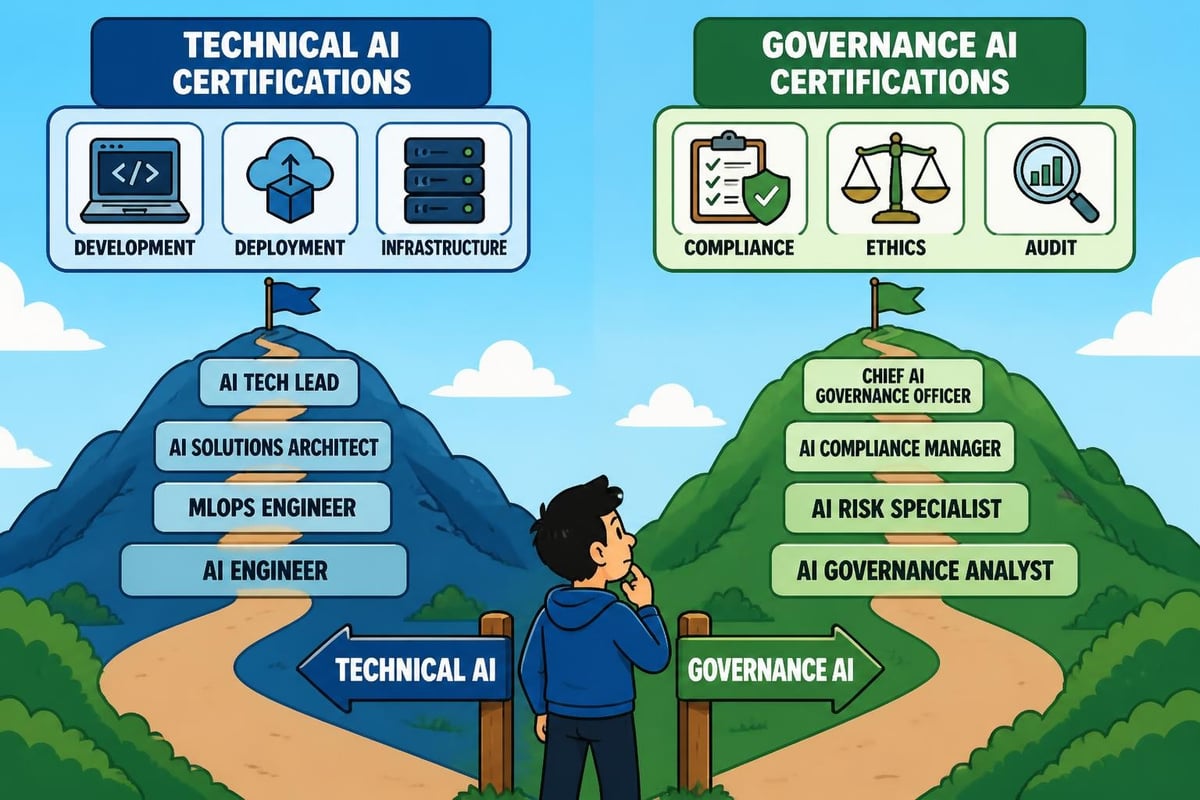
The AI Governance Professional certification exemplifies this governance-focused approach, equipping professionals with skills to develop and deploy AI systems safely and responsibly. This credential has become particularly valuable as organizations navigate emerging AI regulations across different jurisdictions.
| Certification Type | Primary Audience | Key Skills Validated | Typical Prerequisites |
|---|---|---|---|
| Technical Implementation | Data Scientists, ML Engineers | Model building, deployment, optimization | Programming experience, statistics background |
| AI Governance | Compliance Officers, Legal Teams | Risk management, regulatory frameworks | Professional experience, business acumen |
| AI Security | Cybersecurity Professionals | Threat modeling, secure AI systems | Security certifications (CISSP, CISM) |
| AI Audit | Internal Auditors, Risk Managers | AI system evaluation, control testing | Audit certification (CISA preferred) |
Industry-Recognized Certification Bodies
Several organizations have established themselves as authoritative certification providers in the AI space. The International Association of Privacy Professionals (IAPP) offers the AI Governance Professional credential, while ISACA provides specialized certifications for audit and security professionals.
ISACA's Advanced in AI Audit credential targets professionals who already hold CISA or equivalent qualifications, covering AI governance, risk assessment, and specialized audit tools. Similarly, their AI Security Management certification requires CISM or CISSP credentials and focuses on AI-specific security controls and risk frameworks.
The International Organization for Standardization has also entered the ai course certification space with ISO/IEC 42001:2023, establishing a comprehensive AI management system standard that addresses governance, risk management, transparency, and continuous improvement requirements.
Choosing the Right AI Certification for Your Career Path
Selecting an appropriate ai course certification requires careful assessment of your current skills, career objectives, and organizational needs. The wrong credential can waste time and resources while delivering minimal career impact.
Assessment Framework for Certification Selection
Evaluate your current position:
- What AI-related responsibilities do you currently hold?
- Which skills gaps prevent you from advancing or taking on new projects?
- Does your organization require specific certifications for promotion or project leadership?
- What budget and time can you realistically allocate to certification preparation?
Research market demand by analyzing job postings in your target roles. Look for certifications mentioned repeatedly in positions that align with your career goals. Many organizations now specify preferred AI credentials in job descriptions, particularly for roles involving regulated industries or high-stakes AI deployments.
The research on skill-driven certification pathways demonstrates that certifications like Microsoft's AI-900, when combined with degree programs, significantly improve graduate employability. This evidence-based approach validates the career impact of strategic certification choices.
Vendor-Specific Versus Vendor-Neutral Credentials
Vendor-specific certifications provide deep expertise in particular platforms but may limit career flexibility. Microsoft AI certifications offer strong Azure-specific skills, while IBM AI certification paths focus on Watson and related technologies.
Vendor-neutral certifications offer broader applicability:
- They demonstrate platform-agnostic understanding of AI principles
- They remain valuable even as technology stacks evolve
- They signal theoretical depth alongside practical skills
- They often command higher salary premiums in consulting roles
Preparing Effectively for AI Certification Exams
Success in ai course certification requires structured preparation combining theoretical study, hands-on practice, and strategic exam technique development.
Building a Comprehensive Study Plan
Most professionals underestimate the preparation time required for rigorous AI certifications. Technical certifications typically demand 60-120 hours of focused study, while governance certifications may require 40-80 hours depending on your existing knowledge base.
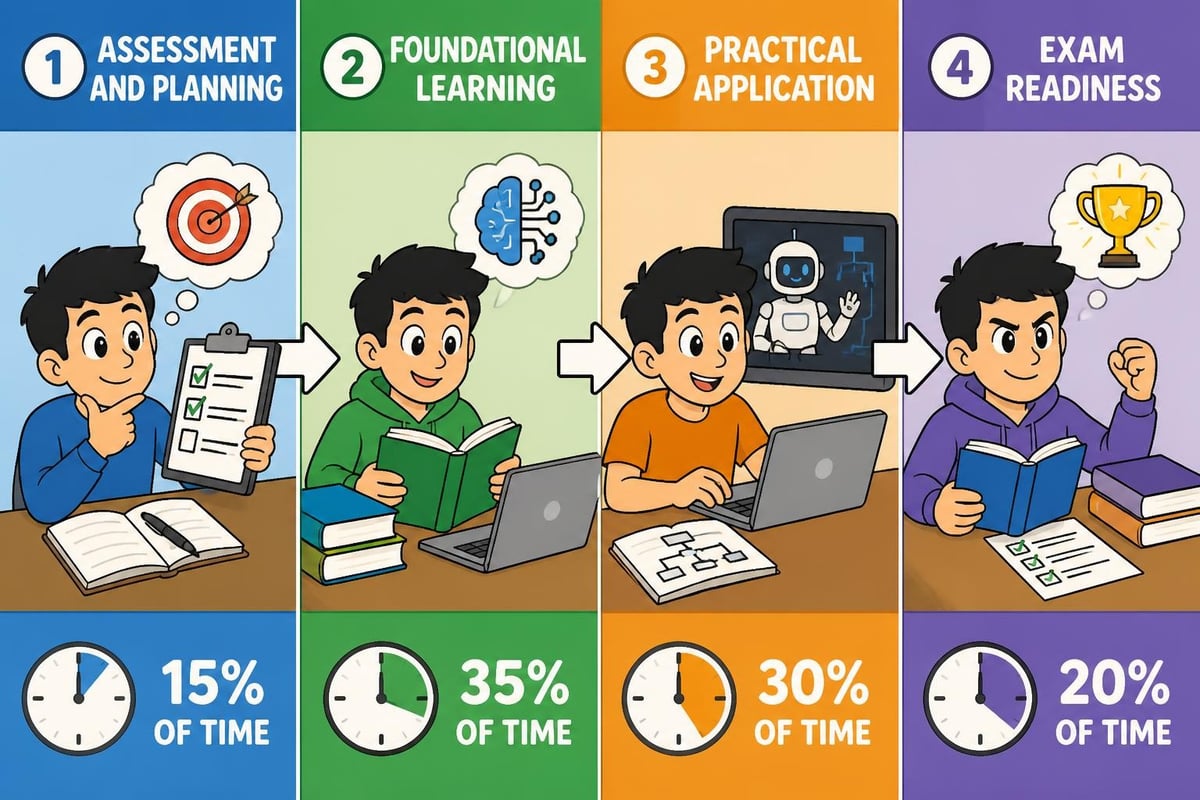
Structured preparation phases:
- Foundation building (30-40% of total time): Master core concepts through video lectures, reading materials, and documentation
- Hands-on practice (40-50% of total time): Complete labs, projects, and real-world scenarios
- Exam preparation (20-30% of total time): Practice exams, weak area reinforcement, and exam strategy development
The IAPP's AIGP training modules exemplify comprehensive preparation, covering AI development lifecycle, ethical principles, regulatory frameworks, and deployment governance. This structured approach ensures candidates develop both breadth and depth of knowledge.
Leveraging On-Demand Learning Platforms
Modern ai course certification preparation has shifted dramatically toward flexible, self-paced learning. Platforms offering comprehensive AI and ML courses provide the foundation needed for certification success while accommodating professional schedules.
Key advantages of on-demand platforms include:
- Personalized learning paths that adapt to your existing knowledge
- Interactive labs that provide hands-on experience without infrastructure investment
- Progress tracking that identifies knowledge gaps before exam attempts
- Community support through forums and study groups
Many professionals combine multiple resources, using vendor documentation for platform-specific details while relying on third-party courses for conceptual understanding and exam strategy.
Specialized AI Certification Tracks
The maturation of the AI field has created numerous specialized certification paths addressing specific industry needs and professional roles.
Responsible AI and Ethics Certifications
As AI systems increasingly impact critical decisions affecting human lives, certifications focused on responsible AI development have gained prominence. These credentials address bias detection and mitigation, transparency requirements, fairness metrics, and accountability frameworks.
Organizations deploying AI in healthcare, finance, or criminal justice face heightened scrutiny regarding algorithmic fairness and transparency. Professionals holding ethics-focused certifications command premium compensation due to their ability to navigate these complex requirements.
Security and Compliance Specializations
AI security represents a rapidly growing certification category as organizations recognize unique vulnerabilities in machine learning systems. These certifications cover adversarial attacks on models, data poisoning prevention, model theft protection, and privacy-preserving machine learning techniques.
The Cloud Security Alliance's STAR for AI certification requirements establish standards for third-party certification bodies conducting AI security assessments. This framework aligns with the AI Controls Matrix and ISO/IEC 42001, creating a comprehensive assurance model for AI governance.
Domain-Specific AI Certifications
Industry-specific certifications address unique requirements in sectors with specialized AI applications:
| Domain | Focus Areas | Typical Candidates | Key Differentiators |
|---|---|---|---|
| Healthcare AI | Medical imaging, diagnostic support, HIPAA compliance | Clinical informaticists, health tech developers | Regulatory knowledge, patient safety |
| Financial Services AI | Risk modeling, fraud detection, regulatory compliance | Quantitative analysts, risk managers | Financial regulations, model validation |
| Manufacturing AI | Predictive maintenance, quality control, robotics | Industrial engineers, operations managers | IoT integration, real-time systems |
| Legal Tech AI | Contract analysis, e-discovery, research automation | Legal technologists, paralegals | Legal reasoning, confidentiality requirements |
Professionals pursuing AI specialization courses often stack credentials, combining foundational certifications with domain-specific qualifications to demonstrate both breadth and depth of expertise.
Corporate AI Certification Programs and ROI
Organizations increasingly invest in structured ai course certification programs to build internal AI capabilities while managing the risks associated with AI deployment.
Building Organizational AI Competency
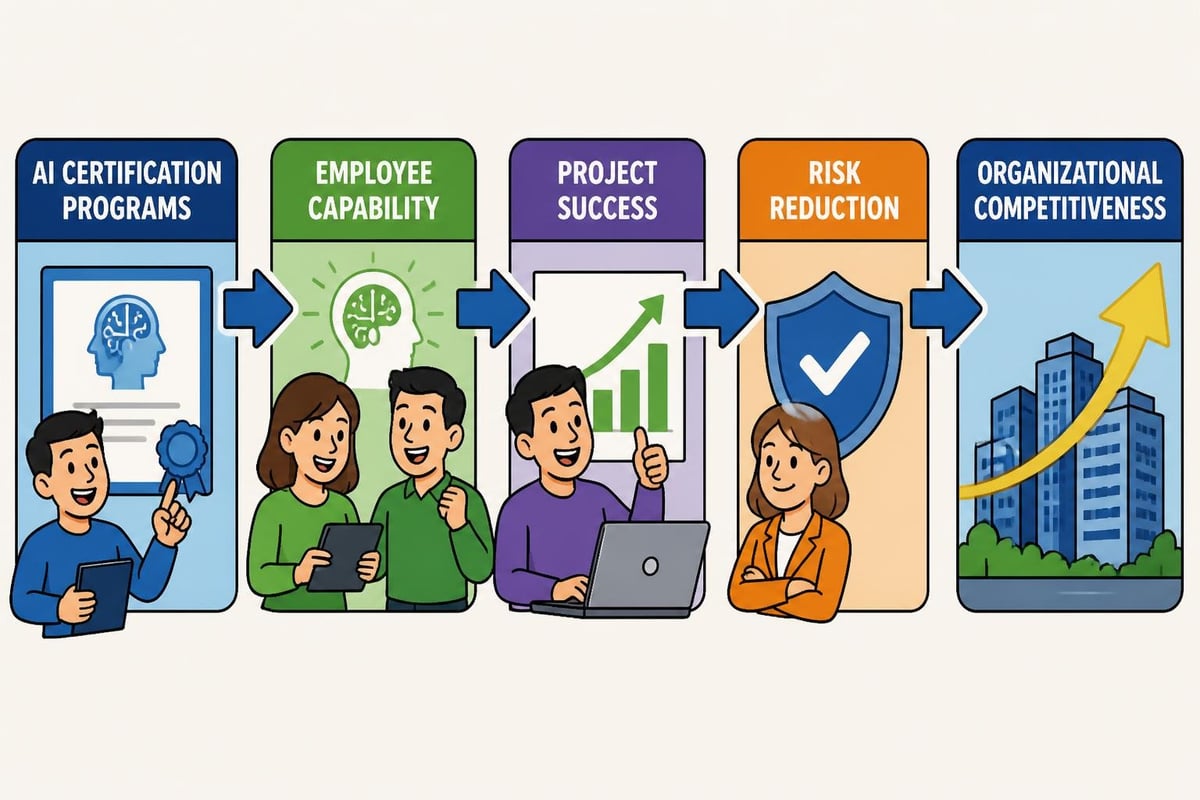
Corporate certification initiatives serve multiple strategic objectives beyond individual skill development. They create common vocabulary across departments, establish baseline competencies for AI project participation, reduce dependence on external consultants, and demonstrate due diligence to stakeholders and regulators.
Effective corporate programs include:
- Tiered certification paths aligned with job roles and responsibilities
- Integration with performance management and promotion criteria
- Dedicated time allocation for study and preparation
- Financial incentives or bonuses for certification achievement
- Internal communities of practice for certified professionals
Organizations leveraging platforms like MammothClub for business training benefit from centralized dashboards that track certification progress, identify skill gaps across teams, and measure training impact on business outcomes.
Measuring Training Impact and Business Outcomes
The value of corporate ai course certification programs extends beyond individual credentials to measurable business impact. Leading organizations establish key performance indicators that connect certification achievements to operational improvements.
Quantifiable metrics include:
- Time-to-productivity: Reduction in onboarding time for AI projects
- Project success rates: Increased completion rates for AI initiatives
- Risk mitigation: Decreased compliance violations or ethical concerns
- Innovation velocity: Faster deployment of new AI capabilities
- Talent retention: Reduced turnover among AI professionals
Research demonstrates that employees who complete certification programs show higher engagement and lower attrition rates. Organizations that invest in structured AI training also experience competitive advantages in recruiting, as candidates increasingly evaluate employers based on professional development opportunities.
Maintaining and Advancing Your AI Credentials
The rapid evolution of AI technology means that ai course certification represents an ongoing commitment rather than a one-time achievement.
Continuing Education Requirements
Most reputable AI certifications include mandatory continuing education to ensure credential holders maintain current knowledge. These requirements typically involve:
- Annual continuing professional education credits (20-40 hours)
- Participation in professional conferences or webinars
- Publication or presentation of AI-related content
- Contribution to professional communities or standards development
- Periodic recertification examinations (every 2-3 years)
The best AI courses evolve continuously to reflect emerging techniques, updated regulations, and new ethical considerations. Certified professionals must stay engaged with evolving best practices to maintain credential validity.
Stacking Credentials for Career Advancement
Strategic professionals often pursue multiple certifications that build upon each other, creating comprehensive expertise profiles that command premium compensation and leadership opportunities.
Effective credential stacking strategies:
- Begin with foundational certifications establishing broad AI literacy
- Add technical depth in your primary area of implementation
- Complement technical skills with governance or ethics credentials
- Pursue leadership or architecture certifications as you advance
- Obtain industry-specific certifications relevant to your sector
This progression mirrors natural career advancement while providing documented proof of expanding capabilities at each stage. Senior AI professionals often hold 3-5 relevant certifications spanning technical implementation, governance, and specialized domains.
Emerging Trends in AI Certification
The ai course certification landscape continues evolving rapidly in response to technological advancement and regulatory development.
Micro-Credentials and Modular Certification
Traditional comprehensive certifications are being supplemented by micro-credentials that validate specific, narrow skill sets. These shorter credentials allow professionals to demonstrate competency in emerging technologies without committing to months of preparation.
Benefits of micro-credential approaches include faster skill validation, lower financial and time investment, ability to quickly pivot to new specializations, and granular skill signaling to employers.
Organizations increasingly recognize collections of micro-credentials as equivalent to traditional comprehensive certifications, particularly when they demonstrate continuous learning and adaptation to new technologies.
AI-Powered Personalized Learning Paths
Certification preparation itself is being transformed by artificial intelligence. Adaptive learning systems analyze your knowledge gaps, learning pace, and retention patterns to create personalized study sequences that optimize preparation efficiency.
These systems offer diagnostic assessments that pinpoint specific weaknesses, customized content sequences based on your learning style, predictive analytics identifying areas requiring additional focus, and automated practice question generation targeting your weak areas.
Platforms implementing these AI-powered approaches report 30-40% reduction in average preparation time while maintaining or improving pass rates.
Regulatory Certification Requirements
Several jurisdictions are moving toward mandatory ai course certification for professionals deploying AI systems in regulated contexts. The European Union's AI Act includes competency requirements for high-risk AI systems, while several U.S. states are considering similar legislation for specific domains.
This regulatory trend will likely accelerate certification adoption as organizations seek to demonstrate compliance through documented employee qualifications. Forward-thinking professionals are pursuing certifications proactively to position themselves advantageously as these requirements take effect.
Selecting Training Providers and Preparation Resources
The quality of your ai course certification preparation directly impacts both exam success and practical skill development.
Evaluation Criteria for Training Programs
Not all certification preparation programs deliver equivalent value. Rigorous evaluation requires assessing multiple dimensions beyond course content and pricing.
Critical assessment factors:
- Instructor credentials: Do instructors hold relevant certifications and professional experience?
- Content currency: How frequently is material updated to reflect evolving best practices?
- Hands-on components: What percentage of training involves practical application versus lecture?
- Pass rate data: What percentage of students successfully achieve certification?
- Post-certification support: Does the provider offer alumni resources or continuing education?
Leading platforms provide transparent data on these metrics, allowing informed comparison across providers. Those offering top machine learning courses typically publish detailed syllabi, instructor biographies, and student outcome data.
Balancing Cost and Quality
AI certification costs vary dramatically, from free vendor materials to premium bootcamps exceeding $10,000. Understanding the value proposition requires looking beyond sticker price to total investment including preparation time, opportunity cost, and likelihood of success.
| Investment Level | Typical Cost Range | Included Components | Best For |
|---|---|---|---|
| Self-Study | $0-$500 | Documentation, free courses, practice exams | Experienced professionals, strong self-discipline |
| Guided Online | $500-$2,000 | Structured courses, instructor support, labs | Most professionals seeking flexibility |
| Intensive Bootcamp | $2,000-$10,000 | Immersive training, mentorship, job placement support | Career changers, rapid skill acquisition |
| Corporate Programs | $1,500-$5,000 per employee | Customized content, cohort learning, business integration | Organizations building team capabilities |
The optimal investment depends on your learning style, time availability, financial resources, and career urgency. Many professionals achieve excellent results through mid-tier guided online programs that balance cost, flexibility, and support.
Professional AI certification has evolved from optional career enhancement to essential credential in an increasingly AI-driven economy. By selecting certifications aligned with your career goals, investing in comprehensive preparation, and committing to ongoing learning, you position yourself for sustained success in this transformative field. MammothClub offers over 3,000 AI and technology courses, interactive bootcamps, and corporate certification programs designed to help professionals and organizations build verified AI expertise efficiently. Our AI-powered learning dashboards and personalized pathways make certification preparation measurable and results-driven, ensuring you develop the skills needed to thrive in the AI era.