The digital marketing landscape has undergone a seismic transformation with artificial intelligence reshaping every aspect of how brands connect with audiences. Professionals who fail to understand AI-driven marketing tools risk becoming obsolete in an industry where algorithms now drive targeting decisions, content creation, and customer engagement strategies. This reality has created explosive demand for ai in digital marketing courses that bridge the knowledge gap between traditional marketing expertise and machine learning capabilities. Whether you're a seasoned marketer pivoting toward AI-enhanced strategies or a business leader evaluating training investments, understanding what these courses offer and how they deliver measurable results has become mission-critical for career advancement and organizational competitiveness.
The Evolution of AI Integration in Marketing Education
Digital marketing training has fundamentally shifted from teaching static tactics to building dynamic AI literacy. Traditional courses focused on platform mechanics-how to run Facebook ads or optimize email subject lines. Modern ai in digital marketing courses now emphasize predictive analytics, natural language processing applications, and algorithmic decision-making frameworks that actually power these platforms.
What Defines Modern AI Marketing Curriculum
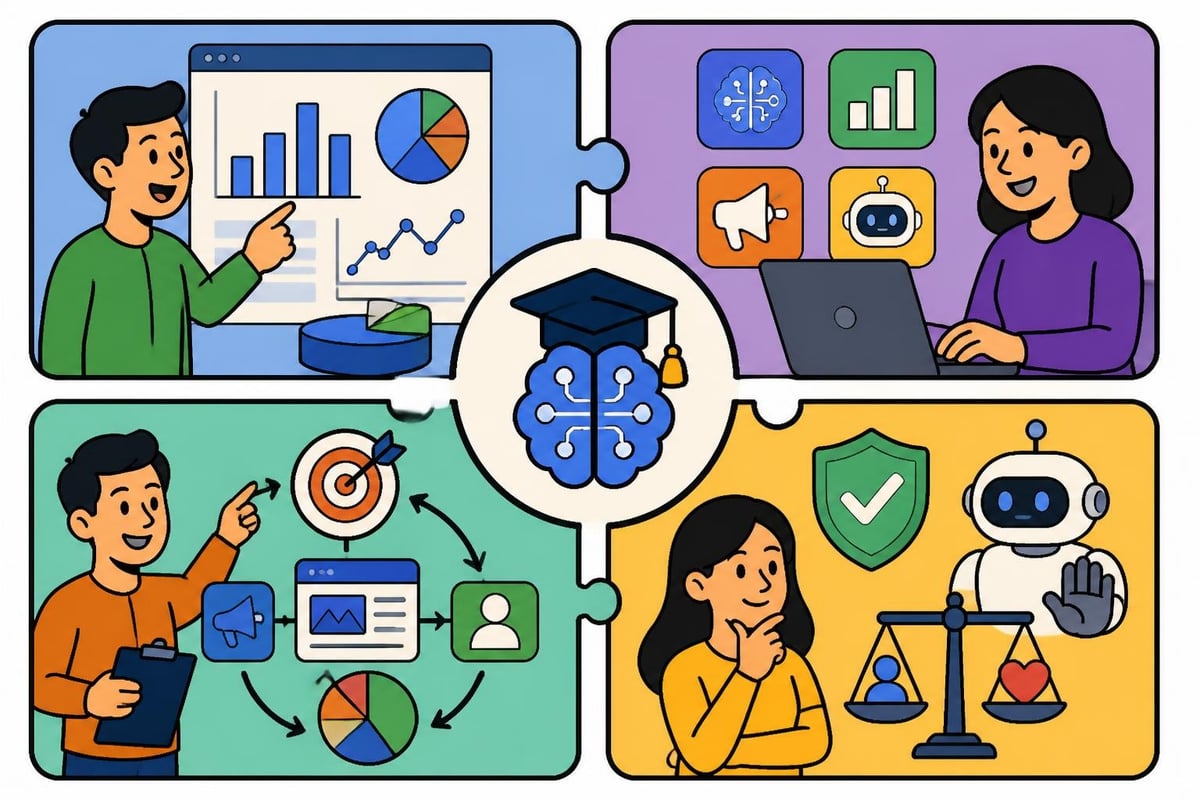
The most effective programs balance three core competencies that reflect real-world marketing operations. First, they teach data science fundamentals specific to marketing contexts, including customer lifetime value prediction, churn modeling, and attribution analysis. Second, they provide hands-on experience with enterprise-grade AI marketing tools like programmatic advertising platforms, conversational AI builders, and predictive lead scoring systems. Third, they develop strategic thinking around AI implementation, covering ethical considerations, budget allocation for AI tools, and team restructuring for AI-augmented workflows.
Core curriculum components typically include:
- Predictive customer analytics and behavioral modeling
- AI-powered content generation and optimization techniques
- Automated campaign management and budget allocation
- Sentiment analysis and social listening with machine learning
- Personalization engines and recommendation systems
- Marketing attribution modeling using neural networks
Industry Certification Standards Taking Shape
Unlike established fields with decades-old credentialing systems, AI marketing certifications are still crystallizing. Major technology companies like Google, Microsoft, and Salesforce have launched specialized programs that blend their proprietary AI tools with broader marketing principles. Platforms offering comprehensive AI courses now compete with traditional business schools launching executive education programs focused exclusively on AI marketing applications.
The certification landscape breaks down into three tiers. Entry-level certifications validate basic understanding of AI concepts and their marketing applications, typically requiring 40-80 hours of study. Professional certifications demand project portfolios demonstrating real campaign implementation and data analysis skills, often taking 3-6 months to complete. Advanced credentials, still emerging in 2026, target senior strategists and require original research or case studies showing measurable business impact from AI marketing initiatives.
| Certification Level | Time Investment | Prerequisites | Typical Cost Range |
|---|---|---|---|
| Foundation | 40-80 hours | Basic marketing knowledge | $300-$800 |
| Professional | 150-300 hours | 2+ years marketing experience | $1,200-$3,500 |
| Advanced/Executive | 200-400 hours | Leadership role + portfolio | $4,000-$12,000 |
Practical Skills That Separate Effective Programs
The gap between theoretical AI marketing courses and programs that actually prepare students for implementation is vast. Effective ai in digital marketing courses emphasize scenario-based learning where students work with real datasets, not sanitized textbook examples. They require learners to make decisions with incomplete information, just as they would when deploying AI tools with limited historical data or uncertain market conditions.
Hands-On Tool Mastery vs. Conceptual Understanding
Understanding how machine learning algorithms work conceptually differs enormously from actually deploying them in marketing campaigns. The best programs provide sandbox environments with enterprise marketing platforms where students can experiment without financial consequences. This includes building custom audiences using lookalike modeling, creating dynamic ad creative variations with generative AI, and setting up automated bidding strategies that optimize for business objectives rather than vanity metrics.
Critical hands-on competencies include:
- Data preparation and cleaning for marketing datasets with customer information, transaction histories, and behavioral signals
- Model selection and tuning for specific marketing objectives like conversion prediction or customer segmentation
- A/B testing design for AI-generated content and algorithmic recommendations
- Performance monitoring with dashboards that track both AI system health and business KPIs
- Bias detection in targeting algorithms and content recommendations to ensure ethical deployment
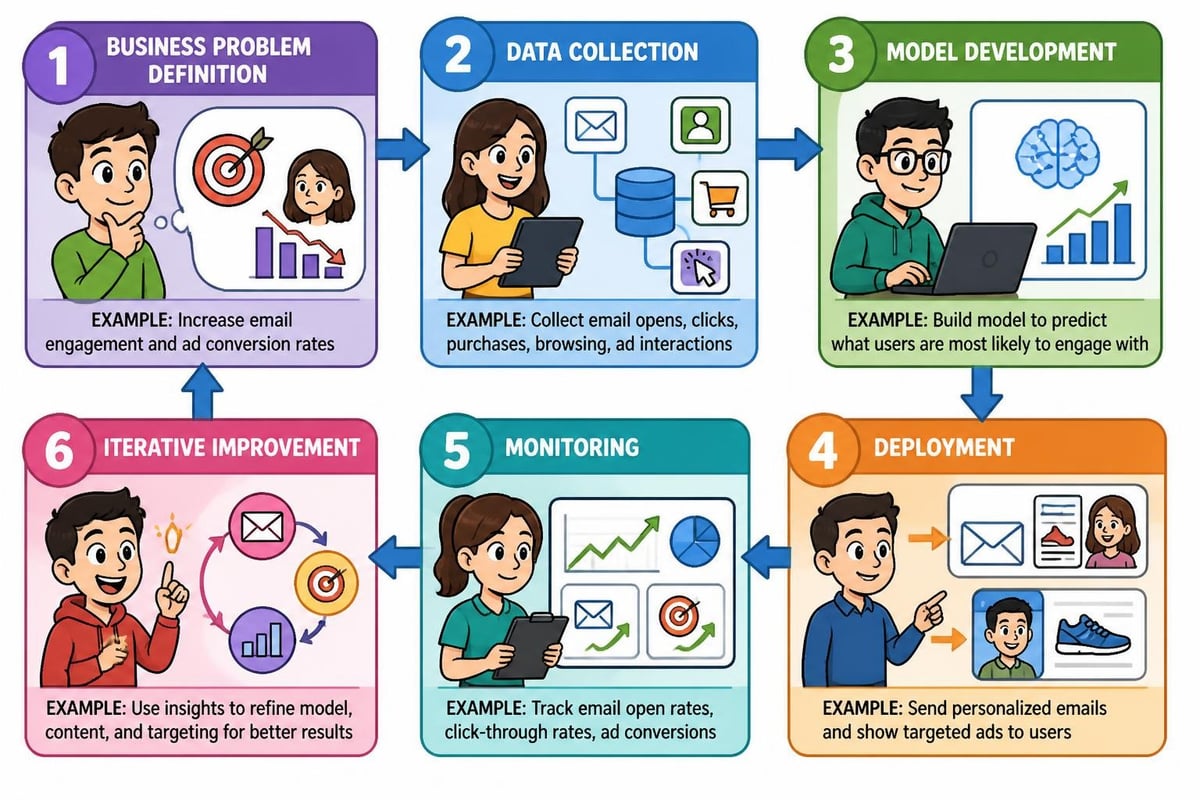
Students should emerge from quality programs able to independently implement at least three AI marketing tools in production environments. This might mean deploying a chatbot that handles customer service inquiries, launching a predictive lead scoring system that integrates with CRM software, or building a content recommendation engine for email campaigns.
Real-World Project Requirements That Matter
Portfolio projects in ai in digital marketing courses should mirror actual business challenges with messy data, competing stakeholder priorities, and resource constraints. Rather than asking students to "build a customer segmentation model," effective assignments frame problems like "increase customer retention by 15% within budget constraints using AI personalization while maintaining brand voice consistency across 12 communication channels."
This approach forces learners to navigate tradeoffs that define real marketing work. They must balance model accuracy against interpretability when explaining recommendations to executives who don't understand neural networks. They wrestle with privacy regulations when implementing behavioral targeting. They confront the reality that AI tools often fail in production and need continuous monitoring and adjustment.
Platform Selection and Learning Environment Considerations
Not all learning platforms deliver ai in digital marketing courses with equal effectiveness. The environment where you study directly impacts skill retention and practical application ability. Self-paced video libraries suit experienced marketers who need targeted knowledge updates, while structured bootcamps with cohort learning and instructor feedback better serve those making substantial career pivots.
Interactive Learning Tools vs. Passive Consumption
The neuroscience of skill acquisition shows that active engagement beats passive watching by enormous margins. Platforms that integrate coding exercises, decision simulations, and peer review into marketing AI curriculum demonstrate completion rates 3-4 times higher than video-only approaches. When evaluating AI and ML courses, prioritize those offering interactive dashboards where you manipulate real marketing data, not just watch instructors do it.
Progressive learning platforms now incorporate AI itself into the educational experience. Adaptive learning systems adjust content difficulty based on quiz performance and assignment scores. AI teaching assistants provide instant feedback on code errors or strategic decisions in simulations. Personalized learning paths recommend specific modules based on career goals and existing skill assessments.
Key platform features that enhance learning outcomes:
- Live coding environments integrated directly into lessons
- Peer code review and collaborative project work
- Real-time data visualizations that respond to student inputs
- Spaced repetition systems for concept reinforcement
- Integration with actual marketing platforms (Google Ads, Meta Business Suite, HubSpot)
- Project galleries showcasing previous student work
Corporate Training vs. Individual Certification Paths
Organizations pursuing team-wide AI marketing upskilling face different requirements than individual professionals. Corporate training programs need standardized curricula that bring team members to consistent competency levels, dashboards that track progress across dozens or hundreds of employees, and customization options that reflect company-specific tools and processes.
Individual learners benefit from flexibility and breadth-the ability to explore multiple specializations like SEO automation, programmatic advertising AI, or conversational marketing platforms before committing to a deep specialization. They need career services connecting them with employers seeking AI marketing skills and portfolio-building opportunities that demonstrate capabilities to hiring managers.
| Learning Context | Ideal Format | Duration | Key Success Metrics |
|---|---|---|---|
| Individual Career Transition | Structured bootcamp with mentorship | 12-16 weeks | Job placement within 6 months |
| Marketing Professional Upskilling | Self-paced with deadlines | 8-12 weeks | Implement 1 AI tool in current role |
| Corporate Team Training | Instructor-led cohort | 6-8 weeks | 80%+ completion, measurable KPI improvement |
| Executive Overview | Intensive workshop | 2-3 days | Strategic roadmap development |
ROI Measurement and Career Impact Analysis
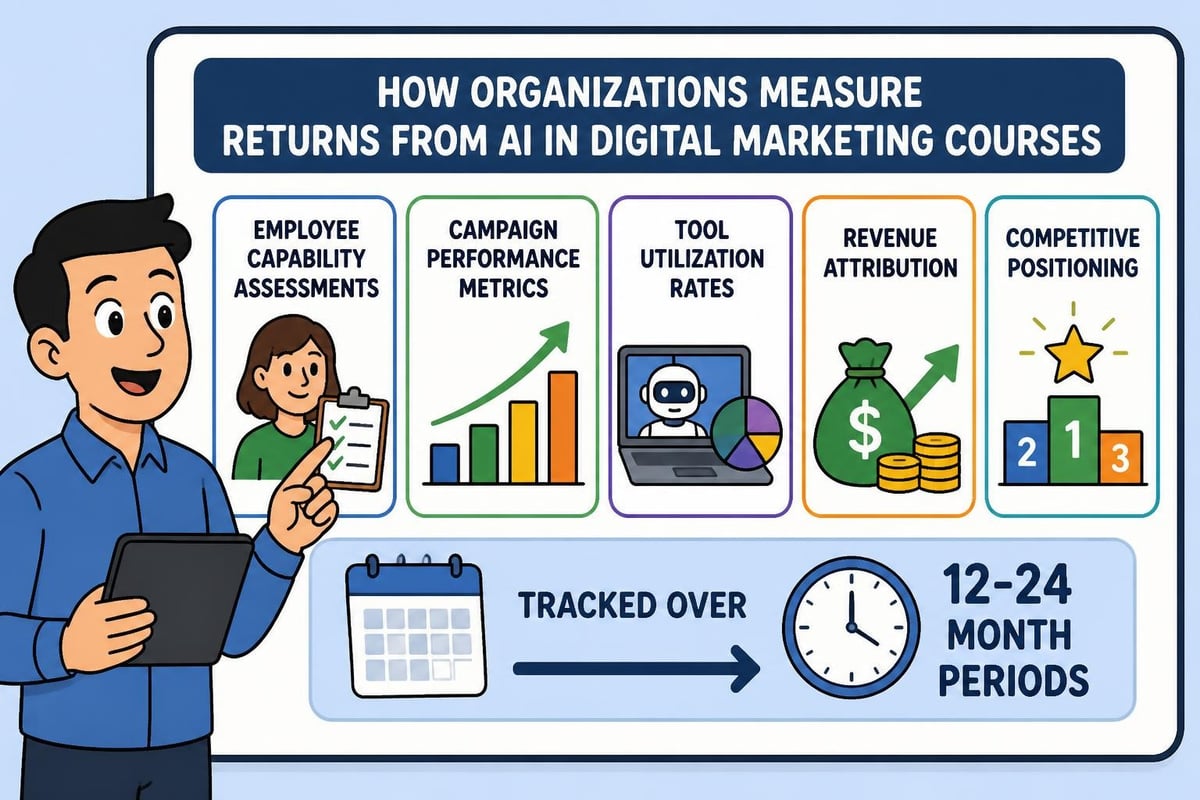
Investing time and money in ai in digital marketing courses demands clear return-on-investment thinking. For individuals, this means quantifying salary increases, role transitions, or expanded responsibilities that directly result from new AI marketing capabilities. For organizations, ROI calculation must connect training investments to concrete business outcomes like revenue growth, cost savings from automation, or competitive advantages in customer acquisition.
Salary Impact and Career Advancement Data
Marketing professionals with demonstrated AI competency command salary premiums averaging 18-35% above peers with equivalent experience but traditional-only skillsets, according to 2026 recruitment data. This gap widens in senior roles where strategic AI implementation decisions directly impact company performance. Marketing directors who can architect AI-driven growth strategies, not just operate tools, see compensation packages 40-60% higher than those managing conventional campaigns.
Career trajectory data shows that marketers completing comprehensive ai in digital marketing courses transition into higher-responsibility roles 7-9 months faster than industry averages. This acceleration comes from both the credentials themselves and the portfolio projects that demonstrate capabilities beyond theoretical knowledge. When combined with specialized AI certifications, professionals position themselves for emerging roles like AI Marketing Strategist, Predictive Analytics Manager, and Marketing Automation Architect.
Quantifiable career outcomes tracked across graduate cohorts:
- Average salary increase: 22% within 12 months of certification
- Role advancement timeline: 40% shorter than industry baseline
- Job offer volume: 3.2x more interview requests with AI credentials listed
- Freelance rate increases: 35-50% for consultants adding AI services
- Internal promotion probability: 2.8x higher than non-certified peers
Business Impact Metrics That Justify Training Investment
Forward-thinking organizations track specific performance indicators before and after deploying AI marketing training programs. The most compelling ROI cases show improvements across multiple dimensions: customer acquisition costs declining 15-30% through better targeting algorithms, marketing team productivity increasing 25-40% through automation, and customer lifetime value rising 20-45% through improved personalization.
Tool utilization metrics matter too. Companies often subscribe to expensive AI marketing platforms but use only 20-30% of capabilities because teams lack training. After comprehensive ai in digital marketing courses, platform utilization typically jumps to 65-85%, dramatically improving cost-per-capability ratios without additional software spending. When analyzing campaigns and tracking performance across channels, link management platforms like Trimy help marketing teams optimize their AI-driven strategies by providing deep insights into which campaigns generate the strongest ROI and user engagement patterns.
Qualitative impacts prove harder to measure but equally important. Teams develop shared vocabulary around AI concepts, enabling faster strategy discussions and decision-making. Marketing and data science departments collaborate more effectively when marketers understand model limitations and data scientists grasp business contexts. Innovation cycles accelerate as teams recognize new opportunities for AI application across customer touchpoints.
Specialized Focus Areas Within AI Marketing Education
The field of AI marketing education has matured beyond generic "AI for marketers" overviews into specialized tracks addressing specific disciplines. This specialization reflects the reality that AI applications in SEO differ fundamentally from those in paid advertising, email marketing, or social media management. Professionals gain more value from deep expertise in their primary channel than surface-level familiarity across all marketing domains.
Content Marketing and SEO Automation
AI has revolutionized content creation workflows, and specialized courses now teach the complete pipeline from keyword research through content distribution. Students learn to use language models for outline generation, competitor content analysis, and semantic keyword clustering. Advanced modules cover content optimization algorithms that predict search rankings, automated internal linking strategies, and programmatic content generation at scale while maintaining quality and brand voice.
SEO-focused ai in digital marketing courses particularly emphasize the shift from manual keyword targeting to topic modeling and entity-based optimization. Search engines themselves use AI to understand content meaning and user intent, requiring marketers to think in terms of conceptual coverage and semantic relationships rather than exact-match keywords. Courses teach how to audit content gaps using competitive intelligence tools, predict trending topics before they peak, and optimize content refresh strategies based on decay patterns.
Paid Advertising and Programmatic Platforms
Programmatic advertising represents perhaps the most mature application of AI in marketing, with billions of daily ad decisions made by algorithms. Specialized courses teach bidding strategy optimization, creative testing frameworks, and audience modeling techniques specific to platforms like Google Ads, Meta's advertising system, and emerging retail media networks. Students learn to balance competing objectives-maximizing conversions while controlling costs, expanding reach while maintaining relevance, and scaling campaigns without sacrificing efficiency.
Advanced topics include multi-touch attribution modeling that accounts for complex customer journeys, incrementality testing to measure true advertising impact versus baseline sales, and privacy-preserving targeting techniques that remain effective as third-party cookies disappear. The best programs provide real advertising budgets (even small ones) where students experience the pressure of spending actual money and defending results to stakeholders.
Conversational Marketing and AI-Powered Customer Engagement
Chatbots, voice assistants, and AI-driven customer service tools require distinct competencies combining marketing strategy, conversational design, and technical implementation. Specialized ai in digital marketing courses in this domain teach intent recognition, dialog flow design, and integration between conversational AI and backend systems like CRM and inventory management.
Students learn to balance automation with human escalation, designing experiences that handle routine inquiries efficiently while seamlessly transferring complex issues to human agents. Courses cover personality design for brand-consistent AI interactions, multilingual deployment strategies, and performance metrics specific to conversational interfaces like containment rates, resolution times, and customer satisfaction scores. For those interested in broader AI applications, exploring no-code AI development can complement marketing-specific skills.
Selecting the Right Program for Your Goals
With hundreds of ai in digital marketing courses available in 2026, selection criteria must align with specific career objectives and learning preferences. The "best" program for a freelance content marketer differs dramatically from the optimal choice for a corporate marketing director overseeing a team of 20. Evaluation frameworks should consider curriculum depth, instructor expertise, peer network quality, and post-completion support.
Evaluation Criteria That Actually Predict Success
Start by examining instructor credentials and course creator backgrounds. The most valuable programs combine marketing practitioners who've deployed AI in real campaigns with data scientists who understand the technical foundations. Avoid courses taught exclusively by academics without industry experience or marketing generalists without deep AI expertise-you need both perspectives integrated throughout the curriculum.
Essential evaluation dimensions:
- Curriculum currency: Does content reflect 2026 AI capabilities and platform changes, or recycle 2024 materials?
- Project portfolio requirements: Are students building work samples that demonstrate skills to employers?
- Tool access: Does the program include licenses for enterprise AI marketing platforms, or just teach concepts abstractly?
- Community and networking: Can you connect with alumni working in your target industry or role?
- Update policies: Do you receive curriculum updates as AI marketing evolves post-completion?
- Support resources: What access do you have to instructors, teaching assistants, or peer groups when stuck?
Read course reviews critically, distinguishing between complaints about difficulty (often a positive signal indicating rigor) and legitimate concerns about outdated content, unresponsive support, or misaligned expectations. Look for specific examples in reviews rather than vague praise or criticism. Students who detail projects they built or skills they've applied provide more reliable signals than those offering generic endorsements.
Balancing Cost, Time Investment, and Expected Outcomes
Premium ai in digital marketing courses charging $3,000-$8,000 justify costs through comprehensive support, extensive hands-on projects, and strong employer networks. Budget options at $500-$1,500 work well for experienced marketers who primarily need exposure to AI tools and concepts rather than extensive skill-building. Free courses from leading AI platforms provide valuable introductions but rarely deliver job-ready capabilities without substantial self-directed supplementation.
Time commitment calculations should account for your learning pace and existing knowledge base. Someone with data analysis experience may progress through technical modules 40-60% faster than peers approaching AI completely fresh. Marketing veterans may breeze through strategy sections while struggling with coding exercises. Honest self-assessment prevents both under-challenging boredom and overwhelming frustration that derails completion.
| Budget Range | Typical Features | Best For | Completion Timeline |
|---|---|---|---|
| Free - $500 | Video lectures, basic exercises | Exploration and awareness building | 4-8 weeks self-paced |
| $500 - $2,000 | Structured curriculum, some projects | Individual skill development | 8-12 weeks with deadlines |
| $2,000 - $5,000 | Comprehensive projects, instructor access | Career transition or advancement | 12-16 weeks intensive |
| $5,000+ | Custom cohorts, extensive support, job placement | Corporate teams or premium individual | Variable, often 12-20 weeks |
Building Continuous Learning Habits Beyond Initial Certification
Completing ai in digital marketing courses represents a beginning, not an endpoint. The AI marketing landscape evolves so rapidly that capabilities mastered in 2026 may become obsolete or significantly enhanced by 2027. Professionals who maintain relevance build continuous learning systems that keep pace with new tools, algorithm updates, and emerging best practices without requiring complete recertification annually.
Creating a Personal AI Marketing Learning System
Effective continuous learning combines multiple information sources at different depths. Follow 3-5 AI marketing thought leaders who publish regular content analyzing new tools and sharing implementation case studies. Subscribe to platform update feeds from major marketing technology vendors to understand capability changes as they roll out. Join practitioner communities where peers share lessons learned from real campaigns, not just theoretical discussions.
Dedicate time weekly to hands-on experimentation with new features and tools. Most enterprise AI platforms release significant updates monthly-trying these in low-risk contexts builds familiarity before high-stakes implementations. Set up personal testing environments using free tiers of marketing automation platforms where you can deploy AI features without affecting actual business operations.
Sustainable learning habits that compound over time:
- Weekly review of 2-3 case studies from different industries
- Monthly hands-on testing of one new AI tool or platform feature
- Quarterly deep-dive into emerging specialization (voice search optimization, AI-powered video marketing)
- Semi-annual skill assessment to identify knowledge gaps requiring formal training
- Annual portfolio update documenting new AI implementations and measurable results
Transitioning From Learning to Leading AI Marketing Initiatives
The ultimate value of ai in digital marketing courses emerges when you apply knowledge to drive organizational change and business results. This transition requires moving beyond personal skill development to change management, stakeholder education, and strategic roadmap development. Leaders who successfully implement AI marketing initiatives typically follow phased approaches that build quick wins before attempting comprehensive transformations.
Start by identifying specific pain points where AI offers clear advantages-repetitive manual tasks consuming team time, targeting inefficiencies causing wasted ad spend, or personalization gaps creating poor customer experiences. Propose pilot projects with defined success metrics and limited scope, making failures educational rather than catastrophic. Document processes and results rigorously, creating case studies that justify expanded AI adoption.
Build internal advocacy by training team members on AI tools you've deployed, not just using them yourself. Cross-functional education sessions help sales teams understand lead scoring algorithms, creative teams grasp content optimization systems, and executives see the strategic implications of predictive analytics. As AI literacy spreads across your organization, resistance to adoption decreases and innovation opportunities multiply.
Mastering AI marketing capabilities through structured education represents one of the most valuable professional investments in 2026, delivering measurable career advancement and organizational competitive advantages. Ready to build the skills that define marketing's future? MammothClub offers 3,000+ AI and technology courses with interactive learning tools, corporate certification programs, and AI-powered dashboards that make upskilling measurable and results-driven-helping you stay competitive in the AI era.