Engineering has entered a transformational phase where artificial intelligence and machine learning are no longer optional specializations but fundamental competencies. The integration of an aiml course in engineering programs reflects this shift, preparing engineers to solve complex problems using data-driven methodologies. From optimizing manufacturing processes to designing autonomous systems, AI and ML have become the backbone of modern engineering innovation. As industries demand professionals who can bridge traditional engineering disciplines with computational intelligence, specialized courses and certifications have proliferated across universities and professional learning platforms, each offering unique pathways to mastery.
Why AI and ML Matter in Engineering Disciplines
Engineering has always been about optimization, prediction, and design. What artificial intelligence brings to these traditional pursuits is unprecedented computational power and pattern recognition capabilities.
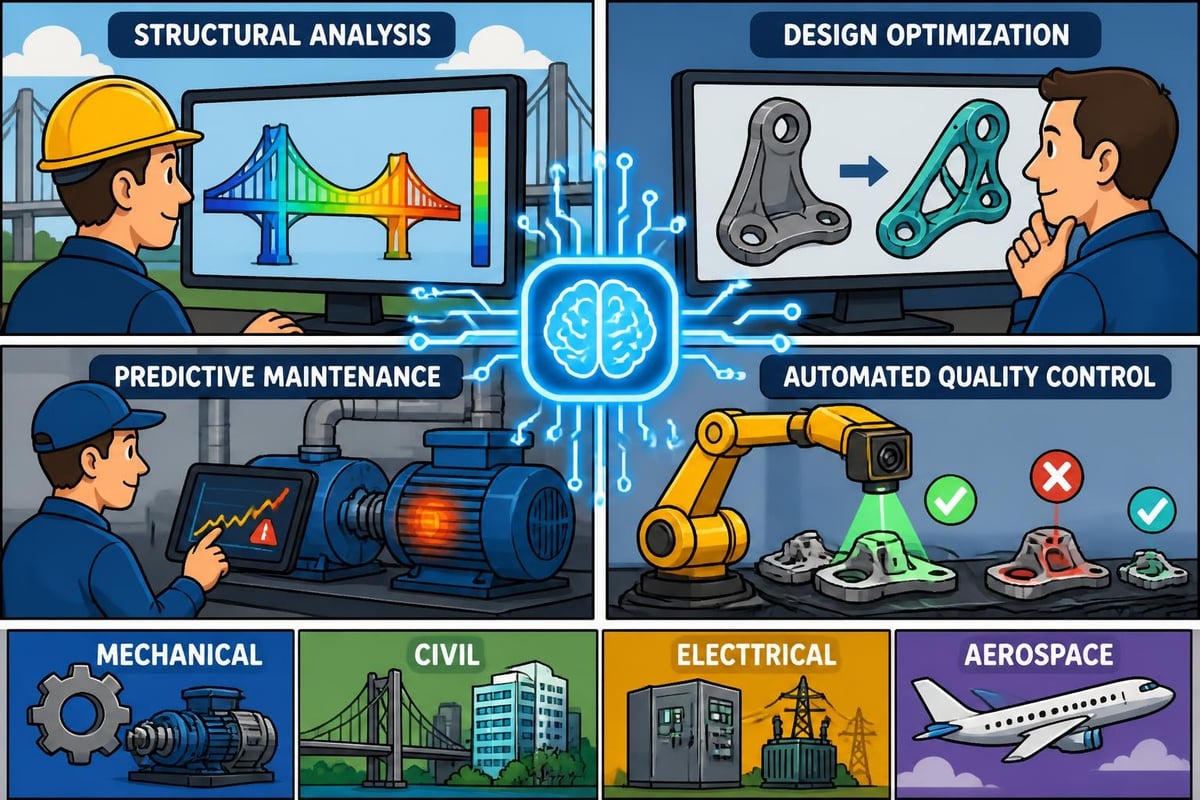
Civil engineers now use machine learning algorithms to predict structural failures before they occur. Mechanical engineers deploy AI-driven simulations to optimize product designs in ways that manual calculations could never achieve. Electrical engineers leverage neural networks to improve power grid efficiency and reliability.
The fundamental reasons engineers need AI/ML skills include:
- Automating repetitive design calculations and simulations
- Processing massive datasets from sensors and IoT devices
- Predicting equipment failures and maintenance needs
- Optimizing complex systems with multiple variables
- Accelerating innovation cycles through rapid prototyping
The University of Washington's Master of Science in Artificial Intelligence and Machine Learning for Engineering exemplifies how institutions are restructuring curricula to meet this demand. Their program specifically targets working engineers who need to integrate AI capabilities into existing engineering frameworks.
Beyond theoretical knowledge, practical application drives value. Engineers who complete an aiml course in engineering gain the ability to implement solutions immediately, translating complex algorithms into tangible improvements in efficiency, safety, and innovation.
Core Curriculum Components in Engineering AI/ML Programs
A comprehensive aiml course in engineering balances mathematical foundations with practical implementation skills. The curriculum typically spans several critical domains that prepare engineers for real-world challenges.
Mathematical Foundations and Theory
Linear algebra, calculus, probability, and statistics form the mathematical backbone. Engineers learn how optimization algorithms work, why gradient descent converges, and how to evaluate model performance rigorously.
Essential mathematical topics include:
- Matrix operations and eigenvalue decomposition
- Multivariate calculus for optimization
- Probability distributions and Bayesian inference
- Statistical hypothesis testing and confidence intervals
- Information theory and entropy measures
| Core Subject | Engineering Application | Learning Outcome |
|---|---|---|
| Linear Algebra | Sensor data processing | Matrix decomposition for signal analysis |
| Calculus | Optimization problems | Gradient-based parameter tuning |
| Probability | Risk assessment | Uncertainty quantification in designs |
| Statistics | Quality control | Process monitoring and anomaly detection |
Machine Learning Algorithms and Implementation
The MIT course on Artificial Intelligence and Machine Learning for Engineering Design demonstrates how algorithms translate into engineering solutions. Students learn supervised learning for predictive modeling, unsupervised learning for pattern discovery, and reinforcement learning for control systems.
Implementation training typically covers:
- Supervised Learning: Regression for parameter estimation, classification for defect detection
- Unsupervised Learning: Clustering for process segmentation, dimensionality reduction for visualization
- Deep Learning: Convolutional networks for image analysis, recurrent networks for time-series prediction
- Reinforcement Learning: Optimal control policies, adaptive system behavior
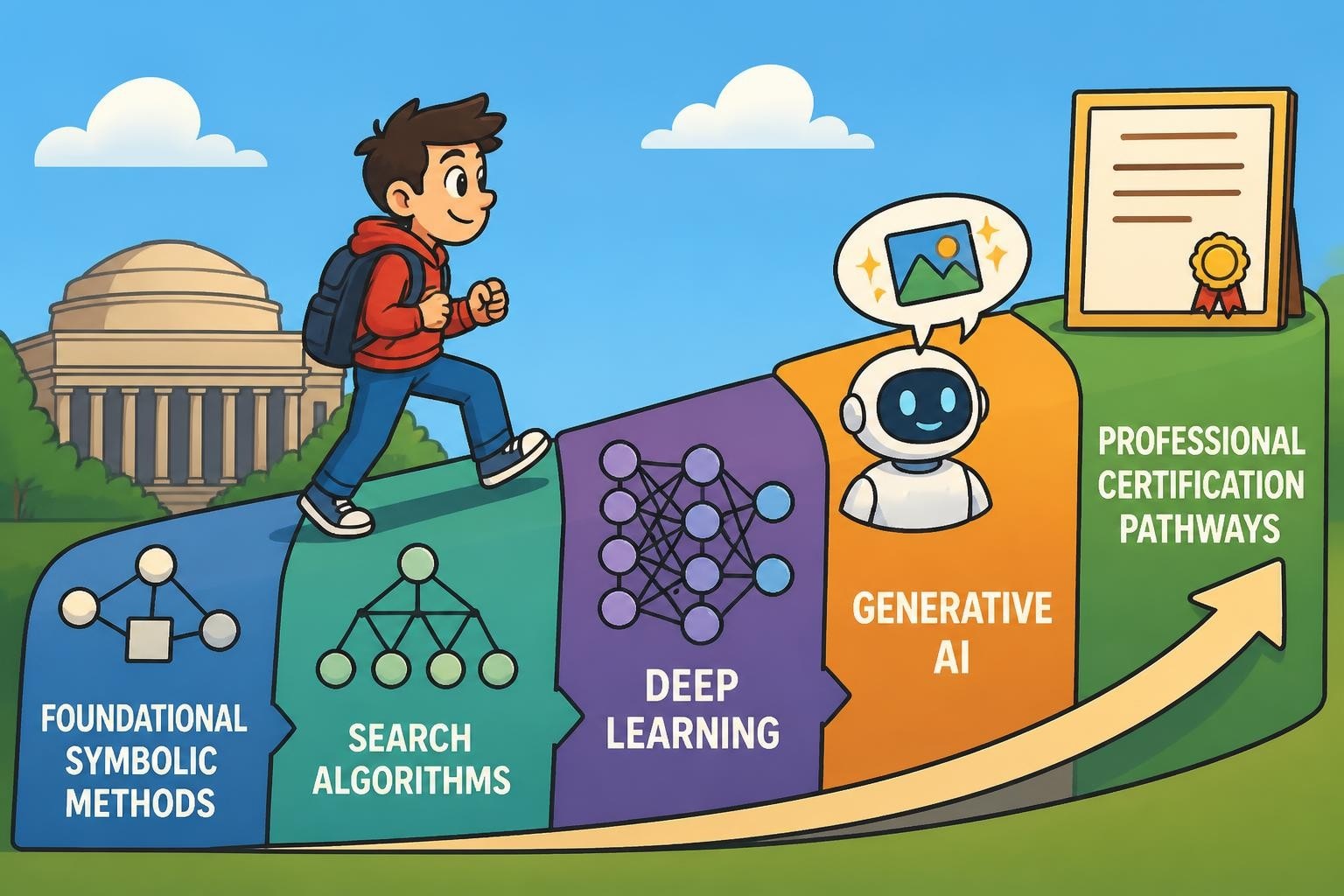
Understanding the complete AI ML learning path helps engineers structure their education progressively, building from fundamentals to advanced applications.
Engineering-Specific Applications
Generic data science courses don't address engineering constraints like real-time processing, safety-critical systems, or physical limitations. An aiml course in engineering focuses on domain-specific challenges.
The University of Maryland's ENME440 course exemplifies this approach, teaching machine learning within the context of engineering design constraints, manufacturing limitations, and regulatory requirements.
Engineering-specific topics include:
- Physics-informed neural networks that respect conservation laws
- Time-series forecasting for sensor data and system monitoring
- Computer vision for quality inspection and defect detection
- Optimization under constraints for design and planning
- Reliability engineering and failure prediction
Choosing the Right AI/ML Engineering Program
Not all programs serve the same career objectives. Engineers must evaluate curriculum depth, practical components, industry connections, and credential value.
University Graduate Programs vs. Professional Certificates
Graduate programs like Arizona State University's Master of Science in Artificial Intelligence Engineering offer comprehensive academic foundations with twelve concentration options. These programs typically require 30-36 credits over two years, providing deep theoretical grounding and research opportunities.
Professional certificates offer faster pathways. They condense essential knowledge into focused modules, typically completing in 3-12 months. For working engineers, this format provides immediate applicability without career interruption.
| Program Type | Duration | Depth | Best For |
|---|---|---|---|
| Master's Degree | 1.5-2 years | Comprehensive | Career transitions, research roles |
| Graduate Certificate | 6-12 months | Focused | Skill enhancement, specialization |
| Professional Bootcamp | 3-6 months | Applied | Immediate implementation |
| Online Courses | Self-paced | Variable | Foundational learning |
Evaluating Curriculum Quality and Industry Relevance
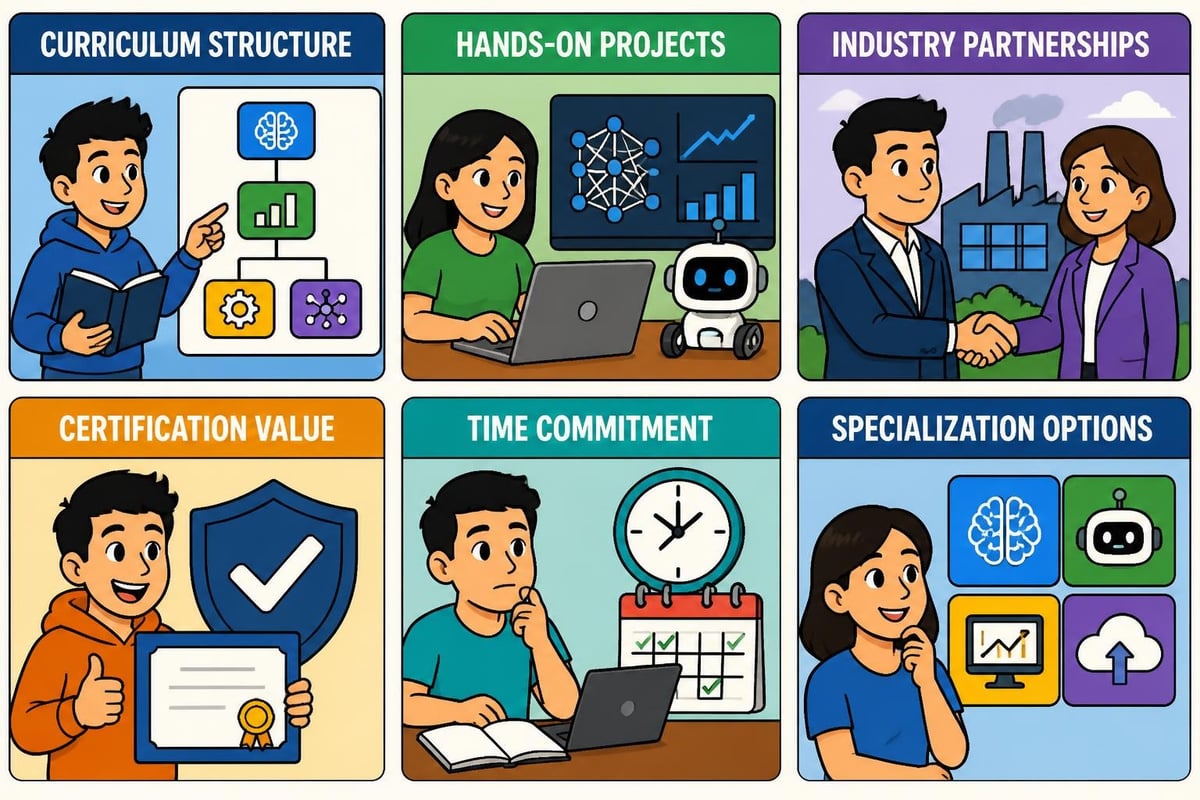
The University of Massachusetts Amherst's M.S. Concentration in AI and Machine Learning Systems balances theoretical rigor with practical projects. Quality programs feature:
- Hands-on projects using real engineering datasets
- Industry partnerships providing case studies and mentorship
- Modern tools and platforms like TensorFlow, PyTorch, and cloud computing
- Capstone experiences solving actual engineering problems
- Faculty with research credentials in both AI and engineering domains
Engineers should investigate whether courses address their specific discipline. A mechanical engineer needs different applications than a civil engineer, though both benefit from core ML competencies.
Accreditation and Career Advancement Value
Professional AI certification programs vary significantly in market recognition. Engineers should prioritize programs that:
- Offer credentials recognized by employers in their industry
- Include portfolio-building projects demonstrating competency
- Provide networking opportunities with AI engineering professionals
- Feature instructors with practical implementation experience
- Update curriculum regularly to reflect emerging technologies
The George Washington University's Master of Engineering in Artificial Intelligence and Machine Learning emphasizes this balance between theoretical understanding and practical skills, preparing graduates for immediate industry contribution.
Practical Skills Developed Through AI/ML Engineering Courses
Beyond algorithms and mathematics, an aiml course in engineering develops critical practical competencies that distinguish capable practitioners from theoretical students.
Programming and Software Engineering
Modern AI engineering requires proficiency in multiple programming languages and development practices. Python dominates for ML implementation, but engineers often need C++ for performance-critical applications or MATLAB for simulation integration.
Essential programming skills include:
- Python libraries: NumPy, Pandas, Scikit-learn, TensorFlow, PyTorch
- Version control with Git for collaborative development
- Cloud platforms: AWS, Azure, Google Cloud for scalable deployment
- API development for model serving and integration
- Testing frameworks ensuring model reliability
Research on software engineering for AI and machine learning systems reveals unique challenges in developing production-ready AI applications, emphasizing the need for rigorous engineering practices beyond model training.
Data Engineering and Management
Models are only as good as the data feeding them. Engineers learn to collect, clean, transform, and manage datasets spanning sensor readings, simulation outputs, and operational logs.
Data engineering curriculum typically covers:
- Data acquisition from sensors, databases, and streaming sources
- Data cleaning handling missing values, outliers, and inconsistencies
- Feature engineering creating predictive variables from raw measurements
- Database systems for efficient storage and retrieval
- Data pipelines automating collection, processing, and model updating
Engineers working with AI training platforms need these skills to prepare real-world data for model consumption, often the most time-consuming aspect of AI projects.
Model Deployment and System Integration
Training accurate models represents only half the challenge. Engineers must deploy models into production environments, integrate them with existing systems, and maintain performance over time.
The Carnegie Mellon course 24-787 addresses these practical concerns, teaching students how AI components fit within larger engineering systems.
| Deployment Aspect | Engineering Challenge | Solution Approach |
|---|---|---|
| Real-time inference | Latency constraints | Model optimization, edge computing |
| System integration | Legacy system compatibility | API design, microservices architecture |
| Monitoring | Performance degradation | Continuous evaluation, retraining pipelines |
| Scalability | Growing data volumes | Distributed computing, cloud infrastructure |
Career Opportunities and Industry Applications
Completing an aiml course in engineering opens diverse career pathways across industries experiencing digital transformation. The skills acquired translate directly into high-value roles solving complex technical challenges.
Emerging Job Roles for AI-Enabled Engineers
Traditional engineering titles are evolving to reflect AI integration. New roles combine domain expertise with computational capabilities:
- Machine Learning Engineer (Engineering Focus): Develops AI solutions for specific engineering problems
- AI Systems Engineer: Integrates AI components into complex engineering systems
- Robotics Engineer (AI Specialization): Designs autonomous systems using perception and control algorithms
- Predictive Maintenance Engineer: Implements AI-driven asset monitoring and failure prediction
- Manufacturing Intelligence Engineer: Optimizes production using computer vision and ML analytics
Engineers with comprehensive AI and ML training command premium salaries due to their ability to deliver measurable business value through innovation.
Industry Sectors Driving Demand
Manufacturing leads AI adoption among traditional engineering sectors, using computer vision for quality control and ML for process optimization. Aerospace follows closely with autonomous systems and structural health monitoring.
High-demand sectors include:
- Automotive: Autonomous vehicle development, advanced driver assistance
- Energy: Grid optimization, predictive maintenance, renewable integration
- Construction: Building information modeling with AI, safety monitoring
- Biomedical: Medical device design, diagnostic systems, personalized treatment
- Aerospace: Flight optimization, predictive maintenance, autonomous systems
The research paper on engineering artificial intelligence frameworks discusses systematic methodologies and challenges organizations face when implementing AI solutions, highlighting the growing need for engineers who understand both technical and organizational dimensions.
Salary Expectations and Career Growth
Engineers with AI/ML specialization typically earn 20-40% premiums over their non-specialized counterparts. Entry-level positions for engineers with relevant coursework start around $85,000-$105,000, while experienced AI engineers in specialized domains command $150,000-$200,000 or more.
Career growth accelerates as engineers demonstrate ability to deliver AI solutions that reduce costs, improve quality, or create new capabilities. Those who can communicate technical concepts to business stakeholders while maintaining engineering rigor advance fastest.
Building Your Learning Path in Engineering AI/ML
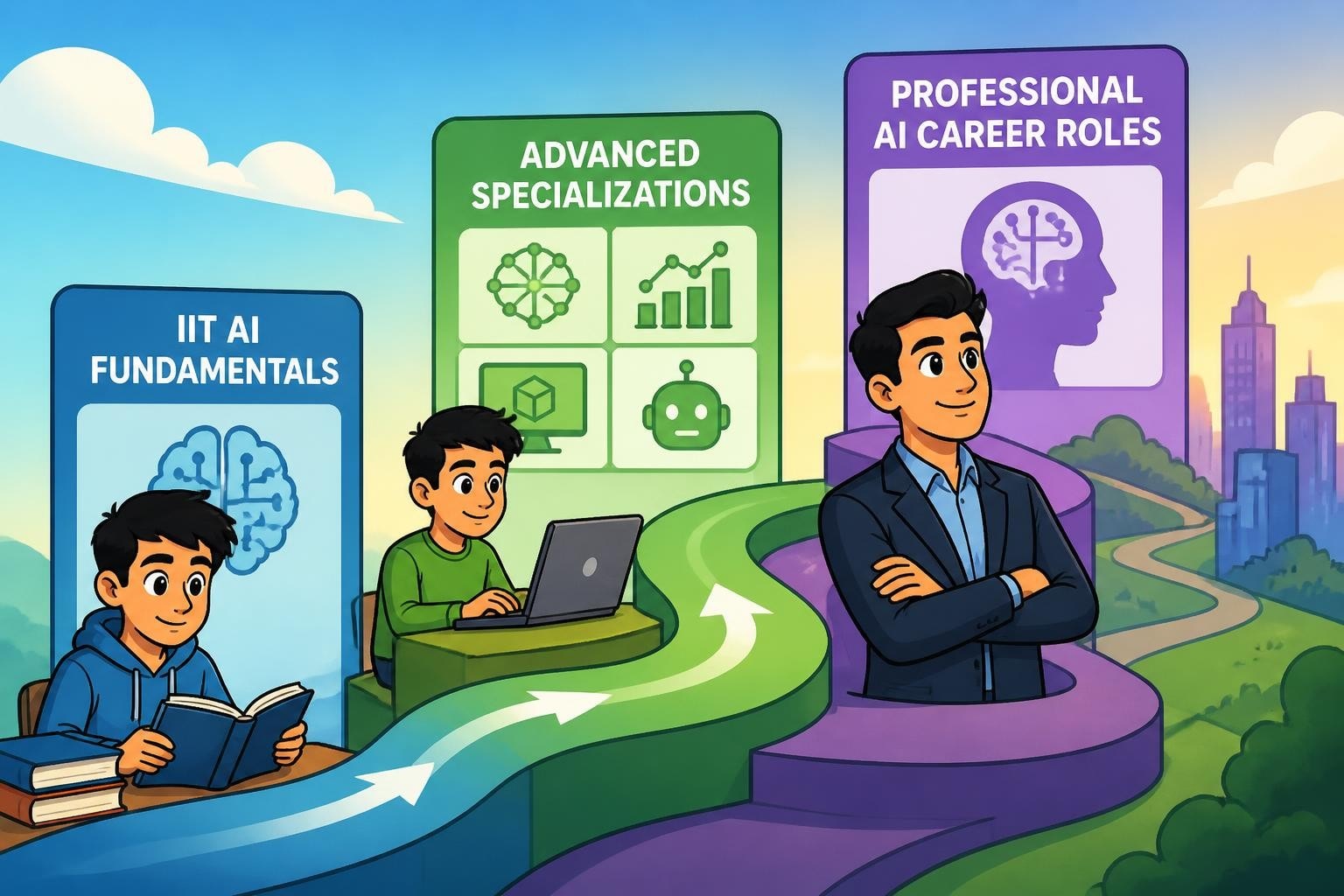
Success requires strategic planning that balances theoretical knowledge, practical skills, and portfolio development. Engineers at different career stages need customized approaches.
Prerequisites and Foundational Knowledge
An aiml course in engineering assumes certain baseline competencies. Engineers should strengthen fundamental areas before diving into advanced topics.
Recommended prerequisites include:
- Programming proficiency in at least one language (Python preferred)
- Undergraduate mathematics through multivariate calculus
- Basic statistics and probability theory
- Understanding of engineering fundamentals in your discipline
- Familiarity with computational tools and simulation software
Engineers lacking these foundations can address gaps through AI basics courses before tackling specialized engineering applications.
Structured Learning Sequence
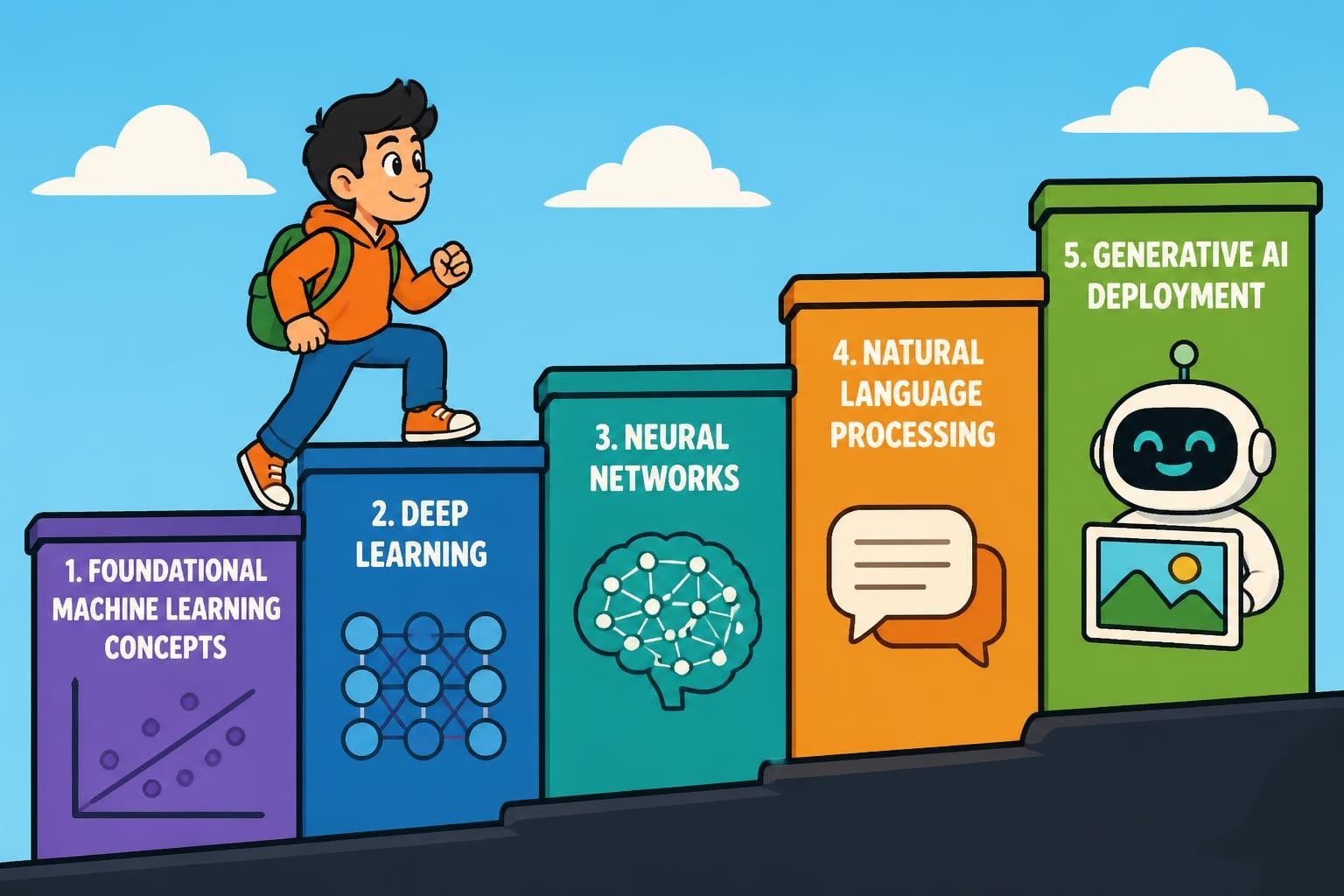
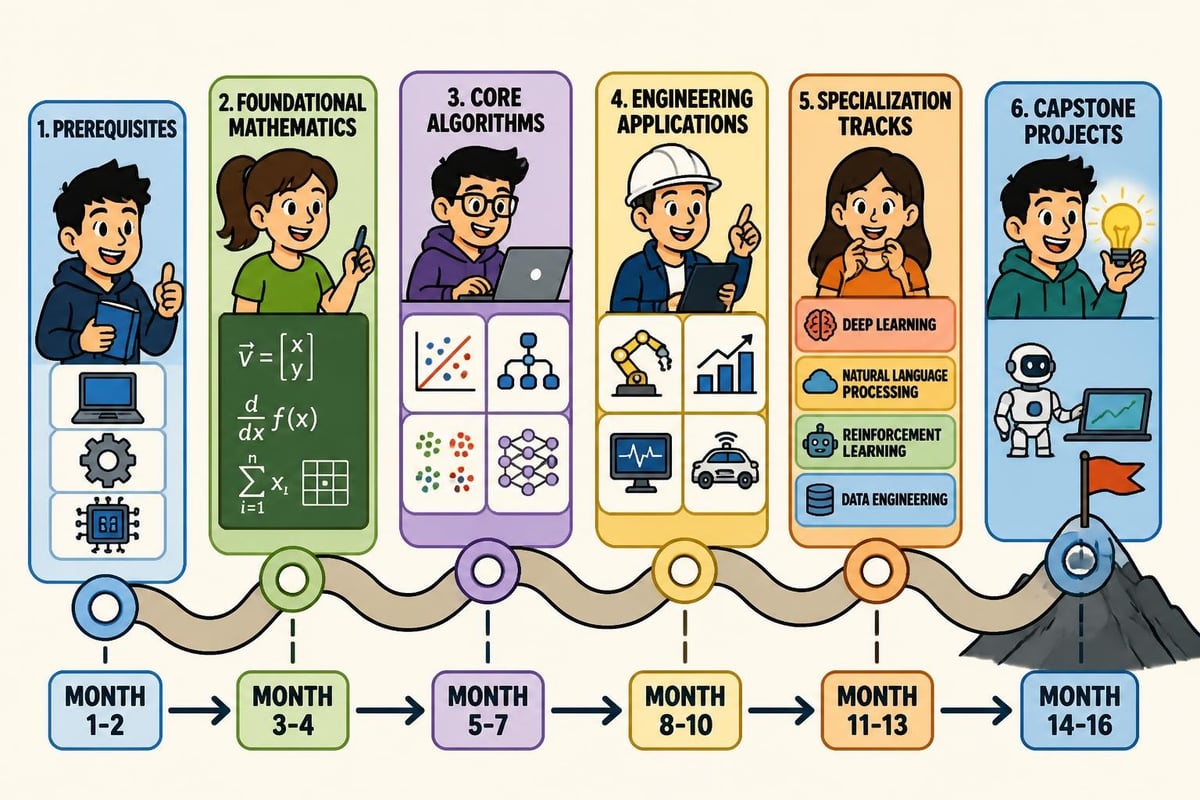
Progressive skill development prevents overwhelm and ensures solid understanding. A typical learning sequence spans 6-18 months depending on prior knowledge and time commitment.
Phase 1 (Months 1-3): Foundations
- Mathematical foundations review
- Python programming for data science
- Introduction to machine learning concepts
- Basic data manipulation and visualization
Phase 2 (Months 4-6): Core Algorithms
- Supervised learning methods
- Unsupervised learning techniques
- Model evaluation and validation
- Engineering-specific case studies
Phase 3 (Months 7-9): Advanced Topics
- Deep learning and neural networks
- Computer vision or NLP (discipline-dependent)
- Time-series analysis
- Reinforcement learning basics
Phase 4 (Months 10-12): Specialization and Projects
- Domain-specific applications
- Capstone project in your engineering discipline
- Deployment and production considerations
- Ethics and responsible AI
Studies on utilizing online ML toolkits for sustainable engineering education provide implementation guides showing how engineers can leverage open-source resources effectively throughout this learning journey.
Balancing Self-Study with Structured Programs
Self-directed learning using online resources offers flexibility but requires exceptional discipline. Structured programs provide accountability, expert guidance, and peer collaboration.
Most successful engineers combine approaches:
- Structured courses for systematic knowledge building and credentials
- Self-study for exploring specific topics and tools in depth
- Projects for hands-on practice and portfolio development
- Community engagement through forums, meetups, and professional networks
Platforms offering comprehensive AI and robotics courses provide structured curricula while allowing flexible pacing, balancing both needs effectively.
Overcoming Common Challenges in AI/ML Engineering Education
Engineers transitioning into AI face predictable obstacles. Recognizing these challenges enables proactive solutions.
Time Management for Working Professionals
Most engineers pursuing an aiml course in engineering maintain full-time employment. Balancing work, education, and personal commitments requires deliberate strategies.
Effective time management approaches:
- Block 5-10 hours weekly for focused study during consistent time slots
- Break learning into 30-45 minute sessions for better retention
- Use commute time for video lectures or podcast content
- Apply learned concepts to work projects for reinforcement
- Communicate education goals with employers for potential support
Many corporate AI certification programs recognize this challenge, offering accelerated formats designed for busy professionals.
Bridging the Theory-Practice Gap
Understanding algorithms mathematically doesn't automatically translate to implementing effective solutions. Engineers struggle when classroom examples don't match messy real-world data.
Strategies for practical competency development:
- Work with industry datasets rather than sanitized academic examples
- Complete end-to-end projects from problem definition through deployment
- Participate in competitions like Kaggle for diverse problem exposure
- Contribute to open-source projects gaining code review and collaboration experience
- Seek mentorship from engineers successfully applying AI in your domain
The gap narrows fastest when engineers actively apply concepts to actual engineering problems rather than abstract exercises.
Staying Current with Rapid Technology Evolution
AI technologies evolve continuously. Techniques considered state-of-art become obsolete within years, sometimes months.
Engineers maintain relevance by:
- Following key research venues like NeurIPS, ICML, and domain-specific conferences
- Engaging with practitioner communities sharing implementation experiences
- Experimenting with emerging tools and frameworks on small projects
- Reading both academic papers and industry blogs
- Focusing on fundamental principles that transcend specific tools
Research-oriented courses covering AI fundamentals provide theoretical grounding that remains relevant despite tool changes.
Integration with Traditional Engineering Disciplines
The most powerful applications emerge when AI capabilities enhance rather than replace traditional engineering expertise. An aiml course in engineering emphasizes this integration.
Mechanical and Manufacturing Engineering
Machine learning transforms product design, manufacturing optimization, and maintenance strategies. Engineers use generative design algorithms to explore design spaces impossible to evaluate manually, producing optimized components that balance multiple performance criteria.
Key applications include:
- Topology optimization using AI-driven iterative design
- Predictive maintenance reducing unplanned downtime
- Computer vision for automated quality inspection
- Process parameter optimization in manufacturing
- Energy consumption modeling and reduction
CAD and simulation tools increasingly incorporate AI features, making ML literacy essential for mechanical engineers regardless of specialization.
Civil and Structural Engineering
Infrastructure monitoring benefits enormously from AI capabilities. Sensors embedded in bridges, buildings, and tunnels generate continuous data streams that traditional analysis cannot efficiently process.
Civil engineers apply AI for:
- Structural health monitoring using sensor fusion and anomaly detection
- Traffic flow optimization through predictive modeling and control
- Construction scheduling with AI-powered resource allocation
- Building energy management optimizing HVAC and lighting systems
- Seismic response prediction improving disaster preparedness
These applications require understanding both structural engineering principles and AI methodologies, precisely what specialized programs deliver.
Electrical and Computer Engineering
Power systems, communication networks, and embedded systems all leverage machine learning for enhanced performance and reliability.
Electrical engineers implement AI in:
- Smart grid management balancing generation and demand
- Signal processing for communication and sensor systems
- Chip design optimization using AI-driven layout tools
- IoT systems with edge AI for distributed intelligence
- Power electronics control using adaptive algorithms
The convergence of hardware and AI creates opportunities for engineers who master both domains, positioning them for leadership in emerging technology areas.
Certification and Credential Options
Formal credentials validate competency and signal commitment to professional development. Engineers should understand credential types and their market value.
Academic Degrees vs. Professional Certificates
Master's degrees provide comprehensive education and research exposure but require significant time and financial investment. Professional certificates focus on applied skills, completing faster and costing less.
| Credential Type | Duration | Cost Range | Market Recognition | Best Application |
|---|---|---|---|---|
| M.S. in AI Engineering | 1.5-2 years | $30,000-$60,000 | High, universal | Career transition, leadership roles |
| Graduate Certificate | 6-12 months | $8,000-$20,000 | Moderate, growing | Specialization, skill update |
| Professional Certification | 3-6 months | $1,000-$5,000 | Variable by provider | Specific tool/platform expertise |
| Online Course Certificate | Self-paced | $50-$2,000 | Low to moderate | Foundational learning |
Engineers should align credential choice with career objectives, existing expertise, and resource constraints.
Industry-Recognized Certifications
Beyond academic credentials, industry certifications demonstrate platform-specific expertise valued by employers using particular technologies.
Popular industry certifications include:
- AWS Certified Machine Learning - Specialty
- Google Professional Machine Learning Engineer
- Microsoft Azure AI Engineer Associate
- TensorFlow Developer Certificate
- NVIDIA Deep Learning Institute credentials
These vendor-specific AI certifications complement engineering degrees, proving practical implementation capability on widely-used platforms.
Building a Portfolio Demonstrating Competency
Credentials open doors, but portfolios close deals. Engineering managers hiring for AI roles want evidence of practical capability through documented projects.
Effective portfolios include:
- 3-5 substantial projects showing diverse AI applications
- Documentation explaining problem, approach, results, and lessons learned
- Code repositories on GitHub demonstrating clean, professional development
- Performance metrics quantifying improvements achieved
- Visualizations making technical work accessible to non-specialists
Projects addressing real engineering challenges in your discipline carry more weight than generic exercises, demonstrating domain expertise alongside AI capability.
Mastering artificial intelligence and machine learning represents a transformative investment for engineering professionals, opening career opportunities while enhancing capability to solve increasingly complex technical challenges. Whether pursuing academic degrees, professional certificates, or self-directed learning, engineers who systematically build AI competencies position themselves at the forefront of their disciplines as industries continue digital transformation.
MammothClub provides the comprehensive learning platform engineering professionals need to master AI and ML efficiently, offering over 3,000 on-demand courses, interactive bootcamps, and corporate certification programs specifically designed for technical audiences. Our AI-powered learning dashboards track progress and recommend personalized pathways, ensuring engineers build skills systematically while balancing demanding work schedules. Explore our engineering-focused AI curriculum and accelerate your transformation into an AI-capable engineer today.