The artificial intelligence skills gap continues to widen as businesses race to implement AI solutions across every department. Earning a top AI certification has become the clearest way to signal competency, validate technical skills, and stand out in a competitive job market. Whether you're transitioning into AI, deepening existing expertise, or leading AI transformation initiatives, choosing the right certification requires understanding which credentials carry weight with employers, align with your career trajectory, and deliver measurable return on investment. This guide examines the most valuable AI certifications available in 2026, helping you make an informed decision based on your professional goals and learning style.
Why AI Certifications Matter in 2026
The demand for verified AI skills has accelerated beyond simple resume credentials. Organizations now require proof that candidates can implement solutions, navigate ethical considerations, and align AI projects with business objectives.
Professional certifications serve multiple strategic purposes:
- Validate hands-on competency with specific tools, frameworks, and methodologies
- Demonstrate commitment to continuous learning in a rapidly evolving field
- Provide standardized benchmarks that hiring managers recognize across industries
- Open access to exclusive communities, resources, and career opportunities
- Signal understanding of governance, ethics, and responsible AI principles
Research into certification labels for trustworthy AI shows that structured certification programs correlate with better practitioner outcomes when they combine theoretical knowledge with practical application. The most effective certifications require candidates to solve real problems, not just memorize concepts.
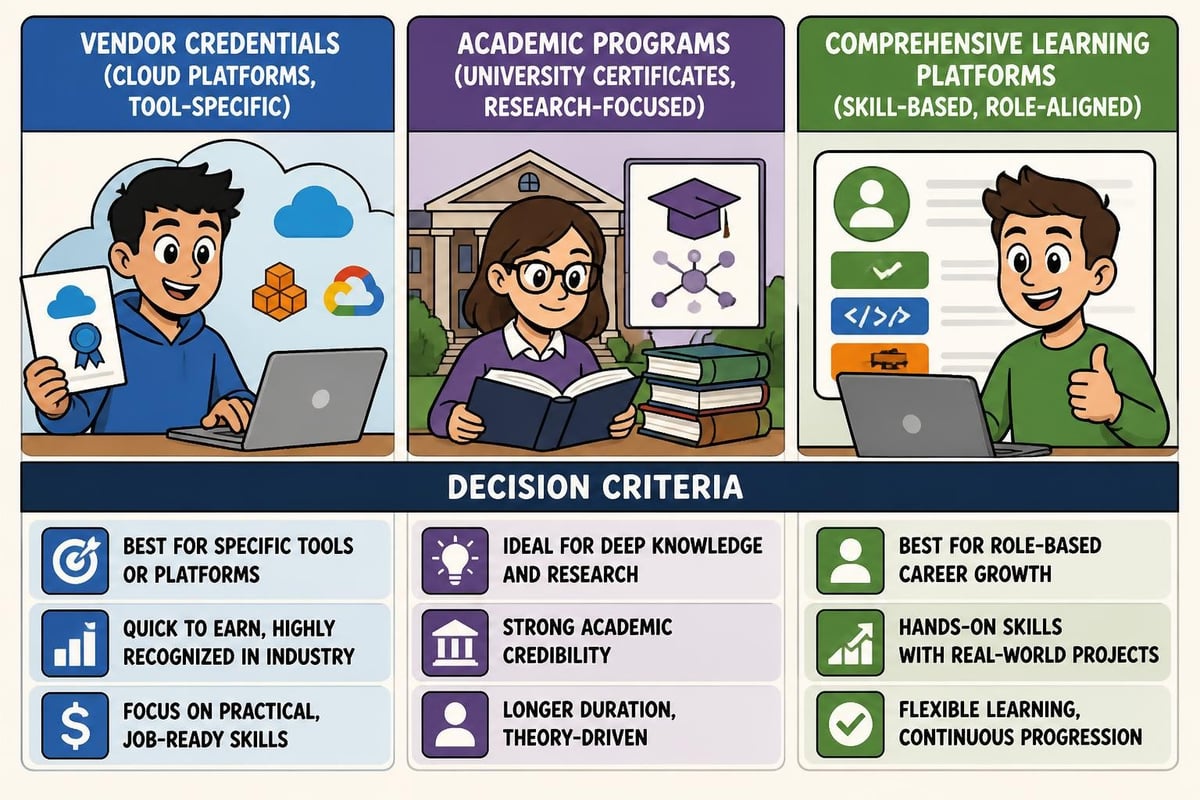
For many professionals, the decision between vendor-specific credentials, academic certificates, and platform-based programs creates confusion. Each certification type offers distinct advantages depending on your current role, target position, and preferred learning approach.
Leading Vendor-Specific AI Certifications
Major technology companies have developed certification programs that validate expertise with their AI and machine learning platforms. These credentials carry significant weight when your target roles involve those specific ecosystems.
Google Cloud Professional Machine Learning Engineer
The Google Cloud Professional Machine Learning Engineer certification remains one of the most respected cloud-based AI credentials. This certification validates your ability to design, build, and productionize ML models using Google Cloud technologies.
Exam coverage includes:
- Architecting low-code ML solutions and custom training applications
- Building and automating ML pipelines with Vertex AI
- Scaling predictions and managing ML solutions in production
- Implementing ML models that align with responsible AI practices
- Optimizing ML infrastructure for cost and performance
The certification requires hands-on experience with TensorFlow, BigQuery ML, AutoML, and Vertex AI. Google recommends at least three years of industry experience and one year working with Google Cloud before attempting the exam. The credential validates skills that directly translate to production ML engineering roles.
Microsoft Azure AI Certifications
Microsoft offers a tiered approach through multiple AI certifications that serve different experience levels and specializations. The AI-900 Azure AI Fundamentals provides entry-level validation, while AI-102 Azure AI Engineer Associate targets practitioners building production solutions.
| Certification | Target Audience | Key Skills Validated | Renewal Period |
|---|---|---|---|
| AI-900 Fundamentals | Beginners, managers | AI concepts, Azure AI services, responsible AI | N/A (fundamentals) |
| AI-102 Engineer Associate | AI developers | Custom vision, NLP, knowledge mining, conversational AI | Annual |
| DP-100 Data Scientist | ML practitioners | Azure ML, MLOps, experiment tracking, deployment | Annual |
The Azure AI-102 certification specifically validates your ability to design and implement AI solutions using Azure Cognitive Services, Azure Applied AI Services, and Azure Machine Learning. This top AI certification demonstrates competency in production-grade AI application development.
IBM AI Engineering and Watsonx Credentials
IBM's certification portfolio includes specialized tracks for AI engineering, data science, and enterprise AI deployment. The IBM AI Engineering Professional Certificate emphasizes scalable deep learning, while watsonx-focused credentials validate expertise with IBM's latest generative AI platform.
These certifications appeal to enterprise professionals working in regulated industries where IBM maintains strong presence. The credentials demonstrate understanding of AI governance frameworks and enterprise integration patterns that matter for large-scale deployments.
Academic and University-Based AI Certificates
Universities offer professional certificate programs that emphasize theoretical foundations alongside practical application. These programs typically require more time investment but provide deeper conceptual understanding.
MIT xPRO AI Professional Programs
MIT xPRO's professional education programs target executives and senior practitioners who need strategic AI understanding. The "Designing and Building AI Products and Services" program combines technical depth with product strategy and organizational transformation.
Program structure includes:
- Twelve weeks of instruction from MIT faculty
- Live online sessions with peer cohorts
- Case studies from real AI product launches
- Frameworks for AI product management and governance
- Professional certificate from MIT upon completion
These academic credentials signal commitment to rigorous learning and appeal to roles where strategic AI decision-making matters as much as technical implementation. The networking opportunities with fellow executives often prove as valuable as the curriculum itself.
Stanford Online AI Certificates
Stanford's continuing studies programs offer flexible online certificates in artificial intelligence, machine learning, and deep learning. These programs maintain Stanford's academic standards while accommodating working professionals.
The distinction of university credentials lies in their research-backed curriculum and emphasis on fundamental principles that remain relevant as specific tools evolve. Academic certificates often carry more weight in research-oriented roles or organizations that value theoretical rigor.
Platform-Based Comprehensive AI Certifications
Learning platforms have emerged as powerful alternatives to traditional vendor and academic programs, offering flexibility, breadth, and practical focus that appeals to self-directed learners.
Advantages of Platform-Based Learning
Modern AI learning platforms provide several benefits that traditional certification paths struggle to match:
- Continuous content updates reflecting the latest AI developments and tools
- Multi-vendor coverage rather than lock-in to a single ecosystem
- Role-based learning paths aligned with specific career objectives
- Hands-on projects using real datasets and business scenarios
- Community support from global networks of practitioners
Platforms like MammothClub combine structured certification programs with on-demand courses, allowing professionals to build customized learning journeys. The ability to explore adjacent topics like AI management or specialized applications creates versatility that vendor certifications cannot provide.
Building a Complete AI Skill Stack
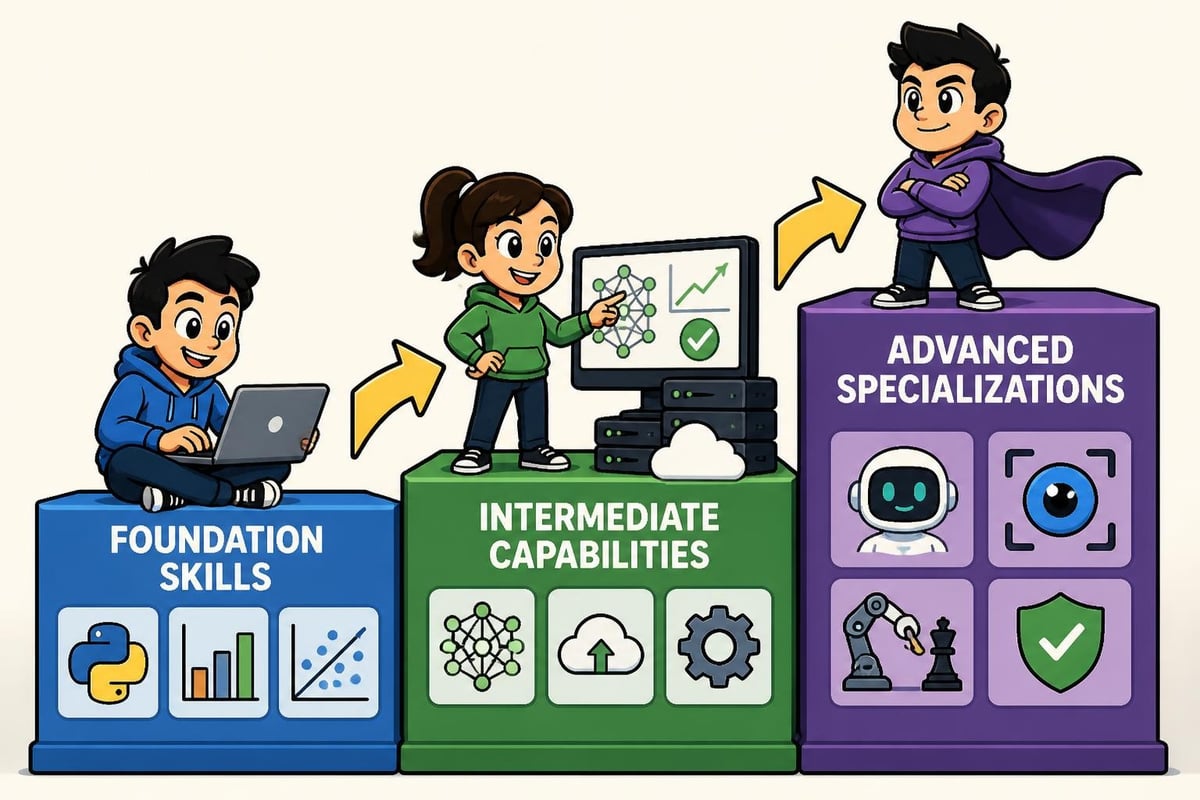
Rather than pursuing a single certification, many professionals now build comprehensive skill stacks through platform-based learning. This approach recognizes that AI roles require diverse competencies spanning technical skills, domain knowledge, and business acumen.
A complete AI skill stack might include:
- Foundational knowledge: Machine learning algorithms, statistics, Python programming
- Specialized techniques: Deep learning, natural language processing, computer vision
- Production skills: MLOps, deployment, monitoring, scaling
- Governance and ethics: Responsible AI, bias mitigation, regulatory compliance
- Business application: AI strategy, ROI analysis, stakeholder communication
The AI and ML learning path demonstrates how progressive skill-building creates more career flexibility than narrow specialist credentials. Understanding AI and ML courses helps you map certification options to specific career milestones.
Evaluating Certification ROI and Career Impact
Not all certifications deliver equal value. Understanding which credentials hiring managers actually prioritize helps you invest time and money wisely.
What Employers Actually Value
According to analysis from CSO Online, organizations increasingly look beyond certification logos to evaluate actual capabilities. Employers prioritize candidates who can demonstrate:
- Practical project experience solving real business problems
- Understanding of ethical AI principles and governance frameworks
- Ability to communicate technical concepts to non-technical stakeholders
- Familiarity with production ML systems and deployment practices
- Continuous learning mindset and adaptation to emerging tools
This reality means that certifications work best when combined with portfolio projects, GitHub contributions, and documented problem-solving. The top AI certification alone rarely guarantees job offers without evidence of applied skills.
Cost-Benefit Analysis Framework
| Certification Type | Typical Cost | Time Investment | Career Boost Potential | Expiration/Renewal |
|---|---|---|---|---|
| Vendor (Cloud Provider) | $200-400 per exam | 40-80 hours prep | High for platform-specific roles | 1-2 years |
| Academic (University) | $2,000-8,000 | 3-12 months | High for strategic/research roles | Permanent |
| Platform Certificates | $30-500/year | Flexible, self-paced | Moderate to high, depends on portfolio | Annual subscription |
| Professional Association | $300-1,000 | 20-40 hours | Moderate, industry-specific | Varies |
The most cost-effective path often combines multiple approaches. Starting with platform-based learning to build foundational skills, then pursuing vendor certifications for your target tech stack, creates both breadth and specialized depth. Organizations investing in team certifications through corporate programs often achieve better ROI through volume pricing and coordinated skill development.
Specialized AI Certifications for Niche Roles
As AI applications diversify, specialized certifications have emerged for specific domains and use cases.
AI Engineering and Architecture
The AI engineer certification path focuses on production system design, model optimization, and scalable infrastructure. These credentials validate skills in building robust AI pipelines rather than research or experimentation.
Core competencies include:
- Designing distributed training systems for large models
- Implementing MLOps workflows for continuous deployment
- Optimizing models for inference speed and resource efficiency
- Building monitoring and observability for AI systems
- Managing model versioning and experiment tracking
Engineers working with computationally intensive AI applications benefit from understanding GPU selection for AI training, which directly impacts production system design.
Domain-Specific AI Applications
Certifications increasingly target specific application domains where AI creates business value. These include AI for healthcare, financial services, manufacturing, and marketing.
For example, professionals entering AI-powered trading need certifications that validate understanding of both machine learning techniques and financial market structures. Similarly, those working in AI robotics require credentials demonstrating knowledge of reinforcement learning, computer vision, and control systems.
Domain certifications signal that you understand not just AI techniques but how to apply them within industry constraints, regulatory requirements, and business contexts.
Building Your Certification Strategy
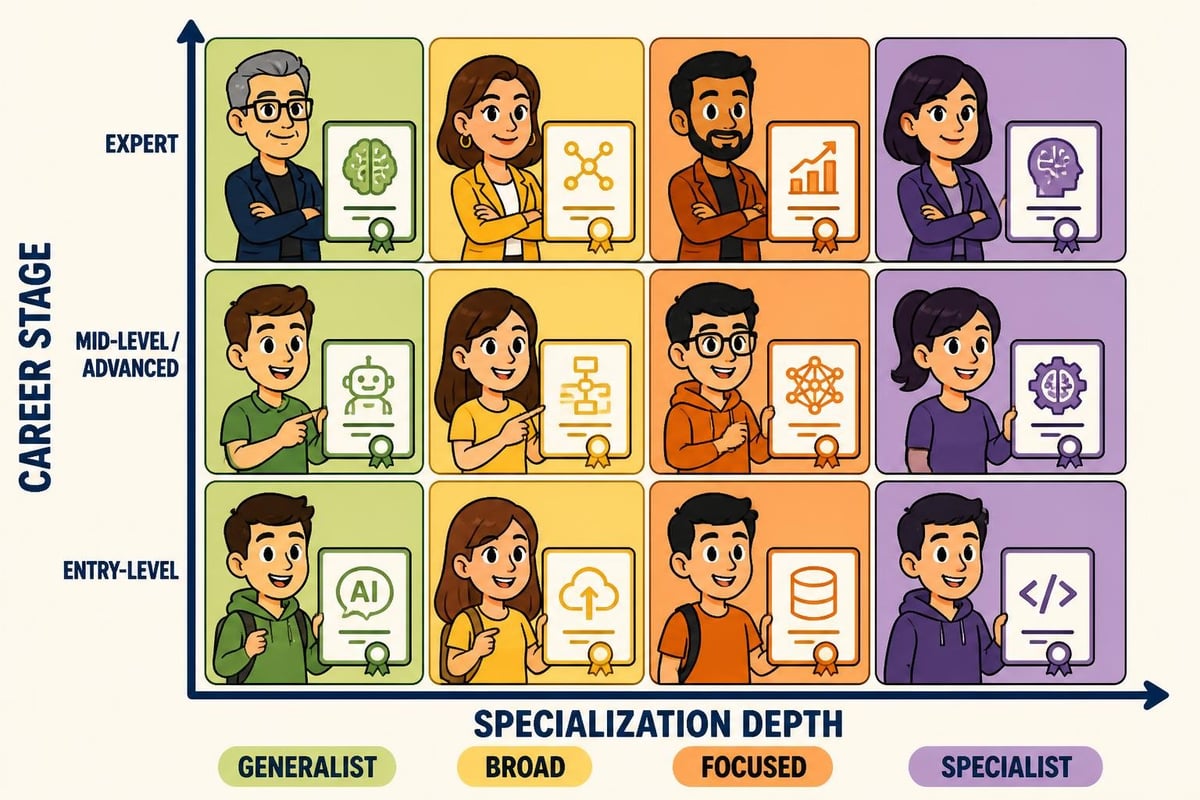
The most successful AI professionals approach certifications strategically rather than collecting credentials randomly.
Aligning Certifications with Career Goals
Your certification roadmap should reflect your three to five year career objectives. Different paths serve distinct ambitions:
For career transitioners: Start with foundational certifications that validate core competencies across the AI landscape. Platform-based programs offering comprehensive coverage help you explore different specializations before committing to a specific path. The complete AI and ML full course approach builds versatile skills applicable across roles.
For technical specialists: Pursue advanced vendor certifications in your primary technology stack while maintaining awareness of complementary tools. Deep expertise in specific platforms often commands premium compensation.
For leaders and managers: Focus on certifications emphasizing AI strategy, governance, and organizational transformation. Understanding technical foundations matters, but strategic credentials demonstrate ability to drive enterprise AI adoption.
For consultants and freelancers: Build a portfolio of certifications spanning multiple vendors and domains. Breadth signals versatility to potential clients across different technology environments.
Continuous Learning Beyond Initial Certification
AI evolves too rapidly for any certification to remain current indefinitely. The most valuable credentials exist within ecosystems that support ongoing learning.
Effective continuous learning strategies include:
- Following certification provider updates and recertification requirements
- Engaging with practitioner communities sharing real-world applications
- Contributing to open-source AI projects that demonstrate applied skills
- Attending conferences and workshops focused on emerging techniques
- Building personal projects that explore cutting-edge AI capabilities
Organizations implementing AI governance should align their certification requirements with frameworks like NIST's AI Risk Management Framework, ensuring credentials validate responsible AI practices alongside technical competency. Standards from professional organizations like ACM's AI policy guidance help define what ethical AI certification should encompass.
Emerging Certification Trends for 2026
The AI certification landscape continues evolving as new technologies and priorities emerge.
Generative AI and Large Language Model Certifications
The explosion of generative AI has created demand for certifications validating prompt engineering, LLM fine-tuning, and responsible generative AI deployment. Platforms now offer specialized programs in working with models from OpenAI, Anthropic, and open-source alternatives.
These certifications emphasize practical skills like prompt design, retrieval-augmented generation, and evaluating model outputs for accuracy and bias. As businesses deploy chatbots, content generation tools, and AI assistants, credentials demonstrating safe implementation become increasingly valuable.
AI Governance and Ethics Credentials
Regulatory pressure and public scrutiny have elevated the importance of AI governance certifications. These credentials validate understanding of:
- Algorithmic bias detection and mitigation strategies
- Privacy-preserving machine learning techniques
- Explainability and interpretability requirements
- Compliance with emerging AI regulations (EU AI Act, etc.)
- Audit frameworks for AI systems
Organizations building AI products increasingly require team members with governance credentials alongside technical certifications. This trend reflects growing recognition that trustworthy AI requires intentional design, not just powerful models.
Cross-Functional AI Literacy Programs
Forward-thinking organizations now certify employees across all departments in AI fundamentals, not just technical teams. These programs validate that marketing, finance, HR, and operations professionals understand AI capabilities, limitations, and appropriate use cases.
Cross-functional AI literacy helps organizations identify automation opportunities, communicate effectively with technical teams, and make informed decisions about AI investments. The democratization of AI knowledge through accessible certifications accelerates enterprise-wide AI adoption.
Maximizing Certification Value Through Application
Earning a certification represents just the beginning. Translating credentials into career advancement requires deliberate effort.
Building a Public Portfolio
Document every certification with visible proof of competency. Create a portfolio showcasing:
- Capstone projects from certification programs with documented results
- GitHub repositories demonstrating code quality and best practices
- Technical blog posts explaining complex concepts in accessible language
- Conference presentations sharing lessons learned from implementations
- Open-source contributions showing collaboration and community engagement
Employers reviewing candidates look for evidence that certifications translated into practical application. A strong portfolio differentiates you from others holding identical credentials.
Leveraging Certifications for Internal Advancement
Within organizations, certifications provide leverage for role changes, project assignments, and compensation discussions. Communicate certification achievements through:
- Presentations sharing new skills with your team
- Proposals for AI pilot projects applying certified competencies
- Volunteering for cross-functional initiatives requiring AI expertise
- Mentoring colleagues pursuing similar certifications
- Documentation of efficiency gains or innovations enabled by new skills
Making your certification visible and valuable to your organization accelerates internal opportunities beyond simply listing credentials on LinkedIn.
Choosing the right top AI certification depends on your career stage, target roles, and learning preferences. The most effective approach combines foundational platform-based learning with specialized vendor credentials and continuous skill-building through practical projects. Whether you pursue cloud provider certifications, academic programs, or comprehensive learning paths, the key is selecting credentials that align with your professional goals and demonstrating applied competency beyond the certificate itself. MammothClub offers over 3,000 on-demand AI and tech courses, interactive bootcamps, and corporate certification programs designed to help professionals and organizations master AI skills quickly and measurably. Our AI-powered learning tools make training engaging and results-driven, helping you stay competitive as the AI landscape continues evolving.