Coursera has become one of the most recognized names in online education, particularly for artificial intelligence training. With thousands of professionals seeking to upskill in AI, understanding what an ai course coursera offers-and how it compares to modern alternatives-is essential for making informed training decisions. This comprehensive guide examines Coursera's AI curriculum, evaluates real learner outcomes, and explores how today's AI education landscape has evolved to meet the demands of 2026's fast-paced technology environment.
Understanding Coursera's AI Course Ecosystem
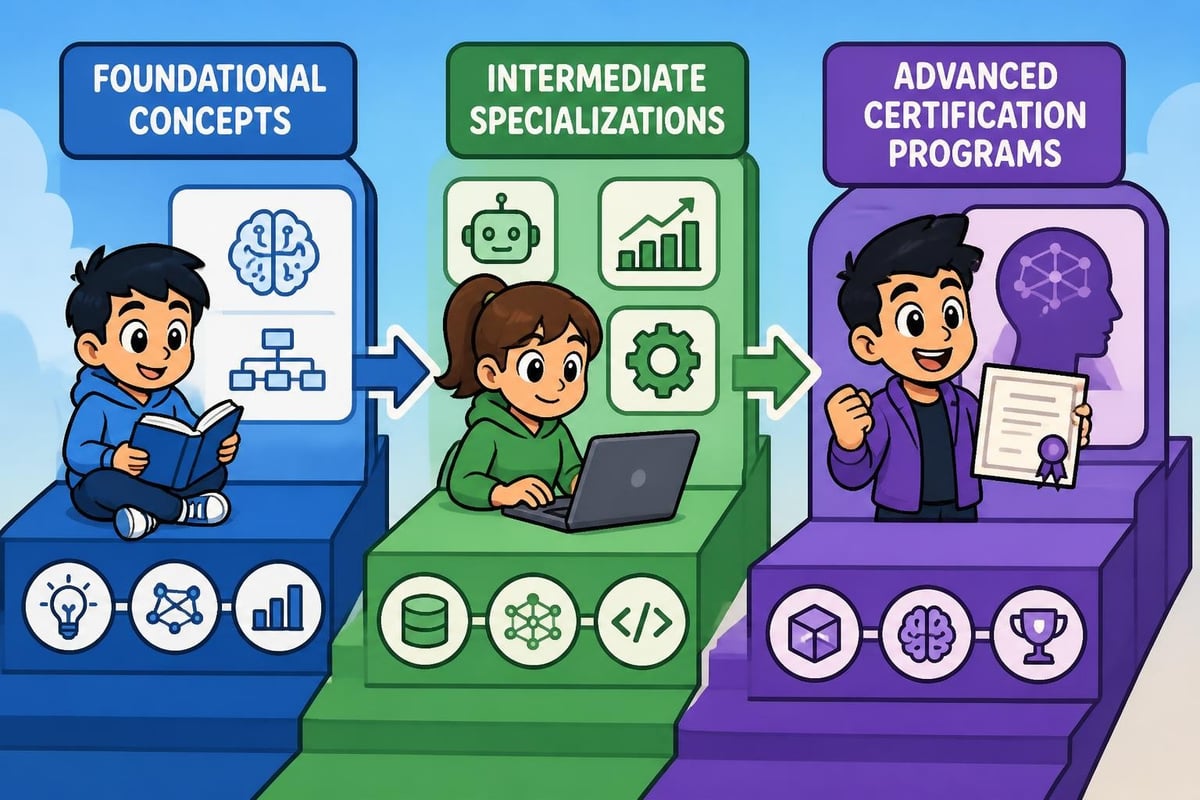
Coursera partners with universities and technology companies to deliver structured AI education at multiple levels. The platform categorizes its AI offerings into beginner-friendly introductions, intermediate specializations, and advanced professional certificates.
Course Structure and Learning Pathways
The typical ai course coursera follows a university-style format with video lectures, quizzes, peer-reviewed assignments, and capstone projects. Most courses run 4-8 weeks with an estimated 3-5 hours of weekly commitment.
Key components include:
- Pre-recorded video lectures from university professors or industry experts
- Graded assignments with automated feedback systems
- Discussion forums moderated by teaching assistants
- Final projects that demonstrate applied knowledge
- Certificates upon completion (paid tier required)
The platform emphasizes academic rigor, which appeals to learners seeking structured, theory-based education. However, this approach can feel slower compared to platforms designed specifically for rapid professional upskilling.
Popular AI Programs on Coursera
Several signature programs dominate Coursera's AI catalog. The Machine Learning Specialization, Deep Learning Specialization, and AI for Everyone represent different entry points based on technical background.
| Program Type | Duration | Prerequisites | Best For |
|---|---|---|---|
| AI for Everyone | 4 weeks | None | Business leaders, non-technical roles |
| Machine Learning Specialization | 3 months | Basic Python | Engineers transitioning to AI |
| Deep Learning Specialization | 5 months | Python, ML fundamentals | Data scientists, ML engineers |
| TensorFlow Developer Certificate | 4 months | Python, neural networks | Developers seeking framework expertise |
These programs provide solid theoretical foundations, particularly valuable for learners who prefer academic credentials. Research on AI innovations in engineering education demonstrates how traditional academic structures are adapting to include more practical AI applications, though gaps between theory and workplace implementation persist.
Measuring Real-World Outcomes from Coursera AI Training
Understanding whether an ai course coursera translates to career advancement requires examining concrete data. According to Coursera's 2025 Learner Outcomes Report, which surveyed 52,000+ learners across 179 countries, AI-focused courses showed measurable impacts on professional development.
Reported outcomes included:
- 33% of learners received tangible career benefits within six months
- 45% of career changers successfully transitioned to new roles
- Average salary increase of 21% among promoted learners
- 87% completion rate for employer-sponsored programs versus 15% for self-enrolled learners
These statistics reveal important insights about how AI education effectiveness depends significantly on organizational support and learner motivation. The gap between self-enrolled and employer-sponsored completion rates suggests that structured corporate learning programs deliver better ROI.
The Employability Factor
Recent academic research reinforces these findings. A 2025 study published in Frontiers in Artificial Intelligence examined how AI skills impact graduate employability, finding that specialized AI competencies correlate with better job placement and role alignment.
However, the research emphasized that technical skills alone don't guarantee employment success. Employers increasingly value:
- Ethical reasoning in AI application design
- Communication abilities to explain AI decisions to non-technical stakeholders
- Adaptability to rapidly evolving AI tools and frameworks
- Problem-solving with AI augmentation rather than replacement
This broader skill requirement suggests that while an ai course coursera provides foundational knowledge, professionals need supplementary training in soft skills, ethics, and practical implementation. Exploring responsible AI course options can help fill these critical gaps.
Academic Rigor Versus Professional Agility
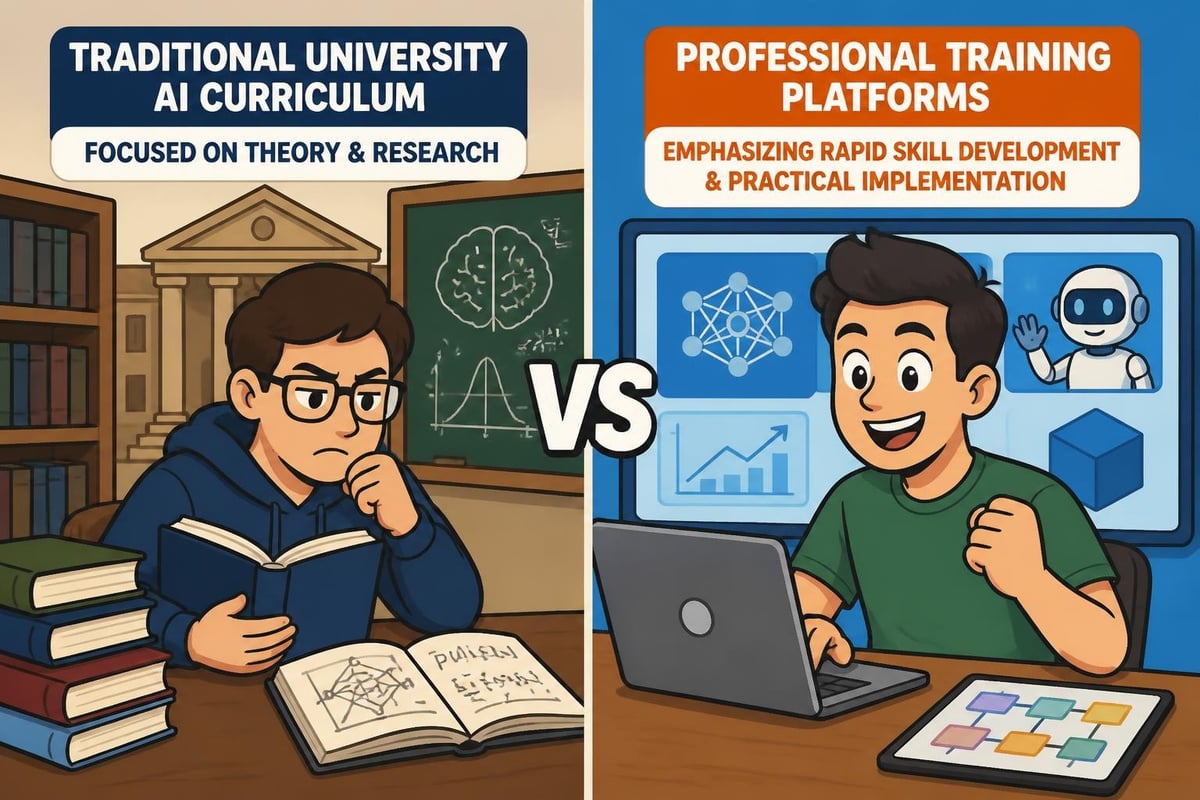
Universities have traditionally led AI curriculum development, but the 2026 landscape shows increasing divergence between academic and professional training needs. Analysis of university AI curricula through syllabus review reveals distinct patterns in learning objectives, assessment methods, and tool selection.
What Academic AI Courses Emphasize
Academic programs prioritize mathematical foundations, theoretical understanding, and research methodologies. A typical university AI course dedicates substantial time to:
- Linear algebra and calculus fundamentals
- Statistical inference and probability theory
- Algorithm analysis and computational complexity
- Research paper reading and critical evaluation
- Original research or thesis projects
This approach builds deep understanding but may not align with immediate workplace needs. Many working professionals need practical implementation skills faster than traditional academic timelines allow.
The Professional Training Alternative
Modern AI training platforms designed for professional development take different approaches. Rather than semester-long theory immersion, they focus on:
Project-based learning with real datasets and business scenarios
Modular microlearning allowing 15-30 minute focused sessions
Latest tool integration including current frameworks and platforms
Measurable skill verification through hands-on assessments
For organizations seeking rapid team upskilling, these differences matter significantly. When comparing best AI courses, consider whether academic credentials or immediate application capability better serves your goals.
Navigating Coursera's Certification Options
An ai course coursera typically offers multiple credential pathways, each with different costs and recognition levels. Understanding these distinctions helps learners choose appropriate programs.
Certificate Types and Their Value
| Certificate Type | Cost Range | Time Investment | Industry Recognition |
|---|---|---|---|
| Course Certificate | $49-79 | 4-8 weeks | Low to moderate |
| Specialization | $199-499 | 3-6 months | Moderate |
| Professional Certificate | $399-799 | 6-12 months | High (with brand names) |
| MasterTrack Certificate | $2,000-6,000 | 4-7 months | High (university credit) |
The value proposition varies considerably. Brand recognition matters-certificates from Stanford, DeepLearning.AI, or Google carry more weight than lesser-known institutions. However, employers increasingly focus on demonstrated skills rather than credential collections.
Subscription Model Considerations
Coursera Plus ($399/year) provides unlimited access to 7,000+ courses, making it cost-effective for learners planning multiple programs. However, many specialized AI courses require separate professional certificate purchases beyond the subscription.
Financial planning tips:
- Calculate total certification costs before starting
- Check if your employer offers Coursera for Business access
- Consider financial aid options for individual courses
- Evaluate whether completion likelihood justifies upfront investment
Organizations evaluating enterprise training should compare Coursera for Business against platforms offering unlimited access models with corporate analytics. Modern AI training platforms often provide more transparent pricing and better measurement tools.
Addressing AI Ethics and Policy Integration
As generative AI reshapes professional work, educational programs must address ethical considerations and governance frameworks. Research analyzing generative AI policies in computing course syllabi shows institutions struggling to integrate these concerns systematically.
How Coursera Addresses AI Ethics
Many ai course coursera offerings now include ethics modules, though depth and integration vary significantly. Some programs treat ethics as standalone lectures, while others weave responsible AI principles throughout technical instruction.
Common ethical topics covered:
- Algorithmic bias detection and mitigation
- Privacy preservation in machine learning
- Transparency and explainability requirements
- Environmental impact of large model training
- Societal implications of automation
However, critics argue that 60-90 minute ethics modules insufficient for professionals deploying AI in sensitive domains. Healthcare, finance, and legal applications require deeper ethical training than most general AI courses provide.
Professionals working in regulated industries should supplement general AI training with specialized AI ethics course content focused on their sector's specific compliance requirements.
Competency Frameworks for AI-Augmented Work
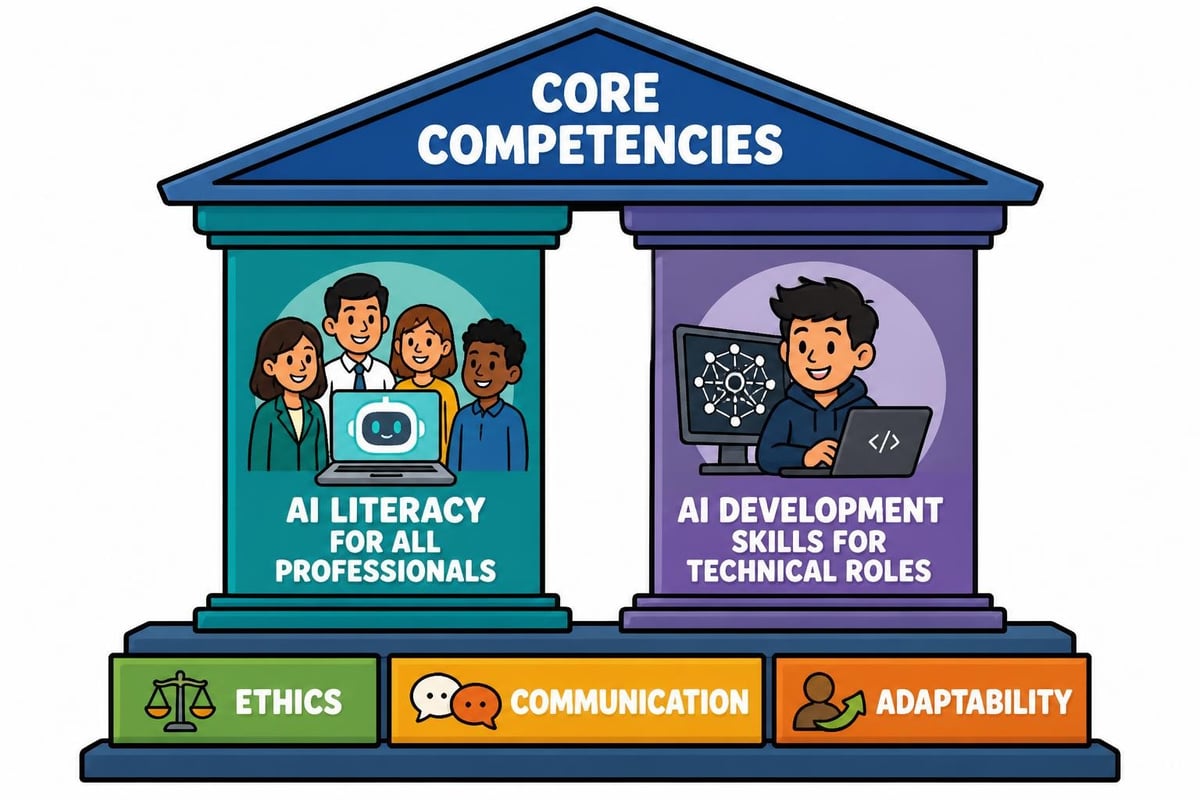
Understanding what skills actually matter in 2026's AI-integrated workplaces helps evaluate whether an ai course coursera delivers relevant preparation. Recent research on software engineering competencies in the age of AI proposes two new core competencies beyond traditional technical skills.
AI Literacy as Foundational Knowledge
AI literacy encompasses understanding how AI systems work, their capabilities and limitations, and when AI solutions are appropriate. This doesn't require deep technical expertise but demands conceptual clarity about:
- Differences between machine learning approaches (supervised, unsupervised, reinforcement)
- How training data quality affects model performance
- What "black box" models mean for decision accountability
- How to evaluate AI vendor claims critically
Non-technical professionals benefit enormously from AI literacy training, even without coding skills. Coursera's "AI for Everyone" addresses this need, though completion alone doesn't guarantee practical application ability.
AI Development Skills for Technical Roles
Engineers and data professionals need hands-on development competencies, including:
- Data pipeline engineering for model training and deployment
- Model selection and tuning for specific business problems
- Integration patterns connecting AI services with existing systems
- Performance monitoring and model drift detection
- Security considerations for AI applications
Traditional programming skills remain essential, but AI development introduces new complexity layers. Professionals must understand not just coding but also data governance, versioning, and continuous learning systems.
Comparing Coursera with Modern Learning Platforms
The ai course coursera model represents one approach to professional development, but 2026's landscape offers diverse alternatives optimized for different learning styles and organizational needs.
Traditional MOOC Limitations
Massive Open Online Courses pioneered accessible education but face persistent challenges:
Low completion rates averaging 5-15% for self-enrolled learners
Slow content updates due to academic partnership processes
Limited personalization with one-size-fits-all learning paths
Minimal corporate analytics for measuring team progress
These limitations don't negate Coursera's value but highlight where purpose-built professional training platforms excel. Organizations needing rapid deployment, custom learning paths, and detailed progress tracking often find traditional MOOCs insufficient.
The Case for Specialized AI Training Platforms
Platforms designed specifically for professional AI education offer distinct advantages:
- Curriculum agility with monthly updates reflecting latest tools and techniques
- Interactive labs using cloud-based environments with real tools
- Skill assessments measuring practical competency, not just video completion
- Corporate dashboards tracking team progress, skill gaps, and ROI
- Bootcamp options for intensive, cohort-based learning with instructor support
When exploring best AI ML courses online, consider how different platform models align with your learning objectives, timeline constraints, and budget parameters.
Preparation for AI-Integrated Workplaces
Academic research on preparing students for AI-integrated workplaces emphasizes that technical training alone doesn't ensure workplace success. Professionals need broader capabilities for thriving in AI-augmented environments.
Beyond Technical Skills
Effective AI professionals in 2026 demonstrate:
Collaborative intelligence - Working alongside AI systems rather than competing or defaulting to them
Continuous learning orientation - Adapting as AI capabilities evolve monthly
Critical evaluation skills - Questioning AI outputs and understanding failure modes
Interdisciplinary thinking - Connecting AI capabilities to domain-specific problems
An ai course coursera may teach PyTorch syntax, but workplace success requires understanding when neural networks solve real business problems and when simpler approaches suffice.
Industry-Specific Application
Generic AI training provides foundations, but professionals need domain contextualization. A marketing analyst applying AI for customer segmentation needs different knowledge than a healthcare researcher using AI for drug discovery.
Industry-specific considerations include:
- Regulatory compliance requirements (healthcare, finance, legal)
- Domain data characteristics and availability
- Ethical implications unique to the sector
- Integration with existing workflows and legacy systems
- Stakeholder communication and change management
Supplementing general AI courses with industry-focused training accelerates practical application. Exploring artificial intelligence class options tailored to specific sectors can bridge this gap effectively.
Making Strategic Training Decisions for 2026
Choosing the right AI education pathway requires balancing multiple factors: learning objectives, time constraints, budget, current skill levels, and career goals.
Decision Framework for Individual Learners
If you need academic credentials for career transitions: Traditional university partnerships through Coursera provide recognized certificates
If you need rapid skill acquisition for current role: Specialized platforms with hands-on labs accelerate practical competency
If you're exploring AI fundamentals: Introductory courses like "AI for Everyone" provide accessible entry points
If you're advancing existing AI skills: Advanced specializations or AI specialization courses offer depth in specific domains
Decision Framework for Organizations
Corporate training leaders face different considerations:
| Criterion | MOOC Platforms (Coursera) | Specialized AI Platforms |
|---|---|---|
| Content breadth | Excellent (7,000+ courses) | Good (focused on tech/AI) |
| Update frequency | Moderate (quarterly/yearly) | High (monthly updates) |
| Learner analytics | Basic to moderate | Advanced with dashboards |
| Custom learning paths | Limited | Extensive |
| Instructor support | Minimal (forum-based) | Available (bootcamps) |
| Cost structure | Per-user licensing | Tiered or unlimited access |
Organizations prioritizing comprehensive analytics, rapid upskilling, and measurable outcomes often find dedicated AI training platforms deliver better ROI than general MOOC subscriptions.
Integration with Broader Technology Education
AI skills rarely exist in isolation. Professionals benefit from understanding how AI connects with cloud computing, data engineering, software development, and cybersecurity.
Complementary Skill Development
Building effective AI capabilities requires foundational knowledge in:
- Cloud platforms for training and deploying models at scale
- Data engineering for building robust pipelines feeding AI systems
- DevOps practices for continuous integration and deployment
- Security principles protecting AI systems and training data
Learners focusing exclusively on AI algorithms without understanding deployment infrastructure face practical limitations. Comprehensive training programs address these interdependencies rather than treating AI as isolated coursework.
For professionals managing AI infrastructure, understanding GPU for AI training becomes essential technical knowledge alongside algorithm selection.
Vendor-Specific Certifications Versus Platform-Agnostic Learning
Another strategic consideration involves choosing between vendor-specific AI training and platform-agnostic education. An ai course coursera might teach TensorFlow specifically, while alternative approaches emphasize transferable concepts applicable across frameworks.
The Vendor Certification Path
Major technology companies offer AI certifications for their platforms:
- Microsoft Azure AI Engineer
- Google Cloud Professional Machine Learning Engineer
- AWS Certified Machine Learning Specialty
These credentials demonstrate platform-specific expertise valuable for organizations standardized on particular cloud providers. However, they may become obsolete as platforms evolve or if you change employers using different technology stacks.
Platform-Agnostic Skill Development
Alternative approaches teach fundamental concepts applicable regardless of specific tools:
- Machine learning theory transferable across scikit-learn, TensorFlow, PyTorch
- Data preparation principles independent of specific pipeline tools
- Model evaluation methodologies applicable to any framework
- Deployment architecture patterns that work across cloud providers
This broader approach provides more career flexibility but may require additional time learning specific tool syntax when joining new organizations.
Looking Ahead: AI Education Evolution
The AI education landscape continues evolving rapidly. Understanding emerging trends helps professionals make forward-looking training investments rather than learning soon-to-be-obsolete skills.
Emerging Educational Approaches
Several trends are reshaping how professionals learn AI:
AI-powered personalization - Learning platforms using AI to customize content delivery, pacing, and practice problems based on individual progress patterns
Microlearning modules - 10-15 minute focused sessions replacing hour-long lectures for better knowledge retention
Simulation environments - Virtual labs allowing risk-free experimentation with AI tools and datasets
Collaborative learning - Cohort-based programs with peer interaction and group projects
These innovations address traditional MOOC limitations, particularly low engagement and completion rates. Platforms incorporating these features demonstrate higher learner satisfaction and better skill transfer to workplace applications.
The Role of Continuous Learning
Given AI's rapid advancement, one-time training becomes insufficient. Professionals need ongoing learning systems that:
- Deliver monthly updates on new tools and techniques
- Provide just-in-time learning when adopting new AI capabilities
- Support experimentation with emerging approaches
- Build communities for knowledge sharing and problem-solving
Organizations should evaluate whether their training partners support continuous learning models or require repeatedly purchasing new courses as technology evolves.
Making Your AI Learning Investment Count
Whether choosing an ai course coursera or exploring alternatives, maximizing training ROI requires strategic planning and active engagement.
Before Starting Training
Clarify specific learning objectives - "Learn AI" is too vague; "Build customer churn prediction models using Python" provides clear direction
Assess prerequisite knowledge gaps - Starting advanced courses without foundations wastes time and money
Secure dedicated learning time - Block calendar time rather than hoping to "find" hours
Identify application opportunities - Plan how you'll apply new skills to real projects
During Training
Take handwritten notes even with downloadable materials - Active engagement improves retention
Complete all practice exercises without skipping to solutions - Struggle builds competency
Connect concepts to work scenarios - Mental links between theory and practice accelerate application
Join community discussions - Peer learning often clarifies confusing concepts
After Completing Courses
Apply skills within two weeks - Knowledge decays rapidly without practical use
Document projects in portfolios - Concrete examples demonstrate competency to employers
Teach others - Explaining concepts reinforces understanding and reveals gaps
Plan next learning steps - Continuous development maintains momentum
These practices transform passive course consumption into active skill development, regardless of which platform or program you choose.
Navigating AI education options in 2026 requires understanding how traditional academic platforms, specialized training providers, and emerging learning models serve different professional needs. While an ai course coursera offers recognized credentials and structured academic content, modern alternatives provide faster upskilling, better corporate analytics, and more agile curriculum updates. MammothClub delivers exactly this modern approach-3,000+ on-demand tech and AI courses, interactive bootcamps, and AI-powered learning dashboards that help professionals and organizations build measurable AI competency fast. Whether you're an individual seeking career advancement or a business leader building team capabilities, choosing the right learning platform accelerates your competitive advantage in the AI era.