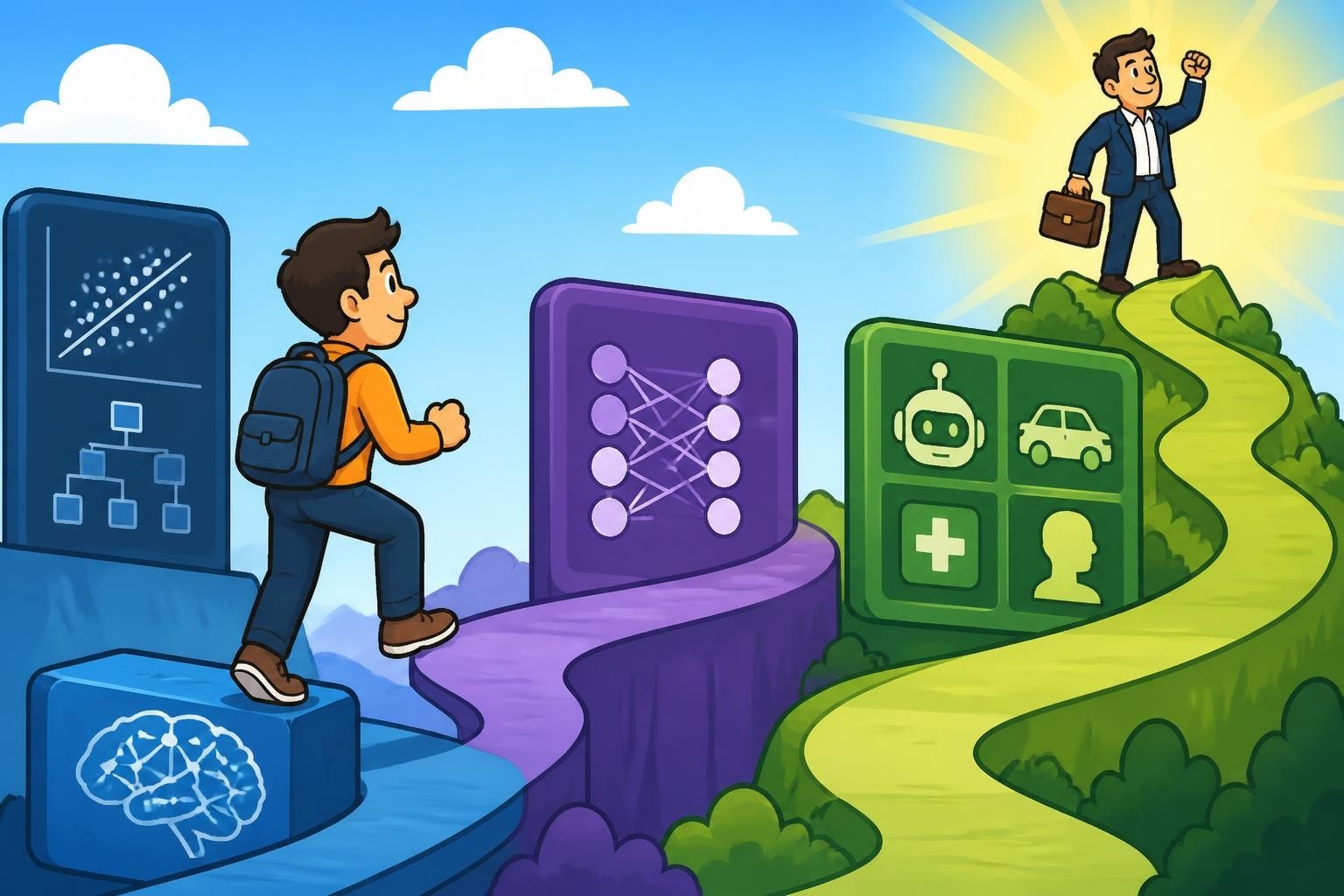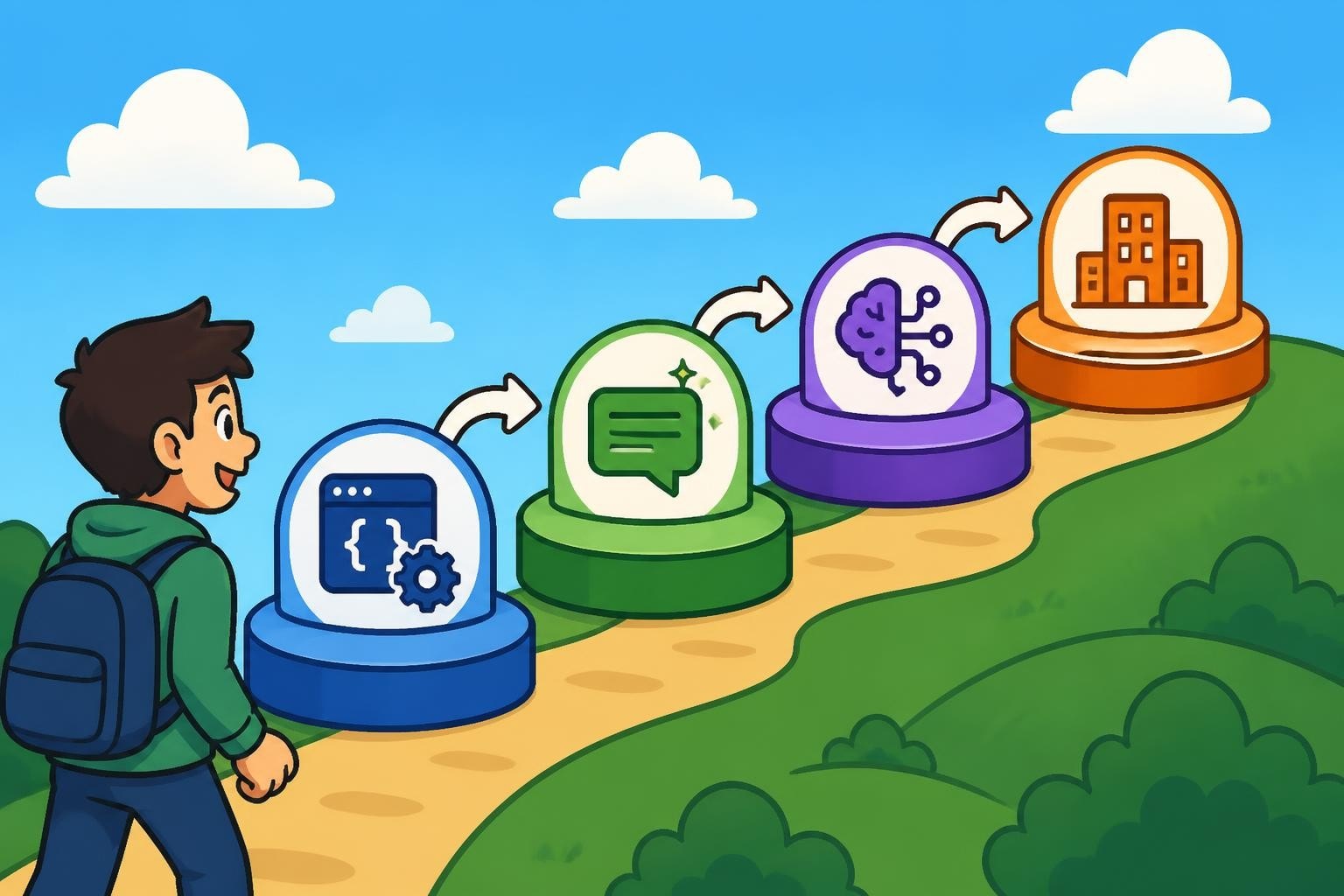
Machine learning has become the cornerstone skill for technology professionals in 2026, driving everything from personalized recommendations to autonomous systems. Google's free machine learning course, officially known as the Machine Learning Crash Course, has trained over two million students since its launch, establishing itself as one of the most accessible entry points into this transformative field. This comprehensive program combines theoretical foundations with hands-on TensorFlow exercises, interactive visualizations, and real-world case studies that mirror the challenges data scientists face daily. Whether you're a software engineer expanding your skillset or a business analyst seeking to understand ML capabilities, understanding what this google machine learning course offers and how it fits into your broader learning strategy is essential for career advancement in the AI era.
What Makes the Google Machine Learning Course Unique
The Official Google Machine Learning Crash Course distinguishes itself through its engineering-first approach rather than pure academic theory. Developed by Google engineers who build production ML systems, the curriculum emphasizes practical skills that translate directly to workplace applications.
Core Curriculum Structure
The google machine learning course follows a carefully scaffolded progression that builds from fundamental concepts to advanced techniques:
- Framing: Defining ML problems and understanding when to apply machine learning versus traditional programming
- Descending into ML: Linear regression foundations, loss functions, and gradient descent optimization
- Reducing Loss: Iterative learning processes, learning rates, and convergence strategies
- First Steps with TensorFlow: Hands-on coding with Google's flagship ML framework
- Generalization: Preventing overfitting through validation sets, regularization, and cross-validation
- Training and Test Sets: Data splitting strategies and evaluation methodologies
- Representation: Feature engineering, categorical encoding, and feature crosses
- Feature Crosses: Creating synthetic features to capture nonlinear relationships
- Regularization: L1, L2 regularization techniques and their practical applications
- Classification: Logistic regression, ROC curves, and evaluation metrics
- Neural Networks: Introduction to deep learning architectures and activation functions
- Training Neural Networks: Backpropagation, batch normalization, and dropout strategies
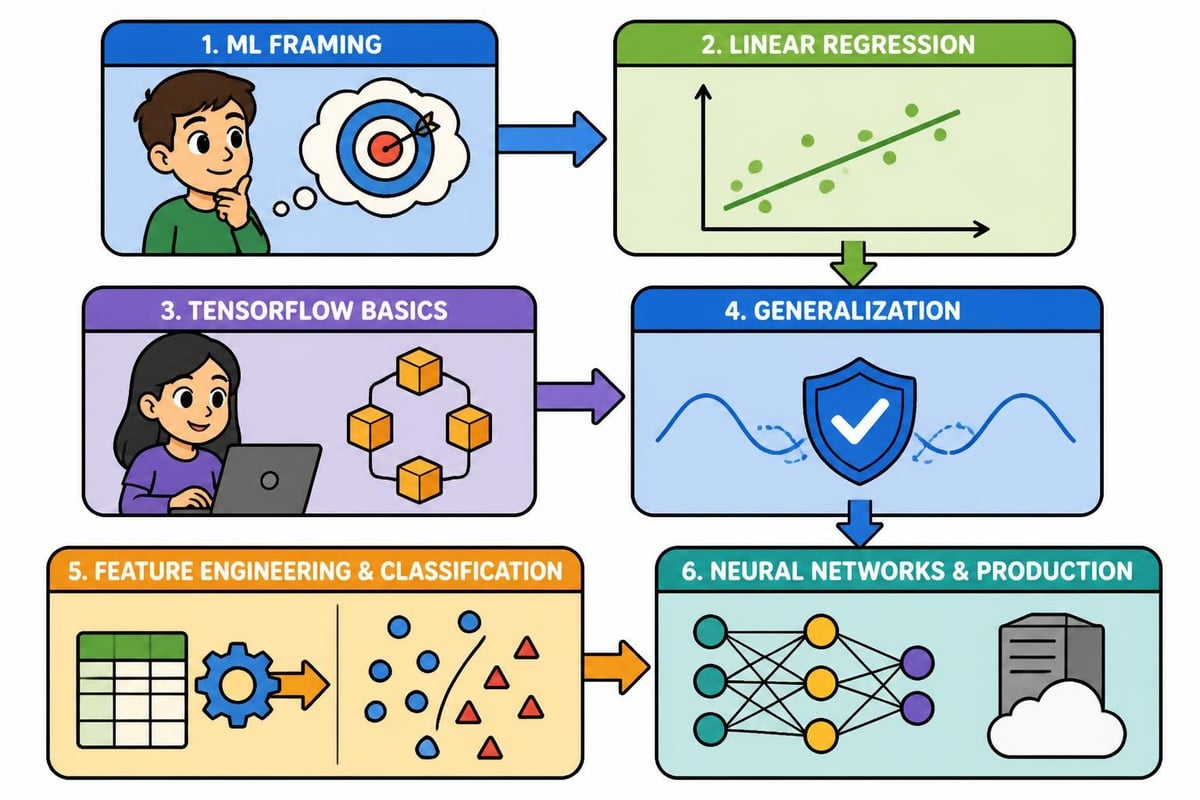
Each module combines video lectures, interactive visualizations, and programming exercises that require approximately 15 hours to complete. Research published in Education & Information Technologies demonstrates that hands-on ML exercises significantly improve knowledge retention compared to lecture-only formats, validating Google's pedagogical approach.
Prerequisites and Technical Requirements
Unlike many introductory courses, the google machine learning course requires genuine technical preparation:
| Prerequisite | Required Level | Purpose |
|---|---|---|
| Python Programming | Intermediate (functions, lists, dictionaries, NumPy, pandas) | Writing and debugging ML code |
| Linear Algebra | Basic (vectors, matrices, multiplication) | Understanding model mathematics |
| Calculus | Basic (derivatives, gradients) | Comprehending optimization algorithms |
| Statistics | Intermediate (mean, median, variance, distributions) | Evaluating model performance |
This technical baseline ensures students can focus on ML concepts rather than struggling with syntax. For professionals needing Python foundations first, courses like those in MammothClub's Python development curriculum provide the necessary groundwork.
Hands-On Projects and Practical Applications
The google machine learning course emphasizes learning by doing through integrated coding exercises and real datasets. Students work with TensorFlow directly in Google Colaboratory notebooks, eliminating local installation complexity while providing cloud-based GPU access for neural network training.
Programming Exercises Breakdown
Real Estate Price Prediction: Students build linear regression models to predict California housing prices using latitude, longitude, population density, and median income. This exercise teaches feature scaling, learning rate selection, and loss function interpretation.
Binary Classification Tasks: Logistic regression exercises use medical datasets to predict disease presence, introducing precision-recall tradeoffs and threshold selection strategies that mirror healthcare ML applications.
Neural Network Image Classification: Using the MNIST handwritten digit dataset, students construct multi-layer perceptrons, experiment with hidden layer architectures, and observe how depth affects model performance.
Beyond these structured exercises, the course encourages experimentation through interactive visualizations. The TensorFlow Playground allows students to manipulate network architectures, activation functions, and datasets while observing real-time training dynamics. This visual feedback accelerates intuition development about how hyperparameters influence learning.
Recent research on evaluating LLMs in machine learning programming education shows that modern AI coding assistants can provide personalized feedback on ML exercises, complementing traditional autograders. Students working through the google machine learning course in 2026 increasingly use tools like GitHub Copilot and Claude to debug TensorFlow code and understand error messages, though the core conceptual learning still requires human effort.
Comparing Google's Course to Alternative Learning Paths
The landscape of machine learning education has expanded dramatically, with options ranging from university degrees to bootcamps to self-paced online courses. Understanding where the google machine learning course fits helps learners make informed decisions about their educational investments.
Free vs. Paid ML Programs
| Feature | Google ML Crash Course | Paid Bootcamps | University Programs |
|---|---|---|---|
| Cost | Free | $8,000-$20,000 | $30,000-$150,000 |
| Duration | 15 hours (self-paced) | 12-24 weeks | 2-4 years |
| Certification | None (completion badge) | Professional certificate | Academic degree |
| Job Placement Support | None | Often included | Career services |
| Depth of Coverage | Fundamentals | Fundamentals to intermediate | Fundamentals to advanced research |
| Instructor Access | None (self-paced) | Live instruction + mentorship | Professors + teaching assistants |
The google machine learning course excels as a foundation builder and skill validator. It allows professionals to determine whether ML genuinely interests them before committing to expensive programs. Many students complete Google's course, then pursue AI courses on Coursera for specialization or Andrew Ng's AI programs for deeper theoretical grounding.
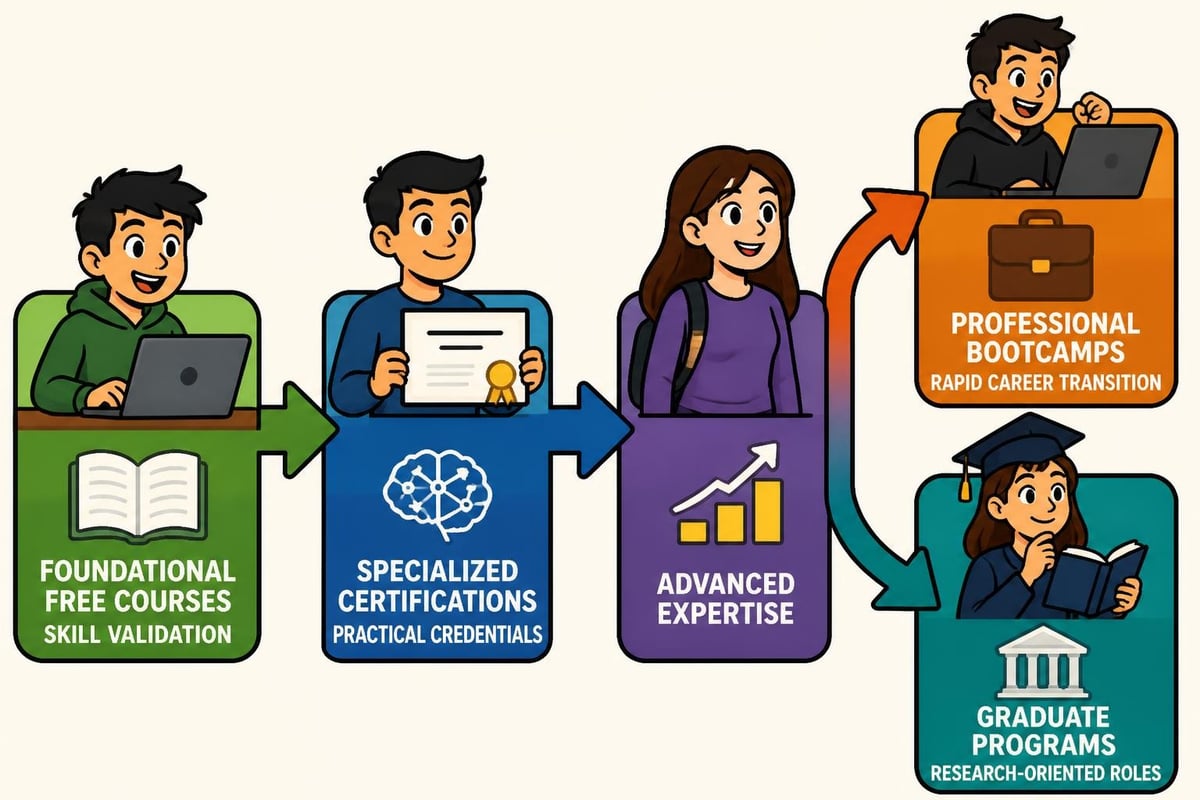
For organizations evaluating training options, the zero-cost structure of the google machine learning course makes it ideal for initial team upskilling. Companies can have entire engineering departments complete the course to establish common ML vocabulary before investing in specialized training. However, businesses requiring comprehensive certification programs with progress tracking often supplement free resources with platforms offering structured learning paths and administrative dashboards.
Integration with Google Cloud Certifications
While the google machine learning course itself doesn't offer formal certification, it serves as foundational preparation for Google Cloud's Professional Machine Learning Engineer certification. This professional credential validates ability to design, build, and productionize ML models using Google Cloud technologies.
The certification exam covers:
- Architecting low-code ML solutions using BigQuery ML and AutoML
- Building custom training pipelines with Vertex AI
- Deploying and monitoring production ML systems
- Implementing ML workflow orchestration and MLOps practices
- Scaling training workloads across distributed infrastructure
Students who complete the google machine learning course gain conceptual foundations but need additional cloud-specific training from Google Cloud's training hub for Machine Learning & AI to master platform tools. This combination of free foundational learning plus targeted cloud training creates a cost-effective certification pathway.
Advanced Topics and Extension Opportunities
The google machine learning course intentionally covers fundamentals rather than cutting-edge techniques. Students completing the program often ask about next steps for deepening expertise in specialized domains.
Beyond the Basics: Specialization Paths
Computer Vision: After mastering neural network fundamentals, students interested in image processing should explore convolutional neural networks (CNNs), transfer learning with pretrained models, and object detection architectures. Courses focused on robotics and artificial intelligence often include substantial computer vision components.
Natural Language Processing: Text-based applications require understanding embeddings, recurrent networks, transformers, and attention mechanisms. The google machine learning course introduces basic text classification but doesn't cover modern large language models or sequence-to-sequence architectures.
Reinforcement Learning: Applications in robotics, game AI, and optimization require understanding Markov decision processes, Q-learning, and policy gradients. The google machine learning course doesn't address reinforcement learning, which represents a distinct paradigm from supervised learning.
Time Series Forecasting: Financial applications, demand prediction, and sensor data analysis need specialized techniques for temporal dependencies. Students interested in AI trading applications should pursue dedicated time series courses after completing foundational ML training.
Production ML and MLOps
The google machine learning course focuses on model development rather than deployment. Production machine learning requires additional skills:
- Model serving infrastructure and API design
- Monitoring for data drift and concept drift
- A/B testing frameworks for model comparison
- Feature stores for consistent preprocessing
- Model versioning and experiment tracking
- Continuous training pipelines
Organizations moving from experimentation to production ML benefit from comprehensive training programs that cover the entire machine learning lifecycle. While Google's course teaches the science of ML, deploying reliable systems requires engineering discipline and operational expertise typically gained through project experience or specialized MLOps training.
Learning Effectiveness and Student Outcomes
Evaluating the effectiveness of any educational program requires examining both completion rates and career outcomes. The google machine learning course presents interesting patterns in both metrics.
Completion Statistics and Learner Behavior
Self-Paced Challenges: The course's self-directed structure creates flexibility but reduces completion accountability. Industry data suggests approximately 15-25% of students who start free online courses complete all materials, though Google hasn't published official statistics for the ML Crash Course.
Time Investment Reality: While marketed as a 15-hour program, most students report spending 20-30 hours to truly master the material through multiple exercise attempts and supplementary reading. Rushing through exercises without genuine comprehension undermines learning effectiveness.
Prerequisite Gaps: Students lacking solid Python or statistics foundations frequently struggle with programming exercises, spending additional hours debugging basic syntax rather than focusing on ML concepts. This highlights the importance of honest self-assessment before beginning the course.
Career Impact Measurement
The google machine learning course alone rarely leads directly to ML engineer roles, which typically require 2-3 years of programming experience plus substantial project portfolios. However, it serves valuable career functions:
- Role Expansion: Data analysts use ML skills to build predictive models rather than just descriptive dashboards
- Cross-Functional Communication: Product managers gain technical vocabulary to collaborate effectively with ML teams
- Career Exploration: Software engineers test ML interest before committing to full career transitions
- Interview Preparation: Foundational knowledge helps candidates discuss ML concepts during technical interviews
Students seeking credentials that employers recognize often combine the free google machine learning course with paid certifications from IBM, Oracle, or NVIDIA that provide formal certificates and verified skill badges.
Supplementary Resources and Learning Strategies
Maximizing value from the google machine learning course requires strategic supplementation with additional resources and practical application opportunities.
Effective Learning Approaches
Spaced Repetition: Rather than completing the course in consecutive days, distribute learning across weeks to improve long-term retention. Review earlier modules before advancing to new topics.
Project Application: Implement learned concepts using personal datasets or Kaggle competitions. Building a housing price predictor using local real estate data reinforces techniques more effectively than completing pre-structured exercises alone.
Study Groups: Join online communities like Reddit's r/learnmachinelearning or ML Discord servers where students discuss exercises, debug code collaboratively, and share insights.
Documentation Deep Dives: Don't just use TensorFlow functions mechanically. Read official documentation to understand parameter options, implementation details, and best practices.
Complementary Learning Materials
| Resource Type | Recommended Options | Purpose |
|---|---|---|
| Mathematics Refresher | Khan Academy Linear Algebra, 3Blue1Brown Calculus | Strengthen prerequisite knowledge |
| Python Practice | LeetCode, HackerRank | Build programming fluency |
| ML Theory | Hands-On Machine Learning by Géron | Deepen conceptual understanding |
| Cloud Platforms | Google Cloud free tier, AWS SageMaker | Gain production deployment experience |
| Kaggle Competitions | Titanic, House Prices datasets | Apply skills to realistic problems |
For professionals seeking structured pathways that combine multiple learning resources, comprehensive platforms like MammothClub offer curated AI learning journeys that integrate foundational courses with advanced specializations, providing continuous skill development beyond what single courses deliver.
Corporate Training Applications
Organizations increasingly recognize machine learning literacy as essential for competitive advantage, not just for engineering teams but across business functions. The google machine learning course presents both opportunities and limitations for corporate training initiatives.
Team Upskilling Advantages
Cost Efficiency: Training 50 employees costs nothing beyond their time, making ML education accessible even for budget-constrained departments.
Common Vocabulary: When entire teams complete the same curriculum, they develop shared language for discussing model performance, feature engineering, and deployment considerations.
Capability Assessment: Managers can identify which team members demonstrate natural aptitude for ML work, informing hiring and project assignment decisions.
Foundation for Specialization: After establishing baseline knowledge through Google's course, organizations can provide targeted advanced training matching specific business needs.
Enterprise Training Limitations
The google machine learning course lacks features that enterprise learning programs typically require:
- Progress Tracking: No administrative dashboard shows which employees have completed modules
- Custom Content: Cannot modify exercises to use company-specific datasets or business scenarios
- Certification: No formal credential that appears on professional profiles or resumes
- Support: No instructor access for clarifying complex concepts or debugging code issues
Companies serious about ML capability development often use Google's free course as a preliminary filter before enrolling motivated employees in comprehensive programs that include instructor support, hands-on projects with business data, and recognized certifications. Platforms specializing in corporate AI training provide the measurement and accountability that free resources cannot.

Keeping Pace with ML Evolution
Machine learning advances rapidly, with new architectures, frameworks, and best practices emerging continuously. The google machine learning course, last substantially updated in 2019, covers timeless fundamentals but inevitably lags cutting-edge developments.
What's Missing from 2026 Perspectives
Transformer Architectures: The course predates the transformer revolution that now dominates both NLP and increasingly computer vision applications. Attention mechanisms receive no coverage.
Large Language Models: GPT, BERT, and similar foundation models represent a paradigm shift in how we approach many ML problems, yet the course focuses exclusively on training models from scratch.
AutoML and Low-Code Tools: Modern practitioners increasingly use automated machine learning platforms that handle hyperparameter tuning and architecture search. The course emphasizes manual experimentation.
Ethical AI Considerations: Topics like fairness, bias detection, and responsible AI deployment receive minimal attention compared to their prominence in 2026 ML practice. Students interested in AI ethics need supplementary coursework.
MLOps Practices: The engineering discipline of productionizing ML systems has matured significantly since the course's creation, with new tools and methodologies now considered essential.
Staying Current Beyond the Course
Students who complete the google machine learning course should recognize it as foundational rather than comprehensive. Staying relevant in ML requires continuous learning through:
- Reading research papers from conferences like NeurIPS, ICML, and CVPR
- Following ML practitioners and researchers on platforms like Twitter/X and LinkedIn
- Experimenting with new frameworks and libraries as they emerge
- Contributing to open-source ML projects for practical experience
- Attending local ML meetups and online webinars
The fundamentals taught in Google's course remain valuable, providing the conceptual framework for understanding newer techniques. Gradient descent, overfitting prevention, and evaluation metrics apply regardless of whether you're training a simple linear model or fine-tuning a billion-parameter transformer.
Practical Implementation Guidance
Understanding machine learning theory matters little without ability to apply concepts to real problems. Students completing the google machine learning course should immediately begin implementing learned techniques on actual projects.
First Project Recommendations
Beginner-Friendly Datasets: Start with well-documented datasets that have clear prediction targets:
- Housing Prices: Predict real estate values using location, size, and feature data
- Customer Churn: Classify which customers will cancel subscriptions based on usage patterns
- Sentiment Analysis: Determine whether product reviews express positive or negative opinions
- Fraud Detection: Identify suspicious transactions in financial data
Project Workflow: Follow a structured approach that mirrors professional ML development:
- Problem Definition: Clearly state the prediction task and success metrics
- Data Exploration: Analyze distributions, identify missing values, discover correlations
- Feature Engineering: Create derived features that capture domain knowledge
- Model Selection: Start simple (linear models) before trying complex architectures
- Training and Validation: Use proper train/validation/test splits to prevent overfitting
- Evaluation: Calculate metrics beyond accuracy (precision, recall, F1 score)
- Iteration: Systematically improve through hyperparameter tuning and feature refinement
- Documentation: Record decisions, results, and lessons learned
Code Portfolio Development: Publish completed projects on GitHub with clear README files explaining approach, results, and insights. Hiring managers evaluating ML candidates weigh demonstrated project work far more heavily than course completion certificates.
Students can expand their practical skills through platforms like MammothClub's hands-on ML courses that walk through complete project implementations from data collection through deployment.
Common Challenges and Solutions
Students working through the google machine learning course frequently encounter similar obstacles. Understanding these challenges in advance helps learners persist through difficulties.
Technical Hurdles
TensorFlow Syntax Complexity: The framework's abstraction layers confuse beginners. Solution: Start with high-level Keras APIs before exploring lower-level TensorFlow operations.
Debugging Model Performance: Understanding why models underperform requires systematic troubleshooting. Solution: Plot learning curves to diagnose overfitting versus underfitting, check feature distributions for data quality issues, and validate preprocessing steps.
Mathematical Intimidation: Calculus and linear algebra notation feels overwhelming. Solution: Focus initially on conceptual understanding rather than mathematical rigor. Computational tools handle the mathematics; you need to understand what operations accomplish.
Environment Setup Issues: Package version conflicts and dependency problems frustrate learners. Solution: Use Google Colaboratory notebooks which provide pre-configured environments with all necessary libraries.
Conceptual Difficulties
When to Apply ML: Distinguishing problems suited for machine learning versus traditional programming requires judgment. Rule of thumb: Use ML when you can define the desired output but cannot easily program the rules to generate it.
Feature Engineering Intuition: Creating useful features demands domain understanding and creativity. Solution: Study examples from similar problem domains, systematically test hypotheses about which features might be predictive, and use techniques like feature importance analysis to validate assumptions.
Hyperparameter Selection: Knowing which values to try for learning rates, layer sizes, and regularization strength seems arbitrary. Solution: Start with established defaults, make one change at a time, and keep systematic records of results to identify patterns.
Interpreting Metrics: Understanding what precision, recall, and AUC really mean takes practice. Solution: Work with confusion matrices and calculate metrics manually for small examples before relying on automated calculations.
Strategic Career Planning with ML Skills
Completing the google machine learning course represents one milestone in a broader career development journey. Strategic planning helps translate technical skills into professional advancement.
Role Transitions Enabled by ML Skills
Data Analyst to ML Engineer: Analysts with strong SQL and statistics backgrounds can transition to ML roles by adding programming depth and model development skills. The google machine learning course provides foundational knowledge, but expect to need 6-12 months of project work before qualifying for junior ML positions.
Software Engineer to ML Specialist: Developers with strong coding foundations but limited ML exposure can become productive ML engineers faster than analysts because they already possess software engineering discipline. Focus on learning ML-specific libraries and understanding when to apply different algorithms.
Domain Expert to ML Practitioner: Professionals with deep knowledge in fields like healthcare, finance, or marketing can become valuable applied ML specialists by combining domain expertise with technical skills. The google machine learning course plus targeted projects in your specialty area can open consulting opportunities.
Product Manager to ML-Informed Leader: PMs don't need to build models personally but benefit enormously from understanding ML capabilities and limitations. This technical literacy improves product roadmap decisions and cross-functional collaboration.
Building Complementary Skills
Machine learning expertise alone rarely suffices for career success. Complement technical skills with:
- Communication: Explain complex ML concepts to non-technical stakeholders
- Business Acumen: Connect model capabilities to revenue impact and strategic objectives
- Software Engineering: Write production-quality code, not just experimental notebooks
- Data Engineering: Understand data pipelines, storage systems, and data quality processes
- Domain Knowledge: Develop expertise in specific application areas like computer vision, NLP, or recommendation systems
The google machine learning course delivers exceptional value as a free, self-paced introduction to machine learning fundamentals, providing the conceptual foundation and TensorFlow experience that enable further specialization. While it cannot replace comprehensive training programs or substitute for hands-on project experience, it serves as an effective starting point for professionals exploring ML careers or organizations establishing baseline team knowledge. If you're ready to accelerate your machine learning journey beyond foundational courses, MammothClub offers 3,000+ curated AI and tech courses, interactive bootcamps, and corporate certification programs that transform introductory knowledge into production-ready skills through measurable, results-driven training paths designed for the demands of 2026's AI-powered workplace.