Microsoft has emerged as one of the most influential players in the artificial intelligence landscape, with its Azure AI services, Copilot suite, and research initiatives shaping how businesses deploy intelligent systems. For professionals looking to learn Microsoft AI, the journey involves mastering a comprehensive ecosystem that spans cloud infrastructure, pre-built cognitive services, responsible AI principles, and cutting-edge development tools. Whether you're a developer aiming to integrate AI into applications, a business analyst seeking to leverage data insights, or an IT professional preparing for digital transformation, understanding Microsoft's AI portfolio has become essential for career advancement in 2026.
Understanding the Microsoft AI Ecosystem
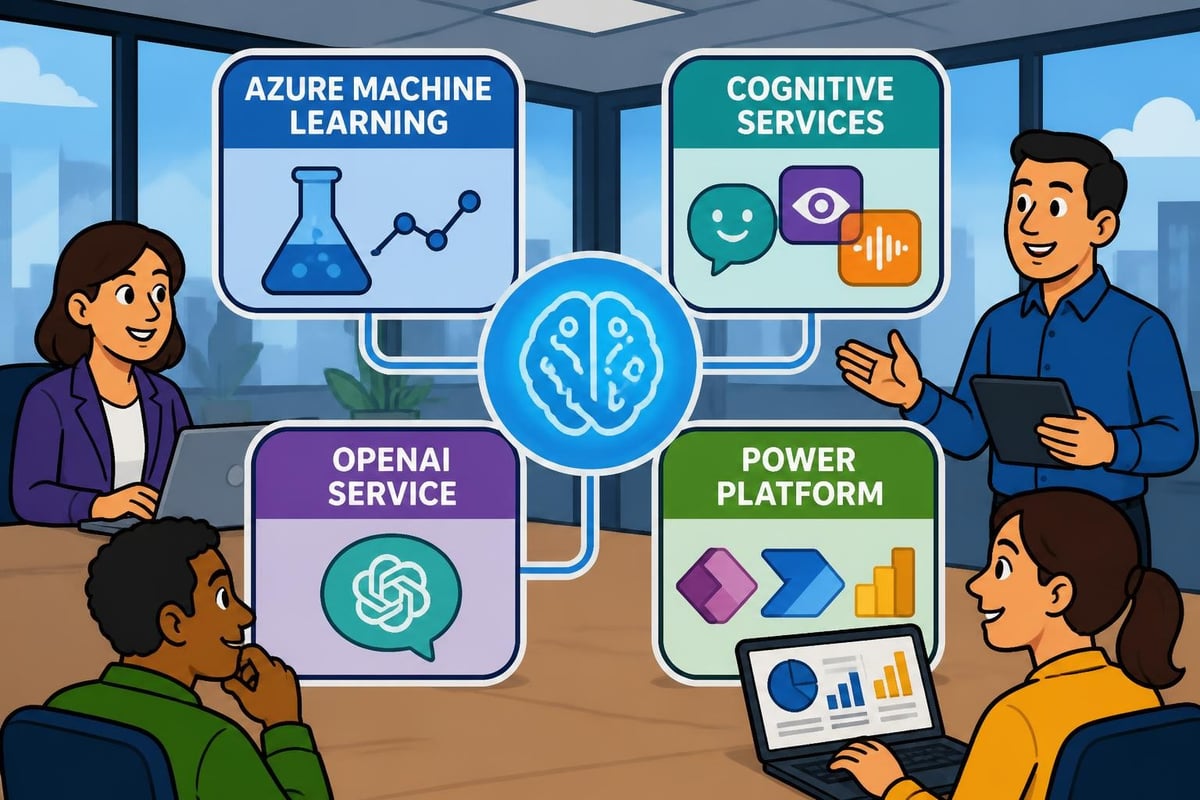
Microsoft's AI infrastructure consists of several interconnected platforms that serve different use cases and skill levels. At the foundation sits Azure AI, a comprehensive cloud platform offering machine learning, cognitive services, and AI infrastructure. This includes Azure Machine Learning for custom model development, Azure OpenAI Service for generative AI capabilities, and dozens of pre-built APIs for vision, speech, language, and decision-making tasks.
The ecosystem extends beyond Azure into productivity tools through Microsoft 365 Copilot, which embeds AI assistance directly into Word, Excel, PowerPoint, and Teams. Developers interact with GitHub Copilot, an AI pair programmer that accelerates coding workflows with intelligent suggestions and context-aware completions.
Key Components to Master
When you learn Microsoft AI, you'll encounter several core technologies that work together:
- Azure Machine Learning for building, training, and deploying custom models at scale
- Azure Cognitive Services providing pre-trained APIs for vision, speech, language, and decision intelligence
- Azure OpenAI Service enabling access to GPT-4, DALL-E, and other advanced models
- Power Platform AI Builder allowing no-code/low-code AI integration into business applications
- Microsoft Fabric unifying data and AI workflows across the organization
Understanding these components and their relationships provides the foundation for effectively learning and applying Microsoft AI technologies in real-world scenarios.
Microsoft AI Certification Pathways
Formal certifications provide structured learning paths and industry-recognized credentials that validate your Microsoft AI expertise. The certification landscape offers multiple entry points depending on your background and career objectives.
Foundational Certifications
The Microsoft Certified: Azure AI Fundamentals (AI-900) serves as the ideal starting point for anyone new to AI or Microsoft's ecosystem. This certification covers AI workload types, machine learning principles, computer vision, natural language processing, and conversational AI fundamentals. It requires no prerequisites and provides a solid conceptual foundation before diving into implementation details.
For those exploring AI basics across different platforms, MammothClub offers comprehensive AI basics courses that complement Microsoft-specific learning with broader conceptual understanding.
Advanced Technical Certifications
| Certification | Target Audience | Key Focus Areas |
|---|---|---|
| Azure AI Engineer Associate (AI-102) | Developers, AI Engineers | Building, managing, and deploying AI solutions on Azure |
| Azure Data Scientist Associate (DP-100) | Data Scientists, ML Engineers | Designing and implementing ML solutions using Azure ML |
| Azure Solutions Architect Expert (AZ-305) | Architects, Senior Engineers | Designing comprehensive Azure solutions including AI components |
These advanced certifications require hands-on experience and deeper technical knowledge. Recent research published in academic studies on certification impact demonstrates that professional certifications significantly improve employability and serve as reliable signals of practical competency.
Hands-On Learning Resources and Study Paths
Theoretical knowledge alone won't make you proficient when you learn Microsoft AI. Practical experience building and deploying solutions separates casual learners from job-ready professionals.
Official Microsoft Learning Paths
Microsoft Learn provides free, interactive training modules organized into comprehensive learning paths. These self-paced courses combine documentation, hands-on exercises in sandbox environments, and knowledge assessments. The platform tracks your progress and awards achievement badges as you complete modules.
Key learning paths include:
- AI fundamentals for non-technical stakeholders
- Machine learning operations (MLOps) for production deployment
- Responsible AI principles and implementation
- Generative AI application development with Azure OpenAI
Complementary Technical Skills
To maximize your effectiveness with Microsoft AI tools, strengthen foundational skills in adjacent areas. Understanding neural network architectures through resources like Stanford's CS231n course provides deeper insight into how AI models function. Similarly, practicing core machine learning workflows using TensorFlow tutorials helps you understand model training, evaluation, and optimization concepts that translate directly to Azure ML workflows.
MammothClub's catalog includes specialized courses covering AI-related topics that build complementary skills alongside your Microsoft-focused training.
Practical Applications: Azure AI Services in Action
Understanding how to apply Microsoft AI services to solve business problems transforms theoretical knowledge into professional value. Real-world implementation experience demonstrates competency to employers and clients.
Building with Cognitive Services
Azure Cognitive Services eliminate the need to build AI models from scratch for common tasks. The Vision APIs enable applications to analyze images, detect objects, read text from documents, and recognize faces. Speech services convert audio to text, synthesize natural-sounding speech, and provide real-time translation across dozens of languages.
A practical learning project might involve building a customer support application that:
- Uses Speech-to-Text to transcribe customer calls
- Applies Language Understanding (LUIS) to extract intent and entities
- Leverages Question Answering to provide automated responses
- Implements Translator to support multilingual customers
- Analyzes sentiment to route urgent issues to human agents
This single application integrates five different Azure Cognitive Services, providing hands-on experience with API integration, authentication, error handling, and service orchestration.
Developing with Azure OpenAI Service
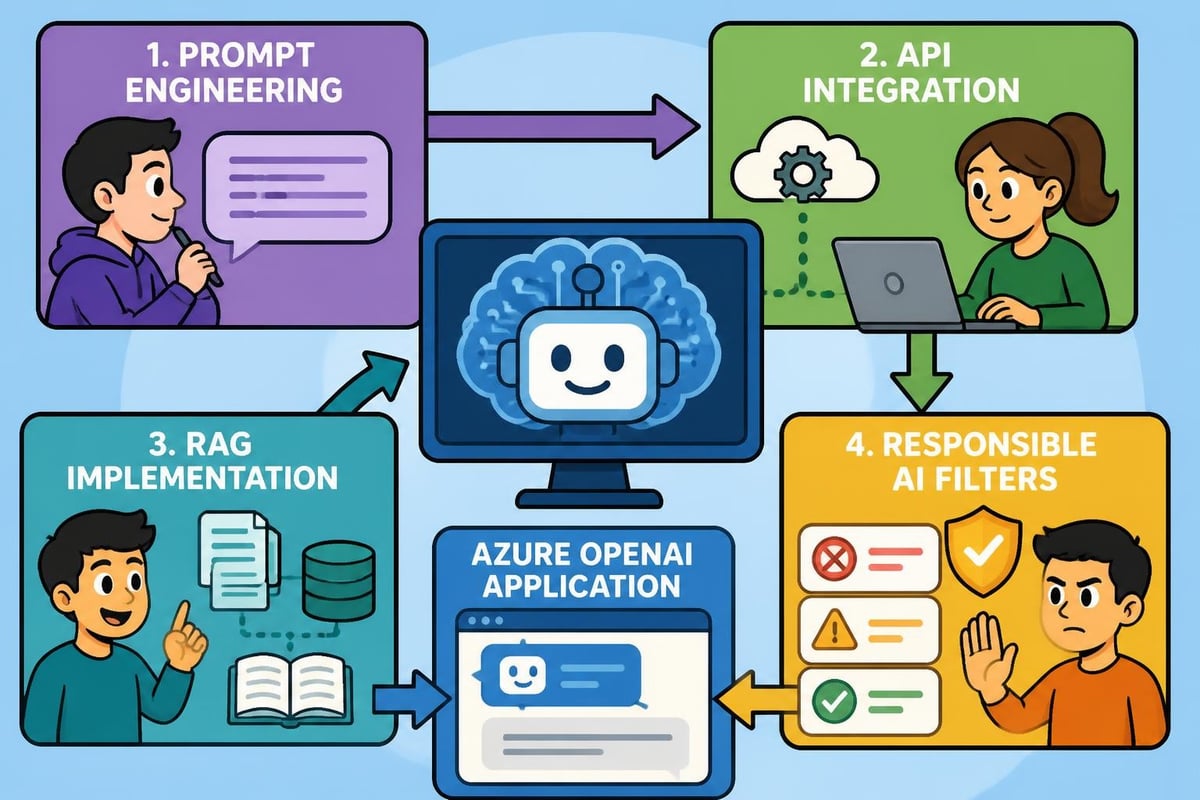
Generative AI capabilities through Azure OpenAI Service represent one of the most powerful and sought-after skills in 2026. Learning to effectively prompt large language models, manage context windows, implement retrieval-augmented generation (RAG), and handle responsible AI guardrails distinguishes advanced practitioners.
Developer Tools: GitHub Copilot and Beyond
Microsoft's acquisition of GitHub brought AI-powered development assistance into the core workflow of millions of developers. When you learn Microsoft AI, mastering these developer productivity tools becomes increasingly important.
GitHub Copilot Integration
GitHub Copilot documentation provides comprehensive guidance on integrating AI assistance into Visual Studio Code, Visual Studio, and other IDEs. Copilot suggests code completions based on context, generates entire functions from natural language comments, and helps developers work in unfamiliar languages or frameworks.
Effective Copilot usage requires understanding:
- How to write descriptive comments that guide better suggestions
- When to accept, modify, or reject AI-generated code
- Security implications of AI-assisted development
- Code review practices for AI-generated content
AI-Assisted Development Workflows
Modern development increasingly incorporates AI at multiple stages. Beyond code completion, tools help with documentation generation, test creation, code refactoring, and bug detection. Learning to orchestrate these tools effectively multiplies developer productivity.
For those building AI-powered automation workflows, exploring AI automation platforms provides practical experience connecting AI services into broader business processes.
Responsible AI and Ethical Implementation
Technical proficiency must be balanced with ethical understanding when you learn Microsoft AI. Microsoft has established comprehensive responsible AI principles that guide how its services are designed and how customers should implement them.
Core Responsible AI Principles
Microsoft's Responsible AI Principles and Approach outlines six foundational principles:
- Fairness: AI systems should treat all people fairly and avoid perpetuating bias
- Reliability and Safety: AI systems should operate reliably and safely under expected conditions
- Privacy and Security: AI systems should be secure and respect privacy rights
- Inclusiveness: AI systems should empower everyone and engage people
- Transparency: AI systems should be understandable to users
- Accountability: People should be accountable for AI system design and deployment
These principles aren't abstract ideals-they translate into concrete implementation practices, evaluation frameworks, and governance processes.
Practical Implementation Strategies
Implementing responsible AI requires specific technical and organizational practices:
| Practice Area | Implementation Approach |
|---|---|
| Bias Detection | Use Fairness dashboards in Azure ML to analyze model performance across demographic groups |
| Explainability | Implement model interpretability tools to understand feature importance and prediction rationale |
| Privacy Protection | Apply differential privacy techniques and data minimization principles |
| Safety Guardrails | Configure content filters and moderation systems for generative AI outputs |
| Documentation | Maintain model cards and datasheets documenting intended use, limitations, and evaluation results |
Government frameworks like NIST's AI guidance provide additional standards and risk management approaches that complement Microsoft's principles.
For professionals focused specifically on ethical AI development, responsible AI courses offer structured training on governance, compliance, and best practices.
Building Your Learning Plan
Success when you learn Microsoft AI requires a structured approach that balances theoretical understanding, hands-on practice, and real-world application.
Skill Level Assessment
Begin by honestly evaluating your current capabilities:
- Cloud fundamentals: Do you understand basic cloud concepts, services, and architecture patterns?
- Programming proficiency: Are you comfortable with Python, C#, or other languages used in AI development?
- Data skills: Can you work with datasets, perform analysis, and understand statistical concepts?
- AI foundations: Do you grasp basic machine learning concepts like supervised learning, neural networks, and model evaluation?
Your starting point determines the optimal learning path. Complete beginners should start with AI fundamentals and cloud basics before advancing to specialized certifications.
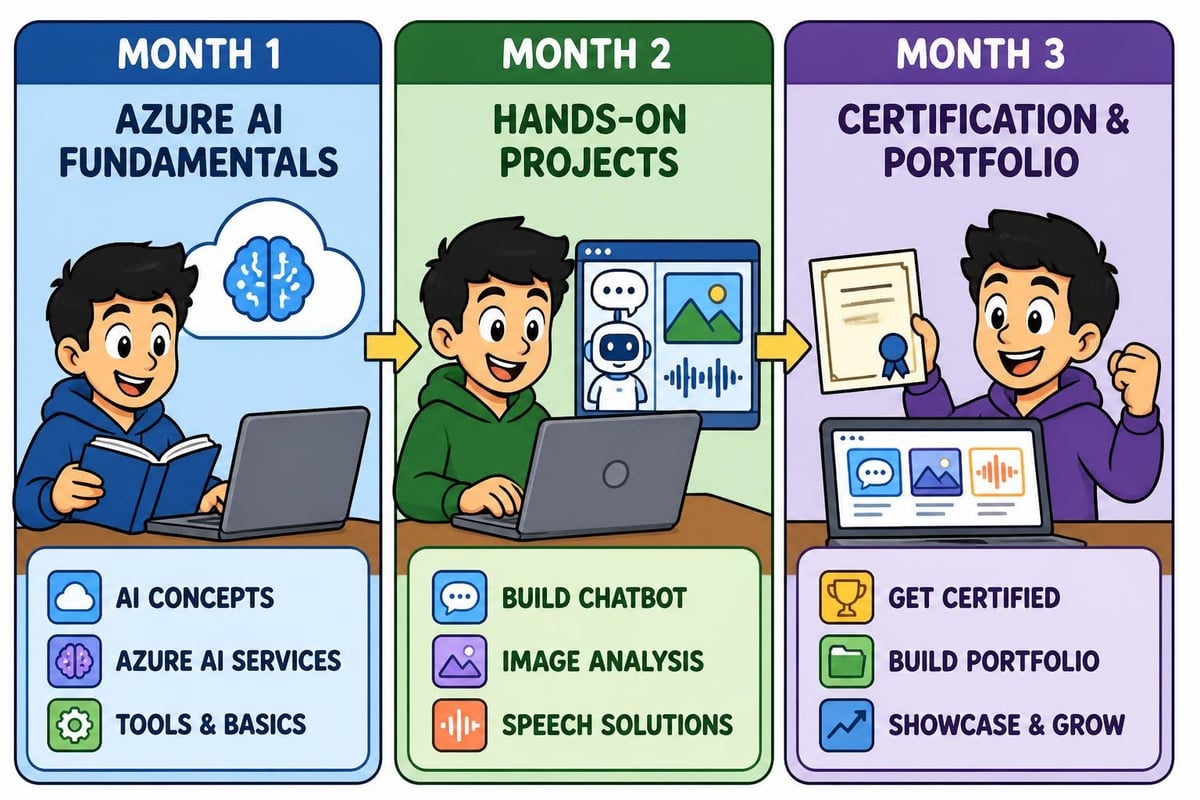
Structured 90-Day Learning Plan
A focused three-month plan might look like this:
Month 1: Foundations
- Complete Azure AI Fundamentals (AI-900) preparation materials
- Set up Azure account and explore Cognitive Services through free tier
- Build three small projects using different Cognitive Services APIs
- Study responsible AI principles and Microsoft's approach
Month 2: Specialization
- Choose focus area (AI Engineer, Data Scientist, or Solutions Architect)
- Complete relevant Microsoft Learn paths for chosen specialization
- Build one substantial project incorporating multiple Azure AI services
- Practice with sample exam questions and hands-on labs
Month 3: Certification and Portfolio
- Schedule and complete certification exam
- Develop portfolio project demonstrating end-to-end solution
- Document projects with architecture diagrams and explanations
- Contribute to open-source projects using Microsoft AI technologies
Advanced Topics and Specialization Areas
As you progress beyond fundamentals, several specialized domains offer opportunities for deeper expertise when you learn Microsoft AI.
MLOps and Production Deployment
Moving models from experimentation to production requires understanding machine learning operations (MLOps). Azure Machine Learning provides comprehensive tools for model versioning, automated training pipelines, deployment orchestration, and monitoring at scale.
Key MLOps concepts include:
- Automated model retraining based on data drift detection
- A/B testing for model deployment strategies
- Performance monitoring and alerting systems
- Governance and compliance tracking for regulated industries
Custom Model Development
While pre-built services handle many scenarios, some business requirements demand custom models. Azure Machine Learning supports the complete model development lifecycle, from data preparation through training, evaluation, and deployment.
Advanced practitioners work with:
- Distributed training across GPU clusters for large models
- AutoML for rapid experimentation and baseline establishment
- Custom training scripts using popular frameworks (TensorFlow, PyTorch, scikit-learn)
- Model optimization techniques for edge deployment
For those exploring specialized AI applications, areas like AI in drug discovery or AI in digital marketing demonstrate domain-specific applications of Microsoft AI technologies.
Industry Context and Career Impact
Understanding where Microsoft AI fits within the broader technology landscape helps you make strategic learning decisions and communicate your expertise effectively.
Microsoft's AI Research Leadership
Microsoft Research's AI work spans fundamental research, applied development, and responsible AI initiatives. Following their publications and projects provides insight into emerging technologies that will eventually reach commercial products.
Research areas particularly relevant to practitioners include transformer architectures, multimodal AI, AI for scientific discovery, and human-AI collaboration patterns.
Workforce Transformation and Opportunity
Analysis from sources like IEEE Spectrum's coverage of AI's workforce impact highlights both displacement risks and creation opportunities. Professionals who learn Microsoft AI position themselves for roles that augment rather than compete with automation.
Emerging roles include:
- AI Solution Architects designing enterprise AI strategies
- Prompt Engineers optimizing generative AI outputs
- MLOps Engineers managing production model lifecycles
- Responsible AI Specialists ensuring ethical implementation
- Citizen Developers building AI-powered applications without traditional coding
The breadth of Microsoft's ecosystem creates opportunities across technical depth and business focus dimensions.
Integration with Broader AI Knowledge
While specializing in Microsoft technologies provides clear career advantages, combining that expertise with broader AI understanding creates even stronger professional profiles.
Cross-Platform Competencies
Understanding how Microsoft AI services compare with competitors like AWS SageMaker, Google Vertex AI, or specialized platforms helps you make informed architectural decisions and communicate across organizational boundaries. Exploring resources like best AI courses from various providers develops this comparative perspective.
No-Code and Low-Code Approaches
Not every AI solution requires custom coding. Microsoft's Power Platform enables business users to incorporate AI through visual interfaces and pre-built connectors. Learning no-code AI approaches complements technical skills and enables collaboration with non-technical stakeholders.
Community and Continuous Learning
Technology evolves rapidly, making continuous learning essential when you learn Microsoft AI. Building connections with the practitioner community accelerates your growth.
Community Resources
Engage with Microsoft AI communities through:
- Microsoft Tech Community forums for Q&A and discussion
- GitHub repositories with sample code and reference architectures
- Azure AI blog for product announcements and best practices
- Local meetups and user groups focused on Azure and AI
- Conferences like Microsoft Build and Ignite for annual deep dives
Staying Current with Updates
Microsoft releases new AI capabilities and service updates continuously. Following official channels ensures you stay aware of new features:
- Azure updates RSS feed for service announcements
- What's new in Azure AI documentation pages
- Microsoft AI blog for strategic direction and case studies
- Preview features program for early access to upcoming capabilities
Setting aside dedicated time weekly for exploring new releases and experimentation maintains your competitive edge as the technology evolves.
Measuring Progress and Demonstrating Expertise
Tracking your advancement and building evidence of your capabilities ensures your learning translates to career opportunities.
Portfolio Development
Create a public portfolio showcasing projects that demonstrate:
- End-to-end solution architecture using multiple Azure AI services
- Custom model development with clear problem statements and evaluation metrics
- Responsible AI implementation including bias testing and explainability
- Integration with existing systems and data workflows
- Documentation explaining technical decisions and trade-offs
Host code on GitHub with comprehensive README files, link to deployed demos where possible, and write blog posts explaining your implementation approach.
Professional Networking
Communicate your Microsoft AI expertise through:
- LinkedIn profile highlighting certifications and project work
- Technical blog posts sharing lessons learned
- Speaking at local meetups about implementation experiences
- Answering questions in community forums to establish expertise
- Contributing to open-source projects using Microsoft AI technologies
Active community participation often leads to job opportunities, consulting engagements, and collaborative learning relationships.
Mastering Microsoft AI technologies opens pathways to high-impact roles across industries experiencing digital transformation. The combination of cloud infrastructure, cognitive services, generative AI capabilities, and responsible development frameworks positions Microsoft's ecosystem at the center of enterprise AI adoption. Whether you're pursuing formal certifications, building hands-on projects, or developing specialized expertise in areas like MLOps or responsible AI, structured learning accelerates your progress. MammothClub provides the comprehensive training platform you need, with thousands of AI and technology courses, interactive learning tools, and certification programs designed to help professionals and organizations build job-ready skills efficiently in 2026's competitive landscape.