The artificial intelligence revolution has created unprecedented demand for skilled professionals who can leverage AI tools, build machine learning models, and lead digital transformation initiatives. Organizations worldwide are investing billions in AI capabilities, yet 73% report talent shortages as their biggest implementation barrier. This gap has sparked explosive growth in AI education, with thousands of courses now available across platforms, universities, and corporate training providers. Understanding which programs deliver genuine skill development versus surface-level theory has become critical for professionals seeking to advance their careers and organizations aiming to build competitive AI capabilities.
Understanding the AI Course Landscape in 2026
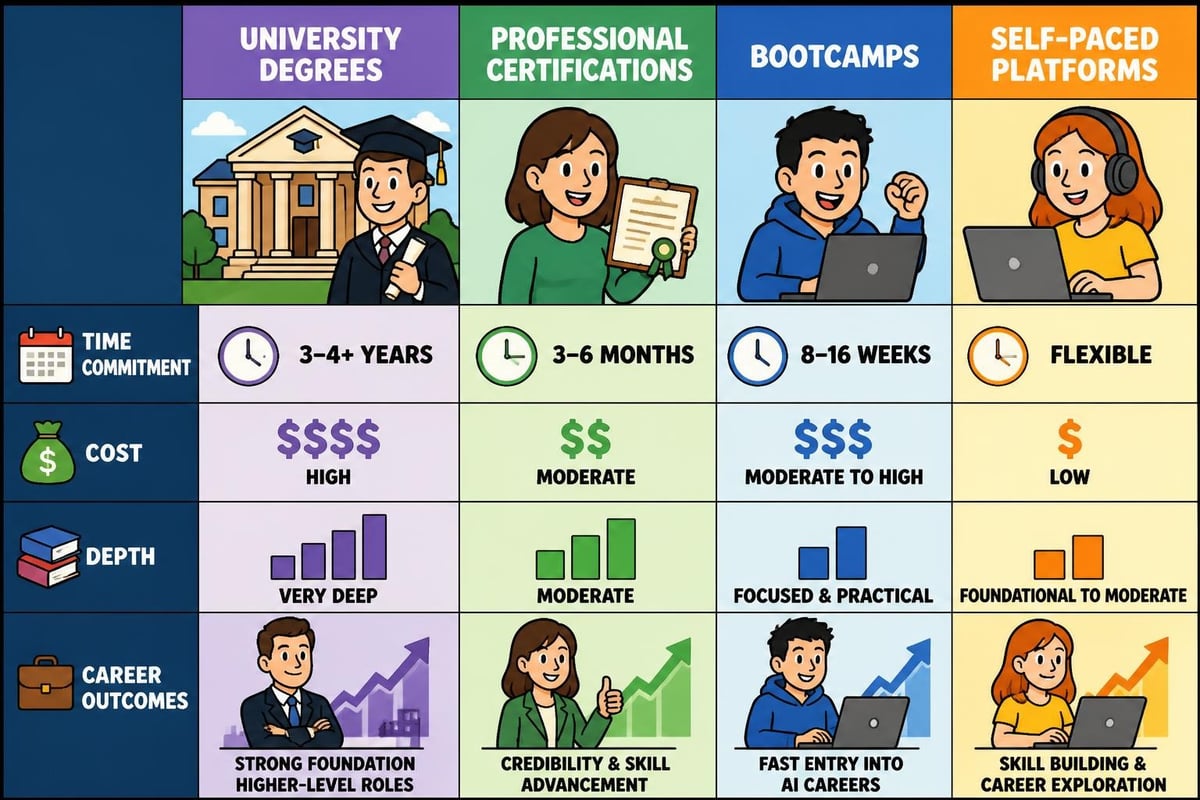
The AI education market has evolved dramatically from its early days of purely academic programs. Today's learners face choices spanning university degrees, professional certifications, bootcamps, self-paced platforms, and corporate training programs. Each format serves different needs, timelines, and career objectives.
Traditional university programs typically offer comprehensive theoretical foundations but require multi-year commitments. Professional certifications from tech giants like Google, Microsoft, and AWS focus on practical implementation within specific ecosystems. Bootcamps compress learning into intensive 8-16 week experiences with project-based curricula. Self-paced platforms provide flexibility for working professionals but demand high self-discipline.
The top AI courses in 2026 share common characteristics regardless of format:
- Hands-on projects using real datasets and business scenarios
- Current content reflecting 2026 AI capabilities and frameworks
- Industry-recognized credentials that hiring managers value
- Clear learning paths from fundamentals to advanced applications
- Community support and instructor access for problem-solving
Skill Levels and Prerequisites
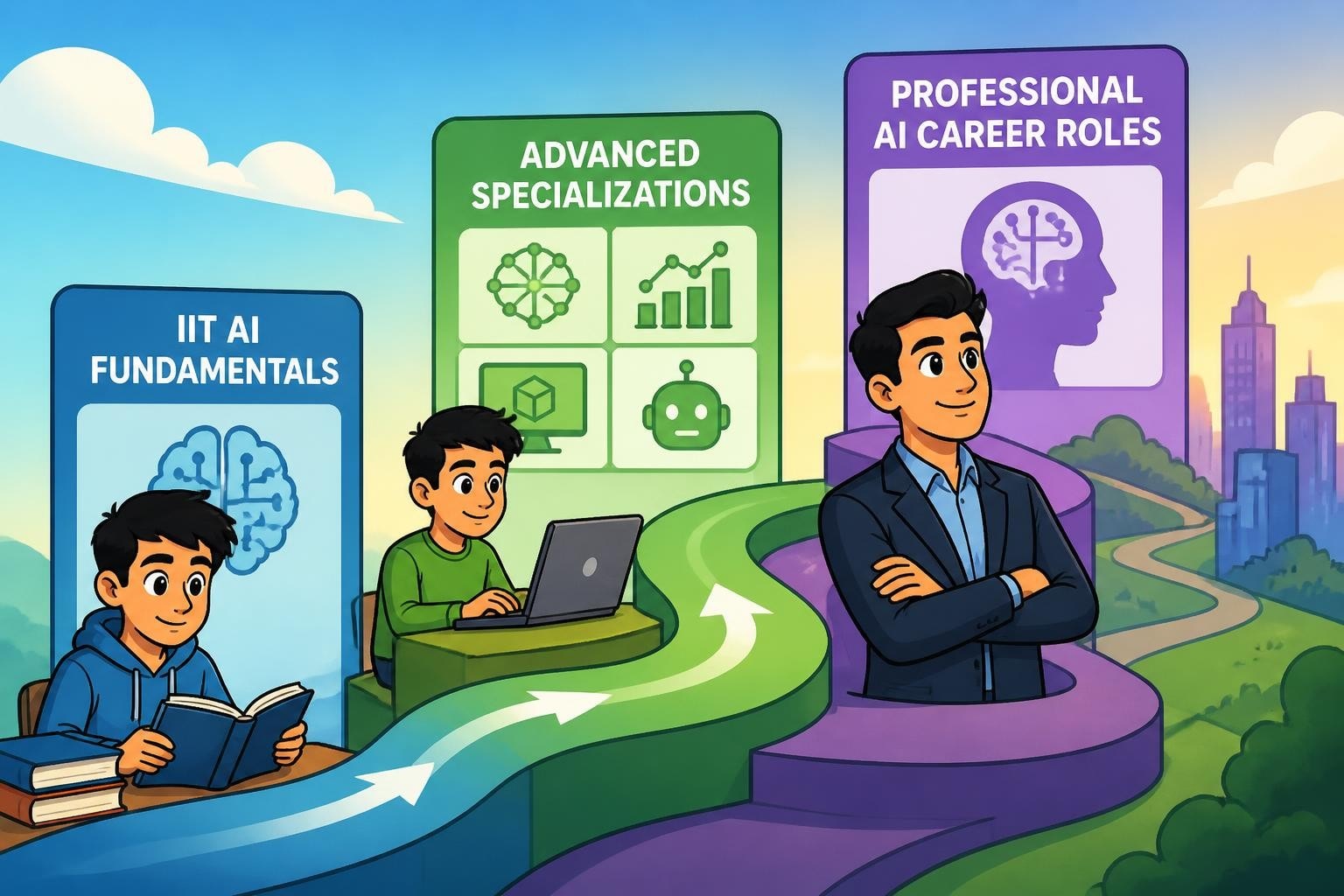
One of the most common mistakes learners make is enrolling in programs misaligned with their current capabilities. The top AI courses segment clearly into three tiers based on prerequisites and outcomes.
Foundational programs assume no technical background and focus on AI literacy, tool usage, and business applications. These courses teach professionals how to leverage ChatGPT, Claude, and industry-specific AI tools effectively. They're ideal for managers, marketers, and business analysts who need to understand AI's potential without building systems from scratch.
Intermediate programs require basic programming knowledge (typically Python) and teach machine learning fundamentals, data preprocessing, model training, and deployment. These represent the sweet spot for most professionals transitioning into AI roles.
Advanced programs target experienced developers and data scientists, covering deep learning architectures, natural language processing, computer vision, and AI research methodologies. These courses often include AI specialization paths that dive deep into specific domains.
Evaluating Course Quality and ROI
Not all AI courses deliver equivalent value. Understanding how to assess program quality prevents wasted time and money on substandard offerings.
| Evaluation Criteria | What to Look For | Red Flags |
|---|---|---|
| Curriculum Relevance | 2026 frameworks, transformer models, LLM applications | Content focused on outdated techniques from 2020-2022 |
| Instructor Credentials | Active practitioners with shipped AI products | Pure academics with no industry experience |
| Project Portfolio | 3-5 substantial projects mimicking real work | Simple tutorials with toy datasets |
| Career Support | Portfolio reviews, interview prep, job placement assistance | No mention of career outcomes or alumni success |
| Community Access | Active forums, peer collaboration, office hours | Isolated learning with no support channels |
Price alone doesn't determine quality. Some free AI courses recommended for 2025 deliver exceptional value, while expensive programs may offer little beyond brand recognition. The most effective approach evaluates cost against concrete outcomes: skills acquired, projects completed, and career advancement potential.
Independent reviews from experts who evaluate top AI courses and certifications provide valuable third-party perspectives beyond marketing materials. Look for reviews that test course content hands-on rather than simply repeating course descriptions.
Corporate Training Versus Individual Learning
Organizations face different considerations than individual learners when selecting the top AI courses. Corporate programs need scalability, progress tracking, content customization, and measurable business impact.
Scalable delivery matters when training dozens or hundreds of employees simultaneously. Platforms offering cohort-based learning, administrative dashboards, and bulk licensing provide better ROI than individual course purchases.
Skills tracking allows learning and development teams to measure competency development across departments. The best corporate AI training includes assessments, skill benchmarking, and progress analytics that tie learning to performance outcomes.
Content customization enables organizations to focus training on their specific AI use cases, data types, and technology stacks. Generic courses often waste time on irrelevant topics while missing critical internal applications.
Organizations also need to consider AI training and placement programs that connect learning to concrete career development opportunities within their company structure.
Essential Topics Covered in Top AI Courses
Curriculum comprehensiveness separates superficial AI courses from programs that build genuine capability. The top AI courses in 2026 address both technical skills and practical implementation knowledge.
Core Technical Skills
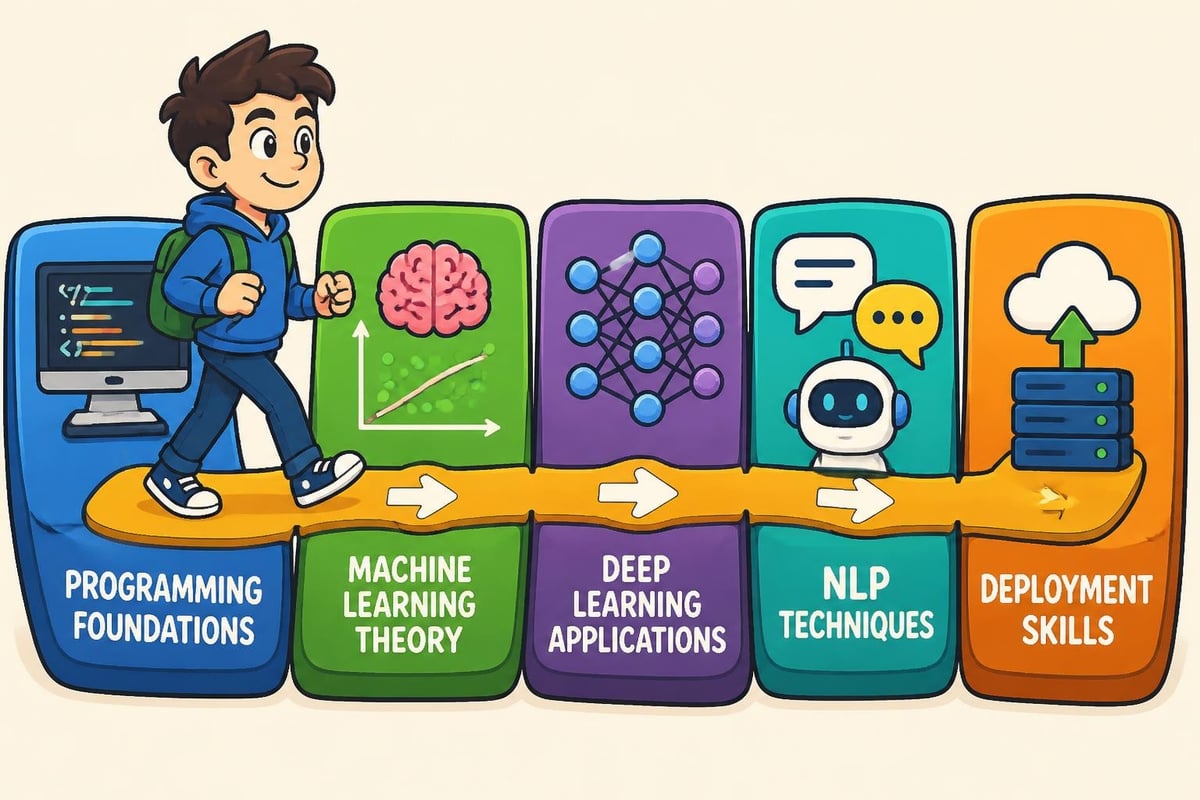
Regardless of specialization, effective AI practitioners need foundational knowledge in several areas:
- Python programming for AI development, including libraries like NumPy, Pandas, and Scikit-learn
- Machine learning fundamentals covering supervised learning, unsupervised learning, and reinforcement learning
- Deep learning architectures including neural networks, CNNs for computer vision, and RNNs for sequential data
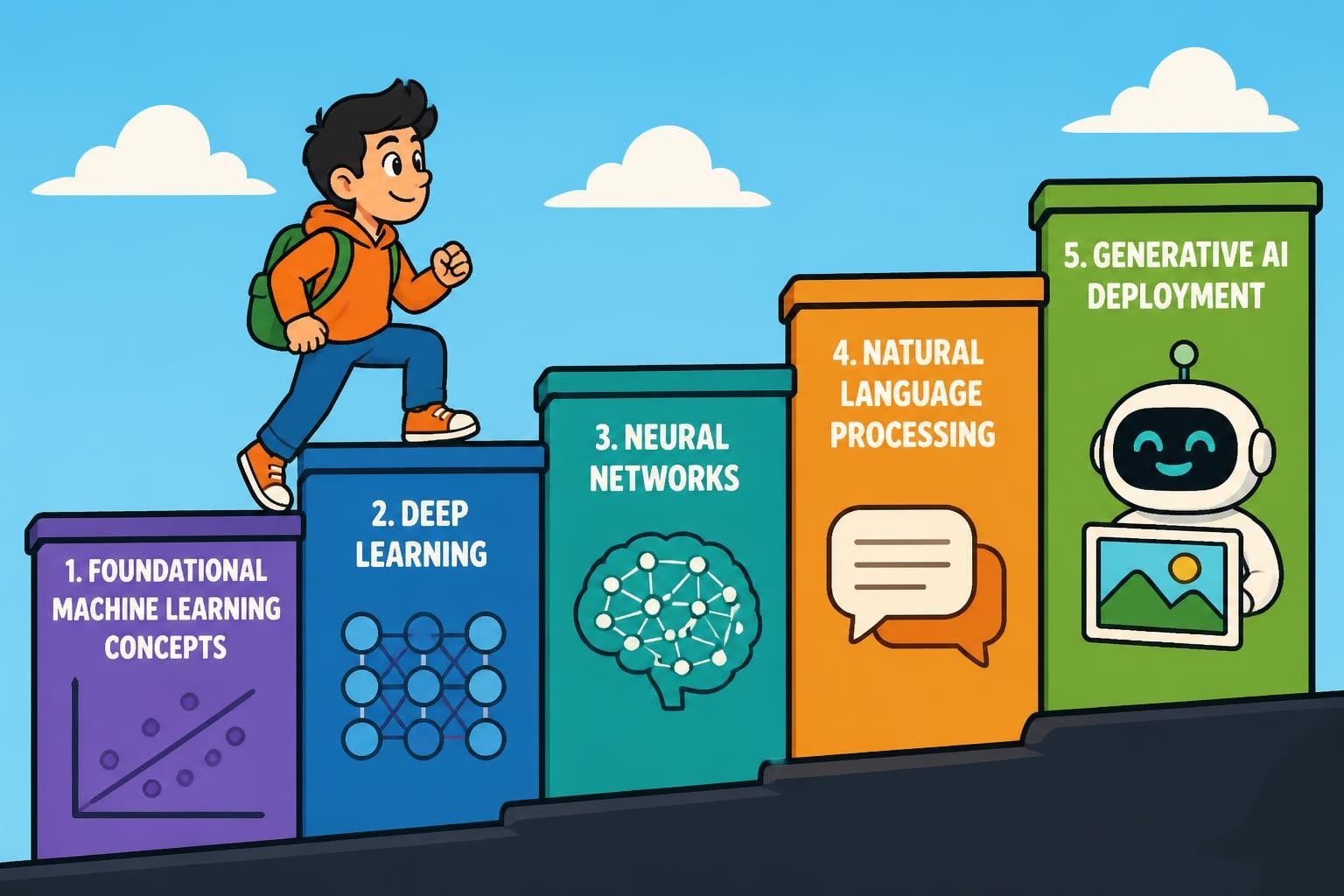
- Natural language processing with focus on transformers, attention mechanisms, and large language models
- Model deployment covering containerization, API development, and production monitoring
The best programs integrate these topics through progressive projects rather than teaching them in isolation. For example, a computer vision project might require Python proficiency, data preprocessing, CNN architecture design, and deployment to cloud infrastructure.
Practical Business Applications
Technical skills alone don't ensure career success. The top AI courses also teach how to identify business problems suited for AI solutions, scope projects realistically, and communicate results to non-technical stakeholders.
Problem framing helps learners determine when AI provides the best solution versus simpler alternatives. Many real-world challenges don't require sophisticated deep learning when basic statistics or rule-based systems suffice.
Data strategy teaches how to assess data quality, handle missing information, and determine when insufficient data makes AI projects unviable. This prevents costly failed initiatives that proceed despite inadequate foundations.
Ethics and responsibility address bias detection, fairness considerations, privacy requirements, and regulatory compliance. As highlighted in responsible AI courses, these topics have shifted from optional to mandatory in professional AI education.
Platform and Provider Comparison
The AI education market includes dozens of major providers, each with distinct strengths, weaknesses, and ideal use cases. Understanding these differences helps match programs to specific learning objectives.
University-Affiliated Programs
Elite universities offer AI programs ranging from executive education to full master's degrees. Stanford, MIT, and Carnegie Mellon provide rigorous theoretical foundations but require significant time and financial investment. Their credentials carry weight in research-oriented roles and academia.
Strengths: Comprehensive theory, research access, prestigious credentials, networking with top faculty
Weaknesses: High cost ($20,000-$75,000), extended time commitment (6 months to 2 years), limited practical focus
Technology Company Certifications
Google, Microsoft, AWS, and NVIDIA offer vendor-specific AI certifications teaching their platforms and tools. These programs excel at practical implementation within their ecosystems and carry weight with employers using those technologies.
For example, Microsoft Azure AI certifications focus on Azure Machine Learning, Cognitive Services, and cloud-based AI deployment. NVIDIA's AI training programs emphasize GPU-accelerated computing and deep learning optimization.
Strengths: Practical hands-on experience, recognized industry credentials, often more affordable ($200-$500)
Weaknesses: Platform-specific knowledge may not transfer, vendor bias in approach, limited theoretical depth
Specialized AI Platforms
Dedicated AI learning platforms offer comprehensive curricula combining theory and practice. Resources like detailed comparisons of the top 10 AI courses help learners evaluate these options systematically.
MammothClub stands out in this category by combining breadth (3,000+ courses), depth (specialized AI and ML learning paths), and business focus (corporate certification programs with measurable outcomes). The platform's AI-powered dashboards track progress and recommend personalized learning sequences based on career goals.
Choosing Based on Career Goals
Different career trajectories require different educational approaches. The top AI courses for a marketing manager differ substantially from those ideal for an aspiring machine learning engineer.
AI-Enhanced Professionals
Many professionals don't aim to build AI systems but want to leverage AI tools more effectively in their existing roles. AI for digital marketing courses teach marketers to use generative AI for content creation, audience analysis, and campaign optimization.
Similarly, AI for finance courses help financial analysts apply machine learning to forecasting, risk assessment, and algorithmic trading without requiring them to become data scientists.
These domain-specific programs typically run 4-8 weeks and emphasize tool proficiency over algorithmic understanding. They deliver faster ROI for professionals who need immediate applicable skills.
Transitioning to AI Roles
Professionals transitioning from software development, data analysis, or related fields into dedicated AI positions need more comprehensive technical training. These learners benefit from structured programs covering the full ML development lifecycle.
According to reviews of AI courses catering to various skill levels, the most effective transition programs include:
- 100+ hours of instruction and practice
- 5-7 portfolio-ready projects demonstrating core competencies
- Capstone projects solving realistic business problems
- Interview preparation focused on technical AI interviews
- Job placement support or employer partnerships
The typical timeline spans 3-6 months for motivated learners dedicating 15-20 hours weekly. Artificial intelligence classes designed for career transitions structure learning to build momentum while accommodating working professionals' schedules.
AI Specialists and Researchers
Professionals targeting cutting-edge research roles, PhD programs, or specialized positions in computer vision, NLP, or reinforcement learning need advanced theoretical foundations beyond typical professional courses.
These learners should prioritize programs teaching:
- Mathematical foundations including linear algebra, calculus, probability theory, and optimization
- Research methodology and academic paper comprehension
- Advanced architectures like transformers, GANs, and diffusion models
- Experiment design and reproducibility practices
- Publication and research communication skills
Graduate-level university programs or specialized research-oriented courses serve this audience best. The comprehensive survey of undergraduate AI programs provides insights into academic AI education standards as of early 2026.
Learning Format Considerations
How you learn matters as much as what you learn. The top AI courses in 2026 offer multiple formats to accommodate different learning preferences and life circumstances.
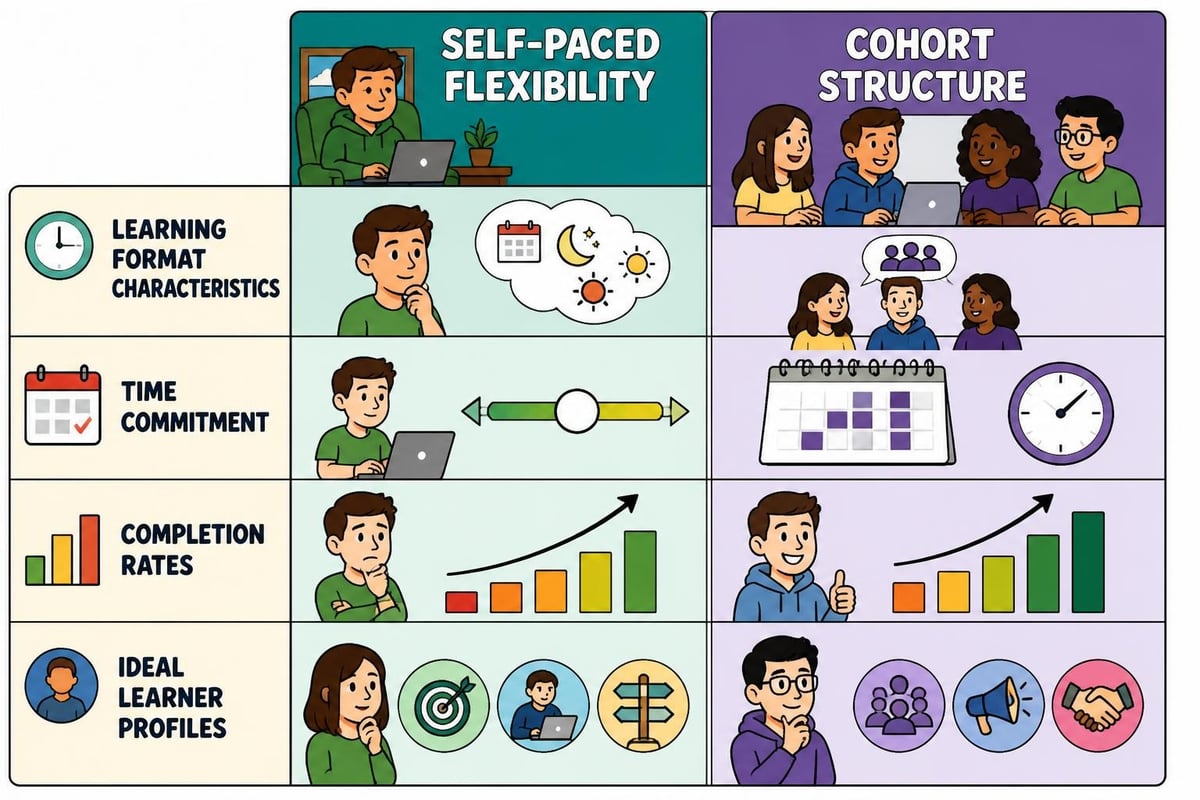
Self-paced courses provide maximum flexibility for busy professionals but require exceptional self-discipline. Success rates drop significantly without structured deadlines and accountability mechanisms. These work best for highly motivated learners with prior online learning success.
Cohort-based programs create peer learning communities, scheduled deadlines, and collaborative projects. Live sessions with instructors enable real-time question answering and discussion. This format significantly improves completion rates (typically 60-80% versus 10-15% for self-paced MOOCs) but requires committing to specific schedules.
Bootcamp intensives compress learning into full-time or near-full-time experiences over 8-16 weeks. These immersive programs accelerate skill development but require taking leave from work or significant schedule flexibility. Career changers often find this format most effective despite its intensity.
Hybrid approaches combine self-paced content with scheduled live sessions, office hours, and group projects. This middle ground provides flexibility while maintaining structure and community. Many learners find this optimal for balancing work, learning, and personal responsibilities.
Time Investment and Pacing
Realistic time estimation prevents learner burnout and incomplete courses. The top AI courses clearly communicate expected weekly commitments and total program duration.
| Program Type | Typical Duration | Weekly Commitment | Total Hours |
|---|---|---|---|
| Introductory Courses | 4-6 weeks | 5-7 hours | 25-40 hours |
| Intermediate Programs | 10-16 weeks | 10-15 hours | 100-180 hours |
| Comprehensive Bootcamps | 12-24 weeks | 20-30 hours | 250-500 hours |
| University Degrees | 12-24 months | 15-25 hours | 500-1200 hours |
Underestimating time requirements leads to rushed learning that fails to build genuine competency. The artificial intelligence course duration varies significantly based on depth and prerequisites, making realistic planning essential.
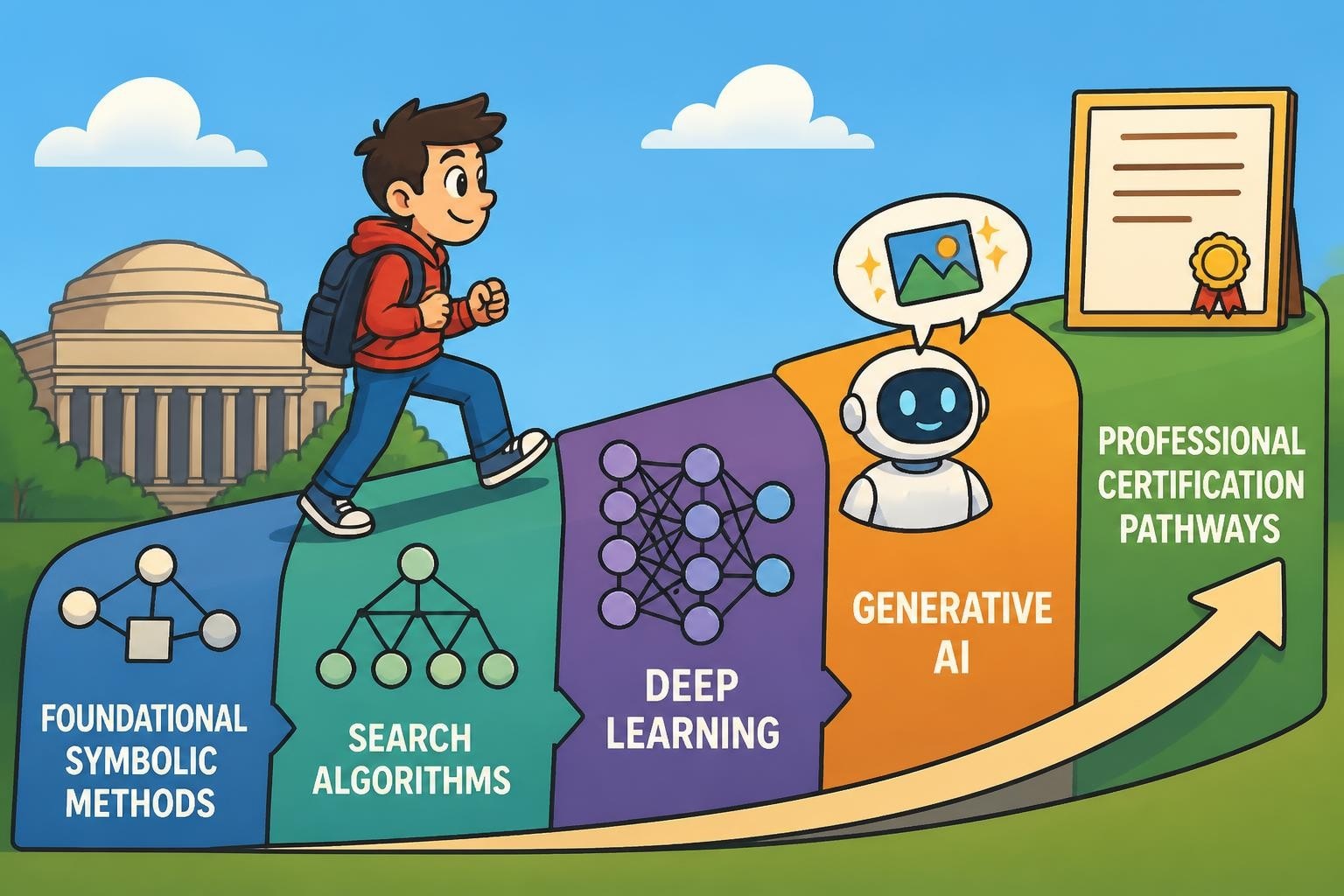
Certification Value and Recognition
Not all AI certificates carry equal weight with employers. Understanding which credentials matter in your target industry and role helps focus learning investments effectively.
Vendor-specific certifications from Google, AWS, Microsoft, and NVIDIA demonstrate platform proficiency. They're particularly valuable when applying to companies using those specific technologies. For cloud-heavy roles, these often outweigh generic AI certificates.
University credentials from recognized institutions carry prestige but vary widely in rigor. A certificate from Stanford or MIT signals serious commitment, while lesser-known online university offerings may provide limited differentiation.
Professional association certifications are emerging as AI matures as a discipline. While not yet as established as certifications in cybersecurity or project management, they're gaining recognition among forward-thinking employers.
Portfolio over certificates remains the dominant hiring criterion for many AI roles. Demonstrable projects solving real problems often outweigh credentials alone. The best AI certification programs emphasize portfolio development alongside formal credentials.
Insights from curated lists of the best AI courses organized by learner goals emphasize that credentials should align with specific career objectives rather than pursuing certificates for their own sake.
Cost Considerations and Financial Planning
AI education represents a significant investment ranging from free resources to $75,000+ degree programs. Understanding total cost of ownership helps make informed decisions.
Direct Costs
Tuition and fees vary dramatically by provider and format. Free MOOCs offer basic content at no cost. Professional courses typically range $500-$3,000. University programs command $10,000-$75,000. Bootcamps fall in the middle at $7,000-$20,000.
Software and compute resources add to total costs. While many courses provide cloud credits or free-tier access, serious AI development eventually requires paid compute time. Budget $50-$200 monthly for cloud resources during intensive learning periods.
Books and supplementary materials typically add $100-$300 for comprehensive programs, though many resources are available free online.
Indirect Costs
Opportunity cost of time spent learning instead of earning or other activities often exceeds direct tuition. A 300-hour program represents 7.5 weeks of full-time work, potentially worth $10,000-$30,000+ in forgone income for high earners.
Career transition risk affects professionals leaving stable roles to pursue AI careers. Building a financial buffer covering 3-6 months of expenses reduces stress during transitions.
ROI Calculation
The top AI courses deliver positive ROI through salary increases, role changes, or business value creation. According to 2026 compensation data, AI engineers earn median salaries of $145,000-$185,000, with senior roles reaching $200,000-$300,000+.
A $15,000 investment in education that accelerates a career transition by 6-12 months easily pays for itself through higher lifetime earnings. Similarly, business professionals who leverage AI tools more effectively can demonstrate measurable productivity gains and revenue impact.
Staying Current in a Rapidly Evolving Field
One challenge with AI education is rapid obsolescence. Techniques and tools evolve quickly, making 2-3 year old content potentially outdated. The top AI courses address this through regular content updates and teaching principles that remain relevant despite technological changes.
Foundational concepts in mathematics, statistics, and computer science remain stable even as frameworks change. Courses emphasizing first principles over specific tools age better than those focused on particular libraries or platforms.
Continuous learning mindset matters more than any single course. The development of AI teaching assistants demonstrates how AI itself is transforming ongoing education, enabling personalized learning paths that adapt as the field evolves.
Community engagement through conferences, papers, and practitioner networks helps professionals stay current. Many top courses include alumni communities that share emerging trends and learning resources.
Making Your Final Decision
Selecting among the top AI courses requires weighing multiple factors against your specific circumstances, goals, and constraints.
Start by clarifying your objective: Do you want to use AI tools more effectively in your current role? Transition to an AI-focused position? Specialize in a particular AI domain? Your answer determines appropriate program depth and focus.
Next, honestly assess your current skills and available time. Overcommitting to programs beyond your current level or schedule leads to frustration and incomplete courses. Better to complete a foundational program successfully than abandon an advanced one halfway through.
Research specific programs through multiple sources: official materials, independent reviews like comparisons addressing learners who want to use versus build AI systems, and alumni feedback. Pay particular attention to criticism and negative reviews to understand potential weaknesses.
Finally, consider trial periods or money-back guarantees that let you evaluate programs risk-free. Many top providers offer 7-14 day trial access or satisfaction guarantees recognizing that course fit varies by individual.
Choosing among the top AI courses requires balancing curriculum quality, learning format, cost, and career alignment. The most effective programs combine rigorous technical content with practical business applications and measurable outcomes. Whether you're looking to enhance your current role with AI capabilities or transition into a dedicated AI position, MammothClub provides 3,000+ AI and tech courses, interactive bootcamps, and corporate certification programs designed to accelerate your learning journey. Our AI-powered learning tools and progress dashboards ensure your training delivers measurable results and keeps you competitive in the rapidly evolving AI landscape.